in the population sciences published by the Max Planck Institute for Demographic Research Konrad-Zuse Str. 1, D-18057 Rostock · GERMANY www.demographic-research.org
DEMOGRAPHIC RESEARCH
VOLUME 22, ARTICLE 23, PAGES 691-732
PUBLISHED 23 APRIL 2010
http://www.demographic-research.org/Volumes/Vol22/23/ DOI: 10.4054/DemRes.2010.22.23
Descriptive Findings
Mortality in the Caucasus:
An attempt to re-estimate recent mortality
trends in Armenia and Georgia
Géraldine Duthé
Irina Badurashvili
Karine Kuyumjyan
France Meslé
Jacques Vallin
© 2010 Géraldine Duthé et al.
This open-access work is published under the terms of the Creative Commons Attribution NonCommercial License 2.0 Germany, which permits use, reproduction & distribution in any medium for non-commercial purposes, provided the original author(s) and source are given credit.
1 Introduction 692 2 Recent changes in population: post-census reassessment 693 2.1 Causes of dramatic changes in population numbers 693
2.1.1 Migration flows across new borders 693
2.1.2 Conflicts and territory changes 693
2.2 Population estimates since the last censuses 694 2.2.1 Collapse of the Soviet migration registration system 694 2.2.2 Reassessment of population estimates after 2001 and 2002 censuses 695
3 Incomplete birth and death registration 698
3.1 Recent reforms to improve civil registration 699
3.1.1 In Armenia 699
3.1.2 In Georgia 700
3.2 Available data on births and deaths 700
3.2.1 Births counts 700
3.2.2 Deaths counts 701
3.3 Crude mortality rates 703
4 Re-estimating life expectancy 703
4.1 Infant mortality 703
4.2 Mortality at old ages 709
4.3 Life expectancy at birth 710
4.3.1 Armenia 710
4.3.2 Georgia 712
5 Discussion-Conclusion 715
6 Acknowledgements 716
References 717
6
Annex 1 722
Annex 2 728
Mortality in the Caucasus:
An attempt to re-estimate recent
mortality trends in Armenia and Georgia
Géraldine Duthé1
Irina Badurashvili2
Karine Kuyumjyan3
France Meslé4
Jacques Vallin5
Abstract
With the collapse of the Soviet Union, Caucasian countries have experienced remarkable migration flows, political conflicts, and deterioration of civil registration systems. The reassessment of the populations of Armenia and Georgia after censuses carried out in the early 2000s enables researchers to re-estimate recent mortality levels in both countries. Vital statistics from the 1980s to the present are presented and discussed. Infant mortality is corrected according to sample surveys, and mortality above age 60 is estimated using model life tables. These estimates show that trends in life expectancy were similar in the two countries - unfavourable during the 1990s, especially for Georgian males for whom health progress is still low.
1 Institut National d’études Démographiques (www.ined.fr), Paris 133, bd Davout, 75980 Paris Cedex 20. Tel.: 33 (0)1 56 06 22 47. Fax.: 33 (0)1 56 06 21 94. E-mail: [email protected].
2 Georgian Centre of Population Research (www.gcpr.ge), Tbilisi.
3 National Statistical Service of the Republic of Armenia (http://www.armstat.am), Yerevan. 4 Institut National d’Études Démographiques (www.ined.fr), Paris.
1. Introduction
In light of unfavourable mortality trends observed in the region of the former Soviet Union since the 1960s, it is of particular interest to look at the specific evolution of Caucasian countries. Indeed, the consideration of the “Soviet world” as a whole has concealed the existence of different mortality patterns which may diverge from the Russian pattern characterized by high adult mortality (Meslé et al. 1996; 2003; Meslé, Vallin, and Shkolnikov 1998; Shkolnikov, Meslé, and Vallin 1996). For instance, due to different socioeconomic conditions, Albania shows divergence from other communist countries (Gjonça, Wilson, and Falkingham 1997). In order to discuss mortality patterns in the Caucasus, one must first create better estimates of mortality levels and trends. In this region, data quality has always been at issue (Kingkade 2000; Kingkade and Sawyer 2001), but since the collapse of the Soviet Union in 1991 data quality issues have increased. Not only did the region experience a failure in the control of dramatic international migration flows, along with a series of political conflicts in the Caucasian countries that disrupted many statistical series, but it seems that even the current data collection systems for births and deaths have been deteriorating (Badurashvili and Kapanadze 2003; Meslé, Vallin, and Badurashvili 2006).
In the 1990s, mortality rates provided by Armenian and Georgian statistical offices were underestimated6 and any attempt to re-estimate them was difficult, due to the imprecision of population estimates which were still relying on the most recent Soviet census held in 1989 (Badurashvili et al. 2001; Tsuladze and Maglaperidze 2000; Yeganyan et al. 2001). However, both countries had carried out new censuses at the beginning of the 2000s. These new counts provide a much more reliable basis for re-estimating recent mortality trends in these two Caucasian countries. After summarizing the main causes of disruption in the statistical series, we present new estimated population trends (section 1) and discuss under-registration of vital events over time (section 2). Finally, new estimates of mortality trends during the last two decades in these two Caucasian countries are proposed (section 3).
2. Recent changes in population: post-census reassessment
2.1 Causes of dramatic changes in population numbers
The collapse of the Soviet Union had two main consequences in terms of population changes: internal migration between regions suddenly became international migration between new independent nations; and the relative peace between minorities imposed by the Soviet power degenerated into major local conflicts, including wars.
2.1.1 Migration flows across new borders
Before the collapse of the USSR, migration between Armenia or Georgia and the other republics of the Soviet Union was internal migration, undertaken mainly for economic or private purposes, and strongly regulated by the Soviet rules. When the Soviet Union collapsed, the creation of new international borders changed the situation radically and many people belonging to minorities or suffering from economic hardship felt trapped inside new independent countries and were to get out (Tishkov, Zayinchkovskaya, and Vitkovskaya 2005). Furthermore, while crossing the international borders of the former Soviet Union without special permission by authorities was forbidden, new opportunities for emigration towards Western countries or Israel emerged. Thus in both Armenia and Georgia, a sharp increase in out-migration occurred in the 1990s. Many Russians returned to Russia in the first years following the collapse. The migration out-flow became even greater after 1991 due to the social and economic crisis and the dramatic deterioration in living conditions in satellite countries, which grew substantially worse than in Russia. Later in the 1990s, international migration flows stabilized.
2.1.2 Conflicts and territory changes
Armenia was involved in a war with Azerbaijan over Nagorny Karabakh, an autonomous territory inside the former Soviet Republic of Azerbaijan, mostly populated by Armenians. The war did not affect Armenian population data substantially7 but it led
to massive inflows of Armenian refugees who used to live in Azerbaijan. The direct impact of war was much greater in Georgia (Meslé, Vallin, and Badurashvili 2006). Soon after Independence, Georgia had to face two armed conflicts resulting from the claims for independence by both the Abkhazian Republic and South-Ossetian autonomous oblast.8 The 1993 war resulted in 10,000 deaths and around 200,000 refugees, and since the mid-1990s, the Georgian government has lost control over most of Abkhazia and a large part of the former autonomous oblast of South Ossetia (the “Tzkhinvali region”)9. These regions were subsequently missed by the 2002 census (Meslé, Vallin, and Badurashvili 2006).
2.2 Population estimates since the last censuses
2.2.1 Collapse of the Soviet migration registration system
During the Soviet era, out-migration from the USSR was practically impossible and all changes of residence were subject to out- and in-registration. As a result, relatively good-quality migration data were available, especially for inflows.10 The USSR Goskomstat centralized information from local authorities and established a complete matrix of inter-republic migration flows. With the collapse of the USSR, migration statistics deteriorated for three main reasons: migration outside of the former Union became possible, inter-republic collaboration to produce a general matrix ceased, and the quality of in- and out-registration declined. The phenomenon was particularly acute in Armenia (Karapetyan, Yeganyan, and Shakhnazaryan 1996; Yeganyan 2000; Yeganyan and Davtyan 2000) and in Georgia as well (Tsuladze and Badurashvili 1999). The registration of vital events (births and deaths) also deteriorated, but to a lesser extent, and with smaller consequences for population estimates.
According to current11 official estimates, during the Soviet era, migration flows were quite regular until the late 1970s, resulting in a balance that was slightly positive in Armenia and slightly negative in Georgia (Figure 1). During the 1980s, trends
8 Before the collapse of the Soviet Union, the socialist Republic of Georgia included two small autonomous republics, Abkhazia and Adjaria, and one autonomous oblast, South Ossetia.
9 The 2008 Russian intervention enlarged the area no longer controlled by the Georgian authorities while the Russian Government officially recognized Abkhazia and South Ossetia as independent states.
10 Indeed, the migration registration system was far from perfect (Anderson, Katus, and Silver 1994). In particular, rural-rural migration was not registered. Nevertheless, it seems that it covered inter-Republic flows rather well for rural-urban, urban-rural and urban-urban migration, which makes reasonable total estimates possible.
became more erratic with a negative net migration in both countries. It seems that the control of movements had already slackened, making official estimates more difficult. In particular, the 1987 peak in Georgia seems unrealistic, without any specific event to explain it. On the contrary, the huge deficit observed in 1992-94 in Armenia and in 1992-96 in Georgia is obviously related to the collapse of the USSR that resulted in substantial out-migration (return migration of Russians and political and/or economic migration). Once again, more recently, the Georgian peak in 2005 is highly improbable since no explanatory events correspond this large migration inflow. More generally, consequent to all the problems described above, annual official population estimates diverged more and more from reality and age structure became less and less consistent with the actual population distribution until the most recent censuses were conducted.
Figure 1: Armenian and Georgian annual migration flows according to official estimates since 1960
-250 -200 -150 -100 -50 0 50 100
1960 1965 1970 1975 1980 1985 1990 1995 2000 2005 2010
Armenia Georgia
Number (thousands) Independance year
Sources: for Armenia: NSS 2007; for Georgia: European Population Committee 2006 (until 1989) and Tsuladze, Maglaperidze, and Vadachkoria 2007 (from 1990).
2.2.2 Reassessment of population estimates after 2001 and 2002 censuses
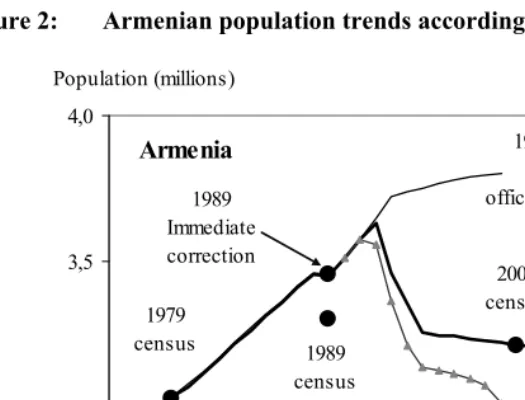
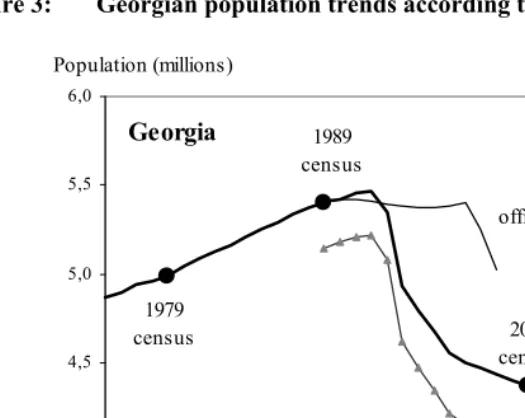
where the 1989 Soviet census was dramatically disrupted in the aftermath of the 1988 earthquake.12 Figures 2 and 3 show the large difference between official estimates used before the last censuses and the after-census official estimates. They also display alternative estimations made by various authors.
Figure 2: Armenian population trends according to different estimates
Armenia
2,5 3,0 3,5 4,0
1975 1980 1985 1990 1995 2000 2005 2010 Population (millions)
1979
census 1989 census
Yeganyan's estimates
1975-2000 former offical estimates
1979-2007 current official estimates 2001
census 1989
Immediate correction
Sources: censuses: 1979, 1989, 2001; current official estimates: NSS 2007; former official estimates: NSS 2002; Yeganyan’s estimates: Yeganyan et al. 2001.
In Armenia, the new census reported 3.2 million inhabitants, much less than the 3.8 millions reported in 2001 by official statistics (NSS 2002), but significantly higher than the only 3 millions estimated by Yeganyan, et al. (2001).13 Following the census, NSS produced new annual population estimates for the period of 1989-2001.14 The readjustment took into account the post-independence emigration wave that resulted in a dramatic population decline between 1992 and 1995. Current population estimates after 2001 are probably less problematic than in the early 1990s, since migration flows are thought to have stabilized. Population trends based on these new official estimates appear realistic15 and they will serve as a basis for calculating Armenian mortality rates. In Georgia too, population estimates varied a lot prior to the 2002 census (Figure 3). For 2001, official estimates indicated 4.9 million inhabitants while Tsuladze proposed 4.0 million, a difference of close to 25%, like in Armenia. The gap was even larger in 1999, since the official estimates during the 1990s continued to include the populations of Abkhazia and Tzkhinvali which were excluded de facto from the Georgian population after 1993, while Tsuladze excluded Tzkhinvali in 1993 and Abkhazia in 1994. The new census gave an intermediate result: 4.4 million. The new official estimated trends include a short period of continued growth (1989-92) followed by a dramatic fall resulting from the loss of the Ossetian (1993) and Abkhazian (1994) populations and positive out-migration flows (1992-96). After checking that territories involved are the same for population and vital events, 1989-2002 official inter-census estimates will be used hereafter to compute mortality rates, as in the case for Armenia. However, more recent estimates for Georgia seem quite unreliable since they are largely influenced by the artificial peak of in-migration already discussed, even if a positive natural growth rate is taken into consideration. Consequently, we correct population estimates for 2005-2007 based on linear population trends beginning in 1998.
13 The main cause of such a divergence was the method used to estimate migration flows. While official population estimates relied on migration registered through the regional passport offices of the Police of RA, a system which did not capture migration completely, Yeganyan et al. (Yeganyan 2000; Yeganyan and Davtyan 2000)attempted to re-assess migration (Yeganyan 2000; Yeganyan and Davtyan 2000), on the basis of various sources, including migration surveys (Karapetyan, Yeganyan, and Shakhnazaryan 1996; Yeganyan and Shakhnazaryan 1999).
14 The Armenian statistical office decided to take the corrected value from the 1989 census as the starting point for the recent reassessment. However, slight changes have also been made for the previous inter-census period from 1979 to 1989.
Figure 3: Georgian population trends according to different estimates
Georgia
3,5 4,0 4,5 5,0 5,5 6,0
1975 1980 1985 1990 1995 2000 2005 2010
Population (millions)
1979 census
1989
census 1975-2001
former official estimates
1989-2007 current official estimates 2002
census
Tsuladze's estimates
authors' correction
Sources (official and Tsuladze estimates are both published in the Demographic Yearbooks of Georgia): censuses and current official estimates and Tsuladze’s estimates: Tsuladze, Maglaperidze, and Vadachkoria 2007; former official estimates: Tsuladze, Maglaperidze, and Vadachkoria 2001.
3. Incomplete birth and death registration
During the last decade of the Soviet era, problems of reliability in death registration remained for deaths in infancy and above age 60, and had greater impact in specific regions such as Central Asia and Caucasus (Anderson and Silver 1989). The under-estimation of infant deaths in Caucasian countries (Ksenofontova 1994; Velkoff and Miller 1995), was thus probably much more significant than in Russia (Meslé et al. 2003) or in the Ukraine (Meslé and Vallin 2003) where the problem was only related to the definition of live birth.16 Since independence, however, the registration system has deteriorated in both Georgia and Armenia, mainly because administrative control of the
population has weakened, but also for other reasons, such as the establishment of registration fees in Georgia17 or the centralization of civil registration services.18 More recently, health and statistical authorities have tried to reverse this negative trend, by implementing recovery measures.
Furthermore, in Georgia, the Abkhazian and Ossetian conflicts resulted in more specific difficulties. First, vital statistics no longer cover the “Tzkhinvali region” as of 1991, or Abkhazia as of 1992. The only way to calculate rates is thus to refer to the population of Georgia without these territories. Second, in 1993, while mortality climbed due to the conflict, the civil registration system was disrupted and no regular data are available for that year. Georgian Statistical Office gives only a rough estimate of death numbers.
3.1 Recent reforms to improve civil registration
3.1.1 In Armenia
The first steps for improving the Armenian registration process were taken in 1999 with a decree introducing a social allowance for women giving birth to a live child. Its amount was increased considerably in 2003,19 and, since 2005, specific allowances are available to families receiving social aid.20 The Demographic and Health Survey (DHS), conducted in 2005, revealed that 96% of births in the five years preceding the survey were registered (NSS, Ministry of Health, and ORC Macro 2006), suggesting that the government measures were effective despite the centralization of the registration system. Under-registration of deaths is less problematic, except for the very young and the very old. Concerning neonatal deaths, the RA law “On Acts of Civil Status” states that any infant death occurring in the first four weeks of life must be registered by the Medical service where the death certificate was issued. Since 1996, funds are also allocated to families for the death registration of a pensioner, and the amount was also increased in 2003.21
17 The fees were rather high for Georgian people who were facing a severe social and economic crisis. At that time burial could take place without a death certificate, especially in rural areas, many people no longer registered death. Registration of births deteriorated much less but completeness of birth statistics was also affected because child benefits for women were abolished.
18 In Armenia, the centralization of services at regional level in 1996 made the registration difficult for people living in villages far from the regional capital.
19 35,000 Dram or AMD (69€ in mid-2009) whereas it was previously 5,900 AMD.
20 The allowance is twice more important for thoses families and since 2007, families under social aid received an allowance of 200,000 AMD from the third child.
3.1.2 In Georgia
A first improvement occurred in Georgia when, in 1998, fees for birth and death certificates were abolished, first in the capital city of Tbilisi, and then in the countryside.22 In 2005, a reorganization of the civil registration system was implemented, with the establishment of an independent agency, the Georgian Civil Register, to centralize the civil registration process. If the reform improved the availability and the quality of services for Georgians, the centralization of services discouraged many people in rural areas from registering events. Consequently, there were 18% fewer deaths registered in 2005 than in 2004 and the Department for Statistics (DS)23 re-estimated the number of deaths in rural areas in 2005 based on the rural/urban ratio observed in 2004. Nevertheless, an advertising campaign about the usefulness of registration and the accessibility of services played a positive role. Recent official statistics show an increase in the number of registered events, especially births and marriages. In 2006, the number of deaths increased slightly, but remained less than before the reform. At the same time, in order to improve vital statistics, a dual system of data collection was organized in 2004. The “old” system (the traditional process of civil registration) was duplicated by a “new” one, based on data available from medical facilities. The comparison between the two sources should result in a better estimate of actual number of deaths.
3.2 Available data on births and deaths
3.2.1 Births counts
In Armenia and in Georgia, both statistical offices and Ministries of Health publish routine annual birth counts (Figure 4). In addition, in Georgia, the statistical office has published corrected estimates since 1996, while the new data collection system and its cross-matching with the old system gives slightly different results for the years 2004-06. Tsuladze has also published his own yearly estimates since 1998.
In Armenia, except for the last two years of Soviet rule, the Ministry of Health used to register significantly fewer births than the Statistical office through civil registration, but since 2000, it has counted slightly more births at hospitals than total births registered through civil registration. Nevertheless, NSS and the Ministry of
22 However, people still have to pay medical doctor to issue the medical certificate they need to register a vital event.
Health give similar trends throughout the period. The situation is quite different in Georgia, where the annual birth counts provided by the Ministry of Health are much higher than those produced from civil system since the late 1990s. For this reason, DS also published an adjusted series, which is almost the same, but slightly higher, than that of the Ministry until 2003. After that year, official data rely totally on the results of the cross-matched data from the dual-collection system.24 In both countries, the dramatic drop observed around the independence year is obviously due to the corresponding population decline mentioned above, which is much larger in Georgia because of territory losses. This phenomenon is exacerbated by an actual fertility decline in the two countries.25
The almost-perfect match between official statistics and Ministry of Health data in Armenia suggests that birth registration is quite good. However the increase in birth numbers starting in 2003, observed from the two sources, is probably due to improvement of the registration system. In Georgia, given the large discrepancies beginning in the mid-90s, the quality of civil registration data seems questionable. Nevertheless, official estimates, which take into account both better recent estimates from the Ministry of health and the cross-matching of data in 2004,26 provide more realistic series.
3.2.2 Deaths counts
While only one annual death series is available in Armenia, four different estimates can be found for Georgia. Indeed, Georgian series of registered deaths published by the Statistical Office have been much more irregular since Independence than those of Armenia (Figure 5), with a first dramatic drop in 1994-1995 and a second in 2005. As for births, the first drop correlates to a certain degree with the population decrease, but is much more pronounced than in Armenia and probably also reflects a deterioration of death registration. Georgian crude data certainly needed more adjustment than Armenian data. The series adjusted by DS from 1989, which is much higher than the registered death series for the 1990s, seems to take into account the first drop, but for the second, it relies entirely on the cross-matched data without any correction. The Tsuladze series adopted much higher numbers of deaths for the years 2005 and 2006.
24 It is interesting to note that both the “old” and “new” systems, upon which the dual collection system is based give very similar total birth counts, but the births registered by each system are not the same. This explains why data cross-matching gives a significantly higher number of births.
25 For the period 2005-2010, the Total Fertility Rate is 1.7 in Armenia and 1.6 in Georgia, compared to 3 and 2.6 in 1970-1975 respectively (United Nations 2009).
Before concluding discussion of these data, let us have a look at crude death rates which take into account the population size.
Figure 4: Available estimates of annual numbers of births in Armenia and Georgia
Armenia
30000 35000 40000 45000 50000 55000 60000 65000 70000 75000 80000 85000
1975 1980 1985 1990 1995 2000 2005 2010 Number of births
Civil registration
Ministry of health registration Independence year
Georgia
30000 40000 50000 60000 70000 80000 90000 100000
1975 1980 1985 1990 1995 2000 2005 2010 Number of births
DS estimates
Tsuladze estimates Civil registration
Ministry of health registration
Cross-matched
data
New system Independence year
3.3 Crude mortality rates
In Armenia, a decrease in the crude mortality rate is still observed in the years following Independence (Figure 6). This could be related to deterioration in death registration that was not clear from the death series. But the quality of mortality statistics is even lower in Georgia when only registered deaths are considered. Official estimates seem to give a more realistic view for the 1990s. If we take into account the 1993 mortality peak due to the Abkhazian conflict, this correction removes the unexpected gap in 1995-96 by increasing observed mortality rates differently over time. However, it does not abolish the sharp drop of 2004-05 as Tsuladze’s estimates do. For all these reasons, we think that further adjustments are needed. But examining the overall under-registration of deaths is not enough to solve the problem. It is very probable that under-registration varies with age. In particular, infant mortality and mortality above age 60 deserve special attention.
4. Re-estimating life expectancy
4.1 Infant mortality
There are specific causes for under-registration of infant mortality (Aleshina and Redmond 2005; Anderson and Silver 1986), but fortunately sources of information totally independent from routine registration are available to make comparisons. In Armenia, two Demographic and Health Surveys (DHS) were carried out in 2000 and 2005 (NSS, Ministry of Health, and ORC Macro 2001; 2006), while Georgia also produced results from two Reproductive and Health Surveys (RHS), very similar to DHS, conducted in 1999 and 2005 (Serbanescu et al. 2001; 2007).
In Armenia, Ministry of Health27 data show infant mortality rates slightly higher than statistical office data (Figure 7), which probably means that infant deaths are significantly under-registered by the civil registration system. Four measures from each DHS28 are reported in Figure 7 and whatever the period, both 2000 and 2005 DHS show significantly higher rates than those of the civil registration system, as do those
27 From this source, we obtained two unpublished series for 1996-2003 and 2003-2006, but infant death counts for the common year (2003) are different. We therefore plotted two series on Figure 8. This difference reveals that infant deaths registered through the health system should also be considered carefully.
es.
from health services. The two DHS also confirm a steady decrease in infant mortality over the past three decad
Figure 5: Available estimates of annual numbers of deaths in Armenia and Georgia
Armenia
15000 20000 25000 30000 35000 40000
1975 1980 1985 1990 1995 2000 2005 2010 Number of deaths Independence year
1988 earthquake
Civil registration
Georgia
30000 35000 40000 45000 50000 55000 60000
1975 1980 1985 1990 1995 2000 2005 2010 Number of deaths
DS estimates
Tsuladze estimates
Cross-matched
data
New system Independance year
Independence year
Civil registration
Figure 6: Available estimates of crude death rates in Armenia and Georgia
5 6 7 8 9 10 11 12 13
1975 1980 1985 1990 1995 2000 2005 2010 Crude mortality rate (‰)
DS estimates
New system Cross-matched
data Tsuladze estimates
Independence year
Georgia
Civil registration 5
6 7 8 9 10 11 12 13
1975 1980 1985 1990 1995 2000 2005 2010 Crude mortality rate (‰)
Armenia
Independence year
Civil registration
Figure 7: Available estimates of infant mortality rates in Armenia and Georgia
0 10 20 30 40 50 60 70
1975 1980 1985 1990 1995 2000 2005 2010 Infant mortality rate (‰)
Ministry of Health, 2004 2005 DHS 2000 DHS
Independence year
Armenia
Civil registration
Ministry of Health, 2008
0 10 20 30 40 50 60 70
1975 1980 1985 1990 1995 2000 2005 2010 Infant mortality rate (‰)
Ministry of Health
2005 RHS 1999 RHS
Civil registration
Cross-matched
data DS estimates
Independence year
Georgia
The same phenomenon is observed in Georgia, when comparing rates based on civil registration to survey data. However, for the 2000-2004 period (the five-year period preceding the survey), the second survey shows a mean infant mortality rate which is very close to the Ministry of Health data (slightly lower) and official estimates (slightly higher).
We assume that the survey results give a better view of general levels and trends than current vital statistics. However, different biases are linked to such surveys and despite a standardized method, results for a similar period are not systematically equal. In Armenia, for instance, Figure 7 shows that for the period 1996-2000, IMR was estimated at 37 per thousand according to the first DHS, compared to 27 according to the second one. Different reasons may explain this gap. First, the sample is not the same in the two surveys, because the last census carried out in between. There are also some well-known limits to questioning women about their birth histories: problems of recollection, underestimation of early neonatal mortality, reliability of children’s ages as well as that of those who died (Potter 1977; Institute for Resource Development 1990). In addition, there are specific limits due to low fertility levels which lead to small numbers of infant deaths in the DHS samples (UNICEF 2003; 2006; Aleshina and Redmond 2005; Redmond 2007). For these reasons, it is certainly better to rely on estimates based on current statistics to capture the actual short-term changes in infant mortality.
In order to estimate annual IMR, we proceeded in four steps (details in annex 1). First, we estimated linear IMR on the basis of a linear regression of the eight points given by the two surveys. Second, we used these linear estimates to calculate five-year coverage rates of the “civil registered IMR”. Those IMR are calculated on the basis of births and infant deaths counted through civil registration.29 Third, we estimated annual IMR by applying these coverage rates to annual “civil registered IMR”. Fourth, for the most recent years, trends in annual estimated IMR were extrapolated through 2006. Figure 8 compares our IMR estimates to official estimates. For Armenia, in the last step, we assume not only that the general decrease in IMR is ongoing, but also that the recent reforms in the civil registration system substantially improved the measure and led to the artificial increase observed in official IMR. For Georgia, according to the RHS, our estimates are very close to official estimates for years 2003 and 2004. Indeed, the new dual-collection system seems to have been effective. Compared to other estimates, the correction gives higher levels than those provided by Kingkade and Sawyer (2001), the Georgian IMR estimated by SDS, NCDC, and UNICEF (2008) and
the Armenian official IMR adjusted by Ministry of Health and UNICEF (2002), but we assume that their methods still underestimate infant mortality rates.30
Figure 8: Infant mortality rates in Armenia and Georgia according to official statistics and authors’ estimates
0 10 20 30 40 50 60 70
1975 1980 1985 1990 1995 2000 2005 2010 Infant mortality rate (‰)
Civil registration
Authors' estimates Armenia Independence year
0 10 20 30 40 50 60 70
1975 1980 1985 1990 1995 2000 2005 2010 Infant mortality rate (‰)
DS estimates Authors' estimates
Georgia Independence year
Civil registration
Annual coverage rates applied to “civil registered IMR” are used to estimate annual IMR for males and females, as well as for both sexes combined (Annex 1). This assumes that there is no sex difference in birth and infant death registration. For 2001 in Georgia, sex ratio at birth (SRB) calculated on the basis of registered live births was 1.18 boys born per girl, whereas DS data present a constant SRB from 1996 to 2002 (1.11). The latter is actually higher than the usual 1.05 but lower than 2005 RHS estimates. A higher actual level is thus consistent with the sharp increase in the sex ratio at birth observed in the Caucasus (Meslé, Vallin, and Badurashvili 2007). In Georgia, births registered through the civil system along with DS estimates lead to a similar level of male and female IMR since 2004, contrary to the 2005 RHS results (excess male infant mortality is about 1.5 over the period 2000-05). The excess male infant mortality was 1.36 on average according to events recorded in the civil registries over the 10-year period 1994-2003. We thus decided to apply this ratio in order to estimate male and female IMR since 2004.
4.2 Mortality at old ages
The above correction of infant mortality gives a solid basis for re-estimating life expectancy. If infant deaths are under-registered, then registration of deaths after age one is also likely to be incomplete. No survey gives any reliable estimate of adult mortality or provides reliable and detailed data on completeness of registration of deaths over age 1.31 Actually, in the former USSR countries, the burden of cardiovascular diseases and external causes of death leads to adult mortality rates that are much higher than predicted by any model life table (Shkolnikov, Meslé, and Vallin 1996). Using such model life tables is thus not very relevant for estimating young adult mortality in Caucasian countries.
Nevertheless, model life tables can be used as a reference to assess mortality at old ages, not on the basis of 1-59 mortality, but according to the level of infant mortality. For this reason, we have examined the relationship between corrected infant mortality and life expectancy at age 60 from official statistics32 (Annex 2). The comparison with
31 Only the 2006 Georgian Gender and Generation Survey (GGS) inquired regarding deaths that occurred in the household during the five preceding years (Badurashvili et al. 2008). However, it produced quite unreliable levels of mortality, with a life expectancy at birth estimated at 72.2 years for males and 78.5 years for females for the period April 2001- March 2006. Regarding registration in the civil system, the question about registration of declared deaths has been asked to respondents, and according to the answers, around a quarter of deaths over age 1 were not registered, but low frequencies do not allow a detailed analysis by sex and age group.
levels given by Coale and Demeny Regional Life Tables (Coale, Demeny, and Vaughan 1983) reveals an overestimation of life expectancy at age 60 in both countries through the early 1990s. In Armenia, the 1980s33 are characterized by relatively high life expectancy at age 60 according to the infant mortality rate, compared to regional life table models (the East and the West ones for males; the North and the East ones for females). By contrast, e60 is relatively low in the most recent years, lower than the West model for males, and lower than the East model for females. In Georgia, a similar phenomenon can be observed in the 1980s: life expectancy at age 60 seems too high for the IMR level. From 1991, the relationship between e60 and IMR is very close to the West model for males, and varies from the North model to the East model for females. Again, in 2005 for both sexes and 2006 for females, e60 appears to be overestimated. Thus, we decided to correct life expectancy at age 60 through 1991 in Armenia and in Georgia34 according to the West regional model for males and the North model for females. As in Georgia, the years 2005 and 2006 are also questionable and were corrected in the same way.
4.3 Life expectancy at birth
For both countries, age-specific mortality rates from age 1 to 60 were computed from official data. Life tables were then built on the basis of these age-specific rates plus our estimates of IMR and life expectancy at age 60. It then became possible to compare official statistics of life expectancy at birth with those obtained after applying the corrections proposed above.
4.3.1 Armenia
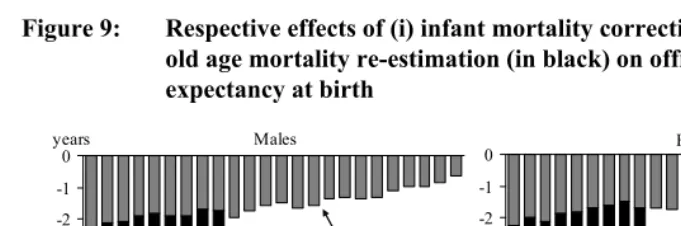
In Armenia, the correction of infant mortality rates led to a reduction of life expectancy at birth of more than two years for both sexes in 1983. The discrepancy with respect to official statistics has decreased over the period and in 2006 the reduction is less than one year (0.6 for males and 0.5 for females). Taking into account estimated life expectancy at age 60 until 1991 has resulted in a second reduction in estimated life expectancies with respect to official statistics. This has also decreased over time, however, with a greater impact on female mortality, resulting in a loss of 3.4 years in 1983. At the beginning of the period, the global correction reduces the official life
33 Except for 1988, the year of the earthquake.
expectancy at birth by 4.6 years for males and by 5.6 years for females. The gap between official statistics and proposed estimates has decreased regularly over time (Figure 9). For the most recent years, those estimates are certainly a minimum correction.
Figure 9: Respective effects of (i) infant mortality correction (in grey) and (ii) old age mortality re-estimation (in black) on official Armenian life expectancy at birth
-6 -5 -4 -3 -2 -1 0
1983 1986 1989 1992 1995 1998 2001 2004 Females
-6 -5 -4 -3 -2 -1 0
1983 1986 1989 1992 1995 1998 2001 2004 years Males
IMR correction
e60 estimation
According to those estimates, Armenian male and female life expectancies were 65.5 and 70.4 years, respectively in 1983, whereas current official estimates suggest 70.0 for men and 76.0 years for women. In 2006, they are estimated at 69.2 and 75.6 (Figure 10), with a gain of less than 4 years for males but more than 5 years for females over the two decades.
The impact of the 1988 earthquake is obviously massive35. Life expectancy at birth fell to just 58.2 years for males and 58.3 years for females; and the sex difference almost vanished given the greater impact of the earthquake on females than on males. Apart from the earthquake, female life expectancy increased slowly over the period, except for some short interruptions just after Independence. Since 2006, progress has stopped but it is too early to know if this is a sustainable trend. For males, the downtrends were much sharper and the up trends have levelled off since the end of the 1990s.
Figure 10: Trends in Armenian life expectancy at birth from 1983 according to official statistics and authors’ estimates
58 60 62 64 66 68 70 72 74 76 78
1980 1985 1990 1995 2000 2005 2010
Males Females
Official statistics
Authors' estimates e0 (in years)
earthquakeIndependence year
Sources: for official statistics: NSS 2002; 2007.
4.3.2 Georgia
Figure 11: Effects of (i) population correction (in white), (ii) infant mortality correction (in grey) and (iii) old age mortality re-estimation (in black) on annual official Georgian life expectancy rates
-4 -3 -2 -1 0 1
1982 1985 1988 1991 1994 1997 2000 2003 2006
Males years
Population correction
IMR correction
e60 estimation
-4 -3 -2 -1 0 1
1982 1986 1990 1994 1998 2002 2006
Females
Unlike in Armenia, the difference between those estimates and civil registered data36 did not decrease with time (Figure 12). They are nevertheless closer to official statistics which already took into account the poor reliability of the data source. Finally, according to our estimates, life expectancy at birth is 68.8 and 76.7 years for Georgian males and females in 2006. This is 4 and 5 years more than levels estimated for the year 1982.
As in Armenia, health progress has stagnated starting from the first year of independence, but the crisis is more pronounced with the strong impact of the 1993 war, especially among males. In 1995, life expectancies recovered the years lost during this difficult period, and from that year, global trends started to increase. However, a divergence between sexes is observed for 2004: whereas female life expectancy goes on increasing at the same pace, for males it decreased before returning to a similar level in 2005. The IMR correction smoothed this discontinuity for females, but not totally for males.37 Nevertheless, these estimates reduce the suspicious sharp increase in official life expectancies.
36 They are missing in 1993 because of the war. More recently, deaths registered through the civil system are no longer published since the implementation of the new system (cross-matched data) in 2003. Those data are thus from unpublished tables.
Figure 12: Trends in Georgian life expectancy at birth from 1982 according to official statistics and authors’ estimates
71 72 73 74 75 76 77 78 79 80 81
1980 1985 1990 1995 2000 2005 2010
civil registration Official
statistics
Females
e0 (in years) Independence year
Authors' estimates
63 64 65 66 67 68 69 70 71 72 73
1980 1985 1990 1995 2000 2005 2010
civil registration Official
statistics
Authors' estimates
Males
e0 (in years) Independence year
5. Discussion-Conclusion
In this paper, a special attention has been paid to infant and old age mortality. Concerning mortality over age 1 and below age 60, available information was insufficient to permit a reliable correction. Even though results from retrospective surveys such as DHS have to be interpreted cautiously, especially because of large confidence intervals (Redmond 2007), corrected trends confirm that infant mortality sharply decreased in the last decades of the twentieth century (Hakobyan, Mkrtchyan, and Yepiskoposyan 2006). In both countries, the correction doubles official figures in the 1980s. In the most recent years, the correction is still 40% in Armenia. In Georgia, official estimates can be considered reliable at the beginning of the 2000s but sex ratio at birth and estimates of infant deaths remain doubtful. Moreover, the recent deterioration in the registration system has led to a new divergence of official statistics from reality. This is also true for mortality at old ages which was corrected in the two countries before independence, but also in the two most recent years in Georgia.
Figure 13 compares recent trends estimated for Armenia and Georgia (Annex 3). In spite of various differences in the way crude data are adjusted, the results are quite comparable, apart from the very specific impact of the 1988 earthquake in Armenia. Changes in life expectancy appear to be similar in both countries for females since 1994, whereas life expectancy was previously a bit higher in Georgia than in Armenia. For males, the opposite is true: despite a recovery in 1994 and 1995, Georgian life expectancy has remained lower than that of Armenia throughout the period, with a strong effect of the war in 1993.
The sex difference is lower in Armenia than in Georgia. At the beginning of the 1980s, the IMR correction led to an Armenian female IMR higher than that of Georgia. Although DHS and RHS are similar, the quality of the surveys can be different, resulting in various IMR trends. However, with large proportion of Russians in Georgia compared to Armenia during the Soviet period (10% and 1%, respectively in 1979), Georgian mortality may correspond more closely to a Russian pattern. By contrast, Armenian mortality seems to be less favourable to women, corresponding to a
Mediterranean pattern; though this Armenian female pattern disappeared after
Independence while Georgian males still experienced relatively high mortality.
Figure 13: Trends in Georgian and Armenian life expectancy at birth since the early 1980s according to authors’ estimates
58 60 62 64 66 68 70 72 74 76 78
1980 1985 1990 1995 2000 2005 2010
Males e0 (in years) Independence year
Females
Armenia
Georgia
6. Acknowledgements
References
Aleshina, N. and Redmond, G. (2005). How high is infant mortality in Central and Eastern Europe and the Commonwealth of Independent States? Population Studies 59(1): 39-54. doi:10.1080/0032472052000332692.
Anderson B.A., Katus, K., and Silver, B.D. (1994). Developments and Prospects for Population Statistics in Countries of the Former Soviet Union. Population Index 60(1): 4-20. doi:10.2307/3645322.
Anderson, B.A. and Silver, B.D. (1986). Infant mortality in the Soviet Union: Regional differences and measurement issues. Population and Development Review 12(4): 705-738. doi:10.2307/1973432.
Anderson, B.A. and Silver, B.D. (1989). The Changing Shape of Soviet Mortality, 1958-1985: An Evaluation of Old and New Evidence. Population Studies 43(2): 243-265. doi:10.1080/0032472031000144106.
Badurashvili, I., Cheishvili, R., Kapanadze, E., Tsiklauri, S., and Sirbiladze, M. (2008). Gender Relation in Modern Georgian Society. Tbilisi: UNFPA and Georgian Centre of Population Research.
Badurashvili, I. and Kapanadze, E. (2003). South Caucasian Region: Armenia, Azerbaijan and Georgia. In: Katus, K. and Puur, A. (eds.). Unity and diversity of population development: Baltic and South Caucasian regions. Tallinn: Estonian Interuniversity Population Research Centre: 1-48. (RU Series D, no. 3).
Badurashvili, I., McKee, M., Tsuladze, G., Meslé, F., Vallin, J., and Shkolnikov, V. (2001). Where there are no data: What has happened to life expectancy in Georgia since 1990? Public Health 115(6): 394-400. doi: 10.1038/sj.ph.1900808.
Coale, A.J., Demeny, P., and Vaughan, B. (1983). Regional Model Life Tables and Stable Populations (Second edition). New York: Academic Press.
Demoscope Weekly (2004). 16 лет назад в Армении произошло землетрясение, унесшеежизни 25 тысяччеловек [16 years ago, 25 thousands people killed in the Armenian earthquake]. Demoscope Weekly N183-184, 20/12/2004-09/01/2005.
Gjonça, A., Wilson, C., and Falkingham, J. (1997). Paradoxes of Health Transition in Europe's Poorest Country: Albania 1950-90. Population and Development Review 23(3): 585-609. doi:10.2307/2137576.
Hakobyan, M., Mkrtchyan, A., and Yepiskoposyan, L. (2006). Infant mortality in Armenia, 1992-2003. Economics & Human Biology 4(3): 351-358. doi:10.1016/j.ehb.2006.04.002.
Institute for Resource Development (1990). An Assessment of DHS-I Data Quality. Maryland, Columbia: Institute for Resource Development, Macro Systems (DHS Methodological Reports, no. 1).
Karapetyan, S.A., Yeganyan, R.S., and Shakhnazaryan, N.V. (1996). Migratsiya naseleniya Armenii za postsovetskiy period (1991-1995) [Migration of the Armenian population during the post-Soviet period (1991-1995)]. Yerevan: UNFPA.
Kingkade, W.W. (2000). Caucasian old age mortality: The case of Armenia. Paper presented at theAnnual Meeting of the Population Association of America, Los Angeles, March 2000. Washington: US Census Bureau.
Kingkade, W.W. and Sawyer, C.C. (2001). Infant mortality in Eastern Europe and the former Soviet Union before and after the breakup. Paper presented at the IUSSP Conference, Salvador de Bahia, Brazil, 19-24 August, 2001.
Ksenofontova, N.Y. (1994). Trends in infant mortality in the USSR. In: Lutz, W., Scherbov, S., and Volkov, A. (eds.). Demographic trends and patterns in the
Soviet Union before 1991. New York: Routledge:359-378.
Meslé, F. (2004). Mortality in Central and Eastern Europe: Long-term trends and recent upturns. Demographic Research S2(3): 46-70. doi:10.4054/DemRes.2004.S2.3.
Meslé, F., Shkolnikov, V., Hertrich, V., and Vallin, J.(1996). Tendances récentes de la
mortalité par cause en Russie 1965-1994 [Recent trends in cause-specific
mortality in Russia 1965-1994].Paris: INED.
Meslé, F. and Vallin, J. (2003). Mortalité et causes de décès en Ukraine au XXe siècle [Mortality and causes of death in Ukraine in the 20th century]. Paris: INED. (Les cahiers de l'INED n°152).
In: Institute for Demography and Social Studies (ed.). Mortality in countries of
the former USSR. Fifteen years after break-up: change or continuity? Vol. 2.
Kiev: IDSS, CDHE, MPIDR, INED, IUSSP, UNFPA: 6-27.
Meslé, F., Vallin, J., and Badurashvili, I. (2007). A sharp increase in sex ratio at birth in the Caucasus. Why? How? In: Attané, I. and Guilmoto, C.Z. (eds.). Watering the
neighbour's garden: The growing demographic female deficit in Asia. Paris:
CICRED: 73-88. http://www.cicred.org/Eng/Publications/pdf/BOOK_singapore. pdf#page=85.
Meslé, F., Vallin, J., Hertrich, V., Andreev, E., and Shkolnikov, V. (2003). Causes of death in Russia: Assessing trends since the 50s. In: Kotowska, I.E. and Józwiak, J. (eds.). Population of Central and Eastern Europe: Challenges and opportunities. Warsaw: Statistical Publishing Establishment: 389-414.
Meslé, F., Vallin, J., and Shkolnikov, V. (1998). Reversal of mortality decline: The case of contemporary Russia. World Health Statistics Quarterly 51(2-4): 191-206. Ministry of Health and UNICEF (2002). Infant Mortality in Armenia: A Review of
Procedures for Registration, Classification, and Related Medical Services. Yerevan: Ministry of Health [Armenia] and UNICEF.
MLSI and NSS(2008). Report on sample survey on external and internal migration in RA. Yerevan: Ministry of Labor and Social Issues [Armenia], National Statistical Service [Armenia], and UNFPA.
NSS (2002). Demographic Yearbook of the Republic of Armenia, 1940-2000 (in Armenian). Yerevan: National Statistical Service [Armenia].
NSS (2007). The Demographic Handbook of Armenia 2007. Yerevan: National Statistical Service [Armenia].
NSS, Ministry of Health, and ORC Macro (2001). Armenia Demographic and Health Survey 2000. Calverton, Maryland: National Statistical Service [Armenia], Ministry of Health [Armenia], and ORC Macro.
NSS, Ministry of Health, and ORC Macro (2006). Armenia Demographic and Health Survey 2005. Calverton, Maryland: National Statistical Service [Armenia], Ministry of Health [Armenia], and ORC Macro.
Redmond, G. (2007). “Infant Mortality in Armenia 1992–2003”: A comment. Economics & Human Biology 5(2): 350-354. doi:10.1016/j.ehb.2007.03.003. RIA NOVOSTI (2008). Twenty years on, victims of Armenia earthquake remembered.
Newspaper article, 07/12/2008.
SDS, NCDC, and UNICEF (2008). Georgia Monitoring the situation of children and women. Multiple Indicator Cluster Survey. Tbilissi: State Department of Statistics [Georgia], National Centre for Disease Control [Georgia], and UNICEF.
Serbanescu, F., Imnadze, P., Bokhua, Z., Nutsubidze, N., Jackson, D.B., and Morris, L. (2007). Reproductive health survey Georgia, 2005: Final report. Atlanta, Georgia: Centers for Disease Control and Prevention.
Serbanescu, F., Morris, L., Nutsubidze, N., Imnadze, P., and Shaknazarova, M. (2001). Women´s reproductive health survey Georgia, 1999-2000: Final report. Atlanta, Georgia: Centers for Disease Control and Prevention.
Shkolnikov, V., Meslé, F., and Vallin, J. (1996). Health crisis in Russia. I. Recent trends in life expectancy and causes of death from 1970 to 1993. Population - An English Selection 8: 123-154. http://www.jstor.org/stable/2949159.
Tishkov, V., Zayinchkovskaya, Z., and Vitkovskaya, G. (2005). Migration in the countries of the former Soviet Union. Paper prepared for the Policy Analysis and Research Programme of the Global Commission on International Migration. International Organization for Migration. http://ftp.iom.int/jahia/webdav/site/ myjahiasite/shared/shared/mainsite/policy_and_research/gcim/rs/RS3.pdf. Tsuladze, G. and Badurashvili, I. (1999). Demographic Yearbook of Georgia, 1998.
Tbilissi: Centre for Social Studies.
Tsuladze, G. and Maglaperidze, N. (2000). Demographic Yearbook of Georgia, 1999. Tbilissi: Centre for Social Studies.
Tsuladze, G., Maglaperidze, N., and Vadachkoria, A. (2001). Demographic Yearbook
of Georgia, 2000. Tbilissi: Georgian Academy of Sciences, Institute of
Demographic and Sociological Research, and Centre for Social Studies.
Tsuladze, G., Maglaperidze, N., and Vadachkoria, A. (2007). Demographic Yearbook of Georgia, 2006. Tbilissi: UNFPA, Institute of Demography and Sociology. UNICEF (2003). Special feature: Infant mortality. In: Innocenti Social Monitor 2003.
UNICEF (2006). Innocenti Social Monitor 2006. Florence: UNICEF Innocenti Research Centre.
United Nations (2009). World Population Prospects: The 2008 Revision. New York: Population Division of the Department of Economic and Social Affairs of the United Nations Secretariat.
Velkoff, V.A. and Miller, J.E. (1995). Trends and differentials in the Soviet Union, 1970-90: How much is due to misreporting? Population Studies 49(2): 241-258. doi:10.1080/0032472031000148496.
Yeganyan, R.S. (2000). Demografitcheskiye realii i perspektivi RA na poroge 21-go veka [Demographic realities and perspectives of Armenia at threshold of the 21th century]. Materials presented at the scientific seminar on Demography of Armenia between two centuries, Dilijan, 2000.
Yeganyan, R.S., Badurashvili, I., Andreev, E., Meslé, F., Shkolnikov, V., and Vallin, J. (2001). Life expectancy in two Caucasian countries: How much due to overestimated population? Demographic Research 5(7): 217-244. doi:10.4054/DemRes.2001.5.7.
Yeganyan, R.S. and Davtyan, L.M. (2000). Vneshnemigratsionnaya situatsiya Armenii [Armenian situation with external migration]. Material presented at the scientific seminar on Demography of Armenia between two centuries, Dilijan, 2000. Yeganyan, R.S. and Shakhnazaryan, N.V. (1999). Issledovaniye vneshnemigratsionnikh
Annex 1: Method for estimating annual infant mortality rates in
Armenia and Georgia
Armenia
Year
IMR Civil registration
(1)
IMR 2000 DHS
(2)
IMR 2005 DHS
(3)
IMR linear estimates
(4)
coverage rate estimates
(5)
IMR annual estimates
(6)
‰ ‰ ‰ ‰ ‰
1980 26.2
1981 23.4
1982 24.1
1983 24.7 56.3 54.0 0.45 55.2
1984 23.6 52.6 0.46 51.5
1985 24.7 51.2 0.47 53.1
1986 23.6 49.9 0.48 48.9
1987 22.8 48.5 0.48 47.2
1988 25.6 44.6 40.5 47.2 0.47 54.5
1989 20.4 45.8 0.46 44.4
1990 18.3 44.4 0.46 40.2
1991 18.0 43.1 0.43 41.6
1992 18.9 41.7 0.42 44.8
1993 17.8 48.5 43.8 40.3 0.42 42.6
1994 15.1 39.0 0.42 36.1
1995 14.2 37.6 0.41 34.3
1996 15.5 36.3 0.41 37.5
1997 15.4 34.9 0.43 35.6
1998 14.7 37.0 26.9 33.5 0.46 32.0
1999 15.7 32.2 0.48 32.7
2000 15.8 30.8 0.49 32.1
2001 15.5 29.4 0.49 31.4
2002 14.0 28.1 0.49 28.6
2003 11.8 26.0 26.7 0.49 24.2
2004 11.5 25.3 0.50 22.9
2005 12.3 0.53 23.2
a) Column (4) gives linear estimates for IMR resulting from linear regression on the eight points given by the two surveys.
y = -1.3627x + 2756.2 R2 = 0.7443
0 10 20 30 40 50 60
1980 1985 1990 1995 2000 2005 2010
IMR (‰) Estimates from 2000 and 2005 DHS
b) Column (5) is the coverage rate computed as the ratio between 5-year civil registration IMR (moving average) and linear estimated IMR (column 4).
c) Column (6) estimates annual IMR obtained by applying the coverage rate (column 5) to annual civil registration IMR (column 1).
d) For the last two years (in bold in column 6), the estimates result from a linear progression made from all previous estimates. Final estimates are deduced from the corresponding coverage rates.
y = -1.4187x + 2867.7 R2 = 0.9281
0 10 20 30 40 50 60
1980 1985 1990 1995 2000 2005 2010
e) Same coverage rates have been applied to infant mortality by sex.
0 10 20 30 40 50 60
1980 1985 1990 1995 2000 2005 2010 Civil registration
Authors' estimates
M M
F F IMR (‰)
Armenia
Georgia
Year
IMR Civil registration
(1)
IMR 1999 RHS
(2)
IMR 2005 DHS
(3)
IMR linear estimates
(4)
coverage rate estimates
(5)
IMR annual estimates
(6)
‰ ‰ ‰ ‰ ‰
1980 25.4
1981 29.4
1982 25.4 56.1 51.2 0.50 50.9
1983 23.8 49.9 0.51 47.0
1984 23.7 48.7 0.50 47.2
1985 23.9 47.4 0.51 46.7
1986 25.5 46.1 0.52 49.1
1987 24.5 36.5 44.9 0.51 47.6
1988 22.0 42.7 43.6 0.49 44.8
1989 19.6 42.4 0.45 43.4
1990 15.8 41.1 0.41 38.8
1991 13.8 39.9 0.40 34.2
1992 12.6 40.1 38.6 0.40 31.6
1993 18.3 35.8 37.4 0.40 45.9
1994 16.7 36.1 0.43 38.6
1995 13.1 34.9 0.47 27.9
1996 17.4 33.6 0.47 37.2
1997 16.3 37.1 32.4 0.49 33.2
1998 15.2 33.9 31.1 0.52 29.0
1999 17.5 29.9 0.51 34.5
2000 14.9 28.6 0.49 30.6
2001 11.8 27.3 0.47 25.1
2002 10.1 26.1 0.44 22.9
2003 10.2 21.6 24.8 0.42 24.4
2004 10.4 23.6 0.44 23.6
2005 9.6 0.43 22.3
a) Linear regression on the eight points given by the two surveys
y = -1.2535x + 2535.6 R2 = 0.7826
0 10 20 30 40 50 60
1980 1985 1990 1995 2000 2005 2010
IMR (‰) Estimates from 1999 and 2005 RHS
d) Linear regression on the annual IMR estimates from 1980 to 2003
y = -1.2427x + 2513.9 R2 = 0.8187
0 10 20 30 40 50 60
1980 1985 1990 1995 2000 2005 2010
e) Annual IMR estimates by sex
0 10 20 30 40 50 60
1980 1985 1990 1995 2000 2005 2010 Civil registration
DS estimates Authors' estimates
M
M M
F
F F
IMR (‰)
Annex 2: Relationship between corrected infant mortality rate and
life expectancy at age 60
In the following figures, dots correspond to crude data and lines correspond to the four Coale and Demeny Regional Life Tables (South, North, East, and West). Years for which life expectancy at age 60 is clearly overestimated compared to other points have to be corrected. This led us to construct a coherent period which is 1983-91 in Armenia (excluding 1988 because of the earthquake). For Georgia, 1982-90 also corresponds to a period of overestimated life expectancy, along with 1991 for females, 2005 for both sexes and 2006 for females. For all these years, we estimate life expectancies according to the closest regional model: West model for males and North model for females.
For the year 1988 in Armenia, the estimation has been done in different steps for each sex: First, using the linear trends of observed life expectancy at age 60 from 1983 to 1987, we calculated an expected life expectancy which would have been observed in the absence of the earthquake (e’60 obs). Second, using the linear trends of estimated life expectancy at age 60 from 1983 to 1987, we calculated an expected level life expectancy which would have been estimated in the absence of the earthquake (e’60 est). Third, we assume that the difference between the expected observed level (e’60 obs) and the actual model (e60 obs) is due to the earthquake and we estimated life expectancy at age 60 (e60 est), reporting this difference in the expected estimated model.
Estimation of life expectancy at age 60 in Armenia in 1988 Males Females
Observed level e60 obs 17.0 20.7
Expected level without earthquake
before correction (linear trends 1983-1987) e’60 obs 18.2 21.9
Expected level without earthquake
after correction (linear trends 1983-1987) e’60 est 15.9 18.4
Armenia 2006 2005 2004 2003 2002 2001 2000 1999 1998 1997 1996 1995 1994 1993 1992 1991 1990 1989 1987 1986 1985 1984 1983 15 16 17 18 19 20 21
0.01 0.02 0.03 0.04 0.05 0.06 0.07
e60
1q0
South North East West Males 2006 2005 2004 2003 2002 2001 2000 1999 1998 1997 1996 1995 1994 1993 1992 1991 1990 1989 1987 1986 1985 1984 1983 16 17 18 19 20 21 22 23 24
0.01 0.02 0.03 0.04 0.05 0.06 0.07
e60
1q0
South
North East
eorgia G 2006 2005 2004 2003 2002 2001 2000 1999 1998 1997 1996 1995 1994 1992 1991
1990 19891988 1987 1986 1985 1984 1983 1982 15 16 17 18 19 20 21
0.01 0.02 0.03 0.04 0.05 0.06 0.07
e60
1q0
Males South North East West 2006 2005 2004 2003 2002 2001 2000 1999 1998 1997 1996 1995
1994 19921991 19901989
1988 1987 1986 1985 1984 1983 1982 16 17 18 19 20 21 22 23 24
0.01 0.02 0.03 0.04 0.05 0.06 0.07
e60
1q0
South
North East
n of life expectancy at age 60 in both countries
e60 Armenia Georgia
Correctio
(in years) Official data Authors’ correction Official data Authors’ correction
Males Females Males
West
Females North
Males Females Males
West
Females North
1982 16.7 20.8 15.5 18.4
1983 18.5 21.9 15.5 18.0 16.8 20.9 15.7 18.7
1984 18.2 22.0 15.6 18.2 16.4 20.4 15.6 18.7
1985 18.3 21.6 15.6 18.0 16.6 20.4 15.7 18.6
1986 18.3 22.0 15.7 18.3 16.6 20.5 15.6 18.6
1987 18.3 22.0 15.8 18.4 16.7 20.6 15.7 18.6
1988 17.0 20.7 14,7 17,1 16.7 20.4 15.8 18.8
1989 18.0 21.4 15.8 18.8 16.4 20.2 15.8 18.9
1990 17.3 20.7 16.0 19.0 16.5 20.0 16.0 19.1
1991 16.9 20.1 16.0 18.7 16.2 19.9 19.4
1992 16.1 19.3 16.1 19.7
1993 15.2 18.6 12.3 15.1
1994 16.2 19.6 16.0 19.6
1995 15.7 19.1 16.2 19.7
1996 16.0 19.1 16.2 19.6
1997 16.4 19.4 16.2 19.6
1998 17.1 19.8 16.2 19.6
1999 16.9 19.4 16.1 19.6
2000 16.9 19.8 16.1 19.6
2001 16.6 20.0 16.8 19.6
2002 16.1 19.3 16.7 19.7
2003 16.0 19.4 16.5 20.2
2004 16.3 19.6 16.2 20.0
2005 16.2 19.8 17.5 21.9 17.0 20.5
d Georgia
according to authors’ estimates
en
Annex 3: Life expectancy at birth in Armenia an
Arm ia Georgia e0
(i years) n Male Fe ale m Male emalF e
1982 64.8 71.8
1983 65.5 70.4 65.4 72.3
65.7 71.0 65.0 72.1 66.1 70.4 65.4 72.1 66.9 71.3 65.3 72.0
67.2 71.5 65.6 72.1 58.2 58.3 65.6 72.5 66.3 72.3 65.3 72.4
66.4 72.9 65.8 73.1 66.6 72.7 66.1 73.6 65.3 72.8 65.2 73.7
64.3 72.1 63.0 72.1 64.8 73.9 65.1 73.7 65.8 73.5 66.3 74.4 66.2 73.3 66.1 73.9
67.3 73.8 66.5 73.9 68.5 74.4 66.8 74.4 68.6 74.3 66.6 74.2
68.8 74.9 66.9 74.5
2001 68.6 75.2 67.9 74.9
2002 68.7 74.7 68.1 74.9
2003 69.0 75.1 68.7 75.5
2004 69.2 75.7 67.9 75.6
2005 69.2 75.7 68.9 75.9
2006 69.2 75.6 68.8 76.7
1984 1985 1986
1987 1988 1989
1990 1991 1992
1993 1994 1995 1996
1997 1998 1999