a Web 2.0 Asynchronous Collaborative Computer-Mediated Context Zohreh Zafarani, Islamic Azad University, Science and Research Branch, Tehran, Iran Parviz Maftoon*, Islamic Azad University, Science and Research Branch, Tehran, Iran
Corresponding author: Department of English, Islamic Azad University, Tehran, Iran Email address: [email protected]
Abstract
This study aims at investigating the effect of dynamic assessment (DA) on L2 writing achievement if applied via blogging as a Web 2.0 tool, as well as examining which pattern of interaction is more conducive to learning in such an environment. The results of the study indicate that using weblogs to provide mediation contributes to the enhancement of the overall writing performance, vocabulary and syntactic complexity, and quantity of overall information presented in a single paragraph. That is to say, DA procedures are applicable via Web 2.0 tools and are advantageous to L2 learners’ writing suggesting that L2 practitioners and instructors should actively consider the integration of Web 2.0 technology into L2 education system using DA. Moreover, the collaborative pattern of interaction as compared to expert/novice, dominant/passive, and dominant/dominant patterns is found to be more conducive to fostering writing achievement in the asynchronous computer-mediated communication environment.
Key words: Dynamic assessment; Web 2.0; Vocabulary complexity; Syntactic complexity, Quantity of overall information; Patterns of interaction.
Article Information:
Received: 15 May 2016 Revised: 17 July 2016 Accepted: 3 August 2016
1. Introduction
In the second half of the twentieth century the understandings about mind and mental development took on new perspectives, notably constructivist and sociocultural perspectives. These orientations brought about dynamic insights into educational philosophy, and assessment is no exception among other issues related to education. Assessment has experienced a comparable conceptual shift from behaviorist to constructivist paradigm (Lantolf & Poehner, 2004, 2006, 2011; Poehner, 2008; Poehner & Lantolf, 2013).
Being an integral part of the paradigm of constructivism, Vygotsky’s sociocultural theory (SCT) advocates the primacy of social constructivist theory in which social interaction is the main thrust in language development. Social constructivist theory is chiefly applied to address learning through social interaction as represented by the much-heralded concept of zone of proximal development (ZPD), the distance between one’s actual cognitive capacity, and the level of potential development through mediation or scaffolding (Poehner, 2008). Subsequently, under collaborative conditions, learners reveal certain emergent functions which have not been yet fully internalized or have not been part of ZPD (Poehner & Lantolf, 2013; Poehner, Zhang, & Lu, 2015).
Drawing on SCT, advocates of dynamic assessment (DA) claim that assessment should be directed at discovering what learners can do with assistance. Thus, it is proposed that assessment needs to be an integral part of instruction (Poehner, 2008; Poehner & Lantolf, 2010, 2013). If the aim of education is to boost cognitive development in learners, the logical conclusion is that assessment and instruction can, in no sense, be divorced. DA provides language practitioners with a valuable tool for integrating teaching and assessment (Heywood & Lidz, 2007). Such an integration gains considerable importance when considered in Iranian context, where normally one-shot tests are used as an information-gathering tool to make judgments about individual learners. In such a context, where in-depth empirical research on DA still appears to be limited, doing further research zeroing in on DA appears to be necessary.
Moreover, writing in asynchronous computer-mediated communication (ACMC) environments has become frequent since they have become an inherent part of people’s communication to the extent that their dispersion into the daily life of particularly youngsters has been unnoticeable. Yet their effect is widespread. Consequently, weblogs have gained mounting notice in educational settings since their emergence, and ESL/EFL setting is no exception. Many ESL learners practice writing skills asynchronously specifically as in e-mailing (Campbell, 2003, 2005; Johnson, 2004; Ocker & Yaverbaum, 2001; Pena-Shaff, Altman, & Stephenson, 2005; Zeiss & Isabelli, 2005).
Yet there remains the question of whether blogging in the EFL settings improves learning. Even though blogging for an educational purpose is not a new trend, the use of weblogs in teaching is still in an early stage. And clearly, there is evident scarcity of such research in the EFL context. The empirical research in this area in Iran is even more nascent. The researchers are, for that reason, aspired to bridge the gap between teaching and testing through the integration of writing assessment with writing instruction through blogging.
2. Review of the Related Literature
2.1. DA: A conceptual shift in assessment
DA history stretches back to the distant past, its formal beginnings are more recent. While static tests reveal information about the already existent abilities, there has always been a need for an on-the-go testing system which reveals information about the emergent abilities of learners and which can “lead them to higher levels of functioning” (Lidz & Gindis, in Poehner, 2008, p. 3). Hence, DA is proposed as a unified way of teaching and assessing which not only can measure the growing abilities of learners in the realm of ZPD but can bring about learning through embedding intervention in the assessment procedure.
DA is in favor of a teacher-student unanimity that works together towards students’ potential development through ZPD. In other words, DA is neither an assessment tool nor a method of teaching but a framework for conceptualizing teaching and assessment as an integrated activity of traditional assessment. As such, DA is an interactive approach to undertaking assessment that follows a test-intervene-retest format, which focuses on learning processes and modifiability and provides the possibility of direct linkage between assessment and intervention through focusing on the ability of the learner to respond to intervention (Heywood & Lidz, 2007).
A central tenet of the DA approach is the modifiability of knowledge. That is to say, DA proponents regard abilities as being “malleable and flexible rather than fixed” (Sternberg & Grigorenko, 2002, p. 1). This has also led to an appealing division between two perspectives on cognitive developments, past to present and present to future (Lantolf & Poehner, 2006; Poehner, 2008). Based on the past-to-present perspective, development is viewed as a matter of a person going through some mandatory pre-sequenced stages that would inevitably lead to the final stage meaning that future unfolds in present as the individual future ability is the final stage of growth in a recognized sequence of stages.
By contrast, the present-to-future perspective turns its back on the inevitability of the past to the present. According to Poehner and Lantolf (2005), the present-to-future view focuses on predicting the future “not a priori but on the basis of concrete mediated activity,” which enables “researchers and educators to chart out development while it is emerging” and also “to participate actively in the development process itself” (pp. 237-238). Accordingly, it is essential to appreciate how individuals can perform in cooperation with helpful others. In other words, to understand a person’s potential development, one has to take into account what they can do with assistance provided by others in social interactions. An individual’s potential development is thus mediated by supportive interaction with others (Philp & Mackey, 2010).
2.2. Computer-mediated communication in EFL/ESL
Computer-mediated communication (CMC), as a process by which people create, exchange, and perceive information using networked telecommunications systems, has technologically revolutionized the means of knowledge production and delivery. From a socio-cultural perspective, CMC, with the high interactivity of its communication capacity, is not only a tool but also a medium of social interactions. CMC shapes social communities, within which diverse interactions take place, thus providing ample collaborative learning opportunities for L2 learners (Rouhshad, Wigglesworth, & Storch, 2015; Thorne, 2008).
One of the emerging technologies that allow L2 CMC is Web 2.0. As a paradigm shift in the manner by which the long-established World Wide Web (retroactively referred to as Web 1.0) is used, Web 2.0 refers to the “Read-Write Web” which empowers Internet users to generate their own ideas rather than merely reading someone else’s; thus, fostering greater collaboration among them. A mounting number of studies have highlighted the effectiveness of Web 2.0 tools in L2 teaching and testing (Akcay & Arslan, 2010; Birjandi & Ebadi, 2010; Elola & Oskoz, 2010; Montero-Fleta & Pérez-Sabater, 2010; Mueller, 2009; Noytim, 2010; Radia & Stapleton, 2008; Richardson, 2006; Strobl, 2014; Wang & Vásquez, 2012; Wichadee, 2011; Yim & Warschauer, 2017; Zaini, Kemboja, & Supyan, 2011).
2.3. Asynchronous model of collaborative writing
Asynchronous model of collaborative writing encourages delayed interactions between/among the instructor and learners with the goal of uncovering what is learned. This model provides learners with more time to brainstorm ideas, read, understand, reflect, edit, and respond to the written texts of the instructor or peers. Warschauer (1996, 1999, 2017) found that asynchronous interactions led to more syntactically complex texts as demonstrated by the use of subordinate clauses and
longer sentences that are indicative of active cognitive processes involved in text construction. Asynchronous interactions provide learners with more time to construct text, thus enabling student writers to carefully prepare responses. This, in turn, encourages learners to think more critically and focus on both meaning and form to a greater extent than happens during synchronous computer-mediated communications (Warschauer, 2017).
Moreover, in asynchronous context, L2 learners can receive instruction when and where it is most appropriate for them. This puts less pressure on learners to instantly respond and/or reflect on the information and provides them with more time to process information. Still, another advantage of asynchronous writing instruction is that it is possible to asynchronously collaborate through a variety of tools including e-mail and blogs. Also, documentation of collaboration process is made possible through simple technologies, such as cloud technology.
2.4. Collaborative dialogue and patterns of interaction
Collaborative dialogue is that type of dialogue in which interlocutors are engaged in joint problem solving and co-construction of knowledge (Storch, 2013; Swain, 2000). In such a dialogue, collaboration mediates language learners’ perception of how lexical and syntactic systems operate in the target language. The concept of collaborative dialogue is rooted in SCT in that learning is mediated by symbolic tools, including language (Vygotksy, 1978). As Swain (2000, 2010) asserts, collaborative dialogue mediates knowledge building which, in turn, mediates language learning. The notion of collaborative dialogue enables researchers to empirically investigate the assertion that peer-peer interaction can enhance language learning in ZPD. The investigation of the language learners’ patterns of interaction is also in compliance with SCT. As Vygotsky (1978), argues novices need assistance from an expert to accomplish what they would not be able to do on their own. When extending SCT to peer-peer interaction in SLA, peers can concomitantly be experts and novices supporting each other with the process of learning.
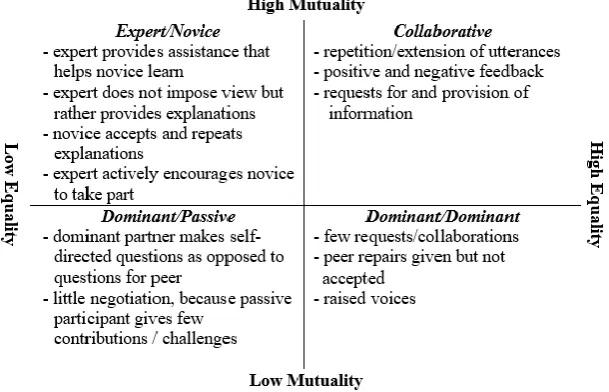
To examine collaborative dialogue and its potential benefits for language learners, investigations use pair dynamic as a unit of analysis. Storch (2002a, 2013) explains pair dynamics in terms of mutuality and equality with former referring to the level of learners’ engagement with each other’s contributions and the latter referring to the degree of control and authority over the task. Storch’s notions of mutuality and equality are continuums with each having a high to low range forming patterns of dyadic interaction of expert/novice collaborative, dominant/passive, and dominant/dominant. These four possible patterns of interaction and their specifics (Storch, 2002a, 2013) are presented in Figure 1.
Figure 1. Quadrant patterns of interaction and their specifics (Storch, 2002a, 2013)
The significance of patterns of interaction in collaborative dialogue is underlined by empirical data (Choo, Sidhu, Fook, & Yong , 2014; Dobao, 2012; Elola & Oskoz, 2010; Li & Zhu, 2013; Kim & McDonough, 2008; Maftoon &
Ghafoori, 2009; Storch, 2002a, 2002b, 2005, 2013; Sarieva, 2007; Storch, 2013; Watanabe & Swain, 2007). When both partners of an interaction have a collaborative pattern, they mutually support each other thus scaffold language learning. Conversely, when one peer assumes a dominant role, the other may lose opportunities to engage in the language learning activity.
Research on the patterns of interaction in Web 2.0 is still limited. One of such research studies is that of Choo et al. (2014) which showed that co-construction of knowledge was evident among the ESL students during online collaboration. Tan Wigglesworth, and Storch (2010) found that modes of communication affected the pattern of interaction; that is, in CMC some pairs became more collaborative. Sarieva (2007) found that the CMC modes (synchronous vs. asynchronous) differently affect language learners’ patterns of interaction. Watanabe and Swain (2010) found that learners who collaborated produced more language-related episodes, i.e. segments in the learners’ dialogues where they deliberate about language while trying to complete the task.
The present study examined the applicability of DA to a Web 2.0 asynchronous collaborative computer-mediated (ACCM) context and its effect on L2 writing achievement. Moreover, the current study investigated the patterns of interaction in such a context. To this end, the following research questions were posed:
1.
Does DA if conducted via ACCM enhance L2 learners’ overall writing
performance?
2. Does DA if conducted via ACCM impact vocabulary complexity, syntactic complexity, and quantity of L2 learners’ writing?
3. What patterns of dyadic interaction are present in ACCM?
4. What patterns of dyadic interaction do high-gainers (H-gainers) and low-gainers (L-low-gainers) adopt during the ACCM interaction process?
3. Method 3.1. Participants
This study was part of a larger extensive study which was conducted in an advanced writing course at Islamic Azad University, North Tehran Branch. The
present study involved 26 students of English Major, one instructor, and two raters. The participants had their English writing class held for 105 minutes each week and 16 weeks in the semester to learn academic paragraph writing. Due to missing data from five participants who contributed to weblog postings 30% less than other participants throughout the semester, five participants were omitted from reports of analyses, despite outcome data being available to the researchers.
Out of these 26 participants, eight participants were purposefully selected as instrumental cases for the investigation of the patterns of dyadic interactions. The type of purposive sampling used the present study was the extreme/deviant sampling technique (Kemper, Stringfield S., & Teddlie, 2003). This technique involves selecting cases near either end of the distribution of the participants; that is, those cases that are most outstanding successes or failure related to the topic of interest. Extreme or deviant cases provide more in-depth understanding of a phenomenon as they provide attention-grabbing contrasts with other cases which allow for comparability across them. The process of identifying extreme or deviant cases happens after some portion of data collection and analysis has been completed. In the present study, the extreme or deviant cases were those participants who showed the highest and lowest writing gains in the post-test.
3.2. Instruments of the study
The instruments implemented in the study were as follows:
1. A sample of Oxford Quick Placement Test (QPT), administered to ensure that the participants enjoyed the same level of language proficiency. The QPT tests grammar, vocabulary, reading, and listening comprehension skills and places test takers into seven language proficiency levels presented in terms of the Association of Language Testers in Europe (ALTE) Framework. The test is consisted of 20-25 multiple-choice questions and takes approximately 15-20 minutes to complete. In the present study the listening section of the test was
not administered. In the current study, the estimate of reliability for the test was 0.80 as estimated by Cronbach’s Alpha.
2. A paragraph writing pre-test administered before the inception of the instruction to measure the participants’ baseline writing performance.
3. A paragraph writing post-test administered in the last session to verify the effect of the mediation.
Three topics were chosen for each of the pre- and post-tests from among which the participants were to choose one that interested them the most. The pre-test topics were 1) your favorite national holiday, 2) your favorite course, and 3) your favorite city to travel to. The post-test topics were 1) the uniqueness of your hometown, 2) a famous person or statue in your country, and 3) benefits of learning a foreign language. The participants were instructed to write a paragraph with a clear topic sentence, minimum two major and two minor supporting sentences, and a clear concluding sentence.
3.3. Procedures
Prior to the first online session, the first researcher of the present study, the instructor, provided the participants with general written guidelines for blog assignments. Also, in order to smooth the process of collaborative work, the instructor engaged the participants in discussions about the benefits of collaboration. Moreover, a Tutor Weblog (TB), a Class Weblog (CB), and an individual weblog for each participant (Learner Weblog (LB)) were created before the first online session. How these three types of weblog were used in the present study is discussed below.
Tutor’s weblog (TB). Through entries of this blog, the instructor provided
instructions and follow-ups on difficult areas of work covered in online sessions. She provided the participants with guidelines to assignments and upcoming topics of instruction. Links to related online sources were set up and organized to aid participants in self-study.
Class weblog (CB). The CB was the result of the collaborative effort of all participants and the instructor. Assignments were announced on this weblog (PrtScn 1). To pave the way for building a dynamic and interactive comment platform, the instructor told four participants to post their assignment both on their individual weblog and the CB (PrtScn 2) within four days. The instructor also told the rest of the participants to post their assignment only on their individual weblog within four days. This allowed ample time for participants to complete the asynchronous interaction prior to submitting their assignments. Checking out the CB on a regular basis, the instructor highlighted a certain part(s) of the participants’ writing and posted comment(s) on it. The participants were instructed to post their comment and to respond to the instructor’s post via comments which was followed by the instructor’s subsequent comment. The instructor’s comments were categorized according to the tags attached to each comment and were compiled on the CB (PrtScn 3, below). Links to each individual weblog were also provided in CB.
PrtScn 1. Sample screen print of hyperlinked assignment announcements on the CB main page
Learner’s weblog (LB). These weblogs were individually used for writing practice and assignments. The idea here was that the participants could get writing practice and develop a sense of ownership. The instructor kept track of ACCM’s blog activities without manually visiting every individual blog by using ‘Real Simple Syndication (RSS)’ technology thus saving time. To this end, the instructor subscribed to the RSS feed of each ACCM member’s blog so as to read all blogs in one site. Furthermore, via using a ‘notifier’ service the instructor was notified whenever her subscription had new items to read.
The participants met online once a week for a period of 16 weeks. These online sessions served as instructor-controlled teaching sessions in which she provided instructions in three stages: (1) choosing topics for writing tasks, (2) generating ideas, outlining, and structuring, and (3) and macro- and micro-revising. As for the mediation, the revised version of the regulatory scale designed by Aljaafreh and Lantolf (1994) was used in this study. Based on this scale, mediation was ranged PrtScn 2. Select participants’ assignment posted on CB main page
PrtScn 3. Sample screen print of instructor’s comment tags on the CB main page
from implicit to explicit and took form of both instructor-initiated and peer-initiated prompts.
As for the operationalization of DA procedures, the researchers adopted Xiaoxia and Yan’s (2010) framework of DA with features of EFL process writing. Each of the stages of choosing a topic, generating writing ideas and structuring, as well as revising passed through a pre-task, mediation, post-task chain. In the choosing topic stage, the instructor provided the participants with a broad topic and told them to narrow it down to one which was of more interest to them under which they could thus write a unique paragraph. Then, working on the first ring of pre-task, mediation, post-task chain, i.e., pre-pre-task, learners made a self-attempt to find a unique topic worth writing.
For the mediation ring, the instructor negotiated the topic with the participants entering into asynchronous dialogues with them and encouraged peer negotiation on the topic for the sake of offering pointers, posing thought-provoking questions, and giving explicit feedbacks. To close the chain, in the post-task stage, the participants were encouraged to modify their topics using the experience they gained through mediation provided by both the instructor and their peers.
For the idea-generation and structuring stage, DA was operationalized by the instructor’s introducing some necessary idea-generation and structuring strategies at the start. She set tasks for the participants to generate ideas and modify the writing topic if necessary. Next, the instructor assigned for the participants to make outlines for their paragraphs according to their own topic. Then, the instructor discussed participants outlines with them and encouraged peer negotiation on other participants’ outlines. Finally, the participants were instructed to modify their outlines based on the mediations they had received.
The drafting step was a pre-task which was done independently. Once the participants finished with drafting, there came the stage of revising with macro-revising at the outset and micro-macro-revising soon after. Subsequently, mediational
moves from the instructor and peers were made by post-task activities in which modification became a want-to-do activity for the learners.
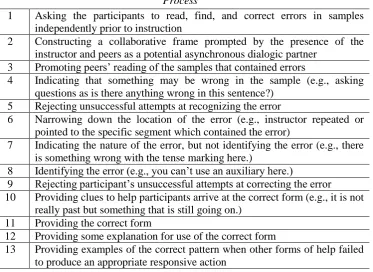
As for the mediation ring, several methods including strategy-explanation, whole-group display, analysis of samples, and peer-review were employed on both CB and LB. By way of illustration, take analysis of samples. The instructor posted several samples; including samples of writing topics, topic sentences, minor and major supporting sentences, and concluding sentences on the CB and used several strategies to provide mediation moving from implicit to explicit as presented in Table 1 below.
Table 1
Sample Implicit and Explicit Mediation Strategies Used Throughout the Study Process
1 Asking the participants to read, find, and correct errors in samples independently prior to instruction
2 Constructing a collaborative frame prompted by the presence of the instructor and peers as a potential asynchronous dialogic partner
3 Promoting peers’ reading of the samples that contained errors
4 Indicating that something may be wrong in the sample (e.g., asking questions as is there anything wrong in this sentence?)
5 Rejecting unsuccessful attempts at recognizing the error
6 Narrowing down the location of the error (e.g., instructor repeated or pointed to the specific segment which contained the error)
7 Indicating the nature of the error, but not identifying the error (e.g., there is something wrong with the tense marking here.)
8 Identifying the error (e.g., you can’t use an auxiliary here.)
9 Rejecting participant’s unsuccessful attempts at correcting the error 10 Providing clues to help participants arrive at the correct form (e.g., it is not
really past but something that is still going on.) 11 Providing the correct form
12 Providing some explanation for use of the correct form
13 Providing examples of the correct pattern when other forms of help failed to produce an appropriate responsive action
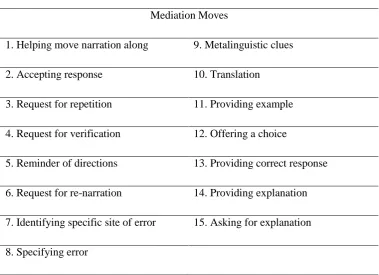
Moreover, the researcher adopted Poehner’s (2005) two typologies for tutor and student mediation moves in his study of advanced French learners’ speaking skills. Inexorably, however, since Poehner’s study was developed for a face-to-face context and thus was different to the present study where the mediation took place in an asynchronous Web 2.0 environment, these typologies had to be modified in order to reflect the different modes of communication (Table 2).
Table 2
Poehner’s Mediational Moves
Mediation Moves
1. Helping move narration along 9. Metalinguistic clues
2. Accepting response 10. Translation
3. Request for repetition 11. Providing example
4. Request for verification 12. Offering a choice
5. Reminder of directions 13. Providing correct response
6. Request for re-narration 14. Providing explanation
7. Identifying specific site of error 15. Asking for explanation
8. Specifying error
Stage I: Choosing topics for writing tasks. This stage was designed to assist the participants in generating topics for writing by means of the instructor’s mediation. To this end, the instructor provided the touchstones of choosing a topic (unique, focused, attractive, and valuable) in an online session and in the TB. Then, the instructor assigned a broad topic in the CB and asked participants to choose any aspect that they thought was worth writing about and post their topic on their LB for others to comment on. Having done this, the instructor asked participants to decide on their own specific writing topics and post them on the LB and CB so as the instructor and other participants could provide some assistance when they came to a decision about participants’ writing topics. Then, finding there was issues with anyone’s topic (e.g., the topic was too broad), the instructor entered into an asynchronous dialogue with that particular participant.
Having offered mediation to one or two participants, the instructor concluded the existing problems of their writing topics in form of a post in CB and gave instruction on how to narrow down a topic in TB. Finally, the instructor asked participants to revise their topics independently in their LB and then go to other LBs to review other participants’ choice of topic to revise other participants’ topic based on the instruction provided in the TB.
Stage II: Generating ideas, outlining, and structuring. The aim of this stage
was to motivate thinking in order to come up with ideas, prepare content, and organize structure in the writing process before composing. The instructor used a pre-task, mediation, post-task chain to practice generating ideas, outlining, and structuring. For igniting preliminary ideas, brainstorming was employed as an idea-generating technique. In order to collaboratively generate ideas, the instructor instructed the participants to post two topics on their LB so that others could provide ideas through posting comments.
The same pre-task, mediation, post-task chain was used for the outlining phase. The instructor provided instructions on how to make an outline and assigned the whole class to do so on the basis of their own topic. After providing mediation asynchronously by the instructor and/or peers, the participants modified their own
outlines. The participants were assigned to post their modified outlines on their individual weblogs with four students on CB so that others could post comments.
Next, the instructor asynchronously introduced elements of a well-organized paragraph on TB, namely topic sentence, major supporting sentence, minor supporting sentence, and closing sentences.
Stage III: Macro- and micro-revising. This stage was carried out through the
CB and LB. In the first phase of this stage, the instructor was concerned with looking at the whole draft in order to identify major problems with regard to topic, audience, and purpose so as to fix them. To this end, the instructor employed teacher-guided sample analysis. That is to say, the instructor, in a macro way, exemplified the criteria of a good paragraph by posting and analyzing a model paragraph on the CB in terms of organization. The summary of the discussion was later posted on TB. Several sample paragraphs were also posted on the CB, and participants were asked to work on them and post their comments or questions on the CB. To wrap up the macro-revision phase, the instructor told participants to post their revising comment on the CB and LB. With regard to micro-revision phase; the instructor employed an expert- and peer-response technique via which language choice, syntax, and grammar were reviewed. The objective of micro-revision for this study was clarity, that is, to write paragraphs that could be read and understood.
4. Data Analysis
Throughout the process of the study, data were analyzed in two quantitative and qualitative phases. The quantitative phase included data analysis of pre- and post-tests scores to study the effects of ACCM on L2 learners’ writing achievements. The qualitative phase was conducted to investigate which pattern of interaction was more conducive to learning in an ACCM environment.
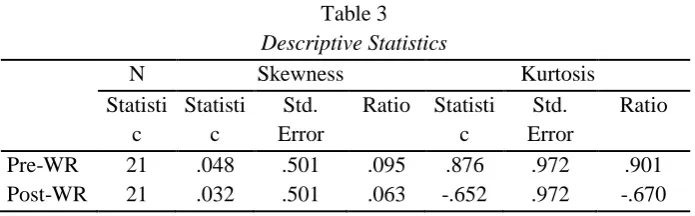
Prior to running statistical tests, the assumptions of independency of the groups and normality of the distribution were examined. To ensure compliance with these assumptions, the researchers used mean pair scores instead of individual scores. As displayed in the following table, the absolute values of the ratios of skewedness and kurtosis over their respective standard errors were lower than 1.96; hence normality of the data (Table 3).
Table 3 Descriptive Statistics
N Skewness Kurtosis
Statisti c
Statisti c
Std. Error
Ratio Statisti c
Std. Error
Ratio
Pre-WR 21 .048 .501 .095 .876 .972 .901
Post-WR 21 .032 .501 .063 -.652 .972 -.670
4.1. Quantitative phase
Out of the 32 students who had initially enrolled in the advance writing course and had taken the QPT, 26 belonged to Level 2 (Threshold) of the ALTE framework. The Threshold level in this framework indicates a lower intermediate proficiency level. These 26 students initially comprised the participants of the present study. However, due to data attrition, only the data gathered from 21 participants were analyzed in the present study (see section 3.1.1).
The participants pre- and post-treatment paragraphs were normalized and scored by two independent raters: the researcher and an ESL writing instructor who was trained by the researcher. Spelling and ambiguity normalization were the two normalization procedures used in the present study. For spelling, the texts were normalized at word level. For ambiguity, the texts were normalized at both word and sentence levels.
The spelling normalization was the first text normalization procedure employed. In order to use computer software to analyze paragraphs for syntactic complexity, vocabulary complexity, and the quantity of overall information, the
spelling normalization was deemed necessary. To this end, the researcher read the paragraphs carefully and identified misspelled words. The operational definition for misspelled words for the researcher were 1) words whose spelling does not represent an English word; for example [vehikle] vehicle; 2) single words of two stems spelt as two words, for instance [everybody] everybody. Next, the researcher made a decision about the spelling of misspelled words by extensively referring to the context of the participants’ writings. In order to ensure the reliability of the spelling interpretations, the second rater reread all of the identified misspelled words and their replacements in the corresponding context. The inter-rater reliability for the raters was found to be 0.98.
For the purpose of the present study, an ambiguous construct was operationally defined as a text segment that required using extensive assumptions on part of the reader in order to understand its meaning. Moreover, words which were semantically odd in a phrase were treated as ambiguous and thus left out from the analysis. On the other hand, an unambiguous construct was operationally defined as a segment that although it might have some grammatical irregularities, it was easy to understand because it did not hamper the readability of the text.
The ambiguity of the text segments was established through the following steps. First, the researcher identified the ambiguous text constructs (words, phrases, clauses, and sentences). To ensure intra-rater reliability, the researcher reread the paragraphs once more with one day interval. Secondly, an independent rater who was trained by the researcher read all the paragraphs to detect ambiguous segments and marked them as so. Finally, both the researcher and the independent rater reviewed ambiguous paragraph segments detected by the other one. High inter-rater reliability above 94% was achieved.
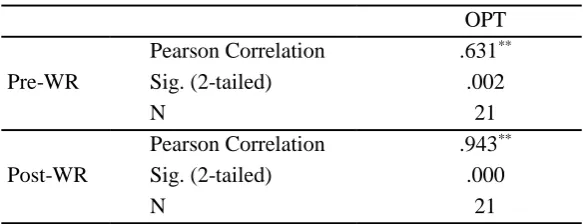
As for the criterion-referenced validity of the writing tests, the results of the Pearson correlations (Table 4) ran between OPT and pre-tests and post-test of writing indicated that OPT had significant correlations with both pre-test of writing
(r (19) = .631, p = .000, representing a large effect size), and the post-test of Writing (r (19) = .943, p = .000, representing a large effect size).
Table 4
Pearson Correlations; Criterion Referenced Validity OPT
Pre-WR
Pearson Correlation .631**
Sig. (2-tailed) .002
N 21
Post-WR
Pearson Correlation .943**
Sig. (2-tailed) .000
N 21
**. Correlation is significant at the 0.01 level (2-tailed).
Concerning the reliability of the writing tests, the pre- and post-test instruments had been examined based on the results of the pilot test ran in the previous semester by the researcher. The pilot study aimed at validating the scores gained by the trait rubric used in the present study. Using the multiple-trait rubrics, the researcher and the second rater had assigned a score to each paragraph wrote during the pilot test. The reliability of each score had been measured by comparing the scores assigned to the produced paragraphs by the participants in the pilot test. For the pilot pre-and post-test paragraphs, the inter-rater reliability for the rubrics scores had been calculated to be 91% using Miles and Huberman’s* formula.
Following the procedures employed in the pilot test, the pre- and post-test paragraphs were marked by two raters. To guarantee high reliability of scores, if a
*Number of agreements/Number of possible agreements = Inter-rater Reliability?
score differed by more than 10%, raters discussed that very paragraph and came to an agreement. To obtain comparable scores for the statistical analysis, all scores were converted to z-scores and were compared through the parametric tests of independent paired-sample t-tests. Miles and Huberman’s (1994) formula was used to calculate the inter-rater reliability for the scores. The inter-rater reliability of the rubric score in this study was calculated to be 93%.
To answer the second research question the researchers evaluated participants’ pre- and post-tests samples and measured three different aspects of the participants’ paragraph writings as it follows:
Syntactic Complexity. Syntactic complexity was measured through T-unit analysis. Both syntactically correct T-units and incorrect but unambiguous T-units (i.e., T-units that had minor grammatical errors but still conveyed the author’s thoughts) were analyzed. The instructor used the Coh-Metrix Software to measure T-units. This software, developed by McNamara et al. (McNamara & Graesser, 2013; McNamara, Graesser, McCarthy, & Cai, 2014), is an automated tool which provides indices for the characteristics of texts on multiple levels of analysis, including word and sentence characteristics.
Vocabulary Complexity. Vocabulary complexity was measured by calculating only vocabulary that was unambiguous. In the present study, the vocabulary complexity score was calculated using Automatic Analysis of Lexical Sophistication (TAALES) (Kyle & Crossley, 2015). TAALES measures 135 indices of lexical sophistication, including the index of frequency used (Nation’s Lexical Frequency Profile). TAALES takes plain text files as input and produces a comma separated values (.csv) spreadsheet that is easily read by any spreadsheet software for further statistical analyses.
Quantity of the Overall Information. Quantity of the overall information that participants presented was measured through the number of idea units. In the context of the present study, it was imperative to found a definition that would provide some tangible norms for detecting idea units in texts that would allow the instructor to analyze the writings of the participants in a consistent manner. To this end, the instructor adopted Hildyard and Hidi (1985) definition of idea units which includes a clause containing a main verb, subject, and objects plus modifiers and measured quantity of the overall information in the participants’ writing through measuring mean length of idea units. In addition, the instructor used Chafe’s (1985) definition which encompasses that two or more idea units can be combined into one sentence, by using “(a) dependent clauses conjoined by a different coordinating conjunctions such as after, although, as, as if, if, in order to and so forth; (b) appositives; and (c) participial clauses” (p. 107). Chafe suggests these three constructs are to be considered as separate idea units. Conversely, if a complement or restrictive relative clause is used or an indirect question or indirect quotation is used, these belong to the idea unit presented by the main clause. In Chafe’s words, “dependent clauses, appositives, and participial clauses are separate idea units” (p.107). The measures of syntactic complexity, vocabulary complexity, and quantity of overall information were presented with continuous scores; thus, they were analyzed using three independent t-tests.
4.2. Qualitative phase
To find what patterns of interaction were present in ACMC, postings on the first draft of three writing assignments of instrumental cases were divided into episodes. These episodes were analyzed line by line and were assigned one of the four patterns of interaction: collaborative, dominant/passive, expert/novice, or dominant/dominant. Assigning patterns was done by identifying examples of the patterns specifics described in Storch’s (2002a, 2013) and Zheng’s (2012) studies. Since there were four pairs and three writing assignments, 24 patterns of interaction were identified. The following sub-sections present how the postings were analyzed.
Dividing postings into units of analysis. To investigate the patterns of interaction, postings were divided into episodes. An episode was defined as a section of the participant’s postings where interlocutors discussed a single topic in the paragraph being reviewed, and when participants proceeded to another topic, another episode began. In the present study, patterns of interaction scheme was applied using episodes that were organized as (1) presenting the problem, (2) discussing possible solutions, and (3) possibly reaching consensus about how the writer should revise.
Log 1 exemplifies a distinct episode where X comments on the topic sentence that Y wrote for her paragraph on ‘Your Best Course at University’. Y structured her topic sentence in form of a question which X found erroneous. Thus, the topic in this episode was if a topic sentence could take the form of a question. The participants, from this point forward, moved on to discuss transition words that Y had used, which was marked as a separate episode.
Log 1
Sample of an Episode in Weblog Postings
Coding reliability. Two independent raters (the instructor and a M.A. holder in applied linguistics) assigned a pattern of interaction to each episode. The instructor and the second rater had three discussion sessions on Storch’s patterns of interaction, her concept of mutuality and equality, and the coding scheme used in Storch (2002a, 2013) and Zheng (2012) studies which were also used in the present study. After these discussion sessions, both raters independently assigned patterns of interaction to the episodes and later shared the results with each other. The raters agreed on 20 out of 24 patterns. The inter-rater reliability was calculated to be 84% by using Miles and Huberman’s (1994) formula. For those patterns on which the raters did not reach a consensus, the raters re-analyzed the corresponding episodes together by repeatedly referring to the coding scheme to work out an agreement. Following Roberson’s (2014) steps in coding, the two raters were considered to be in agreement if the pattern of interaction identified happened in two-third of the length of the episodes. After this discussion, raters reached an agreement on the four patterns which had been points of inconsistencies.
Instances of ACCM episodes and interaction patterns. The following sub-sections present analyses of instances of blog postings in terms of relative mutuality and equality of each pattern depicted in the participants’ postings and provide a discussion of features identified in each episode. It is essential to note that due to the asynchronous nature of discussion that took place in postings, interactions did not necessarily take place on one single day but on different days. It was possible for each participant to post on each other’s weblog either initiating a discussion or reflecting on one which was already created. Each of the sample logs below presents a number of posting exchanges between an actor and his/her partner on a single episode.
Collaborative pattern. Log 2 presents an example of the collaborative pattern in the participants’ postings. In this posting, Z is providing comments on the supporting sentences that W wrote in her paragraph on ‘Finding an Apartment’. These two participants are completely engaged with each other’s opinions and
build on them throughout their interaction [lines 7-14]. How the discussion is going on appears to be acceptable with both partners. The participants evidently indicate consideration of their partner’s contribution by sending positive feedback [lines 5 & 15]. Further, Z and W are both highly active in providing feedback on each other’s postings which is indicative of a high mutuality and high equality trend in this interaction.
As this log shows, each interlocutor expresses her idea(s) in rather long chains of words and makes several collaborative moves which are oftentimes comprised of complete sentences frequently in form of requesting and answering their partner’s question. A close analysis of log 2 reveals that major features of the collaborative pattern were mostly present in this episode as both partners addressed each other by using first names [lines 1, 2, 5-8, 10], asked for information [lines 2 & 3], answered each other’s questions [lines 4, 10, 11, 13], explicitly sought their partner’s input on a specific topic [lines 2-4, 12], stated their suggestion and shared their ideas [lines 4 & 14].
Log 2
Sample of the Collaborative Pattern in Weblog Postings
Dominant/dominant pattern. Log 3 is an example of dominant/dominant pattern in the weblog postings. In this dyad N and H took part in the task completion process of editing and revising. In this log, N provides comments on grammatical aspects of the first draft of H’s paragraph on “Finding an Apartment”. Both partners engaged in the discussion; however, there were no collaborative exchanges. This lack of collaborative moves is an indicator of dominance (Storch, 2002a, 2013). Both participants oftentimes expressed their own ideas and were not receptive of each other’s ideas.
H begins her turn in the interaction in a totally non-receptive manner [line 5] and remains so throughout the interaction [lines 6, 8, 10, 13, 16, 19] and shows a rather hostile manner when she had to accept her partner’s view [typing upper case, line 21]. During the course of interaction, each participant clings to her own view, such that almost no agreement on issues under discussion was reached. Not having reached any agreements, N puts an end to the interaction by shifting to a new subject and showing unwillingness to continue the interaction [lines 34-36]. Yet, she tries to remain polite and asks H to review her paragraph which is totally ignored by H [lines 37-39]. This log shows that there was no evidence of any attempts for creating a joined problem solving space; and unwillingness to engage with each other’s ideas, which exhibits the high equality but low mutuality that characterize the dominant/dominant pattern.
On the whole, the episode in log 3 presents a hostile attitude with partners confronting each other, unable to engage with suggestions, and unable to reach consensus on issues they debate about [lines 3, 8, 10, 13, 16, 27, 33]. Moreover, throughout the interaction both partners provided defensive responses to suggestions, had disagreements that led nowhere, and ignored the other participant’s opinion thus representing a high equality but low mutuality trend.
Log 3
Sample of the Dominant/Dominant Pattern in Weblog Postings
Dominant/passive pattern. Log 4 provides an episode of V and M interaction in which V expresses his ideas on the topic sentence in M’s paragraph on “National Holiday of your Choice”. A line-by-line examination of this episode unveils that V has posted a rather long post as compared to M expressing what he thinks about M’s topic sentence feeling no need to seek her idea on the points he is raising [lines 1, 2, 4, 5]. He takes a dominant stance by maintaining an authoritarian tone throughout the entire episode and repeatedly uses ‘have to’ [lines 1, 5, 11, 14], V is unwilling to assist [line 1], and offers assistance once [line 15] and ignores M’s implicit request for help [line 11]. On the contrary, M who manifests a passive pattern is submissive in tone [lines 3, 5, 10, 12, 16], (implicitly) seeks assistance [line 8] and raises no challenge throughout the exchange.
As the log reads, the dominant partner did not make attempts to involve the passive partner in the discussion, offered little assistance, and took an authoritative
stance. Conversely, the passive partner made a few contributions, was obedient, and sought little assistance.
Log 4
Sample of the Dominant/Passive Pattern in Weblog Postings
Expert/novice pattern. Log 5 is an instance of this pattern in which R comments on A’s choice of grammar and diction in her paragraph on “Young People’s Life: Past and Present”. In this episode, R exhibits an expert stance by willingly providing assistance [line 2, 4-6] and explanation [lines 8 & 14] while pushing A the novice partner to participate [lines 6, 12, 14, 15]. In contrast, A repeatedly confirms R’s ideas and repeats them [lines 3, 7, 10], and directly asks for R’s help. Despite the fact that both partners made a few collaborative moves [lines 6, 12, 14, 15], the main trend is for R (the expert) to lead the discussion and guide A (the novice).
Log 5
Sample of the Expert/Novice Pattern in Weblog Postings
As this log shows, the novice partner contributed to the discussion in a limited manner, frequently admitted failure, confirmed and repeated the experts’ position, and requested her partner’s opinion. On the other hand, the expert partner assumed a different stance in the interaction. She initiated the discussion, repeatedly asked for her partner’s opinion, provided scaffolding and direct instruction, ensured that her comments were clear to her partner, and remained authoritative throughout the interaction. All these moves are representative of a high mutuality but low equality trend.
5. Results
5.1. Quantitative phase
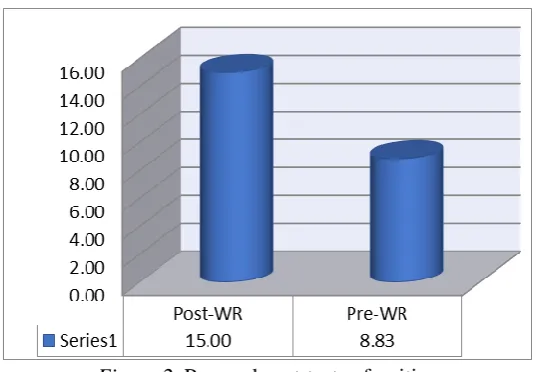
A paired-samples t-test was run to compare participants’ mean scores on the pre- and post-tests in order to probe the null-hypothesis of DA if conducted via ACCM does not enhance L2 learners’ overall writing performance. Based on the results displayed in Tables 5 and 6, it can be claimed that the mean of the post-test (M = 15, SD = 1.57) was significantly higher than that of the pre-test (M = 8.83, SD = 2.19). Thus, the null-hypothesis was rejected suggesting that applying DA via ACCM positively affects learners writing achievement. Figure 2 presents the scores of pre- and post-tests graphically.
Table 5
Paired Samples Statistics
Mean N Std. Deviation Std. Error Mean
Post-WR 15.00 21 1.573 .343
Pre-WR 8.83 21 2.198 .480
Table 6
Paired-Samples Test
Paired Differences
T df Sig. (2-tailed) Mean Std.
Deviation
Std. Error Mean
95% Confidence Interval of the Difference
Lower Upper PostWR-
PreWR 6.167 1.426 .311 5.518 6.816 19.818 20 .000
Figure 2. Pre- and post-tests of writing
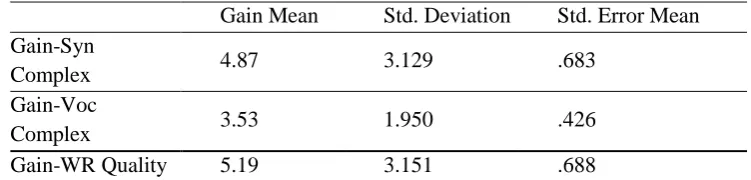
In order to test the null hypothesis of DA if conducted via ACCM does not impact vocabulary complexity, syntactic complexity, and quantity of L2 learners’ writing, the pre- and post-test means on the gain score (post-test minus pre-test) of syntactic complexity, vocabulary complexity, and quantity of the overall information were compared. As Table 7 displays, there was a discernible trend towards enhancement of syntactic complexity, vocabulary complexity, and quantity of the overall information in participants’ writing performance. Therefore, the null hypothesis was rejected.
Table 7
Gain Score of Syntactic Complexity, Vocabulary complexity, and Quantity of the Overall Information
Gain Mean Std. Deviation Std. Error Mean Gain-Syn
Complex 4.87 3.129 .683
Gain-Voc
Complex 3.53 1.950 .426
Gain-WR Quality 5.19 3.151 .688
5.2. Qualitative phase
An exhaustive analysis of weblog interactions revealed that the four interaction patterns of collaborative, dominant/dominant, dominant/passive, and expert/novice were employed in the ACMC environment. Based on the results of the data analyses, there were 12 dyads that revealed high mutuality and high equality trend signifying a collaborative pattern of interaction. There were four dyads that revealed high equality but low mutuality trend thus demonstrating a dominant/dominant pattern. Six dyadic interactions manifested a trend of low mutuality and low equality thus signifying a dominant/passive pattern. Only two pairs manifested a high mutuality and low equality trend in their interactions leading to an expert/novice pattern. Accordingly, the most prevailing interaction of interaction perceived in this study was the collaborative pattern (50%) and the second most dominating pattern was the dominant/passive (25%). Table 8 summarizes patterns of interaction identified in the present study, along with number and percentage of their occurrence.
Table 8
Patterns of Interaction in Participants’ Postings
Pattern Dyads
ACCM interaction
Collaborative 12 (50%) Dominant/Dominat 4 (16.67%) Dominant/Passive 6 (25%) Expert/Novice 2 (8.33%)
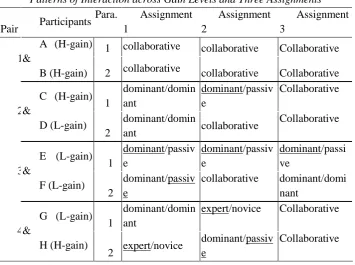
To answer the research question of “what patterns of dyadic interaction H-gainers and L-H-gainers adopt during the ACCM interaction process”, the role that each of H-gainers and L-gainers adopted during blog postings on the draft of three writing assignments was systematically examined. To this end, the blog postings were analyzed line-by-line via adopting the patterns specifics proposed by Storch’s (2002b, 2013) and Zheng’s (2012) studies. For each of the three assignments, there were two drafted paragraphs with each being the first draft written by each of the partners. In Table 9 the distinct role that each participant in the interaction assumed is underlined. Careful data analysis revealed that the collaborative pattern of interaction turned out to be more conducive to improving L2 writing performance in the present study. H-gainers evidently took part in eight out of a total of 12 collaborative interactions. This is while L-gainers took part in only four out of a total of 12 collaborative interactions.
Table 9
Patterns of Interaction across Gain Levels and Three Assignments
Pair Participants
Para. Assignment 1 Assignment 2 Assignment 3 1
A (H-gain) &
B (H-gain)
1 collaborative collaborative Collaborative
2 collaborative collaborative Collaborative
2
C (H-gain) & D (L-gain) 1 dominant/domin ant dominant/passiv e Collaborative 2 dominant/domin
ant collaborative
Collaborative
3
E (L-gain) & F (L-gain) 1 dominant/passiv e dominant/passiv e dominant/passi ve 2 dominant/passiv e
collaborative dominant/domi nant
4
G (L-gain) &
H (H-gain) 1
dominant/domin ant
expert/novice Collaborative
2 expert/novice
dominant/passiv e
Collaborative
6. Discussion
The findings of the present study revealed that ACCM method used to undertake DA significantly improved the writing performance of participants. This outcome, commensurate with the results of earlier studies supporting DA (Ableeva, 2010; Lantolf & Poehner, 2011, 2013; Poehner, 2008; Poehner & Lantolf, 2010, 2013; Poehner, Zhang, & Lu, 2015; Shrestha & Coffin, 2012; Xiaoxia & Yan, 2010), appears reasonably rational in that ACCM method provided the participants with
spot-on mediations that were tailored to their ZPD thus no participant remained totally unaffected hence his/her writing performance advanced. This embraces DA principles. That is to say DA compares current performance of each individual with his/her earlier performance, makes inferences about each individual’s improvement on such grounds and mediates each individual moving a stage above his/her present level of ability. As such, DA enables each learner to gain from its procedure and forge ahead as much as the ZPD allows him/her.
The present study also found that weblogs as a Web 2.0 tool are functional thus beneficial for effectively delivering tailored-to-the-learners’ ZPD mediations. For one thing, using weblogs provided the participants with an environment in which not only they could interact with each other, share their ideas, and co-construct knowledge; but also they could exercise a high level of autonomy while sharing their collaboratively written texts with others thus enhancing their writing performance. This sense of autonomy helped learners to view themselves capable of writing about their own ideas and creating their own text while benefiting from others’ mediation to revise and adjust it progressively until it was changed into something acceptable. Moreover, the text-based nature of weblogs and round-the-clock accessibility of the outcome of the previous stages opened up the possibility of individually practicing and reflecting on what had been done before and carrying on with each stage as a homework assignment.
Furthermore, the results of the present study revealed that participants’ active knowledge of syntax and vocabulary and the amount of information they presented in their writing was enhanced via ACCM. The results can be justified in the light of the mode of offering collaboration and mediation. For one thing, the asynchrony of the CCM made it possible for learners to exercise a higher degree of control over writing mechanisms as it offered learners more time to carefully prepare posts in form of topic initiation moves and comments/responses to the instructor or to other participants. Also, ACCM enabled the learners to focus primarily on both form and meaning when generating ideas, planning their writing, editing their spelling, grammar, and punctuation, and also writing rather long sentences.
Additionally, the results indicated that ACCM enabled learners to realize their mistakes in grammar and choice of words through explicit and implicit mediations
provided by the instructor and other participants in form of comments on their posts in both CB and LB. This served as an aide-mémoire for participants not to repeat the same mistakes in their future weblog posts. Relevantly, participants’ awareness that their posts would remain accessible to other participants motivated them to monitor their writing, thereby encouraged them to cater to both form and meaning, as revealed by other studies including Campbell (2005), Kessler and Bikowski (2010); Montero-Fleta and Pérez-Sabater (2010), Akçay and Arslan (2010), as well as Yim and Warschauer (2017).
Moreover, the results of the study showed that the patterns of dyadic interaction manifested in the participants’ weblog postings matched the model of dyadic interaction proposed by Storch (2002a). In-depth analysis of postings revealed the predominance of the collaborative interaction pattern bearing high mutuality and high equality trend. Moreover, this study found that all of the H-gainers took part in collaborative interactions. This result can be explained in that the participants could scaffold each other’s performance when interacting collaboratively. As there was no fixed expert in the dyad, the interlocutors alternated in the collaborative role and shared knowledge when they had concerns about their language choices. That is, the participants used language as a tool which smoothed negotiations over language choice. Moreover, this result appears logical with reference to Vygtosky’s theory of cognitive development in that the H-gainers engaged in the co-construction of knowledge about language which was afterwards appropriated and internalized by the interlocutors.
The predominance of collaborative pattern in this study is in line with most research studies that have inspected interaction patterns with either a single experimental group (Storch, 2002a; Watanabe and Swain, 2007) or two experimental groups (Dobao, 2012; Kim & McDonough, 2008; Swain, 2010; Tan et al., 2010) in both face-to-face communication and CMC. However, a few studies including Zheng’s (2012) and Sarieva’s (2007) reported the dominant/dominant pattern as the most prevailing one. Regarding Sarieva’s study, the prevalent
occurrence of dominant/dominant pattern could have been because she studied the interaction patterns comparatively in both asynchronous and synchronous modes of communication. Sarieva states that synchronous CMC (SCMC), as compared to ACMC provided more opportunities for more collaboration. In case of Zheng’s study (2012), it could be reasoned that the high representation of the dominant/dominant pattern could have been because of exploratory nature of his research in which limited number of participants were studied. Such findings should be interpreted with caution since the present study, amongst other related studies, also explored a limited number of participants yet it came up with different results. The researchers believe this issue awaits to be addressed in future research if SLA scholars are to draw a firm conclusion as to predominance of certain patterns of interaction in ACMC.
Findings of the qualitative analysis corroborate those from the quantitative analysis. The results of the two levels of analysis, namely, quantitative and qualitative, revealed that post-test paragraphs of those participants who adopted a collaborative pattern tended to be better in terms of overall writing performance, thus making them H-gainers. Consequently, a considerable degree of knowledge was collaboratively created via the extensive process of interaction and providing mediations. Owing to the mediation in terms of stimulating and supportive comments revealed in H-gainers weblog postings, which not only led to participants’ initiative but also brought out collaboration between them, ACCM DA significantly improved the participants’ writing performance.
7. Conclusion
Web 2.0 supports collaborative mediation processes (CMP) in written communication; accordingly, models of CMP are evolving in L2 writing. The process that took place in the present study portrays a model in which texts are composed by a single writer; yet, they are products that integrate the feedback of peers and teachers through collaborative idea generation, mediated drafting, and revision. The results of the present study suggested that using blogging as a Web
2.0 tool to provide mediation within DA framework contributed to the enhancement of the L2 overall writing performance.
Admitting that Web 2.0 is here to stay and its usage in education particularly in language learning is already prevalent, addressing the new literacy skills of L2 learners in language programs is of paramount importance. Should language programs incorporate Web 2.0 into their curriculum, early assessment of learners’ computer literacy will provide useful information about their computer skills. In case of the current study, although the majority of the participants had used computers in their every-day life, almost all of them had not used computers for academic purposes, more specifically when it came to blogging some participants needed additional help. Therefore, extracurricular workshops to enhance educational computer literacy would provide systematic support.
The findings of the present study create some awareness for L2 practitioners and teachers on the use of Web 2.0. Firstly, ACCM mode of communication does not restrict time and space learners may spend and use up while providing collaboration. This calls for intricately designed tasks for each stages of process writing to keep learners’ focused on the main goal of each stage. Secondly, L2 writing teachers should be aware that learners are not essentially ready or eager to engage in an online collaborative writing. This requires teachers’ on-going supervision including openly discussing the process of writing with learners and how they can assist each other by scaffolding through collaboration.
The present study possesses limitations associated with time and sample size. First, this study took place over the course of one semester. However, improvements in writing performance at deep levels; that is, presentation, development, and rhetorical soundness, are mostly detectable over a longer period of time. As the researchers did not have access to the participants once the semester was over, delayed effect of DA on improving writing performance was not tested. Secondly, the sample-size of the present study turned out as a double-edged sword. Due to some missing data, five participants were omitted from reports of analyses.
Perhaps with a larger group of participants the study would have had more power to detect a more significant difference from pre- to post-test. Conversely, with a larger sample size, investigating the specifics and dynamics of collaboration and mediation and how it affects participants writing skills during all stages of process writing via Web 2.0 is close to impossible (Ableeva, 2010; Haywood & Lidz, 2007; Noytima, 2010; Xiaoxia & Yan, 2010; Yim & Warschauer 2017).
Despite the fact that there are diverse ways in which mediation can be made, the researchers chose the Aljaafreh and Lantolf (1994) regulatory scale. This scale with its sequential nature of moving from implicit to explicit was the only practical scale available for the purpose of this study. The researchers would like to emphasize the need for the development and implementation of situation-specific mediation scales tailored to the language needs of learners. Moreover, future studies are warranted to address the delayed effect of DA to further examine the advantageous outcome of using Web 2.0 to undertake DA.
8. References
Ableeva, R. (2010). Dynamic Assessment of listening comprehension in second language learning. Unpublished doctoral dissertation, The Pennsylvania State University, University Park, PA.
Akcay, A., & Arslan, A. (2010). The using of blogs in Turkish education. Procedia Social and Behavioral Sciences, 2(2), 1195-1199.
Aljaafreh, A., & Lantolf, J. P. (1994). Negative feedback as regulation and second language learning in the zone of proximal development. The Modern Language Journal, 78(4), 465-483.
Birjandi, P., & Ebadi, S. (2010). Dynamic assessment in synchronous computer mediated communication. Paper presented at the Conference on Technology for Second Language Learning, Michigan, USA.
Campbell, A. P. (2003). Weblogs for use with ESL classes. Retrieved from http://iteslj.org/ Techniques /Campbell-Weblogs.html