University of New Orleans University of New Orleans
ScholarWorks@UNO
ScholarWorks@UNO
University of New Orleans Theses and
Dissertations Dissertations and Theses
12-20-2009
Study of Magnetization Switching for MRAM Based Memory
Study of Magnetization Switching for MRAM Based Memory
Technologies
Technologies
Huy Pham
University of New Orleans
Follow this and additional works at: https://scholarworks.uno.edu/td
Recommended Citation Recommended Citation
Pham, Huy, "Study of Magnetization Switching for MRAM Based Memory Technologies" (2009). University of New Orleans Theses and Dissertations. 1028.
https://scholarworks.uno.edu/td/1028
This Dissertation is protected by copyright and/or related rights. It has been brought to you by ScholarWorks@UNO with permission from the rights-holder(s). You are free to use this Dissertation in any way that is permitted by the copyright and related rights legislation that applies to your use. For other uses you need to obtain permission from the rights-holder(s) directly, unless additional rights are indicated by a Creative Commons license in the record and/ or on the work itself.
Study of Magnetization Switching for MRAM
Based Memory Technologies
A Dissertation
Submitted to the Graduate Faculty of the University of New Orleans
in partial fulfillment of the requirements for the degree of
Doctor of Philosophy in
Engineering and Applied Science Physics
by
Huy Pham
B.S. Hanoi University of Science, Vietnam, 2001 M.S. University of New Orleans, USA, 2005
Acknowledgments
I am greatly thankful to my advisor, Prof. Leonard Spinu who taught me with a
wealth of knowledge in study and gave me a lot of helpful suggestions in life. This
dissertation could not have been done without his priceless guidance.
I would like to thank my supervisory committee members for their valuable and
insightful suggestions and guidance for this work and for various courses these last years
as well: Prof. Leonard Spinu, the committee chair, Prof. Leszek Malkinski, and Prof.
Ashok Puri from Department of Physics, Prof. Dimitrios Charalampidis from Department
of Engineering, and Prof. Scott L. Whittenburg, Vice Chancellor for Research and Dean
of the Graduate School at University of New Orleans.
I am deeply grateful to my colleagues: Dr. Dorin Cimpoesu, Dr. Ioan Dumitru, Dr.
Juliano Denardin, and Dr. Cosmin Radu for their support and valuable opinions. A lot of
results in this dissertation were contributed by their hard work.
I want to express my deepest gratitude for the continuous support from the
Advanced Materials Research Institute (AMRI) at University of New Orleans that offered
me a graduate research assistant position for all the duration of my studies. I also would
Table of Contents
List of Figures...vii
List of Tables... x
Abstract... xi
Introduction... 1
1. Overview of Magnetism... 9
1.1 Magnetic free energy ... 10
1.1.1 Magnetocrystalline anisotropy ... 10
1.1.2 Magnetostriction and stress anisotropy ... 12
1.1.3 Shape anisotropy... 12
1.1.4 Zeeman energy ... 13
1.1.5 Exchange energy... 13
1.2 Stoner-Wohlfarth model ... 14
1.2.1 Free energy function... 15
1.2.2 Astroid curve ... 17
1.2.3 Hysteresis... 19
1.2.4 Reversible transverse susceptibility ... 20
1.3 Néel and Brown models ... 22
1.4 Landau–Lifshitz–Gilbert equation of motion... 25
1.4.1 The gyromagnetic equation ... 26
1.4.2 The Landau-Lifshitz equation ... 28
1.4.3 Gilbert damping term, Gilbert equation ... 29
1.4.4 Numerical integration of LLG equation ... 32
1.5 Langevin dynamics – Stochastic LLG equation... 34
1.5.1 Stochastic Landau-Lifshitz-Gilbert equation ... 36
1.5.2 Heun scheme... 38
1.5.3 Midpoint numerical technique... 40
1.6 LLG micromagnetic dynamics ... 43
2. Static Critical Curve... 46
2.1 The role of critical curve in MRAM... 47
2.3 The measurement of the critical curve via reversible transverse
susceptibility experiments ... 64
2.3.1 Model ... 65
2.3.2 Experimental results ... 68
2.4 Summary... 73
3. Magnetization Dynamics in Interacting Magnetic Systems... 74
3.1 Magnetization behavior of isolated single domain ellipsoidal particles... 75
3.1.1 Model... 75
3.1.2 Time evolution of the magnetization in pulsed magnetic fields ... 76
3.1.3 Switching diagram of the magnetization in pulsed magnetic fields ... 80
3.2 Magnetization reversal in interacting magnetic systems... 84
3.3 Summary... 95
4. Spin Transfer Switching ... 96
4.1 Spin transfer torques... 97
4.2 Dynamic and temperature effects in spin transfer switching ... 100
4.2.1 Model... 102
4.2.2 Dynamic effects... 108
4.2.3 Temperature effects ... 118
4.3 Magnetization switching under a spin torque current and a magnetic field ... 119
4.3.1 Model... 120
4.3.2 Precession of the magnetization in a dc applied field and a pulsed current ... 122
4.3.3 Precession of the magnetization in a pulsed applied field and a pulsed current... 124
4.4 Summary... 127
5. Static and Dynamic Critical Curves of a Synthetic Antiferromagnet... 129
5.1 Synthetic antiferromagnet and its application in toggle MRAM ... 130
5.1.1 Synthetic antiferromagnet concepts ... 130
5.1.2 Toggle MRAM ... 132
5.2 Static critical curve of SAF... 136
5.2.1 Magnetization behavior of the SAF ... 136
5.2.2 Critical curves and operating field margins... 140
5.3 Dynamic critical curve of SAF... 141
5.3.1 Model... 142
5.3.2 Dynamic critical curves of symmetric and asymmetric SAF structures... 143
5.4 Dynamic and temperature effects in toggle MRAM ... 152
5.4.1 Dynamic toggle switching diagram... 153
5.4.2 Thermal relaxation effect... 160
5.5 Summary... 163
Conclusion... 165
References... 171
Appendices... 178
A. Flowchart for solving LLG equation ... 178
B. External fields for uniformly magnetized ellipsoids ... 179
List of Publications... 181
List of Figures
1.1. Considering an assembly of small magnetic particles ... 15
1.2. Relation between uniaxial anisotropy axis, m, and h... 16
1.3. Control plane of coordinates, and the astroid curve... 17
1.4. Graphical construction defining the possible m orientations... 18
1.5. Magnetization process and hysteresis loops... 19
1.6. Vector diagram for calculation of TS... 20
1.7. Illustrating the barrier energy and Néel-Brown model ... 24
1.8. Precessional motion of magnetization... 27
1.9. Magnetization torque with/without damping term... 30
1.10. Graphical representation of the LLG equation... 32
1.11. Magnetization vector m in spherical coordinates... 33
2.1. MRAM read operation ... 48
2.2. MRAM writing operation... 48
2.3. The critical curve and the operating regions in MRAM ... 50
2.4. Illustration of some complicated critical curves... 51
2.5. Vector diagram corresponding to a uniaxial anisotropy magnetic particle subjected to an external field... 54
2.6. The complex critical curves in eight regions... 56
2.7. Hysteresis loops in eight regions... 57
2.8. Transverse susceptibility curves in eight regions... 58
2.9. The behavior of magnetization in region III and V... 60
2.10. The astroid, hysteresis, and χT curves in region VI ... 61
2.11. The hysteresis, and χT curves in region VII... 62
2.12. The hysteresis, astroid, andχT curves in region VIII... 63
2.13. A thin film sample with coordinate system... 67
2.14. The theoretical curve determined from TS measurements... 68
2.15. TEM image of Co/SiO2 and schematic of TS experiment ... 69
2.16. Experimental critical curve for sample 90A... 70
2.17. Experimental critical curves for samples 90A, B, and 90C ... 72
3.1. Scheme of the magnetic field pulse... 76
3.2. Different representations of the precessional switching of an ellipsoidally shaped particle ... 77
3.4. Time evolution of magnetization vector in a field pulse 0.0/2.75/0.0 ns
of 50 Oe ... 79
3.5. Switching diagrams for different rectangular pulse lengths... 81
3.6. Switching diagram of the magnetization vector under a field pulse 0/0.25/0 ns ... 83
3.7. Time evolution of the magnetization components mx, my, and mz for the four parameter sets labeled (a)-(d) in Fig. 3.6... 83
3.8. Initial configurations of the system consisting of two ellipsoidal particles m1 and m2 ... 84
3.9. Switching diagram and phase portrait of an isolated ellipsoidal particle... 86
3.10. The phase portrait for the particle located at origin in interaction with a neighbor particle situated at the distance D=6 ... 88
3.11. Switching diagrams for two interacting particles with the separation between them D=6... 89
3.12. Switching diagrams for two interacting particles corresponding to the configuration of Fig 3.8(a) ... 91
3.13. Switching diagrams for two interacting particles corresponding to the configuration of Fig 3.8(b) ... 92
3.14. Switching diagrams for two interacting particles corresponding to the configuration of Fig 3.8(c) ... 93
3.15. Switching diagrams for two interacting particles corresponding to the configuration of Fig 3.8(d) ... 94
4.1. Illustration of the STT in a F/N/F pillar ... 98
4.2. Vector diagram of LLG’s equation with spin torque term added ... 104
4.3. Schematic of the free layer, assumed to be ellipsoid shaped ... 106
4.4. Time dependence of the applied current pulse... 107
4.5. AP-P switching diagrams at T =0 K, as a function of current pulse amplitude and duration at different values of damping constant α ... 110
4.6. AP-P switching diagrams at T =0 K for a current sweep rate 1 mA/ps I υ = , and α =0.01... 111
4.7. The precession of magnetization m under the influence of a spin current pulse at different values of the pulse duration ... 114
4.8. The precession of magnetization m under the influence of a spin current pulse at different values of the current sweep rate... 115
4.9. AP-P switching diagrams at T =0 K for a current sweep rate 0.05 mA/ps I υ = and υI =0.1 mA/ps... 116
4.10. AP-P switching diagrams at T =0 K for different initial orientation ϕ Δ of magnetization m ... 117
4.11. AP-P switching diagrams at T =0 K for different out-of-plane initial orientation Δθ of magnetization m... 118
4.13. Schematic of the free layer, assumed to be ellipsoid shaped, and single
domain, with an in-plane external applied field... 121
4.14. Switching diagrams as a function of the applied dc field for different values of the current pulse length... 122
4.15. Time switching as a function of the maximum value of a pulse field for different values of the current pulse length ... 125
4.16. Schematic of the pulsed field and current applied asyncronously ... 126
4.17. Time switching as a function of the maximum value of a pulse field with a current pulse applied at the delay time t1 ... 126
5.1. Schematic representation of the SAF ... 130
5.2. Variation of the indirect exchange coupling constant... 131
5.3. Illustrative switching by SW reversal MRAM... 133
5.4. Illustrative switching by toggle MRAM ... 134
5.5. Schematic of the toggling operation of Savtchenko switching ... 134
5.6. Critical curves for different values of thickness ratio ... 138
5.7. Critical curves for different values of exchange coupling constant ... 139
5.8. Critical curves obtained by Fujiwara et al... 140
5.9. sCCs for a symmetric/asymmetric SAF ... 144
5.10. Switching diagrams of an asymmetric SAF at different values of υH... 146
5.11. Switching diagrams of an asymmetric SAF at different values of α ... 147
5.12. Switching diagrams of an asymmetric SAF at different values of TH ... 148
5.13. Switching diagrams of a symmetric SAF at different values of υH ... 149
5.14. Switching diagrams of a symmetric SAF at different values of α ... 150
5.15. Switching diagrams of a symmetric SAF using B1 configuration ... 151
5.16. Switching diagrams of an asymmetric SAF taking into account both exchange and magnetostatic coupling... 152
5.17. Time dependence of the applied filed pulses ... 153
5.18. Toggle switching diagram of a symmetric SAF element at T =0 K for different values of the applied field sweep rate υH... 155
5.19. Toggle switching diagram of an asymmetric SAF element at T =0 K for different values of the applied field sweep rate υH ... 156
5.20. Toggle switching diagram of a symmetric/asymmetric SAF element at 0 K T = and time evolution of magnetization m... 158
5.21. Toggle switching diagram of a symmetric/asymmetric SAF element for different values of the damping constant α ... 159
5.22. Probability of switching of a symmetric SAF element for T =300 K ... 161
5.23. Probability of switching of an asymmetric SAF element for T =300 K ... 162
List of Tables
Abstract
Understanding magnetization reversal is very important in designing high density
and high data transfer rate recording media. This research has been motivated by interest
in developing new nonvolatile data storage solutions as magnetic random access
memories - MRAMs. This dissertation is intended to provide a theoretical analysis of
static and dynamic magnetization switching of magnetic systems within the framework of
critical curve (CC). Based on the time scale involved, a quasi-static or dynamic CC
approach is used.
The static magnetization switching can be elegantly described using the concept of
critical curves. The critical curves of simple uncoupled films used in MRAM are
discussed. We propose a new sensitive method for CC determination of 2D magnetic
systems. This method is validated experimentally by measuring experimental critical
curves of a series of Co/SiO2 multilayers systems.
The dynamics switching is studied using the Landau-Lifshitz-Gilbert (LLG)
equation of motion. The switching diagram so-called dynamic critical curve of
Stoner-like particles subject to short magnetic field pulses is presented, giving useful information
for optimizing field pulse parameters in order to make ultrafast and stable switching
For the first time, the dynamic critical curves (dCCs) for synthetic antiferromagnet
(SAF) structures are introduced in this work. Comparing with CC, which are currently
used for studying the switching in toggle MRAM, dCCs show the consistent switching
and bring more useful information on the speed of magnetization reversal. Based on
dCCs, better understanding of the switching diagram of toggle MRAM following toggle
writing scheme can be achieved.
The dynamic switching triggered by spin torque transfer in spin-torque MRAM
cell has been also derived in this dissertation. We have studied the magnetization’s
dynamics properties as a function of applied current pulse amplitude, shape, and also as a
function of the Gilbert damping constant. The great important result has been obtained is
that, the boundary between switching/non-switching regions is not smooth but having a
seashell spiral fringes.
The influence of thermal fluctuation on the switching behavior is also discussed in
this work.
Keywords: magnetization switching, critical curve, SAF, MRAM, toggle MRAM,
Introduction
Magnetization dynamics is one of the central issues in the physics of mesoscopic
magnetic systems [1, 2] and its understanding is important not only for its evident
fundamental interest but also due to the big impact on the information technology, more
specifically on magnetic information storage. Magnetic recording is rapidly approaching
the nanometer scale as storage densities are projected to increase to a terabit per square
inch. High volume of data requires higher data transfer rates. These present new
challenges and opportunities in nanometer scale materials engineering and in
inderstanding the magnetic properties of nanometer scale magnetic materials. Among the
critical issues is the manner and speed which the magnetization direction can be reversed
from one stable configuration to another. Also, for the magnetic random access memories
(MRAMs) [3] unlike present forms of nonvolatile memories, they must have switching
rates and rewrite-ability properties surpassing those of conventional RAMS. This can be
achieved only first by understanding and then by controlling the magnetization dynamics
of very confined magnetic elements.
The magnetization dynamics at different timescales is governed by different
physical dynamic mechanisms. Firstly, on the nanosecond range (0.1 ns to 100 ns) the
dipolar interactions, external fields and spin–lattice interactions are the major driving
which is the primary source of magnetization rotation that is gradually opposed by
damping [4, 5]. This regime is described theoretically by the phenomenological
magnetization’s equation of motion Landau-Lifshitz-Gilbert (LLG) and is able to
describe the precessional reversal mechanism. In this regime, the weakly damped
precession of spins induces the so-called ringing of magnetization, which can persist up
to several nanoseconds. Recently, it was shown that it is possible to suppress the ringing,
and so reduce the switching time through a ballistic switching process, by matching the
field-pulse parameters to the frequency and the phase of the magnetic excitation [4]. For
shorter time scales of the order of picoseconds (1-100 ps) the electron excitations cannot
be ignored and electron-phonon, phonon-phonon, and spin-lattice interactions start to be
important. In this case the LLG formalism gradually becomes invalid as quantum effects
appear. Here a new mechanism of magnetization reversal is possible, induced by an
angular momentum transfer from a magnetically polarized electron current [6-9]. Finally,
for very short time scales (1fs-1ps), electron–electron and spin-orbit interactions
dominate. Magnetic structures can be excited by optical probes that are shorter than
fundamental timescales such as spin-lattice relation times and precession times. This
regime became accessible only recently when novel pulsed magneto-optical lasers were
developed capable of studying the spin dynamics at femtosecond resolution [10, 11].
This thesis is intended to provide a theoretical analysis of magnetization dynamics
in nanometer scale magnetic structures in the first regime among those mentioned above.
In spite of continuous efforts on studying this dynamics, there are several fundamental
interactions, the spin-torque transfer effects, the role of thermal fluctuations, and the
basic mechanism of damping of magnetization motion. Specifically, in this work the
study of magnetization dynamics will be performed using the formalism of the critical
curve. The critical curve is a very important concept for both, theoretical study of
switching mechanism in magnetic system and device applications, as MRAM. The
critical curve was first discussed by Slonczewski [12] and then developed further by
André Thiaville in 1997 [13]. However, the name of “critical curve” basically comes
from the Stoner-Wohlfarth model, which was early introduced by Stoner and Wohlfarth
to describe the simplest case of the uniaxial, single domain particles in 1947 [14]. Based
on the remarkable properties of the critical curve, the hysteresis and the corresponding
transverse susceptibility curves can be constructed, providing a lot of useful information
of magnetic materials. It is clear, therefore, that the critical curve is the key to the
understanding of the static behavior of magnetic materials. There are several techniques
developed so far to measure the critical curve. In the first part of this work the
quasi-static case will be considered where a new method for measuring the quasi-static critical curve
using the reversible susceptibility measurements is proposed. This method will be
theoretically presented and experimentally validated in the case of a nanostructured
magnetic system consisting of multilayers of Co/SiO2.
In the case of faster magnetization switching, a dynamic critical curve approach is
used. The switching properties are discussed in the case of interacting single domain
particles subject to an external field pulse. The theoretical description of precessional
equation that includes the pulse magnetic excitation, the exchange and dipolar interaction
fields. The weakly damped precessions of spin induce small fluctuation of magnetization,
or in other words, ringing of magnetization, for a time of nanoseconds. The ringing of
magnetization is strongly dependent on field pulse parameters (as shape, rising and
falling times) and a precise control of ultra fast magnetization can be obtained. The main
goal is to determine the parameters of field pulse for which a fast and stable switching
can be achieved. The influences of interaction between particles and the spatial
placement of the particles on switching behavior are discussed. Our results and analysis
suggest that in dealing with the problem of improving the density of data storage in
MRAM, the dipolar interaction between neighboring magnetic elements is one of
important aspects that needs to be considered carefully.
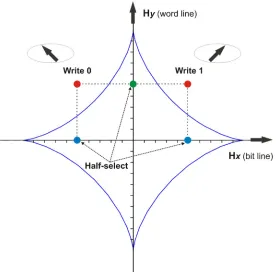
Recently, there are several novel approaches that eliminate the half-select disturb
phenomenon present in conventional MRAM [15-18]. Among them, “magnetization
toggling” and “spin torque transfer” switching are the most promising, introducing new
advanced generations of MRAM, as “toggle-MRAM” and “Spin transfer torque
MRAM”, respectively. This study is also motivated by the considerable interest in
investigating the dynamic switching properties of magnetization in these new advanced
types of MRAM. In toggle MRAM, proposed by Savtchenko [15], the free layer in a
MRAM cell consists of two weakly anti-parallel coupled ferromagnetic layers instead of
a single layer as used in conventional MRAM. Therefore, the free layer in a toggle cell is
a synthetic antiferromagnet (SAF) trilayer stack. The theory of simple uncoupled films of
approach was developed [19-21]. Subsequently, CCs of SAF have been extensively
studied due their technological important for toggle-MRAM [22-29]. However, the CCs
of SAF are restricted only to a quasistatic regime, where the magnetization dynamics and
precessional effects are neglected. As demanding for a high throughput and very short
access time, the magnetization is forced by pulsed magnetic fields to switch at
nanosecond and sub-nanosecond time scales for which the static CC approach is not
anymore adequate. In this dissertation, a dynamic generalization of critical curves for
coupled thin films is presented, analyzing the magnetization switching of SAF elements
subjected to pulsed magnetic fields. The boundary between switching/non-switching
regions represents the natural generalization of static CC, namely the dynamic CC (dCC).
Our original contribution to the study of dCCs gives better understanding of the toggle
dynamic switching mechanism in Toggle MRAM.
The other advanced generalization of MRAM based on “spin transfer torque”
switching approach, so-called spin transfer torque MRAM (STT-MRAM), also attracted
an increased interest [16-18]. The concept of spin angular momentum transfer torque was
proposed in 1996 by Slonczewski [8] and Berger [6]. In the presence of an electric
current, a torque may act on the magnetization of a thin ferromagnetic layer, arising
primarily from the transmission and reflection of incoming electrons. The spin-torque
offers a new way to control the writing process in high density MRAM because a
spin-polarized current can switch the magnetization of a ferromagnetic layer more efficiently
than a current-induced magnetic field. An essential problem in the development of a
current that ensures a reliable magnetization reversal at high operating frequencies. In
this work we present how the current sweep rate, damping constant, initial position,
waiting time, and also thermal fluctuation affect the switching, the reliability, and the
writing speed of spin-torque devices. The main goal is to determine the optimum
parameters of current pulse to achieve a fast and stable switching.
In this thesis, these two recent developments of MRAM mentioned above will be
studied by comprehensive micromagnetic simulations. To be more specific, we shall now
outline the organization of the dissertation below:
Chapter 1, Overview of Magnetism, gives an overview of the background
information required for a full understanding of the remainder of the thesis. The
background information includes a short presentation of the free energy of magnetic
systems, Stoner-Wohlfarth and Néel-Brown models and LLG/stochastic equations of
motion.
Chapter 2, Static Critical Curve, begins with a brief description of the importance
of the critical curve in magnetization switching processes in general and in MRAM
technology in particular. Based on the remarkable properties of the critical curve, the
hysteresis and the corresponding transverse susceptibility curves are also determined and
discussed. The final point of this chapter is concerned about our new sensitive method
based on susceptibility measurements for the critical curve determination of
two-dimension (2D) magnetic systems.
Chapter 3, Magnetization Dynamics in Interacting Magnetic Systems, presents the
pulses, obtained by numerical investigations of the Landau-Lifshitz-Gilbert equation. The
switching properties are discussed as a function of the external field pulse strength and
direction, pulse length and the pulse shape. We advanced the work of M. Bauer and his
co-authors [4] that was developed for non-interacting systems, and we have studied the
dynamic magnetization behavior of a MRAM cell taking into account the dipolar
interaction with neighboring cells.
Chapter 4, Spin Transfer Switching, presents our original contribution to the
problem of dynamic magnetization switching triggered by spin angular momentum
transfer in a pulsed current of a spin-valve-type trilayer structure, and its dependence on
thermal effects. The magnetization switching under coexistence of the spin-transfer
torque and the torque by a pulsed magnetic field is also discussed in this chapter. Our
model is based on the LLG equation and the stochastic LLG equation with a spin-transfer
torque term included.
Chapter 5, Static and Dynamic Critical Curves of a Synthetic Antiferromagnet,
begins with a brief description of a synthetic antiferromagnet (SAF) and its technological
applications. The static critical curve of SAF and its remarkable properties in
understanding the magnetization switching mechanism in Toggle-MRAM are presented.
Then, we discuss our original contribution to the study of a dynamic generalization of
critical curves for SAF structures, analyzing the magnetization switching of SAF
elements subject to pulsed magnetic fields. In order to determine dynamic critical curves
(dCCs) dependence on field pulse’s parameters, we have studied the switching properties
the dCCs, we further investigate the dynamic toggle switching in toggle MRAM and its
dependence on thermal effects.
Finally, conclusions are drawn in the last chapter.
Each of the last four chapters ends with a summary that briefly presents the
essential information such way that one can faster focus its attention on a specific section.
The dissertation ends with a list of author’s publications and a short Vita. The list
of publications includes also several papers published during the last year pertinent to an
experimental work that the author carried out in the framework of a collaborative work
between Prof. Spinu’s research group and Prof. Zhiqiang Mao’s group from Tulane
Universitiy. This works is not directly related to the theoretical work presented in this
thesis and is concerned with the study of the newly discovered family of unconventional
Chapter 1
Overview of Magnetism
Magnetism is certainly one of the cornerstones of what we today call the
information technology era. Following the huge development of electronic devices such
as the personal computer, this era has been strongly driven by the growing demand to
increase the density and the speed of writing and retrieving data in memory devices.
Today, the demand for information storage is enormous and expected to increase even
further. High density of data requires higher data transfer rates. These present new
challenges in understanding of the magnetization behavior from both static and dynamic
points of views. The understanding of the magnetization reversal is extremely important
not only for its evident fundamental interest but also due to the big impact on the
information technology.
This chapter will present the most important contributions to the free magnetic
energy, and the overview of some basic theoretical models describing the static and
dynamic behavior of magnetization. The Stoner-Wohlfarth model regarding the static
switching behavior of an assembly of single domain ferromagnetic particles, the
Néel-Brown model for the system of superparamagnetic particles, as well as the LLG equation
1.1 Magnetic free energy
The following section is intended to facilitate the understanding of the concept of
the energy of magnetic systems. As we all know the problem of investigating the static
equilibrium of a system is always related to the problem of minimizing the total free
energy of the system. For instance, in Stoner- Wohlfarth model (SW) [14] by finding the
total magnetic energy minima, it is possible to predict the magnetization rotation and
switching behavior of the particle under the influence of an applied field. Another
straightforward example is that the existence of well-known domain structure in
ferromagnetic materials can be explained by the result of minimization of the total free
energy. In general, in order to observe the behavior of a magnetic system, it is of
important to fully understand the contribution of each energy term in the total free energy
of the system. In the following, we shall present the most important energy terms.
1.1.1 Magnetocrystalline anisotropy
In a magnetic crystal, the disposition of the magnetic moments reflects the
symmetry of the lattice. Interactions of the magnetic moments between themselves or
with the lattice are thus affected by the symmetry of the crystal and give rise to
anisotropic energy contributions, summarized under the term of magnetocrystalline
anisotropy [30]. Therefore, there are directions in space lattice along which it is easier to
magnetize a given crystal than in other directions. These directions are called easy
directions. Let us now consider the simplest case of the uniaxial magnetic anisotropy,
and suppose that the uniaxial anisotropy axis, or easy axis, is parallel to the c-axis of the
axis, and depends only on the relative orientation of magnetization vector M with respect
to the axis. As M rotates away from c-axis, the anisotropy energy initially increases with
θ, the angle between the c-axis and the magnetization vector, then reaches a maximum
value at θ =900, and decreases to its original value at θ =1800. In other words, the
minimum of anisotropy energy occurs when the magnetization points in either the + or –
direction along the c-axis. We can express this energy density as follows:
2 4
0 1sin 2sin ...
K
W =K +K θ +K θ+ (1.1)
The coefficients Kn
(
n=0, 1, 2....)
are called anisotropy constants, having the dimension of energy per unit volume. The higher-order terms above K2 are negligible since they arevery small. The K0 term is a constant; therefore, it also can be disregarded. For small
deviations of the magnetization vector from the equilibrium position, the anisotropy
density can be approximated, to second order in θ, as
2
1 2 1 2 1cos 2 1 .
K K
W ≅Kθ ≅ K − K θ = K −M H (1.2)
Where 2 1
K s K H
M
= , with Ms is the magnitude of the magnetization vector M. HK is called
the anisotropy field, giving a natural measure of the strength of the anisotropy effect and
of the torque necessary to take the magnetization away from the easy axis. For cubic
crystals, the anisotropy energy can be expressed in terms of the direction cosines
(
α α α1, , 2 3)
of the magnetization vector with respect to the three cube edges2 2 2 2 2 2 2 2 2
1( 1 2 2 3 3 1) 2 1 2 3
K
1.1.2 Magnetostriction and stress anisotropy
Magnetostriction is the phenomenon whereby the shape and volume of a magnetic
specimen change during the process of magnetization. The reason for this behavior is that
the crystal lattice inside each domain is spontaneously deformed in the direction of
domain magnetization and its strain axis rotates with the rotation of the domain
magnetization, thus resulting in a deformation of the specimen as a whole [30]. The
magnetoelastic energy density for isotropic magnetostriction is given by:
2
3
sin
2 s s
Wσ = λ σ θ (1.4)
where θs is the angle between the magnetization and the stress direction, λs is the
appropriate magnetostriction constant, σ is a uniaxial stress applied along the certain
direction.
1.1.3 Shape anisotropy
The origin of shape anisotropy is magnetostatic energy. The magnetization curve
of a material depends not only on its magnetic susceptibility, but also on the shape of the
specimen. When a specimen of finite size is magnetized by an external magnetic field,
the free poles, which appear on its ends, will produce a magnetic field directed opposite
to the magnetization [30]. This field is called the demagnetizing field, and is given by:
d = −N
H M (1.5)
where N is called the demagnetizing factor, which depends only on the shape of the
specimen. For a single domain particle, the magnetostatic energy is related to the
ellipsoidal shape. If we take the principal axes a, b, and c of the ellipsoid as Cartesian
axes, the magnetostatic energy density takes the form
1( 2 2 2)
2
D a x b y c z
W = N M +N M +N M (1.6)
where Na, Nb and Nc are the demagnetizing factors pertaining to the three principal
axes, and satisfy the equation Na +Nb+Nc =4π (in cgs units system).
It is well known that the longer the principal axis, the lower the corresponding
demagnetizing factor and the lower the energy when M points along that direction.
1.1.4 Zeeman energy
Zeeman energy is simply the energy of the interaction between the magnetization
vector and the external applied field, given as:
WH = −M H. (1.7)
1.1.5 Exchange energy
The exchange interaction was first introduced by Heisenberg in 1928 to interpret
the origin of the enormously large molecular fields acting in ferromagnetic materials.
This interaction is due to a quantum mechanical effect. The energy of exchange
interaction is given by: E 2 ij
ij
W = −
∑
J S Si j (1.8)where Si, Sj are spins. The term Jij, which has no corresponding concept in classical
physics, is called the exchange integral. Here Jij >0 brings two spins parallel to each
other (ferromagnetism) whereas Jij <0 brings two spins anti-parallel to each other
1.2 Stoner-Wohlfarth model
Based on the understanding of energy terms defined previously, we are able to
study the magnetization process of magnetic systems through various models. It is well
known that a magnetic body, in general consists of many domains, or in other words has
a multi-domain structure. Thus, the magnetic system is divided into uniformly
magnetized regions (domains) separated by domain walls in order to minimize its total
free energy. However, due to the energy cost of the domain walls formation, the balance
with the magnetostatic energy limits the subdivision in domains to a certain optimum
domain size. As a matter of fact, there is a corresponding lower limit in the crystal size,
below which a single-domain structure does exist, since the energy increase due to the
formation of domain walls in this case is higher than the energy decrease obtained by
dividing the single domain into smaller domains [31].
The magnetization behavior of an assembly of single domain ferromagnetic
particles has been one of the central issues in the physics of magnetism. Many different
models have been taken, in which, Stonne-Wohlfarth (SW) model is one of the simplest
and successful approaches. In 1948, starting from the assumption that it is possible to
identify all magnetic particles which reverse their magnetization by coherent rotation,
Stoner and Wohlfarth came up with a model to describe such a system [14]. The basic
idea of their model, or coherent rotation model, is that a single magnetization vector is
sufficient to describe the state of the whole system. This reduces the number of degree of
freedom to one. The approach is somehow idealized and should not be expected to give
monodomain particle in which the exchange interaction will be able to keep the
elementary spins parallel with respect to each other so that the whole system can be
considered uniform as a big single magnetization vector (see Fig. 1.1). One additional
notable exception of SW model is that the temperature of the system is not taken into
account or, in other words, it can be considered equal to zero. This can be reasonable
when the sizes of all ferromagnetic particles are still large enough so that the thermal
energy is negligibly small, compared to the anisotropy energy E KV= . In this case the
magnetic relaxation (superparamagnetism) phenomena can be disregarded. Also, the SW
model does not take into account the interaction between particles.
Figure 1.1. Considering an assembly of small magnetic particles as a big single moment.
1.2.1 The free energy function
Let us now firstly consider the free energy of a single-domain SW particle. The
free energy of the uniaxial particle per unit volume is composed of two terms, the
magnetocrystalline anisotropy energy and the energy of interaction with the external
(
)
2 1, sin s cos( K)
W θ H =K θ−M H θ θ− (1.9)
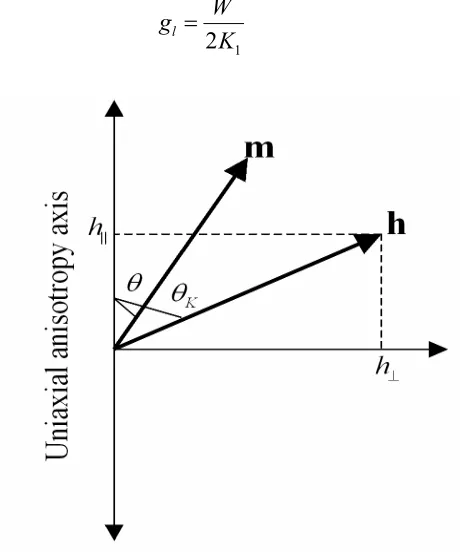
where K1 is the first anisotropy constant, H the external field, θ and θK the angles made
by normalized vectors
S M
= M
m and
K H
= H
h (see Fig. 1.2). It would be convenient to
write (1.9) in dimensionless form, by introducing the dimensionless quantity:
1 2 l W g K
= (1.10)
Figure 1.2. Relation between uniaxial anisotropy axis, magnetization unit vector m, and external field, h.
With this notation (1.9) becomes:
( )
, 1sin2 cos(
)
2
l K
g θ h = θ −h θ θ− (1.11)
Instead of using the variables ( ,hθK) in (1.11) one can use the field components
perpendicular and parallel to the easy axis (h⊥ =hsinθK ; h|| =hcosθK) obtaining:
2
||
1
( , ) sin sin cos
2 l
1.2.2 Astroid curve
Now we would be able to observe the change of the energy function when we
move around in the control plane represented by the plane of coordinates h⊥andh||. By
taking the first and second derivative of the energy function as described in (1.12) and by
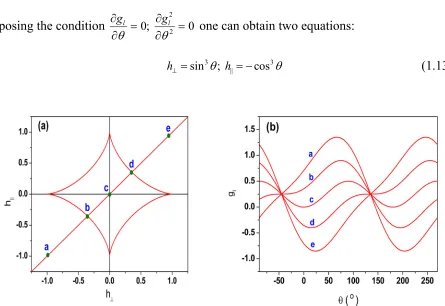
imposing the condition 0; 2 0
2
= ∂ ∂ = ∂ ∂
θ
θl l
g g
one can obtain two equations:
3 3
||
sin ; cos
h⊥ = θ h = − θ (1.13)
Figure 1.3. (a) Control plane of coordinates h and h⊥. The astroid curve defined by (1.13). (b) Examples of the dependence of the system energy gl in (1.12) on θ at different points in control space are shown.
The curve generated by (1.13) when θ varies in the interval
(
0, 2π)
as shown in Fig. 1.3(a) is the critical curve or astroid curve [32]. The figure 1.3(b) shows the energyobtained from (1.12) as a function of θ at different values of the applied field
The astroid curve has remarkable properties. The orientations of m for a given
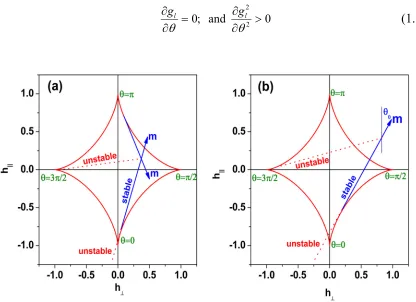
field h can be determined by drawing the tangents to the astroid passing through the
point h of the control plane (see Fig. 1.4). Each tangent may identify either a stable or an
unstable state. The stable orientation provides an energy minimum, and it can be selected
using the two conditions:
0; and 2 0
2
> ∂ ∂ =
∂ ∂
θ
θl l
g g
(1.14)
Figure 1.4. Graphical construction defining the possible m orientations associated with a given applied field: (a) Inside the astroid. (b) Outside the astroid. The straight half-lines marked as “stable” (“unstable”) are sets of local energy minima (maxima) characterized by the same m orientation. θ values show how the angle parameter of (1.13) varies along the astroid.
As a result, we can easily realize that there is only one stable solution when the
point is located outside the astroid, whereas there are two stable tangents that can be
Figure 1.5. (a) Magnetization process under alternating field. Black arrows represent the m orientation in the state occupied by the system, white arrows in the other state available to the system. (b) Hysteresis loops for different values of θK.
1.2.3 Hysteresis
The typical properties of the astroid curve discussed above are the basis for the
analysis of the phenomena taking place when the field is slowly varied over time. The
magnetization process under alternating field, where h oscillates between opposite
values along a fixed direction, is shown in Fig. 1.5(a). The field representative point
moves back and forth in control space along a fixed straight line. The m orientation at
each point is obtained by the tangent construction discussed in the preceding subsection.
Inside the astroid, two orientations are possible, and the one actually realized depends on
the past history. If the field oscillation were all contained inside the astroid, the
magnetization would reversibly oscillate around the orientation initially occupied. If the
field can cross over the astroid boundary, a magnetization reversal (Barkhausen jump)
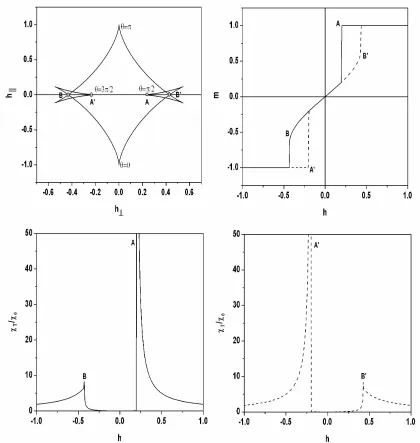
1.2.4 Reversible transverse susceptibility
In the previous section we showed the importance of the astroid, or in general of
the switching critical curve. There are several methods [33, 34] for determining
experimentally the critical curve of magnetic materials and the reversible transverse
susceptibility (RTS) is one of them [35]. In the next chapter we will discuss this method
in some detail and the crucial role of RTS in studying the magnetization process.
Therefore, it is worth mentioning here how to obtain the RTS based on the SW model.
Figure 1.6. The vector diagram corresponding to a uniaxial magnetic particle subjected to a magnetization process in perpendicular fields.
The reversible transverse susceptibility (RTS),χT, is actually a component of the
reversible susceptibility (RS) tensor [36]. In order to define this tensor; one considers a
magnetic field H applied along to z-direction of a ferromagnetic specimen. For a change
ΔH of the field, the RS tensor, χik, is defined as ΔMi =χikΔHk, for ΔHk →0, provided
results that one has two components for RTS measured in two perpendicular directions
with respect to the applied field, and given by:
1
0
, 0
z x T y x H dM H dH χ = ⎛ ⎞ =⎜ ⎟ =
⎝ ⎠ (1.15)
2
0
, 0
y y T x y H dM H dH χ = ⎛ ⎞ =⎜ ⎟ =
⎝ ⎠ (1.16)
We will briefly outline the derivation of theχT expression in the case of a uniaxial
single-domain SW particle with the first anisotropy constant K1, and the saturation
magnetization MS. Based on the spherical coordinate system as shown in Fig. 1.6, the free
energy density of the magnetic system, W W= K +WH, considered in the dimensionless
form of h HM= S / 2K1 is
(
)
21
1
sin cos sin cos sin sin sin sin cos cos
2 (sin sin cos cos cos )
K K M M K K M M K M
H M M H M
W K
hK
θ ϕ θ θ θ ϕ θ θ θ θ
θ θ ϕ θ θ
= − + +
− + (1.17)
The angle θM and ϕM will be determined from two conditions of minimizing the free
energy 0, and 0
M M
W W
θ ϕ
⎛ ∂ = ∂ = ⎞
⎜∂ ∂ ⎟
⎝ ⎠ as follows:
(
)
(
)
2 2
2
sin sin 2 cos ( ) sin 2 cos 2 cos
cos sin 2 2 cos sin sin cos cos 0
K M K M K M K M
K M h H H H M M
θ θ ϕ ϕ θ θ ϕ ϕ
θ θ θ θ θ θ ϕ
− + −
− − − = (1.18)
(
)
(
(
)
)
sin sin sin sin
sin sin cos cos cos sin sin 0
M M K K M
K M K M K M h M M
θ θ θ ϕ ϕ
θ θ ϕ ϕ θ θ θ ϕ
−
⎡ − + ⎤− =
⎣ ⎦ (1.19)
In the limit θH →0, the equation (1.19) can be rewritten as
M K n
where n is an integer. In most cases n=0, but there are some cases in which n=1 give the energy minimum. In the limit θH →0, and using either of the condition n=0 or
1
n= , the equation (1.18) reduces to:
sin 2
(
θM −θK)
+2 sinh θM =0 (1.21)or sin 2
(
θM +θK)
+2 sinh θM =0 (1.22)From the figure 1.6, we have:
Hx =HsinθH, cosHz =H θH, sinMx =Ms θM cosϕM
Hence,
(
)
(
)
0 0
sin cos 3
2 H sin
M M T H d Lim d h θ θ ϕ χ
χ = → θ (1.23)
where 2
0 Ms / 3K1
χ = . By differentiating (1.18) and (1.19) with respect to θH, and using
(1.20) in the case of n=0 one can obtain the final expression for χT as follows
2 2
(
)
2(
)
0
sin cos
3
cos sin
2 cos cos 2 sin
K M
T M
K K
M M K K
h h θ θ χ ϕ θ ϕ χ θ θ θ θ ⎡ − ⎤ = ⎢ + ⎥ + − ⎢ ⎥
⎣ ⎦ (1.24)
This expression of TS of SW particles in (1.24) was first obtained by Aharoni [36]. A
complete analysis of TS curve in the case of quartic crystalline anisotropy will be given
in the next chapter.
1.3 Néel and Brown models
When the system of small single domain particles is concerned, the thermal effect
needs to be taken into account since in this case the thermal energy of the system is
comparable to the magnetic anisotropy energy barrier of single domain particles.
particle is given by E KV= sin2θ where K is the anisotropy constant and θ the angle
between the magnetization vector and the easy axis. Thus, the energy barrier, separating
easy directions is EB =KV , proportional to the volume V . Therefore by decreasing
particle size the anisotropy energy decreases, and for a size lower than a certain value, it
may become comparable to or even lower than the thermal energy kT. This implies that,
the energy barrier for magnetization reversal may be overcome, and then the magnetic
moment of the particle can thermally fluctuate from one easy direction to the other, even
in the absence of the applied field, like a single spin in a paramagnetic material. The
magnetic behavior of an assembly of such small particles is called superparamagnetism
[31]. In the case of dealing with a system of magnetic nanoparticles concerning the
occurrence of superparamagnetism, the SW model failed to describe such a system. The
thermal fluctuation of the magnetic moments of a single-domain particle and its decay
toward thermal equilibrium was then introduced by Néel [37] and further developed by
Brown [38]. The main difference between these two authors is the pre-exponential factor
in their formulas. This pre-factor depends on several parameters such as damping,
temperature and exchange interaction. For simplicity, the pre-factor is assumed to be
constant, and this assumption became well known as the Néel-Brown model. This model
is widely used in magnetism, particular in order to describe the temperature and
time-dependence of the magnetization. However, in this work it will not be discussed in detail
but briefly. The model stated that the timescale for magnetization reversal τ , in a single
particle with uniaxial anisotropy, depends on the anisotropy energy barrier ΔE and the
) / exp(
0 ΔE kT
=τ
τ (1.25)
The pre-exponential factor τ0 as mentioned above depends on various parameters
but typically is in the timescale 10−9s and plays a crucial role in determining the resulting
time frame for superparamagnetic relaxation and hence the blocking behavior observed
by a particular technique.
Figure 1.7. Illustrating the barrier energy and Néel-Brown model.
From (1.25), one can see that for the fine magnetic particles the actual magnetic
behavior depends on the measuring time τm of the specific experimental technique with
respect to the relaxation time τ associated with the overcoming of the energy barriers. If
m
τ >τ , the relaxation appears to be so fast that the magnetic moment can easily overcome
the energy barriers and the assembly of particles behaves like a paramagnetic system
the energy barrier is negligible, the relaxation appears so slow that the assembly of
particles will be in blocked state (ferromagnetic state) (see Fig. 1.7).
The blocking temperature TB, separating the two states, is defined as the
temperature at which measuring time becomes equal to relaxation time, i.e.
τm =τ =τ0exp(ΔE/kT) (1. 26)
Therefore the blocking temperature is not uniquely defined but it related to the time scale
of the experimental technique.
In this work, we only investigate theoretically the magnetization dynamics under
thermal relaxation. Thus, the magnetization dynamics we will mainly focus on is related
with the time necessary for a system to reverse the magnetization. This aspect could not
be achieved in the framework of SW model, but only by using a time dependent equation
of motion of magnetization. This will be the object of the following sections.
1.4 Landau – Lifshitz – Gilbert equation of motion
The behavior of the magnetization of a single domain ferromagnetic particle has
been the subject of many studies. As mentioned in the preceding section, the SW model
can describe the system of single domain particles, provided that the coherent rotation
condition is satisfied, and the magnetic relaxation (superparamagnetism) phenomena and
the interparticle interactions can be neglected. The SW model, however, says nothing
about two other important aspects: how the system will approach equilibrium and how
the magnetization will react to a time-varying applied field. In order to discuss these
magnetization in a homogeneously magnetized body. This equation is useful not only to
describe the equilibrium position but also the dynamics of the moment reaching that
position. Gilbert then modified it in 1955 to overcome the unphysical solution for large
damping parameters [40]. Because the so-called Landau – Lifshitz – Gilbert (LLG) is a
nonlinear differential equation, analytical solutions can be found only in special cases.
1.4.1 The gyromagnetic equation
Let us firstly consider the LLG equation in the absence of the damping term. It is
well known that the magnetic moment of an electron is related to spin momentum by:
M=γS (1.27)
where γ is the gyromagnetic ratio for an electron spin, given by
2 ge mc
γ = − (1.28)
Here, e is the electron charge, m the electron mass, c the velocity of light, and g the
Landé splitting factor. It is worth pointing out that since the charge of an electron is
negative, γ is a positive constant. However, Landau and Lifshitz used a negative γ and
consequently so did many researchers [41].
The equation (1.27) is valid in both classical and quantum mechanics. The torque
exerted on a magnetic moment M by a magnetic field H is
T M H= × (1.29)
Equations (1.27) and (1.29) give an equation of motion for the magnetic moment
d
dt =γ ×
M
M H (1.30)
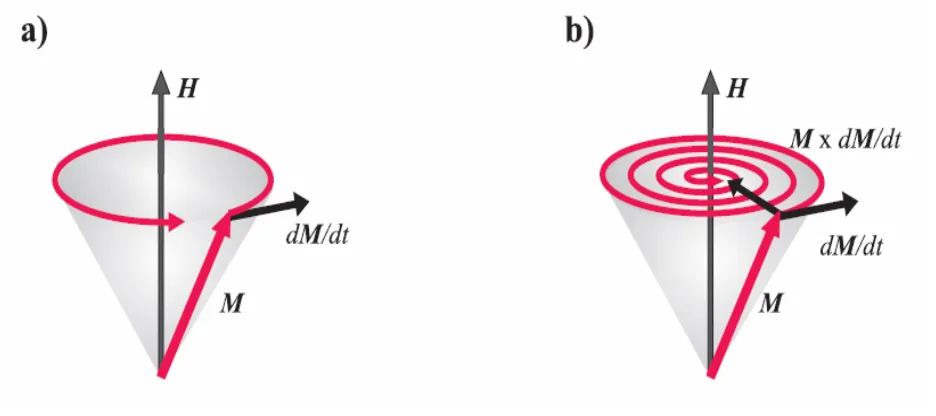
The simple gyromagnetic equation (1.30), simply describes an instantaneous precessional
motion of the magnetization vector, as sketched in Fig. 1.8. This is the most basic
equation describing the dynamic behavior of the magnetization of a single domain
ferromagnetic particle.
Figure 1.8.Precessional motion of magnetization.
The applicability of (1.30) is not limited to the torque exerted by an external magnetic
field. Any torque on a magnetic moment M can be written in the form of (1.30) if we
define an “effective” magnetic field:
( ) E ∂ = −
∂
M H
M (1.31)
where E( )M is the potential energy of the system with respect to the work done by
studies of the properties of ferromagnets have led to identification of five different
domain energy terms
(
H D E K)
E= W +W +W +W +Wσ ∗V (1.32)
where V is the volume and WH is the external field energy density, WD is the
demagnetization energy density, WE is the exchange energy density, WK is the anisotropy
energy density, and Wσ is the magnetoelastic energy density. The corresponding effective
fields are
Total = H + D+ E + K + σ
H H H H H H (1.33)
The first two terms are magnetic fields. The last three are effective fields that have
quantum mechanical origins.
1.4.2 The Landau-Lifshitz equation
The equation (1.30) represents uniform undamped precession of the vector M
about the axis of the field H. The observable behavior, however, of the magnetization of
a single domain ferromagnetic particle, is that of alignment of M with H in time. This
alignment is due to the collisions between precessing electrons which take place within
particle. It is apparent, therefore, that the field does not directly cause alignment; rather it
causes a precession of M about the axis of the field, which along with collision will
produce alignment. With the aim of including this fact in the mathematical analysis,
Landau and Lifshitz introduced a second term into the gyromagnetic equation (1.30), the
tendency of which is to align M with H. In their 1935 paper [39], they proposed an
(M H× )×M H M M= ( . ) ( . )− H M M (1.34)
The Landau-Lifshitz equation in the original form is:
(
)
2 . s M γ ⎡ λ⎛ ⎞⎤ = − ⎢ × + ⎜ − ⎟⎥ ⎢ ⎝ ⎠⎥ ⎣ ⎦H M M
M H M H (1.35)
where λ is a constant of the same dimensions as Ms and limited by the condition that
s M
λ . Using (1.34), the Landau-Lifshitz equation is more commonly written in the
following form: 2
s M
γλ γ
= × − × ×
M M H M H M (1.36)
This equation now represents damped precessional motion, wherein alignment ultimately
takes place between the two vectors, M and H.
1.4.3 Gilbert damping term, Gilbert equation
The Landau-Lifshitz phenomenological damping term could be used when the
damping was small, but encountered problems for large damping. In 1955, Gilbert
proposed an equation describing the dynamic behavior of M which incorporated the
collision damping incurred by the precessional motion, in an effective damping field term
[40]. He assumed that the damping field is
Hdamping = −ηM (1.37)
where η is a damping constant with units such that ηγMs is dimensionless. Including this
damping field in the simple gyromagnetic equation, we have
(
)
γ η
= × −
M M H M (1.38)
Figure 1.9.Magnetization torque without damping and with damping term
It is of interest to compare (1.38) with the Landau-Lifshitz equation (1.36). To do that,
we will bring two equations to the same form and then compare their coefficients. The
equation (1.38) can be rewritten as
s
t M t
α γ ∂ ∂ = × − × ∂ ∂ M M
M H M (1.39)
where α ηγ= Ms, and Ms is the magnitude of vector M.
By substituting the equality 1
2 s
t γλM
γ− ⎡∂ ⎛ ⎞ ⎤
× = ⎢ +⎜ ⎟ × × ⎥
∂ ⎝ ⎠
⎣ ⎦
M
M H M H M into the right-hand
term in (1.36) and simplifying, the equation (1.36) can be rewritten as:
*
s
t M t
α γ
∂ = × − ×∂
∂ ∂
M M
M H M (1.40)
where γ*=γ(1+α2) (1.41)
We observe that the damping terms in (1.39) and (1.40) are identical, the only
α increases in the Landau-Lishitz form, the gyromagnetic ratio γ*and, hence, the rate of
precession of spin also increases. The difference between the two equations is small and
ignorable when α2 1. The connection between these two equations also can be
understood in graphical manner, which was performed by Mallison in 1987 [42].
It is convenient to rewrite the Gilbert equation (1.39) in the form of using the
negative value of γ as mentioned above in (1.28)
s
t M t
α γ
∂ = − × + ×∂
∂ ∂
M M
M H M (1.42)
This equation may be visualized easily upon the surface of a sphere or radius equal to
M . Applying the cross-product right-hand rule, the vector diagram can be shown in Fig.
1.10(a). From the figure 1.10(a), we have
tgβ =α M =α
M (1.43)
hence, 2 1 cos 1 β α =
+ , sin 1 2
α β
α =
+
and
(
)
(
)
2
1 cos
1
t γ β α γ
∂
= × = ×
∂ +
M
M H M H (1.44)
Besides we have: cos .uˆ sin .uˆ
t t β ϕ t β θ
∂ ∂ ∂
= −
∂ ∂ ∂
M M M
(1.45)
Using (1.44), (1.45) becomes
1 2
(
)
2(
)
1 1 s
t M α γ γ α α ∂ = − × − × × ∂ + + M M
Figure 1.10. Graphical representation of the Landau-Liftshitz and Gilbert equations. (a) Vector diagram of Gilbert’s equation (1.42). (b) Vector diagram of Landau-Liftshitz’s equation (1.47).
Now if we put 2 and
1
L L L
γ
γ α α γ
α
= =
+ we can bring the equation (1.46) to the
form of Landau-Liftshitz equation
(
)
L(
)
L
S
t M
α γ
∂
⎡ ⎤
= − × − ⎣ × × ⎦
∂
M
M H M M H (1.47)
with the vector diagram shown in Fig. 1.10(b).
1.4.4 Numerical integration of LLG equation
The first studies of magnetization switching using the LLG equation were
performed by Kikuchi [43]. An analytical solution was found for the magnetization
switching of an isolated, isotropic, single domain sphere. In 1958, anisotropy was
included in this calculation [44]. However, detailed solutions of the LLG equation require
extensive numerical integration and have been feasible only since the mid-1990s due to
We shall now express the LLG equation in spherical polar coordinates
(
r, , ϕ θ)
, reducing Gilbert’s equation to two differential equations, one in each of the angularvariables ϕ and θ, which can be fully solved by computer. Starting from Gilbert
equation (1.42) and using (1.41) or (1.46), the equation (1.42) can be rewritten as the
form of Landau-Lifshitz equation, described as follows:
(
)
2 1 s t M α α γ + ∂ = − × − ⎡ × × ⎤ ⎣ ⎦ ∂ MM H M M H (1.48)
Divided both sides this equation by 2 s
M to give
2
1 1
s s s s s s s
M t M M M M M M
α α γ ⎡ ⎤ ⎛ ⎞ ⎛ ⎞ ⎛ ⎞ + ∂ = − × − ⎢ × × ⎥ ⎜ ⎟ ⎜ ⎟ ⎜ ⎟ ∂ ⎝ ⎠ ⎝ ⎠ ⎢⎣ ⎝ ⎠⎥⎦
M M H M M H (1.49)
By writing 2
1 M ts
γ τ
α
=
+ , = Ms
M
m , and
s M = H
h , we can write the equation (1.49) in
reduced (dimensionless) variables form as follows:
(
)
α τ ∂ ⎡ ⎤ = − × − ⎣ × × ⎦ ∂ mm h m m h (1.50)