A review on applications of greenhouse drying and its
performance
Ravinder Kumar Sahdev
1*, Mahesh Kumar
2, Ashwani Kumar Dhingra
11. Department of Mechanical Engineering, University Institute of Engineering & Technology, Maharshi Dayanand University, Rohtak, 124001, Haryana, India
2. Mahesh Kumar, Department of Mechanical Engineering, Guru Jambheshwar University of Sciences and Technology, Hisar, 125001, Haryana, India
Abstract: Limited sources and rising cost of fossil fuels has instigated researchers to look towards renewable energy resources. Among renewable energy resources, solar energy is required to become indispensable in the future, as it is inexpensive, abundant, inexhaustible, environmental friendly and non-pollutant. Most of the people living in developing countries are dependent on agriculture. Agricultural products are dried to increase the storage life, minimize the packaging requirement and reduce the transportation weight. Solar drying for drying agricultural products is being practiced since long back throughout the world. Because of its drawbacks, advance technique, i.e. greenhouse drying, is being adopted for drying crops to reduce the drying time and increase the quality of the food products. Some new methods have also been attempted to increase the drying efficiency of greenhouse. In this paper, a comprehensive review of greenhouse drying of various commodities is presented. Different parameters such as thermal analysis, drying characteristics of crops, energy and exergy analysis, and greenhouse drying performance were discussed. In addition, the economical aspects of greenhouse dryers were also highlighted. This review paper will be helpful to the new researchers to know about the various technical aspects of the greenhouse dryer.
Keywords: greenhouse drying, agricultural products, convective heat transfer coefficient, energy and exergy analysis, economical aspects, drying performance
Citation: Sahdev, R. K., M. Kumar, and A. K. Dhingra. 2016. A review on applications of greenhouse drying and its performance. Agricultural Engineering International: CIGR Journal, 18 (2):395-412.
1 Introduction
1World population is predicted to be about 7.6 billion
up to 2020. Looking at this growth of population in the
next 25 years, about 50% more food is to be produced.
Therefore, agricultural production must be increased to
guarantee the food demand for the fast growing
population. The population-food imbalance can be
solved by increasing the food production or by limiting
the population. Another most viable solution to this
food problem involves reducing the food losses, which
occur during the food production and post-harvest
Received date: 2015-10-08 Accepted date: 2016-04-10 *Corresponding author: Ravinder Kumar Sahdev, Department of Mechanical Engineering, University Institute of Engineering & Technology, Maharshi Dayanand University, Rohtak, 124001, Haryana, India. Email: [email protected].
(Brown, 1995). The post-harvest losses are considered
to be 30%-40% (El-Sebaii and Shalaby, 2012). Drying
(moisture removal process) of agricultural products is one
of the important post-harvest processes to save the
products from losses. Table 1 presents the
recommended levels of safe moisture content and drying
temperature for long-term storage of agricultural products
(Sharma et al., 1993; Brooker et al., 1993; Tiwari and
Ghosal, 2005; Ahmad and Mirani, 2012; Krzyzanowski
2006; Togrul and Pehlivan 2004; Mujumdar 1987;
El-Sebaii et al. 2002; Purohit et al., 2006 and Oyoh and
Menkiti, 2008), food products (Arun et al., 2014;
Ayyappan and Mayilsamy, 2010) and other commodities
Table 1 Moisture content details of various
commodities
S. No.
Crop Initial
moisture content, % w.b.
Final moisture Content, % w.b.
Maximum allowable temperature, oC
1 Apples 80 24 70
2 Apricot 85 18 65
3 Bananas 80 15 70
4 Brinjal 95 6 60
5 Cabbage, Garlic, Onions
80 4 55
6 Cauliflower 80 6 65
7 Carrots, Green beans
70 5 75
8 Copra 52.2 8 -
9 Coconuts 53.84 7 -
10 Corn 24 14 50
11 Chillies 80 5 65
12 Coffee 65 11 -
13 Fenugreek leaves 89 9 -
14 Fig 70 20 70
15 Ginger 80 8-11 -
16 Groundnuts 40 9 40 – 55
17 Green peas 80 5 65
18 Grapes 80 15 – 20 70
19 Guavas 80 7 65
20 Maize 35 15 60
21 Mulberries, Yam 80 10 65
22 Nutmeg, Sorrel 80 20 65
23 Oil seed 20 – 25 7-9 40 – 60
24 Okra 80 20 65
25 Rice 24 11 30
26 Paddy, raw 22-24 11 50
27 Paddy, parboiled 30-35 13 50
28 Peaches 85 18 65
29 Peanuts 40-55 8-10 -
30 Pineapple 80 10 65
31 Potatoes 75 13 75
32 Prunes 85 15 55
33 Pulses 20-22 9-10 40-60
34 Spinach, Ginger, Turmeric
80 10 -
35 Sweet potatoes 75 7 75
36 Tomatoes 96 7-10 60
37 Wheat 20 16 45
Note: reference sources: Sharma et al. 1993; Brooker et al., 1992; Tiwari and Ghosal, 2005; Ahmed and Mirani, 1012; Krzyzanowski et al., 2006; Togrul and Pehlivan, 2004; Mujumdar, 1987; El-Sebaii et al., 2002; Purohit et al., 2006; Oyoh and Menkiti, 2008; Arun et al., 2014; Ayyappan and Mayilsamy 2010; Panwar et al. 2014; Aritesty and Wulandani, 2014.
Small farmers use the simplest and traditional
method of drying, i.e. open sun drying (OSD) for drying
of agricultural products to the safe moisture level. In the
open sun drying, the product is directly exposed to solar
radiations (Belessiotis and Delyannis, 2011). The solar
radiation falling on the surface of the product is partly
absorbed and partly reflected. The absorbed solar
radiations and surrounding air heat up the surface. A
part of this heat is utilized to evaporate the moisture from
the surface to the surrounding air and part of this heat is
lost through long wave length radiations to the
atmosphere and through to the ground. However,
considerable losses occur due to dust, dirt, insects,
animals, microorganisms, birds. The product is also
discoloured due to ultraviolet radiations. The
post-harvest losses are estimated to be 10%-40%
(El-Sebaii et. al., 2012).
So, the advanced method of drying, i.e. greenhouse
drying is being adopted to overcome the limitations of
traditional (open sun) method. The greenhouse is an
enclosed framed structure having transparent roofs and
walls made up of glass, polyethylene film, etc. (Tiwari,
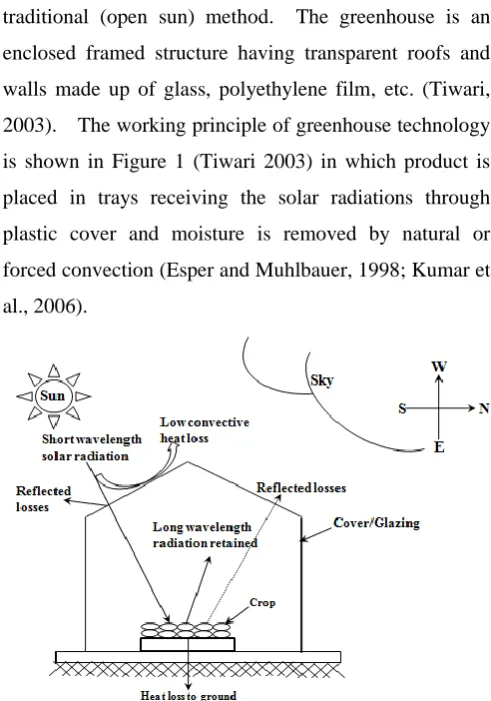
2003). The working principle of greenhouse technology
is shown in Figure 1 (Tiwari 2003) in which product is
placed in trays receiving the solar radiations through
plastic cover and moisture is removed by natural or
forced convection (Esper and Muhlbauer, 1998; Kumar et
al., 2006).
Figure 1 Schematic diagram of greenhouse drying
(Tiwari 2003)
A comprehensive review of developments of
various greenhouse drying systems has been presented by
Prakash and Kumar, (2014a). Prakash and Kumar (2013c)
presented a comprehensive review of various design,
constructional details and operational principles of solar
dryers. Recently a comprehensive review of polyhouse
dryers in terms of design and efficiency has also been
presented by Sangaithra et al. (2014).
In this review paper, work carried out by different
commodities was presented. Various parameters such as
thermal analysis, drying characteristics of products,
energy and exergy analysis, and drying performance
along with economical aspects of greenhouse dryer is also
presented.
2 Research work carried out on various
products
Nowadays, the demand for dried agricultural
products, food grains, vegetables, fruits, herbs, spices and
so on has increased. Traditionally, products are dried in
the open sun and are cheap, but the quality of these
products is deteriorated by ultraviolet rays, dust, insects,
animals, microorganisms, etc. So, the open sun dried
products are not meeting the international standards.
Off-season cultivation of agricultural products in
controlled environment is also increasing. Therefore,
the advanced means of drying, i.e., greenhouse drying are
being adopted to reduce the losses and to increase the
quality of the dried products. Research work carried out
by different researchers on greenhouse drying of various
products has been discussed in the following section.
2.1 Vegetable drying
Tiwari et al. (2004) determined the convective mass
transfer coefficients (CMTC) for jaggery drying under
natural and forced convection greenhouse drying modes
(Figure 2 and Figure 3). The values of CMTC for
jaggery drying were found to vary from 0.55 W/m2
o
C-1.43 W/m2 oC and 0.33 W/m2 oC-1.80 W/m2 oC under
natural and forced modes of greenhouse drying
respectively. Jain and Tiwari (2004) evaluated the
convective heat transfer coefficients for cabbage and peas
drying under open sun, natural and forced convection
greenhouse drying modes. The values of convective
heat transfer coefficients for cabbage and peas under open
sun, natural and forced convection greenhouse modes
were reported to be within the range of 25-10 W/m2 oC,
17-8 W/m2 oC and 38-15 W/m2 oC respectively. Jain and
Tiwari (2004a) studied the thermal behaviour of cabbage
and peas under natural and forced greenhouse modes.
Mathematical models were also developed to predict the
various temperatures and moisture evaporation under
greenhouse drying modes.
Figure 2 Schematic diagram of natural convection
greehouse drying (Tiwari et al., 2004)
Figure 3 Schematic diagram of forced convection
greenhouse drying (Tiwari et al., 2004)
Jain (2005) studied the performance of even span
greenhouse with a north wall and packed bed thermal
storage for drying of onion. Mathematical model was
also proposed to evaluate the performance of crop drying.
Sacilik et al. (2006) presented the thin layer drying
characteristic of organic tomato in a solar tunnel
greenhouse dryer in the climatic conditions of Ankara,
Turkey. Tomatoes were dried from initial moisture
content of 93.35% (w.b.) to final moisture content of
11.50% (w.b.) in 4 d in solar greenhouse tunnel dryer as
compared to 5 d in open sun drying mode. The dried
product was reported to be protected from insects, birds,
rain and dusts.
Kumar and Tiwari (2007) studied the effect of
masses of onion drying under OSD, natural and forced
convection greenhouse drying modes. The values of
convective mass transfer coefficient for onion were found
to vary from 1.19 -2.75 W/m2 oC, 1.28-2.28 W/m2 oC and
1.09-3.08 W/m2 oC under OSD, natural and forced
convection greenhouse drying modes respectively.
Sethi and Arora (2009) improved the conventional
greenhouse by using inclined north wall reflection
(INWR) for faster drying of bitter gourd slices under
natural and forced convection modes. The air
temperature inside improved greenhouse under natural
and forced convection modes were reported to be
increased from 1oC to 6.7oC and 1oC to 4oC respectively.
Jain et al. (2011) evaluated the convective heat and mass
transfer coefficient (CHMTC) for green chilli drying
under open sun and under forced convection greenhouse
drying (FCGHD) mode. Chilli was blanched with
sodium hydroxide and sodium chloride solution. The
values of CHMTC were found to be 4.333 W/m2 oC and
5.520 W/m2 oC for green chilli drying under FCGHD
blanched in sodium hydroxide and sodium chloride
respectively.
Kadam et al. (2011) studied the performance of
low cost greenhouse dryer for the drying of onion.
Onion slices were pre-treated before drying sodium
chloride and potassium metabisulphite. The thermal
efficiency of greenhouse dryer was found to be 20.82%.
Janjai et al. (2011) developed a large scale modified
greenhouse dryer (black concrete floor) having loading
capacity of 1000 kg. Chilli, banana and coffee were
used to dry inside the modified greenhouse dryer from
initial moisture content of 75% (wb) in 3 d, 68% (wb) in
5 d and 52% (wb) in 2 d as compared to 5 d, 7 d and 4 d
in open sun drying conditions respectively. The
payback period of the dryer was estimated to be 2.5 years.
Shahi et al. (2011) developed and studied the
drying of agricultural products (tomato, capsicum,
cabbage, leafy vegetables, carrot and apple) in polyhouse
type solar dryer in the climatic conditions of Kashmir.
The cement concrete floor was painted black for better
absorption of solar radiations and north wall was covered
with black body to reduce heat losses from the northern
side of polyhouse. Payback time of the dryer was
reported to be 1.5 years. Janjai (2012) developed a large
scale greenhouse dryer with LPG burner (during cloudy
and rainy days) and investigated the drying of osmotically
dehydrated tomato inside the dryer. The greenhouse air
temperature was reported to vary from 35oC to 65oC.
The payback period of the dryer was estimated to be 0.65
years.
Bouadila et al. (2014) determined the night time
recovered heat of the solar air heater with latent heat
storage collector in the greenhouse. A new solar air
heater collector (with a compacted layer of spherical
capsules) with the latent heat system was operated and
installed inside a greenhouse. The collector stored
energy during daytime and supplied it during night time
to tomato crop inside the greenhouse. The night time
heat was reported to be 30% attained of the total
requirement of heating. Bouadila et al. (2014a)
investigated the effect of phase change material (PCM)
on greenhouse temperature. Greenhouse temperature
with PCM was found to be 5oC more than the
conventional greenhouse temperature. Bouadila et al.
(2015) also experimentally evaluated the night time
recovered heat of the solar air heater with latent heat
storage collector in the greenhouse. Collector stored the
solar energy during daytime and supplied it to greenhouse
air during night-time for heating. Kooli et al. (2015)
determined the effect of nocturnal shutter and the heat
provided by a solar air heater with latent heat storage
collector inside an insulated greenhouse. Tomato crop
was planted in two identical greenhouses (with and
without nocturnal shutter) for comparison purpose.
Temperature inside the greenhouse with nocturnal shutter
was reported to be 2oC higher than the greenhouse
without nocturnal shutter. The radiation heat loss rate
was reported to be 24% and 61% of the total losses in
insulated greenhouses with and without shutter
It is observed that the vegetables, dried in
greenhouse dryer are better in quality as compared to
open sun drying. The values of convective heat transfer
coefficients for vegetables drying in greenhouse dryer
were found to lie in the range of 1.28 W/m2 oC-17 W/m2
o
C and 1.09 W/m2 oC-38 W/m2 oC under natural and
forced modes respectively. The thermal efficiency of
the greenhouse dryer was reported to be 20.83%. The
maximum payback period of the dryer was estimated to
be 2.5 years.
2.2 Fruits/nuts drying
Bala et al. (2003) studied the performance of the
solar tunnel dryer (150 kg capacity) for drying of
pineapple in the climatic conditions of Mymensingh,
Bangladesh. The dryer was operated by a photovoltaic
system, making it independent of the electricity grid.
Sulfur treated pineapple was dried from initial moisture
content of 87.32% (wb) to final moisture content of
14.13% (wb) in 3 d. Ergunes et al. (2005) studied the
drying of pre-treated plums (with 1% NaOH solution) in
greenhouse and open sun drying modes. Halved-pitted
plums were reported to be dried in 6-12 d and 13-22 d in
greenhouse dryer and open sun respectively. Elicin and
Sacilik (2005) studied the drying kinetics of apples in
solar tunnel dryer from initial moisture content of 82%
(wb) to final moisture content of 11% (wb). Apples
were dried in 28 h in dryer as compared to 32 d in open
sun drying. Fadhel et al. (2005) compared the drying of
Sultanine grapes in open sun, natural convection solar
dryer and solar tunnel greenhouse drying modes. The
solar tunnel greenhouse was reported to be most suitable
for grape drying. A hybrid photovoltaic-thermal (PV/T)
integrated greenhouse dryer (Figure 4) was used to
determine the convective mass transfer coefficient for
grapes drying in forced mode. The value of convective
mass transfer coefficient was reported to vary from 0.26
W/m 2 oC-1.21 W/m 2 oC (Barnwal and Tiwari, 2008).
Rathore et al. (2006) presented the drying of amla in
a solar tunnel dryer from initial moisture content of 80%
to 10% in 2 d. Jairaj et al. (2009) discussed the various
methods adopted for grape drying. Janjai et al. (2009)
studied the performance of a photo voltaic ventilated
solar greenhouse dryer and for drying of peeled logan and
banana. Inside greenhouse temperature was reported to
be increased up to 60oC. The drying time for peeled
logan and banana was found to be 3 d and 4 d
respectively as compared to 5 to 6 d in open sun drying
condition. The quality of the greenhouse drying
products was reported to be high. Rathore and Panwar
(2010) developed and studied the performance of a
walk-in-type hemi cylindrical solar tunnel dryer with heat
protective north wall to dry the seedless grapes (mutant:
Sonaka). Grapes were dried from initial moisture
content of 85% (wb) to final moisture content of 16% (wb)
in about 7 d in dryer where it took about 11 d in open sun
drying. Janjai et al. (2010) investigated the performance
Litchi flesh was dried from initial moisture content of
84% (wb) to final moisture content of 12% (wb) in about
3 d.
Almuhanna (2012) utilized the solar greenhouse as
a solar air heater for drying dates and studied the thermal
performance of the solar greenhouse. The daily average
overall thermal efficiency of the solar greenhouse during
the experiment was reported to be 57.2%. Phusampao et
al. (2014) studied the performance of the greenhouse
dryer for the drying of macadamia nuts. The nuts were
reported to be dried from initial moisture content of 16%
(wb) to final moisture content of 3% (wb) in 5 d.
Payback time for the dryer was estimated to be one year.
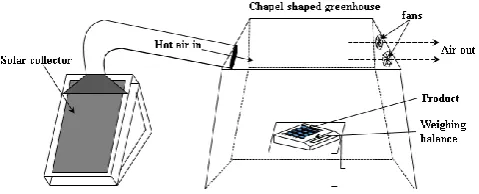
Recently Elkhadraoui et al. (2015) investigated the
performance of a novel mixed mode solar greenhouse
dryer (Figure 5) with forced convection for the drying of
red pepper and sultana grape. A flat plate collector was
integrated with the greenhouse to increase the greenhouse
air temperature. The moisture content of red pepper and
Sultana grapes were reduced to 16% (wb) and 18% (wb)
in 24 h and 50 h respectively.
Figure 5 Schematic diagram of mixed mode greenhouse
drying (Elkhadraoui et al., 2015)
Greenhouse dryers were integrated with solar
collector and PV/T to increase the greenhouse room air
temperature. The drying time was significantly reduced.
The value of convective mass transfer coefficient for the
greenhouse drying of fruits and nuts was found to vary
from 0.26 W/m2 oC-1.21 W/m2 oC. The thermal
efficiency of the greenhouse dryer was found to be 57.2%.
The payback period of the dryer was also judged to be
one year.
2.3 Food products drying
The convective heat transfer coefficients for
various shapes and sizes of jaggery pieces were evaluated
under natural and forced convection greenhouse drying
(Kumar and Tiwari, 2006). The values of the
convective heat transfer coefficients were observed to
vary from 1.31 W/m2 oC-2.75 W/m2 oC and 1.04 W/m2
o
C-3.60 W/m2 oC under natural and forced convection
greenhouse drying mode respectively. A thermal model
was also developed and experimentally validated by
Kumar and Tiwari (2006a) to predict the jaggery
temperature, greenhouse air temperature and moisture
evaporated during jaggery drying under natural
convection greenhouse drying condition.
Ayyappan and Mayilsamy (2010) studied the
drying of copra in natural convection greenhouse drying
mode in the climatic conditions of Pollachi, India.
Copra was dried from initial moisture content of 52.2% to
final moisture content of 8% under full load in 57 h.
The average efficiency of the dryer was reported to be
20%. Quality of copra dried in the dryer was reported to
be better as compared to open sun drying. Sadodin and
Kashani (2011) studied the numerical performance of a
solar greenhouse dryer for drying of copra from 52.2% to
8% moisture content under full load in 55 h. A model
was developed for predicting the performance of the
dryer which was solved using MATLAB software. The
payback period of the dryer was reported to be 2.3 years.
Prakash and Kumar (2012) developed an
adaptive-network-based fuzzy system (ANFIS) model to
predict the jaggery temperature, greenhouse air
temperature and moisture evaporation for drying of
jaggery inside natural convection greenhouse drying
mode. The developed model was validated
experimentally. Prakash and Kumar (2013) also used
artificial neural network (ANN) to predict the jaggery
mass, solar radiations, ambient temperatures and relative
humidity inside natural convection greenhouse drying.
ANN model was validated experimentally. Kumar
(2013) evaluated the convective heat transfer coefficient
mode. Papad was dried to its optimum safe moisture
content of about 14%-15%. The average value of
convective heat transfer coefficient was reported to be
1.23 W/m2 oC. The behaviour of heat and mass transfer
phenomenon during greenhouse papad drying under
forced convection mode was also investigated (Kumar,
2013a). The average values of convective and
evaporative heat transfer coefficient were found to be
0.759 W/m2 oC and 23.48 W/m2 oC respectively.
Kumar (2014) determined the effect of size on the
convective heat and mass transfer coefficients for khoa
for a given mass under natural convection greenhouse
drying mode. The average values of convective heat
and mass transfer coefficients were found to be increased
from 1.59 W/m2 oC-2.53 W/m2 oC and 39.95 W/m2
o
C-60.6 W/m2 oC respectively. Kumar (2014a)
evaluated the effect of size on the convective heat and
mass transfer coefficients of khoa for a given mass with
greenhouse drying under forced convection mode. The
average value of convective heat transfer coefficient was
found to vary from 2.15 W/m2 oC-3.13 W/m2 oC. And
the average value of convective mass transfer coefficient
was found to vary from 63.23 W/m2 oC-93.77 W/m2 oC.
Arun et al. (2014) studied the drying
characteristics of coconuts in a natural convection
greenhouse dryer. Coconuts were dried from initial
moisture content of 53.84% (w.b.) to final moisture
content of 7.4% (w.b.) in 56 h. Greenhouse dried
coconuts were reported to be free from fungal and
bacterial infections. Arun et al. (2014a) designed and
developed a natural convection solar tunnel greenhouse
dryer coupled with biomass backup heater (after 5 PM) to
study the drying characteristics of coconuts. Coconut
fronts, coconut husk and coconut shells were used as fuel
for biomass heater. Coconuts were dried from initial
moisture content of 53.84% (w.b.) to final moisture of
7.003% (w.b.) in 44 h whereas 56 and 148 h were taken
by the dryer without back up heater and open sun drying
mode respectively. Coconuts dried in dryer were
reported to be free from dust, dirt, damage by birds and
infections by bacteria and fungus. Arun et al. (2014b)
compared the existing dryer (Arun et al., 2014b) coupled
with biomass back up heater (after 5 PM) and without
backup heater for drying of coconut and optimized the
existing dryer. Coconuts were dried from initial
moisture content of 53.84% (w.b.) to final moisture of
7.003% (w.b.) in 44 h by dryer with biomass backup
heater whereas 56 h were taken by dryer without biomass
backup heater.
Recently Ayyappan et al. (2015) studied the effect
of various sensible heat storage materials (concrete, sand
and rock-bed) on drying characteristics of coconuts and
thermal performance of natural convection solar
greenhouse for copra drying. Coconuts were dried from
initial moisture content of 52 % (wb) to final moisture
content of 7% (wb) in 53, 66 and 78 h using rock-bed,
sand and concrete respectively as compared to 174 h in
open sun drying mode. The drying efficiency was also
reported to be 9.5%, 11% and 11.65% using concrete,
sand and rock-bed respectively.
It is concluded from the literature that new
methods such as heat storage materials and biomass
backup heaters were used for increasing the greenhouse
room temperature. Food products dried in greenhouse
dryers were observed to be of superior quality as
compared to traditional (open sun) method of drying.
Different softwares (ANFIS, ANN and MATLAB) have
been used for the prediction of various greenhouse
temperatures and moisture evaporated. The values of
CHTC for drying of food products in greenhouse dryers
were found to vary from 1.23 W/m2 oC-2.75 W/m2 oC and
0.759 W/m2 oC-3.60 W/m2 oC under natural and forced
modes respectively. The average efficiency of the dryer
was found to be 20%. The payback period of the dryer
was estimated to be 2.3 years.
2.4 Medicinal/spices/herbs/flower plants drying
Manohar and Chandra (2000) studied the drying of
rewetted mustard in a natural and forced solar greenhouse
type solar dryer. Drying of mustard in natural and
compared to open sun drying mode respectively.
Condori et al. (2001) developed a new low cost forced
convection greenhouse tunnel dryer for drying red sweet
pepper and garlic. The dryer was divided into two
chambers, one having partially dried product and another
containing fresh product. Two fans were used to
circulate the air from first to second chamber. Condori
and Saravia (2003) studied the performance of a tunnel
greenhouse drier (with single and double chambers) for
drying of sweet pepper. Improvement of 160% and 40%
was reported in production, compared with the single
chamber drying and double drying respectively.
Farhat et al. (2004) carried out the solar drying of
pepper in a naturally ventilated tunnel polyethylene
greenhouse dryer. Weight reduction of about 83% was
reported at the end of the experiment. Improvement in
the final product was checked visually and reported to be
of good quality. Koyuncu (2006) designed and tested
two natural circulation greenhouse dryers for drying of
pepper and under no load conditions. The solar absorber
surface was painted black to increase the dryer
temperature. The dryer was investigated with and
without chimney also. The dryer was reported to be two
to five times more efficient than the open air dryer.
Janjai et al. (2008) presented the performance of
roof integrated solar dryer for drying of rosella flower
and chilli and developed a model for drying of chilli.
Aritesty and Wulandani (2014) studied the performance
of rack type solar greenhouse dryer for drying wild ginger
slices. Wild ginger slices were dried from initial
moisture content of 80% (wb) to final moisture content of
8%-11% (wb) in 30 h. Fadhel et al. (2014) presented
the drying of red pepper (Baklouti) in open sun, under
greenhouse and in a solar dryer. Drying time (including
nights) for red pepper were reported to be 73 h, 79 h and
118 h in the solar dryer, greenhouse and open sun
respectively. Among various thin layer drying models
logarithmic model was reported to be most suitable for
describing the drying behaviour of red pepper. Nayak et
al. (2011) studied the drying of mint in a hybrid
photovoltaic-thermal (PVT) forced mode greenhouse
dryer. Mint was dried from initial moisture content of
80% (wb) to final moisture content of 11% (wb). The
drying efficiency of the hybrid PVT greenhouse dryer
was found to be 34.2%.
Panwar et al. (2014) presented the thermal
modelling and experimental validation of a walk-in type
solar tunnel greenhouse dryer for the drying of fenugreek
leaves. Fenugreek leaves were reported to be dried from
initial moisture content of 89% (wb) to final moisture
content of 9% (wb) in 17 h. The energetic and exergetic
performance of fenugreek leaves were also carried out
(Panwar 2014). Energy and exergy efficiencies were
reported to vary 0.841% to 1.613% and 0.018% to
0.102% respectively. Recently Aghbashlo et al. (2015)
developed a new TRNSYS model for simulation of the
solar drying process of chamomile flower in a deep bed
by integrating an equilibrium drying model and thin-layer
drying principles. Elkhadraoui et al. (2015) investigated
the performance of a novel mixed mode greenhouse dryer
for drying of red pepper. A flat plate solar collector was
used to preheat the air entering the greenhouse. The
payback period of the dryer was found to be 1.17 years.
The life of the dryer was estimated to be 20 years.
It was observed that the drying efficiency of the
hybrid dryer was evaluated, as 34.2%. Energy and
exergy efficiencies were found to be 1.613% and 0.102%
respectively. The payback period of the dryer was
found to be 1.15 years.
2.5 Fish/pork drying
Sarkar and Tiwari (2005) developed a thermal model
for greenhouse fish pond system. Tiwari et al. (2006)
determined the convective heat and mass transfer
coefficient (CHMTC) for prawn drying under natural
convection greenhouse drying mode. The value of
CHMTC for greenhouse prawn drying was found to vary
from 1.23 W/m 2 oC-9.2 W/m 2 oC. Das and Tiwari
(2008) evaluated the CHMTC for fish drying under
forced convection greenhouse drying mode. The value
drying under forced convection greenhouse drying mode
was reported to vary from 1.5 W/m 2 oC-21 W/m 2 oC.
Tiwari et al. (2009) studied the energy and exergy
analysis of greenhouse fish drying. Energy analysis was
used to predict fish surface temperature, greenhouse room
air temperature and moisture evaporated for the drying of
fish under natural and forced convection greenhouse
drying modes. Boonyasri et al. (2011) experimentally
investigated the performance of pork drying in semi
cylindrical roof solar greenhouse dryer. Pork was dried
from initial moisture content of 210% (db) to final
moisture content of 70% (db) in 260 min as compared to
320 min in open sun drying condition. The payback
period of the dryer was estimated to be 1.15 years.
It is seen that the values of CHMTC for the drying
of fish were found to vary from 1.23 W/m2 oC-9.2 W/m2
o
C and 1.5 W/m 2 oC-21 W/m2 oC under natural and
forced convection greenhouse drying modes respectively.
Thermal model for greenhouse fish drying was also
developed. The payback period was estimated to be
1.15 years.
2.6 No load analysis
In order to utilize the drying capacity of the
greenhouse dryer, it has been experimented under no-load
conditions. Lokeswaran and Eswaramoorthy (2013)
presented the experimental and numerical analysis of a
natural convection greenhouse dryer under no-load
condition. A model was developed in pre-processor
GAMBIT and analyzed using the Fluent 6.3.26 software.
The experimental results were validated using
computational fluid dynamics software Fluent 6.3.26.
Kumar et al. (2013) studied the performance of active and
passive greenhouse dryer under no-load conditions.
Maximum temperature in natural and forced convection
modes was reported to be 40.6oC and 41.6oC respectively.
Prakash and Kumar (2013a) developed and tested
modified solar active (forced) greenhouse dryer with
opaque northern wall under no-load condition. The
greenhouse was tested under two conditions, firstly
covering inside floor with a black sheet and secondly
without covering the inside floor. Prakash and Kumar
(2013b) presented the ANFIS modeling of the modified
active greenhouse dryer under no-load condition. The
north wall of the greenhouse was made opaque using a
mirror. Prakash and Kumar (2013c) presented the
thermal analysis of a new developed modified active
greenhouse dyer under no-load conditions. Black
polyvinyl chloride (PVC) sheet on the concrete floor and
a reflecting mirror on the north wall were used to
minimize the heat losses.
Prakash and Kumar (2014) designed and
developed a modified natural convection greenhouse
dryer and conducted experiments under no-load
conditions. The north wall of the greenhouse was made
opaque by a mirror and floor was covered with black
PVC sheet. Joudi et al. (2014) attempted to heat the
single slope greenhouse air using solar air heater (SAH)
system under no load condition at Baghdad, Iraq. SAH
covering 45% of the greenhouse roof area was observed
to provide the daily heating load of the greenhouse.
Recently Prakash and Kumar (2015) studied the thermal
performance of passive greenhouse dryer with different
floor conditions (barren floor, floor covered with black
PVC sheet and black painted floor) under no-load
condition. The dryer with black PVC floor was reported
to be more effective. The embodied energy of the dryer
was also determined and its value was reported to be
480.2776 kWh.
It is observed that the greenhouse dryers have been
modified (by covering the greenhouse floor with black
PVC sheet, reflecting mirror on the north wall and by
using solar air heater) to increase the greenhouse air
temperature which shortened the drying time of the
products. Different softwares have also been applied for
validation of the results. Energy analysis in terms of
embodied energy was also calculated and found to be
480.2776 kWh.
3 Theoretical considerations used for the
3.1 Heat and mass transfer analysis for greenhouse
drying system
Heat and mass transfer analysis for greenhouse
drying have been carried out by many authors in natural
and forced convection modes. The convective heat
transfer coefficient (hc) is evaluated by Equation 1 and
Equation 2 Tiwari et al. (2004); Kumar et al. (2011);
Tiwari (2003)
n
v
c
C
Gr
K
X
h
Nu
(
Pr)
For natural convection(1)
n
v c
C
K
X
h
Nu
(Re
Pr)
For forced convection(2)
The rate of heat utilized to evaporate moisture is
given as Equation 3 (Malik et al., 1982; Kumar and
Tiwari, 2006)
(
)
(
)
016
.
0
c p ee
h
P
T
P
T
Q
(3)The evaporative heat transfer coefficient
h
ecan be evaluated by using the following Equation 4
(Kumar et al., 2012):
e p
e p
c e
T
T
T
P
T
P
h
h
0
.
016
(
)
(
)
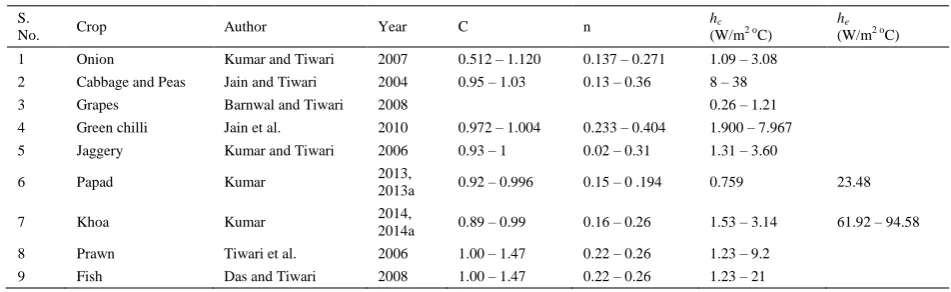
(4)Different researchers have determined the values
of hc and he for the drying of various commodities under
natural and forced modes of greenhouse drying. A brief
analysis of work carried out on different commodities is
summarized in Table 2.
From Table 2, it is concluded that the values of
experimental constants C and n generally lies in the range
of 0.512-1.47 and 0.02-0.271 for the greenhouse drying
of different commodities respectively. And the value of
the convective heat transfer coefficient varies from 0.759
W/m2 oC-38 W/m2 oC. The values of evaporative heat
transfer coefficient lies between 23.48 to 100 W/m2 oC for
different food commodities.
3.2 Drying models for solar greenhouse system
Mathematical modeling of the dehydration process
is very useful in designing and optimization of the
greenhouse dryers (Berlin and Blazquez, 1986; Brook and
Bakker-Arkema, 1978; Vagenas and Marinos-Kouris,
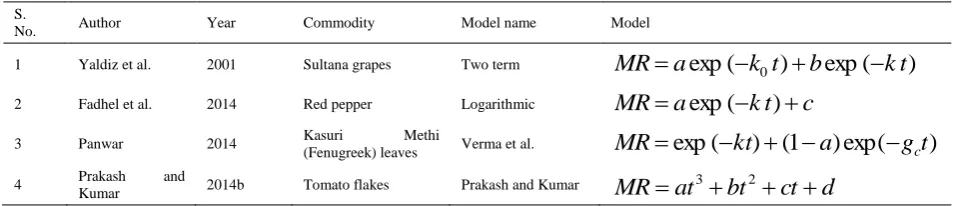
1991). To evaluate the performance of the product dried
in greenhouse, many authors have proposed mathematical
models (Yaldiz et al. 2001; Fadhel et al., 2014; Panwar,
2014; Prakash and Kumar, 2014b) which are summarized
in Table 3.
Table 2 Values of C and n for drying of various commodities in greenhouse drying modes
S.
No. Crop Author Year C n
hc
(W/m2 oC)
he
(W/m2 oC) 1 Onion Kumar and Tiwari 2007 0.512 – 1.120 0.137 – 0.271 1.09 – 3.08
2 Cabbage and Peas Jain and Tiwari 2004 0.95 – 1.03 0.13 – 0.36 8 – 38
3 Grapes Barnwal and Tiwari 2008 0.26 – 1.21
4 Green chilli Jain et al. 2010 0.972 – 1.004 0.233 – 0.404 1.900 – 7.967 5 Jaggery Kumar and Tiwari 2006 0.93 – 1 0.02 – 0.31 1.31 – 3.60
6 Papad Kumar 2013,
2013a 0.92 – 0.996 0.15 – 0 .194 0.759 23.48
7 Khoa Kumar 2014,
2014a 0.89 – 0.99 0.16 – 0.26 1.53 – 3.14 61.92 – 94.58
8 Prawn Tiwari et al. 2006 1.00 – 1.47 0.22 – 0.26 1.23 – 9.2
The moisture ratio (dry basis) of the product is
evaluated as Equation 5 (Elkhadraoui et al., 2015; and
Panwar, 2014) e i e t
M
M
M
M
MR
(5)3.3 Energy and exergy analysis of greenhouse
drying
It is always worthy to remove maximum moisture
from the products up to its safe level with the use of
minimum amount of energy. Nayak and Tiwari (2008)
carried out the energy and exergy analysis for the
performance of photovoltaic/thermal (PV/T) integrated
greenhouse in the climatic conditions of Delhi, India.
The exergy efficiency of PV/T integrated greenhouse was
found to be 4%. Ozgener and Ozgener (2009)
investigated the drying performance of a passively heated
solar greenhouse. Exergy efficiencies were derived as a
function of drying time and temperature of the drying air.
The average exergy efficiency of drying process was
reported to be 63%-73%. The solar heated greenhouse
was proposed for pre-drying during low solar energy
gain.
3.3.1 Energy analysis
Energy efficiency can be determined by Equation 6
Panwar (2014):
100
in out EnergyE
E
(6)where
Energy input can be evaluated by Equation 7 Panwar
(2014):
I
A
E
in (W) (7)Energy output can be calculated by Equation 8 Panwar et
al. (2013):
g amb
a a
out
M
C
T
T
E
(W) (8)3.3.2 Exergy analysis
The exergy input to the greenhouse dryer is the solar
radiation exergy, i.e. radiation to work conversion (Patela,
2003; Tiwari and Mishra, 2012). Exergy efficiency is
given by Tiwari and Mishra (2012). (See Equation 9,
Equation 10 and Equation 11 please).
100
in out solarEx
Ex
(9)where
4 sun amb sun amb inT
T
3
1
T
T
3
4
1
A
I
Ex
(10)and exergy output is given by
273
T
273
T
n
l
73
2
T
T
T
C
M
Ex
ref go amb ref go a ao out (11)A brief analysis of energy and exergy analysis of
greenhouse drying of different commodities is given in
the Table 4.
Table 3 Model implemented and suggested
S.
No. Author Year Commodity Model name Model
1 Yaldiz et al. 2001 Sultana grapes Two term
MR
a
exp
(
k
0t
)
b
exp
(
k
t
)
2 Fadhel et al. 2014 Red pepper Logarithmic
MR
a
exp
(
k
t
)
c
3 Panwar 2014 Kasuri Methi
(Fenugreek) leaves Verma et al.
MR
exp
(
kt
)
(
1
a
)
exp(
g
ct
)
4 Prakash and
Kumar 2014b Tomato flakes Prakash and Kumar
MR
at
bt
ct
d
3.4 Greenhouse dryer performance
Greenhouse dryer performance can be evaluated in
terms of efficiency factor. The drying efficiency of the
greenhouse dryer is evaluated as the ratio of energy used
to evaporate the moisture from the product to the energy
supplied to the greenhouse dryer through solar radiations.
It can be calculated as Equation 12 (Ayyappan et al.,
2015; Nayak et al., 2011; Boonyasri et al., 2011).
100
A
I
m
ev
(12)A brief analysis of greenhouse performance evaluated by
the authors is summarized in Table 5.
4 Economical aspects of greenhouse technology
To know the importance and utilization of
greenhouse dryers, it becomes very important to study its
economic aspects. The temperature inside the
greenhouse can be maintained to the optimum level for a
given crop or product for higher yield. Greenhouse
(controlled environment) drying is more beneficial and
profitable as compared to traditional open sun drying
because of better quality product and reduced drying time.
The life cost of a dryer depends on various factors such as
(Tiwari, 2003):
a) Initial investment and operating cost of greenhouse
b) Maintenance and annual cost of the product dried
in the greenhouse.
c) Life of greenhouse and its salvage value
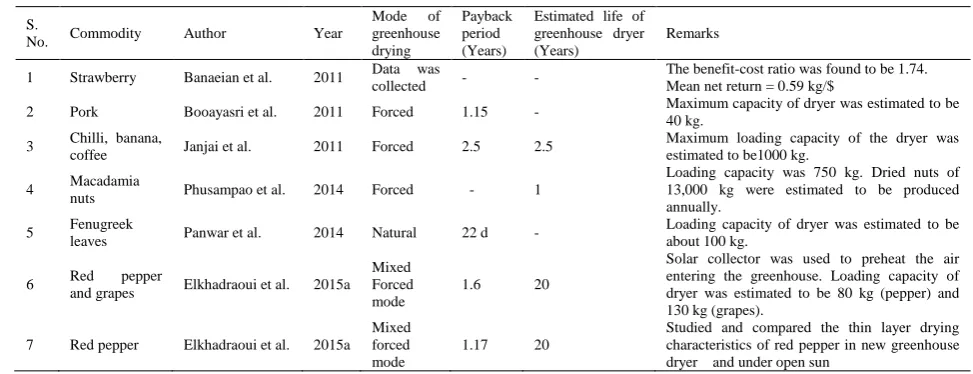
The economic evaluation of greenhouse dryers for
drying of various commodities performed by different
authors is summarized in Table 6.
Table 4 Energy and exergy efficiencies for greenhouse drying of various commodities
S. No. Commodity Author Year Energy efficiency, % Exergy efficiency, %
1 Kasuri methi (fenugreek) leaves Panwar 2014 2.72-28.01 69.43-90.76
2 Jackfruit leather Chowdhury et al. 2011 48.21 41.42
3 No-load Nayak and Tiwari 2008 - 4
Table 5 Summary of greenhouse efficiency of drying of various commodities
S. No. Product Author Year Dryer efficiency, %
1 Pork Boonyasri et al. 2011 55.7
2 Mint Nayak et al. 2011 34.2
3 Coconut Ayyappan et al. 2015 11.65
4 Jackfruit leather Chowdhury et al. 2011 48.21-65.30
Table 6 Economical analysis of greenhouse drying of commodities
S.
No. Commodity Author Year
Mode of greenhouse drying
Payback period (Years)
Estimated life of greenhouse dryer (Years)
Remarks
1 Strawberry Banaeian et al. 2011 Data was
collected - -
The benefit-cost ratio was found to be 1.74. Mean net return = 0.59 kg/$
2 Pork Booayasri et al. 2011 Forced 1.15 - Maximum capacity of dryer was estimated to be 40 kg.
3 Chilli, banana,
coffee Janjai et al. 2011 Forced 2.5 2.5
Maximum loading capacity of the dryer was estimated to be1000 kg.
4 Macadamia
nuts Phusampao et al. 2014 Forced - 1
Loading capacity was 750 kg. Dried nuts of 13,000 kg were estimated to be produced annually.
5 Fenugreek
leaves Panwar et al. 2014 Natural 22 d -
Loading capacity of dryer was estimated to be about 100 kg.
6 Red pepper
and grapes Elkhadraoui et al. 2015a Mixed Forced mode
1.6 20
Solar collector was used to preheat the air entering the greenhouse. Loading capacity of dryer was estimated to be 80 kg (pepper) and 130 kg (grapes).
7 Red pepper Elkhadraoui et al. 2015a Mixed forced mode
1.17 20
4 Conclusions
About 80% of the world population live in
developing countries and are dependent on agriculture.
Agricultural products, just after harvesting, are dried to
the safe moisture level. Solar energy is the most
promising power source of energy for drying of
agricultural products. Most of the farmers adopt open
sun drying because it is abundant, inexpensive and
non-pollutant. But the open sun dried products are also
subjected to remarkable losses due to environment (dust,
rain, ultra-violet rays, birds, animals etc.). But losses of
fruits and vegetables are estimated to be 30%-40% during
drying under open sunlight. The post-harvest losses can
be reduced by adopting advanced means of drying, i.e.
greenhouse drying. The greenhouse dryer can be
operated in natural and forced mode as required.
Studies reveal that the greenhouse dried products are of
superior quality and colour as compared to open sun
drying. Many authors have studied and presented
various parameters of greenhouse. In this manuscript,
an attempt was made to discuss state-of-the-art for each
aspect. The following conclusions are drawn from this
technical review.
1. The maximum values of CHTC were observed to
be 17 W/m2 oC and 38 W/m2 oC under natural and forced
greenhouse drying modes respectively.
2. Maximum greenhouse drying efficiency was
observed to be 65.30%.
3. The maximum values of energy and exergy
efficiencies were found to be 48.21% and 90.76%
respectively.
4. Minimum and maximum payback period was
found to be 22 d and 2.5 years respectively.
5. The benefit-cost ratio was calculated as 1.74 and
net return was estimated to be 0.59 kg per dollar.
6. Various drying models have been suggested and
implemented to study the drying behaviour of the
products. These models would be helpful in designing
and optimization of the greenhouse dryers.
7. Hybrid greenhouse dryers (with PV/T) were also
used and its efficiency was found to be 34.2% and can be
attempted in remote areas where there is scarcity of
electricity.
8. Greenhouse is integrated with solar collector and
its payback period was observed to be 1.17 years.
9. Modified greenhouses are also being adopted to
increase the performance.
10. Very little work on usages of heat storage and
phase change materials is carried out, and the future
studies can be carried out.
11. Therefore, future researchers should be targeted
on hybrid sustainable greenhouse dryer which can be
introduced in rural regions to reduce the spoilage and
improve the quality of the dried products so that the
farmers get the significant agricultural return on their
efforts.
References
Aghbashlo, M., J. Muller, H. Mobli, A. Madadlou, and S. Rafiee. 2015. Modeling and simulation of deep bed solar greenhouse drying of Chamomile flower. Drying Technology, 33(6): 684-695.
Ahmad, M., and A. A. Mirani. 2012. Heated air drying of Groundnut. Pakistan Journal of Agriculture Research, 25(4): 272-279.
Almuhanna, E. A. 2012. Utilization of a solar greenhouse as a solar dryer for drying dates under the climatic conditions of the Eastern Province of Saudi Arabia Part I: Thermal Performance Analysis of a solar dryer.
Journal of Agricultural Science, 4(3): 237-246. Aritesty, E., and D. Wulandani. 2014. Performance of the rack
type-Greenhouse effect solar dryer for wild ginger (Curcuma Xanthorizza Roxb.) drying. Energy Procedia, 47: 94-100.
Arun, S., K. Velmurugan, and S. S. Balaji. 2014. Experimental studies on drying characteristics of coconuts in a solar tunnel greenhouse dryer. International Journal of Innovative Technology and Exploring Engineering, 4(5): 51-11.
Arun, S., K. Velmurugan, and K. V. Kumar. 2014b. Optimization and comparison studies of solar tunnel greenhouse dryer coupled with and without biomass backup heater.
International Journal of Innovative Science and Modern Engineering, 2(11): 41-47.
Ayyappan, S., and K. Mayilsamy. 2010. Experimental investigation on a solar tunnel drier for copra drying.
Journal of Scientific and Research, 69(8): 635-638. Ayyappan, S., K. Mayilswamy, and V. V. Sreenarayanan. 2015.
Performance improvement studies in a solar greenhouse drier using sensible heat storage materials. Heat Mass Transfer, 1-9.
Banaeian, N., M. Omid, and H. Ahmedi H. 2011. Energy and economic analysis of greenhouse strawberry production province of Iran. Energy Conversion and Management, 52(2): 1020-1025.
Barnwal, P., and G. N. Tiwari. 2008. Grape drying by using hybrid photovoltaic-thermal (PV/T) greenhouse dryer: an experimental study. Solar Energy, 82(12): 1131-1144.
Bala, B. K., M. R. A. Mondol, B. K. Biswas, B. L. D. Chawdury, and S. Janjai. 2003. Solar drying of pineapple using solar tunnel drier. Renewable Energy, 28(2): 183-190.
Belessiotis, V., and E. Delyannis. 2011. Solar drying.
Solar Energy, 85(8) 1665-1691.
Bertin, R., and M. Blazquez. 1986. Modelling and optimization of a dryer. Drying Technology, 4(1): 45-66.
Brooker, D. B., F. W. Bakker-Arkema, and C. W. Hall. Drying and storage of grain and oilseeds. New York: Van Nostrand Reinhold; 1992.
Boonyasri, M., C. Lertsatitthanakorn, L. Wiset, and N. Poomsa-ad. 2011. Performance analysis and economic evaluation of a greenhouse dryer for pork drying. KKU Engineering Journal, 38(4): 433-443.
Bouadila, S., S. Kooli, S. Skouri, M. Lazaar, and A. Farhat. 2014. Improvement of the greenhouse climate using a solar air heater with latent storage energy. Energy, 64: 663-672.
Bouadila, S., S. Skouri, A. Lazaar, and A. Farhat. 2014a. Solar energy storage application in Tunisian greenhouse by means of phase change materials. International conference on Composite Materials & renewable energy application, Sousse, Tunisia, 01/2014. Bouadila, S., S. Skouri, S. Kooli, and A. Lazaar. 2015.
Experimental study of two insulated solar greenhouses one of them use a solar air heater with latent heat. Renewable Energy Congress (IREC), 2015 6th International, pp.1-4, 24-26 March 2015.
Brown, L. Who will feed China? The World watch Environment Alert Series, New York-London. 1995.
Chowdhury, M. M. I., B. K. Bala, and M. A. Haque. 2011. Energy and exergy analysis of solar drying of jackfruit leather. Biosystems Engineering, 110(2): 222-229. Condori, M., R. Echazu, and L. Saravia. 2001. Solar drying of
sweet pepper and garlic using the tunnel greenhouse drier. Renewable Energy, 22(4): 447-460.
Condori, M., and L. Saravia. 2003. Analytical model for the performance of the tunnel-type greenhouse drier.
Renewable Energy, 28(3): 467-485.
Das T., and G. N. Tiwari. 2008. Heat and mass transfer of greenhouse fish drying under forced convection mode.
International Journal of Agricultural Research, 3(1): 69-76.
Diamante, L. M., and P. A. Munro. 1993. Mathematical modelling of thin layer solar drying of sweet potato slices. Solar Energy, 51(4):271–276.
Elicin, A. K., and K. Sacilik. 2005. An experimental study for solar tunnel drying of Apple” Tarim Bilimleri Dergisi, 11(2): 207-211.
Esper, A., and W. Muhlbauer. 1998. Solar drying-an effective means of food preservation. Renewable Energy, 15(1-4): 95-100.
El-Sebaii, A. A., S. Aboul-Enein, M. R. I. Ramadan, and H. G. El-Gohary. 2002. Experimental investigation of an indirect type natural convection solar dryer. Energy Conversion & Management, 43(16):2251-2266. El-Sebaii, A. A., , and S. M. Shalaby. 2012. Solar drying of
agricultural products: a review. Renewable and Sustainable Energy Reviews, 16(1): 37-43.
Elkhadraoui, A., S. Kooli, I. Hamdiand, and A. Farhat. 2015. Experimental investigation and economic evaluation of a new mixed-mode solar greenhouse dryer for drying of red pepper and grape. Renewable Energy, 77: 1-8. Elkhadraoui, A., S. Kooli, and A. Farhat. 2015a. Study on
effectiveness of mixed mode solar greenhouse dryer for drying of red pepper. International Journal of Scientific Research and Technology, 3(2): 143-146. Ergunes, G., S. Tarhan, M. Gunes, and Y. Ozkan. 2005.
Greenhouse and open sun drying of European Plums (Prunes domestica L.). Journal of Applied Science, 5: 910-915.
Fadhel, A., S. Kooli, A. Farhat, and A. Bellghith. 2005. Study of the solar drying grapes by three different processes.
Desalination, 185(1): 535-541.
International Journal of Renewable Energy and Biofuels, 2014: 1-14.
Farhat, A., S. Kooli, C. Kerkeni, M. Maalej, A. Fadhel, and A. Belghith. 2004. Validation of a pepper drying model in a polyethylene tunnel greenhouse.
International Journal of Thermal Sciences, 43(1): 53-58.
Henderson, S. M., and S. Pabis. 1961. Grain Drying Theory. II. Temperature Effects on Drying Coefficients. Journal of Agricultural Engineering Research, 6(3): 169-174. Henderson, S. M. 1974. Progress in developing the thin layer
drying equation [for maize]. Transactions of the America Society Agricultural Engineering (USA). Jain, D., and G. N. Tiwari. 2004. Effect of greenhouse on crop
under natural and forced convection I: Evaluation of convective mass transfer coefficient. Energy Conversion and Management, 45(5): 765-783.
Jain, D., and G. N. Tiwari. 2004a. Effect of greenhouse on crop under natural and forced convection II: Thermal modelling and experimental validation. Energy Conversion and Management, 45(17): 2777-2793. Jain, D. 2005. Modelling the performance of greenhouse with
packed bed thermal storage on crop drying application.
Journal of Food Engineering, 71(2): 170-178.
Jain, D., D. Mridula, P. Barnwal, and R. Kumar. 2010. Kinetics of convective heat and mass transfer coefficient of green chilli during open-sun and greenhouse drying.
Desalination and Water Treatment, 24(1-3): 38-46. Jairaj, K. S., S. P. Singh, and K. Srikant. 2009. A review of
solar dryers developed for grape drying. Solar Energy, 83(9): 1698-1712.
Janjai, S., V. Khamvongsa, and B. K. Bala. 2007. Development, design and performance of a PV-ventilated greenhouse dryer. International Energy Journal, 8(4): 249 – 258. Janjai, S., N. Srisittipokakun, and B. K. Bala. 2008.
Experimental and modelling performance of a roof-integrated solar drying system for drying herbs and spices. Energy, 33(1): 91-103.
Janjai, S., N. Lamlert, P. Intawee, Mahayothee, B. K. Bala, M. Nagle, and J. Muller. 2009. Experimental and simulate performance of a PV-ventilated solar greenhouse dryer for drying of peeled logan and banana.
Solar Energy, 83(9): 1550-1565.
Janjai, S., P. Sruamsiri, P. Intawee, C. Thumrongmas, N. Lamlert, Y. Boonrod, B. Mahayothee, M. Precoppe, M. Nagle, and J. Muller. 2010. Experimental and simulated performance of greenhouse dryer for drying of litchi flesh. International symposium ‘Sustainable Land Use and Rural Development in Mountainous Regions of Southern Asia’ Hanoi, 21-23 July, 2010.
Janjai, S., P. Intawee, J. Kaewkiew, C. Sritus, and V. Khamvongsa. 2011. A large-scale solar greenhouse dryer using polycarbonate cover: modeling and testing in a tropical environment of Lao People’s Democratic Republic.
Renewable Energy, 36(3): 1053-1062.
Janjai, S. 2012. A greenhouse type dryer for small-scale dried food industries: development and dissemination.
International Journal of Energy and Environment, 3(3): 383-398.
Joudi, K. A., and A. A. Farhan. 2014. Greenhouse heating by solar air heaters on the roof. Renewable Energy, 72: 406-414.
Kadam, D. M., D. Nangare, R. Singh, and S. Kumar. 2011. Low-cost greenhouse technology for drying onion (Allium Cepa L.) Slices. Journal of Food Process Engineering, 34(1), 67-82.
Karathanos, V. T. 1999. Determination of water content of dried fruits by drying kinetics. Journal of Food Engineering, 39(4): 337-344.
Kooli S., Bouadila S. Lazaar M. and A. Farhat. 2015. The effect of nocturnal shutter on insulated greenhouse using a solar air heater with latent storage energy. Solar Energy, 115: 217-228.
Koyuncu, T. 2006. An investigation on the performance improvement of greenhouse-type agricultural dryers.
Renewable Energy, 31(7):1055-1071.
Kumar, A., and G. N. Tiwari. 2006. Effect of shape and size on convective mass transfer coefficient during greenhouse drying (GHD) of jaggery. Journal of Food Engineering, 73(2): 121-134.
Kumar, A., and G. N. Tiwari. 2006a. Thermal modeling of a natural convection greenhouse drying system for jaggery: An experimental validation. Solar Energy, 80(9): 1135-1144.
Kumar, A., G. N. Tiwari, S. Kumar, and M. Pandey. 2006. Role of greenhouse technology in agricultural engineering.
International Journal of Agricultural Research, 1(4): 364-372, pp 364-372.
Kumar, A., and G. N. Tiwari. 2007. Effect of mass on convective mass transfer coefficient during open sun and greenhouse drying of onion flakes. Journal of Food Engineering, 79(4), 1337-1350.
Kumar, M., P. Khatak, R. K. Sahdev, and O. Prakash. 2011. The effect of open sun and indoor forced convection on heat transfer coefficients for the drying of papad.
Journal of Energy in Southern Africa, 22(2): 40-46. Kumar, M., S. Kumar, O. Prakash, and K. S. Kasana. 2012.
Kumar, M. 2013. Experimental study on natural convection greenhouse drying of papad. Journal of Energy in Southern Africa, 24(4): 37-43.
Kumar, M. 2013a. Forced convection greenhouse papad drying: An experimental stud. Journal of Engineering Science and Technology, 8(2): 177-189.
Kumar, A., K. Ajay, and T. Abhishek. 2013. Experimental analysis of greenhouse dryer in No-load conditions.
Journal of Environmental Research and Development, 7(4): 1399-1406.
Kumar, M. 2014. Effect of size on the convective heat and mass transfer coefficients during natural convection greenhouse drying of khoa-a heat desiccated milk product. International Journal of Renewable Energy & Biofuels, 2014, 1-11.
Kumar, M. 2014a. Effect of size on forced convection greenhouse drying of khoa. Journal of Mechanical Engineering and Sciences, 7: 1157-1167.
Krzyzanowski, F. C., S. H. West, and J. D. B. F. Neto. 2006. Drying peanut seed using air ambient temperature at low relative humidity. Revista Brasileira de Sementes, 28(3): 1-5.
Lokeswaran, S., and M. Eswaramoorthy. 2013. An experimental analysis of a solar greenhouse drier: Computational Fluid Dynamics (CFD) Validation.
Energy Sources, Part A, 35(21): 2062-2072.
Midilli, A., H. Kucuk, and Z. Yapar. 2002. A new model for single layer drying of some vegetables. Drying Technology,20(7): 1503-1513.
Mujumdar, A. S. 1987. Handbook of Industrial Drying, New York: Marcel Dekker.
Manohar, K. R., and P. Chandra. 2000. Drying of agricultural produce in a greenhouse type solar dryer.
International Agricultural Engineering Journal, 9(3/4): 139-150.
Malik, M. A. S., G. N. Tiwari, A. Kumar, and M. S. Sodha. 1982. Solar distillation. Pergamon Press, Oxford.
Mujumdar, A. S. 1987. Advances in drying. Volume 4. Washington: Hemisphere Publishing Corporation. Nayak, S., and G. N. Tiwari. 2008. Energy and Exergy analysis
of photovoltaic/thermal integrated with a solar greenhouse. Energy and Buildings, 40(11): 2015-2021.
Nayak, S., A. Kumar, J. Mishra, and G. N. Tiwari. 2011. Drying and testing of Mint (Mentha piperita) by a hybrid Photovoltaic-thermal based greenhouse dryer.
Drying Technology, 29(9): 1002-1009.
Oyoh, K. B., and M. C. Menkiti. 2008. Optimum safe drying temperature for seed grains. Agricultural Journal, 3(3): 190-192.
Ozgener, L., and O. Ozgener. 2009. Exergy analysis of drying process: an experimental study in solar greenhouse.
Drying Technology, 27(4): 580-586.
Panwar, N. L., S. C. Kaushik, and S. Kothari. 2013. Thermal modelling and experimental validation of naturally ventilated solar greenhouse for vegetable crop production in an Indian climate. National solar conference for 2013 (SOLAR 2013) held in Baltimore, Md., April 16-20, 2013, Baltimore 01/2013.
Panwar, N. L., N. S. Rathore, and N. Wadhawan. 2014. Thermal modelling and experimental validation of a walk-in type solar tunnel dryer for drying fenugreek leaves (Methi) in Indian climate. Environmental Modeling & Assessment, 20(3):211-223.
Panwar, N. L. 2014. Energetic and exergetic analysis of walk-in type solar tunnel dryer for Kasuri Methi (Fenugreek) leaves drying. International Journal of Exergy, 14(4):519-531.
Panwar, N. L. 2014a. Experimental investigation on energy and exergy analysis of Coriander (Coriendrum sativum L.) leaves drying in natural convection solar dryer,
Applied Solar Energy, 50(3): 133-137.
Patela, R. 2003. Exergy of undiluted thermal radiation. Solar Energy: 74(6): 469-488.
Phusampao, C., W. Nilnout, and S. Janjai. 2014. Performance of a greenhouse solar dryer for drying Macadamia Nuts. International Conference and Utility Exhibition 2014 on Green Energy for Sustainable Development, Jomtien Palm Beach Hotel and Resort, Pattaya City, Thailand, 19-21 March 2014.
Prakash, O., and A. Kumar. 2012. ANFIS modelling of a natural convection greenhouse drying system for jaggery: an experimental validation. International Journal of Sustainable Energy, 33(2): 316-332. Prakash, O., and A. Kumar. 2013. Application of artificial
neural network for the prediction of jaggery mass during drying inside the natural convection greenhouse dryer. International Journal of Ambient Energy, 35(4): 186-192.
Prakash, O., and A. Kumar. 2013a. Performance evaluation of greenhouse dryer with opaque north wall. Heat and Mass Transfer, 50(4): 493-500.
Prakash, O., and A. Kumar. 2013b. ANFIS prediction of a modified active greenhouse dryer in no-load conditions in the month of January. International Journal of Advance Computer Research, 3(1): 220-223.
Prakash, O., and A. Kumar. 2013c. Thermal performance evaluation of modified active greenhouse dryer.
Prakash, O., and A. Kumar. 2013d. Historical review and recent trends in solar drying systems. International Journal of Green Energy, 10(7): 690-738.
Prakash, O., and A. Kumar. 2014. Design, development, and testing of a modified greenhouse dryer under conditions of natural convection. Heat Transfer Research, 45(5): 433-451.
Prakash, O., and A. Kumar. 2014a. Solar greenhouse drying: a review. Renewable and Sustainable Energy Reviews, 29: 905-910.
Prakash, O., and A. Kumar. 2014b. Environomical analysis and mathematical modelling for tomato flakes drying in a modified greenhouse dryer under active Mode.
International Journal of Food Engineering, 10(4): 669-681.
Prakash, O., and A. Kumar. 2015. Annual performance of a modified greenhouse dryer under passive mode in no-load conditions. International Journal of Green Energy, 12(11): 1091-1099.
Purohit, P., A. Kumar, and T.C. Kandpal. 2006. Solar drying vs. open sun drying: a framework for financial evaluation.
Solar Energy, 80(12): 1568-1579.
Rathore, N. S., A. S. Jhala, G. K. Mathur, and J. Vijayavargiya. 2006. Solar dryi