Paolo Picchi
2015
Doctoral School in Environmental Engineering
Doctoral thesis in Environmental Engineering, XXVII cycle
Faculty of Engineering, University of Trento
Academic year 2014/2015
Supervisor: Giuseppe Scaglione, DICAM, University of Trento
Co-supervisor: Davide Geneletti, DICAM, University of Trento; Sven Stremke, LAR,
Wageningen University
University of Trento Trento, Italy
Aknowledgements
I am grateful to my parents and my brothers that supported me during this PhD. I have been lucky to have their comprehension and support. My mentors and friends Anna Lambertini and Tessa Matteini from the University of Florence addressed me to the right way and introduced me to Sven Stremke, really thank you for the support. I am grateful to Fabio Salbitano from the University of Florence, he was the first to encourage me in engaging a PhD. I would like to thank my tutors from the IALE-Europe, Maria Teresa Pinto Correia, dear friend, and Marc Antrop that in Èvora, Portugal, encouraged me to follow this perspective. I run my first research experience in Landscape Ecology with Teresa, the teaching I received from her is still driving me, thank you.
Thanks to Bas Pedroli and Isabel Roupa Lamos, IALE-Europe tutors in Manchester that reviewed my early work with interest and encouragement. I would like to remark how useful is for a PhD student to attend the editions of IALE-Europe courses. During the period spent in Wageningen I would like to thank Marjo Van Lierop, we shared our perspectives and improved them, and Renée de Waal for reviewing the Dutch policies part of this thesis. I would like to mention Adri van den Brink, chair professor, and all the people from the Landscape Architecture Department and NRGlab in Wageningen, that warmly welcomed me and considered me part of the group since the beginning, Esther Bergstra, my officemate that introduced me into the Dutch life style. I really felt to be working in the right environment, where people pose you the right questions. Sander Jansen, from Alterra Institute, dear friend since several years, thanks for all.
Contents
Chapter 1 - Introduction
1.1 Problem description
1.2 Energy transition and landscape change 1.3 Literature discussion
1.3.1 Renewable Energy Sources and policies
1.3.2 Renewable Energy Sources and spatial disciplines 1.4 Knowledge gaps
1.5 Goal and research questions 1.6 Organizations of the thesis 1.6 Definitions and vocabulary
Chapter 2 - Research Design
2.1 Introduction
2.2 Philosophical Worldview 2.3 Strategy of inquiry and methods
Chapter 3 - Towards the sustainability of renewable energy landscapes
3.1 Energy landscapes
3.2 Transition management: regimes and niches
3.3 Local renewable energy organizations: the case of Samsø
Chapter 4 - Planning and design of renewable energy landscapes towards a design approach
4.1 Planning and Design renewable energy landscapes 4.2 Sustainable energy landscapes and ecosystem services
Chapter 5 - Advancing the relationship between Ecosystem Services and Re-newable Energy: a review
5.1 Introduction
5.2 Key concepts and definitions 5.3 Methods
5.4 Results
5.4.1 What are the approaches and ES categories in RE assessment?
5.4.2 What are the methods for assessing synergies and trade-offs among ES and what are the spatial refernce system?
5.5 Discussion 5.6 Conclusions
Chapter 6 - Ecosystem services to plan and design sustainable energy land-scapes: a case study from Zealand, The Netherlands
6.1 Introduction 6.2 Key concepts
6.3 Methods and materials 6.3.1 Method
6.3.2 Study area 6.3.3 Data sources 6.4 Results 6.5 Discussion 6.6 Conclusions
Discussions and conclusions
113 116
Figure 1.1: New natural gas plants and networks in Abruzzo region in Italy Figure 1.2: Direct carbon emissions per sector.
Figure 1.3: The potential application of the cognitive theory at the energy transition. Figure 1.4: The recent movement of “Nopowercrop” in the Abruzzo region, Italy.
Figure 1.5: Temporal scale and administrative level regulating the energy transition process in Italy and Netherland
Figure 1.6: The situation of policies for both Italy and Netherlands
Figure 1.7: The contribute of spatial disciplines to the study, the plan and design of renewable energy landscapes.
Figure 1.8: Flowchart illustrating literature review and knowledge gaps. Figure 1.9: The structure of the thesis.
Figure 2.1: The flowchart of the research design
Figure 3.1: Multiple facets of the notion of energy landscapes and main aspects discussed by the authors
Figure 3.2: Constructs and layers of energy landscapes Figure 3.3: The evolution of the energy landscapes
Figure 3.4: Two Italian energy landscape of the Organic Economy Figure 3.5: The city of Carbonia,
Figure 3.6: The energy landscape of the refineries of Priolo Figure 3.7: The direct layer of a transmission line
Figure 3.8: Hydropower landscape in Tivoli Figure 3.9: Wind turbines in Andalucia
Figure 3.10: A picture of the geothermal landscape at Larderello Figure 3.11: Geothermal landscape at Larderello
Figure 3.12: Energy crop landscape in South Africa (photo source Zntastik -Commoswiki(2005). Figure 3.13: Solar landscape along the motorway A 22
Figure 3.14: Niches and regimes in energy transition Figure 3.15: The landscape at Samsø
Figure 3.16: The regime of ownership at Samsø
Figure 3.18: The reduction of CO2, SO2 and NOx emissions in Samsø
Figure 3.19:The increasing trend of LREOs in the Netherland and the graduatory of the 100% self-sufficieny in RE supply municipalities in Italy
Figure 3.20: The factors that influence the emergence of an occasion for LREOs
Figure 4.1: The values priority for planning and design
Figure 4.2: Renewable energy landscape design for the New Garden of Dyck Castle Figure 4.3: The Solar Herray at UB Campus, Buffalo University
Figure 4.4: The Sacramento Solar Highway
Figure 4.5: Some designs from the LAGI cimpetition 2014
Figure 4.6: A renewable energy scenario for the Green Metropolis region
Figure 4.7:The Conduit Urbanism project developed by Thun and Velikov, rvtr, Toronto, Canada
Figure 4.8: The four dimensions of sustainability criteria
Figure 4.9: The methodological framework of the Five-step approach Figure 4.10: The composition of energy potential maps
Figure 4.11:A multi-layer perspective of Energy potential and heat maps
Figure 5.1: Flowchart of the search strategy
Figure 5.2: The logic behind the clusters of the RE and landscape criterium
Figure 5.3: The differences between the clusters of the Spatial reference system criterium Figure 5.4: ES categories and combination per RE and landscape approach.
Figure 5.5: Spatial scale per RE and landscape approach
Figure 5.6: The selection of parameters per RE and landscape approach. Figure 5.7: Strategy of inquiry per Method of inquiry
Figure 5.8: Strategy of inquiry per Spatial reference Figure 5.9: Participatory mapping of ES
Figure 6.1: The theoretical framework
Figure 6.2: The introduction of the trade-off analysis between RE and ES in the Five-Step Approach
Figure 6.3: The three tasks of the method
Figure 6.4: Landscape types at Schouwen-Duiveland
Figure 6.5: The map of the landscape types at Schouwen Duiveland
Figure 6.6: The map of the green and blue network at Schouwen Duiveland Figure 6.7: The design strategies
Figure 6.8: Map of the hotspots for ES supply Figure 6.9: Work map
Figure 6.10: Work map
Figure 6.11: The overlay between the RET buffers and the hotspots for ES supply
Figure 6.12: An example of the matrix that relate the RET (12) with the inland food production and recreation ES
Figure 6.13: The plan of the vision of the Schouwen-Duiveland community for scenario II, Regional Communities
Table 2.1: The key characteristics of PAR
Table 3.1: constructs and layers of the energy landscapes of sustainable economy
Table 4.1: The CICES classification
Table 5.1: Criteria of the literature review
Table 5.2: Distribution of papers from the first stage Table 5.3: Distribution of papers from the second stage Table 5.4: Distribution of papers from the third stage Table 5.5: The results of the firts stage
Table 5.6: The results of the second stage Table 5.7: Trade-offs options
Table 5.8: The results of the third stage
Table 6.1: The range of five values in spatial synergy or trade-off between RET and ES Table 6.2: The data sources
Table 6.3: The four energy scenarios formulated in the 4th step of DEESD project Table 6.4: The number of stickers with corresponding information on RET
Table 6.5: Landscape design strategies and ES supply
Governments adopt strategies to follow the objective Europe 2020 and focus on the development of Renewable Energy Technologies, RET, to improve the transition of the production of energy from fossil fuels sources to renewable energy sources, RES. More than decades before, the energy transition towards renewable energies emerges as a relevant objective of the European governments. The fluctuating prices of oil and the uncertainty on the future supply of fossil fuels open new challenges for communities to actuate an energy transition towards RES. The RET can afflict deeply the landscape structure and by this point of view the energy transition is one of the most relevant drivers in the landscape change of the last three decades. In several cases energy transition may face opposition from regions and communities because of the change that RET produce in local landscapes and related economic, cultural and ecological functions.
In 1998 The Kyoto protocol was remarking “ Research on, and promotion, development and increased use of, new and renewable forms of energy” (article a, iv, p.2). The international agenda aims at reducing the carbon emissions. Governments emit action plans to reach the objective of the Directive Europe 2020: to reduce the greenhouse emissions of 20%; to increase the production of renewable energy, RE, up to the 20%; and to increase the efficiency in the use of energy up to the 20% in 2020. They focus on the development of Renewable EnergyTechnologies, RET, to improve the transition of the production of energy from fossil fuels sources to Renewable Energy Sources, RES. More than decades before the energy transition figures a relevant objective of the European governments. Member state energy policies promote green certificates and subsidies for investors in renewable energy plants. At regional and local level, national policies can encounter blocks and obstacles from the local administration and NGOs. This is due to the affliction that RET can generate in landscape and ecosystem services and generally a scarce involvement of local communities and broad social consensus in the management of the energy transition process.
This slowdown in the energy transition can be imputed to an inconsistency of governance regulations at regional and local level promoting an energy transition based on communities self-sufficiency and niches scale innovation in technology and transition strategies.
This thesis will consider this problem in relation to community plan and design of a sustainable energy transition landscape, not in terms of energy savings or reduction and efficient use of fossil fuels, but in terms of RE production and self-sufficiency targets.
1.1 Problem description
Introduction
CHAPTER N
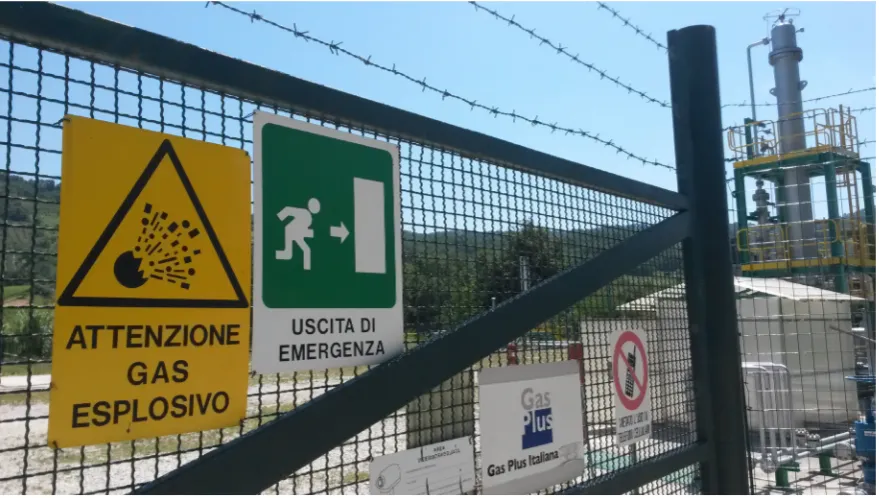
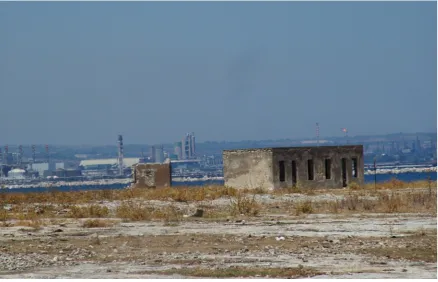
Societies need an energy transition to RES to face the future energy supply. The fluctuation of oil and gas prices and the conflicts that generate at international level, encourages communities to plan an energetic autonomy. The exploitation of fossil fuels will terminate in the future, and communities will face energy emergency. New plans for fossil fuels exploitation around the world still undermine the integrity of ecosystems and their services, consequently the landscape and public health. Recently strong oppositions are emerging in Italy for several new fossil plants along the eastern Adriatic coast. Impact assessments are favorable but local communities arise in protests scared by the possible contamination and risks for public health (figure 1.1).
1.2 Energy transition and landscape change
CHAPTER 3
Figure 1.1 New natural gas plants and networks in Abruzzo region in Italy (image source
https://augustodesanctis.files.wordpress.com).
Energy transition is unavoidable and necessary and governments sustain the transition towards RES in order to support a sustainable development.
CHAPTER N CHAPTER 3
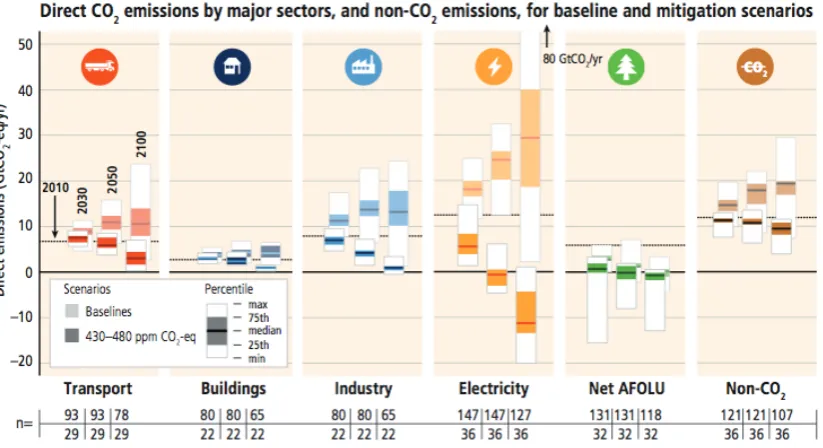
major summits on sustainable development and addressing new and emerging challenges.” And consequently at point 13 “We recognize that opportunities for people to influence their lives and future, participate in decision-making and voice their concerns are fundamental for sustainable development. We underscore that sustainable development requires concrete and urgent action. It can only be achieved with a broad alliance of people, governments, civil society and the private sector, all working together to secure the future we want for present and future generations.” (A/RES/66/288, 2012). The scientific world studying the global clima (IPCC, report 2014) stresses the importance of an energy transition to reduce the anthropogenic carbon emission considered responsible of the global warming. The following image (figure 1.2) shows the direct emission in CO2 by sector; we notice that the electricity sector contributes in the major part (IPPC, 2014, SPM 4.3). The European Union in line with the United Nations and the IPPC adopted strong policies and set targets for the energy transition, as we will se later in this section.
Figure 1.2 The image shows the direct carbon emissions per sector. In light color the actual levels,
in dark color the reduction of emission as expected in the mitigation measures to be adopted by
CHAPTER N
The main question remains a sustainable management of this transition, that needs innovation and a bottom-up processes to get legitimacy from communities. Energy transition is a relevant driver of landscape change. The sustainability of renewable energy sources is not only valuable in term of avoided carbon emissions, but also in term of changes that occur in the landscape structure and consequent supply of ES.
Drivers or driving forces are defined as “... the forces that cause observed landscape changes, i.e., they are influential processes in the evolutionary trajectory of the landscape” (Bȕrgi et al., 2004, p.858).
Landscape changes because of the introduction of RET, which become new layers of it (Stremke, 2013).
The Landscape is dynamic (Pedroli et al., 2007, 2013) and changes following the iter of human development. History and archeology shows that the landscape has always been characterized by periods of rapid changes due to specific drivers, natural or human, and long periods of stabilization and consolidation. The frequency and the magnitude of change are important parameters; these directly depend upon the technological means (Antrop, 1997). The more the technology is invasive, the more the magnitude of change increase, as in the case of the energy landscapes. For invasive technology we mean a technology that is intertwined with several landscape layers and dynamics, and this is not necessary related to the spatial extension of footprints. Technologies with a limited spatial footprint can provoke hidden dynamics that result in a landscape change more than sprawled ones. We can think about a calcareous landscape where the installation of a specific technology interrupts or pollutes a subterranean water flow due to an invisible collapse of the subterranean strata. This fact emerges in distance of several kilometers, where the absence or the pollution of water afflicts the vegetation and human activities with the result of a landscape change. As Selman affirms “Energy production has driven the emergence of distinctive landscapes throughout history, and traditional sites of wind and water power are often important parts of heritage. It is doubtful, though, whether they would have been considered attractive in their heyday” (2010, p. 163).
Anyway the aim of a sustainable landscape development is that the introduction of technology proceeds gradually and with a broad social consensus. This enhances the consolidation of the landscape and its cultural sustainability. Landscape change is unavoidable; the same definition of landscape encloses dynamism and evolution. Populations need time to get costumed with changes in the landscape.
CHAPTER N CHAPTER 3
During the consolidation periods the environment gradually incorporates the innovation and very slowly produces a “traditional landscape”, which can be defined as a landscape whose structure is distinct and recognizable by people (Antrop, 1997). Nowadays the technological means applied at the development of RES increase the magnitude of change, while the frequency is strictly depending on policies and regional planning so that some landscapes develop with higher frequency than others protected for their natural or cultural value. This is typical of a conservative approach, that doesn’t allow any compromise, the approach adopted from several Italian regions as seen in the literature discussion, but this is not the approach aimed by the ELC, that looks forward “a perspective of sustainable development, to ensure the regular upkeep of a landscape, so as to guide and harmonize changes which are brought about by social, economic and environmental processes;”(ELC, article1, e, p.10). Connecting the Antrop definition of landscape change with energy transition, we can affirm that the magnitude of the landscape change during the Sustainable Economy is wider than during the Mineral Economy (Pasqualetti, 2012) because constructs and layers have larger spatial footprints to counterbalance the lower energy content (Stremke, 2013). However, the effects of landscape transformation on site in the mineral economy often exceeded that of the sustainable economy, it is a matter of quantity versus quality of change, we can think about the coal mining landscapes in the Green Metropolis region between Belgium, Netherlands and Germany, that was a whole region providing coal at European scale, of course that landscape was completely transformed from the deep structure to sustain the coal supply. The interactions between the changing of the landscape and its inhabitants have been theorized by Farina in his Cognitive theory (Farina et al., 2005; Farina, 2006).
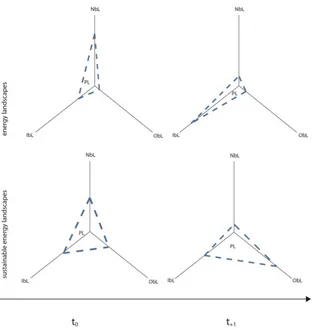
According to the author the landscape is a “network of signals and signs” (Farina et al., 2005, p. 236). Signals are received by animals, humans in this case, that get in contact with signs and conscious of the surrounding environment. It is possible to theorize three types of perceived landscape according to the quality of the signal and the status of observer. The neutral based landscape (NbL) is the landscape that is perceived by a passive observer, unable to codify the signal meanings. Von Uexküll postulated the theory of meanings in 1940 (Von Uexküll, 1940).
CHAPTER N CHAPTER 3
The ObL is prerogative of humans. The IbL is common to all the animal races that from practice and experience get knowledge on their own environment. We introduced this theory because could easily support the codification of what happens in the relationship between local communities and RET in energy landscapes. In the case of energy landscapes, intended non sustainable, the introduction of RET causes at time 0 a shift of the perceived landscape, PL, towards the NbL. At time + 1 the experience move the PL towards the IbL, but the contribution of the culture is scarce and the PL doesn’t shift so much towards the ObL. In the case of sustainable energy landscape, planned and designed with a broad social consensus and share of knowledge with inhabitants, a time 0 the introduction of RET causes a democratic shift towards NbL, IbL and ObL, this means that culture intermediates and supports new meanings since the beginning, at time t+1, the cultural process and the experience shift the
CHAPTER N
IbL at the minimum (figure 1.3).
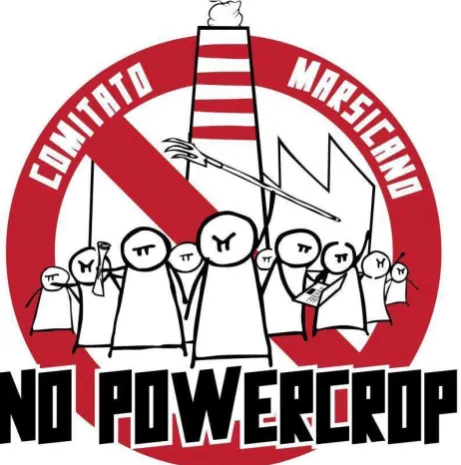
In several cases Nations face difficulties in actuating an energy transition for oppositions and blocks at regional and local level (figure 1.4).
These are due to the change that RET produce in local landscapes and the risk of affliction of cultural, ecological and agricultural production values and consolidated economic activities connected to these as tourism. As Antrop notes, “the ever faster changes to landscapes are experienced by an increasing number of people as a threat” (2005, p. 188).
Referring to renewable energy landscape Pasqualetti notes that most of people believe that their landscape won’t change, it is a sort of faith (Pasqualetti, 2011); they expect permanence in their landscapes (Pasqualetti, 2000). This expectation is at the base of the conflict. Expectation not only in terms of permanence of the landscape appearance but mostly in terms of permanence of the human activities based on the landscape status quo. This expectation for permanence is comprehensible if the installation of RET is perceived as something imposed bottom-up and as something that will bring profit not to the local communities but
CHAPTER N
to the energy companies.
The first step of this research had as aim an introductive discussion of the literature, in or-der to frame the problem as stated in the previous section. This literature discussion was organized in two stages, a first one discussing the relationship between RE and policies, the second one the relationship between RE and spatial disciplines.
The relationship between RE and policies was analyzed referring to EU level and two na-tional levels: Italy and Netherland. The two countries were chosen considering the fact that Italy renewable share is actually the 15% of the total use, having the country a weak tradi-tion in transitradi-tion management and participatory processes, Netherlands renewable share is the 9% of the total use, having the country a strong tradition in transition management and participatory processes, a strong and innovative research in Energy Landscapes at the Uni-versity of Wageningen, Gelderland. Further after some attempts to individuate an adequate case study in Italy the research gained a contribution to the DEESD project and a case study in the Netherlands.
1.3.1.1 The EU level
The European Directive 2009/28/EC EUROPE 2020 remarks that “…member States should therefore support national and regional development measures in those areas, encourage the exchange of best practices in production of energy from renewable sources between local and regional development initiatives…” (3). Still at point 14, the directive underlines “The main purpose of mandatory national targets is to provide certainty for investors and to encourage continuous development of technologies which generate energy from all types of renewable sources”. At point 23: “Member States may encourage local and regional authorities to set targets in excess of national targets and to involve local and regional authorities in drawing up national renewable energy action plans and in raising awareness of the benefits of energy from renewable sources.” It is possible to resume two main key measures:
1. Diversity of RES supply
2. Involvement of local and regional authorities in the formulation of action plans
1.3 Literature discussion
1.3.1 Renewable Energy and policies
CHAPTER 1
CE through the directive 2011/77/EC. According to Directive 2009/28/EC EUROPE 2020, action plans have the objective to manage the energy transition at local and regional scale. This means to define stakes and involve actors at local and regional level in order to address specific laws at National level. Action plans and strategies are intermediate means to address the National legislation towards an adequate transition management. What has been the implementation of 2009/28/EC in EU member states? We will examine briefly the main facts in Italy and Netherlands.
1.3.1.2 The Italian case
CHAPTER 1
and guide-lines. Regional guide-lines define the areas suitable for RET installation. Some regions as Apulia (2004) proposed design principles to introduce them into the landscape. In several cases, as for Apulia, Calabria and Molise, regional governments regulated specific procedures for RET authorization that blocked or delayed the realization of RE production targets. The authorization was based on criteria as the type of RET, the spatial footprints and the safeguard of environmental aspects, the landscape and the cultural heritage. In many cases, as for Calabria, the Constitutional Court recognized these authorization procedures too restrictive and not Constitutional because limiting the capacity of Italy in reaching the objectives of European directives (Ammannati, 2011). In other cases, as for Apulia region, the Constitutional Court legitimated some environmental compensation as required from the regional government. Those restrictions limited the access to a free market of RES from investors. The Italian government edited the Action Plan in 2012 (Strategia Energetica Nazionale).
While the EU directive 2009/28/EC promotes the making of Action Plans to regulate the energy transition management at regional and local level, the Italian Action Plan limits the question to general observations in governance section 4.7: the “modernization of the governance”. The most significant measures are resumed as following:
1. In line with the Plan of the energy infrastructure at EU scale, based on the experience of EU northern countries, the institution of a public debate is challenging in order to facilitate, even before of the authorization procedures, a sharing of knowledge for the introduction of the infrastructure in the territory and its socio-economical context;
2. The public debate should avoid protest from the local communities, frequently due to a lack of knowledge and information on the infrastructure to be realized and the local impacts;
3. The introduction of a cost-benefit analysis at local/regional/national level is necessary in order to show advantages and disadvantages of the infrastructure especially in relation to what could be the costs of a delay in the scheduled time of realization.
CHAPTER 1
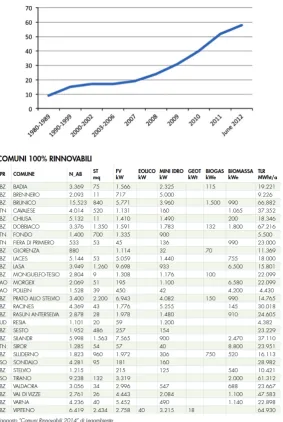
municipalities that got a self-sufficiency energy production based on RES, is increasing. The actual share anyway is due in large part to the hydro-power energy production.
1.3.1.2 The Dutch case
About the situation in the Netherlands it is necessary to remark some relevant measures. The Dutch government updated the Fourth National Environmental Plan in 2001, the NMP-4, “A world and a will”. This introduced and institutionalized the term of “transition” (for the definition, see section 1.5). Transition management was considered a challenge for several Dutch ministries. Transition management with a focus on energy transition originated in policy making at the Ministry of Environment and at the Ministry of Agriculture. Then this became subject of the Ministry of Economic Affairs, the Ministry of Agriculture and Innovation and the Ministry of Environment and Infrastructure (Kemp and Loorbach, 2006). The NMP-4 edition was based on prior research focusing on transition management and innovation system . The transition management approach is useful to reach long-term benefits and not short-term specific objectives (Kemp, 2011). Fragmented policies and institutional deficits as well as short-term thinking are considered as barriers to sustainability and transition management in the Dutch NMP-4 (Dinica and Arentsen, 2003). The efforts of the NMP-4 did not find a real correspondence within the formulation of renewable energy policies. Incoherence, inconsistency and incongruence in the Dutch energy policy are found by Dinica and Arentsen (2001, 2003) and Kemp and Loorbach (2011). The Dutch Energy Policy has been based on green labels or green certificates and subsidies to investors on RET since the 1990’s. At the beginning of 2000 the share of RES in the Netherland was the 1,2% of the total use (Dinica and Arentsen, 2003). Dinica and Arentsen affirm “Dutch policy approach is that being so comprehensive it induced confusion on potential developers, such as private individuals, farmers, small firms, cooperative and local communities, of whom much more was expected in terms of investments […]. Local communities and local governments have strong legal instruments to block the erection of new green electricity facilities. This point has now been recognized in the central government’s announcement to overrule local authorities in case of persistent local resistance. Thus far, it is clear that the green electricity
CHAPTER 1
market in the Netherlands is still in an infant stage of development” (Dinica and Arentsen, 2003, p. 620).
In 2011 the share of RES in Netherlands reached the 4.3%. In September 2013 the SER, a council that advise the Dutch government on socio-economic affairs, facilitated and publishes the “Energieakkoord voor duurzame groei” (Energy agreement for sustainable growth). The SER defined 10 pillars for long-term and mid-term agreements; among these the third pillar encourages “local sustainable energy” (EU Country report, 2013). “There are now hundreds of local energy initiatives. These show in their ideation, plan and realization a strong need for information, knowledge and exchange of knowledge” (SER; 2013, p.37). In section 5 (SER, 2013, Pijler 3: Stimuleren van decentrale duurzame energie) the agreement remarks that municipalities and provinces should produce their own spatial policies to decentralize the supply of RE in close consultation with civil society. Developers and public authorities must handle the “Elverding” approach, an early involvement of stakeholders. The Government will facilitate this by simplification and harmonization of regulations especially in the case of wind energy. For example about heat and cold storage it stresses the involvement of ‘owners’ associations, energy companies, housing associations, cooperatives, and associations of greenhouse horticulture companies on business sites”.
1.3.1.2 Comparing
CHAPTER 1
CHAPTER N
EU
LEVEL IT NATIONAL LEVEL IT REGIONAL LEVEL European Landscape Convention 2000 Directive 2003 2004 2005 2006 2007 2009 2010 2011 2012 Directive 2009/28/EC EUROPE 2020 Directive 2011/77/EC DL 387/03 implementation of 2001 Directive 2001/77/EC
9th January ratification of the European Landscape
Convention DL 28/11 implementation of 2009/28/EC and 2003/30/EC National Energy Action Plan RET RET guide-lines Basilicata Apulia Tuscany RES guide-lines Calabria Marche Sicily Umbria RET guide-lines Abruzzo
DL 10 settembre 2010 National guide-lines for RET assessments
NL NATIONAL LEVEL
NMP-4
New Energy for the Climate Program EREC 2013 SER Energy Agreement for sustainable growth 1st Novbember ratification of the European Landscape
Convention
CHAPTER N
Policies Policies
ITALY
NETHERLANDS
regulate subsidies for RET investements regulate subsidies for RET investements
believe in the development of RE by means of energy companies investments
address the involvement of stakehol-ders for debate and cost-benefit analysis
believe in the development of RE by means of energy companies investments
believe in the development of RE by means of sustainable local plans
address and regulate bottom-up processes in Netherland
TOP-DOWN
BOTTOM-UP
CHAPTER 1
In this section we will examine briefly how spatial disciplines relate to the energy transition. The energy transition requires space. When we talk about “space” we move the discussion towards the relation among RET, the environment and their spatial organization. According to Sijmons “because the two perspectives of energy and space largely proceed independently of each other, opportunities are missed to integrate them in an intelligent and desiderable way” (Sijmons, 2014). The spatial organization of renewable energy is a challenge for the transition. If we introduce the human perception in the perspectives of energy and space, we move from the spatial dimension to the landscape dimension or perspective (Blaschke et al., 2013). The European Landscape Convention defines the landscape as “... an area, as perceived by people, whose character is the result of the action and interaction of natural and/ or human factors (ELC, article 1,a, p.9). Therefore a landscape perspective cannot bypass the human perception.
The notion of energy landscape comes from geography and landscape ecology: “Energy landscape is a landscape whose image and herewith the functions (natural, productive, residential, recreational, cultural, etc.) have been significantly affected by the energetic industry” (Frantál et al., 2014, p.2). This definition, focuses on the impact of RET on the landscape, and doesn’t address in what way these should be studied in a development perspective. Actually the notion of energy landscape became a recurrent topic in the academia in the last 15 years and still is quite ambiguous (Stremke, 2015). Pasqualetti (2012) structures the concept of the energy landscapes in construct and layers, the layers are part of the physical landscape while the constructs can he physical or socio-cultural.
By a landscape architecture perspective Sven Stremke defined the concept of energy landscape in the following way: “Energy landscapes, in other words, are not always distinct spatially bound landscapes such as the coal mining landscapes in Lusatia, Germany. In most cases, the energy landscape is nothing but one of the many layers of complex, multi-faceted and heterogeneous landscapes” (2015, p. 2). This concept supports a Landscape Architecture perspective where the energy landscapes are one of the layers part of the landscape, if we read the landscape in a multi-layer approach (Mc Harg, 1967).
In the last two decades renewable energy landscape dynamics have been studied by geographers and landscape ecologists for the impact of RET on the human perception of the landscape. Studies as Ladenburg and Dungaard (2009) or Gee and Burkhard, Meyerhoff et al. (2009), Drechsler et al. (2009), were investigating how the perception of wind farms
CHAPTER 1
landscape theories and environmental psychology (Zube et al., 1982, Zomm, 1984; Kaplan et al., 1990; Nassauer, 1995; Scott and Canter, 1997; De la Fuente et al., 2006; Kaplan and Kaplan, 2009). Natural scientist and environmental planners were also interested in assessing the relationship between RE and ES (Burgess et al., 2012; Coleby et al., 2012; Blasckhe et al., 2013; Howard et al, 2013). Land use/Land cover is the spatial reference system that most of studies adopt to evaluate this relationship, but a landscape perspective is frequently envisioned in theory but missing in practice. This provokes difficulties when we want to use scientific knowledge in landscape planning and design. If these studies produce data sets on renewable energy landscape dynamics, we wonder what is the utility of these data if not used for energy landscapes planning and design. The knowledge on landscape dynamics is necessary in order to envision future scenarios in renewable energy landscapes. In the proceedings from the Congeo Conference “Exploring new Landscapes of Energy”, held in Brno, Czech Republic (2011), we read “New deliberative, interdisciplinary and integrated approaches are needed to manage the required transformation process and to create a vision for change across publics and different stakeholder groups, sectoral and administrative boundaries, which constitute the scope of landscape planning and decision making process” (Frantàl, 2011). “The creation of a vision” as in Frantàl words can be handled through the formulation of integrative, both in process and substance, landscape scenarios.
Policies and spatial disciplines agree in the need of defining approaches to manage the energy transition both from an energetic and spatial point of view. The contribute of spatial disciplines as Landscape Architecture seems to be not relevant if not in a top-down approach, while the involvement of stakeholders and the definition of future scenarios seem to be relevant for a successful energy transition.
CHAPTER N
dynamics and mobilizing energy to move in different directions, although there are all kinds of ways in which such strategies are grounded in formal political jurisdictions. Because such strategies are social products formed to do governance work, they raise difficult political questions about their legitimacy and accountability.” (p. 442). Stremke et al. (II, 2012) remark, “spatial planners embrace scenario thinking, but have little information about how to give shape to a desired future. While landscape architects may posses the skills to design desirable physical environment, but fail to incorporate critical uncertainties in the design process” (p.313).
In the last decade we witnessed an increasing consciousness in Landscape Architecture on the role of landscape architect in assisting populations in the energy transition management (Minichino, 2014). Stremke et al. evidenced how it is possible to build a methodological framework that affords energy transition management when we joint Strategic Spatial Planning and Landscape Architecture, intended as planning, design and management (Stremke, 2012, II). The authors matured a framework, the Five-step approach, based on the formulation of scenarios for Sustainable Energy Landscapes (SEL). These are defined as “a physical environment that can evolve on the basis of locally available renewable energy sources without compromising landscape quality, biodiversity, food production and other life-supporting ecosystem services” (Stremke and Dobbelsteen, 2012, p.4).
CHAPTER N
the planning and design of sustainable energy landscapes. We will see how the ES approach represents a challenge for the practice of energy transition. In the following flowchart (figure 1.7) we represented the complex of spatial disciplines and how the different knowledge flows can be combined towards the plan and design of sustainable energy landscapes.
landscape planning landscape design spatial planning strategic spatial planning rational planning design approach in regional planning landscape structure and processes incremental planning
mixed scanning ES approach
SPATIAL PLANNING
DOMAIN ENVIRONMENTAL DOMAIN
LANDSCAPE ARCHITECTURE DOMAIN GEOGRAPHY AND LANDSCAPE ECOLOGY DOMAIN TRANS-DISCIPLINARY DOMAIN geography SMCA sustainable energy landscapes
?
par ticipa tor y pr oc ess partcipatory process partcipatory processFigure 1.7 The flowchart represents the contribute of spatial disciplines to the study, the plan and
CHAPTER 1
1.4 Knowledge gaps
Figure 1.8 Flowchart illustrating literature review and knowledge gaps.
We now state the knowledge gaps. The following flowchart (figure 1.8) shows the logical sequence that this thesis will follow. From the initial literature discussion we detect some knowledge gaps. In policies we note that specific regulations for community based energy transition are missing, even if local sustainable energy initiatives are promoted. We moved through spatial disciplines to find valid and relevant approaches able to afford such transition management, we found it in Landscape Architecture. Design approaches at regional scale, based on participatory processes at local scale can manage the energy transition, but frequently they do not integrate data from applied sciences as Landscape Ecology and Environmental Planning, data on off between RE and ES. In chapter 5 we will focus on the trade-off between RE and ES and we will investigate how this can be evaluated in a landscape perspective.
RE and policies RE and spatial
disciplines
knowledge gap knowledge gap
looking for spatial
management at local scale looking for an Ecosystem Services approach
knowledge gap
research questions substanitve issues procedural issues
CHAPTER 1
The gaps of knowledge we identified are resumed as following. Policies and spatial disciplines have been investigated in the first preliminary overview, the ES have been investigated as literature review reported in chapter 5:
RE and policies
1. Absence of -Policies regulating bottom-up processes and community based energy transition
RE and spatial disciplines
2. Absence of- design approach for planning energy landscapes including ES assessment
RE and Ecosystem Services
CHAPTER 1
The research seeks to implement the plan and design of the energy landscapes in order to perform optimal levels in both supply of RE and ES. In this perspective we can identify two sub-goals: 1) To design an efficient framework to evaluate the trade-offs among the supply of Renewable Energy and the supply of Ecosystem Services, 2) Introduce and test this framework in planning and design an energy landscape case study in a trans-disciplinary approach. Therefore the main research question is:
How to implement the plan and design of the energy landscapes in order to perform optimal levels in both supply of RE and ES?
Considering the problems and the knowledge gaps that emerged from the preliminary literature discussion,the following research questions were formulated:
1. What are the parameters for landscape sustainability in the energy transition era?
2. What is the contribute of planning and design the landscape to energy transition?
3. What are the approaches and ES categories in RE assessment?
4. What are the methods for assessing synergies and trade-offs among ES and what are the spatial reference systems?
5. How can Cultural ES be assessed in trade-off with other ES and what the spatial reference systems?
6. How ES and RE relate to one another from a landscape perspective?
7. What is the added value of an ecosystem services approach for planning and designing sustainable energy landscapes?
8. How does energy landscape design affect the supply of ecosystem services?
CHAPTER N
Chapter 1
Introduction and research questions
Chapter 2 Research design
Chapter 3
Towards the sustainability of renewable energy landscapes
Chapter 4
Planning and design of renewable energy landscapes towards a design approach
Chapter 5
Advancing the relationship between Ecosystem Services and Renewable Energy: A review
Chapter 6
Ecosystem services to plan and design sustainable energy landscapes: a case study from Zealand, The Netherlands
substantive issues
procedural issues
Discussions and conclusions
answ
ers t
o r
esear
ch questions
1
2
3,4,5
6,7,8 CHAPTER 1
CHAPTER N
This thesis is organized in 6 chapters (figure 1.2). In chapter 1 we introduce this research, explaining the state of the art and concluding with the knowledge gaps. In chapter 2 we present the design of this research: what are the philosophical worldview, the strategies of inquiry and the methods applied. Chapter 3 and 4 report about the main substantive issue in relation to renewable energy landscapes: the theories that help in reading and understand them, the planning and design approaches with the reference to some design projects and provide an answer to the research questions 1 and 2. Chapter 5 and 6 report the advance of procedures for the planning and design of sustainable energy landscapes as in the objectives of this thesis. These chapters correspond to the theoretical and application investigations of this research. Chapter 5 is based on a paper which is under review by the Ecosystem Services journal, and that was conceived, mature and developed by the author of this thesis together with colleagues from Wageningen University, NL. The chapter reports the literature review on the relationship between RET and ES. Chapter 6 is based on a paper, which is to be submitted to the Landscape Journal before the defense of this thesis, and that was elaborated and developed by the author of this thesis together with colleagues from LAR and Alterra, Wageningen University and Research, NL. Questions 3, 4 and 5 are answered in the chapter 5, questions 6,7 and 8 in chapter 6 of this thesis.
In the discussions and conclusions final chapter we resume the theoretical and application results defining future effort in the research for planning and design of sustainable energy landscapes. The nature of the composition of this thesis, including two scientific peer-reviewed papers, may cause some repetitions of concepts and definitions.
CHAPTER 1
CHAPTER 1
In this section we give an account of definitions of phenomena, concepts and disciplines.
Transition
In general, a transition can be defined as a long-term, continuous process of change during which a society or a subsystem of society fundamentally changes. A transition can be described as a set of interconnected changes, which reinforce each other but take place in different areas, such as technology, the economy, institutions, ecology, culture, behaviour and belief systems. A successful transition is a spiral that reinforces itself, driven by multiple causalities and co-evolution. A pre-requisite for transitions to happen, is that several developments in different domains at different scale-levels come together to reinforce each other. (Rotmans and Kemp, 2003)
Sustainable Energy transition
Sustainable Nergy Transition is aimed at achieving environmentally sustainable energy systems throuhg increasing energy efficieny, promoting Renewable Energy Sources and Sustainable Transport (Strong, 1992; 1993; Solomon and Krhisna, 2011)
Embodied Energies
Represent all the energies and greenhouse emissions which are related to a given landscape (Nadai and van der Horst, 2010)
Energy-conscious planning and design
Energy-conscious planning and design deal with locating energy sources and sinks in the landscape and establishing cascades that distribute residual energy from sources to sinks in order to decreases the need for primary energy. Developing diverse and landscape-specific renewable energy systems provides a multiplicity of sources having more proximate relationships with energy sinks. Reduced distances between source and sink are advantageous for making best use of renewable energy carriers with lower energy density. Energy-conscious planning and design is location specific and it remains difficult (if not impossible) to devise the solution that fits all conditions.(Stremke and Koh, 2011).
Community Energy Planning
Community energy planning is defined here as comprehensive and integrated energy planning at the community scale, taking supply, transmission/distribution, and demand into account. A community vision can be used to define a desired system that includes both sustainability and community perspectives and also makes the most efficient use of energy by matching energy supplies to energy services (Scroth et al., 2013).
CHAPTER 1
Landscape
Landscape means an area, as perceived by people, whose character is the result of the action and interaction of natural and/or human factors (ELC, Art. 1,a).
Energy Landscape by an Impact Assessment perspective
Energy landscape is a landscape whose image and herewith the functions (natural, productive, residential, recreational, cultural, etc.) have been significantly affected by the energetic industry (Frantál et al., 2014).
Energy Landscape by a Landscape Architecture perspective
Energy landscapes, in other words, are not always distinct spatially bound landscapes such as the coal mining landscapes in Lusatia, Germany. In most cases, the energy landscape is nothing but one of the many layers of complex, multi-faceted and heterogeneous landscapes. (Stremke, 2013)
Sustainable energy landscapes
A physical environment that can evolve on the basis of locally available renewable energy sources without compromising landscape quality, biodiversity, food production and other life-supporting ecosystem services (Stremke and Dobbelsteen, 2012).
Ecosystem services
Ecosystem services are the benefits people obtain from ecosystems. These include provisioning services such as food and water; regulating services such as regulation of floods, drought, land degradation, and diseases; supporting services such as soil formation and nutrient cycling; and cultural services such as recreational, spiritual, religious and other non material benefits (MEA, 2005).
Interdisciplinarity and Transdisciplinarity
Interdisciplinarity refers only to integration of different academic disciplines around one problem-solving oriented project. Transdisciplinarity implies integration between academics and non-academics such as policy makers and (local) stakeholders. Both are important and necessary in landscape research, management and planning (Antrop and Van Eetvelde, 2010).
Landscape Architecture
In this chapter we delineate the design of the research (figure 2.1). The research presented in this thesis was conducted in part as my contribution to the DEESD project, Sustainable Energy and Ecosystem Services. This research was set in Netherland and commissioned by the Province of Zealand, the Dutch Ministry of Infrastructure and the Environment and several regional stakeholders, to the University of Wageningen, Landscape Architecture Chair Group (LAR), and the Alterra research institute. I joined LAR in 2014 in two stages: the first in spring for an Erasmus Placement program; the second in autumn involved in the last step of DEESD project. The research project involved landscape architects and environmental planners, and the last step included a participatory process with the community of the island of Schouwen-Duiveland, in the province of Zealand. In the preceding steps, different people had been engaged in the research that pursuit different approaches, strategies and methods. Anyway the design of the research of the last step followed a quite linear research design. As researcher in Landscape Architecture I was interested in enhancing procedural knowledge for landscape planning and design through a case study. The European Council of Landscape Architecture Schools (ECLAS) defined three main typologies of research that can be conducted by landscape architects:
a) Planning and design research; aiming to improve landscape architecture theory and methods (e.g. planning and design processes), drawing conclusions from doing case studies, from analyzing projects, landscapes plans, etc.
b) Research by planning and design: the analysis of complex spatial strategies by producing and evaluating scenarios, making and evaluating new typologies that are based on new needs (of the public), finding solutions for a social or spatial problem by making and evaluating several proposal, scenarios, etc.
c) Research for planning and design – research in social sciences, ecology, or other disciplines, in order to apply them to landscape planning and design, e.g. landscape classification, surveying the needs of the public, perception of landscape values, etc.
2.1 Introduction
Research Design
CHAPTER 2
d) Integration of the above mentioned approaches.
According to the ECLAS typologies, the work here presented can be considered a “Planning and Design research” (a) as well as a “Research by planning and design “(b) but the main objective can be considered as a “research for planning and design”(c). An integration of the three typologies is anyway essential when facing complexity. In particular the three main gaps of knowledge were detected through different research typologies. The first knowledge gap “Absence of policies regulating bottom-up processes and community based energy transition” was stated through the research typologies (a) and (b), from the analysis of theories, policies and projects. The second knowledge gap “Absence of design approach for planning energy landscapes including ES assessment” was stated through the research typology (a). The third and main knowledge gap “Absence of integrated approaches where multiple ES are studied in relation to diverse RES, in a landscape perspective and through participatory processes” was stated through the research typology (c). To reach the main objective o this research, the elaboration of the methodological framework and the application part, both (a) and (c) were necessary in order to define a methodological framework that would joint Landscape Architecture approaches with approaches coming form other disciplines in order to support the planning an design of the landscape.
CHAPTER N
2.2 Philosophical worldview
This research adopts strategies and methods in more than one philosophical worldview (Creswell, 2007). In an Advocacy/participatory worldview this thesis conceive the first literature discussions. According to Kemmis and Wilkinson (1998) participatory processes are recurrent in this worldview, because it helps individuals or communities to the right of self-development, avoiding imposition of injustice structures in a top-down approach as in the case on NIMBY and RET. The inquiry is conducted with participants. This research examines “important issues of the day” (Creswell, 2007, p.227), as the transition to low carbon energy, and the inquiry is preliminary intertwined with policies and the political agenda. We support the sustainable energetic development of local communities.
We can consider our research also in a Social Constructivist worldview in the way it seeks for the complexity of the view and it is not focused on few aspects. A second reason is the fact that the application part of this research is based on a workshop and it is typical of this worldview to count on the participants view. It is further typical of constructivist researchers to study the context where participants live and work and facilitate the interactions among individuals and the understanding of the phenomenon object of the study. The interpretation of participants view is a fundamental step of the research.
This research adopts also a Pragmatic Worldview. The pragmatism emerges as a problem solving worldview; it deals with applications that find solutions to emerging problems. Research that finds solutions to specific problems emerged at societal or institutional level can be considered a pragmatic research. The emphasis is on the problem and not on the method, pragmatists apply different worldviews and investigate and use all the approaches available to solve the question, it is a way to derive useful knowledge.
CHAPTER N CHAPTER 2
CHAPTER N
Our research adopts a Qualitative strategy, and responds to classical qualitative questions starting with “what” and how”. We need to know what phenomena and dynamics we investigate, what theories, concepts and methods are necessary to build our theoretical framework and how to build a method. We need to know what are the trade-off and synergies between RE and ES and how the stakeholders give value to them. A Pragmatic worldview is usually based on a mixed strategy of inquiry using both quantitative and qualitative data. According to Creswell “In qualitative research, the intent is to explore the complex set of factors surrounding the central phenomenon and present the varied perspectives or meanings that participants hold” (2007, p. 129). The strategies of inquiry of this research are composed of three distinct research actions that can be categorized as following (Deming and Swaffield, 2011):
1. Interpretative strategy
2. Modeling and correlational strategy/Dynamic Simulation Modeling 3. Engaged action research/Participatory Design
Interpretative strategy is a “constructionist approach to understanding” (Deming and Swaffield, 2011, p. 152). The interpretative strategy was relevant in investigating the landscape phenomena that involve communities and result form energy transition, trying to relate evidence with theories and interpret them. The methods are Discourse analysis of secondary sources, the literature review phases where it is necessary to interpret and categorize to implement our knowledge in order to formulate a theoretical framework. The Modeling strategy adopted in this research uses a “Spatial Correlations” approach in the formulation of the theoretical framework and merges environmental planning, landscape ecology and landscape architecture, relating social, economical, cultural and ecological dynamics to the design of the landscape.
“As a research strategy in itself, modeling is a process in which the representation of landscape or some aspect of landscape in simplified terms enables new knowledge to be generated” (Deming and Swaffield, 2011, p. 88).
A Dynamic Simulation Modeling strategy (Steinitz, 2003) is adopted in the application of the Five-step approach designed by Stremke et al. (2011, II), when stakeholders define spatially renewable energy scenarios and ecosystem services through siting RET and discussing the landscape design. According to Steinitz et al. (2003), this modeling strategy is
CHAPTER 2
defined as decision-choice. This deals with building alternative possible futures based on the combination of policies. Scenarios constitute “a set of policy choices and their biophysical consequences” (Deming and Swaffield, 2011, p. 107).
Finally the case study application of this research is a Participatory Action Research (PAR). Kindon et al. affirm “Both researchers and participants reflect on, and learn from, this action and proceed to a new cycle of research/action/reflection.” (2008, p. 93) and indeed what we faced was a learn by doing process. In the following table (table 2.1) we resume the key characteristics of PAR.
Methods and tools of PAR can be: mapping, interviewing, questionnaires surveys, focus groups, photography, video, GIS. In our research workshop we applied a participatory mapping and a focus group. The focus group on the landscape design can be framed on the strategy of inquiry of Participatory Design in Service Learning (Deming and Swaffield, 2011). This involves researchers and end users in visioning landscape design processes that support the community needs.
In qualitative research it is possible to check the reliability of the findings paying attention to specific procedures that should be followed during the research steps (Creswell, 2007). The reliability strategy adopted in this thesis is the “triangulation”. In the triangulation we check the convergence of evidence from different sources, included stakeholders in the Engaged action research/Participatory Design.
Triangulation checks when different sources state the same assumption, when the values expressed by stakeholders coincide with the values expressed by precedent research on the same topic and location, when in expert panels we check our findings and intuitions with expert on the specific aspect. This research considered peer-reviewed sources and this increase the reliability.
CHAPTER 2
Table 2.1 The key characteristics of PAR, adapted from Kindon et al. (2008, p. 91).
• Aims to change practices, social structures, and media which maintain irrationality, injustice, and
unsatisfying forms of existence
• Treats participants as competent and reflexive agents capable of participating in all aspects of the
research process
• Is context-bound and addresses real-life problems
• Integrates values and beliefs that are indigenous to the community into the central core of
interventions and outcome variables
• Involves participants and researchers in collaborative processes for generating knowledge
• Treats diverse experiences within a community as an opportunity to enrich the research process
• Leads to the construction of new meanings through reflections on action
• Measures the credibility/validity of knowledge derived from the process according to whether the
Figure 2.1 The flowchart summarizes the design of the research presented in this thesis. Adapted
THE RESEARCH DESIGN
Philosophical Worldview
Social Constructuvist
Advocay Participatory
Pragmatic
Strategies of inquiry-qualitative
Interpretative
Modeling and correlational
Dynamic Engaged action research-participatory design
Research methods
Literature review
Interpreting-theoretical framework on spatial correlations
Workshop-participatory mapping, focus group
research
In this section we will provide some definitions of energy landscape, and examine the development of the energy landscapes through the time.
“Energy landscape is a landscape whose image and herewith the functions (natural, productive, residential, recreational, cultural, etc.) have been significantly affected by the energetic industry” (Frantál et al., 2014, p.2). This is the definition mostly shared among geographers and landscape ecologists whenever their focus is on the impact of energy on a status quo in the landscape. Howard et al. (2013) gave a definition of Energyscapes: “the complex spatial and temporal combination of the supply, demand and infrastructure for energy within a landscape”(p.19). Howard et al. work as natural scientist, in the definition of “energyscape” they try to enclose a landscape perspective, but concretely in their application they adopt a set of land use classes as spatial reference system. The definition of energy landscape can be tricky depending on the perspective or strategy lens. The definition of Energy Landscape as in Frantàl for example doesn’t mention a human perception, as in the European Landscape Convention (2000). Defining the energy landscape without including the population’s perceptions and cognition is not challenging (Blasckhe et al., 2013). “When applying the landscape concept to the energy domain one challenge is that landscape research embraces a multiplicity of topics: history as well as ecology, thoughts as well as actions, and also the physical environment. By way of contrast, energy research has so far been mainly driven by technical, science and engineering concepts” (Blasckhe et al., 2013. p. 9).
Stremke (2013) resumed the multiple facets of the notion of energy landscape and indicated the main aspects discussed by the authors (figure 3.1). The author also gave an explanation of how the concept of energy landscape could be interpreted if we seek for a sustainable energy transition: “Energy landscapes, in other words, are not always distinct spatially bound landscapes such as the coal mining landscapes in Lusatia, Germany. In most cases, the energy landscape is nothing but one of the many layers of complex, multi-faceted and heterogeneous landscapes” (2013, p. 2).
3.1 Energy landscapes
Towards the sustainability of renewable energy landscapes
This concept suggests that the study, the planning and design of the energy landscapes cannot be avulse from the complex of the landscape these are part of. The difference within the Frantàl definition is in the assumption of different perspectives. In Frantàl the perspective is of an impact assessment that studies a landscape status quo, which is afflicted by the energetic industry, while in Stremke, the simple affirmation that the energy landscape is on of the several layers means that this is part of the evolving process of the landscape and reflects its complexity. This thesis perspective reflects the energy landscape concept as in Stremke. This concept is also part of the perspective of Pasqualetti, a geographer, one of the key authors for the definition of energy landscape. The author structures the concept of energy landscapes (2012), he makes distinction between constructs and layers (figure 3.2). The constructs are the spatial footprints of energy technology and networks. The layers are the landscape externalities, the complex of the changes occurring in the landscape, that can be divided into three types: direct, indirect and mitigation. The direct layers are all the expected changes to the landscape due to technology as mining scars, pumping equipment, their costs are internalized and scheduled. The indirect layers are all the unexpected changes as local pollutions and effects on the vegetation, acid rains, and their costs are consequently
CHAPTER 3
Concept
Wind-energy landscapes
Landscapes of energies
Landscapes of carbon neutrality Sustainable energy landscapes Renewable energy landscapes Third-generation energy landscapes Energy Landscapes Alternative energy landscapes
Energy landscapes of the sustainabe economy
Energyscapes
Author(s)
Moeller
Nadai and van der Horst
Selman
Stremke
Van der Horst and Vermeylen
Noorman and Roo
Blasckhe et al.
Jørgensen
Pasqualetti
Howard et al.
Energy Renewables reductionDemand People Planet Economy
CHAPTER N
solid liquid gaseous
exploration extraction transportation processing generation distribution disposal use economic necessity standard of living public perception technological achievement
habitation jurisdiction
INHERENT NATURAL
FUNCTIONAL CULTURAL
topography geology land cover climate
DIREC
T
INDIREC
T
MITIGA
TION
CONSTRUCTS
LA
YERS
Figure 3.2 Constructs and layers of energy landscapes, from Pasqualetti (2012).
Figure 3.3 Evolution of the energy landscapes (Stremke, 2013, p.2).
CHAPTER N CHAPTER 3
Further Pasqualetti defines four historical stages of energy landscape (EL): the EL of the Organic Economy, the EL of the Mineral Economy, the EL of the Electricity Economy and the EL of the Sustainable Economy (figure 3.3).
In the energy landscape of Organic Economy the main sources of energy were wood, wind and water. The historical landscapes of windmills and water mills represent a typical example; the power of water and wind was converted in mechanic power (figure 3.4). Wood was harvested to produce heat. Pasqualetti affirms, “the Golden age of energy landscapes began when the nascent mineral economy grew into the industrial revolution” (Pasqualetti, 2012, p. 16). The energy landscape of the mineral economy owns well delimited footprints: coal, gas, and oil represent mineral, or carbon fossil sources. According to the author the first exploitation of coal in Europe is dated 1113, in Belgium, but its use was not so common till the 18th century. The use of coal as energy source allowed and supported the industrial revolution of the 18th century through the discovering of coal and its high energy potential. Coal mines constitute nowadays entire landscapes through their constructs and layers. Miners new cities were set in proximity of coal fields, is the case of Carbonia founded in 1937 in southwest Sardinia, in Italy, as an ideal and modern city for miners (figure 3.5).
CHAPTER N CHAPTER 3
CHAPTER N
text text
1.1 Title
CHAPTER 3
Figure 3.5 The city of Carbonia, founded in 1937 as miners modern city during the Fascist period (image source http://thule-italia.com/wordpress/carbonia/nggallery/page/2, 2012)
CHAPTER N CHAPTER 3
Figure 3.7 The direct layer of a transmission line as underlined by landscape architects in the
analysis of the landscape perception, Guastalla, Emilia Romagna. In this case the line afflict the
quality of the perception. (image of the author, 2006).
of this energy landscape. Transmission lines cross our everyday life, cutting the perception of the landscape (figure 3.7). The energy landscape of the electricity economy is founded on the energy landscape of the mineral economy when power stations burn fossil fuels. The fourth stage on the evolution of energy landscapes is the “Energy Landscapes of the Sustainable
CHAPTER N CHAPTER 3
Table 3.1 Constructs and layers of the energy landscapes of sustainable economy (adapted from Pasqualetti, 2012, p. 41)
Direct Layer Indirect Layer Mitigation Layer
Water
Wind
Geothermal
Solar
Biomass
reservoires altered downstream,
ecologies, agriculture
roads, turbines installa-tion movements, flickers
visual, roads, drilling pads
roads, lareg areas, reflec-tions
roads, enlarged agricultural areas, new and different shaped buldings, conver-sion of pasture lands
altered property values (up and down), night time impacts, altered farmlands,
drained lands altered vegetation, impact
on surrounding land use, conversion of existing land
use
changed appearance of open land, improvement of the
impacts of fossil fuels
effects on nearby land uses resulting form odors,
reloca-tion of farm workers
disposal sites for sludge from pollution abatement
distributed deployments, repositioning to protect
endamgered species
CHAPTER N
CHAPTER 3
governments and local communities. The wind power generation increased constantly in Italy during the last decade. This was due to high subsidies from the Government to promote the installation of wind farm by energy companies (figure 3.10).