March, 2015 AgricEngInt: CIGR Journal Open access at http://www.cigrjournal.org Vol. 17, No. 1 247
Design, construction and evaluation of an automatic apple
grading system
A. A. Masoumi
1, M. Kalhor
1and S. M. Shafaei
1, 2*(1. Department of Mechanics of Biosystems Engineering, Faculty of Agriculture, Isfahan University of Technology, Isfahan 84156-83111, Iran;
2. Department of Biosystems Engineering, College of Agriculture, Shiraz University, Shiraz 71441-65186, Iran)
Abstract: A system was designed and fabricated to grade apple automatically based on its size using machine vision. The system included several units to single out, orient and grade apple. A cylindrical container with a circular hole in its bottom, which was equipped with agitator, was built to single out the apples. This mechanism delivered apples to an orientation unit, one by one. Two wooden rails with a specific form which was located on the ramp via adequate slope were used to orient the apple during rolling. The apple was placed under the camera to take its photo, after orientation. The photo was transferred to computer for image processing to determine the apple grade based on its size. A belt conveyor carried the apple and set it in appropriate place regard to its grade. As a final point, wind spray valve was opened and the apple was pushed to the marked box. In order to assess the constructed system, 50 red and golden apples of each grade were chosen and the completely randomized design test was conducted. Results demonstrated that the most consumed time was related to image processing. Almost 85% of the apples were properly oriented in the orientation unit and were correctly graded. The overall system performance was satisfactory. Thus, the system can be consumed to grade apple automatically.
Keywords: automatic control, image processing, machine vision, orientation, single out.
Citation: Masoumi, A. A., M. Kalhor, and S. M. Shafaei. 2015. Design, construction and evaluation of an automatic apple grading system. AgricEngInt: CIGR Journal, 17(1): 247-254.
1 Introduction
1Apples play an important rolein the human diet.
Correspondingly to other fruits, they are source of
monosaccharaides, minerals, dietary fiber and various
biologically active compounds, for instance, vitamin C
(ascorbic acid) and certain phenolic compounds which
are identified to act as natural antioxidants (Podsedek et
al., 2000).
Apples are one of the major products of the
agricultural and horticultural division in Iran. Its
production is more than 2660000 t annually. Iran rank is
Received date:2014-09-26 Accepted date: 2014-12-28 *Corresponding author: S. M. Shafaei, E-mail: [email protected] Tel.: (+98) 09132040158 Fax: (+98) 07132286104.
fourth in terms of land area inapple cultivation. In the
past, Iran was the 15th among 231 countries, with 566,066
t of horticultural products to be exported, and now
317,890 t of apples are exported from Iran.Therefore, Iran
is sixth in the world in apple production (Azizi and
Yazdani, 2006).
In Iran, considerable number of appleswereneglected
before exporting,mainly because of improper packaging
and grading system. It is resulted that the apple export
isnot mechanized in Iran yet. Traditional methods are still
used inthe apple grading. Each user takes different
decisions in various conditions of apple grading. Therefore,
the products are not graded in the same way, leading to
less or lack of apple exportation.Consequently, other
countries have tried to grade and package apple
of grading and packaging (Chen et al., 2002; Davies,
2005).
Examining of fruit quality was studied as interested
subject by the researchers. Use of nondestructive methods
to determine fruit quality was expanded with technology
development. A considerable work of the automated
system to control the quality in nutritional industries is
usually done by the vision sensor. It examines some
factors such as color, size, superficial damages and others.
If the method is used along with different waves, it may
transfer some factors, the damages under the peel and
even the chemical qualities to the processing system
(Chen et al., 2002). The main advantage of the vision
system to control the quality of the products is the
accurate and monotonous control process, because the
products are verified qualitatively, continuously during
passing on the conveyor belt in most factories (Davies,
2005).
Fruits are very difficult to grade exactly and
quickly,since their significant difference exist in feature
such as shape, color and size as a result of changeable
conditions of nature environment (Gao et al., 2010).
Different instruments have been designed and fabricated
to grade agricultural products using machine vision.
Special methods were hired in the machines to grade the
products. The components of such devices include
following elements: 1) the units for separation each
product; 2) the section for orientation the products; 3) the
element for taking photos; 4) the software for image
processing; 5) the unit for grade products based on the
favorable factors; 6) the unit for control operations
depends on the type of the product.These systems may not
have some of the mentioned parts, according to the type of
the products.
Some investigators have designed and created different
systems with promoted potential to orient a lot numbers of
apple. One of the systems includes a smooth and steeped
surface, which it put appleon a movable paddle by a motor
rolled (Whitelock et al., 2006). Narayanan et al. (2008b)
studied physical specifications and inertia of apples in
order to orient them. They found that it was possible to use
a steeped surface to orient apple. Therefore, they
conducted the instrument to orient apples by two rails in a
special form to be located into the steeped surface. Their
findings indicated that it was possible to apply a steeped
surface to orient apple. Several researchers announced the
potential of the apple grading system. They found that it
might mail 15 to 20 t/hr (Gao and Sun, 2002; Gao et al.,
2002; Miller and Delwiche, 1989).
It is not possible to use an uncontrolled mechanized
method in account of considering fruits and vegetables are
damageable. Usually, pneumatic and hydraulic force is
applied to grade fruits and vegetables. In other words, the
mechanical grading system was fabricated in a way to
minimize product damage.
Several investigators hired a
pneumatic
cylinderunder apples to grade and separate them from each other.
The container with apples in any grade was emptied into
the special channel to grade the products (Bennedsen et al.,
2005). Ighbal et al. (2002) designed and constructed a
mechanism to grade apple. They used a roller in the system
to separate apples one by one.The apples were separated
from each other,when they were put into the roller boxes
and were poured separately on the conveyor belt of the
grading unit, in this system. The dimensions and size of the
holes on the roller allowed only one apple to be laid there.
They utilized wind to separate the graded apple on specific
time.
Other orientation devices have been established.
Different variations of a wheel-cup were designed, where
a small wheel swelling into the bottom of a cup or cone
contacts the fruit cheek. Rotated unitwas movable stem or
calyx over the wheel that causes the fruit to break rotating.
It has been used for peach successfully (Hait and Kellog,
1960) and apple (Keesling, 1965). Throop et al. (2003)
advanced a system using a protruding wheel in a moving
cup that it oriented over 97% of 14 apple samples in
March, 2015 Design, construction and evaluation of an automatic apple grading system Vol. 17, No. 1 249 complex shuffling machine that moved pears up an
incline to reach orientation.
The photographic unit in the grading systems based on
machine vision is the main part and heart of the system
(Chen et al., 2002; Davies, 2005). The photographic
systems used in agricultural sector take usually photos by
reflection, distribution or fluorescence of agricultural
materials under visible, light, infrared or ultraviolet light.
A basic photographic system includes a camera, computer
with a circuit to take photos and lighting unit. Besides that,
a computer software is necessary to transfer the command
to the camera for taking photos, developing them and
assigning required commands properly (Chen et al., 2002;
Davies, 2005). Researchers have fabricated a special light
box in order to take photos for all dimensions of the apple
and put concave and convex mirrors into the box. They
utilized two, four and six mirrors and computer software to
eliminate common regions in the taken images from the
apple surface (Reese et al., 2009).
Since physical and mechanical specifications of apple
and its damageability during operation after the harvest
are important, the scopes of this study were design,
constructand performance assessment of system to
gradeapple automatically based on its size using images
processing technology.
2 Materials and methods
2.1 System design
A system was designed to grade apple automatically based
on the following step:
1.The apples were poured into a tank and then separated
one by one through a mixer and conveyor belt.
2.Separated apples wereput on the orientation unit where
they fell into a tube by rolling wooden rails in defined
direction (the peduncle would be vertical to the rolling
direction) to become ready for taking their photos.
3.Properly oriented apples were put on the conveyor belt
of the grading unit one by one and were stopped under the
camera. Thus, a photo was taken separately of each apple.
Finally, the photo was analyzed by the image processing
software and the apple size was defined according to the
specified standard.
4.The conveyor belt was moved apple toward path of exit
and was stopped it in a special place, depending on the
grade of each apple, to put it into a defined basket. The
pneumatic
sprinkler was employed to push the apple intothe defined basket. The electrical tap was ordered by the
electronic circuit of the control unit and it opened the gate
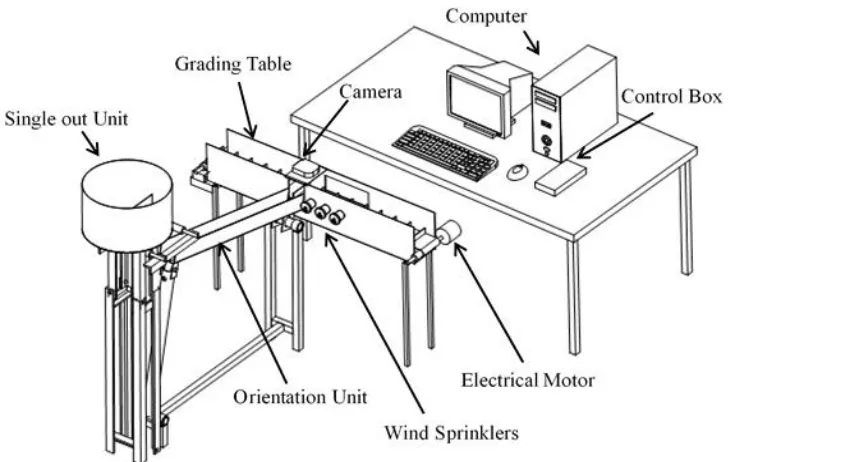
to push the apple using wind. Schema of the designed
system was shown in Figure 1.
2.1.1 The single out unit
A rotary mechanism wasemployed to separate apples
one by one. Specific size and material of instruments
were determined according to the prevention of apple
damage.The rotary mechanism rolled apples into the tank
and threw them into the hole. The size and dimensions of
the rotary mechanism were selected in a way it rolled
easily all apples in front of hole without damaging them.
The hole diameter was determined based on the largest
dimension of apples. It must be larger than the largest
dimension of apples.The falling and holding tube height
was considered 10 cm, because an apple may tolerate
about 20 cm height. The distance of 9 cmwas selected
between the falling tube and the conveyor belt to separate
from each other.The apples put into the falling tube were
located between the wooden separators on the conveyor
belt. Such separators were used to hold and control the
conveyor belt carrying apples in order to put them one by
one on the orientation unit.
2.1.2 The orientation unit
In fact, this part was a steeped surface into which two
wooden rails were located. The width, dimensions and
size were taken into consideration by Narayanan et al.
(2008a).The angles of the rails were adjustable in the
horizontal surface in 12 and 19 degrees. The rails had to
be of flexible and resistant materials. Thus, rush wood
was selected. The rails were put on a chassis into a pipe;
one side of the chassis was fixed and the other one was
adjustable to regulate the steep. Two pipes into each other
a like telescope were used to regulate the steep
angle.There were two holes on one of the pipes and one
on another in a way that when they were in front of each
other, it was possible to regulate the defined angle. The
dimensions and size of the chassis were calculated in
account of that they were in harmony with the units to
separate apples one by one for photography.
2.1.3The grading unit
Separated apples were put on the conveyor belt to
grade them in harmony with the orientation unit. A digital
camera was installed on the conveyor belt. Each apple
was put between the wooden separators on the conveyor
belt to be soled under the camera.The camera has been
already installed above the conveyor belt. To easily
eliminate the apple shade and peduncle in taken photos by
the camera, the black background was used in place of
taking photos. Thus, the image processing software could
detect only apple shape.
2.1.4 The transfer unit
The graded apples were transferred to related basket by
wind. When the apple was graded, the conveyor belt
moved and stopped in front of the related electric tap.So,
the tap was ordered by the control unit and the wind was
blown. Finally, the apple was rolled from the conveyor
belt. The wind was blown properly to avoid damaging the
apples (about five bars).
2.1.5The control box
An electric circuit was designed and fabricated to
control the moving time of the motors, operation of
conveyor belt, stop, imaging and electric taps to grade and
separate apples. The circuit includes a microcontroller
(AVR- Atmega 16) which controlled the move and stop of
the motor to put into operation conveyor belt and opened
and closed the taps on specific time according to the apple
grade.
2.1.6 The vision unit
A digital camera (model: Canon power shot A70) was
used to take the apple photo.The camera may take the
photo with the resolution of 204 × 1,536 in RGB colorful
frame (24 bits). Considering the importance of measuring
apple dimensions in the project, the light control was not
necessary during taking photos.Therefore, the photos were
taken in the environmental light.
2.1.7 The image processing software
The software operated based on trained ANN
(Artificial Neural Network). Dimensions of apple were
determined according to image processing technique.
March, 2015 Design, construction and evaluation of an automatic apple grading system Vol. 17, No. 1 251 using the determined dimensions. The operation time of
the software was controlled by the control unit.
2.2 Sample preparation
The red and golden apples used in this study were
obtained from a localmarket in Isfahan city, Iran. The
apples were cleaned manually and the damaged samples
wereremoved. In order to classify apples, three diameters
of samples were measured carefully by caliper reading to
an accuracy of 0.01 mm.According to Table 1, metered
apples were graded as four types manually.
2.3Applesphericity measurement
The sphericity percentage of samples (Ø) was
calculated by following Equation1 in each case of red and
golden apples (Mohsenin, 1986):
Ø=(LWT )L 1/3× 100 (1)
Note that, L is the biggest diameter (mm);W is medium
diameter (mm) and T is the smallest diameter of sample
(mm).
2.4 Assessment of system performance
Table 1 shows the criterion to grade apple and put the
one in a special grade. The observed main and lateral
diameters were the biggest and smallest dimensions of the
apple, respectively. The least or height diameter was a
dimension of the apple with the most size on the lateral
dimension.
Table 1 United States standards for grading apples
(USSGR, 2002)
Minimum diameter (mm) Class number
70.4 1
67.2 2
64.3 3
60.8 4
In order to evaluate the performance of constructed
units, the system was tested after assembling the units. The
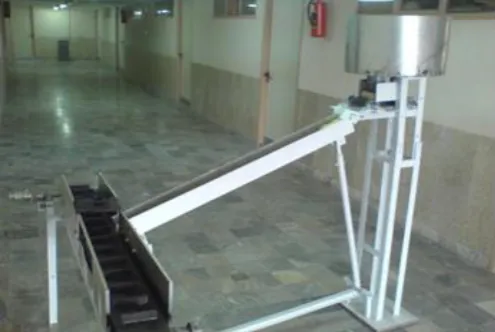
fabricated system was shown in Figure 2. Fifty graded
apples of each class, where their diameters measured by
caliper carefully, were selected.To evaluate the orientation
unit, the apples were put on the rails in three different
positions in each test and trails wererepeated ten times for
every apple.
Figure 2 The constructedapple grading system
The located positions under the camera were observed as
follows:
1. Standing position or vertical to the rail.
2. Horizontal position in a way that the peduncle and end
of the apple were in a vertical position.
3. Angular position; the peduncle and end of the apple
were at 45owith the rails.
Collected data was analyzed according to the completely
randomized design test.
3 Results and discussion
3.1Evaluation of orientated apples
The results of data analysis tests indicated that the
apples with heterogeneous form were oriented worse than
the apples with monotonous and symmetric form.Besides
that, there was a relation between the apple size andits
potential to be oriented. The apples with more height are
oriented better than the shorter ones. Because the gravity
center point of the bigger apples was in a higher position
than the gravity center point of smaller apples. So, they
moved and changed place in a way that the center of
gravity was horizontal.Thus, they were oriented better.
With studyingobtained data, it was known that the
apples with sphericity about 95% were oriented better
The way to be placed under the camera was unimportant
due to little difference between the determined main
diameter and height led to uncorrected classification.
Results of the analyzed data showed that 85% of the
apples are oriented properly.The apples relating toclass
one and threewere oriented better than the class two and
four. Furthermore, the apples were graded in the fourth
class were oriented properly very less than others.The
classification value chart was shown in Figure 3.
Comparison between obtained data and main dimensions
of the samples was demonstrated that the apples were
gradedin two and three class were oriented improperly
13%.Thus, there was error potential in their grouping.
Figure 3 Percentage of sorted apple in every mode
The factor led to improper orientation was
heterogeneous form and lack of monotonous surface of
apples. Heterogeneity and lack of monotonous surface
equalledthat the apple had bigger and smaller parts. A
sample of such apples was presented in Figure 4.Absence
of monotone surface led to roll improperly on the steeped
surface and oriented in improper direction.
Figure 4 Photo of abnormal shape apple
3.2Evaluation of image processing unit
The results of image processing software performance
indicated that, the precision of detection the size of apples
was 91% up to 96%. The error of software, prepared and
used in this study, was occurred related to apples with
poor positioning on the orientation unit. The Figure5 and
Figure 6display the appropriate and inappropriate
situation of apple were placed under the camera,
respectively.Similar to our findings, Different
investigators used the machine vision to grade apple and
they announced its performance successfully
(Garrido-Novell et al., 2012; Mizushima and Lu, 2013).
Figure 5 Corrected location of apples under the camera
Figure 6 Uncorrected location of apples under the camera
90%
85% 89%
77%
67% 72% 77% 82% 87% 92%
Class 1 Class 2 Class 3 Class 4
G
ra
d
ed
A
p
p
le (%
)
March, 2015 Design, construction and evaluation of an automatic apple grading system Vol. 17, No. 1 253
3.3 Assessment of system performance
In sum, all parts of the system operated correctly.
Considering the produced system functioned properly, it
may be concluded that it is possible to automatically
grade apples completely. Table 2 shows the necessary
time for eachelement in every section, separately. The
total time to grade one applewas measured about one
minute. The most consumed time of parts to grade one
apple was determined related to the image processing
unit.
Table 2 consumedTime for apple sorting by type of
part
Previous studies have been presentedin case of apple
grading system by other researchers (Leemans and
Destain, 2004; Throop et al., 2005; Lefcourt et al.,
2009).Whitelock et al. (2006) reported that the high
amounts of big apples were oriented well than the small
ones.Narayananet al. (2008a) used a steeped surface in
order to orient the apples and the study data indicated
about 80% of the apples were oriented by this method.
The proper orientation means the axis among the apples
was vertical to their movable direction. Other researchers
designed and fabricated a device to grade qualitatively the
apples and concluded if the peduncle was removed. The
distinction potential of the device to grade qualitatively
the apples was promoted from 95.33 to 99.04 percent
(Pordarbani et al., 2009).
4 Conclusion
The designed and constructed system was properly
functioned to grade apple without damaging the product
during operation. Although 15% of the apples were
incorrectly oriented, but 85% of them were correctly
graded infour classes.This error was due togeometric
form of apples. The heterogeneous form apples were
oriented worse than the apples via monotonous and
symmetric form.The total time to grade one apple was
about one minute. The most consumed time of operation
was determined related to the image processing by the
computer.It was found that the important element of the
apple grading system was the image processing unit,in
the paper. In all, the system was designed and fabricated
in this study can be used to grade apple automatically.
References
Azizi, J., and S. Yazdani. 2006. Investigation on export market of Iranian apple with respect to comparative advantage export index (in Farsi). Research and Development in Agriculture and Horticulture, 19(4): 145-155.
Bennedsen, B. S., D. L. Peterson, and A. Tab. 2005. Identifying defects in images of rotating apples. Computers and Electronics in Agriculture, 48(2): 92-102.
Chen, Y. R., K. Chao, and M. S. Kim. 2002. Machine vision technology for agricultural applications. Computers and Electronics in Agriculture, 36(2): 173-191.
Davies, E. R. 2005.Machine vision, third edition: theory, algorithms, practicalities (signal processing and its applications). Morgan Kaufman Publishers, San Francisco. Gao, H., and H. Sun. 2002. Mechanization and automatization of
harvested fruit disposing (in Chinese). Journal of World Agriculture, 9(1): 36-38.
Gao, H., H. Li, and H. Zhang. 2002. Automatization of post-harvested fruit grading (in Chinese). Machinery for Cereals, Oils and Food Processing, 2(1): 34-35.
Gao, H., J. Cai, and X. Liu. 2010. Automatic grading of the post-harvest fruit: a review. Computer and Computing Technologies in Agriculture III, 317(1): 141-146.
Gardiner, R. G. 1964. Apparatus for feeding and orienting fruit. U.S. Patent No. 3151729.
Hait, J. M., and B. H. Kellog. 1960. Apparatus for orienting indented fruit. U.S. Patent No. 2993174.
Iqbal, S. M. D., D. Ganesan, and P. Sudhakara Rao. 2002. Mechanical system for on-line fruits sorting and grading using machine vision technology. Journal of Instrument Society India, 34(3): 153-162.
Keesling, T. B. 1965. Fruit processing method. U.S. Patent No. 3225892.
Lefcourt, A. M., P. Narayanan, U. Tasch, M. S. Kim, D. Reese, R., Rostamian, and Y. M. Lo. 2009. Orienting apples for imaging Time, s
Part
5 Single out
1 Orientation
6-8 Taking photo
26 Image processing
using their inertial properties and random apple loading.
Biosystems Engineering, 104(1): 64-71.
Miller, B. K., and M. J. Delwiche. 1989. A color vision system for peach grading. Transactions of the ASAE, 32(4): 1484-1490. Mohsenin, N. N. 1986. Physical properties of plant and animal
materials. Gordon and Breach Science Publisher, New York. Narayanan, P., A. M. Lefcourt, U. Tasch, R. Rostamian, A.
Grinblat, and M. S. Kim. 2008a. Theoretical analysis of stability axially symmetric rotating objects with regard to orienting apples. Transactions of the ASABE, 54(4): 1353-1364.
Narayanan, P., A. M. Lefcourt, U. Tasch, R. Rostamian, and M. S. Kim. 2008b. Orientation of apples using their inertial properties.
Transactions of the ASABE, 51(6): 2073-2081.
Podsedek, A., J. Wilska-Jeszka, B. Anders, and J. Markowski. 2000. Compositional characterization of some apple varieties.
European Food Research and Technology, 210(4): 268–272. Pordarbani, R., H. R. Gasemzadeh, A. A. Golzadeh, and H. Behfar.
2009. Feasibility study of apple quality grading using image
processing (in Farsi). Iranian Food Science and Technology Research Journal, 19(1): 75-85.
Reese, D., A. M. Lefcourt, M. S. Kim, and Y. M. Lo. 2009. Using parabolic mirrors for complete imaging of apple surfaces.
Bioresource Technology, 100(19): 4499-4506.
Throop, J. A., D. J. Aneshansley, W. C. Anger, and D. L. Peterson. 2003. Conveyor design for apple orientation. ASAE Paper No. 036123; St. Joseph, Mich.: ASAE.
Throop, J. A., D. J. Aneshansley, W. C. Anger, and D. L. Peterson. 2005. Quality evaluation of apples based on surface defects: development of an automated inspection system. Postharvest Biology and Technology, 36(3): 281-290.
United States Standards for Grades of Apples. 2002. 67 FR 69663, 14p.