NaCl nanodroplet on NaCl(100) at the
melting point
T. Zykova-Timan
a,b,∗
, U. Tartaglino
a,b, D. Ceresoli
a,b,
W. Sekkal-Zaoui
cand E. Tosatti
a,b,caInternational School for Advanced Studies (SISSA-ISAS), via Beirut 2, 34014
Trieste, Italy
bINFM Democritos National Simulation Center, Trieste, Italy
cInternational Center for Theoretical Physics (ICTP), Strada Costiera 11, 34014,
Trieste, Italy
Abstract
The self-wetting properties of ionic crystal surfaces are studied, using NaCl(100) as a prototype case. The anomalously large contact angle measured long ago by Mutaftschiev [1,2] is well reproduced by realistic molecular dynamics simulations. Based on these results, and on independent determinations of the liquid-vapor (γLV) and the solid-vapor interface free energy (γSV) [3], an estimate of the solid-liquid interface free energy (γSL) is extracted. The solid-vapor surface free energy turns out to be small and similar to the liquid-vapor one, providing a direct thermodynamic explanation of the reduced wetting ability of the ionic melt.
Key words: Equilibrium thermodynamics and statistical mechanics, Molecular dynamics, Surface energy, Surface stress, Surface melting, Wetting, Alkali halides
1 Introduction
A long known unusual property of molten alkali halide salts is their remarkable inability to wet their own solid surface at the melting point, giving rise, in particular to a partial wetting angle as large as 48◦
on NaCl(100) [1,2]. While partial self-wetting must generically arise when there is non-melting of the solid surface, as has been long known e.g. for metal surfaces [4], there are so
∗ Corresponding author.
far no theoretical studies of either effects in ionic systems. In our work [3] we have investigated the properties of solid NaCl(100) near to the melting point in contact with a droplet of its own liquid.
2 Method of calculation
We carried out extensive classical molecular dynamics simulations of a nan-odroplet of liquid NaCl deposited on the solid NaCl surface. For NaCl, whose molecular model was described by the Born-Mayer-Huggins potential as pa-rameterized by Fumi and Tosi [5,6], the Coulomb long-range interactions were treated by the standard 3-dimensional Ewald method [7]. The convergence parameters for the Ewald summations were chosen in order to converge the real and reciprocal space sums to a given tolerance (10−5
Hartree per atom).
We simulated NaCl bulk systems and slabs with (100) orientation, consist-ing of about 4000–5000 molecular units. The chosen time step was 1 fs, and the typical simulation time was 200 ps. After verifying that the bulk ther-modynamic properties of solid NaCl (melting temperature, lattice expansion, volume jump at melting point [3]) are very well described we simulated the approach of a NaCl droplet on NaCl(100) surface.
We prepared a 7200 atom crystalline slab, 8 atomic planes thick (15x15x4 (NaCl)4 conventional cubic cells). The slab was gradually heated up to the
bulk melting point, keeping two atomic layers rigidly fixed at the bottom of the slab, however with a lattice spacing growing with T, in order to simulate a thermally expanding semi-infinite solid. Separately we prepared a small NaCl cluster consisting of 500 NaCl molecular units. The size of this cluster was large enough to yield after melting a near-spherical drop, and also a well-defined defined shape when the drop is deposited on the surface. The cluster was melted by heating above the bulk melting temperature (TM = 1066 K in our
model in good agreement with the experimental value TexpM = 1074 K [3]), and
then it was equilibrated at T=TM for 100 ps, yielding a well-defined spherical
liquid droplet of radius 18 ˚A.
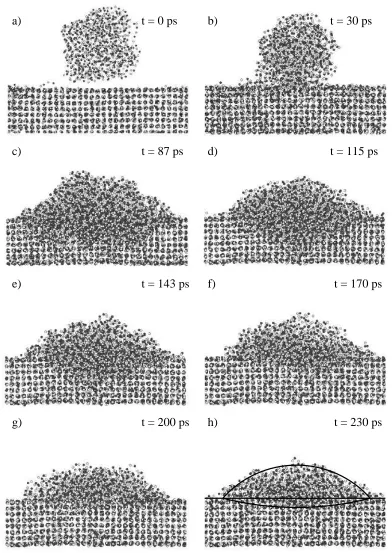
Finally, we placed the drop near the solid NaCl(100) slab surface, the lower-most atoms of the drop a distance 4 ˚A from the surface (fig. 1a). Zero vertical velocity was assigned to the drop center of mass but the drop expanded any-way to touch the surface. As soon as the drop contacted the surface, attempts at equilibrating the system at the theoretical melting temperature (TM) failed,
and the whole solid NaCl slab melted very quickly, which is compatible with the ‘fragile’ nature of non-melting of solid NaCl(100) [3]. At a much lower temperature than TM(1000 K) on the contrary, the substrate remained solid,
forming a nice “stepped” pyramid, made up of (100) facets. We succeeded finally in equilibrating the liquid nanodroplet on the solid surface at the inter-mediate temperature of 1050K, which is only slightly below TM of our model.
This is described in the following section.
3 Results
The nanodroplet and the solid slab were separately equilibrated at 1050 K. During the first 100 ps after contact, the droplet settled down on the substrate, gradually approaching the final shape (fig. 1b-d). In the next 130 ps, the droplet survived in a (not clear if metastable or unstable, but long lived) state without spreading appreciably (fig. 1e-f). At the end of our simulation, the droplet – substrate system looked like fig. 1h. The top view of fig. 2 shows that the drop spread almost circularly.
Before proceeding with further descriptions, it is important to specify the thermodynamics of this situation. Because we are below TM (even if slightly)
the final equilibrium state should consist of a flat solid NaCl(100) surface, i.e. the nanodroplet should completely spread and recrystallize. That however will take a very long time. While the nanodroplet exists, it will form an external wetting angle θLV (fig. 1), as well as an internal angle θSL. The latter θSL is
irrelevant here, because it depends critically on the temperature and on the time. In particular at short times and not too far from TM we expectθSL ≈0.
The external angleθLVis instead significant, as it should equal the macroscopic
wetting angle measured in the bubble experiment[1,2].
Assuming quasi equilibrium for the liquid nanodroplet in the sense specified above, this angle will obey Young’s equation
γSL+γLVcosθLV =γSV (1)
where the γ’s are the interface free energies.
To determine the external wetting angle θLV of the nanodroplet we analyzed
100 configurations in last 100 ps. The instantaneous atomic positions were plotted in cylindrical coordinates (r and z, where r is parallel to the sur-face), and from the profile of the drop, we determined best approximation to a portion of a sphere, by determining the center position and the radius. The contact angle follows immediately by simple geometry from these two quanti-ties. Our best estimate slightly below TMisθLV = 50
◦
±5◦
which is in excellent agreement with the experiment value at the melting point (48◦
The thermodynamical reason leading to the large observed θLV can now be
analyzed. As eq. (1) shows, a large value ofθLV may arise either due to a large
value γSL, or to a small γSV, relative to γLVor to both. These free energies at
T ≈TMare all presently unknown. While simulations are presently under way
to calculate γSV [3], we can already anticipate on purely physical arguments
that both factors namely, a large γSL and a small γSV, will indeed occur on
NaCl(100). The liquid and the solid differ enormously, in density and other properties, and this does suggest thatγSL has no reason to be small, as it was
instead in the case of metals. The solid surface free energy is instead small due to a good cancellation of the Coulomb potential outside the (100) surface, and also to a good vibrational free energy of the not solid surface [3].
4 Discussion
We can now try to relate further the wetting angle θLV to more microscopic
quantities. Di Tolla et al. [4] showed that for a non-melting metal surface, the angle θLV could be related through a simple model to the surface spinodal
temperature TS, that is the maximum temperature above TM to which the
non-melting surface can be overheated. As discussed in a companion paper to this [3], the very same model must be improved in order to describe NaCl, owing to the larger differences between solid and liquid. The free energy gain upon crystallizing the surface atT = TM, ∆γ∞= (γLV+γSL)−γSV is related
to the partial contact angle through Young’s equation (1)
cosθLV = 1−
∆γ∞ γLV
(2)
If we plug in our calculated value of γLV '104 erg/cm2 and θ = 50 ◦
± 5◦
, we obtain ∆γ∞ = 37 erg/cm
2. The large value of ∆γ
∞ represents the ”binding
energy” of the solid-liquid and liquid-vapour interfaces, to form a single one, namely solid-vapour. Assuming a standard form [8]
V(l) =−∆γ∞
2 cos 2πl
a e
−l/ξ
(3)
for the interface interactions, leads to a connection [3] between ∆γ∞ and the
solid surface spinodal temperature TS, which is the temperature where the
solid surface becomes mechanically unstable, in the form:
With our value of ∆γ∞, and L = 4.813×10
9erg/gr, a = 5.9 ˚A we predict
TS = 1210K, very close to that seen in simulations. [3]
5 Conclusion
In conclusion, molecular dynamics simulations indicate that metastable liquid NaCl nanodroplets on solid NaCl(100) can exist for some time close to TM.
They are found to exhibit an unusually large partial wetting angle, whose value is in agreement with the large macroscopic wetting angle observed in the bubble experiment. Thermodynamically this appears to be caused by an unusual small value of the solid-vapor interface free energy, as well as by a large solid-liquid interface free energy. The free energy differences extracted via Young’s equation can also be connected well with other properties, such as the solid surface spinodal temperature.
Acknowledgments
Project was sponsored by Italian Ministry of University and Research, through COFIN02, COFIN03, and FIRB RBAU01LX5H; and by INFM, through PRA NANORUB and and “Iniziativa Trasversale calcolo parallelo”. Calculations were performed on the IBM-SP4 at CINECA, Casalecchio (Bologna).
References
[1] G. Grange and B. Mutaftschiev, Surf.Sci.47, 723 (1975).
[2] B. Mutaftschiev, J. Cryst. Growth 182, 205 (1997).
[3] T. Zykova-Timan, U. Tartaglino, D. Ceresoli, W. Sekkal-Zaoui, E. A. Jagla and E. Tosatti, to be published.
[4] F. D. Di Tolla, F. Ercolessi and E. Tosatti, Phys. Rev. Lett. 74, 3201 (1995); F. D. Di Tolla, E. Tosatti and F. Ercolessi, Interplay of melting, wetting, overheating and faceting on metal surfaces: theory and simulation, in Monte Carlo and molecular dynamics of condensed matter systems (ed. by K. Binder and G. Ciccotti), SIF, Bologna, 1996.
[5] M. P. Tosi and F. Fumi, J. Chem. Phys. Solids 25, 45 (1964).
[7] M. A. Allen and D. J. Tildesley, “Computer Simulation of Liquids”, Oxford Science Press, Oxford, 1987.
[8] B. Pluis, T. N. Taylor, D. Frenkel and J. F. van der Veen, Phys. Rev. B 40 (1989) 1353.
c) d)
a) b)
e)
t = 0 ps t = 30 ps
t = 87 ps
g)
t = 115 ps
t = 170 ps
t = 230 ps f)
h) t = 143 ps
t = 200 ps
Fig. 1. Time evolution of the liquid NaCl drop on NaCl(100). Dark and light circles stand for the Na+ and Cl−
Fig. 2. Top view of the liquid droplet on the NaCl(100) after 230 ps. Dark and light circles stand for the Na+ and Cl−
ions respectively.