The Thirty-Third AAAI Conference on Artificial Intelligence (AAAI-19)
Implanting Rational Knowledge into
Distributed Representation at Morpheme Level
Zi Lin,
1,3Yang Liu
2,31Department of Chinese Language and Literature, Peking University
2Institute of Computational Linguistics, Peking University
3Key Laboratory of Computational Linguistics (Ministry of Education), Peking University
{zi.lin, liuyang}@pku.edu.cn
Abstract
Previously, researchers paid no attention to the creation of unambiguous morpheme embeddings independent from the corpus, while such information plays an important role in ex-pressing the exact meanings of words for parataxis languages like Chinese. In this paper, after constructing the Chinese lex-ical and semantic ontology based on word-formation, we pro-pose a novel approach to implanting the structured rational knowledge into distributed representation at morpheme level, naturally avoiding heavy disambiguation in the corpus. We design a template to create the instances as pseudo-sentences merely from the pieces of knowledge of morphemes built in the lexicon. To exploit hierarchical information and tackle the data sparseness problem, the instance proliferation tech-nique is applied based on similarity to expand the collection of pseudo-sentences. The distributed representation for mor-phemes can then be trained on these pseudo-sentences using word2vec. For evaluation, we validate the paradigmatic and syntagmatic relations of morpheme embeddings, and apply the obtained embeddings to word similarity measurement, achieving significant improvements over the classical mod-els by more than 5 Spearman scores or 8 percentage points, which shows very promising prospects for adoption of the new source of knowledge.
Introduction
Nowadays, learning representations for the meanings of words has been a key problem in natural language process-ing (NLP). The basic unit in NLP is usually and mainly word. However, for parataxis languages like Chinese, which is made up of hieroglyphic characters,wordis not a natural unit, and character can provide yet rich semantic informa-tion (Fu 1981; Xu 2004).
Theoretically, the meanings of Chinese words can be de-duced from the meanings of characters. However, the same Chinese characters within words may hold different mean-ings, so the meanings of an identical character should be fur-ther differentiated. For example, in the words “hu¯a qi´an” (to spend money) and “t´ao hu¯a” (peach-blossom), the character meanings of “hu¯a” are not the same. Chinese linguists use the term yusu(morpheme) to distinguish identical charac-ters with different meanings, which is defined asthe small-est combination of meaning and phonetic sound in Chinese
Copyright c2019, Association for the Advancement of Artificial Intelligence (www.aaai.org). All rights reserved.
(Zhu 1982). Previously, linguists define morpheme as the smallest meaning-bearing unit of language as well as the smallest unit of syntax(Matthews 1972). The Chinese mor-pheme is close to this definition in terms of semantics but requires a smallest phonetic sound, i.e., it should correspond to a character in form. Therefore, the character “hu¯a” in “hu¯a qi´an” and “t´ao hu¯a” refers to different morphemes “hu¯a1”
and “hu¯a2”. We sometimes use the term sememe to refer to
the meanings of morphemes, so the sememe of “hu¯a1” isto spend, while the sememe of “hu¯a2” isflowers.
The meanings of words and the meanings of morphemes are highly related to some extent, and the sub-units of words will form patterns during word-building. For example, in Chinese words “t´ao hu¯a” (peach-blossom) and “h´e hu¯a” (lotus-blossom), one will find “hu¯a”, which meansflowers, as a common component. The components before “hu¯a”, as different modifiers, also hold their meanings. These words are of Modifier-Head structure, and the morphology is some-what similar to that of syntax in Chinese.
Therefore, morphemes and their combination patterns are very important for the generation of the meanings of words. Researchers have addressed the importance of mor-phological compositionality and word-formation analysis. (Lazaridou et al. 2013) explored the application of com-positional distributed semantic models, originally designed to learn phrase meanings. (Luong, Socher, and Manning 2013) combined recursive neural networks with neural lan-guage models to consider contextual information in learning morphologically-aware word representations.
As for Chinese, (Chen et al. 2015) proposed a character-enhanced word embeddings model (CWE) by regarding the word as the simple combination of characters and obtained character embeddings on the corpus, without further knowl-edge of morphemes or sememes input. (Niu et al. 2017) em-ployed HowNet to learn word representation on corpus for the SE-WRL model. By using attention schema for rough word sense disambiguation, HowNet sememe embeddings were thus obtained directly from the large-scale corpus.
To avoid sense disambiguation on the corpus, there was also work trying to obtain word sense embeddings by leveraging the dictionary definitions or lexical resources.
sampling filters out pairs whose words are unrelated in dic-tionaries (Tissier, Gravier, and Habrard 2017). As there is no structured knowledge can be exploited in the dictionar-ies, such selection of word pairs tended to be cumbersome and complicated. WordNet2vec (Bartusiak et al. 2017) created vectors for each word from WordNet by first simpli-fying the WordNet structure into a graph and then utilizing the shortest paths to encode the words, which cannot distin-guish and retain the specific semantic relations.
To the best of our knowledge, all these works aimed to get better representations for words, while little emphasis has been laid on creation and analysis of relatively independent morpheme embeddings. Also, all the works relied highly on corpora or simple dictionary knowledge, and have not been able to form distributed representation directly from the structured rational knowledge.
In this paper, after constructing the Chinese lexical and semantic ontology based on word-formation, we propose a novel approach to implanting the structured rational knowl-edge into distributed representation at morpheme level with-out using any text corpus. We first introduce the construction of rational knowledge of Chinese morphemes at Peking Uni-versity. Then we extract this knowledge to design a template to create instances and proliferate instances based on simi-larity, as a source to train data for morpheme embeddings. For evaluation, we validate the paradigmatic and syntag-matic relations for morpheme embeddings, and apply the ob-tained embeddings to word similarity measurement, achiev-ing significant improvements over the classical models1.
Constructing Rational Knowledge of
Morphemes
In recent years, Chinese lexical and semantic ontologies such as Hantology (Chou 2005) and HowNet (Dong, Dong, and Hao 2007) have exhibited valuable work related to mor-phemes.
One is Hantology. It’s known that a Chinese character sometimes can be roughly deduced to a radical as a part of it, which may help to predict the category of the character. Some radicals themselves even stand alone, known as rad-ical characters. Hantology exploits some 540 radrad-ical char-acters ofShuoWen2 as basic semantic symbols of Chinese.
However, it is also limited to the use of radical characters, regardless of thousands of common Chinese characters in-volving about 20,000 morphemes. Hantology is obviously lacking in fine-grained representation of morphemes.
Another is HowNet. The contributors hypothesize that all the lexicalized concepts can be reduced to the relevant se-memes. They, by personal introspection and examination, al-legedly arrive at a set of around 2,800 language-independent sememes. Having no morphological analysis as the basis,
1
The data of morpheme embeddings and word similarity mea-surement is available at https://github.com/zi-lin/MC for research purpose.
2
Shuowenis historically the first dictionary to analyze the struc-tures and meanings of Chinese characters and give the rationale behind them.
the definitions of HowNet sememes are just abstract and pro-totypic, failing to be linked with any real and existing Chi-nese radical characters or characters or morphemes. Such assumptions may lead to doubt about its objectivity and cov-erage of Chinese semantics.
According to the above analysis, for construction of lan-guage resources, we want to ensure method objectivity as well as data coverage, and fully consider the characteristics of Chinese, i.e., the close relationship between a word and its morphemes.
For years of development, theChinese Object-Oriented Lexicon(COOL) of Peking University has been in process (Liu, Lin, and Kang 2018). We adopt theSynonymous Mor-pheme Set(SMS) to denote theMorphemic Concept(MC) and build the hierarchy of MCs. On this basis,COOLfurther describes word-formation pattern and forms strict bindings between morphemes as sub-units of words and the MCs. Such rational knowledge may be applied to the fields of hu-manities as well as to industries. We plan to release our lex-icon in the near future for research purpose.
Constructing MCs and the Hierarchy
Morpheme Extraction and Encoding To make sure of full coverage and fine granularity, the collection of our mor-phemes and words is from the 5th edition ofXiandai Hanyu Cidian (Contemporary Chinese Dictionary, CCD) by the Commercial Press, the most influential dictionary in China. CCD contains Chinese morphemes as well as their sense definitions, which have been carefully made by lexicogra-phers for tens of years.
As different morphemes may originate from the identical character, we then set a unique encoding for each morpheme in CCD in the formatH X1 X2 X3, whereHrepresents the character as host, andX1means that the current morpheme is theX1thentry of this host in the dictionary,X2means that there areX2 sememes in all for this entry, andX3 means that the current is theX3thsememe. For example, the char-acter “sh`u” carries 4 sense definitions in the dictionary, cor-responding to 4 different morphemes and sememes, and ac-quires encodings as shown in Table 1.
Encoding Sense Definition (Sememe)
树1_04_01 木本植物的通称 (general term of woody plant) 树1_04_02 移植,栽培 (to plant)
树1_04_03 树立,建立 (to set up) 树1_04_04 姓氏 (surname)
Table 1: Examples of morphemes
interjec-tion and affix morphemes. The free morphemes have postags in the dictionary, and for the bound morphemes, we manu-ally annotated the postags of them as complement. We found that nominal, verbal and adjectival morphemes hold a total of 88.74% of Chinese morphemes as the main body, while the rest amounts to 11.26%.
Forming MCs Some morphemes in Chinese actually cor-respond to the same or similar sememes. For example, morphemes “sh`u1 04 01” and “m`u1 07 01” all refer to the meaning of general term of woody plant. Clustering such morphemes together will help to get basic semantic units with high information density. Therefore, we are inspired to merge and represent morphemes in form of SMSs, and try to exploit such pieces of knowledge for further use.
To get reliable SMSs and considering that lexicographers used same or similar brief wordings for some sense defini-tions of morphemes, we measure the sememe similarity by using the co-occurrence model. The automatic clustering is just a reference for the substantial manual annotation, which ensures both the efficiency and the quality of the construc-tion. For a particular sense definition, according to its se-mantic similarity score with others in descending order, and by hand-correcting, we form a corresponding SMS. Repeat this process until all the meanings of morphemes with the same POS are covered, and then turn to other POSs until all sense definitions are covered.
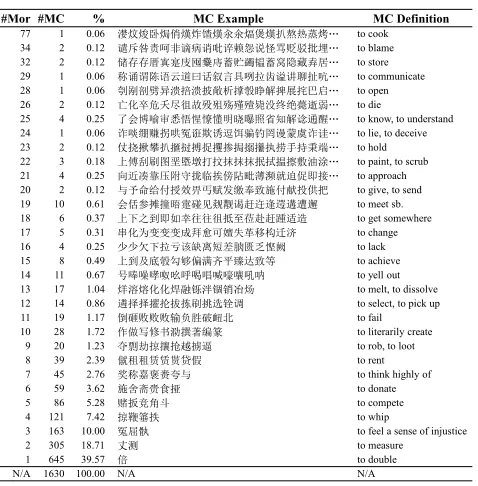
These SMSs just refer to the MCs of Chinese. By now, we have achieved 4,198 MCs for morphemes of the main body, including 2,018 nominal MCs, 1,630 verbal MCs and 550 adjectival MCs respectively. These MCs then form a collec-tion of all the smallest semantic units of Chinese, showing a clear advantage of data coverage and method objectivity.
For example, here we list samples of verbal MCs in Table 2, with the different cardinality of SMS (the number of mor-phemes in the SMS,#Morfor short), i.e., the size of the MC.
#MCthen refers to the total number of MCs with regards to a particular #Mor. Here we just list one MC example for each #Mor, along with its MC definition. For layout problem, we just remove the morpheme encodings and show characters as morphemes in the figure (so multiple occurrences of an identical character are allowed).
Building the Hierarchy of MCs Up to this point, the MCs are still discrete concepts. However, some MCs are highly related to others semantically. For example, as paradigmatic relation, the nominal MCs which mean herbageand xylo-phyta all denote the meaning ofplant; as syntagmatic re-lation, the verbal MCs which meanto sprout andto grow, and the adjectival MCs which meanluxuriantandsere, are relevant to the MCs in connection withplant. Therefore, to express those relations, a hierarchical structure for all the MCs is needed in organizing the knowledge base, with the purpose of facilitating reasoning and computing afterwards. Inspired by WordNet (Miller and Fellbaum 1998), the nominal MCs are structuralized based on hypernymy rela-tion. As for MCs of other POSs, we are enlightened by the Generative Lexicon Theory (Pustejovsky 1995) to build a hierarchy where the nominal MCs are of the core structure. The verbal MCs refer to actions of the nominal, while
ad-#Mor #MC % MC Example MC Definition
77 1 0.06 漤炆焌卧焗俏熯炸馇熯汆氽煏煲熯扒熬热蒸烤… to cook 34 2 0.12 谴斥咎责呵非谪病诮吡谇赖怨说怪骂贬驳批埋… to blame 32 2 0.12 储存存厝寘寔庋囤櫜庤蓄贮蠲韫蓄窝隐藏弆居… to store 29 1 0.06 称诵谓陈语云道曰话叙言具咧拉齿谥讲聊扯吭… to communicate 28 1 0.06 刳剐剖劈异溃掊溃披敞析撑彀睁解捭展挓巴启… to open 26 2 0.12 亡化卒危夭尽徂故殁殂殇殣殪毙没终绝薨逝弱… to die
25 4 0.25 了会博喻审悉悟惺憭懂明晓曝照省知解谂通醒… to know, to understand 24 1 0.06 诈啖绷赚拐哄冤诳欺诱逗饵骗钓罔谩蒙虞诈诖… to lie, to deceive 23 2 0.12 仗挠揪攀扒擓挝搏捉攫掺挶搦攥执捞手持秉端… to hold 22 3 0.18 上傅刮刷图垩塈墩打抆抹抹抹抿拭揾擦敷油涂… to paint, to scrub 21 4 0.25 向近凑靠压附守拢临挨傍阽毗薄濒就迫促即接… to approach 20 2 0.12 与予命给付授效畀丐赋发缴奉致施付献投供把 to give, to send 19 10 0.61 会佸参摊撞晤疐碰见觌觏谒赶迕逢遌遘遭邂 to meet sb. 18 6 0.37 上下之到即如幸往往徂抵至莅赴赶踵适造 to get somewhere 17 5 0.31 串化为变变变成拜愈可嬗失革移构迁济 to change 16 4 0.25 少少欠下拉亏该缺离短差朒匮乏悭阙 to lack 15 8 0.49 上到及底彀勾够偏满齐平臻达致等 to achieve 14 11 0.67 号唪噪哮呶吆呼喝唱喊嚎嚷吼呐 to yell out 13 17 1.04 烊溶熔化化焊融铄泮锢销冶炀 to melt, to dissolve 12 14 0.86 遴择择擢抡拔拣刷挑选铨调 to select, to pick up 11 19 1.17 倒砸败败败输负胜破衄北 to fail 10 28 1.72 作做写修书泐撰著编篆 to literarily create
9 20 1.23 夺剽劫掠攘抢越掳逼 to rob, to loot 8 39 2.39 僦租租赁赁贳贷假 to rent 7 45 2.76 奖称嘉褒赉夸与 to think highly of 6 59 3.62 施舍斋赍食挜 to donate 5 86 5.28 赌扳竞角斗 to compete
4 121 7.42 掠鞭箠抶 to whip
3 163 10.00 冤屈骫 to feel a sense of injustice
2 305 18.71 丈测 to measure
1 645 39.57 倍 to double
N/A 1630 100.00 N/A N/A
Table 2: Samples of verbal MCs and their definitions
jectival MCs refer to attributes of the nominal. In this way, the hierarchy of the main body of Chinese morphemes, com-prising the nominal, verbal and adjectival, is internally iso-morphic in general.
By making use of this solution, we have obtained paradig-matic relations within the same POS and syntagparadig-matic rela-tions across different POSs for Chinese morphemes.
Word-Formation Tagging
As Chinese linguists argued, morphemes as sub-units of words have particular formation patterns in word-building (Chao 1968; Liu 1990). It is necessary to explore these patterns for understanding larger language units like words.
Word-formation Pattern Example Percentage 定中(Modifier-Head) 红旗(red-flag) 37.94%
联合(Parallel) 买卖(buy-sell) 21.90%
述宾(Verb-Object) 植树(plant-tree) 15.62%
状中(Adverb-Verb) 广播(widely-broadcast) 8.09%
后附加(Suffixation) 里头(inside-∅) 4.43%
单纯词(Noncompound) 克隆(clone) 3.99%
连谓(Verb-Verb) 剪贴(clip-paste) 3.28%
前附加(Prefixation) 老虎(∅-tiger) 1.34%
述补(Verb-Complement) 击毙(shoot-died) 1.21%
主谓(Subject-Predicate) 地震(earth-quake) 1.01%
重叠(Overlapping) 星星(star-star) 0.59%
介宾(Preposition-Object) 从小(from-youth) 0.30%
名量(Noun-Classifier) 纸张(paper-piece) 0.15%
数量(Quantifier) 一天(one-day) 0.11%
复量(Classifier-Classifier) 人次(person-(per)time) 0.04%
Table 3: Word-formation patterns and examples
Word POS Word-Formation 1st-MC POS 2nd-MC POS 1st-MC 2nd-MC
植树(plant-tree) 动词(Verb) 述宾(Verb-Object) 动语素(Verbal) 名语素(Nominal) 养1_11_02 木1_07_01
Table 4: Demo of the piece of rational knowledge at morpheme level. For brevity, we use the first morpheme encoding in each MC to denote the MC itself.
<B> <B>-<1st-MC POS> <POS> <1st-MC> <2nd-MC> <Word-Formation> <E> B B-Verbal Verb {养1_11_02} {木1_07_01} Verb-Object E
Table 5: The designed template (the first line) and the pseudo-sentence for the word “zh´ı sh`u” (plant-tree) (the second line).
<B>and<E>refers to the begin-position and the end-position respectively.
Semantic labels have advantages of naturalness and intuition but are hard to unify and too complicated to be processed by computers. In contrast, syntactic labels are relatively sim-ple and uniform and are somewhat consistent with syntactic structures (Fu 2003). Therefore, we eventually choose the labels of word-formation geared towards syntactics to facil-itate the construction of the resources. It is noteworthy that after the strict binding between morphemes and the achieved MCs, we actually acquire semantic word-formation knowl-edge to some extent.
After data analysis, we adopted a collection of 15 labels for Chinese word-formation tagging. The example and per-centage of each word-formation pattern are listed in Table 3. By now, 52,108 Chinese disyllabic words in CCD have all been labelled with their word-formation patterns.
Binding between Sub-units of Words and MCs
After the work of and , this procedure aims to provide character-to-morpheme bindings for Chinese words, i.e., we want to assign specific MCs to morphemes as sub-units of words.
For all these 52,108 Chinese disyllabic words, we list all the possible morphemes for the first and second character, among which we choose the appropriate ones. For example, for word “zh´ı sh`u” (plant-tree), the first sememe isto plant, while the second sememe isgeneral term of the woody plant. Since each sememe corresponds to a unique morpheme encoding, the word is now formalized as <zh´ı1 04 01, sh`u1 04 01>. It is noted that each morpheme encoding longs to a unique MC, and this actually fulfills bindings be-tween sub-units of words and MCs. The morphemes within words would now be constrained by the hierarchy of MCs.
Taking advantage of such lexical and semantic knowledge representation,COOLmay meet a variety of needs. In hu-manities, it shows potential in Chinese lexicography (e.g. concept-based browser), Chinese teaching (e.g., level evalu-ation standard), language study (e.g., Chinese ontology), etc. Such interdisciplinary applications can benefit from these pieces of rational knowledge (Liu, Lin, and Kang 2018). As for NLP, to cope with the difficulties of full seman-tic prediction of unknown words, it can give specific lexi-cal and semantic generation according to tasks and require-ments, showing a high level of flexibility and tailorabil-ity. We leveraged the rich information of COOL to
pre-dict word-formation patterns, morphemes and their postags within words. Our result of prediction is simple and easy for applications (Tian and Liu 2016).
Training Distributed Representation for
Morphemes
Vector-space word representation has been successful in re-cent years across a variety of NLP tasks (Luong, Socher, and Manning 2013). Apart from rational methods in the above-mentioned application, we are motivated to implant such valuable knowledge into distributed representation. How-ever, how to generate the so-called corpus based on such knowledge is a central issue and makes a big challenge. And till now there has not been such practice and approach re-ported.
To address this issue, we design a template based on the structured rational knowledge to generate the instances, and conduct instance proliferation to exploit hierarchical infor-mation and tackle data sparseness problem. Such prolifer-ated instances of the word by semantic word-formation, as pseudo-sentences, have thus formed acorpusrelevant to ra-tional knowledge built in the lexicon. Then word2vec is ap-plied to suchcorpusto obtain distributed representation for morphemes.
Template Design
Instead of using context words to predict the target word, we try to make full use of the piece of rational knowledge to generate the instantiated pseudo-sentence of morphemes. To achieve this, we propose to design a template to create the in-stances merely from the pieces of rational knowledge built in the lexicon. Under this assumption, word by semantic word-formation actually represents a certain and real occurrence of the combination of morphemes as in their respective MCs. Each pseudo-sentence in the so-calledcorpusnow refers to the instance of a word by semantic word-formation.
The piece of knowledge for use at morpheme level is shown in Table 4. As for such piece of information, we hence design the template as shown in the first line in Ta-ble 5. Accordingly, the pseudo-sentence for the word “zh´ı sh`u” (plant-tree) is generated as shown in the second line.
Ca Cb Ca Ca
Seed Word 养1_11_02 木1_07_01
养1_11_02 (to plant)
浇1_04_03 (to water) ... ...
耕1_02_01 (to cultivate)
木1_07_01 (tree)
李1_03_01 (fruit) ... ...
禾1_03_02 (crop)
Pseudo-Sentences
<养1_11_02, 木1_07_01>, <养1_11_02, 李1_03_01>, ..., <养1_11_02, 禾1_03_02> <浇1_04_03, 木1_07_01>, <浇1_04_03, 李1_03_01>, ..., <浇1_04_03, 禾1_03_02> ... ...
<耕1_02_01, 木1_07_01>, <耕1_02_01, 李1_03_01>, ..., <耕1_02_01, 禾1_03_02>
Table 6: Demo of instance proliferation by similarity for the seed word “zh´ı sh`u” (plant-tree) (<yˇang1 11 02 m`u1 07 01>), whereCaandCbrefer to a set of similar MCCaandCb.
applying the template to all the disyllabic words in the lexi-con.
Instance Proliferation
To exploit hierarchical information and tackle data sparse-ness problem, we go on to expand our lexicon based on similarity measurement of the achieved MCs. The similarity score between two MCs (C1,C2) in the hierarchy of MCs is defined as
sim(C1, C2) =2× |path(C1)∩path(C2)|
|path(C1)|+|path(C2)|
(1)
wherepath(C)is the set of all the tree nodes along the path from the root to the tree nodeC.
According to the threshold, for a certain MCC, a set of similar MCs can be achieved asC. For every morphemea∈
Caandb∈Cb, if they ever happen to form a disyllabic word
abin the lexicon, we then generate more pseudo-sentences betweenCa andCb. As for the missing knowledge of POS
and word-formation, it is naturally assumed to be the same as the original one. In this way, the seed word can now be proliferated intonpseudo-sentences, wheren=|Ca×Cb|.
For example, the proliferated instances we get for the seed word “zh´ı sh`u” (plant-tree) (<yˇang1 11 02 m`u1 07 01>) are listed in Table 6.
We set the threshold equal to 0.85 in the experiments and finally get a total of54,880,628pseudo-sentences from
52,108real disyllabic words as the seeds input.
Data Training
Word2vec (Mikolov et al. 2013) is an algorithm to learn distributed word representation using a neural language model. It has two models, the continuous bag-of-words one (CBOW) and the skip-gram one.
In this paper, we train the distributed representation for morphemes based on CBOW, which aims at predicting the target word given context words in a sliding window. For morpheme embeddings on these 54,880,628 pseudo-sentences, we set the dimension to 20 and context window size to 3 to include all the rational knowledge when the MC is the target word.
Experimental Results and Evaluation
By the above approach we proposed, the rational knowledge of morphemes is now implanted into distributed represen-tation. To evaluate such representation, intrinsic evaluation, such as paradigmatic and syntagmatic relations among mor-phemes, and extrinsic evaluation like word similarity mea-surement are taken into consideration.
Figure 1: Illustration of paradigmatic MCs in 2D planes
Paradigmatic Relation Validation
dimen-Morpheme MC Nearest MCs
法1_07_01 (law) {宪1_03_02, 制1_05_04, ..., 辟4_01_01}
{命2_03_01, 号3_04_01, ..., 禁1_04_03} (command) {禅1_02_02, 佛3_05_03, ..., 藏1_02_02} (Dharma) {墨1_10_08, 黥1_02_02, ..., 刑1_03_02} (punishment)
法1_07_02 (method) {道1_12_03, 方3_02_01, ..., 筹1_03_03}
{典1_06_01, 度2_15_06, ..., 师1_07_02} (model)
{揆1_04_02, 理1_07_02, ..., 谛1_02_02} (theory and principle) {准2_06_01, 标1_10_04, 杠1_07_07} (standard)
法1_07_04 (to emulate) {则1_05_03, 宗1_08_05, ..., 象2_02_02}
{问1_06_01, 叩1_04_03, ..., 难1_02_02} (to address inquiries) {绎1_01_01, 验1_03_01, ..., 搜1_02_02} (to search)
{造1_03_02, 编1_09_05, ..., 蔑2_01_01} (to make up)
Table 7: Different morphemes with identical character “fˇa” and their nearest MCs
MC Top-Related MCs
{骏1_01_01, 马1_03_01, ..., 驹1_02_02} (horse)
{骏1_01_01, 马1_03_01, ..., 驹1_02_02} (horse) {镫1_01_01, 鞍1_01_01, ..., 鞒1_01_01} (saddle) {兵1_05_02, 军1_03_01, ..., 卒1_03_01} (soldier)
{鸡1_02_01, 鸭1_01_01,..., 鹅1_01_01} (fowl)
{仔3_01_01, 子1_13_08, ..., 雏1_02_02} (chick) {野1_07_04} (wild)
{坤1_02_02, 母1_06_03, ..., 牝1_01_01} (female)
{牛1_04_01, 牦1_01_01, ..., 犊1_01_01} (cattle)
{乳1_05_03, 奶1_03_02} (milk)
{牛1_04_01, 牦1_01_01, ..., 犊1_01_01} (cattle) {土1_07_01,垆1_01_01, ..., 壤1_03_01} (soil)
Table 8: Different MCs and their related MCs in word-building
sional reduction on morpheme embeddings to show paradig-matic relations as internal knowledge input. The results are illustrated in Figure 1.
We further take different morphemes with the identical character for example and list their corresponding MCs. Ta-ble 7 illustrates the nearest 3 MCs of each morpheme for observation. It can be observed that the MCs with similar meanings are naturally gathered together in general.
Syntagmatic Relation Validation
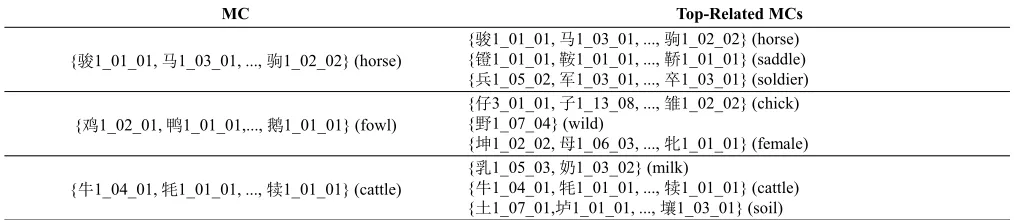
In addition to paradigmatic relations, we also explore the syntagmatic relations as internal knowledge input, i.e., which morphemes are more likely to form words.
For each MC, we predict its context words, which are the rational knowledge already input, and extract the most prob-able MCs in the context words.
We list some of the MCs and 3 of their top-related MCs in Table 8, from which it can be observed that given a specific MC, which MCs are prone to be involved in word-building. From the table, we notice that the cases of combination ob-tained from morpheme embeddings are quite consistent with human judgment. Take MC which meanshorsefor example, many words can be formed between the MC and its top-related MCs, such as “j`un mˇa” (steed), “mˇa j¯u” (foal), “mˇa ¯an” (saddle) and “q´ı b¯ing” (cavalryman).
Word Similarity Measurement
The above are all intrinsic evaluation. For extrinsic evalu-ation, word similarity computation is an appropriate task. In order to compute the semantic distance between word pairs, many previous works take words as basic units and
learn word embeddings according to external knowledge (contexts), ignoring the internal knowledge of words (mor-phemes and word-formations). However, as we argued, the internal knowledge also plays an important role in Chinese. The ideal way to measure semantic similarity may be to combine external and internal knowledge together.
Word-Formation Pattern 1st-MC 2nd-MC
后附加(Suffixation) 1 0
述补(Vreb-Compliment) 0.8 0.2
述宾(Verb-Object) 0.6 0.4
联合(Parallel) 0.5 0.5
单纯词(Noncompound) 0.5 0.5
定中(Modifier-Head) 0.45 0.55
状中(Adverb-Verb) 0.45 0.55
主谓(Subject-Predicate) 0.4 0.6
前附加(Prefixation) 0 1
Table 9: Weight assignments for different word-formation patterns
Based on this, we try to obtain word embedding for each word by a weighted average of itsnmorpheme embeddings. It is calculated asvi=P
n
k=1wik×cik, wherevistands for
the word vector of the ith word in the lexicon,w
ik is the
weight assigned by the above table andcikis the morpheme
embedding which thekthcharacter corresponds to. This is how our MC model will work on word similarity by purely exploiting internal knowledge.
As for CBOW and skip-gram, we use the corpus ofBaidu Encyclopedia, which contains 203.69 million words in to-tal. In the experiments, the dimension is set to 50, and the context window size is set to 5. Cosine similarity is ap-plied to measure word similarity score for models of CBOW, skip-gram and MC individually. We also combine similarity scores obtained from the classical model (CBOW and skip-gram respectively) and MC model with the same weight assignment, namely the hybrid models of CBOW+MC and skip-gram+MC.
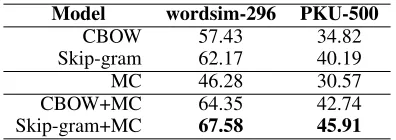
In the experiments, wordsim-296 (Jin and Wu 2012) and PKU-500 (Wu and Li 2016) are used as evaluation datasets. We extract the disyllabic words in the datasets and get a total of 141 word pairs in wordsim-296 and 232 word pairs in PKU-500 respectively. These serve as the test sets for word similarity measurement. Spearman’s correlation ρ(Myers, Well, and Lorch 2010) is then adopted to evaluate all the outputs on the test sets. The experimental results of the 5 models are shown in Table 10.
Model wordsim-296 PKU-500
CBOW 57.43 34.82
Skip-gram 62.17 40.19
MC 46.28 30.57
CBOW+MC 64.35 42.74
Skip-gram+MC 67.58 45.91
Table 10: Evaluation results on wordsim-296 and PKU-500 (ρ×100)
Note that our morpheme embeddings are trained with only 52,108 original pieces of semantic word-formation knowledge (approximately 2.79 MB of storage as in the ex-periments), without a corpus of data harnessed as before. The MC model, by purely exploiting such internal knowl-edge, alone achieves a fairly good performance, compared with the classical models. Furthermore, experiments on test sets show that the hybrid models of CBOW+MC and Skip-gram+MC, by exploiting external and internal knowledge, achieve significant improvements over the classical models by more than 5 Spearman scores or 8 percentage points. This indicates that both sources of knowledge are very valuable and highly complementary in expressing the meanings of words.
As for the combination for hybrid models, we set differ-ent weight assignmdiffer-ents for similarity scores obtained from the classical model (CBOW and skip-gram respectively) and MC model to explore the cases. The correlation between in-ternal knowledge adopted and performance is shown in Fig-ure 2. Considering the global optimum for both test sets,
:HLJKWDVVLJQPHQWIRULQWHUQDONQRZOHGJH
3HUIRUPDQFH
&%2:0&ZRUGVLP 6NLSJUDP0&ZRUGVLP &%2:0&3.8 6NLSJUDP0&3.8
Figure 2: Correlation between weight assignment for inter-nal knowledge and performance
the most ideal weight assignment for internal and external knowledge is0.35 : 0.65in the experiments, which has been adopted and yielded the results in Table 10.
Conclusion
In this paper, after constructing the Chinese lexical and se-mantic ontology based on word-formation, we try to implant the structured rational knowledge into distributed represen-tation at morpheme level without using any text corpus. For evaluation, we validate the paradigmatic and syntagmatic re-lations of morpheme embeddings, and apply the obtained embeddings to word similarity measurement, achieving sig-nificant improvements over the classical models by more than 5 Spearman scores or 8 percentage points.
The key contributions of this work are as follows: (1) We, for the first time, put forward an approach to implanting the structured rational knowledge into distributed representation by merely using the lexicon. As the form of such piece of knowledge is almost common to most knowledge bases, we actually present an inspiring way of obtaining distributed representation for the desired language units described in the lexicons. (2) For parataxis languages like Chinese, mor-phemes as the basic units play an important role in express-ing the exact meanexpress-ings of words. It is a convenient way by obtaining unambiguous morpheme embeddings simply based on the descriptions in the lexicon, which naturally avoids heavy disambiguation in the corpus as before (Luo et al. 2018a; 2018b).
Acknowledgments
This work is supported by National Social Science Fund of China (General Project, No. 16YY137). We thank the anonymous reviewers for their helpful comments. The cor-responding author of this paper is Yang Liu.
References
Bartusiak, R.; Augustyniak, Ł.; Kajdanowicz, T.; Kazienko, P.; and Piasecki, M. 2017. Wordnet2vec: Corpora agnostic word vectorization method. Neurocomputing.
Chao, Y. R. 1968. A grammar of spoken Chinese. USA: CA: University of California Press.
Chen, X.; Xu, L.; Liu, Z.; Sun, M.; and Luan, H.-B. 2015. Joint Learning of Character and Word Embeddings. In IJ-CAI, 1236–1242.
Chou, Y.-M. 2005. Hantology: The Knowledge Structure of Chinese Writing System and Its Applications. PhD disserta-tion, National Taiwan University.
Dong, Z.; Dong, Q.; and Hao, C. 2007. Theoretical Find-ings of HowNet.Journal of Chinese Information Processing
21(4):3–9.
Fu, H. 1981. The Relationship between Lexical Meaning and Meanings of Morphemes Constituting Words. Lexico-graphical Studies(01):98–110.
Fu, A. 2003. Word Formation and the Recognition of Com-pounds in Chinese Language Understanding. Applied Lin-guistics (China)(04):25–33.
Jin, P., and Wu, Y. 2012. Semeval-2012 task 4: Evaluat-ing Chinese word similarity. In Proceedings of the First Joint Conference on Lexical and Computational Semantics-Volume 1: Proceedings of the main conference and the shared task, and Volume 2: Proceedings of the Sixth Inter-national Workshop on Semantic Evaluation, 374–377. As-sociation for Computational Linguistics.
Lazaridou, A.; Marelli, M.; Zamparelli, R.; and Baroni, M. 2013. Compositional-ly derived representations of morpho-logically complex words in distributional semantics. In Pro-ceedings of the 51st Annual Meeting of the Association for Computational Linguistics (Volume 1: Long Papers), vol-ume 1, 1517–1526.
Liu, Y.; Lin, Z.; and Kang, S. 2018. Towards a
De-scription of Chinese Morphemic Concepts and Semantic Word-Formation. Journal of Chinese Information Process-ing32(2):11–20.
Liu, S. 1990. Hanyu Miaoxie Cihuixue (Descriptive Lexi-cology of Chinese). China: Beijing: The Commercial Press. Luo, F.; Liu, T.; He, Z.; Xia, Q.; Sui, Z.; and Chang, B. 2018a. Leveraging gloss knowledge in neural word sense disambiguation by hierarchical co-attention. In Proceed-ings of the 2018 Conference on Empirical Methods in Natural Language Processing, Brussels, Belgium, October 31 -November 4, 2018, 1402–1411.
Luo, F.; Liu, T.; Xia, Q.; Chang, B.; and Sui, Z. 2018b. In-corporating glosses into neural word sense disambiguation.
InProceedings of the 56th Annual Meeting of the Associa-tion for ComputaAssocia-tional Linguistics (Volume 1: Long Papers), 2473–2482. Association for Computational Linguistics. Luong, T.; Socher, R.; and Manning, C. 2013. Better word representations with recursive neural networks for morphol-ogy. InProceedings of the Seventeenth Conference on Com-putational Natural Language Learning, 104–113.
Matthews, P. H. 1972. Inflectional morphology: A theoret-ical study based on aspects of Latin verb conjugation, vol-ume 6. CUP Archive.
Mikolov, T.; Chen, K.; Corrado, G.; and Dean, J. 2013. Ef-ficient estimation of word representations in vector space.
arXiv preprint arXiv:1301.3781.
Miller, G., and Fellbaum, C. 1998. Wordnet: An electronic lexical database.
Myers, J. L.; Well, A.; and Lorch, R. F. 2010. Research design and statistical analysis. Routledge.
Niu, Y.; Xie, R.; Liu, Z.; and Sun, M. 2017. Improved Word Representation Learning with Sememes. In Proceed-ings of the 55th Annual Meeting of the Association for Com-putational Linguistics (Volume 1: Long Papers), volume 1, 2049–2058.
Pustejovsky, J. 1995.The Generative Lexicon. USA: Mass: MIT Press.
Tian, Y., and Liu, Y. 2016. Lexical Knowledge Representa-tion and Sense PredicRepresenta-tion of Chinese Unknown Words. Jour-nal of Chinese Information Processing30(6):26–34. Tissier, J.; Gravier, C.; and Habrard, A. 2017. Dict2vec: Learning word embeddings using lexical dictionaries. In
Conference on Empirical Methods in Natural Language Processing (EMNLP 2017), 254–263.
Wu, Y., and Li, W. 2016. Overview of the NLPCC-ICCPOL 2016 shared task: Chinese word similarity measurement. In
Natural Language Understanding and Intelligent Applica-tions. Springer. 828–839.
Xu, T. 2004. The ‘Character’ in Chinese Semantics and Syn-tax. Preliminary Studies in Chinese Research Methodology
276–301.
Yin, B.-y. 1984. Hanyu Yusu De Dingliang Yanjiu (A Quan-titative Study of Chinese Morphemes). Zhongguo Yuwen
05:340.