The Thirty-Third AAAI Conference on Artificial Intelligence (AAAI-19)
Migration as Submodular Optimization
Paul G¨olz, Ariel D. Procaccia
Computer Science DepartmentCarnegie Mellon University
Abstract
Migration presents sweeping societal challenges that have recently attracted significant attention from the scientific com-munity. One of the prominent approaches that have been sug-gested employs optimization and machine learning to match migrants to localities in a way that maximizes the expected number of migrants who find employment. However, it relies on a strong additivity assumption that, we argue, does not hold in practice, due to competition effects; we propose to enhance the data-driven approach by explicitly optimizing for these effects. Specifically, we cast our problem as the maximization of an approximately submodular function subject to matroid constraints, and prove that the worst-case guarantees given by the classic greedy algorithm extend to this setting. We then present three different models for competition effects, and show that they all give rise to submodular objectives. Finally, we demonstrate via simulations that our approach leads to significant gains across the board.
1
Introduction
Migration is one of the greatest societal challenges facing humanity in the 21st Century. In 2015 there were 244 mil-lion international migrants in the world, suggesting a larger increase in the rate of international migration than was previ-ously anticipated (McAuliffe and Ruhs 2018). A key reason behind this increase is the widely understood fact that migra-tion often has significant benefits to the migrants and their families, as well as the host country and the country of origin. For example, migrants working in the United States earn wages that are higher by a median factor of 4.11 than those they would have earned in their home countries (Clemens, Montenegro, and Prichett 2008); and the money they send back to their countries of origin is a reliable source of for-eign currency. But the increase in the rate of migration is also driven by globalization, social disparities, and, in no small part, by a vast number of refugees — including, most recently, millions who have fled war in Syria, persecution in Myanmar, and economic calamity in Venezuela.
These events have fueled a surge of attempts to put mi-gration, and, especially, refugee resettlement, on scientific footing. Alvin Roth, a Nobel laureate in economics, nicely summarizes the problem in a 2015 opinion piece (Roth 2015):
Copyright c⃝2019, Association for the Advancement of Artificial Intelligence (www.aaai.org). All rights reserved.
“Refugee relocation is what economists call a match-ing problem, in the sense that different refugees will thrive differently in different countries. Determining who should go where, and not just how many go to each country, should be a major goal of relocation policy.”
This observation underlies work in market design, which draws on the extensive literature on matching problems such as school choice. It focuses on refugee resettlement mech-anisms that elicit refugees’ preferences over localities, and output a matching that is desirable with respect to these pref-erences (Moraga and Rapoport 2014; Jones and Teytelboym 2018; Delacr´etaz, Kominers, and Teytelboym 2016).
By contrast, a recent paper by Bansak et al. (2018), pub-lished in Science, takes a markedly different, data-driven approach to refugee resettlement, which employs machine learning and optimization. Their goal is to maximize the expected number of refugees who find employment.1
Us-ing historical data from the United States and Switzerland, they train predictors that estimate the probabilitypiℓthat a given refugeeiwould find employment in a given locality ℓ. The optimal solution is then an assignment of refugees to localities that maximizes the sum of probabilities, subject to capacity constraints. Assuming their predictions of employ-ment probabilities are accurate, Bansak et al. demonstrate that their approach leads to a 40%–70% increase in the num-ber of employed refugees, compared to the actual outcomes in the United States and Switzerland.
On a high level, we subscribe to the data-driven approach, and believe that the assumptions made by Bansak et al. (2018) are quite reasonable in the context of refugee resettlement — most notably, the implicit assumption that the probabilitypiℓ can be estimated based only on information about the refugee i and the localityℓ, and does not depend on where other refugees are assigned. But as this approach gains traction, we envision it being deployed on a larger scale, and ultimately informing international migration policy more broadly, espe-cially in the context of labor migration.
The key observation behind our work is that, at that scale,
competition effectswould invalidate the foregoing
assump-1
tion. Indeed, the larger the number of, say, engineers, who settle in a specific area, the less likely it is that any particular engineer would find a job. The immigration of approximately 331,000 Jews from the former Soviet Union to Israel in 1990 and 1991 serves as a case in point. A disproportionate num-ber of these highly-educated immigrants were engineers and doctors, leading to a saturation of the local job markets: “a state with an oversupply of doctors could not possibly double the number of its doctors in several years” (Smooha 2008). Our goal in this paper, therefore, is to enhance the data-driven approach to migration by explicitly modeling competition effects, and directly optimizing for them.
1.1
Our Approach and Results
On a technical level, our objective functionf receives a set of migrant-locality pairs as input, and returns the predicted number of employed migrants under the corresponding as-signment. Crucially, we assume thatf is (monotone) sub-modular: individual elements provide diminishing marginal returns. Formally, ifS andT are two subsets of migrant-locality pairs such thatS⊆T, and(i, ℓ)is a migrant-locality pair such that(i, ℓ)∈/T, then
f(S∪ {(i, ℓ)})−f(S)≥f(T∪ {(i, ℓ)})−f(T).
This captures the idea that the larger the number of migrants that compete withifor a job at localityℓ, the less likely it is thatiherself would find employment — especially if it is a skilled job — and the smaller the marginal contribution of
(i, ℓ)to the objective function (overall number of migrants who find employment).
We can therefore cast our optimization problem as the maximization of a monotone submodular function subject to
matching constraints, which represent caps on the number of migrants each locality can absorb.2In fact, we allow the objective function to beapproximately submodular since most ways of estimating employment for a matching will introduce noise that invalidates submodularity.
The matching constraints in question can be naturally de-scribed as the intersection of twomatroids. In Section 3, we show that a simple greedy algorithm — which is known to perform well when given access to an exactly sub-modular function — gives an approximation guarantee of
(P + 1 + 14−ϵϵk)−1when maximizing a submodular func-tionf subject toP many matroids if we only have access to anϵ-approximately submodular function approximating f and ifkis the size of the largest set in the intersection of the matroids. We expect this result to be of independent use. In our setting, it gives us a guarantee — forP = 2— on the performance of our greedy matching with respect to the optimal matching.
The submodular objective function can potentially be learned, or optimized directly, from historical data (Balcan and Harvey 2018; Balkanski, Rubinstein, and Singer 2016) without any further structural assumptions. As an alternative,
2
Capacity constraints can be transformed into matching con-straints on the complete bipartite graph with migrants on one side, and localities on the other, where the number of copies of each locality is equal to its capacity.
in Section 4, we propose three models of how migrants find employment, all of which induce submodular objective func-tions. The purpose of these models is twofold: First, they represent different ways in which competition effects might arise, thereby helping to understand them. Second, in practice they may prove to be more accurate as they are defined by relatively few parameters, and are easier to train.
In Section 5, we compare the employment generated by the greedy heuristic on the submodular model to the baseline approach of assuming additivity. We find that the benefits of accounting for submodularity almost always outweigh the loss associated with using an inexact optimization technique. Across our three models and a variety of settings, the greedy approach frequently increases employment by 10% and more, suggesting that substantial gains can be made in practice.
1.2
Related Work
Our work is most closely related to that of Ahmed, Dicker-son, and Fuge (2017). Motivated bydiversityin problems such as movie recommendation and assignment of papers to reviewers, they formulate a weighted bipartiteb-matching problem with a specific submodular objective, which is sim-ilar to our problem under a particular instantiation of the retroactive-correction model. They show that this problem can be formulated as a quadratic program (which may be intractable at a large scale). They also use the greedy algo-rithm, but only note in passing that it would give worst-case guarantees in a degenerate special case that essentially coin-cides with having no constraints. By contrast, our worst-case guarantees of Section 3 hold for anyapproximately submod-ular objective functionunder capacity constraints, or even under an arbitrary number of matroid constraints. Another key difference is that Ahmed, Dickerson, and Fuge focus on one specific objective function, whereas our results of Sec-tion 4 explore several different models, which are tailored to the migration domain. Perhaps the most striking difference is more fundamental: For Ahmed, Dickerson, and Fuge, diver-sity is an objective that is orthogonal to (additive) efficiency. By contrast, we consider diversity as an inherent part of effi-ciency since matchings lacking in diversity will suffer from competition effects.
A bit further afield, there is a large body of work on sub-modular optimization, and its applications in AI. The papers of (Fisher, Nemhauser, and Wolsey 1978) and (Horel and Singer 2016) are especially relevant — we discuss their re-sults in Section 3. Applications of submodular optimization include influence in social networks (Kempe, Kleinberg, and Tardos 2003), sensor placement (Krause et al. 2008), and human computation (Shahaf and Horvitz 2010), just to name a few.
2
Preliminaries
that maximize a given functionf : 2N×L → R≥0, which
assigns a utility to every matching.
In this paper, we will assume thatfis either submodular or approximately submodular. To besubmodular,fmust satisfy for allS⊆T ⊆N×Landx /∈Tthatf(S∪{x})−f(S)≥ f(T∪{x})−f(T). To prove submodularity, it is sufficient to show the above forT being of the shapeS∪ {y}withy /∈S. A functionfissupermodulariff(−f)is submodular, i.e., iff f(S∪ {x})−f(S)≤f(T∪ {x})−f(T)for appropriate S,Tandx. We will assume all submodular functions to be monotone and normalized, i.e.,f(∅) = 0.
A functionf is ϵ-approximately submodular for some ϵ >0if and only if there is a submodular functionfˆsuch that(1−ϵ) ˆf(S)≤f(S)≤(1 +ϵ) ˆf(S). Note thatf itself need not be monotone.
A (finite)matroidis a pair(G,F)of a finite ground setG and a setF ⊆2G ofindependent setssuch that (i)∅ ∈ F, (ii) ifS∈ F, then every subsetTofSis also inF, and (iii) if S, T ∈ Fsuch that|S|=|T|+ 1, there is somex∈S\T such thatT∪ {x} ∈ F. For any setS⊆G, let itsrankr(S)
denote the size of the largest independent subset ofS, and let itsspansp(S)be the set of all elementsx∈Gsuch that r(S) =r(S∪ {x}). An important class of matroids are the
partition matroidsthat partition the ground setGinto disjoint subsetsG1, . . . , Gkand designateS⊆Gas independent iff |S∩Gi|is at most some capgifor alli.
3
Algorithmic Results
Both the constraint of matching each agent to at most one locality and the constraint induced by locality quotas easily translate into partition matroids overN ×L.3 In the first
matroid, we restrict a matching to select at most one edge out of the set of edges incident to each agenti; in the second matroid, to at mostqℓedges out of the set of edges incident to each localityℓ. Then, the matchings are exactly the sets that are independent in both matroids. Therefore, maximizing employment among matchings is an instance of maximizing a submodular function subject to multiple matroid constraints. To optimize for employment, we must choose a way of pre-dicting it under a given matching. For instance, we might use techniques from machine learning to generalize past obser-vations about employment success. Alternatively, we might adopt a hand-crafted model — such as the ones presented in Section 4 — and set only its parameters based on data. The latter approach ensures that our predictor behaves reasonably on all inputs and requires less data for fitting.
However we choose to predict employment, the corre-sponding employment function will have a fairly compli-cated shape. As a result, we face the obstacle that opti-mizing the function exactly would be impractical from a computational viewpoint. Fortunately, Fisher, Nemhauser, and Wolsey (1978) found that a simple greedy algorithm gives an approximation guarantee of P1+1 when optimizing a monotone, submodular functionz subject toP matroid constraints.4 Furthermore, in practice, the same greedy
al-3
We can even deal with migrant-locality incompatibilities, by removing incompatible pairs from the ground set.
4
Lee et al. (2010) report a polynomial-time algorithm that
gorithm has been found to perform much better than this theoretical guarantee, often giving results that are close to optimal (Kempe, Kleinberg, and Tardos 2003).
Call the matroidsMp= (N,Fp)for1≤p≤P, letspp denote the span with respect toMp, and let the intersection of the matroids beF :=⋂P
p=1Fp. To refer to the marginal contribution of an elementjwith respect to a setS, we set ρj(S) :=z(S∪ {j})−z(S).
The greedy algorithm initializesS0← ∅,N0←N and t←1. Then, it proceeds through the following steps, wherein tdenotes the number of the current iteration:
Step 0.IfNt−1=∅, stop withSt−1as the greedy solution.
Step 1.Selecti(t)∈Nt−1for whichz(St−1∪ {i(t)})is
maximal, with ties settled arbitrarily.
Step 2a.IfSt−1∪ {i(t)}∈ F, set/ Nt−1←Nt−1\ {i(t)}
and return to step 0.
Step 2b.IfSt−1∪ {i(t)} ∈ F, setρ
t−1 ← ρi(t)(St−1),
St←St−1∪ {i(t)}, andNt←Nt−1\ {i(t)}.
Step 3.Sett←t+ 1and continue from step 0.
Although the greedy algorithm is an effective way of max-imizing submodular functions, we are unlikely to have direct access to the submodular function we are interested in, even for the value queries required for the greedy algorithm. If we adopt a machine-learning approach, our predictor might get reasonably close to the real employment function but is unlikely to be exactly monotone and submodular. The same problem presents itself even for the hand-crafted models: While we prove that each model induces a perfectly submod-ular function, this function is defined as the expectation over a random process. For scenarios of nontrivial size, we can only estimate this function through repeated sampling, and the introduced noise may invalidate the monotonicity and submodularity of the function. In both cases, we can only expect our functions to be approximately submodular.
Fortunately, the greedy algorithm still performs well if z is only approximately submodular. We adapt the classic result by Fisher, Nemhauser, and Wolsey (1978) to show the following approximation guarantee.
Theorem 3.1. Let z : 2N →
Rbe ϵ-approximately
sub-modular and letzˆbe the underlying (monotone, normalized) submodular function, i.e., let
(1−ϵ) ˆz(S)≤z(S)≤(1 +ϵ) ˆz(S)
for allS⊆N. LetFbe the intersection ofP matroids, and letkdenote the size of the largestS ∈ F. Then the greedy algorithm selects a setS∈ Fsuch that
(
P+ 1 + 4ϵ 1−ϵk
)
ˆ
z(S)≥max
S′∈Fzˆ(S
′).
To the best of our knowledge, we are the first to give ap-proximation bounds for optimizing approximately submod-ular functions subject to multiple matroid constraints. For
a single matroid, Horel and Singer (2016) give a slightly sharper bound of(2 +12−ϵϵk) ˆz(S)≥maxS′zˆ(S′), but their
proof makes use of strong properties that only hold ifP= 1. By contrast, in order to capture our matching constraints we need to take the intersection of two matroids, that is, for our applicationP= 2, and the corresponding worst-case approx-imation guarantee is roughly1/3— assumingϵis sufficiently small. This is a realistic assumption, especially in our hand-crafted models, as standard concentration inequalities imply that sampling leads to exponentially fast convergence to the true function value.
Turning to the proof, letUtbe the set of elements consid-ered in the firstt+ 1iterations except for the element added toSin iterationt+ 1, i.e.,Ut:=N\Nt. We make use of the following known results.
Lemma 3.2(Fisher, Nemhauser, and Wolsey 1978). For all
t,Ut⊆⋃P
p=1sp
p(St).
Lemma 3.3 (Fisher, Nemhauser, and Wolsey 1978). Let
ρi, σi ≥ 0 be given for i = 0, . . . , K −1 such that
∑t−1
i=0σi ≤ t for t = 1, . . . , K, and the sequence (ρi)i
decreases monotonically. Then,
K−1 ∑
i=0
ρiσi≤ K−1
∑
i=0
ρi.
We are now ready for the theorem’s proof.
Proof of Theorem 3.1. LetTˆ be a maximizing subset forzˆ
and letSbe the set returned by the greedy mechanism when run onz. LetK=|S|and defineRt−1:= ˆT∩(Ut\Ut−1),
rt−1=|Rt−1|, fort= 1, . . . , K. Without loss of generality,
all elements of the ground set can actually appear in a set S∈ F, thusU0=∅.
Letρˆj(S)be the marginal contribution ofjwith respect toSand the functionz. Ifˆ ρt−1was set in the algorithm as
ρi(t)(St−1), letρˆt−1denoteρˆi(t)(St−1).
By submodularity ofz, it holds thatˆ ˆ
z( ˆT)≤zˆ(S) +∑
j∈Tˆ
ˆ
ρj(S). (1)
We can bound the second term as
∑
j∈Tˆ
ˆ
ρj(S)
=
K
∑
t=1 ∑
j∈Rt−1
ˆ
ρj(S)
≤ K
∑
t=1 ∑
j∈Rt−1
ˆ
ρj(St−1) (submodularity,St−1⊆S)
≤ K
∑
t=1 ∑
j∈Rt−1
z(St−1∪ {j})
1−ϵ − K
∑
t=1 ∑
j∈Rt−1
ˆ
z(St−1).
The greedy algorithm chosei(t)as the elementj∈Nt−1=
N\Ut−1with maximumz(St−1∪ {j}), thus
≤ 1
1−ϵ K
∑
t=1 ∑
j∈Rt−1
z(St−1∪ {i(t)})− K
∑
t=1 ∑
j∈Rt−1
ˆ
z(St−1)
≤ 1 +ϵ
1−ϵ K
∑
t=1
rt−1zˆ(St)−
K
∑
t=1
rt−1zˆ(St−1)
=
K
∑
t=1
rt−1ρˆt−1+
2ϵ
1−ϵ K
∑
t=1
rt−1zˆ(St). (2)
We claim that for allt = 1, . . . , K,∑t
i=1
ri−1
P ≤ t. In-deed,
t
∑
i=1
ri−1=|Tˆ∩Ut|.
Since, by Lemma 3.2,Ut⊆⋃P
p=1sp
p(St), it follows that
t
∑
i=1
ri−1≤
P
∑
p=1
|Tˆ∩spp(St)|.
BecauseTˆis independent in the matroid(N,Fp), and be-cause the rank of spp(St)is t,|Tˆ ∩spp(St)| ≤ t. Thus,
∑t
i=1ri−1≤P t, and the claim follows.
From the sequence( ˆρt−1)t, form a new sequence( ¯ρt−1)t, where
¯
ρt−1:= min 1≤t′≤tρˆt′−1.
Clearly, this sequence decreases monotonically and is non-negative. Fix sometand lett′= argmin1≤t′≤tρˆt′−1. Then,
we can relateρˆt−1andρ¯t−1as follows:
ˆ
ρt−1= ˆρi(t)(St−1)
≤ρˆi(t)(St ′−1
) (submodularity ofz,ˆ t′≤t)
= ˆz(St′−1∪ {i(t)})−zˆ(St′−1)
≤z(S
t′−1∪ {i(t)})
1−ϵ −zˆ(S t′−1)
≤z(S t′−1
∪ {i(t′)}) 1−ϵ −zˆ(S
t′−1)
(greedy chosei(t′)overi(t)in iterationt′)
≤1 +ϵ
1−ϵzˆ(S
t′−1∪ {i(t′)})−zˆ(St′−1)
= ˆρt′−1+
2ϵ
1−ϵzˆ(S t′)
≤ρˆt′−1+
2ϵ
1−ϵzˆ(S t)
(monotonicity)
= ¯ρt−1+
2ϵ
1−ϵzˆ(S
t) (def. ofρ¯
t−1, choice oft′).
By Lemma 3.3, we know that
K
∑
t=1
rt−1ρ¯t−1=P
K
∑
t=1
rt−1
P ρ¯t−1≤P K
∑
t=1
¯
ρt−1. (3)
This allows us to continue Eq. (2):
K
∑
t=1
rt−1ρˆt−1+
2ϵ
1−ϵ K
∑
t=1
rt−1zˆ(St)
≤ K
∑
t=1
rt−1 (
¯
ρt−1+
2ϵ
1−ϵzˆ(S t)
)
+ 2ϵ 1−ϵ
K
∑
t=1
≤P K
∑
t=1
¯
ρt−1+
4ϵ
1−ϵ K
∑
t=1
rt−1zˆ(St) (Eq. 3)
≤P K
∑
t=1
ˆ
ρt−1+
4ϵ
1−ϵ K
∑
t=1
rt−1zˆ(St) (def. ofρ¯t−1)
≤Pzˆ(S) + 4ϵ 1−ϵ|
ˆ
T|ˆz(S)
≤Pzˆ(S) + 4ϵ
1−ϵkzˆ(S).
Combining this with Eq. (1) yields
ˆ
z( ˆT)≤
(
P+ 1 + 4ϵ 1−ϵk
)
ˆ
z(S).
4
Submodular Objectives
We propose three models for the submodular effects of com-petition between migrants. Each of them makes different assumptions about how migrants find their jobs and, thus, about how they compete with each other. In each model we are interested in theexpected employment functionthat it induces, i.e., the function that takes as input agent-locality pairs, and outputs the expected number of agents that find em-ployment (in each case this function depends on parameters of the model).
4.1
The Retroactive-Correction Model
The easiest of our models generalizes the additive model used by Bansak et al. (2018), by retroactively correcting employment success for competition. We assume that the agentsN can be partitioned into disjoint professionsπ, and that only agents of the same profession compete for jobs. Each agentihas a probabilitypiℓof finding employment in localityℓ.
In the additive model, one can imagine each migrant’s job search as a coin with a bias of this probability; the employ-ment is the number of successful coin flips, and, therefore, the expected employment is just the sum of probabilitiespiℓover all matched pairs of agentsiand localitiesℓ. In this model, however, the coin flip only simulates an agent’s attempt to qualify for being hired, not her chance of actually landing a job, since the latter is influenced by other agents. An agent might qualify by means of language acquisition, by trans-ferring degrees, through further professional training, or by choosing a good way to present herself to prospective employ-ers. The actual employment at a localityℓand in a profession πis obtained by applying a concave and monotonecorrection functionCℓπ:N→R≥0to the number of qualifying agents.
Total employment is computed by summing up employment over all localities and professions; the submodular function to optimize for is the expected employment generated by this process. While there is no direct competition between agents of different professions, a matching algorithm cannot simply treat them in isolation since different professions have to share the locality caps.
An easy example for a correction function might be x ↦→ min(x, c)for some constantc. This models the sce-nario where there arecjobs in that locality and profession,
and where the job market manages to bring all qualifying agents into work, up to the hard cap ofc. Other functions might slow down their growth before hitting the cap, simulat-ing inefficiencies in the job market.
Observation 4.1. The expected employment function in-duced by the retroactive-correction model is submodular.
To see this, it is enough to show submodularity for a single localityℓand professionπsince a sum of submodular func-tions is submodular. Because all agent-locality pairs haveℓ as the second component, we can identify them with their agents. For a setSof agents and two other agentsxandy, we need to show that the marginal contribution ofxis at least as high with respect toSas it is with respect toS∪ {y}. Fix the coin flips for all agents. Ifxfailed, her marginal contribution is zero in both cases. Ifyfailed, the marginal contribution ofxis the same whetheryis present or not. If both succeed, the marginal contribution must be at least as high with re-spect to the smaller set than with rere-spect to the larger one by the concavity ofCℓπ. Since employment in the case without fixed coin flips can be seen as a convex combination of em-ployment in the cases with fixed coin tosses, submodularity is preserved.
4.2
The Interview Model
In the second model, we again partition agents by profession. In contrast to the previous model, a migrant’s employment success is not determined by a single hurdle of qualification but through a sequence of applications to individual jobs. Each localityℓhas a certain numberkℓπof jobs for profession π, and each agent i ∈ N has a probabilitypiℓ of being accepted at a particular job of their profession at localityℓ.
Employment is calculated individually for each localityℓ and professionπ. Initially, there arekℓπmany jobs available. Then, we iterate over agents of professionπmatched with localityℓin an order selected uniformly at random. For agent i, we throwpiℓ-biased coins until we either hit success or until we have failed as many times as the number of available jobs. Each of these coin tosses represents the agent applying for one of the remaining jobs, where each application succeeds with probabilitypiℓ. If one of the tosses succeeds, this agent is counted as employed, and the process continues with one less job available. Else, the agent is not employed, and the number of available jobs remains the same for the next agent. The utility of a matching is the sum over localities and professions of the expected number of employed agents in that locality and profession.
Theorem 4.2. The expected employment function induced by the interview model is submodular.
In contrast to our other models, it is quite nontrivial to establish submodularity in the interview model. The proof of Theorem 4.2 is relegated to the full version of the paper (G¨olz and Procaccia 2018).
4.3
The Coordination Model
model, each localityℓhas a number kℓ of jobs, and each agentihas a certain probabilitypijof being compatible with a specific jobj. These probabilities might be induced by a strict partition into professions, but can be more fluid with people being more or less qualified for jobs closer to or fur-ther from their areas of expertise. Whereas, in the interview model, a migrant directly takes a job as soon as she is found eligible, we now determine compatibility between all mi-grants and jobs inℓ, and we coordinate the assignment such that employment is maximized.
To calculate employment at a localityℓ, we flip a coin with biaspij for each agentimatched toℓand each jobj atℓ. By drawing an edge between each pair(i, j)whose coin flip succeeded, we obtain a bipartite graph. Employment at this locality is the size of a maximum matching, which corresponds to the highest number of agents that can be given work. Again, the total utility of a matching is the sum of expected employment over localities.
Theorem 4.3. The expected employment function induced by the coordination model is submodular.
The proof of the theorem follows rather easily from the following lemma.
Lemma 4.4(Rabanca 2016). Given a bipartite graphG= (A∪B, E), letf : 2A→Nbe the function that mapsS⊆A
to the size of the maximum matching in the induced graph
G[S∪B]. Thenf is submodular.
Proof of Theorem 4.3. For each agentiand jobj, flip a coin with biaspij, and fix the coin flips hereinafter. As before, the employment function is a convex combination of functions corresponding to these fixed coin flips, so it is sufficient to show that each of these functions is submodular.
For each localityℓ, consider a bipartite graphGℓ= (N∪ Jℓ, Eℓ), whereJℓis the set of jobs inℓ, and(i, j)∈Eℓif and only if the (previously fixed) coin flip corresponding to this edge succeeded. Letfℓ: 2N →Nbe the function that maps N′⊆Nto the size of the maximum matching in the induced graphGℓ[N′∪Jℓ]. By Lemma 4.4,fℓis submodular.
Now denote the employment function (for fixed coin flips) byg. We can writeg=∑
ℓ∈Lgℓ, where eachgℓis defined by
gℓ(S) :=fℓ({i∈N: (i, ℓ)∈S})
for all subsets of agent-locality pairsS ⊆2N×L. The sub-modularity ofgℓfollows directly from the submodularity of fℓ, and thereforegitself is submodular.
5
Simulations
The approximation results of Section 3 provide a way of respecting competition effects when matching migrants to localities. But when is it worth adopting such an approach? After all, besides the potential benefits, embracing submodu-larity also entails an increase in modeling complexity, and it forces us to abandon the efficient optimization tools that are applicable to additive optimization.
If one chooses not to deal with these drawbacks, one can always just ignore submodularity: For each agent and locality, one may estimate the probability of her finding employment at this place in the absence of all other agents. One can then
optimize the additive function induced by the aformentioned probabilities, say, by formulating the problem as an integer linear program, and hope that the result would do well un-der the true objective function. The approach of Bansak et al. (2018) can be understood as doing exactly this. Our goal is to show that — when competition effects are indeed present, and the objective function is submodular — accounting for submodularity is almost always the preferable choice and can lead to significantly better outcomes than the additive ap-proach described above. To this end, we empirically evaluate the two approaches on all three models from Section 4.
Our simulation code is written in Python; we use Gurobi for additive optimization and IGraph for computing maxi-mum bipartite matchings. All code is open source and avail-able for reproduction athttps://github.com/pgoelz/migration, in-cluding the exact setup of our experiments as IPython note-books. We provide additional simulation results in the full version (G¨olz and Procaccia 2018).
For increased performance, we reuse estimations of ex-pected employment. When a model is queried with a match-ing that puts the same agents of professionπ— or just the same agents in case of the coordination model — in the same localityℓas a previous matching, the previous estimation of expected employment is used. Since all these estimations are obtained by averaging many random simulations, this should not significantly influence the experiments. Further-more, since the additive algorithm is not affected, and since all final utility values are computed without memoization, this only disadvantages the greedy algorithm, strengthening our findings.
Due to the high number of parameters in all of our models, we adopt a standard setting that is applicable across all of them. LetNbe a set of 100 agents, split equally between two professions, 1 and 2. While we vary the number of localities, we distribute 100 jobs — 50 per profession — randomly over the localities, ensuring that each locality has at least one job. Furthermore, we set the capacity of each locality to exactly its number of jobs. Finally, we average 1 000 simulations to estimate expected employment whenever our models are queried with a matching.
Figure 1: Increase in utility by using greedy instead of additive by number of localities. Each dot represents a new instantiation of the standard setting for the corresponding model, to which we applied both algorithms. Outliers are indicated by arrows.
for all jobs of her profession and is incompatible with all other jobs.
As shown in Fig. 1, the greedy algorithm outperforms ad-ditive optimization in nearly all cases, frequently increasing employment by 10% and more. Given the wide range of scenarios that are randomly generated, it is striking that the greedy heuristic virtually never leads to worse employment than additive maximization. This trend persists over all set-tings that we simulated. While the advantage of the greedy algorithm does not seem as pronounced for small numbers of localities in the retroactive-correction model, it leads to strong improvements over all locality numbers in the other two models.
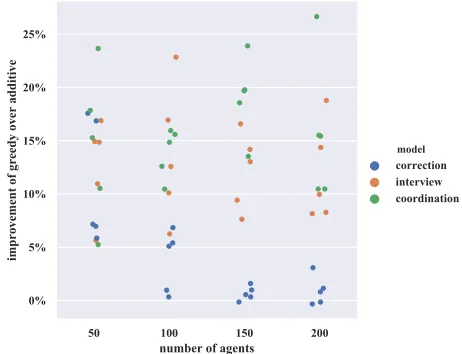
In the following, we set the number of localities to 10 and vary the number of agentsn— still equally split between professions — instead. Each locality has a capacity ofn/10
and hasn/10jobs, where then/2jobs of each profession are randomly distributed within these constraints. Figure 2 shows that the greedy algorithm leads to impressive improvements across all simulated numbers of agents, again especially pro-nounced in the interview and coordination models. While the gains become smaller for high numbers of agents in the correction model, the reason is innocuous: Looking at the absolute utilities instead of the ratio, we see that in these scenarios both additive and greedy get very close to an em-ployment of half of the agents, which is the expected number of qualifying agents and thus optimal (figure in full version).
In the full version (G¨olz and Procaccia 2018), we vary further parameters, namely the number of professions, the level of specialization of localities, and the availability of jobs with respect to fixed capacities. In general, we find that the improvements from the greedy optimization persist across these parameter settings.
Note that the results of the greedy algorithm provide a
lower boundon what can be achieved when submodularity is taken into account. Other heuristics with access to the submodular function might be able to further improve em-ployment while retaining the low query complexity of the greedy algorithm.
Figure 2: Improvements for different numbers of agents split across 10 localities.
6
Discussion
The simulations in the previous section revealed that employ-ment in all of our models can be improved by accounting for submodularity. Since this effect appeared consistently between three significantly different models of how migrants find employment, we conjecture that similar gains can be obtained in practice. The next logical step is to measure com-petition effects on real migration data.
Alas, it seems to be very difficult to obtain datasets with the necessary amount of detail. For instance, theDatabase on Immigrants in OECD Countries(DIOC)5 contains data
on a vast number of migrants in different countries. However, while File D contains information on the level of educational attainment and on the migrants’ current occupations, there is no information about the field of education or pre-migration occupation. As a result, it is unclear whether an unemployed migrant was looking for employment at all and, if so, which
5
job market she participated in. An additional problem is that DIOC does not track migrants who return to their home countries as a result of unemployment.
By contrast, longitudinal studies such as the German Socio-Economic Panel6 contain extensive information about the educational background of individuals. What is more, they follow individual migrants over an extended period of time and therefore track their success on the labor market in perfect detail. Unfortunately, the longitudinal studies that we saw observe too few individuals spread over too many localities. To directly observe competition, we need data on a large fraction of the migrants competing for jobs in a locality, from multiple localities.
Even the paper by Bansak et al. (2018), for which the au-thors had access to sensitive migration data, conspicuously does not use any features relating to the refugees’ field of occupation. Indeed, despite the predictive power of such fea-tures for employment success in a locality, at least one major refugee-resettlement agency in the US does not track this information at all. We have reason to believe that the same is true for other resettlement agencies as well. A clear pol-icy recommendation, therefore, is to compile the records in question and to make them available for research. Hopefully, data on present migration will help to better direct flows of migration in the future — benefitting both the migrants and the societies they join.
Acknowledgements
This work was partially supported by the National Science Foundation under grants IIS-1350598, IIS-1714140, CCF-1525932, and CCF-1733556; by the Office of Naval Research under grants N00014-16-1-3075 and N00014-17-1-2428; and by a Sloan Research Fellowship and a Guggenheim Fellow-ship. We would like to thank Lucas Leopold for his helpful pointers on navigating migration datasets.
References
Ahmed, F.; Dickerson, J. P.; and Fuge, M. 2017. Diverse weighted biparite b-matching. InProceedings of the 26th International Joint Conference on Artificial Intelligence (IJ-CAI), 35–41.
Balcan, M.-F., and Harvey, N. J. 2018. Submodular functions: Learnability, structure, and optimization.SIAM Journal on Computing47(3):703–754.
Balkanski, E.; Rubinstein, A.; and Singer, Y. 2016. The power of optimization from samples. InProceedings of the 30th Annual Conference on Neural Information Processing Systems (NIPS), 4017–4025.
Bansak, K.; Ferwerda, J.; Hainmueller, J.; Dillon, A.; Hangartner, D.; Lawrence, D.; and Weinstein, J. 2018. Im-proving refugee integration through data-driven algorithmic assignment.Science359(6373):325–329.
Clemens, M. A.; Montenegro, C. E.; and Prichett, L. 2008. The place premium: Wage differences for identical workers across the US border. Policy research working paper no. 4671, World Bank.
6
https://www.diw.de/en/diw 02.c.222517.en/data.html
Delacr´etaz, D.; Kominers, S. D.; and Teytelboym, A. 2016. Refugee resettlement. Manuscript.
Fisher, M. L.; Nemhauser, G. L.; and Wolsey, L. A. 1978. An analysis of approximations for maximizing submodular set functions – II.Mathematical Programming Study8:73–87. G¨olz, P., and Procaccia, A. D. 2018. Migration as submodular optimization. URL: https://arxiv.org/pdf/1809.02673.pdf. Horel, T., and Singer, Y. 2016. Maximization of approxi-mately submodular functions. Proceedings of the 30th An-nual Conference on Neural Information Processing Systems (NIPS)3045–3053.
Jones, W., and Teytelboym, A. 2018. The local refugee match: Aligning refugees’ preferences with the capacities and priorities of localities. Journal of Refugee Studies31(2):152– 178.
Kempe, D.; Kleinberg, J. M.; and Tardos, E. 2003. Maxi-mizing the spread of influence through a social network. In
Proceedings of the 9th International Conference on Knowl-edge Discovery and Data Mining (KDD), 137–146.
Krause, A.; Leskovec, J.; Guestrin, C.; VanBriesen, J.; and Faloutsos, C. 2008. Efficient sensor placement optimization for securing large water distribution networks. Journal of Water Resources Planning and Management134(6):516–526. Lee, J.; Mirrokni, V. S.; Nagarajan, V.; and Sviridenko, M. 2010. Maximizing nonmonotone submodular functions under matroid and knapsack constraints. SIAM Journal on Discrete Mathematics23(4):2053–2078.
McAuliffe, M., and Ruhs, M., eds. 2018. World Migration Report. IOM and United Nations.
Moraga, J. F.-H., and Rapoport, J. 2014. Tradable immigra-tion quotas.Journal of Public Economics115:94–108. Rabanca, G. O. 2016. Maximum weight matching and sub-modular functions. Theoretical Computer Science Stack Ex-change. URL: https://cstheory.stackexEx-change.com/q/36209 (version: 2016-07-19).
Roth, A. E. 2015. Migrants aren’t widgets. Politico Opinion. Shahaf, D., and Horvitz, E. 2010. Generalized task markets for human and machine computation. In Proceedings of the 24th AAAI Conference on Artificial Intelligence (AAAI), 986–993.