The Thirty-Third AAAI Conference on Artificial Intelligence (AAAI-19)
Entity Alignment between Knowledge Graphs Using Attribute Embeddings
Bayu Distiawan Trisedya, Jianzhong Qi, Rui Zhang
∗ School of Computing and Information Systems, The University of Melbourne{btrisedya@student., jianzhong.qi@, rui.zhang@}unimelb.edu.au
Abstract
The task of entity alignment between knowledge graphs aims to find entities in two knowledge graphs that represent the same real-world entity. Recently, embedding-based models are proposed for this task. Such models are built on top of a knowledge graph embedding model that learns entity embed-dings to capture the semantic similarity between entities in thesameknowledge graph. We propose to learn embeddings that can capture the similarity between entities indifferent knowledge graphs. Our proposed model helps align entities from different knowledge graphs, and hence enables the in-tegration of multiple knowledge graphs. Our model exploits large numbers of attribute triples existing in the knowledge graphs and generates attribute character embeddings. The attribute character embedding shifts the entity embeddings from two knowledge graphs into the same space by comput-ing the similarity between entities based on their attributes. We use a transitivity rule to further enrich the number of at-tributes of an entity to enhance the attribute character embed-ding. Experiments using real-world knowledge bases show that our proposed model achieves consistent improvements over the baseline models by over50%in terms ofhits@1on the entity alignment task.
1
Introduction
Knowledge bases in the form of knowledge graphs(KGs) have been used in many applications including question answering systems (Yih et al. 2015), recommender sys-tems (Zhang et al. 2016), and sentence generation for a Geographic Knowledge Base (Trisedya et al. 2018; GKB 2017). Many KGs have been created separately for par-ticular purposes. The same entity may exist in different forms in different KGs. For example, lgd:240111203 in a KG named LinkedGeoData (Stadler et al. 2012) and dbp:Kromsdorf in another KG named DBpedia (Lehmann et al. 2015) both refer to a city named Kroms-dorf in Germany. Typically, these KGs are complementary to each other in terms of completeness. We may integrate such KGs to form a larger KG for knowledge inferences.
To integrate KGs, a basic problem is to identify the tities in different KGs that denote the same real-world
en-∗
Corresponding author
Copyright c⃝2019, Association for the Advancement of Artificial Intelligence (www.aaai.org). All rights reserved.
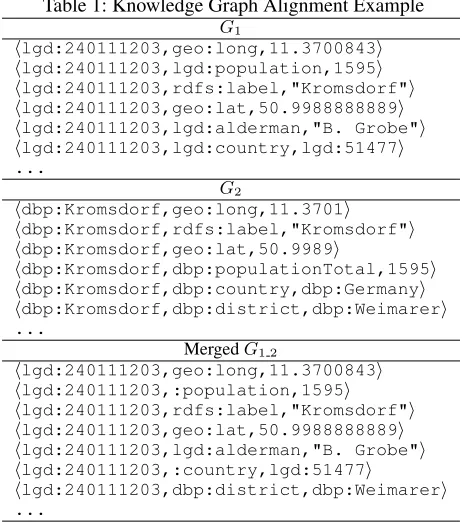
Table 1: Knowledge Graph Alignment Example G1
⟨lgd:240111203,geo:long,11.3700843⟩ ⟨lgd:240111203,lgd:population,1595⟩ ⟨lgd:240111203,rdfs:label,"Kromsdorf"⟩ ⟨lgd:240111203,geo:lat,50.9988888889⟩ ⟨lgd:240111203,lgd:alderman,"B. Grobe"⟩ ⟨lgd:240111203,lgd:country,lgd:51477⟩
...
G2
⟨dbp:Kromsdorf,geo:long,11.3701⟩ ⟨dbp:Kromsdorf,rdfs:label,"Kromsdorf"⟩ ⟨dbp:Kromsdorf,geo:lat,50.9989⟩
⟨dbp:Kromsdorf,dbp:populationTotal,1595⟩ ⟨dbp:Kromsdorf,dbp:country,dbp:Germany⟩ ⟨dbp:Kromsdorf,dbp:district,dbp:Weimarer⟩
...
MergedG1 2
⟨lgd:240111203,geo:long,11.3700843⟩ ⟨lgd:240111203,:population,1595⟩ ⟨lgd:240111203,rdfs:label,"Kromsdorf"⟩ ⟨lgd:240111203,geo:lat,50.9988888889⟩ ⟨lgd:240111203,lgd:alderman,"B. Grobe"⟩ ⟨lgd:240111203,:country,lgd:51477⟩
⟨lgd:240111203,dbp:district,dbp:Weimarer⟩
...
tity, which is commonly referred to as the entity align-ment problem. In this paper, we study entity alignalign-ment between two KGs. Specifically, we consider KGs where real-world facts are stored in the form of RDF triples. An RDF triple consists of three elements in the form of ⟨subject,relationship/predicate,object⟩, where subject de-notes an entity, andobjectdenotes either an entity or a literal. Here, ifobjectis an entity, we call the triple arelationship triple; if object is a literal, we call the triple an attribute triple. Table 1 gives an example of two subsets of RDF triples from two KGsG1andG2(we use prefixes"lgd:"
merged KG, where"lgd:240111203"is used as the uni-fied ID for the entity Kromsdorf which has a set of attributes that is the union of the sets of attributes from both KGs.
Early studies on entity alignment are based on the simi-larity between attributes of entities (Ngomo and Auer 2011; Pershina, Yakout, and Chakrabarti 2015; Volz et al. 2009). These methods rely on user-defined rules to determine the attributes to be compared between the entities. For exam-ple, the attributes to be compared between entities of the two KGs in Table 1 are rdfs:label, geo:lat, and geo:long. Such approaches are error-prone because dif-ferent pairs of entities may need difdif-ferent attributes to be compared, e.g., for two celebrity entities, they may not have attributes such asgeo:latandgeo:long.
Recently, embedding-based models are proposed for the entity alignment task. Such models are built on top of a KG embedding model, such as TransE (Bordes et al. 2013), that learnsentity embeddingsthat capture the semantic similarity between entities in a knowledge graph based on the relation-ship triples in a KG. To adapt the KG embedding for entity alignment between two KGs, the embedding-based mod-els require the embeddings of two KGs to fall in the same vector space. To address this problem, Chen et al. (2017a; 2017b) and Zhu et al. (2017) learn an embedding space for each KG separately and propose to use a transition matrix to map the embedding space from one KG to the other. Their models rely on large numbers of seed alignments (i.e., a seed set of aligned triples from two KGs) to compute the transi-tion matrix. However, the seed alignments between two KGs are rarely available, and hence are difficult to obtain due to expensive human efforts required.
In this paper, we address the above limitations by propos-ing a novel embeddpropos-ing model that first generates attribute embeddings from the attribute triples and then use this at-tribute embeddings to shift the entity embeddings of two KGs to the same vector space. We observe that many KGs contain large numbers of attribute triples, which have not been explored for entity alignment so far. For example, DBpedia, YAGO, LinkedGeoData, and Geonames contain
47.62%,62.78%,94.66%, and 76.78%of attribute triples, respectively. The attribute similarity between two KGs helps the attribute embedding to yield a unified embedding space for two KGs. This enables us to use the attribute embed-dings to shift the entity embedembed-dings of two KGs into the same vector space and hence enables the entity embeddings to capture the similarity between entities from two KGs. Our model includes predicate alignment by renaming the predi-cates of two KGs into a unified naming scheme to ensure that the relationship embeddings of two KGs are also in the same vector space. We further use the transitive rule (e.g., by knowing thatEmporium Toweris located inLondon and Londonis located in England, we also know that Emporium Toweris located inEngland.) to enrich at-tribute triples for atat-tribute embedding computation.
Our contributions are summarized as follows:
• We propose a framework for entity alignment between two KGs that consists of a predicate alignment module, an embedding learning module, and an entity alignment module.
• We propose a novel embedding model that integrates en-tity embeddings with attribute embeddings to learn a uni-fied embedding space for two KGs.
• We evaluate the proposed model over three real KG pairs. The results show that our model outperforms the state-of-the-art models consistently on the entity alignment task by over50%in terms ofhits@1.
The rest of this paper is organized as follows. Section 2 summarizes previous studies on entity alignment. Section 3 defines the studied problem. Section 4 details the proposed model. Section 5 presents the experimental results. Section 6 concludes the paper.
2
Related Work
We discuss two groups of commonly used entity align-ment approaches: string-similarity-based approaches (Sec-tion 2.1) and embedding-based approaches (Sec(Sec-tion 2.2).
2.1
String-Similarity-based Entity Alignment
Earlier entity alignment approaches use string similarity as the main alignment tool. For example, LIMES (Ngomo and Auer 2011) uses thetriangle inequality to compute an ap-proximation of entity similarity. Then, the actual similar-ity of the entsimilar-ity pairs that have a high approximated simi-larity is computed, and the entity pair with the highest ac-tual string similarity is returned. RDF-AI (Scharffe, Yanbin, and Zhou 2009) implements an alignment framework that consists of preprocessing, matching, fusion, interlink, and post-processing modules, among which the matching mod-ule uses fuzzy string matching based on sequence alignment (Rivas and Eddy 1999), word relation (Fellbaum 1998), and taxonomical similarity algorithms. SILK (Volz et al., 2009) allows users to specify the mapping rules using the Silk - Link Specification Language (Silk-LSL). SILK provides similarity metrics including string equality and similarity, numeric similarity, date similarity, and URI equality.
There are also studies using graph similarity to improve the entity alignment performance. LD-Mapper (Raimond, Sutton, and Sandler 2008) combines string similarity with entity nearest neighbor similarity. RuleMiner (Niu et al. 2012) uses an Expectation-Maximization (EM) algorithm to refine a set of manually defined entity matching-rules. Holis-ticEM (Pershina, Yakout, and Chakrabarti 2015) constructs a graph of potential entity pairs based on the overlapping at-tributes and the neighboring entities of the entities. Then, the local and global properties from the graph are propagated us-ingPersonalized Page Rankto compute the actual similarity of entity pairs.
2.2
Embedding-based Entity Alignment
TransE: TransH (Wang et al. 2014), TransR (Lin et al. 2015), and TransD (Ji et al. 2015) use a distributed representation to separate the relationship vector space from the entity vec-tor space; DKRL (Xie et al. 2016) and TEKE (Wang and Li 2016) use additional information (e.g., entity description and word co-occurrence) along with the relationship triples to compute entity embeddings. There are also non-translation-based approaches to learn entity embeddings. The Unstruc-tured model (Bordes et al. 2011) does not explicitly repre-sent the relationship embeddings. RESCAL (Nickel, Tresp, and Kriegel 2012) and HolE (Nickel, Rosasco, and Poggio 2016) use tensor-based factorization and represent relation-ships with matrices. NTN (Socher et al. 2013) uses a bilin-ear tensor operator to represent each relationship and jointly models head and tail entity embeddings.
The embedding models above aim to preserve the struc-tural information of the entities, i.e., entities that share sim-ilar neighbor structures in the KG should have a close representation in the embedding space. The advancement of such embedding models motivates researchers to study embedding-based entity alignment. Chen et al. (2017a; 2017b) propose an embedding-based model for multilin-gual entity alignment based on TransE. First, the embed-dings are computed for each KG. Then, a transition matrix is computed using a set of manually collected seed pairs of aligned entities to provide transitions for each embedding to its cross-lingual counterparts. Zhu et al. (2017) propose an iterative method for entity alignment via joint embeddings. Similar to the previous model, initially, the joint embeddings between KGs is computed using the seed pairs of aligned entities. Then, the joint embeddings are updated iteratively using the newly aligned entities. Sun, Hu, and Li (2017) pro-pose a joint attribute-preserving embedding model for cross-lingual entity alignment. The seed alignments are used to jointly embed the entity embeddings of two KGs into a uni-fied vector space. Then, the embeddings are updated using the attribute correlations that are computed based on the at-tribute type similarity. Although this work also considers the entity attribute information, it differs from ours in that we use the actual attribute value instead of the attribute type.
3
Preliminary
We start with the problem definition. A KG Gconsists of a combination of relationship triples in the form of⟨h, r, t⟩, wherer is a relationship (predicate) between two entities h(subject) andt (object), and attribute triples in the form of⟨h, r, a⟩whereais an attribute value of entityhwith re-spect to the predicate (relationship)r. Given two KGsG1
andG2, the task of entity alignment aims to find every pair
⟨h1, h2⟩whereh1 ∈ G1,h2 ∈ G2, andh1 andh2
repre-sent the same real-world entity. We use an embedding-based model that assigns a continuous representation for each ele-ment of a triple in the forms of⟨h,r,t⟩and⟨h,r,a⟩, where the bold-face letters denote the vector representations of the corresponding element.
Most embedding-based models are built on top of TransE (Chen et al. 2017a; Chen et al. 2017b; Sun, Hu, and Li 2017; Zhu et al. 2017). We first discuss TransE (Bordes et al. 2013)
and its limitations when being used for entity alignment be-fore presenting our proposed model.
3.1
TransE
Given a relationship triple⟨h, r, t⟩, TransE suggests that the embedding of the tail entitytshould be close to the embed-ding of the head entityhplus the embedding of the relation-shipr, i.e.,h+r≈t. Such an embedding model aims to preserve the structural information of the entities, i.e., enti-ties that share similar neighbor structures in the KG should have a close representation in the embedding space. We call it astructure embedding. To learn the structure embedding, TransE minimizes a margin-based objective functionJSE:
JSE= ∑
tr∈Tr ∑
t′
r∈Tr′
max (0,[γ+f(tr)−f(t′r)]) (1)
Tr={⟨h, r, t⟩|⟨h, r, t⟩ ∈G};f(tr) =∥h+r−t∥ (2)
Here,∥x∥is the L1-Norm of vectorx,γis a margin hyper-parameter, andTris the set of valid relationship triples from the training dataset, andTr′ is the set of corrupted relation-ship triples (Eis the set of entities inG):
Tr′={⟨h′, r, t⟩ |h′∈E} ∪ {⟨h, r, t′⟩ |t′ ∈E} (3)
The corrupted triples are used as negative samples, which are created by replacing the head or tail entity of a valid triple inTrwith a random entity.
TransE has been used to address KG completion tasks that aim to predict missing entities or relations based on existing triples in a KG. TransE constructs a low-dimensional and continuous vector (embedding) to describe the latent seman-tic information (as reflected by the neighboring entities) of a KG. The resulting embeddings capture the semantic similar-ity between entities in the embedding space. For example, the embedding of dbp:Germany should be close to the embedding ofdbp:Franceas both entities represent two countries in Europe; they share similar types of neighboring entities (e.g., president, continent, etc.).
The advantages of structure embedding drive further studies of embedding-based entity alignment. However, a straightforward implementation of structure embedding for entity alignment has limitations. In particular, the entity em-beddings computed on different KGs may fall in different spaces, where similarity cannot be computed directly. Exist-ing techniques (Chen et al. 2017a; Sun, Hu, and Li 2017; Zhu et al. 2017) address this limitation by computing a tran-sition matrix to map the embedding spaces of different KGs into the same space, as discussed earlier. However, such techniques require manually collecting a seed set of aligned entities from the different KGs to create the transition ma-trix, which do not scale and are vulnerable to the quality of the selected seed aligned entities.
Next, we detail our proposed model to address these lim-itations.
4
Proposed Model
after-G1
hlgd:240111203, lgd:population, 1595i hlgd:240111203, rdfs:label, ‘Kromsdorf’i hlgd:240111203, lgd:country, lgd:51477i
...
G2
hdbp:Kromsdorf, rdfs:label, ‘Kromsdorf’i hdbp:Kromsdorf, dbp:populationTotal, 1595i hdbp:Kromsdorf, dbp:country, dbp:Germanyi
...
G1_2
hlgd:240111203, :population, 1595i hlgd:240111203, :label, ‘Kromsdorf’i hlgd:240111203, :country, lgd:51477i hdbp:Kromsdorf, :label, ‘Kromsdorf’i hdbp:Kromsdorf, :population, 1595i hdbp:Kromsdorf, :country, dbp:Germanyi
...
Attribute Triple hlgd:240111203, :population, 1595i hlgd:240111203, rdfs:label, ‘Kromsdorf’i hdbp:Kromsdorf, rdfs:label, ‘Kromsdorf’i hdbp:Kromsdorf, :population, 1595i
...
Relationship Triple
hlgd:240111203, :country, lgd:51477i hdbp:Kromsdorf, :country, dbp:Germanyi
...
Transitivity Rule
Transitivity Rule
1. Predicate Alignment
f
Character Attribute Embeddinghce
lgd:24111203 rlabel cK cr cr cf
g
+ =fa ...
Structure Embedding
hse
lgd:24111203 rcountry tlgd:51477
+
=
2. Embedding Learning
hse
lgd:24111203
=
hce
lgd:24111203
update 3. Entity Alignment
EG1 EG2
hmap= argmaxh22G2cos(h1,h2)
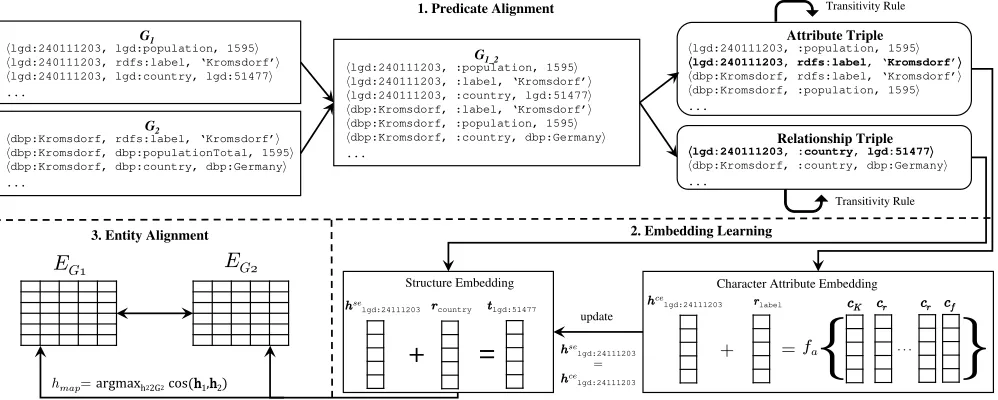
Figure 1: Overview of our proposed solution
wards, including predicate alignment in Section 4.2, embed-ding learning in Section 4.3, entity alignment in Section 4.4, and triple enrichment in Section 4.5.
4.1
Solution Overview
Our solution framework1 uses an embedding-based model
as illustrated in Fig 1. The framework consists of three com-ponents includingpredicate alignment,embedding learning, andentity alignment.
Embedding-based entity alignment requires the embed-dings (both relationship and entity embedembed-dings) of two KGs to fall in the same vector space. To have a unified vector space for the relationship embeddings, we merge two KGs based on the predicate similarity (i.e., predicate alignment). The predicate alignment module (detailed in Section 4.2) finds partially similar predicates, e.g., dbp:bornIn vs. yago:wasBornInand renames them with a unified nam-ing scheme (e.g.,:bornIn). Based on this unified naming scheme, we mergeG1andG2intoG1 2. Then, the merged
graphG1 2is split into a set of relationship triplesTrand a set of attribute triplesTafor embedding learning.
The embedding learning module (detailed in Section 4.3) jointly learns the entity embeddings of two KGs using structure embedding and attribute embedding. The structure embedding is learned using the set of relation-ship triples Tr, while the attribute embedding is learned using the set of attribute triplesTa. Initially, the structure embeddings of the entities that come from G1 and G2
fall into different vector spaces because the entities from both KGs are represented using different naming schemes. In contrary, the attribute embeddings learned from the attribute triples Ta can fall into the same vector space. This is achieved by learning character embeddings from
1
The code and the dataset are made available at http://www.ruizhang.info/GKB/gkb.htm
the attribute strings, which can be similar even if the attributes are from different KGs (we call it as attribute character embedding). Then, we use the resulting attribute character embedding to shift the structure embeddings of the entities into the same vector space which enables the entity embeddings to capture the similarity between entities from two KGs. As an example, suppose that we have triples ⟨lgd:240111203, :country, lgd:51477⟩ and ⟨lgd: 51477, :label, "Germany"⟩fromG1, and
⟨dbp:Kromsdorf, :country, dbp:Germany⟩ and ⟨dbp:Germany, :label, "Germany"⟩ from G2. The attribute character embedding allows both entities
lgd:5147 and dbp:Germany to have similar vector representations since both entities have a similar attribute value"Germany". Then, the structure embeddings of enti-tieslgd:240111203anddbp:Kromsdorfwill also be similar since the two entities share the same predicate and have two tail entities lgd:51477 and dbp:Germany which have similar vector representations.
Once we have the embeddings for all entities inG1and
G2, the entity alignment module (detailed in Section 4.4)
finds every pair⟨h1, h2⟩whereh1∈G1andh2∈G2with
a similarity score above a thresholdβ.
To further improve the performance of the model, we use the relationship transitivity rule to enrich the attributes of an entity that helps build a more robust attribute embedding for computing the similarity between entities. This is detailed in Section 4.5.
4.2
Predicate Alignment
con-ventions, there are partially matched predicates, e.g., dbp:diedInvs.yago:diedIn, anddbp:bornInvs. yago:wasBornIn. Our predicate alignment module finds these predicates and renames them with a unified nam-ing scheme (e.g., :diedIn and :bornIn). To find the partially matched predicates, we compute the edit distance of the last part of the predicate URI (e.g., bornIn vs. wasBornIn) and set 0.95 as the similarity threshold.
4.3
Embedding Learning
Aligning predicates of two KGs allows our model to have a unified relationship vector space and hence enables the joint learning of structure embedding and attribute character em-bedding that aims to yield a unified entity vector space. We detail the joint learning in the following section.
Structure Embedding We adapt TransE to learn the structure embedding for entity alignment between KGs by focusing the embedding learning more on the aligned triples (i.e., triples with aligned predicates). This is done by adding a weight α to control the embedding learning over the triples. To learn the structure embedding, in our model, we minimize the following objective functionJSE:
JSE = ∑
tr∈Tr ∑
t′
r∈Tr′
max (0, γ+α(f(tr)−f(t′r))) (4)
α= count(r)
|T| (5)
whereTr is the set of valid relationship triples, Tr′ is the set of corrupted relationship triples,count(r)is the number of occurrences of relationshipr, and|T| is the total num-ber of triples in the merge KG G1 2. Typically, the
num-ber of occurrences of the aligned predicates is higher than the non-aligned predicates since the aligned predicates ap-pear in both KGs, and hence allows the model to learn more from the aligned triples. For example, for the data in Table 1, weightαhelps the embedding model to focus more on relationships rdfs:label, geo:lat, and geo:long (α = 2/12 for each of these predicates) than on relation-shipslgd:aldermanordbp:district(α= 1/12for each of these predicates).
Attribute Character Embedding Following TransE, for the attribute character embedding, we interpret predicater as a translation from the head entity h to the attribute a. However, the same attributeamay appear in different forms in two KGs, e.g., 50.9989vs.50.9988888889as the latitude of an entity; "Barack Obama" vs. "Barack Hussein Obama"as a person name, etc. Hence, we use a compositional function to encode the attribute value and define the relationship of each element in an attribute triple ash+r ≈ fa(a). Here,fa(a)is a compositional function andais a sequence of the characters of the attribute value a = {c1, c2, c3, ..., ct}. The compositional function en-codes the attribute value into a single vector and maps sim-ilar attribute values to a simsim-ilar vector representation. We define three compositional functions as follows.
Sum compositional function (SUM). The first composi-tional function is defined as a summation of all character embeddings of the attribute value.
fa(a) =c1+c2+c3+...+ct (6)
wherec1,c2, ...,ct are the character embeddings of the
at-tribute value. This compositional function is simple but it suffers in that two strings that contain the same set of char-acters with a different order will have the same vector rep-resentation. For example, two coordinates "50.15" and "15.05"will have the same vector representation.
LSTM-based compositional function(LSTM). To address the problem of SUM, we propose an LSTM-based compo-sitional function. This function uses LSTM networks to en-code a sequence of characters into a single vector. We use the final hidden state of the LSTM networks as a vector rep-resentation of the attribute value.
fa(a) =flstm(c1,c2,c3, ...,ct) (7)
whereflstm is the LSTM networks as defined by Kim et al. (2016).
N-gram-based compositional function(N-gram). We fur-ther propose an N-gram-based compositional function as an alternative to address the problem of SUM. Here, we use the summation of n-gram combination of the attribute value.
fa(a) = N ∑
n=1
( ∑t i=1
∑n j=icj
t−i−1
)
(8)
whereN indicates the maximum value ofnused in the n-gram combinations (N = 10in our experiments) andtis the length of the attribute value.
To learn the attribute character embedding, we minimize the following objective functionJCE:
JCE = ∑
ta∈Ta ∑
t′
a∈Ta′
max (0,[γ+α(f(ta)−f(t′a))]) (9)
Ta ={⟨h, r, a⟩ ∈G};f(ta) =∥h+r−fa(a)∥ (10)
Ta′={ ⟨h′, r, a⟩|h′ ∈E} ∪ {⟨h, r, a′⟩ |a′∈A} (11)
Here,Tais the set of valid attribute triples from the training dataset, whileTa′is the set of corrupted attribute triples (Ais the set of attributes inG). The corrupted triples are used as negative samples by replacing the head entity with a random entity or the attribute with a random attribute value. Here, f(ta)is the plausibility score that based on the embedding of the head entityh, the embedding of the relationshipr, and the vector representation of the attribute value that computed using the compositional functionfa(a).
Joint Learning of Structure Embedding and Attribute Character Embedding We use the attribute character em-bedding hce to shift the structure embeddinghse into the
same vector space by minimizing the following objective functionJSIM:
JSIM = ∑
h∈G1∪G2
Here,cos(hse,hce)is the cosine similarity of vectorhseand
hce. As a result, the structure embedding captures the simi-larity of entities between two KGs based on entity relation-ship while the attribute character embedding captures the similarity of entities based on attribute values. The overall objective function of the joint learning of structure embed-ding and attribute character embedembed-ding is:
J =JSE+JCE+JSIM (13)
4.4
Entity Alignment
The joint learning of structure embedding and attribute char-acter embedding lets the similar entities fromG1andG2to
have a similar embeddings. Hence, the resulting embeddings can be used for entity alignment. We compute the following equation for entity alignment.
hmap= argmax
h2∈G2
cos(h1,h2) (14)
Given an entityh1∈G1, we compute the similarity between
h1and all entitiesh2 ∈G2.⟨h1, hmap⟩is the expected pair of aligned entities. We use a similarity thresholdβ to filter the pair entities that are too dissimilar to be aligned.
4.5
Triple Enrichment via Transitivity Rule
Even though the structure embedding implicitly learns the relationship transitive information, the explicit in-clusion of this information increases the number of attributes and related entities for each entity which helps identify the similarity between entities. For example, given triples ⟨dbp:Emporium Tower, :locatedIn, dbp:London⟩ and ⟨dbp:London, :country, dbp:England⟩, we can infer that dbp:Emporium Tower has a relationship (i.e., ":locatedInCountry") with dbp:England. In fact, this information can be used to enrich the related entity dbp:Emporium Tower. We treat the one-hop transitive relation as follows. Given transitive triples ⟨h1, r1, t⟩ and
⟨t, r2, t2⟩, we interpretr1.r2 as a relation from head entity
h1 to tail entity t2. Therefore, the relationship between
these transitive triples is defined ash1+ (r1.r2)≈t2. The objective functions of the transitivity-enhanced embedding models are adapted from the Eq. 4 and Eq. 9 by replacing the relationship vectorrwithr1.r2.
5
Experiments
We evaluate our model on four real KGs including DBpe-dia (DBP) (Lehmann et al. 2015),LinkedGeoData (LGD) (Stadler et al. 2012),Geonames(GEO)2, and YAGO
(Hof-fart et al. 2013). We run our proposed model to align enti-ties of DBP with those of LGD, GEO, and YAGO, respec-tively. We compare the aligned entities found by our model with those in three ground truth datasets,DBP-LGD, DBP-GEO, andDBP-YAGO, which contain aligned entities3 be-tween DBP and LGD, GEO, and YAGO, respectively. We focus on theLOCATIONentities in the LGD and GEO KGs
2
http://www.geonames.org/ontology/
3
http://downloads.dbpedia.org/2016-10/links/
Table 2: Dataset Statistics
Dataset Entities AttributeTriples RelationshipTriples
LGD 24,309 90,054 10,084 DBP-LGD DBP 22,748 166,008 19,594 GEO 21,794 98,790 17,410 DBP-GEO DBP 22,748 166,008 19,594 YAGO 30,628 173,309 38,451 DBP-YAGO DBP 33,627 184,672 36,906
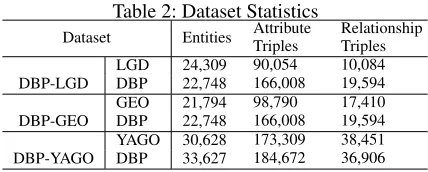
since both KGs contain mainly geographical data. We con-siderLOCATION,PERSON, andORGANIZATIONentities in the YAGO KG. DBP-YAGO contains 15,000 aligned enti-ties and 72 aligned predicates from a total of 279 predicates; DBP-LGD contains 10,000 aligned entities and ten aligned predicates from a total of 510 predicates; and DBP-GEO contains 10,000 aligned entities and ten aligned predicates from a total of 716 predicates. The statistics of the datasets are listed in Table 2.
We use grid search to find the best hyperparameters for the models. We choose the embeddings dimensionality d among{50,75,100,200}, the learning rate of the Adam op-timizer among{0.001,0.01,0.1}, and the marginγamong {1,5,10}. We train the models with a batch size of100and a maximum of400epochs. We compare our proposed model withTransE (Bordes et al. 2013),MTransE (Chen et al. 2017a), andJAPE(Sun, Hu, and Li 2017).
5.1
Entity Alignment Results
We evaluate the performance of the models using
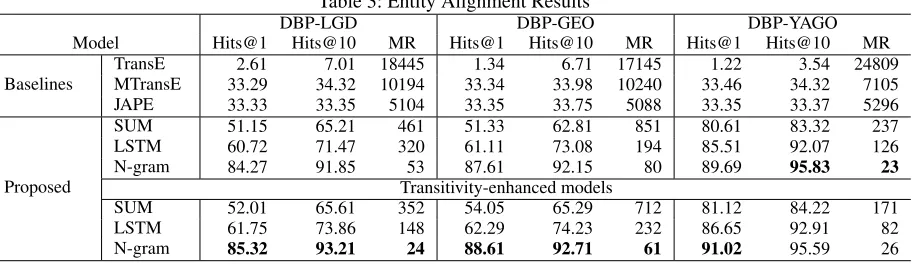
hits@k(k= 1,10)(i.e., the proportion of correctly aligned entities ranked in the top k predictions), and the mean of the rank (MR) of the correct (i.e., matching) entity. Higher hits@kand lower MR indicate better performance. For each entity from DBP, we use Eq. 14 to compute the similarity scores with entities from the other KG (LGD/GEO/YAGO). Table 3 shows that our proposed model consistently out-performs the baseline models, withp < 0.01based on the t-test on the MR. As expected, TransE has poor performance on the entity alignment task because its embeddings of dif-ferent KGs fall into difdif-ferent vector spaces, and hence it fails to capture the entity similarity between KGs. Meanwhile, MTransE and JAPE rely on the number of the seed align-ments (we use30%of the gold standard as the seed align-ments as suggested in the original papers).
Among our attribute character embedding models, using the N-gram compositional function achieves better perfor-mance than using either the LSTM or the SUM composi-tional functions because the N-gram composicomposi-tional function preserves string similarity better when mapping attribute strings to their vector representations than the other func-tions. The transitivity rule further improves the performance of the model since it enriches the attributes of the entities which allows more attributes to be used in the alignment.
Table 3: Entity Alignment Results
DBP-LGD DBP-GEO DBP-YAGO
Model Hits@1 Hits@10 MR Hits@1 Hits@10 MR Hits@1 Hits@10 MR
TransE 2.61 7.01 18445 1.34 6.71 17145 1.22 3.54 24809
Baselines MTransE 33.29 34.32 10194 33.34 33.98 10240 33.46 34.32 7105
JAPE 33.33 33.35 5104 33.35 33.75 5088 33.35 33.37 5296
SUM 51.15 65.21 461 51.33 62.81 851 80.61 83.32 237
LSTM 60.72 71.47 320 61.11 73.08 194 85.51 92.07 126
N-gram 84.27 91.85 53 87.61 92.15 80 89.69 95.83 23
Proposed Transitivity-enhanced models
SUM 52.01 65.61 352 54.05 65.29 712 81.12 84.22 171
LSTM 61.75 73.86 148 62.29 74.23 232 86.65 92.91 82
N-gram 85.32 93.21 24 88.61 92.71 61 91.02 95.59 26
Table 4: Rule-based Entity Alignment Results
DBP-LGD DBP-GEO DBP-YAGO
Model Hits@1 Hits@10 MR Hits@1 Hits@10 MR Hits@1 Hits@10 MR
Label String 80.52 80.57 2603 79.32 79.41 2048 76.41 76.88 484
Label String + Coordinate 86.27 88.85 380 87.61 89.15 441 n/a n/a n/a Label String + Embeddings 88.91 89.12 28 91.51 91.56 23 86.42 86.63 66
Table 5: KG Completion Results
Link Prediction Triple Classification
Model Hits@10 Precision
LGD GEO YAGO LGD GEO YAGO
TransE 78.80 78.77 65.81 80.46 76.94 66.45 MTransE 65.55 63.89 60.40 77.41 73.81 63.21 JAPE 72.89 71.97 61.31 75.19 72.94 62.32 SUM 76.80 75.76 64.89 79.06 75.91 62.64 LSTM 76.69 76.89 63.75 79.44 76.41 64.98 N-gram 76.12 76.37 64.06 78.39 75.11 64.93
Transitivity-enhanced model
SUM 74.87 74.31 62.51 78.21 74.43 62.75 LSTM 75.82 75.43 62.81 79.21 73.71 64.13 N-gram 75.69 76.55 63.40 78.14 74.21 64.73
to align the entities. For the DBP-LGD and DBP-GEO datasets, we add coordinate similarity as an additional metric since both datasets only containLOCATIONentities. From Table 4, we can see that the resulting embeddings of our model can be added as an additional feature to enhance the performance of rule-based models.
5.2
Discussion
We further evaluate our proposed model on KG completion tasks. We follow two standard tasks including link predic-tion (Bordes et al. 2013) and triple classificapredic-tion (Socher et al. 2013). Link prediction aims to predict the missing entity (either the head entityhor the tail entityt) given a relation-shiprand an entity (i.e., predictinghgivenrandt; or pre-dictingtgivenhandr). The evaluation protocol for link pre-diction is defined as follows. First, each relationship triple is corrupted by replacing its head or tail with all possible en-tities in the dataset. Then, these corrupted triples are ranked ascendingly based on the plausibility score(h+r−t)(i.e., valid triples should have smaller plausibility scores than cor-rupted triples). We reporthits@10for the link prediction
task. Triple classification aims to determine whether a triple ⟨h, r, t⟩is a valid relationship triple or not. A binary clas-sifier is trained based on the plausibility score(h+r−t). We report the percentage of correctly classified triples.
Table 5 show the results of KG completion tasks. De-spite not specifically designed for KG completion tasks, our proposed models achieve competitive performance on these tasks compared to TransE which was proposed for these tasks. This degradation in performance is due to that param-eterαin our model guides the model to learn more on the aligned triples. However, the degradation is not significant withp >0.05based on the t-test on the MR of the link pre-diction results. Moreover, our method achieves better perfor-mance than the existing embedding-based entity alignment models MTransE and JAPE on these tasks.
6
Conclusion
We proposed an embedding model that integrates entity structure embedding with attribute character embedding for entity alignment between knowledge graphs. Our proposed model uses the attribute character embedding to shift the entity embeddings from different KGs to the same vector space. Moreover, we adopt the transitivity rule to enrich the number of attributes of an entity that helps identify the sim-ilarity between entities based on the attribute embeddings. Our proposed model outperforms the baselines consistently by over 50% in terms ofhits@1 on alignment of entities between three pairs of real-world knowledge graphs.
Acknowledgments
References
Bordes, A.; Weston, J.; Collobert, R.; and Bengio, Y. 2011. Learning structured embeddings of knowledge bases. In
Proceedings of AAAI Conference on Artificial Intelligence, 301–306.
Bordes, A.; Usunier, N.; Garcia-Duran, A.; Weston, J.; and Yakhnenko, O. 2013. Translating embeddings for modeling multi-relational data. InProceedings of International Con-ference on Neural Information Processing Systems, 2787– 2795.
Chen, M.; Tian, Y.; Yang, M.; and Zaniolo, C. 2017a. Multilingual knowledge graph embeddings for cross-lingual knowledge alignment. InProceedings of International Joint Conference on Artificial Intelligence, 1511–1517.
Chen, M.; Zhou, T.; Zhou, P.; and Zaniolo, C. 2017b. Multi-graph affinity embeddings for multilingual knowledge graphs. InProceedings of NIPS Workshop on Automated Knowledge Base Construction.
Fellbaum, C. 1998. WordNet: An Electronic Lexical Database. MIT Press.
2017. Geographic knowledge base. http://www.ruizhang. info/GKB/gkb.htm.
Hoffart, J.; Suchanek, F. M.; Berberich, K.; and Weikum, G. 2013. Yago2: A spatially and temporally enhanced knowl-edge base from wikipedia.Artificial Intelligence194:28–61. Ji, G.; He, S.; Xu, L.; Liu, K.; and Zhao, J. 2015. Knowledge graph embedding via dynamic mapping matrix. In Proceed-ings of International Joint Conference on Natural Language Processing, 687–696.
Kim, Y.; Jernite, Y.; Sontag, D.; and Rush, A. M. 2016. Character-aware neural language models. InProceedings of AAAI Conference on Artificial Intelligence, 2741–2749. Lehmann, J.; Isele, R.; Jakob, M.; Jentzsch, A.; Kontokostas, D.; Mendes, P. N.; Hellmann, S.; Morsey, M.; van Kleef, P.; Auer, S.; and Bizer, C. 2015. Dbpedia - a large-scale, multi-lingual knowledge base extracted from wikipedia.Semantic Web6(2):167–195.
Lin, Y.; Liu, Z.; Sun, M.; Liu, Y.; and Zhu, X. 2015. Learn-ing entity and relation embeddLearn-ings for knowledge graph completion. InProceedings of AAAI Conference on Arti-ficial Intelligence, 2181–2187.
Ngomo, A.-C. N., and Auer, S. 2011. Limes: a time-efficient approach for large-scale link discovery on the web of data. InProceedings of International Joint Conference on Artifi-cial Intelligence, 2312–2317.
Nickel, M.; Rosasco, L.; and Poggio, T. A. 2016. Holo-graphic embeddings of knowledge graphs. InProceedings of AAAI Conference on Artificial Intelligence, 1955–1961. Nickel, M.; Tresp, V.; and Kriegel, H.-P. 2012. Factorizing yago: scalable machine learning for linked data. In Pro-ceedings of International Conference on World Wide Web, 271–280.
Niu, X.; Rong, S.; Wang, H.; and Yu, Y. 2012. An ef-fective rule miner for instance matching in a web of data. InProceedings of International Conference on Information and Knowledge Management, 1085–1094.
Pershina, M.; Yakout, M.; and Chakrabarti, K. 2015. Holis-tic entity matching across knowledge graphs. InProceedings of International Conference on Big Data, 1585–1590. Raimond, Y.; Sutton, C.; and Sandler, M. B. 2008. Auto-matic interlinking of music datasets on the semantic web. In
Linking Data on the Web Workshop. CEUR Workshop Pro-ceedings, ISSN 1613-0073.
Rivas, E., and Eddy, S. R. 1999. A dynamic program-ming algorithm for rna structure prediction including pseu-doknots. Journal of Molecular Biology285(5):2053–2068. Scharffe, F.; Yanbin, F. L.; and Zhou, C. 2009. Rdf-ai: an ar-chitecture for rdf datasets matching, fusion and interlink. In
Proceedings of IJCAI Workshop on Identity and Reference in Knowledge Representation.
Socher, R.; Chen, D.; Manning, C. D.; and Ng, A. Y. 2013. Reasoning with neural tensor networks for knowledge base completion. InProceedings of International Conference on Neural Information Processing Systems, 926–934.
Stadler, C.; Lehmann, J.; Hoffner, K.; and Auer, S. 2012. Linkedgeodata: A core for a web of spatial open data. Se-mantic Web3(4):333–354.
Sun, Z.; Hu, W.; and Li, C. 2017. Cross-lingual entity align-ment via joint attribute-preserving embedding. In Proceed-ings of International Semantic Web Conference, 628–644. Trisedya, B. D.; Qi, J.; Zhang, R.; and Wang, W. 2018. Gtr-lstm: A triple encoder for sentence generation from rdf data. In Proceedings of Association for Computational Linguis-tics, 1627–1637.
Volz, J.; Bizer, C.; Gaedke, M.; and Kobilarov, G. 2009. Dis-covering and maintaining links on the web of data. In Pro-ceedings of International Semantic Web Conference, 650– 665.
Wang, Z., and Li, J. 2016. Text-enhanced representation learning for knowledge graph. In Proceedings of Inter-national Joint Conference on Artificial Intelligence, 1293– 1299.
Wang, Z.; Zhang, J.; Feng, J.; and Chen, Z. 2014. Knowl-edge graph embedding by translating on hyperplanes. In
Proceedings of AAAI Conference on Artificial Intelligence, 1112–1119.
Xie, R.; Liu, Z.; Jia, J.; Luan, H.; and Sun, M. 2016. Repre-sentation learning of knowledge graphs with entity descrip-tions. InProceedings of AAAI Conference on Artificial In-telligence, 2659–2665.
Yih, W.-t.; Chang, M.-W.; He, X.; and Gao, J. 2015. Se-mantic parsing via staged query graph generation: Question answering with knowledge base. InProceedings of Associ-ation for ComputAssoci-ational Linguistics, 1321–1331.