R E S E A R C H
Open Access
Transcribing Bach chorales: Limitations and
potentials of non-negative matrix factorisation
Somnuk Phon-Amnuaisuk
Abstract
This article discusses our research on polyphonic music transcription usingnon-negative matrix factorisation (NMF). The application of NMF in polyphonic transcription offers an alternative approach in which observed frequency spectra from polyphonic audio could be seen as an aggregation of spectra from monophonic components. However, it is not easy to find accurate aggregations using a standard NMF procedure since there are many ways to satisfy the factoring ofV≈WH. Three limitations associated with the application of standard NMF to factor frequency spectra are (i)the permutation of transcription output; (ii)the unknown factoring r; and (iii)the factoring W and H that have a tendency to be trapped in a sub-optimal solution. This work explores the uses of the heuristics that exploit the harmonic information of each pitch to tackle these limitations. In our implementation, this harmonic information is learned from the training data consisting of the pitches from a desired instrument, while the unknown effectiveris approximated from the correlation between the input signal and the training data. This approach offers an effective exploitation of the domain knowledge. The empirical results show that the proposed approach could significantly improve the accuracy of the transcription output as compared to the standard NMF approach.
Keywords:polyphonic music transcription, non-negative matrix factorisation, tone-models, transcribing Bach chorales
1 Introduction
Automatic music transcription concerns the translation of music sounds into written manuscripts in standard music notations. Important components for automated transcription are pitch identification, onset-offset time identification and dynamics identification. Research activities in this area have been reported in [1-19]. Up to now, it is still not possible to accurately transcribe polyphonic notes from an orchestra, a popular band or even a solo instrument. The mixture of sounds from dif-ferent pitches pose difficulties for the existing techni-ques. To date, the transcription of a single melody line (monophonic) is quite accurate but transcribing poly-phonic audio is still an open research area.
Commonly employed features in audio analysis could be derived from time domain and frequency domain components of the input sound wave. Transcribing a single melody line (i.e., monophonic case) involves
tracking only a single note at any given time. The fun-damental frequency,F0, can usually be reliably estimated using autocorrelation in the time domain or by tracking the F0 in the frequency domain. In the polyphonic case,
multiple F0 tracking has been attempted using both
time domain and frequency domain approaches [20]. However, harmonic interference from simultaneous notes complicate the multipleF0tracking process. Stan-dard techniques relying on either time domain or fre-quency domain approaches do not seem to be powerful enough to address the issue of harmonic interference.
This challenge has been approached from different per-spectives, one of which is the blackboard architecture that incorporates various knowledge sources in the sys-tem [21]. These knowledge sources provide information regarding notes, intervals, chords, etc., which could be used in the transcription process. Explicitly encoded knowledge in this style is usually effective but requires a laborious knowledge engineering effort. Soft computing techniques such as the Bayesian approach [4,8,11,19,22] graphical modeling [23]; artificial neural networks [24];
Correspondence: [email protected]
Music Informatics Research Group, Universiti Tunku Abdul Rahman, Selangor Darul Ehsan, Malaysia
and factoring techniques (e.g., ICA, NMF) [16,25] have emerged as other popular alternatives since knowledge elicitation and maintenance could be performed from the training data.
This article investigates the application of NMF for an automatic transcription task. Although this is not the first time for NMF to be applied in polyphonic tran-scription, this study is different because it addresses three limitations of the conventional automatic tran-scription using NMF (see [16]): (i) the permutation of transcribed notes; (ii) the determination of the factorr
which plays a major role in the accuracy of the tran-scribed output; and (iii) the factorisation process via alternating projected gradient method that may get trapped in local optima.
These three issues will be addressed by the use of heur-istics. In brief, polyphonic audio is transformed into its frequency domain counterpart as a matrixVm×n, where each column corresponds to the frequencymat timen.
NMF factors the matrixVto two components Vm×n≈
Wm×rHr×n. In our approach, the columns of the matrixW
containr Tone-models that represent the frequency
spectra of notes. Each row of matrixHis the weight cor-responding to the activation of noter (i.e., the tran-scribed notes).
The scope of this article is limited to the discussion of polyphonic transcription of Bach chorales using NMF. The materials in this article are organised as follows: in Section 2, related studies are reviewed; in Section 3, the concepts behind our approach are discussed; in Section 4. The experimental results are presented and critically dis-cussed; and finally Section 5 contains the conclusion of this study.
2 Related works
The transcription of polyphonic audio has a long history. Moorer [14] was among the pioneers who investigated automatic transcriptions from polyphonic audio. In his Ph.D thesis in 1975, he demonstrated the transcriptions of a two-part guitar duet as well as a synthesised violin duet (both examples have at most two notes being played simultaneously at any time). Moorer approached this problem by devising a comb filter for each musical note. Each comb filter had many narrow bandpass centered at all the harmonics of the note. The transcribed notes were inferred from the output of these comb filters.
There have been many variations to the research activities in transcribing polyphonic audio in the past few decades. Attempts to solve the polyphonic transcrip-tion problem could be viewed along a spectrum in which at one end is a knowledge-based approach and at the other end, a soft computing approach. Examples of a knowledge-based approach are the organised proces-sing toward intelligence music scene analysis (OPTIMA)
[11]; and the blackboard architecture [2,21]. A knowl-edge-based approach exploits relevant knowledge in terms of rules to assist decision-making process. For example, the blackboard architecture [21] houses thir-teen knowledge sources which hierarchically deal with notes, intervals, chords, etc. Exploiting expert knowledge in problem solving is usually effective since specialised knowledge is explicitly coded for the task. However, there are well known bottlenecks in knowledge acquisi-tion and knowledge exploitaacquisi-tion in a convenacquisi-tional knowledge-based system, especially if the knowledge is encoded in terms of production rules. The bigger the knowledge-based system, the longer the decision process takes. A soft computing approach is more flexible in terms of knowledge acquisition and knowledge exploita-tion since knowledge can be learned from examples. Once the system has learned that piece of knowledge, the exploitation is very effective since the decision pro-cess does not involve traditional searches as in conven-tional knowledge-based systems.
Marolt [24] experimented with various types of neural networks (e.g., time-delay neural network, Elman’s neural network, multilayer perceptrons, etc.) in note classifica-tion tasks. Seventy-six neural network modules were used to recognise 76 notes from A1 to C8. Each neural network was trained to recognise one piano note with the frequency spectral features from approximately 30,000 samples where one-third of them were positive examples. Soft computing approaches such as connec-tionism, support vector machine, hidden Markov model [23,24,26], etc., usually require complete training data as the performance of the model highly depends on the decision boundary constructed using the information from the training examples. Sometimes, this is an unde-sirable requirement. The Bayesian approach is one of the most popular techniques for polyphonic transcription tasks. This may be because it provides a middle ground between the effectiveness of encoding prior knowledge in the model (as in knowledge-based approaches) and the ability to cope with uncertainties (found in soft comput-ing approaches). Bayesian harmonic models have been used in pitch tracking in [8,19]. A Bayesian model exploits the prior knowledge of fundamental frequency and the harmonic characteristics of notes produced by an instrument.
More recently, the non-negative factoring technique has received a lot of attention [16,27,28]. NMF factors a
positive matrixVinto two other positive matricesWH
whereWandHcould bear the interpretation of additive
parts ofV. NMF has been used in many domains as a
separate notes from polyphonic audio. In a recent study by [29], a nearest subspace search technique is employed to find the weight factor (contribution) of different sources in a dictionary.
In [1], the dictionary of atomic spectra was learned from audio examples. The learned dictionary comprised atomic spectra, which could be mapped back to pitches. This learned dictionary represents the basis vector, which could be used to factor out the transcribed notes. It should be noted that the learned atomic spectra often could not successfully represent the spectral characteris-tic of each pitch. From the learning process, a note may be represented by more than one atomic spectra. Furthermore, the mapping process between the pitches and the atomic spectra must still be done manually. In our approach, the matrixWof basis vectors is learned from each pitch from a desired instrument. This ensures that the basis vector (a.k.a. dictionary, Tone-model) represents the harmonic structure of each pitch at the expense of the basis vector matrix being applicable for that particular instrument only (e.g., the Tone-model learned from a piano will not work well with, for exam-ple, a violin). Many applications such as a performance analysis module in a guitar tutoring system, could benefit from this.
3 Exploring NMF for polyphonic transcription
We investigate the application of NMF to extract poly-phonic notes from a given polypoly-phonic audio. Our research problem can be summarised and illustrated
using Figure 1. Let S be unobserved MIDI note-on/off
signals that produce audio signal y(t). The source
fre-quency spectra Vderived from polyphonic audio could
be seen as an aggregation of the components from the basis vector matrixWand their activation patternH.
Intuitively, H should approximate the activation of
note events if Wcould successfully learn the harmonic
structure of those notes events. Although learning W
from the data is flexible and adaptive, there is no known means to control or to guide the learning of W. If the basis vectors wr in the matrixW do not success-fully represent the basis of each note event, then this
would result in an erroneous note transcription in the matrixH.
Conventionally, the initial values of WandHare ran-domly initialised and the NMF algorithms use alternat-ing minimisation of a cost function to find the optimal
values of H andW. In one step,W is fixed and H is
updated, while in the next step, H is fixed and W is
updated. This method often results in an erroneous transcribed matrix, H, since there are many plausible solutions that could satisfy V≈WH. As pointed out in [30], it is impossible to separate polyphonic notes from a single polyphonic sound channel without employing some kind of constraints to the signal.
Here, we propose a novel strategy by constructing a
basis vector matrix W using a Tone-model of the
desired instrument (instead of randomly initialising W
as in the standard NMF). ConstrainingW using
Tone-models has many positive side effects. It resolves the issue of the permutation of transcribed output notes since the output notes would be in the same order as the employed Tone-models. Furthermore, we propose to employ heuristics to switch off the components corre-sponding to the inactive Tone-models (see Section 3.3). This should help improve the quality of the obtained solution, since the search is started with a more or less correct value ofW.
3.1 Non-negative matrix factorisation
NMF decomposes the input matrixVinto its basis
vec-tor matrixWand its activation matrix Has follows:
V ≈WH (1)
where W∈Rm×r, H∈Rr×n, and all the elements in
V, W and H are constrained to real positive numbers
V≥ 0, W≥ 0, H≥ 0. We also assume that r ≤ m < n. Lee and Seung [28,31], suggested two styles of cost function. One is to minimise the squared Frobenius
norm DF(V || WH) and the other is to minimise the
generalised Kullback-Leibler (KL) divergenceDKL(V ||
WH) (see Equations 2 and 3). They also proposed multi-plicative update rules, which compromised between speed and ease of implementation (of conjugate gradient
and gradient descent). Note thatVmn denotes an entry at rowmand column nof the matrixV.
DF(V||WH) = ||V−WH||2 =
mn
(Vmn−(WH)mn) 2
(2)
DKL(V||WH) =
mn
(Vmnlog Vmn
(WH)mn
−Vmn+ (WH)mn)(3)
3.2 Knowledge representation
Letx be a vector representing a sequencexn, wherex1is sample number one, sampled from analog audio signal with a sampling ratefs. The sequence of discrete input
samples xncould be transformed from its time domain
representation to its frequency domain counterpart using Fourier transform. A discrete Fourier coefficient
Xkis defined as follows:
Xk= N−1
n=0
hnxne−j 2knπ
N (4)
where Nis the number of samples in a single
win-dow; hn is the hamming window defined as
0.54−0.46 cos(2πNn); xn are the time domain sam-ples; k is the coefficient index and Xk is the
corre-sponding frequency domain component. Each Xk
coefficient is a complex number; its corresponding magnitude and phase represent the corresponding
magnitude and phase of frequency at kfs
N Hz, where
k= 0,. . .,N2.
3.2.1 Piano roll representation
It is decided that the input to NMF be abstracted at the activation level of each pitch in the standard equal tem-pered scale [32]. This abstraction reduces the size of the input vector significantly (as compared to using the magnitude of STFT coefficients). Smaller input size also reduces the computation effort required for the same task. In our representation, the input matrixVand the matrix Ware represented as piano rolls, where the cen-ter frequency of each pitchi in the piano roll is calcu-lated using the following equation:
fc(i) = 440×2(i−69)/12 (5)
where i is the MIDI note number, i.e., 60 denotes
middle ˆc, C4 (note that C3 is pitch cˆ that is an octave below C4 and C5 is pitch cˆ that is an octave above C4). The magnitude of the pitchiis the average of the mag-nitude of FT coefficients in the range of 0.99fc(i) to 1.01fc(i). For example, according to Equation 5, the pitch C4 has the center frequency of 261.63 Hz and has the lower and upper boundaries of 259.0 Hz and 264.2
Hz, respectively. With a sample ratefs= 44, 100 Hz and window sizeN= 8192, these correspond tokÎ {48, 49, 50}.aHence, the activation magnitude of the pitchican be calculated using the equation below:
pitch(i) = 1
ku−kl+ 1 ku
k=kl
||Xk|| (6)
whereklandkuis the lowermost and the uppermostk index for the pitchi. The sequence of values of pitch(i) form a column of a piano roll.
3.2.2 Representing input V
At each time step, a short time fourier transform (STFT) is employed to transform the input sound wave into its frequency counterpart. Here, the STFT window is set to 8192 samples. The frequency resolution between each fourier transform (FT) coefficient is 5.38 Hz. These FT coefficients are binned according to the pitch on a piano (see Equation 6). For example, the
input vn of a monophonic note C4 would show the
overtone series of pitch C4. The inputVis presented in a piano roll representation by concatenating the column vectorsvnto form the matrixV= [v1 . . .vn].
3.2.3 Representing the tone-model
In our implementation, the basis vector matrix (Tone-model),Wtm, is also represented in a piano roll
repre-sentation. The matrix Wtm is called the Tone-model,
since it describes the harmonic structure of the pitches of an instrument. The matrix Wtmis calculated from a set of training examples which are monophonic pitches from C2 to B6. The magnitude of FT coefficients obtained from each training pitch are averaged across time frames and then binned to each pitch on the piano
roll using Equation 6. Hence, each column of Wtm
represents the Tone-model of each pitch. The matrix
Wtmis constructed by concatenating the column vectors wrtogether to formWtm= [wc2 . . .wb6].
3.3 Proposed transcription strategy
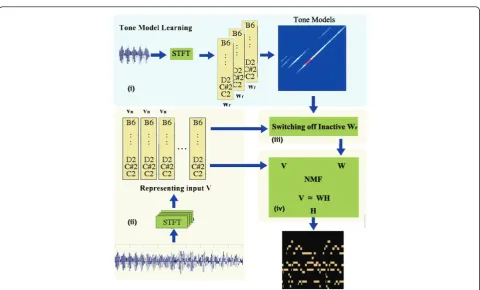
The overall concepts are outlined and summarised below. According to Figure 2, the Tone-modelsWtmare learned in a separate offline process. At run time, poly-phonic audio is transformed into the input matrix V. At
each time frame, the correlation between V and each
component inWtmis computed and this information is
employed as a heuristic to guess whichwrcomponents
in the Tone-models should be switched-off. The NMF process initialises the matrixHwith random values uni-formly distributed on the closed interval 0[1]. NMF
updates HandWuntilWHsuccessfully approximateV,
3.3.1 Switching off inactive pitches
Probable active pitches are guessed by comparing input
Vwith the Tone-modelWtm. This is based on the fact
that since Wtm is a matrix representing Tone-model
vectors, each columnwr represents the Tone-model of
each pitch from C2 to B6. For a given time frame n, if
there is no sounding note, then entries of vn are
expected to be less than the entries of the Tone-model
vectors wr. On the other hand, entries of vn are
expected to share common harmonic structures withwr
if the noter is sounding. Hence, an overlap in an
over-tone series between the input vn and the Tone-model
wris defined as a vectorOLr:
OLr= max(wr−vn, 0) (7)
The ratio ||OLr||/||wr|| has its value lie in the closed interval 0[1].OLris 1 when there is no overlap and OLr is 0 whenwris completely overlapped byvn. The noter is considered not sounding if the ratio ||OLr||/||wr|| is more than a threshold value and considered sounding if it is otherwise. The threshold value is empirically determined.
This heuristic is used to guess whether the pitchr is active by comparing the input spectrum at a time frame
nto all the wrand flagging the active pitch r. For each
time frame n, a vector Ln = [l1, . . . , lr]T estimates whether the pitch r is active or inactive. After running through all the time frames of the input signal, the active pitches are determined as a disjunction of all the active pitch flags L = L1 ν L2 ν. . . νLn. The pseudo code below summarises this process.
functionprobablePitch(Wtm, V)returnLr×1an active pitch vector
for each vnassociated with time framen
Ln= [ ]
for each wrof each Tone-modelr = 1, 2 , . . . , 60
if ||OLr||/||wr||>threshold thenlr= 1elselr= 0 end
Ln¬append(lr,Ln) end
end
L¬ L1νL2 ν. . .νLn returnL
end
The switchL estimated from the inputV is used to
switch off irrelevant basis vectors wr, i.e., the
constrained W = Wdiag(L), where diag(L) returns a diagonal matrix.
3.3.2 Transcribing polyphonic notes using NMF
Multiplicative update rules that minimise the cost func-tions (see Equafunc-tions 2 and 3) proposed by Lee and Seung [31] are considered to be the standard NMF algorithms [33]. They are guaranteed to find at least locally optimum solutions [31]. The update rules in (Equations 8 and 9) corresponding toDKL(V||WH) are reproduced here for readers’convenience.
Hrn←Hrn
mWmrVmn/(WH)mn mWmr
(8)
Wmr←Wmr
nHrnVmn/(WH)mn
nHrn (9)
Factoring the matrixVto two componentsWandHcan be viewed as a search process. The update rules guide the search to a solution using the gradient of the cost functions. There are many plausible solutions that could satisfy this factoring. Sometimes, the search will get stuck in sub-opti-mum solutions. Most search techniques could benefit from extra knowledge introduced in terms of constraints. Depending on applications, extra information introduced to guide the search can be in different forms. In our application, initialising the basis vector matrixWwith Tone-models and switching off inactivercomponents help initialise the search near optimum solutions and better solutions are usually obtained if the search starts near good solutions in the search space. In our implementation, the cost function updated is closely related toexpectation max-imisation maximum likelihood (EMML)which has been studied in image processing [34]. In EMML,His iteratively updated whileWis assumed to be known and fixed. In our experiment,His updated using (following [28]):
Hrn←Hrn
m
Wmr
Vmn
(WH)mn (10)
In our experiment, two experimental designs have been carried out: (i) Tone-model NMF (TM-NMF) where the matrixWis initialised using the Tone-modelWtmandr constraint and its values are fixed throughout the run; and (ii) initialised constrained Tone-model (ICTM-NMF), whereWis initialised in the same fashion as in TM-NMF butWis updated as below:
Wmr←Wmr
nHrn maxrnHrn
(11)
Wmr←
Wmr
mWmr (12)
A column ofVis formed from columns ofWweighted
by value given inH. In other words, a column ofHis a new representation of a column ofVbased on the basis ofW. Hence, eachwris updated by scaling it to the pre-dicted activation of maxr(ΣnHrn) (Equation 11), eachwr is then normalised (Equation 12). The pseudo code below summarises the two NMF processes (TM-NMF and ICTM-NMF) employed in our experiments.
functiontranscribeBach(Wtm, V)returnPitch activa-tionH
L¬ probablePitch(Wtm, V)
InitialiseHrandomly s.t.HrnÎ {h|0 ≤h≤1}
InitialiseWusing Tone-models and heuristics;W¬
Wtmdiag(L)
/* Stopping criteria:
(i) Exceed max-iteration-set at 3000 iterations, or (ii) The matrixHconverges, their values become stable, or
(iii)V- WH≤acceptable error */ whilesome stopping criteria is not satisfied
updateHusing Equation 10
ifTM-NMFthenW¬Wtmdiag(L)
ifICTM-NMF then update Wusing Equations
11, 12 end returnH
end
The outputHis then converted to a binary (note on/ off) by applying a threshold to it. To evaluate H, the note on/off information of each original chorale is extracted from the MIDI file. This forms a ground truth for each chorale. In this process, the MIDI time is retimed to linearly map with the number of frames inH.
4 Experimental results
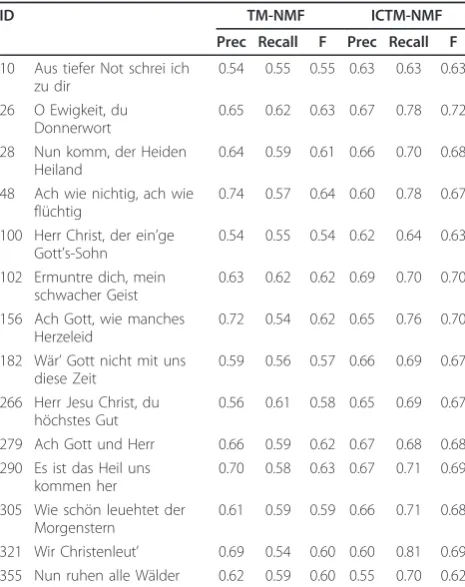
In this experiment, the input wave files were generated by playing back MIDI files using a standard PC sound card. Recording was done with 16 bit mono and with a sampling rate of 44100 Hz. The recorded wave file was transformed to the frequency domain using STFT. The STFT window size was set at 8192 samples. The Ham-ming window function was applied to the signal before converting it to the frequency domain. The experimental results of Bach chorales are summarised in Table 1. Two variations of the Tone-model usage were carried out (i) TM-NMF, and (ii) ICTM-NMF.
4.1 Evaluation measures
duration is not exact? In [35], note detections were cal-culated on each frame. The transcription output was converted to a binary note on/off and was compared to MIDI note on/off on a frame by frame basis. This was a good approach since it took the note duration into account. This work evaluated the transcribed output using the same approach in [35]. The results were evalu-ated based on the standard precision and recall
mea-sures where, in each frame, true positive tp is the
number of correctly transcribed note events, false posi-tivefpis the number of spurious note events and false
negative fn is the number of note events that are
undetected.
The true positive was calculated based on the matched pixels between the original piano roll and the tran-scribed piano roll H (i.e.,Originaland Transcribed in Equations 13, 14 and 15). False positive and false nega-tive were calculated from the unmatched pixels.
tp= max((Original + Transcribed)−1, 0) (13)
fp= max(Transcribed−Original, 0) and (14)
fn= max(Original−Transcribed, 0) (15)
where max(a, b) returned thea ifa >= b otherwise
returned b. The Original and Transcribed were r × n
binary matrices (note on = 1 and note off = 0). The
Transcribed matrix was obtained by thresholding the
output H (see Section 3.3.2). TheOriginalmatrix was
obtained by time-scaling the note on/off matrix to
match the number of time frames in H. In this study,
the note on/off matrix was obtained from the note on/ off events extracted from the MIDI files and this pro-vided the ground truth reference.
We resort to the precision, recalland f measures to judge the performance of the system. Precision provides measurement on the percentage of the correct tran-scribed note-on events from all the trantran-scribed note-on events. Recall provides measurement on the percentage of the correct transcribed note-on events from all actual note-on events (i.e., reference ground truth).
In the transcription task, the precision and recall mea-sures are equally important since it is undesirable to have a system with high precision but poor recall (or vise versa). Hence, the f-measure is computed since it provides an evenly weighted result of both precision and recall measures. These measures are defined as:
precision= tp
tp+fp (16)
recall= tp
tp+fn (17)
f = 2×precision×recall
precision+recall (18)
4.2 Transcribing Bach chorales using ICTM-NMF
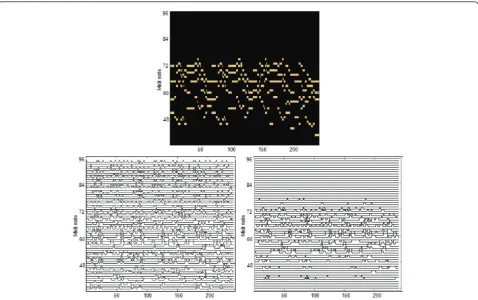
Figure 3 illustrates the effectiveness of our approach in tackling the weakness of applying standard NMF; the top pane shows the piano roll from the original chorale; the bottom left pane shows the output from a standard
NMF whereWandHare randomly initialised andr set
at 60. Noise is observed in many places. This is a com-mon problem with standard NMF algorithms used for transcribing pitches. This problem was mitigated with our proposed NMF with a constrained Tone-model. A great improvement in the output quality was observed in Figure 3 (bottom right pane). Although the tran-scribed output did not show an exact match to the input piano roll, a great improvement was observed in the bottom right pane.
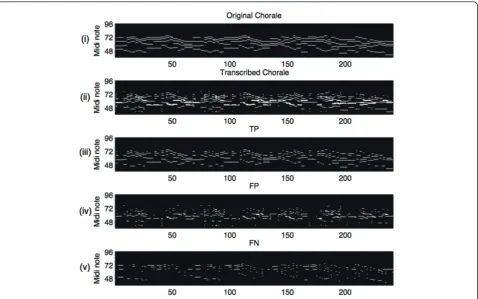
Figure 4 shows the piano roll output from the
tran-scription of chorale Aus tiefer Not schrei ich zu dir
using ICTM-NMF. The first row is a piano roll repre-sentation of an original chorale. The second row shows Table 1 Summary of performance of TM-NMF, and
ICTM-NMF in transcribing Bach chorales.
ID TM-NMF ICTM-NMF
Prec Recall F Prec Recall F
10 Aus tiefer Not schrei ich zu dir
0.54 0.55 0.55 0.63 0.63 0.63
26 O Ewigkeit, du Donnerwort
0.65 0.62 0.63 0.67 0.78 0.72
28 Nun komm, der Heiden Heiland
0.64 0.59 0.61 0.66 0.70 0.68
48 Ach wie nichtig, ach wie flüchtig
0.74 0.57 0.64 0.60 0.78 0.67
100 Herr Christ, der ein’ge Gott’s-Sohn
0.54 0.55 0.54 0.62 0.64 0.63
102 Ermuntre dich, mein schwacher Geist
0.63 0.62 0.62 0.69 0.70 0.70
156 Ach Gott, wie manches Herzeleid
0.72 0.54 0.62 0.65 0.76 0.70
182 Wär’Gott nicht mit uns diese Zeit
0.59 0.56 0.57 0.66 0.69 0.67
266 Herr Jesu Christ, du höchstes Gut
0.56 0.61 0.58 0.65 0.69 0.67
279 Ach Gott und Herr 0.66 0.59 0.62 0.67 0.68 0.68 290 Es ist das Heil uns
kommen her
0.70 0.58 0.63 0.67 0.71 0.69
305 Wie schön leuehtet der Morgenstern
0.61 0.59 0.59 0.66 0.71 0.68
the transcribed output. The fourth and the fifth rows are
fpandfn, respectively. From the Figure,fpandfnwere calculated from the differences between the original chorales and the transcribed chorales.
Table 1 summarises the transcription results of Bach chorales. A total of fourteen chorales were arbitrarily chosen (chorales ID follows Riemenschneider. 371 har-monized chorales and 69 chorale melodies with figured bass). The input wave files of all the Bach Chorales used here were obtained by playing back the Bach chorale MIDI files downloaded from http://www.jsbchorales.net/ bwv.shtml.
The output from ICTM-NMF shows a great improvement over the output from TM-NMF (around
7.5% improvement in f values). ICTM-NMF differed
from TM-NMF in the following points: the
Tone-mod-els (i.e., the matrix W) was fixed in the TM-NMF but
not fixed in ICTM-NMF. The W was allowed to be
varied in ICTM-NMF, subjected to the constraint
mWmn= 1. As a consequence from the above point,
all active basis vector (columns ofW) remained active in TM-NMF. However, it was possible for active basis
vectors in ICTM-NMF to be inactive during the W
update process.
4.3 Performance comparison with related works
4.3.1 Beethoven’s Bagatelle Opus 33, No. 1 in E
In this report, two transcriptions of the pieces demon-strated in previous studies were carried out using our proposed method. The first one was the transcription output from Beethoven’s Bagatelle using NMF presented in [35]. The input sound wave, in [35], was recorded from a MIDI controlled acoustic piano.
The plot between recall and specificitybis reproduced in Figure 5 along with the output from our approach. Varying the threshold values that control the binary note on/off conversion of the outputHproduces the perfor-mance curve plot shown in Figure 5. The plot can be used to visually compare the performance of our system to the NMF output in [35]. The optimalfvalues for both NMF runs in the previous work were about 0.54 and 0.60
while our system obtained the optimal fvalue of 0.72
(recall 73.29% and precision 70.56%).
4.3.2 Mozart’s piano Sonata No. 1 (KV279)
There are three movements in this sonata: Allegro, Andante and Allegro. Polyphonic transcription of the first two minutes of the first movement from KV279 was attempted using non-negative matrix division in [15]. Here, it was decided that, the whole first movement
would be used in our experiment. The main difference in our work is that in [15], the update ofWstep (see 3.1) was omitted. The input sound wave was recorded from a MIDI controlled synthesised piano in our experiment while the input sound wave was recorded from a
computer controlled Bösendorfer SE290 grand piano in [15]. It was reported that the recall rate was 99.1%, the precision rate was 21.8% and thefvalue was 0.35. The issue of poorfvalue was tackled in [15] by further post-processing the output from NMF using classifiers (rule
Figure 4Experimental results (ICTM-NMF):from top to bottom(i)input piano roll of choraleAus tiefer Not schrei ich zu dir(ii)transcribed output,(iii)true positives-tp,(iv)false positives-fp, and(v)false negative-fn.
based, instance based and frame based). This improved thefvalue significantly. Unfortunately, due to the limited length of [15], information given about the process was incomplete. There was no transcription output from [15], so a visual inspection of the output generated by both systems was not possible. For this piece, our approach yielded the optimalfvalue of 0.63 (recall 63.0% and pre-cision 63.9%).
The performance statistics reported in our experi-ments were calculated using the precision and recall measures based on the graphical representation of a piano roll (as discussed in Section 4). It should also be pointed out that the counting of true-positive in [15] was based on correctly found notes,cwhich is unlike our true-positive which was based on frame by frame count-ing. The evaluations of the transcription of Beethoven’s Bagatelle in [35] and our study have been based on similar assumptions.
4.4 Transcribing polyphonic sound from acoustic instruments
Sounds produced from real acoustic instruments possess a much more complex harmonic structure. The manner of note executions, the physical characteristic of the string, the soundboard, etc., all work together to determine the harmonic structures. The dictionary approach, such as the proposed Tone-model, represents complex harmonic structure of a note using a static Tone-model prototype. A static dictionary might not be effective in such a circum-stance. Thus it is important to test the performance of the proposed approach on real acoustic musical instruments.
For this purpose, the chorale numbers 10, 26 and 28 were played on a classical acoustic guitar (model Yamaha CG 40) and on an upright acoustic piano (model Atlas). The sound was recorded directly via a single micropone with 16 bit bit-depth, and a sample rate of 44,100 Hz. The microphone had the following specifications: frequency response: 20 Hz - 16 KHz, sensitivity: -58±3 dB, S/N ratio: 40 dB.
The transcription accuracy of polyphonic pieces per-formed by acoustic and synthesised instruments is
displayed in Table 2. It was observed that the transcrip-tion accuracy obtained from acoustic sources was gener-ally poorer than those from synthesised sources. Figure 6 shows the transcription output from the synthesised gui-tar sound and the acoustic guigui-tar sound. The transcrip-tion output from synthesised sound (first row) shows better recall than the output from the acoustic sound (third row). It was observed from the experiment that transcription output from acoustic instruments tended to give inaccurate duration even though the pitch was cor-rectly transcribed. This was common at a high pitch range region. The synthesised instruments did not suffer from this behaviour.
The overlays of the true positive output on the origi-nal chorale (the second and the fourth rows of Figure 6) shows that the degradation in performance in the acous-tic case is mainly from the inaccuracy in transcribed duration. This could be caused by the harmonic com-plexity of real acoustic instruments and, from our obser-vation, the faster decay rate of acoustic sound as compared to the synthesised sound (especially at the high pitch range).
We would also like to highlight that the degrading performance from the discrepancies in the duration did highlight the potential of our proposed approach. It implies that fine tuning in duration using information from the onset-offset time would greatly improve the quality of the transcriptions.
5 Conclusions
In this article, we proposed a new strategy to tackle the three limitations of standard NMF in the polyphonic transcription task. By constructing a basis vector matrix
Wusing a Tone-model of the desired instrument and
relying on heuristics to switch off the components corre-sponding to the inactive pitches, the experimental results showed an improvement in the transcription perfor-mance. This strategy worked because of the importance of the learned basis vector matrix and the ability of the NMF to switch off inactive basis vectors.
Table 2 Summary of performance of ICTM-NMF in transcribing Bach chorales from acoustic sound and synthesised acoustic sound
Acoustic sound Synthesised sound
Prec Recall F Prec Recall F
Instrument:Guitar
10 Aus tiefer Not schrei ich zu dir 0.46 0.54 0.50 0.75 0.78 0.76
26 O Ewigkeit, du Donnerwort 0.39 0.57 0.46 0.72 0.74 0.73
28 Nun komm, der Heiden Heiland Instrument:Piano
0.37 0.55 0.45 0.71 0.75 0.73
10 Aus tiefer Not schrei ich zu dir 0.58 0.53 0.56 0.63 0.63 0.63
26 O Ewigkeit, du Donnerwort 0.46 0.47 0.47 0.67 0.78 0.72
The number ofrplayed a crucial role in extracting note events. If the number ofrwas set higher than the actual active pitches, noise would appear as transcribed notes. On the contrary, if the number ofrwas set too low, events from different pitches would be transcribed as coming
from the same pitch. To find the exact number ofr is
therefore a big challenge for polyphonic transcription using NMF [16]. In recent works by [6,15], NMF with a fixedW
that learned from a desired instrument was proposed. In these works, the dictionary matrix, the pitch templates and the Tone-models acted as the basis vector matrix. This
work extended the same concept to handle common lim-itations of NMF in polyphonic transcribing application.
Initialising the basis vector matrix using FFT spectra as a Tone-model is a powerful heuristic. However, this alone would not be enough to produce good output. From our study, the following heuristics should be included.
1. The Tone-model must characterise the input instrument;
2. the estimatedrshould be equal to or more than the actualr; and
3. the fixed Tone-model might not work well if r is not accurate.
To elaborate on the above heuristics, let us compare the NMF to a search process. If the NMF factoring process is seen as a search, the act of initialisingWwith a Tone-model is analogous to starting the search near the global
optimum. When the search begins, fixingWbiases the
search to a certain direction. If the basis vector matrixW
characterises the Tone-model of the input instrument and the value of active pitchesr are determined correctly, then, it is likely that the obtained solution would be of good quality. If the value ofris wrongly determined, then the search might be guided to any non-optimal solution.
Allowing theWto vary should lower the magnitude of
inactivewrand it is possible to compensate for an
overes-timated number ofr. The experiment showed that the
best results were obtained when theWwas initialised
using Tone-model andWwas also allowed to be adjusted. In future work, we hope to further explore the extension of the Tone-model concept to handle sound produced from acoustic instruments.
Endnotes a
The index kmight need to be rounded up/down since
the boundary frequency of each pitch would not fall exactly on the desired value.bSpecificity = 1-Precision.
c
As reported in [15]:“A note event is counted as correct if the transcribed and the real note do overlap”.
Acknowledgements
We wish to thank anonymous reviewers for their comments, which help improve this article. We would also like to thank IPSR-Universiti Tunku Abdul Rahman for their partial financial support given to this research.
Competing interests
The author declares that they have no competing interests.
Received: 10 May 2011 Accepted: 27 February 2012 Published: 27 February 2012
References
1. SA Abdallah, MD Plumbley, Polyphonic music transcription by non-negative sparse coding of power spectra, inProceedings of International Conference on Music Information Retrieval (ISMIR 2004), Barcelona, Spain, 2004, pp. 318–325 2. JP Bello, Toward the automated analysis of simple polyphonic music: a
knowledge-based approach, Ph.D. dissertation, Department of Electrical Engineering, Queen Mary, University of London, London, UK (2003) 3. GJ Brown, M Cooke, Perceptual grouping of musical sounds-a
computational model. J New Music Res.23(2), 107–132 (1994). doi:10.1080/ 09298219408570651
4. AT Cemgil, B Kappen, D Barber, Generative model based polyphonic music transcription, inIEEE Workshop on Applications of Signal Processing to Audio and Acoustics, New Paltz, NY, USA, 2003, pp. 181–184
5. C Chafe, D Jaffe, Source separation and note identification in polyphonic music, inProceedings of IEEE international Conference on Acoustic Speech and Signal Processing, Tokyo, Japan, 1986, pp. 1289–1292
6. A Cont, Realtime multiple pitch observation using sparse non-negative constraints, inProceedings of the 7thInternational Symposium on Music
Information Retrieval, (ISMIR), Victoria, BC, Canada, 2006
7. RB Dannenberg, N Hu, Polyphonic audio matching for score following and intelligent audio editors, inProceedings of the International Computer Music Conference (ICMC 2003), San Francisco, USA, 2003, pp. 27–33
8. M Davy, SJ Godsill, Bayesian Harmonic Models for Musical Signal Analysis, in
Bayesian Statistics 7, ed. by Bernardo JM, Bayarri MJ, Berger JO, Dawid AP, Heckerman D, Smith AFM, West M (Oxford University Press, Oxford, 2003), pp. 105–124
9. S Dixon, On the computer recognition of solo piano music, inProceedings of the Australian Computer Music Conference, Brisbane, Australia, 2000, pp. 31–37
10. M Goto, A real-time music-scence-description system: predominant-F0 estimation for detecting melody and bass lines in real-world audio signals. Speech Commun.43, 311–329 (2004). doi:10.1016/j.specom.2004.07.001 11. K Kashino, K Nakadai, T Kinoshita, H Tanaka, Application of bayesian
probability network to music scence analysis, inProceedings of IJCAI workshop on CASA, Montreal, Canada,, 1995, pp. 52–59
12. A Klapuri, Sound onset detection by applying psychoacoustic knowledge, inProceedings of ICASSP, vol. 6. (Phoenix, Arizona, USA, 1999), pp. 3089–3092
13. A Klapuri, Automatic music transcription as we know it today. J New Music Res.33(3), 269–282 (2004). doi:10.1080/0929821042000317840
14. JA Moorer, On the segmentation and analysis of continuous musical sound by digital computer, (PhD thesis, Department of Music, Standford University, USA, 1975)
15. B Niedermayer, Non-negative matrix division for the automatic transcription of polyphonic music, inProceedings of International Conference on Music Information Retrieval (ISMIR 2008), Austria, pp. 545–549 (2008)
16. P Smaragdis, JC Brown, Non-negative matric factorization for polyphonic music transcription, inProceedings of IEEE workshop Applications of Signal Processing to Audio and Acoustics, New Paltz, NY, USA, 2003, pp. 177–180 17. S Phon-Amnuaisuk, Transcribing Bach chorales using non-negative matrix
factorization, inProceedings of the 2010 International Conference on Information Technology Convergence on Audio, Language and Image Processing (ICALIP2010), Shanghai China, 2010, pp. 688–693
18. S Sophea, S Phon-Amnuaisuk, Determining a suitable desired factor for non-negative matrix factorisation for polyphonic music transcription, in
Proceedings of the 2007 International Symposium on Information Technology Convergence, (ISITC 2007), Sori Arts center, Jeonju, Republic of Korea, 2007, pp. 166–170
19. PJ Walmsley, SJ Godsill, PJW Rayner, Bayesian graphical models for polyphonic pitch tracking, inProceedings of diderot forum on mathematics and music, Vienna, Austria, 1999, pp. 1–26
20. A de Cheveigné, inMultiple F0 estimation, ed. by DeLiang W, Brown GJ (Computational Audio Scene Analysis IEEE Press, New York, 2006), pp. 45–79
21. KD Martin, A blackboard system for automatic transcription of simple polyphonic music. M.I.T. Media Lab, Perceptual Computing, Technical Report 385 (1996)
22. I Barbancho, AM Barbancho, A Jurado, LJ Tardón, An information-proach to blind separation and blind deconvolution. Appl Acoust.65, 1261–1287 (2004). doi:10.1016/j.apacoust.2004.05.007
23. C Raphael, Aligning music audio with symbolic acores using a hybrid graphical model. Mach Learn.65(2-3), 389–409 (2006). doi:10.1007/s10994-006-8415-3
24. M Marolt, A connectionist approach to automatic transcription of polyphonic piano music. IEEE Trans Multimedia.6(3), 439–449 (2004). doi:10.1109/TMM.2004.827507
25. E Vincent, X Rodet, Music transcription with ISA and HMM, inProceedings of the Fifth International Conference on Independent Component Analysis and Blind Signal Separation (ICA2004), Gradana, Spain, 2004, pp. 1197–1204 26. GE Poliner, DPW Ellis, A discriminative model for polyphonic piano
transcription. EURASIP J Adv Signal Process.2007(1), 154–154 (2007) 27. PO Hoyer, Non-negative sparse coding, inProceedings of IEEE Workshop on
Neural Networks for Signal Provcessing XII, Martigny, Switzerland, 2002, pp. 557–565
28. DD Lee, HS Seung, Learning the parts of objects by non-negative matrix factorozation. Nature.401, 788–791 (1999). doi:10.1038/44565
30. DPW Ellis, inModel-based Scene Analysis, ed. by DeLiang y, Brown GJ (Computational Audio Scene Analysis IEEE Press, New York, 2006), pp. 115–146
31. DD Lee, HS Seung, inAlgorithms for Non-Negative Matrix Factorization, ed. by Leen Todd K, Dietterich Thomas G, Volker T (Advances in Neural Information Processing Systems 13 MIT Press, Cambridge, MA, 2001), pp. 556–562
32. J Backus, The Acoustical Foundations of Music, (W.W. Norton & Company, Inc, New York, 1977), 2
33. A Cichocki, R Zdunek, NMFLAB MATLAB Toolbox for non-negative matrix factorization. http://www.bsp.brain.riken.jp/ICALAB/nmflab.html (2006) 34. CL Byrne, Accelerating the EMML algorithm and related iterative algorithms
by rescaled block-iterative (RBI) methods. IEEE Trans Image Process.7(1), 100–109 (1998). doi:10.1109/83.650854
35. MD Plumbley, SA Abdullah, T Blumensath, ME Davies, Sparse representation of polyphonic music. Signal Process.86(3), 417–431 (2005)
doi:10.1186/1687-4722-2012-11
Cite this article as:Phon-Amnuaisuk:Transcribing Bach chorales: Limitations and potentials of non-negative matrix factorisation.EURASIP Journal on Audio, Speech, and Music Processing20122012:11.
Submit your manuscript to a
journal and benefi t from:
7Convenient online submission 7Rigorous peer review
7Immediate publication on acceptance 7Open access: articles freely available online 7High visibility within the fi eld
7Retaining the copyright to your article