O R I G I N A L A R T I C L E
Smart Cutting Tools and Smart Machining: Development
Approaches, and Their Implementation and Application
Perspectives
Kai Cheng1•Zhi-Chao Niu1• Robin C. Wang1•Richard Rakowski1• Richard Bateman1
Received: 19 December 2016 / Revised: 8 May 2017 / Accepted: 24 July 2017 ÓThe Author(s) 2017. This article is an open access publication
Abstract Smart machining has tremendous potential and is becoming one of new generation high value precision manufacturing technologies in line with the advance of Industry 4.0 concepts. This paper presents some innovative design concepts and, in particular, the development of four types of smart cutting tools, including a force-based smart cutting tool, a temperature-based internally-cooled cutting tool, a fast tool servo (FTS) and smart collets for ultra-precision and micro manufacturing purposes. Implemen-tation and application perspectives of these smart cutting tools are explored and discussed particularly for smart machining against a number of industrial application requirements. They are contamination-free machining, machining of tool-wear-prone Si-based infra-red devices and medical applications, high speed micro milling and micro drilling, etc. Furthermore, implementation tech-niques are presented focusing on: (a) plug-and-produce design principle and the associated smart control algo-rithms, (b) piezoelectric film and surface acoustic wave transducers to measure cutting forces in process, (c) critical cutting temperature control in real-time machining, (d) in-process calibration through machining trials, (e) FE-based design and analysis of smart cutting tools, and (f) applica-tion exemplars on adaptive smart machining.
Keywords Smart cutting toolSmart machiningFast tool servo (FTS)Precision machiningMicro manufacturing
Smart tooling
1 Introduction
Smart tooling and smart machining have tremendous potential and are drawing attention as one of next gen-eration precision machining technologies particularly in the Industry 4.0 context [1–5]. In modern advanced manufacturing, it is becoming an essential trend for machining components with an ever increasing dimen-sional/form accuracy and finer surface roughness, even surface functionality requirement. In high precision machining, however, to position the cutting tool with such high accuracy and repeatability is the key and this is normally undertaken in a ‘‘passive’’ manner, i.e., the tool’s position relying on the slideways’ positioning accuracy but without measuring the tool cutting beha-viour and process conditions. Furthermore, for many high value precision machining processes, it is important to use smart cutting tools to carry out the processes in a ‘proactive’ manner, in order to cope with machining dynamics, process variations and complexity. For instance, ultra-precision and micro machining, with the surface roughness normally at the nanometric scale and features/patterns at the micrometer level, is increasingly and continuously demanded particularly for high preci-sion components and products with improved function-ality and performance. The smart precision and micro manufacturing in a ‘proactive’ manner will be the way forward [6].
Aiming at high quality surfaces and dimensional/form accuracy, some monitoring methods have been proposed to Supported by the UK Technology Strategy Board (TSB) and Innovate
UK (SEEM Project, Contract No.: BD266E; KTP Project, Contract No.: 9277).
& Kai Cheng
1 College of Engineering, Design and Physical Sciences,
monitor cutting forces with high precision and the process conditions. The variations of the cutting forces are most likely related to the tool wear or other process conditions and therefore will have direct influences on the machining outcomes [7–9]. Tool wear or tool breakage can also increase the cutting forces and vibrations in the machining system, which will result in poor surface roughness, loss of the form and dimensional accuracy, and even chatter marks on machined surfaces [10]. In order to avoid such manu-facturing defects or tool damages, some devices are designed and developed to measure the cutting forces and cutting dynamics. For instance, dynamometers are devel-oped by researchers and industrial companies to measure cutting forces and the process dynamics in high precision and wide bandwidth. Currently, however, dynamometers have some limitations in their industrial application, such as their costs and reliability in stringent production envi-ronment. Furthermore, dynamometers are not applicable for layout-constrained machines and tooling setup, due to their size and weight. The dynamometer could also inter-fere with the cutting process and performance because of the tooling stiffness reduction in the machining system [11].
Some high value components require to be machined in a contamination-free environment, which means coolant cannot be applied during the machining. How-ever, dry cutting condition would lead to tool wear and high cutting temperature, and poor surface quality would thus occur and tool life be shortened. Some materials, such as aluminum and magnesium alloys, are not rec-ommended for applying direct dry-cutting, since the cutting tool is prone to suffering excessive built-up edge (BUE). So for high precision and micro machining, there is a need for new sensor technologies to be applied to further exploit and understand the cutting mechanics and machining process [6].
Based on the underlying principle and application requirements above, four types of smart tools are developed, including a cutting force based smart tool, a cutting temperature sensing oriented internally cooled cutting tool a fast tool servo (FTS), and smart collets for ultraprecision and micro machining purposes. This paper presents the design concept, development pro-cesses, application principles for the above smart tools, for high precision and micro machining in particular. The paper also explores and discusses the implemen-tation and application perspectives of those smart tools against the smart machining requirements from a number of industrial applications, such as microma-chining maintained with constant cutting force, extra-high speed micro drilling, and contamination-free machining of medical device or explosive materials [12, 13].
2 Smart Cutting Tools and Smart Machining
Smart cutting tools are built with autonomous sensing and self-learning capabilities, and operate in-process sensoring and actuation and will thus likely lead to improved part quality and surface roughness, reduced production costs and higher manufacturing productivity. They are characterized with some distinguished features such as plug-and-play, autonomous operation, self-con-dition monitoring, self-positioning adjustment, self-learning, compatible with highly automated CNC envi-ronments. Four types of smart toolings have been developed by the authors as highlighted in Figure1. They include the cutting force measurement based smart cutting tool, cutting temperature oriented smart cutting tool, fast tool servo (FTS), and the smart fixtures and smart collets, which are applicable to measure cutting force, cutting temperature, tool positioning and actuation in process, respectively or combined. The force-based smart cutting tool employs a piezoelectric film as the sensoring element, mainly using force shunt and indirect force measurement methods. The surface acoustic wave (SAW) sensor is also adopted in developing the smart cutting tool by measuring the cutting force through an alternative approach. The temperature-based smart cut-ting tool focuses on the development of the internally cooled cutting tool, reducing the cutting temperature
around the cutting edge, in order to extend tool life and produce a better surface finish at the workpiece. It can also be extended for the use of measuring the cutting temperature in a specific machining environment. A fast tool servo is normally employed to position the cutting tool operating in a dynamic cutting and actuation sce-nario with a high precision accuracy and wide band-width, for precision machining of complex geometrical features in particular. Smart collets and smart fixtures are essential as enabling machining system devices for smart machining.
Smart machining has the unique manufacturing advan-tages, which will likely result in:
(1) Minimizing the tool paths and machining time; (2) Improving the component surface finish;
(3) Maximizing the cutting tool life and cutting performance;
(4) Machining complex geometrized components with improved precision and efficiency, such as thin-wall structures, hollow cylinders or slender shafts; (5) Process optimization in light of autonomous sensing; (6) Self-learning and performance improvement in the
process;
(7) Sensing of the cutting process dynamically, covering cutting forces, chip formation, and interactions at the cutting zone.
3 Force-based Smart Cutting Tools
3.1 Smart Cutting Tool Using Piezoelectric Films
3.1.1 Design Configuration
Cutting force can be generally measured by three methods, i.e., using force shunt, direct force measurement and indi-rect force measurement. Regarding diindi-rect cutting force measurement method, a sensoring unit is mounted directly in the force path in order to measure the entire process
force. Conversely, the indirect force measurement method measures the force through a strain proportional to the process force [14]. For using the force shunt method, a fraction of the cutting force passing through the sensoring unit is measured. One smart cutting tool (namely, smart tool 1) as shown in Figure2 uses the force shunt and the indirect force measurement to detect the cutting force respectively.
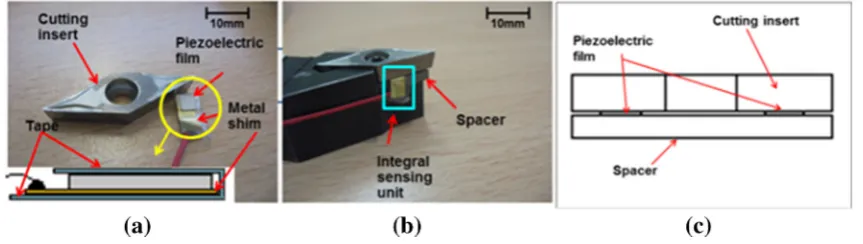
This type of the smart cutting tool design comprises of a cutting insert, a single-layer piezoelectric film, a metal shim and two pieces of insulation tape, as shown in Fig-ure2(a). The tool design considerations include [15]:
(1) The metal shim as output electrode of the piezo-electric sensor;
(2) Piezoelectric film (3 mm93 mm90.26 mm), to sensor the orthogonal cutting force;
(3) The integral sensing unit is placed 6 mm from the cutting tip, between the cutting tool and spacer; (4) The wire and a part of the metal shim are exposed
from the cutting insert surface, but there is a safe distance from the cutting insert tool tip.
The development protocol for the smart cutting tool is summarized in a flow chart and illustrated in Figure3. 3.1.2 Cross-talk Analysis
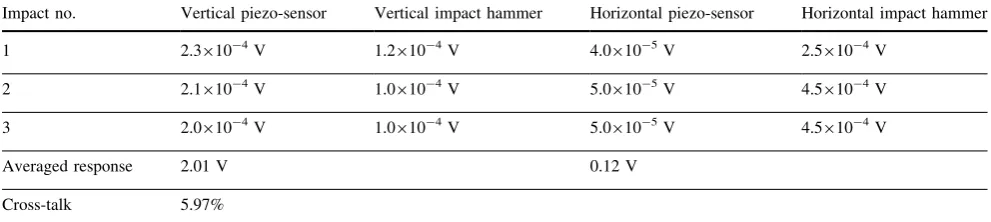
The impact hammer testing was carried out to assess cross-talk effects on the proposed smart tool 1. The Kistler impact force hammer (Type 9722A), with the force range of 0 to 500 N and sensitivity of 10 mV/N, is used to impact the cutting tip of the tool insert both vertically and hori-zontally. In order to produce a strong signal in the low frequency range, a plastic tip head of the impact hammer is applied in the hammer test. Both signal outputs from the digital impact hammer and the piezoelectric sensor were converted from the time domain into the frequency domain. The low frequency components from 0 to 50 Hz are the only parts to be considered in the frequency domain. Table1 tabulates the responses from the
piezoelectric sensor and the digital impact hammer when the impact forces were applied vertically, which are shown in the second and third columns, and horizontally as shown in the fourth and fifth columns. At the following step, the responses of the two impacts were normalized by dividing the dynamic response of the piezoelectric sensor with the one from the impact hammer. This step was repeated three times for the three replications of the impact tests and the averages of the normalized values are obtained accordingly for the vertical and horizontal impacts respectively. Those average values are numerically compared and computed as the cross-sensitivity, which leads to 5.97% in this smart tool configuration (with piezoelectric sensors).
3.1.3 Cutting Force Measurement Using the Smart Cutting Tools
Two smart cutting tools were used to measure the cut-ting force in dry turning process. The cutcut-ting process
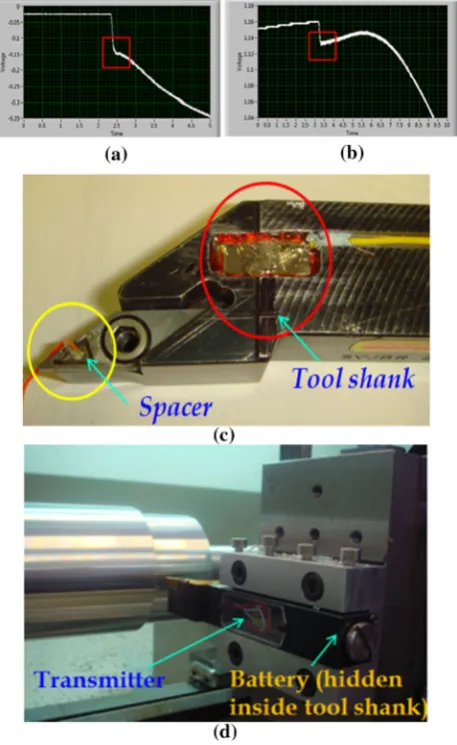
trials are conducted under the following conditions: depth of cut varying from 0.1 mm to 0.8 mm with 0.1 mm increments in each pass, the feedrate of 0.15 mm/ rev and cutting speed of 330 m/min. Figures4(a) and
4(b) show the corresponding voltage outputs generated from the smart cutting tools using the direct and indirect force measurement methods respectively. The ‘‘steps’’ highlighted in red squares, are generated from impulsive engagement between the insert and the workpiece, indicate static cutting force during the machining. From Figure4(b), it can be observed that the voltage output is increasing slightly after the ‘‘step’’ from the indirect force measurement and this is most likely due to the tool shank locating on its equilibrium position. In Fig-ure 4(a), the ‘step’ rise signal cannot be observed due to the force shunt measurement method measuring the force directly (smart tool 1). Furthermore, the slow changing patterns of the signals after 2.5 s and 5.5 s in respective Figures4(a) and4(b) are not related to the cutting force, Figure 3 Illustration of the
smart tool development protocol
Table 1 Cross-talk of the smart tool 1
Impact no. Vertical piezo-sensor Vertical impact hammer Horizontal piezo-sensor Horizontal impact hammer
1 2.3910-4V 1.2910-4V 4.0910-5V 2.5910-4V
2 2.1910-4V 1.0910-4V 5.0910-5V 4.5910-4V
3 2.0910-4V 1.0910-4V 5.0910-5V 4.5910-4V
Averaged response 2.01 V 0.12 V
but most probably due to the pyroelectric effect of the piezoelectric material.
The cutting trials were carried out in each depth of cut using cutting conditions mentioned above. The cor-responding cutting forces were measured by the smart tools 1 and 2, and Kistler dynamometer (for calibration reason). Figure5 shows the measured cutting forces using the proposed smart tools 1 and 2 respectively against Kistler dynamometer calibration simultaneously, which are in good agreement. However, signal outputs from both of smart cutting tools are affected by tem-perature fluctuations in real machining environment due to the temperature prone pyroelectric effect of the piezoelectric material. Therefore, surface acoustic wave (SAW) sensor as an alternative is further researched in the smart tool design and development, which may also lead to the smart cutting tool for ultraprecision and micro machining in particular.
3.2 Smart Cutting Tool Development Using Surface Acoustic Wave (SAW) Sensors
3.2.1 Smart Tool Development Using SAW-Based Force Sensor and Its FEA Simulation
SAW based sensors are playing an increasingly impor-tant role in sensoring and measurement with diverse applications ranging from gas and vapor detection to strain measurement [16, 17]. SAW sensor technology has the potential to be applied to measure cutting forces through its indirect force measurement principle. The location of the SAW sensor is critical to minimize the pyroelelctric effect. In the smart tool design and devel-opment, the sensors are normally placed onto the tool shank, particularly at the points where the maximum strain takes place. The tool shank is usually bolted at its one end in machining, and thus over hanged and suffers strain under static cutting forces generated in the machining process. Since the relationship between the cutting force and the strain is defined, the SAW sensor is able to measure the force. The advantages of using SAW Figure 4 aVoltage output from smart tool 1;bvoltage output from
smart tool 2;csmart tool 2;dcutting trails illustration
technology for smart tooling and smart machining application include:
(1) It is able to undertake wireless data transmission; (2) It is possibly powerless or energized externally; (3) High sensitivity;
(4) Working in high frequency response;
(5) It likely leads to plug-and-produce - smart integra-tion and connectivity;
(6) Low cost.
Therefore, SAW sensor technology is applicable to monitor the tool wear and machining processes through the in-process cutting force measurement, which is increas-ingly beneficial to smart machining and high value manu-facturing automation in the context of Industry 4.0.
Surface acoustic waves are ultrasonic waves propa-gating along the surface of solid objects, where there is the transmitting-receiving principle on the basis of piezoelectric transduction. An SAW sensor often con-sists of a large amount of electrodes, i.e., inter-digital transducers (IDTs), fabricated like comb-shapes on the top surface of a piezoelectric substrate material, such as quartz and lithium-niobate. The IDTs are functioned to convert electrical energy into mechanical energy, and vice versa, for generating and detecting the surface acoustic waves. When the cutting force is acted at the tool tip, the corresponding strain at the tool shank can be produced and detected by the SAW strain-principle sensor, as shown in Figure6. The strain shifts the nat-ural frequency of the surface acoustic waves away from its original one, the relationship between the cutting force and the frequency difference can thus be estab-lished as illustrated in Figure6. The relationship between the force and frequency changes can be expressed by Eqs. (1) and (2):
e¼ h
2
FðLxÞ
IE ; ð1Þ
Df¼2SGe: ð2Þ
Whereh,b,Lrepresent the thickness, width and length of the tool shank respectively. Df is the natural frequency change of the SAW strain sensor,x, the distance between the SAW and the fixed end.EandIrepresent the Young’s modulus and the second moment of area at the tool shank. The piezoelectric performance of the SAW sensor is represented with Eqs. (3) and (4) below. The FEA simu-lation, set up under accurate boundary conditions, is carried out to investigate a variety of proposed design structures so as to obtain a scientific understanding on the SAW strain performance of the sensors when being applied as the cutting force sensors.
T¼CESþeE; ð3Þ
D¼etSþesE: ð4Þ
WhereTis the stress vector andSis the strain vector, both has six elements includingx,y,z,xy,yz,xz.Dis the electric displacement vector andEis the electric field vector, both has three elements including x, y, z). CE is the stiffness matrix being evaluated in the constant electric field, i.e., short circuit. Whileeis the piezoelectric matrix relating to stress electric field,etis the piezoelectric matrix relating to stress electric field (transposed) and es represents the dielectric matrix evaluated at constant strain, e.g., clamped mechanically.
The SAW strain sensor substrate is made of quartz with a STX cut and the electrodes are made from Al. Rayleigh waves can be generated using the quartz-STX with a velocity of 3158 m/s. Moreover, the energy of the Rayleigh wave is confined close to the surface and dies out within two or three wavelengths in depth from the surface. The resonant frequency of the SAW is chosen to be 433 MHz. Based on the resonant frequency (fr) and the velocity (V), the elastic wavelength (k) can be determined by
k¼V
fr¼
3158 m=s
433 MHz¼7:29lm:
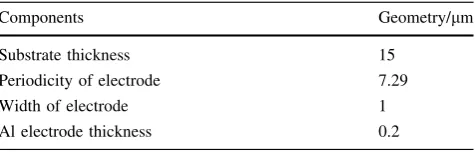
The distance between the successive IDT electrodes P is 3.645lm, which is half of the elastic wavelength. The geometric parameters of the SAW structure applied in the simulation are summarized and highlighted in Table2.
Figure 6 Schematic illustration of the principle using SAW sensors on the tool shank to detect cutting forces
Table 2 Geometry of the SAW sensor substrate and IDT
Components Geometry/lm
Substrate thickness 15
Periodicity of electrode 7.29
Width of electrode 1
In developing FEA simulation for the SAW strain sen-sor, the boundary conditions for the simulation, as shown in Figure7, need to be defined accurately. The material properties for both the piezoelectric substrate and the Al electrodes should be defined accurately as well. The stiff-ness matrix, the piezoelectric matrix, and the permittivity matrix are required as inputs into the FEA simulation. Young’s modulus, the Poisson’s ratio and the density are
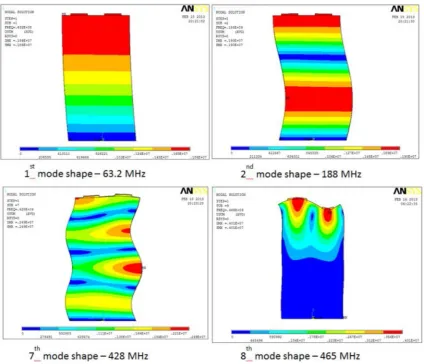
essential data as the inputs for the Al electrodes. The modal analysis is carried out to determine the modal frequencies and corresponding mode shapes so as to choose the proper propagation wave mode travelling along the substrate. The simulation can also be used as the starting point for further harmonic analysis to find out the corresponding dynamic response in the frequency components of interest. The modal analysis is performed to show several mode shapes and modal frequencies. The 8th mode shape and its cor-responding modal frequency of 465 MHz are found to be the preferred propagation wave mode as shown in Figure8, since the wave only propagates near the surface and maximally penetrates about 1.2k below the surface. This agrees with the Rayleigh waves theory [18].
In the harmonic analysis, an AC voltage of 10 V is applied onto one electrode, with a range of frequencies from 464 MHz to 472 MHz around the modal frequency obtained in the previous analysis. The resonant peak is obtained in the modal frequency of 465 MHz with a dynamic response of 0.16 lm as shown in Figure9. The Figure 7 Boundary conditions defining the propagation for the FEA
simulations
results of the simulation have been extended to support the experimental implementation of attaching SAW sensors onto the tool shank and calibrating their utilization for cutting force measurement.
3.2.2 Experimental Implementation
The two SAW sensors are mounted onto two aluminum plates which are firmly bolted to the top and bottom side of the tool shank respectively, as shown in Figure10. The advantage of this design configuration is that it can make the SAW devices reusable and reduce the amount of heat generated during the cutting process and its transferring to the SAW devices, and therefore avoid their failure. Fur-thermore, the proposed half bridge design configuration can theoretically produce characteristics of temperature compensation. It makes the traction and torque compres-sion compensations be possible, as the SAW gauges ori-entation leads the loading having no side-effect.
For evaluating and validating the SAW-based smart cutting tool for cutting force measurement in real machining environment, calibration is carried out so as to establish the scientific understanding of the intrinsic rela-tionship between the SAW strain and the cutting force.
A pre-defined static force as indicated and defined with a force gauge FT 200, is applied at the cutting tool tip so as to generate a corresponding strain to be measured by the SAW sensor. Figure11 shows the linear relationship between the applied force and the strain output in the range of 0–120 N, which is due to the elastic deformation of the Figure 9 Frequency response of the SAW in the harmonic analysis
Figure 10 SAW strain sensors instrumented onto the cutting tool shank
y= 0.092x
R² =0.997
0 2 4 6 8 10 12
0 20 40 60 80 100 120
Micro strain
Force/N
Figure 11 Correlation between static force and strain output
tool shank [19]. The curve fitting also leads to the expression equation for representing the relationship between the applied force and the strain, with a consider-ably high correlation, i.e.,R2value of 0.9968.
3.2.3 Preliminary Machining Trials
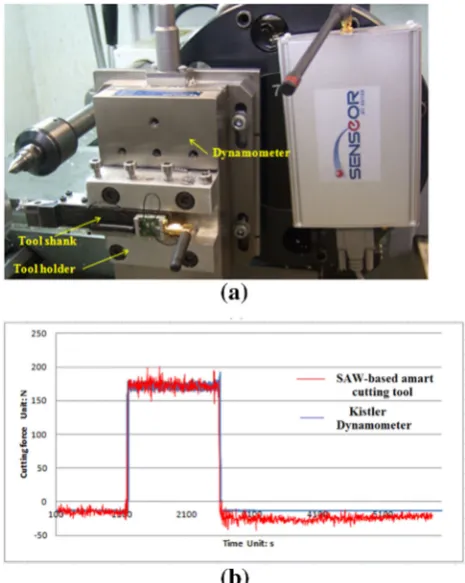
The SAW-based smart cutting tool is used to determine the cutting force in dry turning process, in the machining conditions: the depth of cut, 1 mm, constant federate at 0.2 mm/r, and a spindle speed at 900 r/min. Figure12(a) shows the experimental setup with the tool shank mounted on top of the Kistler dynamometer and the interrogation unit communicating with the SAW-based smart cutting tool. Figure12(b) shows the comparison of the cutting force measurement results by using the SAW-based smart tool and the Kistler dynamometer. The signal pattern captured by the smart cutting tool is in good agreement with the one by Kistler dynamometer.
4 Design of Cutting Temperature-based Smart
Cutting Tools
The increase in cutting temperature normally causes the premature cutting tool failure or excessive tool wear, while most of the wear processes occurs at the major flank face and rake face of the cutting tool. There are four main wear mechanisms in association with tool failure, including: oxidation, abrasion, adhesion and diffusion. All of these wears are related to the temperature sensitivity even under normal cutting conditions [20, 21]. At low cutting tem-perature (due to soft cutting or high cooling efficiency), adhesive and abrasive wears are dominant. While the cut-ting temperature is higher than a certain threshold, thermal induced wear, such as oxidation and diffusion, are acti-vated and dominate total wear. The utilization of cutting fluid, traditionally applied to remove heat generated from the cutting process, can additionally cause environmental pollution, health hazards, surface contamination and an Figure 13 aExperimental
increased cost of production [22]. The above issues can be avoided by using an internally-cooled smart cutting tool.
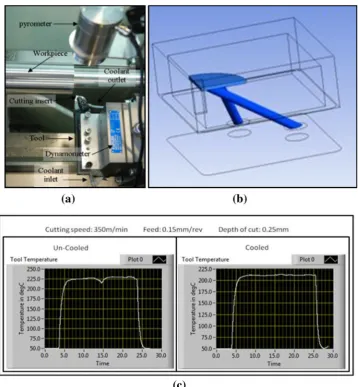
Figure13(a) shows the experimental setup, a pyrometer for measuring the temperature at the cutting tip and the Kistler dynamometer for measuring the cutting force in three directions during dry machining of the aluminum workpiece using an internally-cooled smart cutting tool developed by authors. As shown in Figure13(b), at the internally-cooled cutting tool, micro-channels (coolant inlet and outlet) are machined within the solid cutting insert, which are close to the cutting tip where the maxi-mum heat being generated. The micro-channels are designed to achieve optimal cooling performance, while maintaining the sufficient mechanical strength of the cut-ting tool. Pure water, functioning as the cooling fluid, is pumped through micro-channels to reduce the temperature near the cutting tip. The tool temperature reaches 225°C in machining the aluminum workpiece (cutting speed: 350 m/min; feedrate: 0.15 mm/rev and depth of cut: 0.25 mm). However, the temperature drops to 210°C (Figure13(c)) when the internal coolant is applied. It is possible to maintain the tool within a ‘safe’ cutting temperature range by using such a smart tool. As discussed above, the cutting temperature affects the tool wear albeit the observed total wear is not necessarily linked with the cutting temperature in all cases. The cutting trials results indicate that using the internally-cooled smart cutting tool can reduce the cutting temperature and activation of adhesion, oxidation and diffusion wears; and lead to an optimum cutting tempera-ture which can minimize tool wears development.
Although more experimentation and machining trials need to be undertaken for further validation, internally-cooled smart cutting tools can be applied in the following applications:
(1) Adaptive smart machining of high value components;
(2) Contamination-free machining such as medical devices and explosive materials;
(3) Machining of difficult-to-machine materials includ-ing titanium, magnesium and Inconel alloys, etc.
5 Fast Tool Servos (FTS)
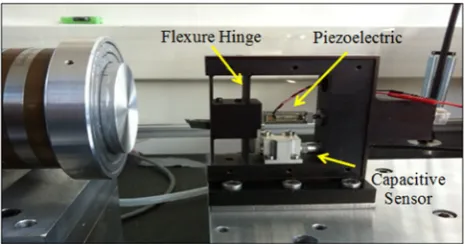
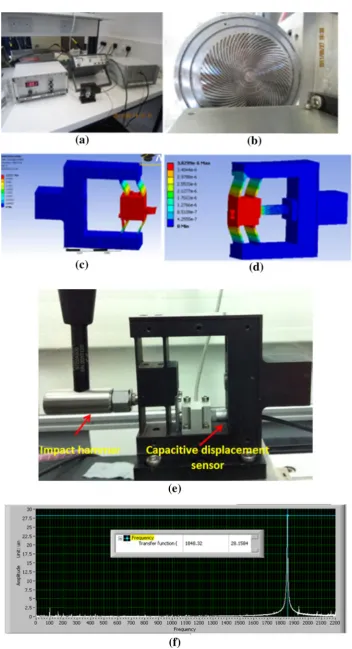
Fast tool servos (FTS) play an important role in precision turning of micro-featured or free-form surfaces with a diamond cutting tool. The FTS system normally includes a piezoelectric (or voice coils) actuator, flexure hinges, and positioning feedback sensor as illustrated in Figure14[23]. The piezoelectric actuator is a critical component in the FTS system and designed to perform precision positioning of the cutting tool during short stroke turning operations.
Furthermore, the piezoelectric actuator is selected as the driving element because of its high frequency oscillation operation capability. Static deformation of the FTS struc-ture caused by cutting forces during rough and finish machining, must be minimized to reduce the form and dimensional errors of the component. Therefore, high stiffness, which affects the machined surface directly, is required particularly in the feed direction. A high natural frequency and anti-fatigue is required in the FTS structure design so as to prevent its resonant vibrations particularly caused by cutting forces. On other hand, the high stiffness of the FTS structure is helpful in reducing the effective stroke of the piezoelectric actuator to some extent. For this reason, a compromise is made between the high stiffness and actuator stroke reduction [24]. Figure15(a) shows the FTS system off-line testing, using some equipment such as the capacitive sensor unit, signal generator, and the voltage amplifier/supplier for driving the actuator.
Based on the design criterion discussed above, the FTS developed can achieve a natural frequency of 1866.5 Hz (FEA simulation), as shown in Figure15(c). In the experimental testing and implementation, impact force is horizontally applied onto the hinge of the FTS structure with an impact hammer and the corresponding dynamic response is acquisited using the capacitive displacement sensor as shown in Figure15(e). In Figure15(f), the fun-damental natural frequency is 1840.3 Hz as detected using the impact hammer testing technique. There is a close agreement on the fundamental natural frequency between the FEA and experimental results with an error of 1.4%. Multi-physics analysis is investigated on the interaction between the piezoelectric actuator and FTS structure. As the piezoelectric actuator is driven by a DC voltage 30 V, the corresponding stroke length is 3.829 lm as shown in Figure15(d). Moreover, the static stiffness of the FTS developed is computed in 10.88 N/lm. The machine stiffness loop of the micro turning machine can be esti-mated as shown in Figure14.
Figure 15 aExperimental setup for using the FTS;
bmicro-featured surface machined by using the FTS developed;cmodal analysis;
dmulti-physics analysis on the FTS structure and piezoelectric actuator;eimpact hammer testing on the FTS structure; and
the geometric error of the component. The detailed analysis is as follows:
(1) Axial stiffness of the spindle:Kspinlde= 40.00 N/lm (2) Lateral stiffness of the air bearing slide:KX_Slide_Z=
40.00 N/lm
(3) Axial stiffness of the tool holder: KTool_holder = KFlexure?KPiezo= 10.88 N/lm?20.00 N/lm=30.88 N/lm
Therefore, the total machine loop stiffness is
1=KTotal loop¼1=Kspinldeþ1=KX Slide Zþ1=KTool holder
)KTotal loop¼12:14 N/lm
Preliminary cutting trials are carried out for machining micro-featured surface pattern on an Al workpiece using the FTS in the face turning process shown in Figure15(b). The FTS can be considered as one type of smart tool systems to position the tool precisely and dynamically, which is essential for machining micro-structured surfaces and special-featured components.
6 Smart Collets and Smart Spindles
Through an industrial project engagement, the authors have developed the smart collets to be fitted with high speed precision spindles for smart micro drilling and micro mil-ling purposes. For instance, Figure16illustrates the design of an automatic loading smart collet, which can be appli-cable and essential to undertaking high speed micro drilling or micro milling spindles operating in an industrial scale.
An alternative design of the automatic collet for high speed spindles is illustrated in Figure 17, which shows the design and development principles, i.e., being able to fulfill automatic loading and unloading the micro tools in an industrial operation environment. The collets can also be integrated with sensoring capacities, such as micro cutting forces or torques, which are desired for development of smart spindles and smart machines. They collectively together provide the enabling technology for undertaking smart micro manufacturing particularly in industrial oper-ation environment.
7 Smart Machining – Application Exemplars
The smart tool 1 developed by authors, can provide real time in-process data on cutting forces. It renders a compact low cost sensoring tool configuration with the plug-and-produce feature. The innovative concept and utilization of the smart cutting tool and the associated embedded algo-rithms are further studied for smart machining processes. In particular, using adaptive computer control (ACC) to maintain the constant cutting force with varied depths of cut is experimentally tested. The test is encouraging and promising, as it likely enables:
(1) Protecting and enhancing the tool when the mea-sured force is greater than the reference force; (2) Maintaining high productivity when the measured
force is less than the reference force, and;
(3) The improved reliability of the smart cutting tools in smart machining applications [25].
Figure18(a) illustrates a block diagram of a CNC machine with adaptive control, where the adaptive control process is based on the smart cutting tool in-process measuring cutting force. Through LabVIEW programming, the adaptive smart machining system is prototyped, which can perform self-monitoring and optimize their operations. For instance, it can determine whether the current cutting parameters are optimal and then adapt with the optimal process setups to operate the precision turning machine as needed. The test machining system includes a communi-cation interface for extracting current cutting parameters. Figure 16 Design layout of an automatic collet for high speed micro
milling or micro drilling
The prototype system, including the smart cutting tool and the associated algorithms, is tested with cutting trials on the well-designed component as shown in Figure18(a). Fig-ure18(b) illustrates the linear relationship between cutting force and feedrate at the constant surface speed of 330 m/min and depth of cut of 0.5 mm. Furthermore, the equation is provided on describing this linear relationship using curve fitting technique. As a result, if the cutting parameters require a depth of cut of 0.5 mm, a feedrate of 0.15 mm/rev with a constant surface speed of 330 m/min, the actual cutting force should be 84 N, as observed from Figure18(b), when the cutting tool is in good condition. However, due to the variation of the dynamic cutting force amplitudes, the cutting force is chosen to lie within the control range of 79 N to 91 N.
Figure19(a) demonstrates a LabVIEW based user-interface for communicating and adaptive control with CNC control system, which is developed to enable extracting cutting process data, such as feedrate, constant surface speed, depth of cut, and spindle speed. The interface system also records the main cutting force using the smart cutting tool signals obtained during the machining process. The measured cutting force is then compared with the desired cutting force range, in order
to adapt the operational feedrate to be an optimal one (as illustrated in Figure 18(b)). In order to extract the cut-ting parameters from the CNC turning machine (ALPHA 1350XS), C?? programming is developed and inte-grated into the LabVIEW interface. The function of the C?? programming is to manage the data transmit/re-ceive sequence, based on IP addresses with the CNC lathe through Ethernet, and then to obtain the cutting parameters using proprietary coding provided from the Fanuc library. Partial communication sequence is shown in Figure19(b). When the main cutting force of 98.87 N drops outside of the pre-defined control range of 79 N to 91 N, the adaptive control works out the adapted fee-drate to be 85% of the previous feefee-drate, in order to maintain a constant cutting force.
Through the case study and discussion above, it can be found that the adaptive smart machining with smart cutting tools likely enable the machining process:
(1) to operate autonomously (Intelligent) in a smart manner.
Figure 18 aAdaptive control loop and adaptive smart machining trails on a CNC machine;bthe relationship between the federate and cutting force
(2) to avoid and correct processing errors in process (Secured).
(3) to self-learn from the real-time data and anticipate the dynamic changes (Managed).
(4) to interact with other machines and systems (Con-nected), while operating on the shop-floor manufac-turing cell and system.
ISMC (Intelligent, Secured, Managed and Connected) represents the essential features of smart machining pro-cesses enabled by smart toolings (smart cutting tools, smart collets and smart fixtures, etc.). ISMC is the essential and dispensable design rules and fundamentals in developing smart toolings and adaptive smart machining systems.
8 Conclusions
A number of smart tools, including cutting force-based smart cutting tools, cutting temperature-based tools, FTS and smart collets/fixtures are presented in this paper. The design concepts of the force-based smart cutting tools are proposed using the piezoelectric film based on the force shunt measurement and the indirect force measurement methods. With the depth of cut from 0.1 mm to 0.8 mm, a close agreement on the orthogonal cutting force measure-ment can be achieved by using Kistler dynamometer and the two respective smart cutting tools developed. In order to achieve higher accuracy and more reliable measurement, SAW-based smart tooling development is exploited with the application to ultraprecision machining. Based on modelling and simulation analysis, a better understanding of SAW-based sensors is obtained and used to optimize the practical design of the SAW-based smart cutting tool. The experimental results from machining trials show close agreement between the Kistler dynamometer and the SAW-based smart cutting tool on the main cutting force measurement. The preliminary cutting trials using the internally cooled smart cutting tool have demonstrated the temperature of the cutting tip can be reduced by pumping the coolant through internal micro-channels within the smart cutting tool. Smart collets are also presented in line with requirements for smart spindles and high precision micro drilling and milling application. Further in-depth research for the internally cooled cutting tool is carried out particularly on its applications in adaptive machining. In the final part of this paper, one of the presented smart tools was used in smart machining by using adaptive control to maintain the cutting force constant with varied depths of cut by adapting the federate, which can be used particularly in machining components made from hybrid materials or hybrid structures, such as composite-aluminum-titanium structures, in aerospace industry.
This paper presents the smart cutting tools which act as the essential interface devices between smart machine tools and smart machining processes. The smart tooling can also be extended into smart fixtures and jigs, which are indis-pensable parts of smart machining systems particularly applicable in the context of Industry 4.0 and beyond [26]. Acknowledgements The authors gratefully acknowledge the com-mitted support of all the technical staff of the AMEE Department at Brunel University London. Particular gratitude is expressed to Dr Saiful Anwar Bin Che Ghani, Dr Hui Ding and Mr Paul Yates.
Open Access This article is distributed under the terms of the Creative Commons Attribution 4.0 International License (http://crea tivecommons.org/licenses/by/4.0/), which permits unrestricted use, distribution, and reproduction in any medium, provided you give appropriate credit to the original author(s) and the source, provide a link to the Creative Commons license, and indicate if changes were made.
References
1. J B Hentz, V K Nguyen, W Maeder, et al. An enabling digital foundation towards smart machining. 8th CIRP Conference on Intelligent Computation in Manufacturing Engineering, 2013, 12: 240–245.
2. G W Vogl, M A Donmez, A Archenti. Diagnostics for geometric performance of machine tool linear axes.CIRP Annals - Manu-facturing Technology, 2016, 65(1): 377–380.
3. B Peukert, S Benecke, J Clavell, et al. Addressing sustainability and flexibility in manufacturing via smart modular machine tool frames to support sustainable value creation. The 22nd CIRP Conference on Life Cycle Engineering, 2015, 29: 514–519. 4. M Fujishima, M Mori, K Nishimura, et al. Study on quality
improvement of machine tools.The 5th International Conference on Through-life Engineering Services (TESConf 2016), 2017, 59: 156–159.
5. C Prinz, F Morlock, S Freith, et al. Learning factory modules for smart factories in Industrie 4.0.6th CIRP Conference on Learn-ing Factories, 2016, 54: 113–118.
6. K Cheng, D H Huo.Micro Cutting: Fundamentals and Appli-cations. John Wiley & Sons Ltd, Chichester, October 2013. 7. J Tlusty, G Andrews. A critical review of sensors for unmanned
machining.Annals of the CIRP, 1983, 32 (2): 611–622. 8. M Weck. Machine diagnostics in automated production.Manuf.
Syst, 1983, 2 (2): 101–106.
9. R Teti, K Jemielniak, G O’Donnell, et al. Advanced monitoring of machining operations. CIRP Annals - Manufacturing Tech-nology, 2010, 59: 717–739.
10. K Cheng. Machining Dynamics: Theory, Applications and Practices. Springer, London, 2008.
11. J L Stein, K Huh. Monitoring cutting forces in turning: A model: Base approach. Manuf. Sci. Eng., Trans. ASME. 2002, 124: 27–31.
12. W Sawangsri, K Cheng. An innovative approach to cutting force modelling in diamond turning and its correlation analysis with tool wear.Proc. IMechE, Part B J. of Engineering Manufacture, 2016, 230(3): 405–415.
14. T Kim, J Kim. Adaptive cutting force control for a machining center by using indirect cutting force measurements. Interna-tional Journal of Machine Tools & Manufacture, 1995, 36: 925–937.
15. C Wang, R Rakowski, K Cheng. Design and analysis of a piezoelectric film embedded smart cutting tool. Proc. IMechE, Part B: J. Engineering Manufacture,2013, 227: 254-260. 16. P Alfred. A review of wireless SAW sensors. IEEE Transactions
on Ultrasonics, Ferroelectrics, and Frequency Control, 2000, 47: 317–322.
17. H Moussa, C Andrew, W Wojtek. Acoustic wave sensors: design, sensing mechanisms and applications.Smart Mater. Struct, 1997, 6: 647–657.
18. M Hofer. Finite-element simulation of wave propagation in periodic piezoelectric SAW structures. IEEE Transactions on Ultrasonics, Ferroelectrics, and Frequency Control, 2006, 53: 1192–1201.
19. B Donohoe, D Geraghty, G E O’Donnell. Wireless calibration of a surface acoustic wave resonator as a strain sensor.IEEE Sen-sors Journal, 2011, 11: 1026–1032.
20. E M Trent, P K Wright. Metal cutting. 4th ed. Butterworth-Heinemann, Woburn Massachusetts, July 2000.
21. A Saiful. Design and analysis of the internally cooled smart cutting tools with the applications to adaptive machining.PhD Thesis, Brunel University, 2013.
22. X Sun, R Bateman, K Cheng, et al. Design and analysis of an internally cooled smart cutting tool for dry cutting.Proc. IMechE, Part B: J. Engineering Manufacture, 2011, 226: 585–591. 23. H Li, R Ibrahim, K Cheng. Design of an innovative compliant
fast tool servo for precision engineering. Mech. Sci, 2011, 2: 139–146.
24. D H Huo, K Cheng. A dynamics-driven approach to the design of precision machine tools for micro-manufacturing and its imple-mentation perspectives. Proc. IMechE, Part B: J. Engineering Manufacture, 2008, 222: 1–13.
25. C Wang, K Cheng, R Rawkoski. Cutting force based analysis and correlative observations on the tool wear in diamond turning of single-crystal silicon.IMechE, Part B: J. Engineering Manufac-ture, 2015, 229(10): 1867–1873.
26. K Cheng. Keynote presentation - 2: Smart tooling, smart machines and smart manufacturing: Working towards the Industry 4.0 and beyond. IEEE International Conference on Automation and Computing (ICAC2015), Glasgow, UK, September 2015.
Kai Cheng,born in December 1961, is currently a Chair Professor and Theme Leader in Ultraprecision and Micro/Nano Manufacturing atBrunel University London, United Kingdom. Professor Cheng is a Fellow of the IMechE and IET since 2004. His current research interests include ultraprecision and micro machining, design of smart tooling and smart machining, multiscale multi-physics based design and analysis, and sustainable manufacturing systems. Tel: ?44 (0)1895-267255; E-mail: [email protected].
Zhi-Chao Niu,born in September 1990, is currently a PhD candidate in Ultraprecision and Micro/Nano Manufacturing Theme at Brunel University London, United Kingdom. He received his master degree on Advanced Engineering Design from Brunel University London. His research interests include ultraprecision and micro machining, micro cutting mechanics, and composite materials machining. Tel: ?44(0)7743844131; E-mail: [email protected].
Robin C. Wang,is currently a research fellow atBrunel University London, United Kingdom. His current research interests include smart cutting tools, design of air-bearings, and smart machining. E-mail: [email protected].
Richard Rakowski,is currently a senior lecturer atBrunel University London, United Kingdom. His current research focuses on smart cutting tools, manufacturing metrology, and creative engineering design. E-mail: [email protected].