O R I G I N A L A R T I C L E
Open Access
A comparison of the effectiveness of two
types of deceit detection training methods
in older adults
Jennifer Tehan Stanley
*and Britney A. Webster
Abstract
Background:In general, people are poor at detecting deception. Older adults are even worse than young adults at detecting deceit, which might make them uniquely vulnerable to certain types of financial fraud. One reason for poor deceit detection abilities is that lay theories of cues to deception are not valid. This study compared the effectiveness of two training methods to improve deceit detection among older adults: valid facial cues versus valid verbal cues to deception. Approximately 150 older adults were randomly assigned to facial training, verbal training, or a control condition. Participants completed a pre-test deceit detection task, their assigned training, and a post-test deceit detection task.
Results:Both training groups significantly improved at recognizing their respectively trained cues after training. However, the facial cue training group were less accurate at detecting deception post-test compared to pre-test and the control group exhibited improved accuracy of deceit detection from pre-test to post-test.
Conclusions:These results are consistent with the body of literature on deception suggesting people hover around chance accuracy, even after training. Older adults’facial and verbal cue recognition can be improved with training, but these improvements did not translate into more accurate deceit detection, and actually hampered performance in the facial condition. Older adults showed the most benefit from sheer practice at detecting deception (in the control condition), perhaps because this condition encouraged implicit rather than explicit judgments of deception.
Keywords:Deceit detection, Aging, Training, Emotion recognition, Verbal cues
Significance
Older adults are worse than young adults at detecting deception, which may a play a role in the increasing oc-currence of financial exploitation of the elderly. One rea-son for poor deceit detection abilities is that lay theories of cues to deception are not valid. In addition, older adults are less able than young adults to accurately iden-tify emotional facial expressions, and this hampers their ability to detect deception (e.g., shame, fear, and“duping delight”). This study involved the training of two groups of older adults on valid cues to deception: one group on valid verbal cues and one group on valid facial cues. There was also a control condition. Results showed that although the training was effective at improving the
recognition of valid cues to deception, the facial group’s performance was worse after training on facial cues, but the control group’s accuracy increased from pre-test to post-test. The most interesting finding was the success of training older adults on emotion recognition, with significant improvements in accuracy. We were sur-prised to find that the accuracy of older adults’ deceit detection improved in the control condition, where no training was provided. We think these data have two possible implications: (1) the training may not have boosted performance on the recognition of valid cues enough to improve the accuracy of deceit detection, or (2) older adults may benefit most from following their
“gut instincts” when detecting deception, such that mere practice improves performance. Future training inter-ventions should assess whether practice with detecting deceit improves accuracy.
© The Author(s). 2019Open AccessThis article is distributed under the terms of the Creative Commons Attribution 4.0 International License (http://creativecommons.org/licenses/by/4.0/), which permits unrestricted use, distribution, and reproduction in any medium, provided you give appropriate credit to the original author(s) and the source, provide a link to the Creative Commons license, and indicate if changes were made.
* Correspondence:[email protected]
Despite evidence that older adults may be uniquely vulnerable to financial exploitation due to age-related differences in the accuracy of deceit detection, there is little research on ways to reduce this vulnerability. Given recent findings pointing to specific mechanisms for age differences in deceit detection (Ruffman, Murray, Hal-berstadt, & Vater, 2012; Stanley & Blanchard-Fields,
2008), it is surprising that no training intervention re-search has been conducted with older adults to improve their accuracy in deceit detection. With the increasing age of the population, research is needed on ways to im-prove the accuracy of deceit detection in older adults.
Age-related differences in deceit detection and emotion recognition
A meta-analysis of the literature on deception showed that individuals are only slightly above chance at detect-ing deception: an average 54% accuracy was found across more than 200 studies where 50% is chance ac-curacy in these dichotomous truth/lie decision tasks (Bond & DePaulo,2006). Most of the deception research is based on young adult college student samples. How-ever, studies on aging and deception show that older adults (age 60 years plus) are even less accurate than young adults at detecting deception (Ruffman et al.,
2012; Stanley & Blanchard-Fields, 2008). A primary component of many types of financial fraud against the elderly is that the perpetrator lies to the older adult. For example, in one type of scam commonly perpetrated against older adults, victims are conned into paying for unsolicited work (e.g., roof repairs, paving, or auto re-pairs) that is unnecessary and often poorly or partially completed. Older adults may be uniquely vulnerable to falling victim to fraudulent schemes because they are less able to determine when someone is lying.
Interestingly, age-related differences in deceit detec-tion are largely due to age-related differences in recog-nizing facial expressions of emotion (Ruffman et al.,
2012; Stanley & Blanchard-Fields, 2008). In numerous studies, aging researchers have found an age-related re-duction in the ability to correctly identify certain facial expressions of emotion (see Ruffman, Henry, Living-stone, & Phillips, 2008 for a meta-analysis). Specifically, young adults are more accurate than older adults at identifying angry, sad, and fearful facial expressions. Key cues to deception are micro-expressions of emotion (e.g., fleeting 40–200-ms expressions of fear, shame, and
“duping delight”) that leak out when a person lies - un-beknownst to the liar (Frank & Ekman, 1997, 2004). Older adults score lower than young adults on tests of emotion recognition accuracy (correctly identifying a fa-cial expression such as fear or shame), and under certain conditions these age differences in emotion recognition
statistically account for older adults’ poorer deceit
detection accuracy (relative to young adults; Ruffman et al.,2012; Stanley & Blanchard-Fields,2008). Much of the work on age differences in emotion recognition and de-ceit detection use stimuli with young adult targets. How-ever, more recent research has shown that older adults exhibit an own-age bias such that they are more likely to judge an older adult to be telling the truth than a young adult (Slessor, Phillips, Ruffman, Bailey, & Insch, 2014). This suggests that the age of the target is important when examining age differences in deceit detection.
Deception training interventions
Now that researchers have some insight into the under-lying mechanisms for age-related differences in deceit detection, it is important to apply this knowledge to a training intervention aimed at improving the deceit tection accuracy of older adults. A meta-analysis of de-ceit detection training studies with young adults showed that training participants to identify verbal cues to de-ception was the most effective method of training (Hauch, Sporer, Michael, & Meissner, 2014). For ex-ample, one established method for identifying deception using verbal cues is the criteria-based content analysis
(CBCA) developed by Steller and Köhnken (1989). This
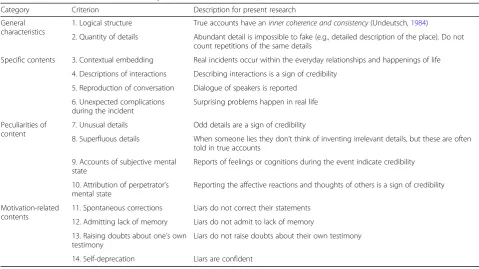
method identifies 19 reality criteria for analyzing state-ments for credibility. Subsequent training studies elimi-nated 5 of the original criteria because they were only relevant to children’s testimonies or were difficult to understand (Landry & Brigham, 1992). A revised list of 14 criteria have been used successfully in a training paradigm to significantly increase deceit detection accur-acy, with accuracy for untrained adults - at 47% - signifi-cantly lower than accuracy for participants trained on
the CBCA - 55% (see Table 1 for list of criteria). No
study has investigated whether these training techniques can improve the accuracy of deceit detection in older adults. It is important to compare the effectiveness of different training approaches in an older adult sample, given some of the unique characteristics of older adults (i.e., reduced accuracy in emotion recognition).
Valid facial cues to deception
In addition to verbal cues to deception, noticing incon-gruent facial expressions of emotion during a lie are valid cues to deception (Frank & Ekman,1997,2004; ten Brinke & Porter, 2012). Because of age-related differ-ences in the accuracy of emotion recognition (Ruffman et al.,2008), older adults may receive the greatest benefit from learning how to identify micro-expressions of emo-tion (e.g., fear, shame, and “duping delight”) that are valid cues to deception. Young adults’accuracy in emo-tion recogniemo-tion improves with training when the
train-ing includes feedback (Elfenbein, 2006). Similarly, a
training young adults on the more broad ability of person perception (judgment of the internal state of others) is with practice and feedback (Blanch-Hartigan, Andrze-jewski, & Hill,2012). However, it may be difficult to im-prove older adults’emotion recognition accuracy through training. Across four studies, using a lifespan sample, young and middle-aged adults improved emotion recogni-tion accuracy after brief computerized training, while older adults’accuracy did not improve following the train-ing (Schlegel, Vicaria, Isaacowitz, & Hall,2017). Given that the underlying mechanism(s) responsible for age-related differences in emotion recognition are still unclear (Isaa-cowitz & Stanley,2011), it is possible that these differences are not malleable (for example, they may be rooted in brain-based functional changes associated with aging such as reduced amygdala activation in response to emotional stimuli (Cacioppo, Bernston, Bechara, Tranel, & Hawkley,
2011; Mather et al.,2004)).
Valid verbal cues to deception
If training in the accuracy of emotion recognition is not effective in older adults, it may be more fruitful to train older adults to recognize the valid verbal cues to decep-tion such as less speaking time, more nervousness, fewer details, less logical arguments, and less cooperation (DePaulo et al., 2003; ten Brinke, Stimson, & Carney,
2014). Interestingly, many individuals’lay theories of de-ceit detection rely upon invalid cues to deception (Ake-hurst, Köhnken, Vrij, & Bull, 1996). For example, many people believe that arm and leg movements increase
during deception when in fact they decrease, and that admitting lack of memory and raising doubts increase during deception, when in fact it decreases (Akehurst et
al., 1996). Furthermore, although both young and older
adults associate averted gaze with lying, when actually making judgments about veracity, older adults are less likely to use direct versus averted gaze cues than young adults (Slessor et al., 2012). Thus, it is important to understand the cues that young and older adults actually use when judging veracity.
A secondary data analysis of the Stanley and Blanchard-Fields (2008) thought-listing data investigated whether there are age differences in the cues that young and older adults use to detect deception. In this study,
166 young adults (ages 18–27 years; 49% female) and
184 older adults (ages 61–83 years; 54% female) were
presented with 10 videos of young men being interro-gated about whether they committed a crime (all 10 claimed innocence but half were lying). Participants made a truth versus lie judgment about each target and then listed the factors that went into their decision in an open-format thought-listing task. Participants were ran-domly assigned to one of three between-subjects condi-tions that varied based on the presentation modality of the video statements: audio-visual, visual alone, or audio alone. The main finding of the published study was that young adults were better than older adults at detecting deceit in the conditions with visual information (i.e., vis-ual and audio-visvis-ual). Older adults were better than chance when audio information was available.
Table 1Content criteria for statement analysis (from Steller & Köhnken,1989)
Category Criterion Description for present research
General characteristics
1. Logical structure True accounts have aninner coherence and consistency(Undeutsch,1984)
2. Quantity of details Abundant detail is impossible to fake (e.g., detailed description of the place). Do not count repetitions of the same details
Specific contents 3. Contextual embedding Real incidents occur within the everyday relationships and happenings of life
4. Descriptions of interactions Describing interactions is a sign of credibility
5. Reproduction of conversation Dialogue of speakers is reported
6. Unexpected complications during the incident
Surprising problems happen in real life
Peculiarities of content
7. Unusual details Odd details are a sign of credibility
8. Superfluous details When someone lies they don’t think of inventing irrelevant details, but these are often told in true accounts
9. Accounts of subjective mental state
Reports of feelings or cognitions during the event indicate credibility
10. Attribution of perpetrator’s mental state
Reporting the affective reactions and thoughts of others is a sign of credibility
Motivation-related contents
11. Spontaneous corrections Liars do not correct their statements
12. Admitting lack of memory Liars do not admit to lack of memory
13. Raising doubts about one’s own testimony
Liars do not raise doubts about their own testimony
To inform the design of the present study, we coded a total of 2262 responses from the thought-listing using a theory-driven and data-driven coding scheme. Two inde-pendent coders reached 78% agreement categorizing 22% of the responses. A single coder who was blind to participant age coded the remaining responses. This pilot study is the only study to examine age differences in reported cues used to detect deception. There were age differences in the frequency of mentioningquality of argumentas a factor used to make deception judgments.
A response was coded as quality of the argument if the
participant referenced the degree of elaboration, whether the argument was convincing, clear, or specific (e.g.,
“The arguments were clearly presented”). Young adults mentioned using quality of argument (55%) more often than older adults (38%), p< .05. Using quality of argu-ment as a cue was positively correlated with the accur-acy of deceit detection (rpb= .25, p< .01). This provides initial evidence that older adults are less likely than young adults to report using valid verbal cues to detect deception, such as the quality of the argument. Thus, training older adults to recognize and use the valid ver-bal cues to deception may be effective at improving the accuracy of their deceit detection.
Present study
The purpose of this study was to determine (1) the effi-cacy of a validated emotion recognition training tool in improving the accuracy of older adults’emotion recogni-tion, (2) the efficacy of a brief training tool in improving the recognition of valid verbal cues to deceit, (3) whether deceit detection training can improve accuracy in deceit detection among older adults, and (4) whether training on deciphering verbal cues to deception or fa-cial cues to deception is more effective at improving the accuracy of deceit detection among older adults.
Hypotheses
Because the micro-expression training tool is effective at improving the accuracy of emotion recognition among
young adults (Hurley, 2012), we expected the emotion
recognition training to be effective at improving the ac-curacy of emotion recognition for older adults (Hypoth-esis 1 (H1)).Similarly, because we created the verbal cue training to mimic the emotion recognition training as closely as possible, we expected our newly developed verbal cue training would increase accurate recognition of valid verbal cues among older adults (H2). Based on findings from a meta-analysis of the literature on deceit detection training among young adult participants, which suggests a small to medium positive effect for
training studies (Hauch et al., 2014) - combined with
evidence that after training older adults improve their performance on a diverse set of tasks, including visual
search (Becic, Boot, & Kramer, 2008) and memory
(Lachman, Weaver, Bandura, Elliott, & Lewkowicz,
1992) - we expected that deceit detection training would improve deceit detection accuracy among older adults (H3).
It was difficult to predict which training method (ver-bal cues or emotion recognition) would be more effect-ive for older adults. On the one hand, findings from a meta-analysis on studies of deceit detection training with young and middle-aged adults suggests that verbal cue training is more effective than nonverbal cue training for increasing accuracy of deceit detection in general
(Hauch et al., 2014). Furthermore, preliminary work in
my laboratory showed that older adults were less likely than young adults to report using valid verbal cues to deception (i.e., quality of argument) and the use of these cues correlated with the accuracy of deceit detection. This suggests that older adults may indeed benefit from training on identifying valid verbal cues to deception. However, robust findings from the literature on aging highlight older adults’ poorer performance at recogniz-ing facial expressions of emotion (Ruffman et al., 2008) and the detrimental consequences of this vulnerability for detecting deception (Ruffman et al.,2012; Stanley & Blanchard-Fields, 2008). On balance, there is currently more evidence showing that older adults perform poorly on deceit detection because of less accurate emotion recognition rather than poorer usage of verbal cues. We also expected that older adults might have more room to improve on emotion recognition training than verbal cue training. Because the links between aging, emotion recognition, and accurate deceit detection are more established in the literature than those for verbal cues, we expected that the emotion recognition intervention (facial training) would be more effective at improving older adults’accuracy for deceit detection than the ver-bal training (H4). However, we expected both training groups to improve more on detecting deception post-treatment than the control group: control < verbal train-ing < facial traintrain-ing (H5).
Methods
Participants and design
corrected-to-normal vision. All participants were screened for demen-tia and completed tests of visual and hearing acuity. Par-ticipants were recruited from our existing participant database and the local community using fliers, word of mouth, and advertisements and received US$25 for their participation. Participants could not be the same individ-uals who participated in the validation study.
The main training study included a total of 157 partic-ipants (ages 57–87 years; mean age = 68.76 years, SD= 5.80). Each participant was randomly assigned to one of three experimental conditions: verbal training, facial training, or control. Participants were screened for de-mentia with the Modified Telephone Interview for Cog-nitive Status (TICS-M 15 items; Brandt, Spencer, &
Folstein, 1988; Welsh, Breitner, & Magruder-Habib,
1993). Nine participants scored below the cutoff of 21
and were not included in further analysis, leaving a total of 148 participants (ages 60–87 years; mean age = 68.96,
SD= 5.75; n = 51 male and 91 female participants) for
analyses. The breakdown of participants by group was as follows: 51 (15 male, 36 female) participants in the facial condition, 48 participants (22 male, 29 female) in the verbal condition, and 49 participants (20 male, 29 fe-male) in the control condition. Within each condition, participants were randomly assigned to video set A or video set B.
Stimuli creation
To create the videos of truth/lie statements, we recruited
20 middle-aged adults (ages 40–59 years; 50% women)
because the majority of fraud against the elderly is per-petrated by middle-aged adults (Burnett, Xia, Suchting,
& Dyer, 2017; DeLiema, Yonashiro-Cho, Gassoumis,
Yon, & Conrad,2017). Participants (hereafter referred to assuspects) were asked to lie or tell the truth about their agreement on six controversial topical issues (legalizing marijuana, euthanasia, labor unions, abortion, cloning of human cells, and government healthcare). We selected lies about attitudes and opinions (rather than a theft) be-cause these are the most common types of lies (DePaulo
et al., 2003) and we wanted to avoid putting suspects
and judges into unfamiliar situations. Indeed, on average, individuals tell one or two social lies per day. Suspects were randomly assigned to lie about their opinion for three topics and tell the truth about their opinion for three topics. The interrogator was blind to which topics were lies. Suspects were provided with a monetary in-centive (US$20) if they could convince the experimenter that they were telling the truth on all six statements. Past research has shown that a monetary incentive is im-portant for creating a high-stakes lies scenario to best imitate the types of situations where con-artists lie in ac-tual fraud or other criminal situations (Frank & Ekman,
1997; Hauch et al.,2014). Suspects’heads and shoulders
were videotaped while being interrogated with a stand-ard set of questions (e.g., When did you first develop this opinion? Who was with you when you first developed this opinion? Are you lying to me now?).
Recent work in forensic psychology highlights the im-portance of employing the principle of differential recall enhancement in order to elicit content that provides dis-cernible cues to deception (Colwell, Hiscock-Anisman, & Fede, 2013). The idea is that a person who is being honest believes that their honesty is transparent and therefore they do not try to manage their impression. In addition, a person who is being honest is able to recall the actual events from memory, which takes less effort than creating information while trying to appear consist-ent and credible (in the case of someone lying). We employed the principle of differential recall enhance-ment by simply asking at the end of each interview for
the suspect to “Describe in as much detail as possible
everything you remember about your opinion on this topic”. This final question can highlight differences in the credibility of statements and is now recommended as a basic requirement of standard interviewing tech-niques by police officers (Colwell et al.,2013).
Validation of stimuli
In order to select the best set of stimuli for the main training study, we conducted a validation study with the sets of six statements from all 20 middle-aged suspects (a total of 120 videos, which ranged from 56 s to 4 min, 20 s (mean (M) = 1 min, 54 s;SD= 49 s). The aim was to select one truth and one lie from each suspect that yielded typical performance (based on prior research), to avoid ceiling or floor effects and allow for an increase in accuracy after the training intervention. A lifespan
sam-ple of 23 men and women (18–78 years old; M= 53.13
years,SD= 18.81; 70% women) participated in the valid-ation study. Because judging 120 videos would likely fa-tigue participants, each participant viewed 30 video statements in a randomized order and judged each state-ment as a truth or a lie. Each video was judged by 8–10 participants (with age groups equally represented). In order to select stimuli that elicited typical, near-chance accuracy detection of truth versus deception in naïve participants, we selected one truth and one lie statement
from each suspect that was closest to 50% accuracy in
of the 90%-truth videos for this suspect to be included in the main study. Another suspect’s lie videos were de-tected with 0%, 0%, and 11% accuracy in the validation study. We selected this suspect’s 11%-accuracy lie video to be included in the main study. This yielded 20 truth-lie pairs to use pre-test and post-test (before and after the training study). The final set of videos ranged in ac-curacy in the validation study from 11 to 90%. For the main study pre-test and post-test, we created two sets of videos with 10 videos (5 truths and 5 lies) for pre-test and 10 videos (5 truths and 5 lies) for post-test. Each suspect was only represented once in each video set. Thus, if the “truth” statement was used in video set A from suspect 702, then the lie statement from suspect 702 was used in video set B.
These videos were then coded for the presence of valid facial cues and verbal cues to deception. To code the fa-cial expressions of the videos, we used the Affectiva Aff-dex facial expression recognition engine within the iMotions Biometric Research Platform (version 7.1 soft-ware, 2018; Copenhagen, Denmark). First, two coders in-dependently watched the playback of the videos with the video box and points of reference to identify videos with artifacts that interfered with the facial processing. One person was chewing gum and one person brought their hand to their mouth several times, which interfered with the automated coding. This left 36 videos to code for fa-cial expressions (18 truth-lie pairs). Because we expected individuals who were lying would try to hide some of their facial expressions (Porter & ten Brinke, 2008), we used a criterion threshold of 10% to capture fleeting and partially concealed facial expressions. Ninety percent of lies in a previous study were correctly categorized as lies just based on the presence of fear or disgust (Frank &
Ekman, 1997). Coding of real televised footage of
emo-tional pleas about a missing relative found that the pres-ence of disgust and lower face smiles were predictive of liars (ten Brinke & Porter,2012). Based on this prior evi-dence, we focused on the basic facial expressions of joy, fear, and disgust, as well as the presence of smiles (or
“duping delight”). We included both joy expressions and smiles, in case the duping delight only leaked through on the lower half of the face, in a smile. The sampling rate was 17 ms. For each frame, if the software reported greater than 10% confidence that the emotion was present, that frame received a 1, all else received a zero. Then we multiplied the number of frames that exceeded the threshold by 17 to obtain the total duration (in milli-seconds) of each facial expression per video. Next, we divided this duration of facial expressions by the total duration of the video to obtain a percent duration of each facial expression for each video. Given that there are individual differences in the facial expressions that
leak out when lying (Frank & Ekman, 2004), we
examined each video pair for the strongest emotional ex-pressions. Nine video pairs differed on smile duration, with lie videos (M= 8.90%, SE= 3.22%) containing sig-nificantly greater overall durations of smiles than truth
videos (M= 4.98%, SE= 2.50%) (paired samples t test:
t(8) = 2.35, p= .047). Five video pairs (including one of the video pairs in the smile group) differed on the dur-ation of the facial expression of disgust, with lie videos (M= 1.44%, SE= 0.70%) containing significantly greater overall durations of facial expressions of disgust than
truth videos (M= 0.11%, SE= 0.09%) (related samples
Wilcoxon signed rank test, p= .043). This left six video pairs without clear facial expression cues differing be-tween truth and lie. Thus, we confirmed that 13 (of 20) video pairs contained valid facial cues to deception.
The verbal content in the videos were transcribed and verified. To code the videos for valid verbal cues to de-ception, two coders independently coded transcripts of the 40 videos on the 14 verbal cues presented in Table1. All cues were coded as present (1) or absent (0), except
quantity of details, which was coded as absent (0), some (1), or a lot (2). The codes were not mutually exclusive; each transcript could be coded as having anywhere from 0 to 14 cues present. The coders first trained on tran-scripts from eight videos that were not selected for this study, and then coded half of the 40 transcripts from the videos used in this study (20 transcripts). Coders worked independently, and the transcripts were stripped of iden-tifying information such as gender and veracity. There was an overall mean kappa score (κ) = 0.88 (SD= 0.22)
across the 14 cues and the mean Z score (κ divided by
theSDofκ) was 3.94, indicating that agreement was sig-nificantly greater than chance (because the Z score was greater than 1.96). Discrepancies were resolved with dis-cussion and the final codes agreed upon were used to determine whether the videos contained valid verbal cues to deception. A single coder coded the final 20 transcripts, after achieving reliability with the second coder on the first 20 transcripts.
Across all 20 video pairs, McNemar’s test for repeated measures showed that truth videos (19 of the 20 truth vid-eos) were more likely to contain logical structure than lie videos (13 of the 20 lie videos),p= .031. Both quantity of details and spontaneous corrections were also valid verbal cues for a subset of these video pairs (i.e., for 10 video pairs, with 3 video pairs that had both cues). The related samples Wilcoxon signed rank test was significant (p= .008) for quantity of details for seven video pairs, with
truth videos (M= 1.43, SD= 0.53) containing greater
quantity of details than lie videos (M= .43,SD= .55). For spontaneous corrections, for six video pairs, the truth vid-eos all had spontaneous corrections whereas none of the
lie videos did (McNemar’s test for repeated measures,
For the dependent variables of pre and post accuracy of deceit detection, we focused on the video pairs with valid cues to deception. Each set of videos (pre-test A, post-test A, pre-test B, and post-test B) contained at least two lies and two truths with valid cues to deception in the facial, verbal, and control conditions. Videos that did not contain facial or verbal cues were excluded from the control accuracy scores. We converted number cor-rect to percent corcor-rect for each condition (separately pre-test and post-test) as our main dependent variables.
Procedure
Participants sat at a computer with headphones pre-test and post-pre-test. They adjusted the volume of headphones prior to the task using a music sample. Instructions were presented on the computer. Partic-ipants were told to watch each video and then make a judgment as to whether the suspect was lying or telling the truth. They were told that anywhere from ¼ to ¾ of the people in the videos were lying. They made their response after each video by circling truth or lie on a sheet of paper. Each video was numbered 1 through 10. Participants either saw video set A or video set B. After each test (pre and post), participants rated how accurate they thought they were at judging who was lying (on a 10-point scale). They also rated how confident they felt about their judgments (on a 10-point scale). Finally, partic-ipants listed the cues they used to detect deception. The procedure was identical pre-test, which occurred prior to training, and post-test, which occurred fol-lowing training. The entire study took about 2.5 h (with breaks) to complete.
Training
Facial training was a self-paced tutorial through the Micro-Expression Training Tool (METT; available at
paulekman.com) created by Paul Ekman. This training tool includes a benchmark assessment of accuracy in identifying micro-expressions of emotion, followed by 75 min of training and practice with feedback, and then an improvement measure assesses micro-expression ac-curacy again after training. The emotion recognition training consisted of 3 parts: (1) a tutorial on the evi-dence for valid facial cues to deception, namely that fear of getting caught, shame of lying, and joy or“duping
de-light” leak out during deceptive statements
(approxi-mately 15 min; Frank & Ekman, 1997), (2) completing the computerized Microexpression Training Tool (eMett 3.0; created by Paul Ekman), which has been shown to improve the accuracy of microexpression identification and includes instructions on how to identify different microexpressions of emotion (e.g., fear, joy, shame; ap-proximately 45 min) and, (3) practice items with
feedback in the form of identifying the different micro-expressions of emotion (approximately 20 min). These practice items of microexpressions are the same micro-expressions that have been identified as valid cues to de-ception in videos from a mock crime scenario (Frank & Ekman,1997,2004).
We created the verbal training to match the facial training using the cadre of valid verbal cues from the lit-erature including the 14 criteria of the CBCA described
above (Table 1) and additional verbal cues provided in
the literature (e.g., less fluency; Driskell, 2012; Hauch et al., 2014). The CBCA has shown satisfactory reliability and validity for detecting adult lies (Gödert, Gamer, Rill, & Vossel, 2005; Landry & Brigham, 1992). The training consisted of 3 parts: (1) a tutorial on the evidence for valid versus invalid verbal cues to deception (approxi-mately 10 min), (2) detailed descriptions of valid verbal
cues to deceit adapted from DePaulo et al. (2003;
ap-proximately 40 min) and Steller and Köhnken (1989),
and (3) practice with sample transcripts of statements containing each of the valid verbal cues (approximately 20 min). Participants gained practice with identifying valid verbal cues to deceit and received feedback on their ability to identify these cues.
In order to provide diversity in the practice items, they were culled from two sources of truths and lies on dif-ferent topics: (1) transcripts of videos of truths and lies we obtained from ten Brinke and colleagues (ten Brinke
et al., 2014), and (2) videos we collected for another
study. The videos of ten Brinke et al.’ (2014) consist of six individuals lying and six telling the truth about whether they stole money in a mock crime scenario where they were instructed to either steal the money or not but always claim innocence. These videos were tran-scribed and good and bad examples of each of the valid verbal cues to deception were used as sample items in the practice part of the training. In addition, we
col-lected videos of 20 young (18–30 years; 50% women)
and 20 older (60–85 years; 50% women) adults lying or
telling the truth about six of their personal hopes and dreams (three lies and three truths from each person). These videos were transcribed and the transcripts were used as material for practice items of valid and invalid verbal cues to deception.
the training. The entire verbal training took about 75 min.
For the control condition, participants completed a series of questions on the computer presented using Qualtrics software (Qualtrics, Provo, UT). Questions in-cluded logic and math problems, personality items, per-ceptual items/optical illusions, and puzzles. This took about 75 min.
Coding of cues
Participants listed the cues or strategies they used to make truth/lie judgments twice during the study: once after the deceit detection pre-test (after all 10 truth/lie judgments) and once after the deceit detection post-test (after the second set of all 10 truth/lie judgments). This yielded two thought-listing responses for each partici-pant. Specifically, participants were asked: “What cues or strategies did you use to determine which statements were truths and which statements were lies?”
A theory and data-driven coding scheme was devel-oped for these open-ended responses. The coding scheme included the following 14 categories: hesitation, facial expressions, eye movements, logical response, re-call of comments, speech characteristics, nonverbal be-havior, nervous manner, details/context, personal beliefs, liar’s use of notes, miscellaneous, no cue reported/guess-ing, and not codeable. Two coders independently coded 20% of the 314 responses. Inter-rater agreement was high (85–100%). Coders discussed discrepancies to reach an agreement. A single coder coded the remainder of the responses.
Results Data checks
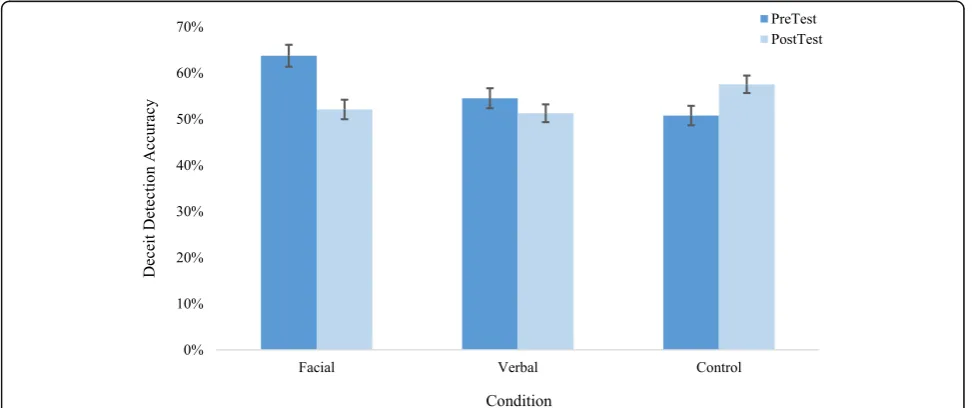
Unfortunately, despite random assignment to the three training conditions, there were significant differences in the accuracy of deceit detection between the conditions at pre-test, F(2, 132) = 8.56,p< .001, ηp2= .12, with par-ticipants in the facial condition (M= 63.70%,SE= 2.40%) outperforming the other two conditions pre-test (verbal
M= 54.50%,SE= 2.20%; control M= 50.80%,SE= 2.10%)
ps < .05. These differences in the accuracy of deceit de-tection between the facial condition and the other two conditions pre-test were not expected, and made it more difficult to detect the predicted Test Time × Condition interaction. There were no significant gender differences in the accuracy of deceit detection. There were no sig-nificant differences in the accuracy of deceit detection accuracy between the two video sets (A and B) at pre-test or post-pre-test.
Graphical visualization of the data suggested that the change in the accuracy of detection of deceit (DeceitCh-ange) variable is normally distributed. However, statis-tical tests of normality suggested that the change in the
accuracy of deceit detection was not normally distrib-uted for the facial condition. Analyses were run two ways: assuming normality and with nonparametric tests that do not assume normality. The pattern of findings was identical so tests with normality assumptions are reported.
Training efficacy
For the two experimental conditions (verbal training and facial training), we assessed performance on identifying verbal categories or facial categories before training and after training. For the facial condition, participants
scoredM= 38.88%,SD= 14.29 for on the benchmark
as-sessment. After the 75-min tutorial on recognizing
micro-expressions, participants scoredM= 51.94%,SD=
19.21, a significant improvement (t (49) = 6.01, p< .001,
d= 0.89). Similarly, for the verbal condition, participants
scoredM= 45.95%,SD= 14.29 on the benchmark
assess-ment. After the 75-min tutorial on categorizing verbal cues to categories, participants scoredM= 78.21%,SD= 11.64, a significant improvement (t(47) = 15.89, p< .001,
d= 2.30). Figure1depicts the results.
There was a wide range of change in performance as a function of training: For the facial condition, change in
performance ranged from −21 to 50%. For the verbal
condition, change in performance ranged from 0 to 60%. All inferential analyses were conducted with only partici-pants who scored greater than zero on the change in performance for the training: 13 participants did not meet this threshold, which left 39 participants in the fa-cial condition, 47 in the verbal condition, and 49 in the control condition.
Inferential statistics
A 2 (Test time: pre versus post) × 3 (Condition: facial,
verbal, control) mixed-design analysis of variance
(ANOVA) was conducted on the accuracy of deceit de-tection with test time as a within-subjects variable. Re-sults are depicted in Fig. 2. The Test time × Condition interaction was significant, F(2, 132) = 10.13, p< .001, ηp2
= .13. Separate simple effects analyses for each condi-tion revealed significant differences between pre-test and post-test for the facial and control conditions. For the fa-cial condition, participants performed significantlyworse
post-test (M= 52.10%, SE= 2.10%) than pre-test (M=
63.7%, SE= 2.80%), F (1, 38) = 14.70, p< .001, ηp2= .28. For the control condition, participants performed
signifi-cantly better post-test (M= 57.60%, SE= 1.80%) than
pre-test (M= 50.80%, SE= 2.20%), F (1, 48) = 6.21,
p= .016,ηp2= .11.
significantly better than chance,ps < .01. Post-test accur-acy in the control condition was significantly better than chance,p< .001.
Cue analyses
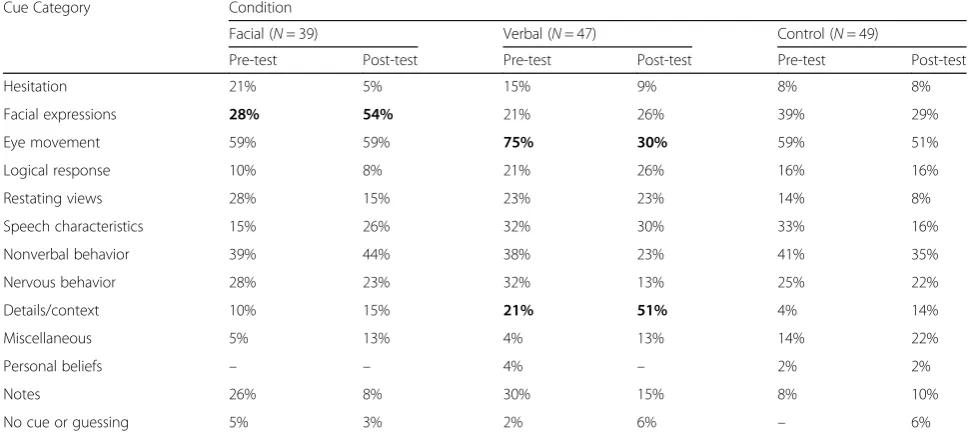
Table 2 displays the frequency of cues mentioned by
condition. Pilot testing of the training study indicated that it was important to inform participants that tar-gets in the videos were told they could make notes to refer to when discussing their opinions on different topics, just as you might have notecards when giving a speech. Still, it seems that some participants fac-tored in whether participants looked at their notes as
a sign that they were lying (Table 2, “Notes”). It is also interesting that some individuals judged whether a target was lying or telling truth based on whether the target’s stated belief aligned with their own belief or not (Table 2, “Personal beliefs”). The exact
McNe-mar’s test determined that for the facial condition,
there was a significant increase in reported use of fa-cial expressions post training relative to pre training,
p= .031. For the verbal condition, the exact
McNe-mar’s test determined that there was a significant de-crease in eye movement cues reported pre to post training (p< .001) and a significant increase in the re-ported use of details/context (p= .001).
Fig. 1Efficacy of training. Note, bars represent standard error of the mean
To determine whether there was an association be-tween condition and the use of certain cues after train-ing, the post-test cue-use frequency values were tested for independence from condition using the Pearson chi-square statistic. Separate chi-chi-square tests were run for each of the post-test cues comparing facial versus con-trol condition and verbal versus concon-trol condition.
Table 3 displays the cues that were not independent
from condition, suggesting an association between con-dition and post-training cue usage.
Point-biserial correlations were tested separately for the three conditions for test cue usage and post-test accuracy of deceit detection, to determine the rela-tionship between post-test cue usage and the accuracy of post-test deceit detection. For the facial condition, greater reported usage of hesitation correlated positively with the post-test accuracy of deceit detection (rpb(N=
39) = .48, p= .002). For the verbal condition, greater
reported usage of notes correlated positively with post-test accuracy of deceit detection (rpb (N= 47) = .32,
p= .029). For the control condition, greater usage of per-sonal beliefs on the topic correlated negatively with post-test accuracy of deceit detection (rpb (N= 49) = −.44,p= .002).
Discussion
This study examined the effectiveness of two training methods for improving the accuracy of deceit detection among older adults. First, we developed two training methods and tested whether older adults improved in identifying facial and verbal cues post-training. Perform-ance at accurately identifying cues post-training signifi-cantly improved in both groups, suggesting that the training was successful. Past interventions aimed at im-proving emotion recognition accuracy with training has failed to improve the performance of older adults (Schle-gel et al., 2017), so the success of the emotion recogni-tion training in this study is a novel finding. The effect
size for improvement in the verbal training (d= 2.30)
was much larger than the effect size for improvement in the facial training (d= 0.89), suggesting greater success in training on verbal cues than on facial cues. This repli-cates findings from a meta-analysis on deceit detection training studies with young and middle-aged adults showing that verbal cue training is more effective than nonverbal cue training for improving the accuracy of de-ceit detection (Hauch et al.,2014). These results extend those findings because it may be more difficult to im-prove emotion recognition accuracy in older adults through training than to improve verbal-cue recognition
Table 2Frequency of cues mentioned by condition
Cue Category Condition
Facial (N= 39) Verbal (N= 47) Control (N= 49)
Pre-test Post-test Pre-test Post-test Pre-test Post-test
Hesitation 21% 5% 15% 9% 8% 8%
Facial expressions 28% 54% 21% 26% 39% 29%
Eye movement 59% 59% 75% 30% 59% 51%
Logical response 10% 8% 21% 26% 16% 16%
Restating views 28% 15% 23% 23% 14% 8%
Speech characteristics 15% 26% 32% 30% 33% 16%
Nonverbal behavior 39% 44% 38% 23% 41% 35%
Nervous behavior 28% 23% 32% 13% 25% 22%
Details/context 10% 15% 21% 51% 4% 14%
Miscellaneous 5% 13% 4% 13% 14% 22%
Personal beliefs – – 4% – 2% 2%
Notes 26% 8% 30% 15% 8% 10%
No cue or guessing 5% 3% 2% 6% – 6%
Note.Percentages in bold font were significantly different from pre to post test,p< .05
Table 3Significant differences between training conditions and control in percentage of participants reporting cue usage at post test
Facial versus control
Cue category Facial use Control use Number χ2(1) p
Facial expressions 54% 29% 88 5.79 .016
Verbal versus control
Cue category Verbal use Control use N χ2(1) p
Eye movements 30% 51% 96 4.48 .034
Restating view 23% 8% 96 4.23 .040
accuracy. Given baseline age differences in emotion rec-ognition accuracy (older adults are less accurate than young adults) and verbal ability (older adults are better than young adults), it would be interesting to see if these same training differences extend to young adult samples with the training tools used in the present study. Overall, we considered the training for both groups successful, confirming hypotheses 1 and 2.
The results for improvement in deceit detection were less promising, as we found that accuracy de-creased after participants received emotion recogni-tion training in the facial condirecogni-tion, and accuracy increased in the control condition where participants did not receive any training. We found no difference in performance for the verbal condition from pre to post test. Despite random assignment to the three dif-ferent conditions and the use of the same pre-test videos across conditions, we found significant differ-ences in pre-test accuracy, with participants in the fa-cial condition being more accurate than those in the other two conditions. These unequal starting points may have played a role in this pattern of findings, be-cause the verbal and control conditions had more room for improvement than the facial condition. We expected the two training conditions to improve de-ceit detection accuracy relative to the control condi-tion, with the facial training improving accuracy more than the verbal training. None of these hypotheses were supported (hypotheses 3, 4, and 5).
Taken together, the one finding of improvement was that the control condition improved in accuracy pre-test to post-test. This suggests that older adults might do better when they go with their gut-feeling rather than analyzing the facial or verbal cues to deception. Some research suggests that first impressions are more accur-ate than more deliberaccur-ate processing, and this advantage
remains intact with age (Ambady, 2010; Ambady,
Ber-nieri, & Richeson,2000; Krendl, Rule, & Ambady,2014). This might also explain why older adults performed worse in the facial condition after receiving training: older adults in this condition may have switched from more heuristic processing to more analytic processing, causing their performance to suffer. Given that perform-ance improves from pre-test to post-test in the control condition, older adults’deception accuracy might benefit from mere exposure to lie and truth videos. It would be interesting to compare training via practice and practice with feedback to tease apart the mechanism for im-provements in the control condition (i.e., implicit pro-cessing versus practice effects).
Because these results were surprising, we analyzed the open-ended responses after the pre-test and post-test, on which cues participants actually used to de-termine deception to try to gain more insight into
the cues the participants actually used. The coding of the qualitative data revealed several important find-ings. First, even though participants were told that targets were encouraged to use their notes when be-ing interrogated about their beliefs, participants still considered referring to notes as an indicator of some-one lying. If this study were conducted again, it would be better to remove this misleading cue from the target videos. Second, some participants men-tioned that they thought a person was telling the truth about their opinion on a controversial social
issue if the target’s stated opinion was in line with
their own opinion on the topic. That is, if the target’s
stated opinion matched the participant’s own opinion,
the participant was more likely to judge the target as telling the truth. Although this was a rare cue, it came up often enough to be included in the coding scheme. This is very interesting in light of recent
so-ciopolitical accusations of “fake news” whereby news
that is not consistent with one’s own beliefs is
deemed untrue. It seems that some individuals judge truth in terms of agreement with their own views. This “way of knowing” is outside of the scientific way of knowing. Another aspect of the personal beliefs cue is that these individuals are exhibiting a lack of theory of mind. This is consistent with a meta-analysis that found that increasing age is associated with increasing difficulty with theory of mind, or the
understanding that other people have different
thoughts and experiences from your own (Henry, Phillips, & Bailey, 2013). Interrogating targets in a crime scenario rather than an opinion scenario might circumvent this issue in future studies.
Participants appeared to change their cue usage ac-cording to the training they received. Participants in the facial condition reported using facial expressions as a cue post-test significantly more than participants in the control condition. Similarly, participants in the verbal condition reported using eye movements significantly less and restating views and details significantly more than the control group post-test. Cue usage post-test also positively correlated with post-test accuracy of de-ceit detection. Participants in the facial condition who reported using hesitation were more accurate at detect-ing deceit post-test. And it turns out that participants in the control group who relied on agreement with their own personal beliefs as a cue to deception
were less accurate at detecting deceit post-test,
indi-cating that this is not a valid cue to deception. These interesting findings suggest that there may be an interaction at play where individual differences in cue usage after training interact with training type to
predict deceit detection accuracy. Future work
have adequate power to probe these more complex relationships.
Limitations and future directions
Based on the available literature, improving accuracy at identifying valid cues to deception (facial and verbal) should have led to improvements in the accuracy of de-ceit detection. There are many possible reasons why this was not the case. First, differences between con-ditions at pre-test may have created an uneven play-ing field for improvement across the three conditions, with some conditions having more room for improve-ment than others. Second, although facial recognition and verbal cue recognition improved significantly, these might not have been sufficient improvements to lead to better accuracy in the deceit detection task.
Understanding the minimally sufficient “amount” of
valid cue recognition for improving the accuracy of deceit detection would help in the design of studies to train to that criterion. Third, although participants improved at recognizing the respective trained cues, the extent to which they applied these cues to the post-deceit detection videos is not clear. The
thought-listing cues reported by participants suggested
changes in cue usage in the expected directions with training, but these changes occurred in some, but not all of the participants. Future training studies could be more explicit in instructing participants to use the trained cues to improve their post-test accuracy in deceit detection. Given that there are valid facial and verbal cues to deception, and that people can be suc-cessfully trained on the recognition of both, it would be interesting to train participants on both types of cues and examine the effect on the accuracy of deceit detection. It may be that some individuals benefit more from the facial cue training, whereas others benefit more from the verbal training.
Conclusions
This study is consistent with past work suggesting that people are not very good at detecting deceit, even after being trained on valid cues to deception. A major contribution of this study was the success of the facial training at improving the accuracy of older
adults’ emotion recognition. This was the first study
to show that the accuracy of older adults’ emotion
recognition can improve with training. Another con-tribution of this study was the verbal-cue training tool we developed, which was successful at improving participants’ability to identify valid verbal cues to de-ception. While these improvements did not translate to improvements in the accuracy of deceit detection, they provide a first step toward creating a successful
training intervention. The results of this study suggest
that the accuracy of older adults’ deceit detection
might benefit most from sheer practice with detecting deceit. In contrast with the explicit nature of identify-ing valid cues to deception, older adults might per-form best when relying on their gut instincts, making more implicit/holistic judgments about veracity.
Acknowledgements
We are grateful for Jennifer Turner’s help with data collection and help with recruitment and data entry from Kiara Chatman, Frank Glicker, and Ivy Novosel.
Authors’contributions
JS developed the design of the study, JS and BW developed the materials for the study, BW collected the data, BW coded and analyzed the qualitative data, JS analyzed the quantitative data, and JS wrote the manuscript. Both authors read and approved the final manuscript.
Funding
The Retirement Research Foundation funded this research. The funding body did not participate in the design of the study, data collection, analysis, interpretation, or writing of the manuscript. This research was supported by a grant from The Retirement Research Foundation awarded to Jennifer Tehan Stanley.
Availability of data and materials
The datasets used and/or analyzed during the current study are available from the corresponding author upon reasonable request.
Ethics approval and consent to participate
The Institutional Review Board at The University of Akron approved this study. Prior to participation, all participants read a consent form that described the study purpose and design as well as their rights as a volunteer. Participants were given the opportunity to ask the experimenter any questions about the study and then signed the consent form if they agreed to participate.
Consent for publication Not applicable.
Competing interests
The authors declare that they have no competing interests.
Received: 4 September 2018 Accepted: 5 June 2019
References
Akehurst, L., Köhnken, G., Vrij, A., & Bull, R. (1996). Lay persons’and police officers’ beliefs regarding deceptive behaviour.Applied Cognitive Psychology,10(6), 461–471. https://doi.org/10.1002/(SICI)1099-0720(199612)10:6<461::AID-ACP413>3.3.CO;2-U.
Ambady, N. (2010). The perils of pondering: intuition and thin slice judgments.
Psychological Inquiry,21(4), 271–278.https://doi.org/10.1080/1047840X.2010.
524882.
Ambady, N., Bernieri, F. J., & Richeson, J. A. (2000). Toward a histology of social behavior: judgmental accuracy from thin slices of the behavioral stream. In P. Z. Mark (Ed.),Advances in Experimental Social Psychology, (vol. 32, pp. 201– 271). San Diego, Academic Press.
Becic, E., Boot, W. R., & Kramer, A. F. (2008). Training older adults to search more effectively: scanning strategy and visual search in dynamic displays.Psychology
and Aging,23(2), 461–466.https://doi.org/10.1037/0882-7974.23.2.461.
Blanch-Hartigan, D., Andrzejewski, S. A., & Hill, K. M. (2012). The effectiveness of training to improve person perception accuracy: a meta-analysis.Basic and
Applied Social Psychology,34(6), 483–498.https://doi.org/10.1080/01973533.
2012.728122.
Bond Jr., C. F., & DePaulo, B. M. (2006). Accuracy of deception judgments.
Personality and Social Psychology Review,10(3), 214–234.https://doi.org/10.
Brandt, J., Spencer, M., & Folstein, M. (1988). The Telephone Interview for Cognitive Status.Cognitive and Behavioral Neurology,1(2), 111–118. Burnett, J., Xia, R., Suchting, R., & Dyer, C. B. (2017).Exploring elder financial
exploitation victimization: identifying unique risk profiles and factors to enhance
detection, prevention and intervention. National Criminal Justice Reference
Service, Office of Justice Programs.
Cacioppo, J. T., Bernston, G. G., Bechara, A., Tranel, D., & Hawkley, L. C. (2011). Could an aging brain contribute to subjective well being?: The value added by a social neuroscience perspective. In A. Todorov, S. T. Fiske, & D. Prentice (Eds.),Social Neuroscience: Toward Understanding the Underpinnings of the
Social Mind, (pp. 249–262). New York: Oxford University Press.
Colwell, K., Hiscock-Anisman, C., & Fede, J. (2013). Assessment criteria indicative of deception: an example of the new paradigm of differential recall
enhancement. In B. S. Cooper, D. Griesel, & M. Ternes (Eds.),Applied issues in
investigative interviewing, eyewitness memory, and credibility assessment, (pp.
259–292). New York: Springer Science + Business Media.
DeLiema, M., Yonashiro-Cho, J., Gassoumis, Z. D., Yon, Y., & Conrad, K. J. (2017). using latent class analysis to identify profiles of elder abuse perpetrators.The
Journals of Gerontology: Series B,73(5), e49–e58.https://doi.org/10.1093/
geronb/gbx023.
DePaulo, B. M., Lindsay, J. J., Malone, B. E., Muhlenbruck, L., Charlton, K., & Cooper, H. (2003). Cues to deception.Psychological Bulletin,129(1), 74–118. Driskell, J. E. (2012). Effectiveness of deception detection training: a meta-analysis.
Psychology, Crime & Law,18(8), 713–731.
Elfenbein, H. A. (2006). Learning in emotion judgments: Training and the cross-cultural understanding of facial expressions.Journal of Nonverbal Behavior, 30(1), 21–36.https://doi.org/10.1007/s10919-005-0002-y.
Faul, F., Erdfelder, E., Buchner, A., & Lang, A.-G. (2009). Statistical power analyses using G*Power 3.1: tests for correlation and regression analyses.Behavior
Research Methods,41(4), 1149–1160.
Faul, F., Erdfelder, E., Lang, A.-G., & Buchner, A. (2007). G*Power 3: A flexible statistical power analysis program for the social, behavioral, and biomedical sciences.Behavior Research Methods,39(2), 175–191.
Frank, M. G., & Ekman, P. (1997). The ability to detect deceit generalizes across different types of high-stake lies.Journal of Personality and Social Psychology, 72(6), 1429–1439.
Frank, M. G., & Ekman, P. (2004). Appearing truthful generalizes across different deception situations.Journal of Personality and Social Psychology,86(3), 486–495. Gödert, H. W., Gamer, M., Rill, H. G., & Vossel, G. (2005). Statement validity
assessment: Inter‐rater reliability of criteria‐based content analysis in the mock‐crime paradigm. Legal and Criminological Psychology, 10(2), 225–245. Hauch, V., Sporer, S. L., Michael, S. W., & Meissner, C. A. (2014). Does training
improve the detection of deception? A meta-analysis.Communication
Research.https://doi.org/10.1177/0093650214534974.
Henry, J. D., Phillips, L. H., Ruffman, T., & Bailey, P. E. (2013). A meta-analytic review of age differences in theory of mind. Psychology and Aging, 28(3), 826. Hurley, C. M. (2012). Do you see what I see? Learning to detect micro expressions
of emotion.Motivation and Emotion,36(3), 371–381.https://doi.org/10.1007/ s11031-011-9257-2.
Isaacowitz, D. M., & Stanley, J. T. (2011). Bringing an ecological perspective to the study of aging and emotion recognition: past, current, and future methods.
Journal of Nonverbal Behavior,35(4), 261–278.
https://doi.org/10.1007/s10919-011-0113-6.
Krendl, A. C., Rule, N. O., & Ambady, N. (2014). Does aging impair first impression accuracy? Differentiating emotion recognition from complex social inferences.
Psychology and Aging,29(3), 482–490.https://doi.org/10.1037/a0037146.
Lachman, M. E., Weaver, S. L., Bandura, M., Elliott, E., & Lewkowicz, C. J. (1992). Improving memory and control beliefs through cognitive restructuring and self-generated strategies.Journals of Gerontology,47(5), P293–P299. Landry, K. L., & Brigham, J. C. (1992). The effect of training in criteria-based
content analysis on the ability to detect deception in adults.Law and
Human Behavior,16(6), 663–676.
Mather, M., Canli, T., English, T., Whitfield, S., Wais, P., Ochsner, K.,…Carstensen, L. L. (2004). Amygdala responses to emotionally valenced stimuli in older and younger adults.Psychological Science,15(4), 259–263.https://doi.org/10.1111/ j.0956-7976.2004.00662.x.
Porter, S., & ten Brinke, L. (2008). Reading between the lies: Identifying concealed and falsified emotions in universal facial expressions.Psychological Science, 19(5), 508–514.https://doi.org/10.1111/j.1467-9280.2008.02116.x. Ruffman, T., Henry, J. D., Livingstone, V., & Phillips, L. H. (2008). A meta-analytic
review of emotion recognition and aging: Implications for
neuropsychological models of aging.Neuroscience & Biobehavioral Reviews, 32(4), 863–881.https://doi.org/10.1016/j.neubiorev.2008.01.001.
Ruffman, T., Murray, J., Halberstadt, J., & Vater, T. (2012). Age-related differences in deception.Psychology and Aging,27(3), 543–549.https://doi.org/10.1037/ a0023380.
Schlegel, K., Vicaria, I. M., Isaacowitz, D. M., & Hall, J. A. (2017). Effectiveness of a short audiovisual emotion recognition training program in adults.Motivation
and Emotion,41(5), 646–660.https://doi.org/10.1007/s11031-017-9631-9.
Slessor, G., Phillips, L. H., Bull, R., Venturini, C., Bonny, E. J., & Rokaszewicz, A. (2012). Investigating the“Deceiver Stereotype”: do older adults associate averted gaze with deception?Journals of Gerontology: Psychological Sciences, 67B(2), 178–183.
Slessor, G., Phillips, L. H., Ruffman, T., Bailey, P. E., & Insch, P. (2014). Exploring own-age biases in deception detection.Cognition & Emotion,28(3), 493–506. https://doi.org/10.1080/02699931.2013.839438.
Stanley, J. T., & Blanchard-Fields, F. (2008). Challenges older adults face in detecting deceit: the role of emotion recognition.Psychology and Aging, 23(1), 24–32.https://doi.org/10.1037/0882-7974.23.1.24.
Steller, M., & Köhnken, G. (1989). Criteria-based statement analysis. In D. C. Raskin (Ed.),Psychological methods in criminal investigation and evidence, (pp. 217– 245). New York: Springer Publishing Co..
ten Brinke, L. M., & Porter, S. (2012). Cry me a river: identifying the behavioral consequences of extremely high-stakes interpersonal deception.Law and
Human Behavior,36(6), 469–477.https://doi.org/10.1037/h0093929.
ten Brinke, L. M., Stimson, D., & Carney, D. R. (2014). Some evidence for unconscious lie detection.Psychological Science,25(5), 1098–1105.https://doi. org/10.1177/0956797614524421.
Undeutsch, U. (1984). Courtroom evaluation of eyewitness testimony.Applied
Psychology,33(1), 51–66.https://doi.org/10.1111/j.1464-0597.1984.tb01416.x.
Welsh, K. A., Breitner, J. C., & Magruder-Habib, K. M. (1993). Detection of dementia in the elderly using telephone screening of cognitive status.Neuropsychiatry,
Neuropsychology, & Behavioral Neurology,6(2), 103–110.
Publisher’s Note