JEFFREY A. BARRETT
Abstract. This paper is concerned with how a simple metalanguage might coevolve with a simple descriptive base language in the context of interacting Skyrms-Lewis signaling games [16, 19, 7]. We will first consider a metagame that evolves to track the successful and unsuccessful use of a coevolving base language, then we will consider a metagame that evolves to track the truth of expressions in a coevolving base language. We will see how a metagame that tracks truth provides an endogenous way to break the symmetry between indicative and imperative interpretations of the base language. Finally, we will consider how composite signaling games provide a way to characterize alternative pragmatic notions of truth.
1. Introduction
Language may describe the world directly, but language may also describe
lan-guage. An expression might describe the number of letters in a word or more subtle
facts such as whether a particular utterance led to successful action or whether a
particular statement provides a faithful description of the world. Here we are
con-cerned with how a metalanguage might coevolve with the language it describes.
Skyrms-Lewis signaling games illustrate how it is possible for agents with limited
dispositional resources to evolve successful signaling systems and languages with
simple grammars as the agents interact with the world and each other.1 Signaling
games may also evolve to interact with each other to form more complex games.2
Here we will consider the composition of a base game and a metagame that takes
states of the base game as input, and we consider how such a composite game may
coevolve a simple descriptive language and a metalanguage that is descriptive of
the base language and its use.
The first metagame we consider coevolves to indicate the success and failure of
the base-game agents as they evolve and use a very simple language. In the second
metagame, the sender attends to the coevolving customary use of expressions in
the base game. In those cases where the base game evolves a successful signaling
system, this metagame evolves to track whether the expressions of the base-game
Date: April 5, 2015.
1See David Lewis’s [16] characterization of signaling games. See Barrett [4] for an example of the evolution of a simple grammar in a two-sender signaling game and Skyrms [19] for an overview of recent signaling games.
2See Barrett and Skyrms [7] for a discussion of how simpler signaling games may combine to form more complex games by cue-reading, template transfer, and modular composition.
sender are true. Insofar as the metagame evolves to track the truth of the base-game
sender’s expressions, the model provides a sense in which the base language might
be understood to have evolved propositional content. Such composite signaling
games also provide a way to characterize alternative pragmatic notions of truth.
2. success and failure
Consider two signaling games: a base game that takes states of nature as input
and a metagame that takes states of the base game as input.
The base game is a 4×4×4 signaling game with unbiased nature where the
agents learn by simple reinforcement.3 In this game there are four possible states
of nature, each requiring a different receiver action for success. Nature chooses
a state at random. The sender has four urns, each corresponding to one of the
possible states of nature and each beginning with one ball corresponding to each of
the four possible signal types. The sender observes the state of nature, draws a ball
at random from the corresponding urn, then sends the signal indicated by that ball.
The receiver, who has no direct access to nature, has four urns, each corresponding
to one of the possible signals and each beginning with one ball corresponding of
each of the four possible actions. The receiver observes the signal, draws a ball
from the corresponding urn, then performs the corresponding action. If the action
matches the state of nature, it is successful, and the sender and receiver each return
the ball they drew to the urn from which it was drawn and add another ball of the
same type to that urn. If the action does not match the state of nature, they just
return the balls to the urns from which they were drawn.
The signals are initially meaningless and are used randomly. Consequently, the
receiver’s actions are typically unsuccessful. As the agents learn, however, the
signals evolve meanings that communicate information that serves to coordinate
the actions of the receiver to the states of nature.4 On simulation, the receiver
exhibits a cumulative success rate of better than 0.95 about 0.75 of the time, with
1000 runs of 1×10⁶ plays per run. The rest of the time the game gets stuck in a
suboptimal partial pooling equilibrium that exhibits a cumulative success rate of
about 0.75.5
3See Herrnstein [12] for a discussion of simple reinforcement learning and Roth and Erev [18, 9]
and Huttegger, Skyrms, Tarr`es, Wagner [15] for discussions of more subtle forms of reinforcement learning and other options. In the case of the simplest varieties of reinforcement learning, one might imagine the agents learning by adjusting the contents of urns on the basis of their experience as described here.
4See Skyrms [19] for a discussion of the precise sense in which the evolved signals communicate
information.
5See Barrett [5] for further details regarding the behavior of this and closely related signaling
Note that when the base game evolves to match states of nature to successful
actions there is a symmetry between indicative and imperative interpretations of
the signals. In particular, they might be interpreted as indicatives where the sender
reports the state of nature or as imperatives where the sender tells the base-game
receiver what to do. In either case, however, when a successful signaling system
evolves, the signals transmit information regarding the state of nature, which is
reflected in the uniform success of the receiver’s actions.6
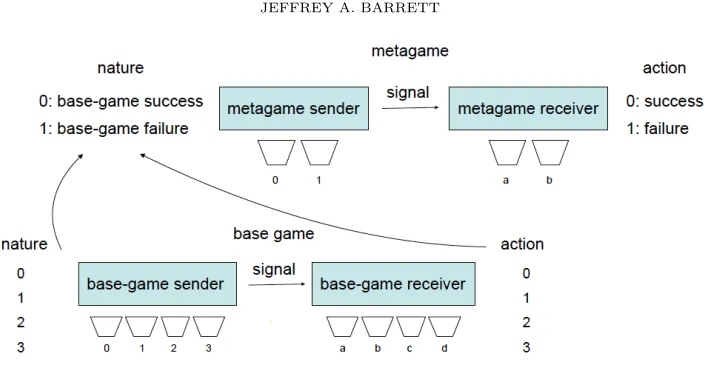
The metagame is a 2×2×2 signaling game where a second pair of agents learn
by simple reinforcement.7 The metagame sender takes the success and failure of
the agents in a particular play of the base game as input. It is the play of the base
game, then, that provides the states of nature of the metagame (Figure 1).
The metagame agents also learn by simple reinforcement. The metagame sender
has two urns, one corresponding to success and one corresponding to failure in the
base game. Each of these urns begins with one ball of each of the two possible
signal types. The metagame sender observes whether the current play of the base
game is successful. This might involve observing the state of nature and the
ac-tion in the base game then checking whether they match, observing whether the
agents in the base game reinforce, or just directly observing whether the base-game
receiver’s action produces a result that in fact indicates success given the
second-order dispositions of the agent to reinforce. The metagame sender then draws a ball
at random from the corresponding urn and sends the signal indicated on that ball.
The metagame receiver has two urns, each corresponding to one of the two possible
signals and each beginning with one ball corresponding of each of the two possible
actions. One metagame action type is successful if and only if the current play
of the base game was successful, the other is successful otherwise. The metagame
receiver observes the signal, draws a ball from the corresponding urn, then performs
the corresponding action. If his action was successful, then the metagame sender
and receiver each return the ball they drew to the urn from which it was drawn and
add another ball of the same type to that urn. If it was unsuccessful, then they
just return their balls to the urns from which they were drawn.
Here the dispositions of the metagame agents coevolve with the dispositions of
the base-game agents. The metagame sender begins by randomly sending signals
6Again, see Skyrms [19] for a characterization of how one might understand information transfer
in the context of signaling games.
7The composite system might be taken to model agents observing the evolving language use of
Figure 1. Composite success-failure game
and the metagame receiver begins by randomly acting on the signals. But they
learn from their observations of the evolving dispositions of the base-game agents.
On simulation, the metagame receiver exhibits a cumulative success rate of better
than 0.95 on better than 0.99 of the runs of the model, with 1000 runs of 1×10⁶
plays per run. An action is successful here if and only if it correctly matches whether
the base-game agents were in fact successful on the current play of their game.
Interpreting the success of the metagame, however, requires some care. It is
known that a 2×2×2 signaling game where the agents learn by simple reinforcement
will converge to a successful signaling system if nature is unbiased, but it is also
known that it may get stuck in a suboptimal partial pooling equilibrium if nature
is biased.8 Nature for the metagame is the evolving success and failure of the base
game, which is strongly biased toward success over time. Indeed, as we have seen,
the base game typically evolves to exhibit a nearly perfect cumulate success rate.
When it does, the metagame might exhibit a similarly high cumulative success
rate if the receiver always acted as if the base game were successful regardless
of the signal he gets. Those successful dispositions would be reinforced in the
metagame, and both terms would evolve to be associated with success. In this
case, the metagame would be successful, but it would not coevolve the expressive
resources to represent both success and failure in the base game.9
8See Argiento, Pemantle, Skyrms, and Volkov [1] for a proof of the first point, and see Hofbauer
and Huttegger [14] for a proof of the second point in the context of a population model under replicator dynamics.
9Note that we are not assigning indicative content to the evolved signals of the base game or
But that is not what happens here. Rather, since the base game is significantly
more complicated than the metagame, and hence evolves more slowly, by the time
the base-game agents have evolved meaningful signals, the metagame agents have
had plenty of time to evolve signals that distinguish between successful and
un-successful plays of the base game. More specifically, on simulation, the metagame
agents evolve signals that distinguish sharply between success and failure in the
base game better than 0.98 of the time, with 1000 runs of 1×10⁶ plays per run.10
In short, on the present model, the metagame agents have the chance to observe
enough unsuccessful signaling to learn to make the distinction between successful
and unsuccessful signaling in the base game.
The base-game signals, then, typically evolve to correspond to the four states of
nature that they individuate and the actions that successfully match those states.
And the metagame signals typically evolve to communicate information concerning
whether the base-game agents were successful on a particular play of their game.
Note that while an incorrect action in the base game may be the result of the
sender using the wrong signal or the receiver doing the wrong thing when he gets the
signal or some combination of both, the metagame does not evolve the expressive
resources to indicate which agent was responsible for an unsuccessful base-game
action. Rather, it just evolves to track whether particular plays of the base game
were successful. And since it only tracks whether the base-game agents were
suc-cessful or unsucsuc-cessful together, it does not brake the symmetry between indicative
and imperative interpretations of the base-game signals. These signals may equally
well be interpreted as indicatives where the base-game sender reports the state of
nature or as imperatives where the she tells the base-game receiver what to do.
A metagame might, however, coevolve to track whether the base-game sender
used the right signal on a particular play of the game given the current state
of nature and how the base-game conventions have in fact evolved. When the
base game evolves a successful signaling system, such a metagame game might
be understood as tracking whether the base-game sender’s signal represents the
current state of nature. As such, the signals in the metagame would communicate
information concerning the truth of the base-game sender’s signal. And, insofar as
nature. We will consider how the symmetry between indicative and imperative interpretations of the signals might be broken in the next section.
10More specifically, the magnitude of the dispositions that individuate signals nearly always differ
one understands the metagame as tracking the truth of the base-game signals, they
might be taken as indicatives representing the states of nature.11
3. true and false
Metagame signals that track whether the base-game sender used the customary
signal given the current state of nature may coevolve when the metagame sender
attends to how the base-game sender’s use of the base-game signals evolve. If so,
and if the base-game signals come to be associated with particular states of nature,
the metagame signals might be interpreted as tracking the truth of the base-game
sender’s descriptions of nature.
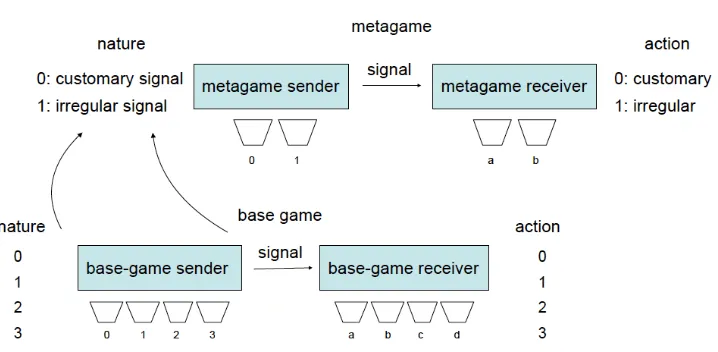
Consider the same 4×4×4 base game and a new 2×2×2 metagame. The new
metagame agents learn by simple reinforcement, but here the metagame sender
observes whether the base-game sender sent the signal in the current play that she
has used most often to this point when she has observed the current state of nature.
And the metagame receiver has two new actions. One is successful if and only if the
base-game signal was the most often used given the current state of nature and the
other is successful otherwise. The metagame agents learn by simple reinforcement
on the success of the metagame receiver (Figure 2).
On simulation, the metagame agents typically evolve signals that distinguish
well between the base-game sender sending the signal that she has sent most of the
time in the current state of nature and her not doing so. More specifically, they
evolve sharply distinguishing signals approximately 0.78 of the time on 1000 runs
of 1×10⁶plays per run.12 When successful, the metagame sender’s signals coevolve
to represent whether or not the base-game sender used her current signal in the
customary way.
11See Harms [10, 11] and Millikan [17] for discussions of the propositional content of evolved
lan-guages and Huttegger [13] and Zollman [20] for discussions of alternative approaches for breaking the symmetry between indicative and imperative interpretations of the evolved signals in Skyrms-Lewis signaling games. In short, Huttegger’s approach is to introduce deliberation as an additional primitive option in the game then individuate interpretations of the evolved signals by whether the sender or receiver choose to deliberate, and Zollman’s is to introduce a second receiver then consider a game where the sender might assert to both receivers or direct each separately. The present proposal, rather, is to break the symmetry by allowing for the evolution of a metalanguage that tracks the sender’s use of the base language given the current state of nature and how the base language has evolved. It is likely that the symmetry between indicatives and imperative is broken in multiple, context-dependent ways in the evolution and use of natural languages.
12When they fail to do so, both metagame signals evolve to indicate that the base-game sender
Figure 2. Composite true-false game
In consequence, if the metagame signals coevolve to communicate whether the
base-game sender sent the customary signal given the current state of nature and if
the base game evolves a successful signaling system that matches states of nature
to successful actions, then the metagame signals will also successfully communicate
whether or not the base-game sender’s signal correctly represents the current state
of nature given the evolved base-game conventions. Under these conditions, then,
the metagame will coevolve to track whether the base-game sender’s signal iscorrect
given the current state of nature and the evolved base-game conventions. And
it will do so independently of the success or failure of the base-game receiver’s
action on a particular signal. That is, when the base-game evolves a successful
signaling system, the metagame typically coevolves to track thetruth of the
base-game sender’s signals.
Insofar as they may be taken as true or false from the perceptive of the metagame,
the base-game sender’s signals, then, are good candidates for indicatives that
ei-ther succeed of fail to correctly describe of nature. This provides an endogenous
means of breaking the interpretational symmetry between indicative and imperative
interpretations of the base-game signals.13
The present model illustrates how it is possible, with modest dispositional
re-sources, to coevolve a simple descriptive base language and a metalanguage that
13Note that while there is nothing here that breaks the symmetry of the interpretation of
tracks the truth of evolved base-game expressions.14 More generally, one might
ex-pect a more sophisticated base language to evolve in a more subtle base game and
a more sophisticated metagame to track more subtle aspects of how expressions in
that base language may relate to the history of successful use and the nature of
the world. The compositions of such games would provide correspondingly richer
languages and hence richer evolutionary accounts of truth.15
4. Discussion
In the first metagame, the agents learn to distinguish between successful and
unsuccessful language use in the base game. In this case, the evolution of a
mean-ingful metalanguage does not require the base game to evolve a successful signaling
system. Indeed, the faster the base game evolves toward optimal signaling the more
difficult it is for the metagame agents to evolve signals that track success and failure
in the base game.
In the second metagame, the agents coevolve a metalanguage that tracks the
truth of the base-game expressions by attending to whether the base-game sender
uses her signals in the evolved customary way. Here the evolution of a truth
predi-cate in the metagame requires that the base-game agents in fact evolve a successful
signaling system.
Insofar as the second metagame can be understood as tracking whether the
base-game expressions provide true descriptions of nature, the base-game
expres-sions can, in turn, be understood as having propositional content. Namely, they
communicate the state of nature that currently obtains. As in the first metagame,
the resulting metalanguage is weakly normative in what it evolves to communicate;
in this case, the coevolving conventional use of expressions in the base language.
It is a significant feature the present model that the metagame evolves to track
the truth of the base-game expressions even as these expressions themselves evolve
meanings. Before there is a meaningful base-game language, there are no
expres-sions that might be true or false. And, before the base-game language evolves to
allow for successful action, there is nothing to tie the customary use of the
base-game expressions with what is in fact true.
The composite game, then, provides a simple pragmatic model of truth. On a
pragmatic notion of truth, a language comes to allow for true descriptions of nature
only as it comes to allow for successful coordinated action. On the present model, it
14The evolved distinction between true and false is available to represent possible failures in
future plays of the base-game agents due to a broken or deceptive sender. Such use would further reinforce the metagame distinction.
15A metagame like the one described here that is associated with the base game described in
is only when the base game agents evolve a language that communicates information
regarding nature that allows for successful coordinated action that the metagame
coevolves a language that communicates the truth of the base-game expressions.16
One would expect more subtle evolutionary models to pick out alternative, richer,
varieties of pragmatic truth.17 The thought here is that one might individuate
alternative pragmatic notions of truth by the games that evolve them. On this
view, the pragmatic notion of truth illustrated in the present model would be
among the simplest that connect successful use to one’s coevolved representations.
18
16See Barrett [2, 6] for discussions of how faithful description might coevolve with successful
inquiry.
17Kevin Zollman, for example, suggested a natural extension of the present metagame where the
metagame receiver uses the metagame signal to decide whether to use the base-game signal as a basis for action.
18I would like to thank Andrew Bollhagen, Brian Skyrms, Simon Huttegger, Cailin O’Connor,
References
[1] Argiento, Raffaele, Robin Pemantle, Brian Skyrms and Stas Volkov (2009) “Learning to Signal: Analysis of a Micro-Level Reinforcement Model,”Stochastic Processes and Their Applications
119(2): 373–390.
[2] Barrett, J. A. (2014) “On the Coevolution of Theory and Language and the Nature of Suc-cessful Inquiry,”Erkenntnis 79(4): 821–834.
[3] Barrett, J. A. (2013a) “On the Coevolution of Basic Arithmetic Language and Knowledge”
Erkenntnis78(5): 1025–1036
[4] Barrett, J. A. (2007a) “Dynamic Partitioning and the Conventionality of Kinds,”Philosophy of Science74: 527–546.
[5] Barrett, J. A. (2006) “Numerical Simulations of the Lewis Signaling Game: Learning Strate-gies, Pooling Equilibria, and the Evolution of Grammar,”Institute for Mathematical Behav-ioral SciencesPaper 54. http://repositories.cdlib.org/imbs/54.
[6] Barrett, J. A. (2001) “Toward a Pragmatic Account of Scientific Knowledge,”PhilSci Archive. uri: http://philsci-archive.pitt.edu/498/ accessed 20 August 2014.
[7] Barrett, J. A. and B. Skyrms (2015) “Self-Assembling Games,” forthcoming inThe British Journal for the Philosophy of Science.
[8] Barrett, J. A. and Kevin Zollman (2009) “The Role of Forgetting in the Evolution and Learning of Language,”Journal of Experimental and Theoretical Artificial Intelligence21(4): 293-309. [9] Erev, I. and A. E. Roth (1998) “Predicting How People Play Games: Reinforcement Learning in Experimental Games with Unique, Mixed Strategy Equilibria”American Economic Review
88: 848–81.
[10] Harms, W. F. (2004a) Information and Meaning in Evolutionary Processes. Cambridge: Cambridge University Press.
[11] Harms, W. F. (2004b) “Primative Content, Translation, and the Emergence of Meaning in Animal Communication,” in D. Kimbrough O. and U. Griebel (eds.)Evolution of Communi-cation Systems: A Comparative Approach.Cambridge: MIT Press.
[12] Herrnstein, R. J. (1970) “On the Law of Effect,” Journal of the Experimental Analysis of Behavior13: 243–266.
[13] Huttegger, Simon (2007) “Evolutionary Explanations of Indicatives and Imperatives. Erken-ntnis 66, 2007, 409-436.
[14] Hofbauer, Josef and Simon Huttegger (2008) “Feasibility of Communication in Binary Sig-naling Games,”Journal of Theoretical Biology254(4): 843–849.
[15] Huttegger, Simon, Brian Skyrms, Pierre Tarr`es, and Elliott Wagner (2014) “Some Dynamics of Signaling Games,”Proceedings of the National Academy of Sciences111(S3): 10873–10880. [16] Lewis, David (1969)Convention.Cambridge, MA: Harvard University Press.
[17] Millikan, R. G. (2005)Language: A Biological Model.Oxford: Oxford University Press. [18] Roth, A. E. and I. Erev (1995) “Learning in Extensive Form Games: Experimental Data and
Simple Dynamical Models in the Immediate Term,”Games and Economic Behavior 8:164– 212.
[19] Skyrms, Brian (2010)Signals Evolution, Learning, & Information.New York: Oxford Uni-versity Press.
UC Irvine; Irvine, CA 92697, USA