Analyzing Hypermedia and Internet Communication
Models in Educational Applications
ANSHU SAXENA, D. P. KOTHARI, SUDHIR K. JAIN AND AMULYA KHURANA
Indian Institute of Technology India
Hypermedia has long been considered to have great potential to support educational tasks and applications. Many success stories of hypermedia support in education have been reported. Much of this work has been done in the context of traditional closed hypermedia systems rather than more contemporary open hypermedia systems. Developing hypermedia programs has similarities to normal software development, but the issues are more complex. While program design is important, the design of the educational material and the graphic design of the user interface are probably more important.
The impact of hypermedia, multimedia, and Internet communication in education is likely to be the most contro-versial of all the applications. In the other areas, the success of hypermedia is settled on pragmatic grounds: it depends on whether or not it solves practical problems or answers consumer desires. In education, on the other hand, there may be complications, since, as well as offering a promise of positive change that will improve the quality of education for all, hypermedia also represents a threat to the traditions, values, and practices that have grown up over the years. Developing educational hypermedia differs from corporate, product-oriented research and development. Educational hypermedia applications could offer our schools, colleges
and universities a powerful means of enriching the educa-tional experience of their students when (and if) its proper place in the formal educational process can be established.
In the early years of development of computer programs, programmers and their managers learned some painful lessons about software development. Many software projects were over budget, late, full of bugs, and failed to live up to expectations. The problem with most software is that, because of it’s intangible nature, it is often very difficult to specify in advance exactly what you want the software to do. Paradoxically, it is essential to specify as much as possible of the functionality of the software in advance.
Interactive multimedia is more problematical than standard software development, due to its novel nature and because it is not yet clear what the range of possibilities are with this medium. The emerging interactive multimedia technology has imposed a number of communication, naviga-tion, and graphic design issues on top of software development matters. These issues complicate design and development to such an extent that it is impossible to create an effective design on the first attempt. It is therefore important to design for flexibility, while trying at the same time not to waste money and effort. As more sophisticated uses of Internet communication were developed in the 1990s for purposes of education, e-commerce, and everyday communication, there was an increased general recognition that informational uses of new electronic media or telecommunications ever involve processes of interaction, communication, and even human communi-ty. This is evidenced by how the previously dominant generic term for interactive electronic media, Information Technology, is now increasingly being replaced by Information and Communications Technologies and even Communication and Information Technologies (Richards, 2000).
Hypermedia is a philosophy of representation and access of information. Its conceptual basis is the model of the information space as a graph whose nodes store information, and whose arcs represent semantic relationships. The information stored in a true hypermedia system should encompass all media that current computers can process, including text, graphics, anima-tion, digitized pictures, and sound. Hypermedia thus combines the elements of radio (audio), television (moving images), magazines (text), and the computer (video display terminal) with hypertext links to form the basis for a unique computer-mediated environment. Hypertext is described as non-sequential written text that allows branches and multiple paths to be selected by the reader. The essential point here is control by the reader and the linked arrangement of the information being presented. Sequential flow imposed by authors in the printed medium is replaced by flow initiated by the reader.
In summary, the authors list the following characteristics of hypertext:
z association of ideas or content;
z nonsequential representation of ideas or content;
z nonlinear and dynamic; and
z content is not bound by structure and reliance of prior knowledge or association cannot be assumed.
HYPERMEDIA AND INTERNET COMMUNICATION
The Internet operationalizes a model of distributed computing that facilitates interactive multimedia many-to-many communication. As such, the Internet supports discussion groups, multi-player games and communications systems, file transfer, electronic mail, and global information access and retrieval systems.
From a marketing perspective, recent developments toward a de facto standard in enabling software, including the Hypertext Markup Language (HTML) and the set of NCSA Mosaic, Netscape, and other Web clients (browsers) and servers, provide for the first time a uniform platform-independent hypermedia interface between consumers and firms.
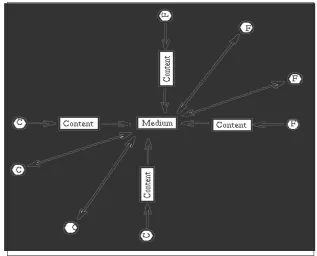
Figure 1 presents a many-to-many communication model for the Web, given by Hoffman and Novak (1996).
Figure 1. New model of marketing communications in hypermedia (Note: F denotes firm; C denotes consumer)
bonds and associations with the consumers, for example Relationship Marketing. If the consumer is a student/teacher/educator, then firms catering to this segment will focus on the needs, desires and wants of this segment. In fact, students and teachers help in building the World-Wide Library Cata-logue on the Web.
EDUCATIONAL HYPERMEDIA TECHNOLOGIES
Hypermedia is both an adaptable communications medium and a tool for managing complexity that allows the assembly and manipulation of a mass of disparate multi-sensory information.
Developing educational hypermedia differs from corporate, product-oriented, research and development. Apart from obvious funding differenc-es, it has different objectives. For example, where it may be of prime concern to a commercial developer that a system be user friendly, there may be limits to this concept within an educational setting that aims to make students confront issues and think for themselves. Education is not only about ready access to off-the-shelf information, but also about the develop-ment of a critical awareness and the ability to transform what one is given into something more meaningful.
One of the oldest techniques for learning with the help of a computer is programmed instruction in which there is some sort of a dialogue between a user and a computer in the sense that the user answers questions asked by the computer.
Computer Aided Instruction (CAI)
The CAI method was somewhat more successful in using computers in education than the programmed instruction, where printed material played a more prominent role than a computer.
Computer Aided Learning (CAL)
CAL represents the next phase in the use of computers in education, in which an attempt was made to correct the negative aspects of CAI. As early as in late 60’s, pedagogues were criticizing the disadvantages of CAI. Among the first critics was Ted Nelson who coined the term hypertext in the 60’s to denote the notion of linking pieces of text from different articles. He warned that students using CAI are flooded with facts that fit the question-answer model and thus are prevented from exploring the wider context of the subject on their own. The purpose of using CAI would be only for testing of skill and knowledge, and it most cases students would be the ones to initiate the educational process and use the computer as a tool.
Computer Based Training (CBT)
CBT is a more contemporary form of CAI. It is of a particular importance to note that this form of training is one of the oldest and most popular uses of interactive multimedia technology and multimedia usage within comput-er networks.
As said earlier, application of CAI has been advantageous in situations where testing of skill and knowledge is required as is the case in corporate training areas like management skills, industrial factory floor training, information technology products, medical and health care, government services, and military weapons system operation and maintenance.
relatively modest price, but the system was less flexible than multimedia delivery platforms based on computers.
Advancement in compression techniques allowed video to enter interactive multimedia applications and to distribute such educational courseware on a CD-ROM disk, which in turn has driven out interactive video.
HYPERMEDIA NETWORKING TECHNOLOGIES IN EDUCATION
In countries throughout the world new methods and means are used to improve education. In particular, in developed countries special attention is being paid to the role of computer technology in this process. Under consideration is the planned introduction of computer technology in
education—not only in schools and universities, but also in corporations and homes. Beside these global projects at government levels, there is a multi-tude of smaller projects involving introduction of individual technologies, such as digital video, distance learning, multimedia, and networking, in individual schools and universities. While in some countries these efforts are strategically planned, in others, such projects represent isolated initiatives and more modest attempts which merely have a goal to build computer infrastructure and give schools and universities limited access to the Internet.
In what follows several examples will be given of efforts to improve the educational process by introduction of modern computer technology (primarily hypermedia and networking). Most of the examples come from the USA (being well ahead of other countries), and Canada, Australia, and Europe. In this introduction general questions are discussed concerning the advantages of uses of computer technology in education, and the focus is on the uses of the Internet service WWW, which represents the most widely used hypermedia network service, and as such opens entirely new possibili-ties in education.
KIDLINK is the name of an organization, which, each year, leads KIDS-nn project. The goal of these projects is to involve as many children, ages 10-15, as possible in a global dialogue using Internet. The Educational Re-sources Information Center (ERIC)—is an information system in the US that provides, through its 16 subject-specific clearinghouses and support
components, a variety of services and products on education-related issues.
In Australia, since 1975, Australian Society for Educational Technology (ASET)is active as the national organization for people with professional interests in Educational Technology. ASET defines Educational Technology as “the design, development, implementation and evaluation of systems, methods and materials to achieve effective outcomes and improve the process of human learning.”
There are similar projects and research efforts in the European Union. For example, within Information Market—Europe (I*M EUROPE)—an organization that acts as a medium for supporting the actions of DGXIII of the European Commission in stimulating the European electronic informa-tion services market and multimedia content industries.
Project Internet dla Szkol (Internet in School) has a goal to provide internet access for high schools in Poland and to teach students and teachers how to use internet services for communication (e-mail, Usenet, IRC) and for obtaining resources (ftp, WWW).
CONCLUSION
This article provides an in-depth understanding of hypermedia and further explores the role of Internet communication in educational applications. The focus is on educational hypermedia technologies and their acceptance worldwide. This article has engaged influential hypermedia models and educational hypermedia technologies as a context for considering an integrated framework of electronic literacy and the inherent ambivalence of interactive electronic media from a “communication” rather than “informa-tion” perspective.
The role of the Web as a navigator is also important because it enables educators to find proper resources by the help of computerized search agents, which will surf the Internet looking for requested information, or catalogues which have listings of educational web sites. The Web appears to be a World-Wide Library Catalogue, but unlike a traditional library, students and teachers have created the books that are available.
References
ASET—Australian Society for Educational Technology (1996). [Online].
Available: http://cleo.murdoch.edu.au/gen/aset/index.html
Bielefeldt, T. (Ed.) (1996). International Society for Technology in Educa-tion (ISTE) [Online]. Available: http://ISTEonline.uoregon.edu/ Bornman, H., & von Solms, S.H. (1993), Hypermedia, multimedia and
hy-pertext— definitions and overview, Electronic Library, 11(4-5), 259-268.
Bush, V. (1945), As we may think, Atlantic Monthly, 176(1), 101-108. ERIC (1996). [Online]. Available: http://ericir.syr.edu/About/
Gerli, I. (1996, May). Multimedija u obrazovanju - slovenski projekat.
Pro-ceedings of Multimedia and Hypermedia Systems, MIPRO ’96. (pp.
2-97, 2-102). Rijeka, Croatia: MIPRO.
Hoffman, D., & Novak, T. (1996, July). Marketing in hypermedia comput-er-mediated environments: Conceptual foundations, Journal of Market-ing, 60, 50-68.
I*M EUROPE (1996). [Online]. Available: http://www2.echo.lu/
Internet dla Szkol (Internet Access for High Schools in Poland) (1995).
[Online]. Available: http://idsserv.waw.ids.edu.pl/ids/
KIDLINK (1996). [Online]. Available:
Mele, M., & Dragan, A.N. (1995, May). Multimedia and Slovenian educa-tional system. Proceedings of Multimedia and Hypermedia Systems,
MIPRO ’95. (pp. 82-84). Rijeka, Croatia: MIPRO.
Nelson, T. (1967), Getting it out of our system. In G. Schechter (Ed.)
Infor-mation retrieval: A critical review. Washington, DC: Thompson
Books.