© Kieran O’Halloran. Informal Logic, Vol. 29, No.1, pp. 15-53.
argument: A corpus-based reconstruction
K
IERANO’H
ALLORANSenior Lecturer in Linguistics
Centre for Language and Communication Faculty of Education and Language Studies Open University
Milton Keynes MK7 6AA UK
Abstract: This paper focuses on an explanation in a newspaper article: why new European Union citizens will come to the UK from Eastern Europe (e.g., because of available jobs). Using a corpus-based method of analysis, I show how regular target readers have been positioned to generate premises in dialogue with the explanation pro-positions, and thus into an understand-ing of the explanation as an argument, one which contains a biased conclu-sion not apparent in the text. Employ-ing this method, and in particular ‘corpus comparative statistical key-words’, I show how two issues can be freshly looked at: implicit premise re-covery; the argument/explanation
dis-Résumé: J’emploie un logiciel qui analyse quantitativement un article (dont le but est d’expliquer pourquoi des citoyens de la nouvelle Europe vont quitter l’Europe de l’Est pour aller habiter au Royaume-Uni) de journal pour démontrer que son auditoire cible régulier est influencé à produire des prémisses dans un dia-logue contenant des explications, et ainsi à interpréter des explications comme si elles étaient des arguments. Cette approche apporte une nouvelle optique sur l’identification des pré-misses implicites et sur la distinction entre des arguments et des expli-cations.
tinction.
Keywords: Argument, corpus-based analysis, corpus comparative statistical keyword, cultural keyword, explanation; implicit dialogical premise recovery; plausible fuzzy reasoning
1. Introduction
1.1 Orientation
eight of which are located in Eastern Europe.1 The piece of text I focus on explains, via a few propositions, why new immigrants from the accession countries would want to come to the UK. From a linguistic analysis of previous, related newspaper stories, I show the following:
• how regular target readers have, in fact, been positioned over time into an understanding of the explanation as an argument with a biased conclusion. This conclusion includes the understanding that large numbers of Eastern European migrants will place strain on UK social services, which is, in part, due to government incompetence. This understanding is not apparent in the textual explanation, but could well be generated in reading by regular target readers.
• how, in understanding the explanation as an argument, regular target readers are likely to generate implicit premises in a dialogical manner—i.e., in dialogue with the explanation.
• how representation via an explanation rather than an argument is a state of affairs which helps the UK newspaper in question to evade charges of bias—since the bias is not in the text as such, but would be in the mind of the reader.
To reveal the argument, I draw on corpus-based text analysis, and in particular the concept of corpus comparative statistical keywords, which I explain below. Using this method, I highlight how two perennial issues in informal logic study can be freshly looked at: implicit premise recovery and the argument/explanation distinction.
1.2 Two perennial issues in informal logic
1.2.1 Recovering implicit premises
Informal arguments frequently are elliptical, since they usually leave out premises that according to formal logic are necessary for valid conclusions (Anderson et al., 1997; Govier, 1987). They are thus ‘enthymemes’ (in Aristotelian language) or ‘incomplete’ (Walton, 2006)2. On the issue of implicit premise recovery, there
1 On May 1st 2004 the EU expanded from 15 to 25 countries. On January
1st 2007, the EU expanded to 27 countries when both Bulgaria and
Romania joined. On the history of the EU, see: http://www.europa.eu
2 Walton and Reed (2005) have a defeasibilistic view of enthymemes (‘A
has been interesting work recently. For example, Katsav and Reed (2008) focus on the modelling of implicit premises for computational analysis of arguments. Walton and Reed (2005) show how argumentation schemes (e.g., Walton, 1996) based on defeasible generalisations can be useful in recovery of premises. Furthermore, Araucaria software (Reed and Rowe, 2001), ‘given the user’s markup of an argument in a given text of discourse’, can assist in determining implicit premises (Walton and Reed, 2005: 340).
The cited works are fascinating approaches to implicit premises revelation. They are based, though, on analysis of arguments outside of the reading conditions in which they might be processed. Once an analyst tries to take account of how a text might be processed by a target readership, this creates a problem: to what extent is the recovery of implicit premises a reflex of the perspective/background knowledge of the analyst? The analyst runs the risk of: (i) over-interpretation (O’Halloran, 2003; O’Halloran and Coffin, 2004; Coffin and O’Halloran, 2008), i.e., the implicit premise recovery might say more about the analyst’s perspective than the target readership’s; (ii) arbitrary recovery of implicit premises which leads to circularity; in other words the analyst arbitrarily focuses on a part of an argument where s/he supposes there is an implicit premise, then goes on to interpret the content of the implicit premise which, in turn, reinforces the original analysis that there was an implicit premise in the first place.
1.2.2 Argument versus explanation
It has been noted often that there can be difficulty in distinguishing argument from explanation. One problem is because explanations and arguments share indicator words such as ‘so’ and ‘then’, and because ‘both explanations and arguments consist of groups of statements where some of the statements are taken as starting 2005: 367))’. This would seem to be at odds with the Aristotelian view on enthymemes where implicit premises are recovered deductively. However, Walton and Reed (2005: 339-340) argue:
points and lead to others as end points’ (Walton, 2006: 76). Despite these difficulties, several theorists have contended the distinction between argument and explanation is an important one to retain (e.g., Govier, 1987; Walton, 2006; Schwarz and Asterhan, forthcoming). An important reason why can be found in Walton’s (2006: 76-77) illuminating and useful distinction:
…the purpose of an argument is to give a reason to support a claim made by one party in a dialogue. The claim is something that is doubted by the respondent in the dialogue. It is a proposition that is at issue or is unsettled. An argument is supposed to present a good reason for the respondent to come to accept this proposition as true, thus removing the doubt… .
…explanations and arguments are different because each has a different purpose in a dialogue. The goal of an explanation is not to convince or persuade the party that a particular proposition is true [i.e., unlike an argument] but to express the queried proposition in some more familiar terms or relate it to another set of propositions that can be put together so that it is more familiar or comprehensible to him.
I concur with this distinction. However, in practice as this paper shows, it is possible that a reader might blur the distinction between argument and explanation, not because of obtuseness or ignorance, but because they have been primed to read an argument into an explanation from regular exposure to a particular set of arguments.
1.3 Corpus methods of analysis
To show how target readers are potentially positioned into reading an argument into an explanation in the May 1stSun text, I draw on the following: a database, or corpus, of texts on related topics from The Sun in the six weeks preceding May 1st. A corpus is a large electronic database of texts in a particular language, e.g., The Bank of English is a corpus of 450 million words; The British National Corpus consists of 100 million words of English. In the last 10 to 20 years, technology has developed to allow quick searches of corpora using software known as concordancers. Many advantages can be gained through employing large corpora. For instance, instead of relying on intuitions of how language is used, or on small amounts of data, one can now make empirically robust statements about widespread language use.
repeated patterns of argument over the six week period. An important focus in my analysis of this Sun corpus is corpus comparative statistical keywords, which are explained in Section 3. It is on their basis that I generate premises which are potentially implicit in the processing of target readers of the May 1st text, and thus show the following: not only that the explanation can be read as an argument, but that arbitrariness of implicit premise generation by the human analyst is constrained because the software generates such keywords.
Corpora are more and more being drawn on in argumentation study (e.g., Degano, 2007; Reed, 2006; Stubbs, 1996, 2001; Zagar, 2007; Coffin and O’Halloran, 2008, 2009) and for a variety of different purposes. Michael Stubbs is probably the key pioneer of corpus-based text analysis. He was also one of the first scholars to use corpus-based approaches in relation to argumentation analysis (Stubbs, 1996; 2001) (though this is not a sustained focus). Stubbs’ approach has been criticised by the argumentation theorists, Eddo Rigotti and Andrea Rocci (Rigotti and Rocci, 2005). In relation to my corpus-based argumentation analysis, this article takes cues from Stubbs’ corpus-based work (see Section 3) and its unfolding is affected by engagement with Rigotti and Rocci’s (2005) critique of Stubbs’s work (see Section 4).
2. May 1st text 2004 in The Sun
2.1 The explanation
On May 1st 2004, 10 new countries joined the EU: Czech Republic, Estonia, Hungary, Latvia, Lithuania, Poland, Slovakia, Slovenia (all Eastern European countries) as well as Cyprus and Malta. On that day, The Sun reported this event in the following text.
a.
Migrants are the first of many
By NICK PARKER CHARLES RAE and CHARLES YATES
b. HISTORY will be made today as new EU citizens begin leaving their homelands for new lives in Britain.
c. They will come in their hundreds by coach, train and plane, desperate for decently-paid work—or any job at all.
d. They are citizens of ten new member states of the EU who now have the right to live and work in Britain.
e. Those states are the Czech Republic, Estonia, Hungary, Latvia, Lithuania, Poland, Slovakia, Slovenia, Cyprus and Malta.
f. Eight are poverty-stricken former Soviet states in Eastern
Europe—with a total population of 75 million.
g. Our government says there are half a million jobs waiting
h. And if the new arrivals find legitimate work in Britain, paying tax and national insurance, they will qualify for a range of benefits.
i. These will include free health care, child tax credit, child
benefit, working tax credit and housing benefit.
j.Other EU countries like France and Germany have ruled out
free access to jobs for up to seven years.
k. Small wonder that eager men and women used to working for
a pittance in countries with huge unemployment are
snapping up tickets to the UK.
l. People out to get a head start in the exodus crammed into coaches yesterday at stations in Warsaw, Poland, the Czech capital Prague and the Slovak capital Bratislava.
m. Seventy-one LATVIANS smiled as they boarded a double-decker bus in the capital Riga for a 24-hour journey west. n. Coach firm Eco-Lines said they had put on an extra service
to London this week for the £75 trip. o. All services are booked for the next week.
p. ESTONIANS are travelling from their capital Tallinn, via Helsinki in Finland.
q. Budget airlines like Sky Europe, which has services from Slovakia to Britain, have reportedly sold out all flights. r. POLAND’S Air Polonia alone has bookings for about 4,000
migrant workers this month.
s. Warsaw-based coach operator Orbis expects migrants to fill 1,500 of its monthly 4,500 seats to Dover. (source: http:\\www.thesun.co.uk 1st May 2004) (my italics)
Consider what I have italicised above, which I reproduce propositionally below:
Proposition 1. Eight countries are poverty-stricken former
Soviet states in Eastern Europe—with a total
population of 75 million. (sentence f)
Proposition 2. Government says that there are 500,000 jobs inUK. (sentence g)
Proposition 3. There are social benefits for migrants if they find legitimate work in UK. (sentences h and i) Proposition 4. Two other major economies have ruled out free
access to jobs. (sentence j)
Proposition 5. Eastern Europeans do not earn much.
(sentence k)
Proposition 6. There is much unemployment in Eastern Europe (sentence k)
Explanation summary:
I regard this as an explanation—an explanation of why people from the new member states would want to come to the UK, e.g., because there are available jobs and the social benefit system is an attraction. It is not an argument because, in line with Walton’s definition, it is not setting out to persuade readers that Eastern Europeans will want to come to the UK. The marker of explanation summary I contend is ‘small wonder’ (see sentence k). As evidence for interpreting what I have italicised as an explanation, I draw on a large corpus—the 450 million word Bank of English. In this corpus, there are 625 instances of ‘small wonder’. The default is a series of propositions which are followed by ‘small wonder’, providing a summary explanation such as in:
Of course, paper-based books are a technology that works. They are lightweight, portable, cheap, renewable and recyclable—and free from the bugs, viruses and system crashes that plague your PC. Small wonder, then, that the "paperback in your jeans pocket", as Penguin promoted its novels to post-war teenagers, has never been bettered, despite attempts by software and hardware companies to do so for today's e-generations.
In the Bank of English, 405 instances (65%) of ‘small wonder’ are followed by the relativiser, ‘that’. Also, overwhelmingly ‘small wonder’ begins a sentence (with or without a preceding ‘It is’). On the evidence of the Bank of English, language users would seem to be primed to expect the use of ‘small wonder’ as an explicit marker of explanation (paraphrasable as ‘it is hardly surprising why’) at the beginning of a sentence and followed by a that-clause. This is just the same as happens in the May 1st text.3
2.2 The Sun Corpus
I compiled a corpus of all texts in the six weeks prior to May 1st which contain the search terms: ‘(im)migration’, ‘(im)migrant(s)’, ‘EU’ and ‘European’. The reason for using six weeks’ worth of texts is because it was six weeks before May 1st that The Sun began publishing texts regularly on the imminent expansion of the EU. The corpus consists of 76 texts, a total of 26,350 words, and 1,429 sentences, and is organised in chronological order from March 20th
3 By ‘primed’, I am referring to Hoey’s (2005) argument for ‘lexical
priming’: that words are primed for prototypical lexicogrammatical associations from our experience of how they are used. These
to April 30th 2004. These texts, at least on cursory reading, seemed to form a quasi-campaign to persuade readers of the negative consequences of Eastern European immigration to the UK. In Section 5, my quantitative investigation of the corpus reveals regular associations of words, what is known in linguistics as collocation. In Section 6, my qualitative exploration reveals semantic patterns or ‘strategies’ (see below), in relation to Eastern European immigration, which correlate with these collocations. In Section 7, I will show that repeated exposure to these strategies potentially primes regular target readers to generate a set of dialogical premises in their reading of the May 1st text’s explanation—i.e., generated in dialogue with the explanation—and to derive a biased conclusion through plausible reasoning (Walton, 2006).4
2.3 Strategies and their linguistic realization
I take the concept of ‘strategies’ from Wodak et al. (1999). This work, in Critical Discourse Analysis, is an examination of the construction of national identity in Europe with a particular focus on Austria. Wodak et al. (1999) detail strategies for how national identities are constructed through particular types of language use as well as the linguistic realisations of these strategies.5 For example, the authors highlight the strategy of ‘emphasising the difference between us and them’ (Wodak et al., 1999: 36). Here is Wodak et al.’s (1999: 34) definition of a strategy:
4 Walton and Reed (2005) show that, while many logic textbooks
reconstruct missing premises for enthymemes using deductive logic, this treatment does not work for natural language discourse. For the ten case studies they analyse, they contend that implicit premise reconstruction requires ‘a less strict standard of reasoning that is defeasible in nature’ (Walton and Reed, 2005: 339), i.e., plausible reasoning.
5 Aside from strategies and their linguistic realization, Wodak et al.
(1999) also indicate topoi or argumentation schemes which accompany strategies. They conceptualise ‘topoi’ (Greek) or ‘loci’ (Latin) classically: ‘…highly conventionalized parts of argumentation which belong to the obligatory elements of argumentation and take the form either of explicit or inferable premises. They are more or less formal (for example locus a
minore) or content-related (for example topos of external constraints)
…we conceive strategies to be more or less ‘automated’ activity plans based on models which are located on the different levels of mental, cognitive organization and which are more or less elaborated. As such the concept of ‘strategy’ is closely connected to the concepts of ‘frame’, ‘scheme’ and ‘scripts’…In contrast to ‘script’, ‘scheme’ and ‘frame’, ‘strategy’ is mainly identified in terms of planned social (in our case, discursive) activities, of the political or socio-psychological aims or functions of these activities, and of the (linguistic) means designated to help realize these aims.
Since in The Sun, in the six weeks prior to May 1st, there appeared to be a quasi-campaign—to persuade readers of a set of possibilities, e.g., detrimental effects on social services from huge Eastern European immigration—there seemed to be a ‘social-psychological aim’ behind these predictions. For this reason, I use ‘strategies’ to refer to cognitive models that regular target readers of The Sun may have constructed in relation to the predicted effects of Eastern European immigration. Another reason I prefer the concept is because this paper looks at the dynamic relationship between language and the circulation of ideas in relation to immigration. Like Wodak et al. (1999), I also make links between strategies and their linguistic realizations.
How I qualitatively identify such strategies in The Sun corpus will be constrained by quantitative-based generation of ‘corpus comparative statistical keywords’ from The Sun corpus. I do this through using the software, Wordsmith Tools 5.0 (Scott, 2008). There are a number of different uses of the concept of keyword. The next section discriminates types of keyword which are relevant to this article,6 and prepares the ground for what I mean by ‘corpus comparative statistical keywords’.
3. Keywords
3.1 Cultural Keywords
One meaning of keyword is associated with Raymond Williams, the Marxist thinker. In Williams (1983), ‘key’ in ‘keyword’ indicates that a particular concept is salient across a culture. So, for example, ‘democracy’ and ‘revolution’ are keywords for Williams.
6 There are other uses of the term ‘keyword’. For example, in using
Williams (1983) is a socio-historical, diachronic dictionary of keywords where their semantic development over centuries is traced and interrelationships explored. For this work, Williams used the complete Oxford English Dictionary (OED), which runs to several volumes. To help with discriminating different types of keyword, I shall refer to this sort as a cultural keyword (as indeed does Stubbs, 1996; 2001). This concept of keyword is used in the argumentation work of Rigotti and Rocci (2005)—see section 4.
3.2 Corpus-based Cultural Keywords
Chapters in Stubbs (1996) and (2001) also examine cultural keywords (and we shall see briefly how such examination bears on an argumentation analysis of his in a moment). The difference from Williams is that Stubbs’ investigation of cultural keywords is done in the main synchronically and is informed by corpus-based methods. ‘Standard’ is one of the cultural keywords which Williams (1983) investigates diachronically using the OED. Stubbs (2001) uses a 200-million-word corpus of contemporary English in order to highlight the most common collocates (i.e., words which regularly associate with other words in collocation) of ‘standard’: ‘living’, ‘high’, etc. In other words, the most common collocations are ‘living standard’, ‘high standard’, etc. The method is more rigorous than when Williams focuses on contemporary usage since it provides objective quantitative support for the extent to which cultural keywords are being used, and the lexical company they keep. It thus provides a measure of what meanings are being culturally reproduced. We might refer to the cultural keywords Stubbs looks at as corpus-based cultural keywords.
Stubbs (1996; 2001) uses corpus-based methods to examine cultural keywords related to argumentation around education policy of the UK Conservative party during the 1980s and 1990s (e.g., the cultural keywords, ‘correctness’, ‘grammar’, ‘standards’). As an example of this, here is Stubbs (2001: 158), which is largely a restatement of Stubbs (1996: 162). He contends that since different cultural keywords collocate with one another in the language use of different socio-political groups, in turn the kinds of arguments such groups would make would be constrained:
Keywords often inter-collocate, and ideas gain stability when they fit into a frame. Many everyday ideas about language fit very firmly into a frame which contains terms such as:
For linguists, the same terms mean something quite different because they fit into an entirely different lexical field, which contains terms such as:
• dialect, language planning, high prestige language, social variation
These fields are systems of meaning, which use particular vocabulary, take particular things for granted, appeal to different states of knowledge (for example, lay and professional), and therefore allow only particular argumentative moves.
3.3 Corpus-Comparative Statistical Keywords
A large corpus is not only used to provide quantitative support for cultural keywords. It can be used to find a different type of keyword: corpus-comparative statistical keywords. These are defined as being statistically more frequent in a text or set of texts than in a large corpus which is taken to be representative of a language. When a large corpus is used for such comparative purposes it is known as a ‘reference corpus’. ‘Keyness’ here is established through statistical measures such as log likelihood value (see Dunning, 1993). A log likelihood value at ≥ 6.63 (p < 0.01) confers keyness on a word. Keyness value is proportional to the size of the log likelihood value greater than 6.63. Corpus comparative statistical keywords can be lexical words (e.g., table, beautiful, psychologically) as well as grammatical words (e.g., she, their, to). Imagine a comparison of a corpus of several thousand mobile phone text messages in English with a large reference corpus of English consisting of millions of words from a variety of different genres. It is likely that the grammatical word, ‘da’ (a short version of the definite article), would have relatively high keyness since it is much more likely to feature in text messages than in most other genres. It would then be a corpus-comparative statistical keyword.
3.4 Relationship between corpus comparative statistical keywords and cultural keywords
on quantitative evidence, all the same this is quantitative evidence around cultural keywords which have been pre-established by a human interpreter. This may be uncontroversial as in the case of ‘democracy’ or ‘immigration’. Alternatively, choice of cultural keyword may overly reflect the cultural and political sympathies of the human interpreter. For example, Williams (1983) includes ‘peasant’ as a cultural keyword. In contrast, an advantage of corpus-comparative statistical keywords is that they are established objectively by software. They are not then intuited by human researchers who are open to accusations that their intuitions are arbitrary. However, it must be stressed that though corpus-comparative statistical keywords are generated objectively by software, this objectivity is always relative to a particular reference corpus.
Recently, in relation to argumentation, Stubbs’ work has been criticized by Rigotti and Rocci (2005). Since, as I said in Section 1, this article takes cues from Stubbs’ work on keywords and its unfolding is affected by engagement with Rigotti and Rocci (2005), in the next section I will set out Stubbs’ perspective and my response to Rigotti and Rocci’s critique.
4. Rigotti and Rocci (2005)
4.1 Critique of Stubbs
In an anthology devoted to recent work on argumentation, Rigotti and Rocci (2005: 129) take issue with Stubbs’ corpus-based position on the relationship between cultural keyword collocation and argumentative text (see section 3.2):
Rigotti and Rocci’s point is one worth taking account of.7 To understand cultural / ideological reproduction through texts, analysis of ‘quantitative patterns of lexical occurrence’ would need to take account of text structure. This is because text structure will have a significant effect on the types of inference readers and listeners generate around cultural keywords. In relation to this issue, the Critical Discourse Analyst, Fairclough (1992: 84), gives the following useful example (which includes the word, ‘job’, identified as a cultural keyword in Stubbs (1996)):
…what establishes the coherent link between the two sentences ‘She’s giving up her job next Wednesday. She’s pregnant’ is the assumption that women cease to work when they have children. In so far as interpreters take up these positions and automatically make these connections, they are being subjected by and to the text, and this is an important part of the ideological ‘work’ of texts and discourse in ‘interpellating’ subjects.
‘Ideological work’ would not take place through ‘job’ or indeed through ‘pregnant’, but through the coherence inference linking these words in the two sentences, i.e., coherence is set up through the structure of the text. See O’Halloran (2003) on different types of coherence inference.
4.2 Enthymematic argument structure and cultural keywords
Rigotti and Rocci (2005: 130) go on to usefully explore the link between cultural keywords, and the enthymematic structure of ‘natural language’ arguments. They give as one example ‘He’s a traitor. Therefore, he deserves to be put to death’ where they identify ‘traitor’ as a cultural keyword. They unpack this argument syllogistically:
Major premise: Traitors deserve to be put to death (implicit)
Minor premise: He is a traitor
7 Rigotti and Rocci have an unusual definition of text as ‘a coherent
Conclusion: He deserves to be put to death.
They contend that cultural keywords such as ‘traitor’ play an ‘important role in the recovery of the unstated major premise’ (Rigotti and Rocci, 2005: 130). Rigotti and Rocci (2005: 131) have a ‘working hypothesis for the discovery and testing of cultural keywords:
words that typically have this kind of function in public argumentation within a community are likely candidates to the status of [cultural] keywords in the culture of that community.
Again, I find Rigotti and Rocci’s perspective valuable in its engagement with the concept of cultural keyword, and how they extend the concept into the issue of implicit premise recovery. I support the spirit of their hypothesis in that I also maintain that there is a link between identifying cultural keywords and recovering implicit premises.
Nevertheless, there are things to take issue with. The textual examples they provide, such as the example of ‘traitor’, appear to be concocted rather than taken from a relevant empirical dataset. The latter needs to be drawn on; otherwise, the exemplification seems arbitrary. In any case, other support for ‘traitor’ as a cultural keyword would be needed; without it, their argument is circular. To establish the judgment that Rigotti and Rocci make in the quotation above, one needs a large amount of relevant data, again pace Rigotti and Rocci’s non-empirical approach. And in relation to the earlier quote (see Section 4.1), I am not sure how one can make a convincing case that text structure is important in cultural reproduction via cultural keywords if text structure is in effect being concocted in exemplification. A ‘natural language text’ should be just that. Finally, despite the emphasis on text structure that they make, they do not seek to establish possible patterns between cultural keywords and grammatical words which provide text structure, e.g., ‘so’ and ‘therefore’.
strategies and, in turn, could indicate the kinds of premises regular target readers may generate in dialogue with the propositions of the explanation in the May 1st text. Thus, in contrast to Rigotti and Rocci (2005), I show that implicit premise recovery needs to go beyond identification of single cultural keywords. Moreover, I show that an advantage of identifying strategies round CCSKs is that arbitrariness of text structure identification can be reduced (pace Rigotti and Rocci, 2005), and in turn, arbitrariness of strategy identification can also be reduced.
5. CCSKs and text structure
5.1 CCSKs
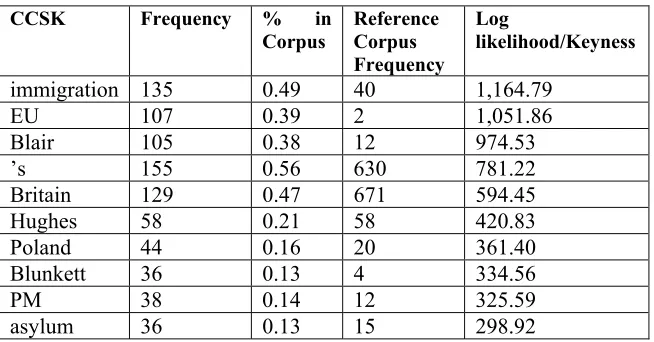
Using Wordsmith Tools 5.0, the first procedure is finding the CCSKs of The Sun corpus. The reference corpus used is BNC-baby, an approximately four million word sample of the British National Corpus, which consists of around one million words each of academic prose, conversation, fiction and newspaper text. This reference corpus is chosen since its genres are mainstream ones and, as a whole, can be taken as a ‘snapshot’ of mainstream use of English. To ascertain CCSKs, firstly wordlists for both corpora need to be generated. (A wordlist provides word frequencies in a corpus). Then, these wordlists are compared by the software to establish log likelihood values, i.e., measures of keyness. Table 1 shows the 10 highest values for ‘keyness’. As can be seen, the keyword ‘immigration’ has high keyness, as does ‘EU’. What this means is that ‘immigration’ and ‘EU’ occur statistically more often in The Sun corpus than in the reference corpus. Since the corpus texts are selected in part using these search terms, it is not surprising that they should feature as CCSKs.
CCSK Frequency % in Corpus
Reference Corpus Frequency
Log
likelihood/Keyness
immigration 135 0.49 40 1,164.79
EU 107 0.39 2 1,051.86
Blair 105 0.38 12 974.53
’s 155 0.56 630 781.22
Britain 129 0.47 671 594.45
Hughes 58 0.21 58 420.83
Poland 44 0.16 20 361.40
Blunkett 36 0.13 4 334.56
PM 38 0.14 12 325.59
asylum 36 0.13 15 298.92
Table 1. The 10 highest CCSK values for The Sun corpus8
5.2 Keyword Dispersion Plot
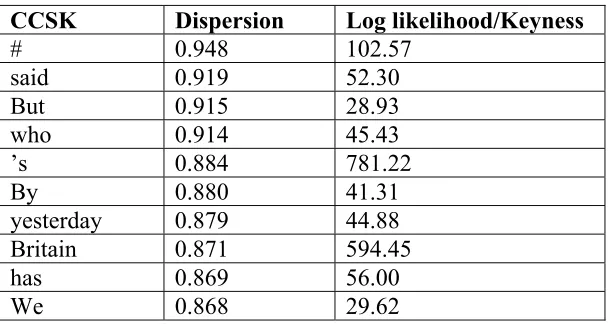
For a word to occur as a CCSK, it does not necessarily need to occur very frequently. For example, ‘Trajce’ (a town in Poland) has keyness of 30.04; it only occurs 3 times in The Sun corpus but does not occur at all in the reference corpus. Because I am interested in seeing whether repeated strategies in The Sun corpus can be identified around CCSKs, keyness is not the only criterion I need to take into account. Another is CCSK frequency. However, it must be borne in mind that out of the 76 texts, some CCSKs may occur very frequently in just a handful of texts. Because my focus is on identifying regularly recurrent strategies over the whole of the corpus, CCSKs which feature in a concentrated burst are of less relevance to me. I need then to find CCSKs which are not only frequent but well dispersed across the six weeks’ worth of texts. The dispersion plot facility of Wordsmith Tools 5.0 is useful for my purposes. Table 2 shows the 10 highest dispersion plot values for CCSKs. The dispersion value is a number between 0 and 1 with those CCSKs with a value close to 1 having the greatest dispersion.9 Organisation is in terms of descending dispersion values.
8 Wordsmith Tools treats ‘’s’ (as in ‘Britain’s’ or ‘he’s’) as a whole word. 9 Plot dispersion uses the first of the 3 formulae supplied in Oakes (1998:
CCSK Dispersion Log likelihood/Keyness
# 0.948 102.57
said 0.919 52.30 But 0.915 28.93 who 0.914 45.43
’s 0.884 781.22
By 0.880 41.31
yesterday 0.879 44.88
Britain 0.871 594.45
has 0.869 56.00
We 0.868 29.62
Table 2. The 10 highest CCSK dispersion plot values for The Sun
Corpus10
Interestingly, the grammatical word ‘But’ (i.e., with a capital ‘B’) has the third highest dispersion value (0.915); it has keyness of 28.93. This is interesting for my focus since, as a grammatical word, it signals a contrastive relation across sentences and thus creates text structure. On the basis of corpus evidence, Scott and Tribble (2006: 72) indicate that ‘it seems that the items which are most likely to be key are nouns, determiners, prepositions, pronouns’ and thus not a sentence coordinator like ‘But’. So, the keyness of ‘But’ is significant. In contrast, ‘but’ (i.e., with a lower-case ‘b’) does not have keyness since it has a negative value (-30.53). There are 85 instances of ‘But’ and 49 instances of ‘but’ in The Sun corpus (0.31% and 0.18% of the total number of words respectively). However, in BNC-baby there are 6,594 instances of ‘But’ and 14,619 instances of ‘but’ (0.16% and 0.36% of the total number of words respectively). The ratio of quantities of ‘But’ / ‘but’ in The Sun corpus is almost the opposite to that of BNC-baby. So, on this comparison, that ‘But’ has keyness is even more significant. To sum up: in The Sun Corpus ‘But’ has significant: keyness, frequency, and dispersion.
10 Even though ‘#’ and ‘said’ have higher dispersion than ‘But’, I don’t
The results for ‘But’ are interesting especially since, in starting a sentence, ‘But’ has prominence. This is even more the case if it begins a sentence which initiates a paragraph. And indeed, it is common in The Sun for paragraphs to be one sentence in length. So, if ‘But’ is providing text structure for strategies on a regular basis, in turn the strategies will have prominence. Because ‘But’ rather than ‘but’ has prominence, I don’t collapse all instances of ‘But’/‘but’ in my analysis. Furthermore, if ‘But’ is providing grammatical structure for strategies, it will be doing so in concert with lexical words or perhaps with other grammatical words. To reduce arbitrariness of strategy identification and thus circularity, I need to discern whether there are collocations of ‘But’ with lexical or other grammatical CCSKs. Finding such collocations can be done by employing another function of Wordsmith Tools 5.0— keyword links.
5.3 Keyword links
The ‘keyword links’ function of Wordsmith Tools shows the number of CCSKs which collocate with a particular CCSK in a designated word span. The highest word span possible is 25 words to the left and 25 words to the right of a search term. I choose this span so as to capture the maximum possible co-occurrences with ‘But’. There are 9 CCSK links for ‘But’ for this span (one which crosses sentence and paragraph boundaries):
Britain, he, home, immigration, Mr, UK, vote, will, yesterday.
Interestingly, one lexical CCSK is ‘immigration’—a cultural keyword. Furthermore, and again in relation to the point made by Scott and Tribble (2006: 72), not all of these CCSKs are nouns or pronouns (there are no prepositions or determiners) since they include the modal verb ‘will’. In fact, ‘will’ (171 instances) has relatively high keyness (152.66).
before and 25 words after a CCSK, the strategy highlighting may go beyond this span.
6. Strategy types via ‘But’
6.1 The Five Strategy Types
In exploring the text fragments of the Appendix, I identified five different but related strategy types associated with ‘But’ and the CCSK links. For the strategies identified, the lexical CCSKs which are most repeatedly linked to ‘But’ are ‘UK’, ‘Britain’, ‘immigration’, and ‘home’ (in ‘Home Office’, the UK government department which deals with immigration). There is one grammatical CCSK which is repeatedly linked to ‘But’; this is ‘will’. Below, I indicate the five strategy types in the corpus via representative examples with the CCSKs bolded. ‘But’ signals negative contrast in all of the 36 strategies identified. All relate to projections of immigration generally, and Eastern European immigration specifically.
Strategy 1 (x 18): for (Eastern European) immigration, there is UK government or official agency incompetence
With this strategy, there is often a reporting of government figures for immigration from new EU countries, the actions of immigration officials, etc. Then ‘But’ begins a sentence or paragraph which contrasts negatively with the UK government perspective and which sets up retrospective negative evaluation, either explicit or implicit, that the government, officials etc are incompetent as in Example 1:
(1) 26 April
The Home Office estimates that no more than 13,000 workers will come each year.
But others put the figure as high as 54,000 due to high unemployment in the East.
Strategy 2 (x 8): for (Eastern European) immigration, (fear, worry, challenge from) large numbers predicted to arrive in the UK
(2) 27 April: Stay Strong
THE SUN welcomes Tony Blair’s assurance that he will keep a tight grip on immigration
from Eastern Europe.
He is right to recognise that people are worried about what will happen after May 1.
But the PM faces a huge challenge. Thousands are heading for Britain in search of a better life.
Strategy 3 (x 4): for (Eastern European) immigration, there will be strain on social services
With this strategy, there is a projection of numbers of Eastern European ‘migrants’ coming to the UK. Then, the strategy via ‘But’ indicates, through negative contrast, that this will lead to overstretched UK social services as in Example (3):
(3) 26 April
THOUSANDS of plane, train and bus seats had been snapped up last night by poor East Europeans seeking a better life in Britain. They are free to come here when ten new countries join the EU this Saturday, May 1.
But it is feared that in some areas overstretched UK services like schools and hospitals will be unable to cope with the influx.
Strategy 4 (x 4): for (Eastern European) immigration, there will be some illegal (EU) status
Strategy 4 relates to stories about illegal immigrants in the UK, or predictions that there will be immigrants arriving in the UK from Eastern Europe who will have illegal EU citizenship (posing as Polish below) as in Example (4):
(4) 2 April
Lieutenant Miroslaw Szacillo, 46, of the Polish Border Guards, assured The Sun: “Only the most serious criminals with big money can afford to buy false documents in Poland. We make stringent checks on our borders and we are getting more equipment to detect fake documents.”
But Poles who do get in and find work in
including free healthcare, child tax credit, child benefit, working tax credit, housing benefit and council tax benefit.
‘But’ is used, in negative contrast, in predicting that people falsely claiming to be a member of a new EU country will be able to claim benefits.
Strategy 5 (x 2): for (Eastern European) immigration, there will be some criminality
In Strategy 5, ‘But’ is used to signal, through negative contrast, the prospect of serious criminality characterising some immigration from Eastern Europe, as in Example (5):
(5) 31 March
Many new arrivals will be good news for
Britain.
But some will be up to no good. Gun-happy crime syndicates have already set up vicious vice and drug rackets.
Others want to do our nation harm. The Wall Street Journal says Islamic fanatics are using immigration as a “Trojan horse to expand jihad, or holy war”.
In sum: strategies relating to Eastern European immigration have been identified around CCSK links with ‘But’, i.e., they have been grounded in text structure. I hope I have shown the value of grounding interpretation of strategies in corpus-generated lexico-grammatical patterns since arbitrariness of identification, and circularity of analysis to interpretation to analysis, has been considerably reduced. It should be said that there seems to be other evidence for these 5 strategies in the dataset but where the strategies are not realised through ‘But’. However, to avoid accusations of arbitrariness, identification of further strategies would also need to be grounded in lexico-grammatical patterns constituted by CCSKs. Further investigation along these lines has been beyond the scope of this article.
6.2 The interrelatedness of the strategies and plausible reasoning
negative consequences of projected Eastern European immigration; taken together, Strategies 3, 4 and 5 amount to 10 instances.
Interestingly, while the strategies are semantically distinct in the texts, they are often in close proximity to each other, linked to one another around the ‘But CCSK links’. Consider Example (6):
(6) 26 April
DON’T blame the people of Eastern Europe for heading for Britain. (Strategy 2).
The Government has put out the welcome mat. (Strategy 1) And to hard-up foreigners this looks the land of milk and honey.
But most will end up in unskilled low-paid jobs in the South East.
How will they afford to live? And how can schools and hospitals which are already at breaking point find room for them? (Strategy 3) [my italics]
Strategy 1, seemingly so different to Strategies 2-5, links in the data to other strategies as can be seen in the example above. Because of regular interrelating of strategies around ‘But CCSK links’ over the 6 weeks prior to May 1st, potential has been created for the reader to plausibly reason, in reading of a particular strategy, other strategies. This is because regular interrelating of strategies sets up a series of linked contextual assumptions from which can be plausibly reasoned contextual effects (Sperber and Wilson, 1995). For example, on the basis of exposure to text fragments such as Example 6, when:
• a reader is exposed to Strategy 1, they may well plausibly reason Strategy 2; i.e., highlighting of government incompetence could lead to the inference that large numbers of migrants will arrive in the UK;
• when a reader is exposed to Strategy 1 and/or Strategy 2, they may well plausibly reason Strategy 3; i.e., highlighting of government incompetence could lead to the inference that large numbers of migrants will arrive in the UK, and the (further) reasoning that this will lead to strain on social services.
Consider also Example (7): (7) 2 April
voters because of the strains being placed on schools, hospitals and housing.
But for their first five years in power, all the Government did was make matters worse with a tangled mess of rules that didn’t work. (Strategy 1)
For the past two years they have talked tough but achieved what?Police don’t even arrest lorryloads of illegals (Strategy 4)—they ask them to make their own way to the
immigration HQ in Croydon. (Strategy 1)
Due to the interrelating of these strategies in this fragment and in others, when:
• a reader is exposed to Strategy 1, they may well plausibly reason Strategy 4, i.e., highlighting of government incompetence could lead to the inference that there will be illegal migrants amongst new Eastern European migrants. Finally, consider Example (8):
(8) 2 April
Almost 10,000 forged passports and other ID documents were discovered at British ports in 2002, the latest year for which figures are available—an increase of 46 per cent on 2001.
But an unknown number of illegals with false papers make it into Britain each year. (Strategies 1 and 4)
Forged passports are commonly used by terrorists to slip in and out of countries undetected.
Two al-Qaeda terrorists, jailed in Britain in 2003, were discovered with hundreds of false travel documents. (Strategy 5)
Due to the interrelating of these strategies in this fragment, when: • a reader is exposed to Strategy 1 and/or Strategy 4, they may
See the Appendix for further evidence of interrelatedness of strategies along ‘But CCSK links’, and thus potential for the above types of plausible reasoning, since many of the text fragments exhibit more than one strategy. The preponderance of Strategy 1 (18 instances) across the corpus might seem to protect The Sun from accusations of bias against migrants (i.e., on the whole, it seems to blame the government, not migrants). However, the interrelatedness of Strategy 1, along the ‘But CCSK links’, with other strategies means that in practice it would be disingenuous for The Sun to claim that it is only criticizing the government.
It is also worth noting that all of the plausible inferences detailed above are causal consequent inferences. A consensus in current psycholinguistic evidence indicates how causal consequent inferences are only weakly generated at best in the absence of relevant information, i.e., absence of relevant contextual assumptions. However, causal consequent inferences can be generated if ‘necessary information can become available quickly’ (O’Halloran, 2003: 181). The strategies then are unlikely to be generated in the reading of a non-regular, non-target reader. However, as the corpus analysis has shown, they stand a good chance of being generated, and chains of plausible reasoning established, if readers have been regularly exposed to these interrelated strategies in the six weeks leading up to the May 1st text.
6.3 ‘But’ and negative contrast priming
The corpus investigation shows there is evidence that ‘But’ has potentially been ‘primed’ for regular Sun readers, in the Hoey (2005) sense, to indicate negative evaluative contrast, specifically in relation to predictions around future migration to the UK. Significantly, ‘But’ is never used in the corpus to indicate a positive evaluation of migrants as contrasting with a previously stated negative one (e.g., ‘Some migrants from Eastern Europe may be criminals. But the majority will be good for the economy’.). The priming of ‘But’ relates also to the grammatical word, ‘will’, and lexical words such as ‘immigration’; the priming is actually lexicogrammatical. So, regular readers of The Sun during the six-week period could well expect ‘But’ to preface a negative prediction (most likely around ‘will’) about Eastern European migration to the UK.
repeated exposure to the five interrelated strategies. In subsequent related texts, references to ‘Eastern Europeans’ could thus be regarded as But strategy activators. For the May 1st text (see Section 7), I will highlight how this could work. Another point to make is that, given the high level of interrelation of strategies via the ‘But CCSK links’, regular readers are actually being subtly primed (should they accept this positioning) into interrelating the strategies.
7. The May 1st text and Implicit Dialogical Premise Reconstruction
7.1 How the text positions regular target readers into negative evaluative dialogue
For ease of reference, here again are the five interrelated strategies which were identified around CCSK links with ‘But’:
Strategy 1 (x 18): for (EE) immigration, there is UK government or official agency incompetence
Strategy 2 (x 8): for (EE) immigration,
(fear/worry/challenge from) large numbers predicted to arrive in the UK
Strategy 3 (x 4): for (EE) immigration, there will be strain on social services
Strategy 4 (x 4): for (EE) immigration, there will be some illegal (EU) status
Strategy 5 (x 2): for (EE) immigration, there will be some criminality.
Annotated below in italics is an interpretation of how regular readers of The Sun who have accepted the positioning of the interrelated five strategies, over the six weeks, could plausibly infer the following in their reading of the May 1st text:
(i) strategies as ‘negative But contrastive inferences’ in dialogue with strategy activators (i.e., text which refers to Eastern Europeans / semantically relates to the strategies) in the May 1st report.
(ii) plausible inferences from strategies indicated in Section 6.2.
possible that unannotated parts of the May 1st text will be ‘alive’ as strategy activators for some target readers. The explanation part of the text is bolded.
a. Migrants are the first of many
By NICK PARKER CHARLES RAE and CHARLES YATES
b. HISTORY will be made today as new EU citizens begin leaving their homelands for new lives in Britain. c. They will come in their hundreds[ACTIVATE STRATEGY 2
AS CONTRASTIVE INFERENCE: BUT for EE immigration (fear, worry, challenge from) large numbers predicted to arrive in the UK: PLAUSIBLY REASON STRATEGY 3: BUT for EE immigration, there will be strain on social services] by coach, train and plane, desperate for decently-paid work—or any job at all [ACTIVATE STRATEGY 5 AS CONTRASTIVE INFERENCE BUT for EE immigration, there will be some criminality].
d. They are citizens of ten new member states of the EU who now have the right to live and work in Britain. e. Those states are the Czech Republic, Estonia, Hungary,
Latvia, Lithuania, Poland, Slovakia, Slovenia, Cyprus and Malta.
f. Eight are poverty-stricken former Soviet states in Eastern Europe—with a total population of 75 million [ACTIVATE STRATEGY 2 AS CONTRASTIVE INFER-ENCE : PLAUSIBLY REASON STRATEGY 3].
g. Our government says there are half a million jobs waiting here to be filled [ACTIVATE STRATEGY 1 AS CONTRASTIVE INFERENCE: BUT for (EE) immigration, there is UK government or official agency incompetence: PLAUSIBLY REASON STRATEGIES 2, 3, 4, 5].
h. And if the new arrivals find legitimate work in Britain [ACTIVATE STRATEGY 5 AS CONTRASTIVE INFERENCE],paying tax and national insurance, they will qualify for a range of benefits [ACTIVATE STRATEGY 3 AS CONTRASTIVE INFERENCE].
i. These will include free health care, child tax credit, child benefit, working tax credit and housing benefit
[ACTIVATE STRATEGY 3 AS CONTRASTIVE INFERENCE]. j. Other EU countries like France and Germany have
ruled out free access to jobs for up to seven years
[ACTIVATE STRATEGY 1 AS CONTRASTIVE INFERENCE: PLAUSIBLY REASON STRATEGIES 2, 3, 4, 5].
k. Small wonder that eager men and women used to working for a pittance in countries with huge unemployment are snapping up tickets to the UK
l. People out to get a head start in the exodus [ACTIVATE STRATEGY 2 AS CONTRASTIVE INFERENCE: PLAUSIBLY REASON STRATEGY 3] crammed into coaches yesterday at stations in Warsaw, Poland, the Czech capital Prague and the Slovak capital Bratislava.
m. Seventy-one LATVIANS smiled as they boarded a double-decker bus in the capital Riga for a 24-hour journey west.
n. Coach firm Eco-Lines said they had put on an extra service to London this week for the £75 trip.
o. All services are booked for the next week [ACTIVATE STRATEGY 2 AS CONTRASTIVE INFERENCE : PLAUSIBLY REASON STRATEGY 3].
p. ESTONIANS are travelling from their capital Tallinn, via Helsinki in Finland.
q. Budget airlines like Sky Europe, which has services from Slovakia to Britain, have reportedly sold out all flights [ACTIVATE STRATEGY 2 AS CONTRASTIVE INFERENCE: PLAUSIBLY REASON STRATEGY ].
r. POLAND’S Air Polonia alone has bookings for about 4,000 migrant workers this month[ACTIVATE STRATEGY 2 AS CONTRASTIVE INFERENCE: PLAUSIBLY REASON STRATEGY 3].
s. Warsaw-based coach operator Orbis expects migrants to fill 1,500 of its monthly 4,500 seats to Dover[ACTIVATE STRATEGY 2 AS CONTRASTIVE INFERENCE : PLAUSIBLY REASON STRATEGY 3].
(source: http:\\www.thesun.co.uk 1st May 2004)
In sum: while the May 1st text does not explicitly evaluate potential migrants negatively, as a result of prior positioning readers could well be reproducing evaluative meanings such as ‘new migrants will be a drain on social services, schools and hospitals’ and ‘many migrants will be criminals since the government/official agencies will have problems in preventing their entry to the UK’. Audience reception studies would, of course, be needed to establish these claims.
7.2 Reconstructing the explanation as argument
Below, I reproduce from Section 2.1 my propositional analysis of the explanation in the May 1st Sun news text (in italics). Where I interpret semantic content in the propositions of the explanation as potentially functioning as strategy activators, I include the inference which regular target readers could well generate (on the basis of Section 7.1). Since these inferences can become premises in a piece of argumentative reasoning which leads to a conclusion, I refer to these inferences as implicit premises.
Proposition 1. Eight [new member states] are poverty-stricken former Soviet states in Eastern Europe—with a total population of 75 million (sentence f).
Premise 1 (implicit): BUT there is(and the target reader potentially has fear of) a large number of migrants (escaping poverty) arriving in the UK. (Strategy2)
Proposition 2. Government says that there are 500,000 jobs in the UK (sentence g).
Premise 2 (implicit): BUT for EE immigration, there is government incompetence. (Strategy1)
Proposition 3. There are social benefits for migrants if they find legitimate work in UK (sentences h and i).
Premise 3 (implicit): BUT for EE immigration, potential illegitimate (criminal) behaviour. (Strategy5)
Premise 4 (implicit): BUT for EE immigration, there is strain on social services. (Strategy3)
Proposition 4. Two other major economies have ruled out free access to jobs (sentence j).
Premise 2 (implicit): BUT for EE immigration, there is government incompetence. (Strategy1)
Proposition 5. Eastern Europeans do not earn much (sentence k).
Proposition 6. There is much unemployment in Eastern Europe (sentence k).
Explanation summary on basis of propositions:
All this explains why people from Eastern European countries want to come to UK (sentence k).
Argument conclusion on basis of implicit premises:
Therefore (the target reader is afraid that) large numbers of migrants will place strain on social services and this is due, in part, to government incompetence since numbers of immigrants will be greater than predicted.
By grounding implicit premise recovery on the strategies I identified, I have in effect based this recovery on linking a cultural keyword, ‘(Eastern European) immigration’ to lexical CCSKs and to the grammatical CCSK ‘But’, i.e., to text structure. Moreover, the state of affairs I have uncovered using the corpus-based method is one which helps The Sun to evade charges of bias. This is because the bias is not in the text as such (i.e., in the explanation), but would be in the mind of the reader (i.e., in the argument). Another aspect of this corpus-based examination that is worth commenting on is as follows. In the original proposition analysis, there would seem to be an implicit proposition that Eastern Europeans can earn much more money in the UK than they can in their home country; see sentence k (‘working for a pittance’). Interestingly, the seeming implicitness of this proposition increases the likelihood that regular target readers will understand that Eastern Europeans are attracted by social benefits—which in turn will lead to a strain on social services—rather than understand that Eastern Europeans are attracted by the higher wages in the UK. In other words, that this proposition seems implicit in the explanation facilitates reading of the explanation as the argument I have reconstructed. Echoing the quote from Fairclough (1992) in Section 4.1, in the right priming conditions, implicit propositions can do ‘ideological work’.
reader, i.e., the extent to which they are reading casually (see O’Halloran, 2003). I would contend that much reasoning by casual readers, on the basis of regular positioning by patterns of evaluative meanings (e.g., in the media), is of this order. So while the goal of the writers of the May 1st text may have been to provide an explanation of why people from new member states would want to come to the UK (e.g., because there are available jobs; the social benefit system is an attraction), regular readers of The Sun are likely to read the explanation fuzzily—as a hybrid of an explanation and an argument with a conclusion. Some may give more weight to plausibly reasoning to a conclusion over their processing of an explanation and vice-versa; all will depend on the degree to which they have accepted the positioning of the strategies.
8. Conclusion
In this article, I have shown the following:
• the value of a corpus of texts for highlighting how regular target readers can, on the basis of prior positioning, be primed to read an argument into an explanation. I have indicated how this state of affairs can favour a popular tabloid newspaper, and potentially other types of media, because accusations of bias can be rebutted: a biased conclusion is in the minds of regular target readers and not on the page.
• the value of generating corpus-comparative statistical keywords (CCSKs) and linking them to cultural keywords for the business of implicit premise recovery. One reason that CCSKs are useful is because analysis of them helps to reveal text structure around cultural keywords, which is important for the recovery of implicit premises. Another reason is because their generation reduces arbitrariness in implicit premise recovery. In turn, circularity of analysis to interpretation to analysis is also reduced.
Acknowledgements
Many thanks to Jean Goodwin, Chris Reed, and Catherine Williams for their very helpful feedback on an earlier version, as well as to the anonymous reviewers and the editors for very useful comments that helped to improve this article.
References
Anderson, R.C, Chinn, C., Chang, J., Waggoner, M., and Yi, H. (1997). On the logical integrity of children’s arguments, Cognition and Instruction, 15: 135-167.
Bigi, S. (2007). Keywords in argumentative texts and their persuasive power. In F.H. van Eemeren, J.A.Blair, C.A. Willard, & B. Garssen (Eds.), Proceedings of the sixth conference of the international society for the study of argumentation, pp.129-135. Amsterdam: SicSat, International Center for the Study of Argumentation.
Burnyeat, M. (1994). Enthymeme: Aristotle on the logic of persuasion. In D.J. Furley & A. Nehemas, (Eds.), Aristotle’s Rhetoric: Philosophical Essays, pp. 3-55. Princeton, NJ: Princeton University Press.
Coffin, C. and O’Halloran, K.A (2008). New directions, New methods. In C. Coffin & K.A. O’Halloran, K.A (guest Eds.), Researching argumentation in Educational Contexts: New Directions, New Methods, International Journal of Research and Method in Education, 31(3): 219-227.
Coffin, C. and O’Halloran, K.A. (forthcoming) Argument Reconceived? Educational Review,61(3).
Cook, G. (1994). Discourse and literature: The interplay of from and mind. Oxford: Oxford University Press.
Degano, C. (2007). Presupposition and dissociation in discourse: a corpus study. Argumentation, 21: 361-378.
Dunning, T. (1993). Accurate methods for the statistics of surprise and coincidence in Computational Linguistics, 19 (1): 61-74. Fairclough, N. (1992) Discourse and social change, Cambridge:
Polity Press.
Govier, T. (1987). Problems in argument analysis and evaluation. Providence, RI: Foris.
Hoey, M. (2005). Lexical priming . London: Routledge.
Katzav, J. and Reed, C. (2008). Modelling argument recognition and reconstruction. Journal of Pragmatics 40: 155-172.
O’Halloran (2003). Critical discourse analysis and language cognition. Edinburgh: Edinburgh University Press.
O’Halloran, K.A and Coffin, C (2004) Checking overinterpretation and underinterpretation: Help from Corpora in critical linguistics. In C. Coffin, A. Hewings & K.A. O’Halloran (Eds.), Applying English Grammar: Functional and Corpus Approaches, pp. 275-297.London: Hodder Arnold.
Reed, C. (2006). Preliminary results from an argument corpus. In Eloína Miyares Bermúdez & Leonel Ruiz Miyares (Eds), Linguistics in the twenty-first century, pp. 185-196. Cambridge: Scholars Press.
Reed, C. and Rowe, G. (2001). Araucaria: software for puzzles in argument diagramming and xml. Technical report, Department of Applied Computing, University of Dundee.
Rigotti, E. and Rocci, A. (2005). From argument analysis to cultural keywords (and back again). In F.H. van Eemeren & P. Houtlosser (Eds.), Argumentation in Practice, pp.125-142. Amsterdam: John Benjamins.
Schwarz, B. and Asterhan, C. (forthcoming). Argumentation and reasoning. In K. Littleton, J. Kleine Staarman & C. Wood (Eds.), Elsevier Handbook of Educational Psychology. London: Elsevier.
Scott, M. (2008). Wordsmith tools version 5.0. Oxford: Oxford University Press.
Scott, M. and Tribble, C. (2006). Textual patterns: Key words and corpus analysis in language education. Amsterdam: John Benjamins.
Sperber, D. and Wilson, D. (1995) Relevance, 2nd ed. Oxford: Blackwell.
Stubbs, M. (1996). Text and corpus analysis: Computer-assisted studies of language and culture. Oxford: Blackwell.
Stubbs, M. (2001). Words and phrases: Corpus studies of lexical semantics. Oxford: Blackwell.
Walton, D. (1996). Argumentation schemes for presumptive reasoning. Mahwah, NJ: Erlbaum.
Walton, D. (2006). Fundamentals of critical argumentation. Cambridge: Cambridge University Press.
Walton, D. and Reed, C. (2005). Argumentation schemes and enthymemes. Synthese 145: 339-370.
Widdowson, H.G. (2004). Text, context, pretext: Critical issues in discourse analysis.Oxford: Blackwell.
Williams, R. (1983). Keywords: A vocabulary of culture and society, 2nd ed. London: Flamingo.
Zagar, I.Z. (2007). Arguing from large corpora: Some epistemological and methodological dilemmas; experimental study aimed at quantifying political argumentation. In F.H. van Eemeren, J.A. Blair, C.A. Willard, B. Garssen (Eds.), Proceedings of the sixth conference of the international society for the study of argumentation, pp.1553-1558. Amsterdam: SicSat, International Center for the Study of Argumentation.
Appendix: Strategies (and their interrelatedness) around ‘But CCSK links’
Strategy 1 (x 18)
30 March
"The applicants rarely know what is in their business plan, cannot speak English, and have absolutely no knowledge or experience in the type of skills needed for respective businesses," wrote Mr Ramsden.
But the applications were "unfortunately" being approved by IND against the "strongest recommendations" of the embassy.
31 March
Last Monday, a senior British diplomat was also suspended for lifting the lid on MORE blunders. James Cameron, who was in charge of visa applications in Bucharest, revealed bogus applications from Romania and Bulgaria—not among the EU eight—were being nodded through by the suitcase-load.
He claimed that many had previously been refused tourist or student visas for fear they were benefit scroungers.
But yesterday it emerged alarm bells were already being sounded in high places 18 months ago.
31 March
He said: “Interviewed applicants rarely knew what was in their business plans. It was often clear that applicants had no idea about the trade they were supposed to be setting up in the UK.”
But he claimed the dodgy applications were rubber-stamped by
immigration chiefs in Leeds—even when they were warned of “flaws”.
31 March
An official in Romania wrote to the UK immigration department “strongly” urging them to refuse him, saying she did not find his statement “credible”.
But on July 24, 2003, the Home Office granted him a visa.
31 March Lost warning
MR C, a Romanian, applied for a visa in August 2003.
But he got his visa after the Home Office “lost” the letter suggesting his claim was bogus .
1 April
He was sent to a detention centre in Oxfordshire where he applied for asylum claiming he had received death threats from criminals in his homeland.
But immigration officers who quizzed Kunowski failed to uncover his true identity.
2 April
The huge number of illegal immigrants who have sneaked into Britain is a major worry to voters because of the strains being placed on schools, hospitals and housing.
But for their first five years in power, all the Government did was make matters worse with a tangled mess of rules that didn’t work.
For the past two years they have talked tough but achieved what? Police don’t even arrest lorryloads of illegals – they ask them to make their own way to the immigration HQ in Croydon.
Naturally, they do a runner. That’s why our cities and towns have an underclass of illegals prepared to work as slave labour.
2 April
Almost 10,000 forged passports and other ID documents were discovered at British ports in 2002, the latest year for which figures are available — an increase of 46 per cent on 2001.
But an unknown number of illegals with false papers make it into
Britain each year. Forged passports are commonly used by terrorists to slip in and out of countries undetected. Two al-Qaeda terrorists, jailed in
Britain in 2003, were discovered with hundreds of false travel documents.
5 April
Tony Blair is where he belongs – slap at the centre of the row over
immigration.
Home Secretary David Blunkett has borne the brunt of public fury.
But his hands were tied by a Prime Minister who initially saw nothing wrong with a million new people moving into Britain.
6 April
Right now the PM is surrounded on three sides — by illegal immigration, Iraq and the EU.
His instinct is to choose his own turf and come out fighting.
So far he has always come out on top — from his first tussle with the unions over Clause Four to the Commons vote to go to war.
He has always believed he would win a vote on the EU once the battle was joined.
If his closest allies are right and he is planning a referendum this year, it is a courageous and welcome move.