I
I
I
N
N
N
T
T
T
E
E
E
R
R
R
N
N
N
A
A
A
T
T
T
I
I
I
O
O
O
N
N
N
A
A
A
L
L
L
J
J
J
O
O
O
U
U
U
R
R
R
N
N
N
A
A
A
L
L
L
O
O
O
F
F
F
R
R
R
E
E
E
S
S
S
E
E
E
A
A
A
R
R
R
C
C
C
H
H
H
I
I
I
N
N
N
C
C
C
O
O
O
M
M
M
M
M
M
E
E
E
R
R
R
C
C
C
E
E
E
,
,
,
I
I
I
T
T
T
A
A
A
N
N
N
D
D
D
M
M
M
A
A
A
N
N
N
A
A
A
G
G
G
E
E
E
M
M
M
E
E
E
N
N
N
T
T
T
C
C
C
CONTENTS
ONTENTS
ONTENTS
ONTENTS
Sr.
No.
TITLE & NAME OF THE AUTHOR (S)
Page No.
1.
RESPONSIBILITY ACCOUNTING IN SMALL AND MEDIUM SCALE INDUSTRIES MANUFACTURING AUTO COMPONENTSANIRUDDHA THUSE & DR. NEETA BAPORIKAR
1
2.
LIBERALIZED FINANCIAL SYSTEM AND ECONOMIC DEVELOPMENT IN NIGERIAOLOWE, OLUSEGUN
6
3.
AN INVESTIGATION ON HIGHER LEARNING STUDENTS SATISFACTION ON FOOD SERVICES AT UNIVERSITY CAFETERIASARAVANAN RAMAN & SUBHASENI CHINNIAH
12
4.
IDENTIFYING AND PRIORITIZING THE MAIN BARRIERS TO KNOWLEDGE MANAGEMENTDR. S. ALI AKBAR AHMADI, MOHAMAD ALI AFSHARI & HAMIDEH SHEKARI
17
5.
PERFORMANCE EVALUATION OF PRIVATE AND PUBLIC SPONSORED MUTUAL FUNDS IN INDIANOONEY LENIN KUMAR & DR. VANGAPANDU RAMA DEVI
24
6.
TALENT MANAGEMENT PRACTICES IN IT SECTORDR. K. JANARDHANAM, DR. NIRMALA M. & PRATIMA PANDEY
36
7.
FREQUENT PATTERN MINING USING DYNAMIC PROGRAMMINGV. G. RAJALEKSHMI & DR. M. S. SAMUEL
41
8.
PRICE AND LIQUIDITY CHANGES AFTER STOCK SPLITS - EMPIRICAL EVIDENCE FROM INDIAN STOCK MARKETDHANYA ALEX, DR. K. B. PAVITHRAN & EAPEN ROHIT PAUL
45
9.
THE IMPACT OF REVERSE CULTURAL SHOCK AMONG REPATRIATESN. PADMAVATHY & DR. N. THANGAVEL
50
10.
BRAND LOYALTY’S INFLUENCE ON WOMEN’S BUYING BEHAVIOR WITH SPECIAL REFERENCE TO PERSONAL CARE PRODUCTSR. SUNDARI & DR. M. SAKTHIVEL MURUGAN
57
11.
ANALYSIS OF COTTON TEXTILE INDUSTRY IN KARUR DISTRICT, TAMILNADUDR. N. RAJASEKAR & M. GURUSAMY
63
12.
ANALYSING THE TRADING ACTIVITIES OF MUTUAL FUNDS TO IDENTIFY THE TREND OF THE INDIAN STOCK MARKETM. JEEVANANTHAN & DR. K. SIVAKUMAR
69
13.
VIABILITY OF ORGANIC PRODUCTS’ BUSINESS AMONG THE NON-ORGANIC PRODUCT CONSUMERS – A DESCRIPTIVE STUDYDR. R. DHANALAKSHMI
75
14.
EMPLOYEES PERCEPTION TOWARDS ENVIRONMENTAL CHALLENGES: AN EMPIRICAL STUDY ON VEDANTA LTD. IN ODISHADR. B. CHANDRA MOHAN PATNAIK, DR. IPSEETA SATPATHY & DEEPAK KUMAR SINGH
79
15.
CASH CONVERSION CYCLE AND CORPORATE PROFITABILITY – AN EMPIRICAL ENQUIRY IN INDIAN AUTOMOBILE FIRMSDR. A. VIJAYAKUMAR
84
16.
A STUDY ON BEST PRACTICES IN FINANCIAL SERVICES AT A PUBLIC SECTOR COMPANY AT BHOPALDR. N. SUNDARAM & AJAY KUMAR SHARMA
92
17.
AN EMPIRICAL STUDY OF FIRM STRUCTURE AND PROFITABILITY RELATIONSHIP: THE CASE OF INDIAN AUTOMOBILE FIRMSDR. A. VIJAYAKUMAR
100
18.
PERCEPTION OF BANK EMPLOYEES TOWARDS ADOPTION OF INFORMATION TECHNOLOGY IN PRIVATE SECTOR BANKS OF INDIABINDIYA TATER, DR. MANISH TANWAR & NAVRATAN BOTHRA
109
19.
KEY SKILLS IDENTIFICATION AND TRAINING NEED ANALYSIS @ SMALL AND MEDIUM RETAILERS IN DELHI AND NCRPOOJA MISRA, NEHA JOSHI & RAHUL GOYAL
118
20.
STRATEGIES FOR MERGERS AND ACQUISITIONS – CASE STUDIES OF SELECTED BUSINESS HOUSESDR. PREETI YADAV & DR. JEET SINGH
127
21.
MANAGEMENT OF NPAS IN DCCBS IN INDIA – AN EMPIRICAL ASSESSMENTDR. A. DHARMENDRAN
136
22.
IMPACT OF MOBILE MARKETING ON THE PURCHASE DECISION OF CONSUMERS: A STUDY OF JALANDHAR REGIONHARENDRA SINGH, SALEEM ANWAR & SHUJA QAMMER SHAH
141
23.
A STUDY ON LEADERSHIP STYLE AND THEIR IMPACT IN PUBLIC SECTOR – TAMIL NADUN. PRABHA
146
24.
PARAMETERS OF RATING OF INDIAN COMMERCIAL BANKS – A CRITICAL ANALYSISDR. MUKTA MANI
149
25.
IMPACT OF INTERNET BANKING ON CUSTOMER SATISFACTION: A COMPARATIVE STUDY OF PUBLIC SECTOR BANKS, PRIVATE SECTOR BANKS AND FOREIGN SECTOR BANKSRITU SEHGAL & DR. SONIA CHAWLA
156
INTERNATIONAL JOURNAL OF RESEARCH IN COMMERCE, IT & MANAGEMENT
CHIEF PATRON
CHIEF PATRON
CHIEF PATRON
CHIEF PATRON
PROF. K. K. AGGARWAL
Chancellor, Lingaya’s University, Delhi
Founder Vice-Chancellor, Guru Gobind Singh Indraprastha University, Delhi
Ex. Pro Vice-Chancellor, Guru Jambheshwar University, Hisar
PATRON
PATRON
PATRON
PATRON
SH. RAM BHAJAN AGGARWAL
Ex. State Minister for Home & Tourism, Government of Haryana
Vice-President, Dadri Education Society, Charkhi Dadri
President, Chinar Syntex Ltd. (Textile Mills), Bhiwani
CO
CO
CO
CO----ORDINATOR
ORDINATOR
ORDINATOR
ORDINATOR
AMITA
Faculty, E.C.C., Safidon, Jind
ADVISORS
ADVISORS
ADVISORS
ADVISORS
PROF. M. S. SENAM RAJU
Director A. C. D., School of Management Studies, I.G.N.O.U., New Delhi
PROF. M. N. SHARMA
Chairman, M.B.A., Haryana College of Technology & Management, Kaithal
PROF. S. L. MAHANDRU
Principal (Retd.), Maharaja Agrasen College, Jagadhri
EDITOR
EDITOR
EDITOR
EDITOR
PROF. R. K. SHARMA
Dean (Academics), Tecnia Institute of Advanced Studies, Delhi
CO
CO
CO
CO----EDITOR
EDITOR
EDITOR
EDITOR
DR. BHAVET
Faculty, M. M. Institute of Management, Maharishi Markandeshwar University, Mullana, Ambala, Haryana
EDITORIAL ADVISORY BOARD
EDITORIAL ADVISORY BOARD
EDITORIAL ADVISORY BOARD
EDITORIAL ADVISORY BOARD
DR. AMBIKA ZUTSHI
Faculty, School of Management & Marketing, Deakin University, Australia
DR. VIVEK NATRAJAN
Faculty, Lomar University, U.S.A.
DR. RAJESH MODI
Faculty, Yanbu Industrial College, Kingdom of Saudi Arabia
PROF. SANJIV MITTAL
University School of Management Studies, Guru Gobind Singh I. P. University, Delhi
PROF. ANIL K. SAINI
Chairperson (CRC), Guru Gobind Singh I. P. University, Delhi
DR. KULBHUSHAN CHANDEL
Reader, Himachal Pradesh University, Shimla
DR. TEJINDER SHARMA
DR. SAMBHAVNA
Faculty, I.I.T.M., Delhi
DR. MOHENDER KUMAR GUPTA
Associate Professor, P. J. L. N. Government College, Faridabad
DR. SHIVAKUMAR DEENE
Asst. Professor, Government F. G. College Chitguppa, Bidar, Karnataka
MOHITA
Faculty, Yamuna Institute of Engineering & Technology, Village Gadholi, P. O. Gadhola, Yamunanagar
ASSOCIATE EDITORS
ASSOCIATE EDITORS
ASSOCIATE EDITORS
ASSOCIATE EDITORS
PROF. NAWAB ALI KHAN
Department of Commerce, Aligarh Muslim University, Aligarh, U.P.
PROF. ABHAY BANSAL
Head, Department of Information Technology, Amity School of Engineering & Technology, Amity University, Noida
PROF. A. SURYANARAYANA
Department of Business Management, Osmania University, Hyderabad
DR. ASHOK KUMAR
Head, Department of Electronics, D. A. V. College (Lahore), Ambala City
DR. JATINDERKUMAR R. SAINI
Head, Department of Computer Science, S. P. College of Engineering, Visnagar, Mehsana, Gujrat
DR. V. SELVAM
Divisional Leader – Commerce SSL, VIT University, Vellore
DR. PARDEEP AHLAWAT
Reader, Institute of Management Studies & Research, Maharshi Dayanand University, Rohtak
S. TABASSUM SULTANA
Asst. Professor, Department of Business Management, Matrusri Institute of P.G. Studies, Hyderabad
TECHNICAL ADVISOR
TECHNICAL ADVISOR
TECHNICAL ADVISOR
TECHNICAL ADVISOR
AMITA
Faculty, E.C.C., Safidon, Jind
MOHITA
Faculty, Yamuna Institute of Engineering & Technology, Village Gadholi, P. O. Gadhola, Yamunanagar
FINANCIAL ADVISOR
FINANCIAL ADVISOR
FINANCIAL ADVISOR
FINANCIAL ADVISORSSSS
DICKIN GOYAL
Advocate & Tax Adviser, Panchkula
NEENA
Investment Consultant, Chambaghat, Solan, Himachal Pradesh
LEGAL ADVISORS
LEGAL ADVISORS
LEGAL ADVISORS
LEGAL ADVISORS
JITENDER S. CHAHAL
Advocate, Punjab & Haryana High Court, Chandigarh U.T.
CHANDER BHUSHAN SHARMA
Advocate & Consultant, District Courts, Yamunanagar at Jagadhri
SUPERINTENDENT
SUPERINTENDENT
SUPERINTENDENT
INTERNATIONAL JOURNAL OF RESEARCH IN COMMERCE, IT & MANAGEMENT
CALL FOR MANUSCRIPTS
CALL FOR MANUSCRIPTS
CALL FOR MANUSCRIPTS
CALL FOR MANUSCRIPTS
We
invite unpublished novel, original, empirical and high quality research work pertaining to recent developments & practices in
the area of Computer, Business, Finance, Marketing, Human Resource Management, General Management, Banking, Insurance,
Corporate Governance and emerging paradigms in allied subjects like Accounting Education; Accounting Information Systems;
Accounting Theory & Practice; Auditing; Behavioral Accounting; Behavioral Economics; Corporate Finance; Cost Accounting;
Econometrics; Economic Development; Economic History; Financial Institutions & Markets; Financial Services; Fiscal Policy;
Government & Non Profit Accounting; Industrial Organization; International Economics & Trade; International Finance; Macro
Economics; Micro Economics; Monetary Policy; Portfolio & Security Analysis; Public Policy Economics; Real Estate; Regional
Economics; Tax Accounting; Advertising & Promotion Management; Business Education; Business Information Systems (MIS);
Business Law, Public Responsibility & Ethics; Communication; Direct Marketing; E-Commerce; Global Business; Health Care
Administration; Labor Relations & Human Resource Management; Marketing Research; Marketing Theory & Applications;
Non-Profit Organizations; Office Administration/Management; Operations Research/Statistics; Organizational Behavior & Theory;
Organizational Development; Production/Operations; Public Administration; Purchasing/Materials Management; Retailing;
Sales/Selling; Services; Small Business Entrepreneurship; Strategic Management Policy; Technology/Innovation; Tourism,
Hospitality & Leisure; Transportation/Physical Distribution; Algorithms; Artificial Intelligence; Compilers & Translation; Computer
Aided Design (CAD); Computer Aided Manufacturing; Computer Graphics; Computer Organization & Architecture; Database
Structures & Systems; Digital Logic; Discrete Structures; Internet; Management Information Systems; Modeling & Simulation;
Multimedia; Neural Systems/Neural Networks; Numerical Analysis/Scientific Computing; Object Oriented Programming;
Operating Systems; Programming Languages; Robotics; Symbolic & Formal Logic; Web Design. The above mentioned tracks are
only indicative, and not exhaustive.
Anybody can submit the soft copy of his/her manuscript
anytime
in M.S. Word format after preparing the same as per our
submission guidelines duly available on our website under the heading guidelines for submission, at the email addresses,
[email protected]
or
.
GUIDELINES FOR SUBMISSION OF MANUSCRIPT
GUIDELINES FOR SUBMISSION OF MANUSCRIPT
GUIDELINES FOR SUBMISSION OF MANUSCRIPT
GUIDELINES FOR SUBMISSION OF MANUSCRIPT
1. COVERING LETTER FOR SUBMISSION:
DATED: _____________
THE EDITOR
IJRCM
Subject:
SUBMISSION OF MANUSCRIPT IN THE AREA OF .
(e.g. Computer/IT/Finance/Marketing/HRM/General Management/other, please specify)
.
DEAR SIR/MADAM
Please find my submission of manuscript titled ‘___________________________________________’ for possible publication in your journal.
I hereby affirm that the contents of this manuscript are original. Furthermore it has neither been published elsewhere in any language fully or partly, nor is it under review for publication anywhere.
I affirm that all author (s) have seen and agreed to the submitted version of the manuscript and their inclusion of name (s) as co-author (s).
Also, if our/my manuscript is accepted, I/We agree to comply with the formalities as given on the website of journal & you are free to publish our contribution to any of your journals.
NAME OF CORRESPONDING AUTHOR:
Designation:
Residential address with Pin Code:
Mobile Number (s):
Landline Number (s):
E-mail Address:
Alternate E-mail Address:
2. INTRODUCTION: Manuscript must be in British English prepared on a standard A4 size paper setting. It must be prepared on a single space and single column with 1” margin set for top, bottom, left and right. It should be typed in 8 point Calibri Font with page numbers at the bottom and centre of the every page.
3. MANUSCRIPT TITLE: The title of the paper should be in a 12 point Calibri Font. It should be bold typed, centered and fully capitalised.
4. AUTHOR NAME(S) & AFFILIATIONS: The author (s) full name, designation, affiliation (s), address, mobile/landline numbers, and email/alternate email address should be in italic & 11-point Calibri Font. It must be centered underneath the title.
5. ABSTRACT: Abstract should be in fully italicized text, not exceeding 250 words. The abstract must be informative and explain the background, aims, methods, results & conclusion in a single para.
6. KEYWORDS: Abstract must be followed by list of keywords, subject to the maximum of five. These should be arranged in alphabetic order separated by commas and full stops at the end.
7. HEADINGS: All the headings should be in a 10 point Calibri Font. These must be bold-faced, aligned left and fully capitalised. Leave a blank line before each heading.
8. SUB-HEADINGS: All the sub-headings should be in a 8 point Calibri Font. These must be bold-faced, aligned left and fully capitalised.
9. MAIN TEXT: The main text should be in a 8 point Calibri Font, single spaced and justified.
10. FIGURES &TABLES: These should be simple, centered, separately numbered & self explained, and titles must be above the tables/figures. Sources of data should be mentioned below the table/figure. It should be ensured that the tables/figures are referred to from the main text.
11. EQUATIONS: These should be consecutively numbered in parentheses, horizontally centered with equation number placed at the right.
12. REFERENCES: The list of all references should be alphabetically arranged. It must be single spaced, and at the end of the manuscript. The author (s) should mention only the actually utilised references in the preparation of manuscript and they are supposed to follow Harvard Style of Referencing. The author (s) are supposed to follow the references as per following:
•
All works cited in the text (including sources for tables and figures) should be listed alphabetically.•
Use (ed.) for one editor, and (ed.s) for multiple editors.•
When listing two or more works by one author, use --- (20xx), such as after Kohl (1997), use --- (2001), etc, in chronologically ascending order.•
Indicate (opening and closing) page numbers for articles in journals and for chapters in books.•
The title of books and journals should be in italics. Double quotation marks are used for titles of journal articles, book chapters, dissertations, reports, working papers, unpublished material, etc.•
For titles in a language other than English, provide an English translation in parentheses.•
The location of endnotes within the text should be indicated by superscript numbers.PLEASE USE THE FOLLOWING FOR STYLE AND PUNCTUATION IN REFERENCES:
BOOKS
•
Bowersox, Donald J., Closs, David J., (1996), "Logistical Management." Tata McGraw, Hill, New Delhi.•
Hunker, H.L. and A.J. Wright (1963), "Factors of Industrial Location in Ohio," Ohio State University.CONTRIBUTIONS TO BOOKS
•
Sharma T., Kwatra, G. (2008) Effectiveness of Social Advertising: A Study of Selected Campaigns, Corporate Social Responsibility, Edited by David Crowther & Nicholas Capaldi, Ashgate Research Companion to Corporate Social Responsibility, Chapter 15, pp 287-303.JOURNAL AND OTHER ARTICLES
•
Schemenner, R.W., Huber, J.C. and Cook, R.L. (1987), "Geographic Differences and the Location of New Manufacturing Facilities," Journal of Urban Economics, Vol. 21, No. 1, pp. 83-104.CONFERENCE PAPERS
•
Garg Sambhav (2011): "Business Ethics" Paper presented at the Annual International Conference for the All India Management Association, New Delhi, India, 19–22 June.UNPUBLISHED DISSERTATIONS AND THESES
•
Kumar S. (2011): "Customer Value: A Comparative Study of Rural and Urban Customers," Thesis, Kurukshetra University, Kurukshetra.ONLINE RESOURCES
•
Always indicate the date that the source was accessed, as online resources are frequently updated or removed.WEBSITE
INTERNATIONAL JOURNAL OF RESEARCH IN COMMERCE, IT & MANAGEMENT
BRAND LOYALTY’S INFLUENCE ON WOMEN’S BUYING BEHAVIOR WITH SPECIAL REFERENCE TO
PERSONAL CARE PRODUCTS
R. SUNDARI
LECTURER
DEPARTMENT OF MANAGEMENT STUDIES
ST. JOSEPH’S COLLEGE OF ENGINEERING
CHENNAI – 600 119
DR. M. SAKTHIVEL MURUGAN
PROFESSOR AND HEAD
DEPARTMENT OF CORPORATE SECRETARYSHIP AND BUSINESS ADMINISTRATION
D B JAIN COLLEGE
CHENNAI – 600 096
ABSTRACT
People buy products, but which products they buy and how they make a buying decision have a lot to do with how they feel about the brand. Products are what the company makes, what the customer buys is a brand. Brands are strongly linked by consumer’s emotion. Billions of dollars have been spent trying to impress consumers while aiming to increase brand loyalty and recognition. Brand Loyalty is something that every brand and company strives for and believes they can attain. The eternal search for companies has been to identify brand loyal customers who in long run prove to be a valuable asset. The study has been conducted to analyze brand loyalty and its effect on purchase decision among 350 women towards personal care products in Chennai city. Findings suggest that Meera and Sunsilk shampoo, Spinz talc, Liril and Mysore Sandal soap and Pepsodent toothpaste has high brand loyalty among women consumers. It is also evident that women with high and medium brand loyalty are driven by secondary benefits such as ingredients of the product, Product should serve the purpose, innovative features, manufacturer’s reputation, and the product should be medically tested, while purchasing personal care products.
KEYWORDS
Brand loyalty, buying behaviour, Consumer, Personal care products.
INTRODUCTION
uccessful brands live in the hearts and minds of the consumer A brand is been defined as, “an identifiable product, service, person or place, augmented in s such a way that the buyer or user perceives relevant unique added values that mast their needs most closely.”(Freire and Caldwell, 2004) Brands have a social and emotional value for the users. According to a study by Mademoiselle Magazine, today’s females are “more likely to know what brands they want before they go shopping.”(Parks, 1997).In comparison with males, females shop more, and they search for more information when they make purchase decisions. It is assumed that females will pay more attention to brands and place more value on brand names.
Brand loyalty, in marketing, consists of a consumer's commitment to repurchase or otherwise continue using the brand and can be demonstrated by repeated buying of a product or service or other positive behaviours such as word of mouth advocacy. Brand loyalty is more than simple repurchasing, however. Customers may repurchase a brand due to situational constraints (such as vendor lock-in), a lack of viable alternatives, or out of convenience. Such loyalty is referred to as "spurious loyalty". True brand loyalty exists when customers have a high relative attitude toward the brand which is then exhibited through repurchase behaviour. This type of loyalty can be a great asset to the firm: customers are willing to pay higher prices, they may cost less to serve, and can bring new customers to the firm.
Personal care products are generally used for personal health and hygiene. It includes products like body talc, body scrub, tooth paste, tooth brush; tongue cleaner, tooth powder, bathing salts, bathing gel, essential oils, moisturizer, skin creams, face wash, hair oil, hair shampoo, hair conditioner, soap, nail and cuticle care products. The personal care product market was a success on all counts in 2005-2006 with good performances. The major demand is for the products that are of basic need for the consumers like soap, shampoo, hair oil etc. The personal care products industry consists of four major sub-sectors manufacturing a range of products. These sub-sectors are:
• Face Care Products
• Hand and Foot Care Products
• Hair Care Products
• Cosmetics
Factors Influencing the Growth of Personal Care Products;
The global personal care products industry is growing at a very rapid pace; some of the factors responsible are:
• Rise in consumer spending power,
• Increased demand due to people consciousness,
• Key demographic factors,
• Entry of herbal and organic products,
• Lifestyle and climactic changes, and
• Massive advertising and promotion strategy
REVIEW OF LITERATURE
particular brand).on the contrary, most people are “polygamous”(which basically implies being loyal to a portfolio of brands in a product category).from this perspective, ; loyalty is defined as ‘an ongoing propensity to buy the brand, usually as one of several”(Ehrenberg and scriver,1999).Several researchers have found satisfaction and attitude to be major antecedents of customer repurchase intentions leading to loyalty over time (Oliver, 1980, 1981, Bearden and Teel, 1983; Innis, 1991; and Roest and Pieters, 1997).A high level of satisfaction is likely to increase the probability that the brand in question will be retained in customer’s consideration set and will increase the customer’s preference for the brand, thus tending towards loyalty overtime (Westbrook and Oliver,1981).
Brand loyal consumers reduce the marketing costs of the firm, as the cost of attracting a new customer has been found to be about six times higher than the costs of retaining an old one (Rosenberg &Czepiel,1983) (Raj,1985) investigated the relationship between a brand’s share of users and its loyal franchise. Based on data on consumer habits covering, 1000 brands in 86 product categories, it was found that brands with a larger share of users have proportionately larger fractions of loyal buyers.Hoyer & Brown (1990) examined two aspects of brand loyalty-purchase loyalty and attitudinal loyalty – purchase loyalty leads to greater market share and attitudinal loyalty leads to higher relative price for the brand.Raju et al (1990) analysed the role played by brand loyalty in determining the optimal price promotional strategies used by firms in a competitive setting. The analysis suggested that a brand’s likelihood of using price promotions increase with an increase in the competing brands in a product category. Krishnamurthi and Raj (1991) explored the relationship between consumer brand preference or loyalty and price elasticity in purchase behaviour. They found that loyal consumers were less price sensitive than non-loyal ones in the choice decision but more price sensitive in the quantity decision.Laurent et al (1995) identified three classical measures of brand awareness – aided, spontaneous, and top of mind. The relationships between these measures across asset of brands in the same product category were close, but highly non linear.
Papatla and Krishnamurthi (1996) proposed a brand choice model that provides an estimate of the dynamic effects of promotions on loyalty to the brand and customers sensitivity to the price of the brand, and measures whether promotional purchases reinforce or reduce subsequent response to similar promotions. Results indicated that increased purchases using coupons erode brand loyalty and increase price sensitivity. Consumers make product attributes that meet their needs on dimensions of value, cost and prior satisfaction (Kotler 1997).
Lau and Lee (1999) discussed about the importance of brands in the consumer market. The brands are the interface between consumers and the company, and consumers may develop loyalty to brands.Vigneron and Johnson (1999) reportedthat people’s needs for appearances and materialism were increasing and this created a boom in the cosmetic and toiletries sector across the world. Study found that the pattern and use of these items vary according to different segments of gender, age and socio-economic class. The study proposed that trust in a brand is important and is a key factor in the development of brand loyalty. (Thiele and Bennett, 2001) defined brand loyalty as the biased (non – random) behavioural response (re-purchase, referral, price sensitivity) expressed over time by some decision-making unit with respect to one or more alternative brands out of a set of brands and is a function of psychological processes. Knox and Walker (2001) developed a measure in which both brand commitment and brand support were found to be necessary and sufficient conditions for loyalty to exist. Based on this measure, four consumer purchasing styles were identified and characterized as loyals, habitual, variety seekers and switchers. Fred
Reichheld (2001)
Enhancing customer loyalty could have dramatic effects on profitability. Among the benefits from brand loyalty specifically, longer tenure or staying as a customer for longer was said to be lower sensitivity to price.
Advertising and Marketing Journal’s (A&M) Annual Survey of 2002 revealed that “Colgate” remained as India’s top brand followed by Dettol, Tata,Lux and Lifebuoy respectively.Vikas Saraf, studied the necessity of branding. The study reveals the basis for brand management and it also revealed that, how to create brand image and brand loyalty. The author concludes that branding is everything and brands are not simply products or services. Brands are the sum totals of all the images that people have in their heads about a particular company and a particular mark.Day G.S.A. had put forth a ‘Two dimensional concept of Brand Loyalty’. He stated that brand attitudes as well as purchase are needed to measure brand loyalty. Analysis on purchases of convenience food brands shows that the true loyal buyers are very conscious of the need of the economies when buying, confident of brand judgement and heavy use of the product. Lau et al (2006)
conducted a study on brand loyalty with a sample of 280 students aged from 18 to 24 years. The study explored that brand loyalty behaviour in sportswear and examined key brand loyalty factors: brand name, product quality, price, style, store environment and service quality.
OBJECTIVES OF THE STUDY
• To study the impact of demographic variables viz. Age, Educational qualification, Income etc. on the consumers brand loyalty towards personal care products
• To identify the most preferred brand in each product category
• To analyze the brand loyalty existing among women consumers with regard to personal care products.
• To know the important variable that influences the women in purchasing her brand of personal care products.
RESEARCH HYPOTHESIS
The study is based on the hypothesis framed:
H0: There is no significant difference among the levels of brand loyalty and purchase decision of personal care products.
RESEARCH METHODOLOGY
INTERNATIONAL JOURNAL OF RESEARCH IN COMMERCE, IT & MANAGEMENT
ANALYSIS & INTREPRETATION
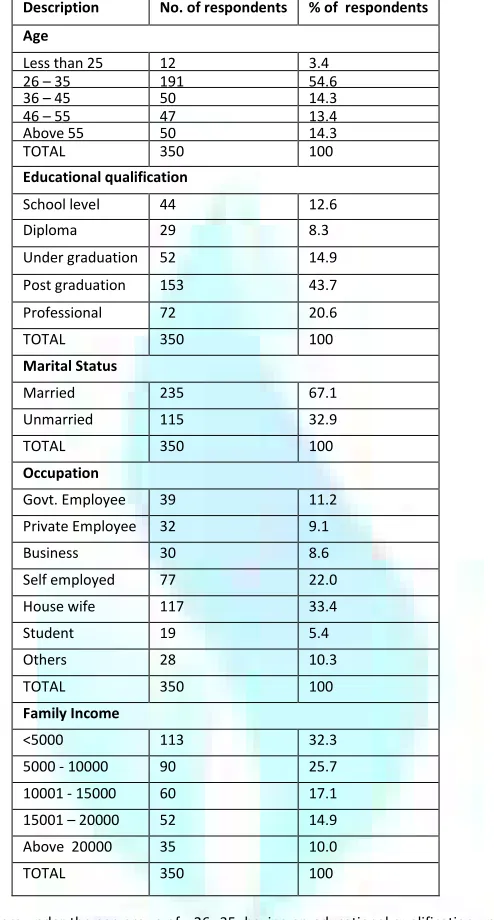
DEMOGRAPHIC PROFILETABLE 1.1 SHOWS THE DEMOGRAPHIC PROFILE OF THE RESPONDENTS
Table 1.1 shows that majority of the women are under the age group of 26 -35, having an educational qualification up to post graduation. These women are married, housewives having a family income less than Rs.5000 per month.
CHI SQUARE ANALYSIS
Chi square technique was employed to know whether or not there exists a significant association between i) age and loyalty of women consumers ii) marital status and loyalty of women consumers iii) Family income and loyalty of women consumer
TABLE 1.6: SHOWING THE RELATIONSHIP BETWEEN DEMOGRAPHIC VARIABLES AND BRAND LOYALTY OF WOMEN
Description Chi square value df Significant value
Age 1.718 8 .000*
Marital status 19.206 4 .000* Family Income 2.481 10 .000*
∗ At 5% significant level
Table 1.6 indicates that brand loyalty has a highly significant association with age, marital status, and family income of women.
CORRESPONDENCE ANALYSIS
Correspondence analysis was employed to analyse the loyalty levels existing among the different brands of personal care products.
Description No. of respondents % of respondents
Age
Less than 25 12 3.4
26 – 35 191 54.6
36 – 45 50 14.3
46 – 55 47 13.4
Above 55 50 14.3
TOTAL 350 100
Educational qualification
School level 44 12.6
Diploma 29 8.3
Under graduation 52 14.9
Post graduation 153 43.7
Professional 72 20.6
TOTAL 350 100
Marital Status
Married 235 67.1
Unmarried 115 32.9
TOTAL 350 100
Occupation
Govt. Employee 39 11.2
Private Employee 32 9.1
Business 30 8.6
Self employed 77 22.0
House wife 117 33.4
Student 19 5.4
Others 28 10.3
TOTAL 350 100
Family Income
<5000 113 32.3
5000 - 10000 90 25.7
10001 - 15000 60 17.1
15001 – 20000 52 14.9
Above 20000 35 10.0
CORRESPONDENCE ANALYSIS SHOWING THE LOYALTY LEVELS OF SHAMPOO BRANDS
INFERENCE
From the chart it is inferred that in shampoo category women are highly loyal towards Meera and Sunsilk brands and medium loyalty is found in Pantene brand.
CORRESPONDENCE ANALYSIS SHOWING THE LOYALTY LEVELS OF TALCUM POWDER BRANDS
INFERENCE
From the above chart it is inferred that in talcum powder category women are highly loyal to Spinz talc, Lifebuoy has medium loyalty and Gokul sandal has low loyalty
CORRESPONDENCE ANALYSIS SHOWING THE LOYALTY LEVELS OF SOAP BRANDS
INFERENCE
INTERNATIONAL JOURNAL OF RESEARCH IN COMMERCE, IT & MANAGEMENT
CORRESPONDENCE ANALYSIS SHOWING THE LOYALTY LEVELS OF TOOTH PASTE BRANDS
From the above chart it is inferred that in tooth paste category women are highly loyal to pepsodent brand and medium loyalty is found in promise and Colgate brand.
FACTOR ANALYSIS
PURCHASE DECISION AND ITS IMPACT ON PERSONAL CARE PRODUCTS
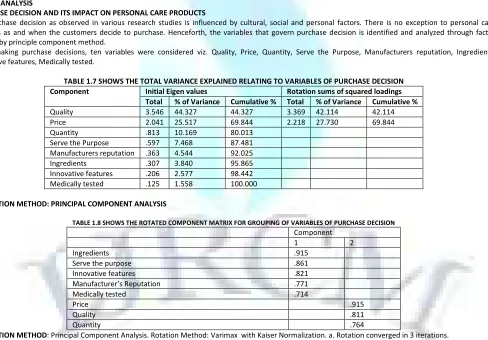
The purchase decision as observed in various research studies is influenced by cultural, social and personal factors. There is no exception to personal care products as and when the customers decide to purchase. Henceforth, the variables that govern purchase decision is identified and analyzed through factor analysis by principle component method.
While making purchase decisions, ten variables were considered viz. Quality, Price, Quantity, Serve the Purpose, Manufacturers reputation, Ingredients, Innovative features, Medically tested.
TABLE 1.7 SHOWS THE TOTAL VARIANCE EXPLAINED RELATING TO VARIABLES OF PURCHASE DECISION Component Initial Eigen values Rotation sums of squared loadings
Total % of Variance Cumulative % Total % of Variance Cumulative %
Quality 3.546 44.327 44.327 3.369 42.114 42.114 Price 2.041 25.517 69.844 2.218 27.730 69.844 Quantity .813 10.169 80.013
Serve the Purpose .597 7.468 87.481 Manufacturers reputation .363 4.544 92.025 Ingredients .307 3.840 95.865 Innovative features .206 2.577 98.442 Medically tested .125 1.558 100.000
EXTRACTION METHOD: PRINCIPAL COMPONENT ANALYSIS
TABLE 1.8 SHOWS THE ROTATED COMPONENT MATRIX FOR GROUPING OF VARIABLES OF PURCHASE DECISION
Component
1 2
Ingredients .915
Serve the purpose .861
Innovative features .821
Manufacturer’s Reputation .771
Medically tested .714
Price .915
Quality .811
Quantity .764
EXTRACTION METHOD: Principal Component Analysis. Rotation Method: Varimax with Kaiser Normalization. a. Rotation converged in 3 iterations. It is found that ten variables explain 69.84% of the total variance and two major factors are secured as revealed in table 1.7.
As observed in table 1.8 the first factor “primary benefit” includes price, quality, and quantity. The second factor “secondary benefit” comprises of ingredients of the product, Product should serve the purpose, innovative features, manufacturer’s reputation, and the product should be medically tested.
ANOVA
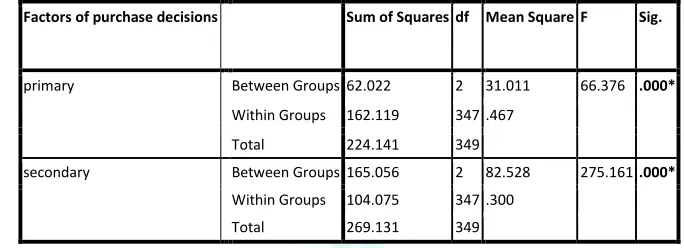
The difference between the levels of brand loyalty and factors responsible for purchase decision of Personal care products has been verified parametrically using Analysis of Variance (ANOVA)
TABLE 1.9 SHOWS THE DIFFERENCE AMONG DIFFERENT LEVELS OF BRAND LOYALTY AND PURCHASE DECISION OF PERSONAL CARE PRODUCTS.
Factors of purchase decisions Sum of Squares df Mean Square F Sig.
primary Between Groups 62.022 2 31.011 66.376 .000*
Within Groups 162.119 347 .467
Total 224.141 349
secondary Between Groups 165.056 2 82.528 275.161 .000*
Within Groups 104.075 347 .300
Total 269.131 349
∗ At 5% significant level
The ANOVA table indicates that the factors of purchase decision as primary benefit
(F = 275.161), and secondary benefit (F=66.376) differ significantly with respect to different levels of brand loyalty at 5% level. The mean wise comparison for the significant variables is presented in the following table1.9.
TABLE 1.10 SHOWS–DESCRIPTIVE FOR THE LEVELS OF BRAND LOYALTY ON THE FACTORS OF PURCHASE DECISION Brand Loyalty N Primary secondary
High 171 4.05 4.36
Medium 164 3.20 3.77
Low 15 4.00 1.00
Women with high and medium brand loyalty are driven by secondary benefits such as ingredients of the product, Product should serve the purpose, innovative features, manufacturer’s reputation, and the product should be medically tested, while purchasing personal care products.
Whereas women with low brand loyalty consider primary benefits such as price, quality, and quantity, when it comes to purchase of personal care products.
FINDINGS
• Majority of the women are under the age group of 26 -35, having an educational qualification up to post graduation. These women are married, housewives having a family income less than Rs.5000 per month.
• Women while choosing shampoo show high loyalty towards Meera and Sunsilk brands. In talcum powder category, they are highly loyal towards Spinz. In soap brand they are loyal to Liril and Mysore sandal. The most preferred tooth paste brand among women is Pepsodent.
• There is a significant relationship between age, marital status, family income and brand loyalty among women consumers.
• The factors influencing purchase decision of personal care products are “Primary benefit” and “secondary benefit”. The primary benefit includes price, quality, and quantity. And the “secondary benefit” which comprises of ingredients of the product, Product should serve the purpose, innovative features, manufacturer’s reputation, and the product should be medically tested.
• Women with high and medium brand loyalty are driven by secondary benefits such as ingredients of the product, Product should serve the purpose, innovative features, manufacturer’s reputation, and the product should be medically tested, while purchasing personal care products. Whereas women with low brand loyalty consider primary benefits such as price, quality, and quantity, when it comes to purchase of personal care products.
CONCLUSION
Women today are extremely aware of the various brands in the market and are conscious of the products they use or consume. They pick and chose carefully according to their needs, style preferences, etc. They also exercise a lot of independence in decision making and influence the family buying behavior.Companies have realized that selling to brand loyal customers is less costly than converting new customers. Brand loyalty provides companies with strong, competitive weapons. This study provides an insight of Chennai women’s brand loyalty towards personal care products. While purchasing personal care products the factors which influence high brand loyal women consumers are ingredients of the product, Product should serve the purpose, innovative features, manufacturer’s reputation, and the product should be medically tested, and women with low loyalty consider primary benefit viz., price, quality and quantity while purchasing personal care products. It is evident from the study that brand loyal consumers don’t think about primary benefit when it comes to purchase of personal care products. Hence marketers need to provide additional benefits to their loyal consumers in order to retain and sustain them for their future business.
BIBLIOGRAPHY
1. Aaker DA (1996a), Building strong brand, Free press,Newyork, pp136 – 174
2. Dr.D.Kamalaveni, Kalaiselvi, and S.Rajalakshmi (2008) “Brand loyalty of Women consumers with respect to FMCG’s, Indian Journal of Marketing.Setember,2008.Vol.38, No:9, pp 44 – 51
3. Philip Kotler (2003), Marketing Management, Prentice Hall of India
4. A Sarangapani and T Mamta, (2008) “Rural consumer behaviour with regard to selected FMCG’s consumption patterns and Brand usage: A Study”, The ICFAI University Journal of Brand Management, September 2008, Vol.5,No:3,pp 22-50
5. Pallabi Mishra and Biplab Datta (2006)” The Wheel and its spokes: Mapping the relationship between the key elements of brand management, A literature Survey September 2006, The ICFAI University Journal of Brand Management, Vol.3, No: 3, pp 15 – 27
6. Thiele SR and Bennett R (2001), A Brand for all seasons “ A discussion of Brand loyalty approaches and their applicability for different markets”, Journal of Product and Brand management,Vol.10,No:1,pp 25 – 37
7. Dr.Neeraj Kaushik and Deepak Gupta,(2009) “ A Study of consumer’s buying pattern of cosmetics products in south Haryana”, Indian journal of Marketing.Setember,2009,Vol.34 No:9, pp 27 – 33.
8. Reichheld, Frederick F., Teal, Thomas A. 2001. The Loyalty effect: The Hidden force behind growth, profits and lasting value. Harvard business School Press. 9. Jacoby, Jacob and chestnut, Robert W. 1978. Brand Loyalty: Measurement and Management. John Wiley & Sons Inc.
INTERNATIONAL JOURNAL OF RESEARCH IN COMMERCE, IT & MANAGEMENT
REQUEST FOR FEEDBACK
Dear Readers
At the very outset, International Journal of Research in Commerce, IT and Management (IJRCM)
acknowledges & appreciates your efforts in showing interest in our present issue under your kind perusal.
I would like to request you to supply your critical comments and suggestions about the material published
in this issue as well as on the journal as a whole, on our E-mails i.e.
or
for further improvements in the interest of research.
If you have any queries please feel free to contact us on our E-mail
.
I am sure that your feedback and deliberations would make future issues better – a result of our joint
effort.
Looking forward an appropriate consideration.
With sincere regards
Thanking you profoundly
Academically yours
Sd/-
Co-ordinator