styles in predicting marital commitment
Mohammad Shakarami1, Kianoosh Zahrakar2, Farshad Mohsenzadeh2Abstract
Family is the most important pillar of a society, whose stability requires the couples’ commitment to each other. Difficulties and disagreements in married life are natural and how to resolve these conflicts can cause either stability or instability of the couples’ life. This descriptive-correlational study was conducted to investigate the predictive role of conflict resolution styles in marital commitment. The population included all married staff working in Farabi hospital in Tehran. Among all, 221 participants were selected through random sampling method based on the sample size formula. To collect data, the marital commitment questionnaire and the Rahim organizational conflict inventory-B were used. The results showed that there was a significant correlation between the constructive and non-constructive conflict resolution styles and the marital commitment and conflict resolution styles predict about 14% of changes in marital commitment that is statistically significant. By teaching the conflict resolution styles to couples, we can indirectly increase their marital commitment in addition to helping them solve their conflicts.
Keywords: Conflict, Education, Marriage Journal of Research & Health
Social Development & Health Promotion Research Center
Vol. 6, No. 4, Sep & Oct 2016 Pages: 438- 444 DOI: 10.7508/jrh.2016.04.009
Original Article
1. Correspondence to: Department of Counseling, Faculty of Psychology
and Educational Sciences, Isfahan University, Isfahan, Iran
Email: [email protected]
2. Department of, Counseling, Faculty of
Psychology and Educational Sciences, Kharazmi University, Tehran, Iran
Received: 20 Sep 2014 Accepted: 18 Dec 2014
How to cite this article: Shakarami M, Zahrakar K, Mohsenzadeh F. Determine the contribution of conflict resolution styles in prediction of marital commitment. J Research & Health 2016; 6(4): 438- 444.
Introduction
Marital commitment, as a feeling of persistence in attractions and restrictions [1], shows the nature of dependence of a person on a relationship and how much the person feels safe in a relationship and to what extent he feels that the relationship is valuable in the long run. According to Johnson [2], marital commitment includes three dimensions: personal commitment, moral commitment, and structural commitment. Personal commitment means one's interest in continuing the marital relationship. This commitment reflects the person’s perceptions of his/her partner,
than other couples. That is why the way we deal with problems can usually be more problematic compared with the problems themselves [5]. Rahim [6] knows the conflict resolution styles as conflict management strategies that the person uses when facing conflicts. Every person has a unique way to deal with conflicts. Trying to understand our own style and motives, as well as those of our partner can significantly contribute to constructive conflict resolution. If a marital relationship wishes to continue dynamically, conflicts must be resolved in the right way. Although conflicts may be normal statistically, they should not be led to verbal and physical violence and should not be suppressed. If the spouses do not apply a constructive way to deal with the conflict, they may gradually separate from each other [7]. However, a conflict may be associated with negative emotions and considered a potential threat under some circumstances. The important point is that conflict is considered an opportunity for promoting intimacy and improving the relationships. Also, disagreement may give couples this chance to learn how to take advantage of constructive strategies of conflict resolution for meeting the needs of each other [8].
In this study, the concept of conflict resolution style provided by Blake and Mouton was used. Conceptualization and classification of interpersonal conflict resolution styles were first conducted by Blake and Mouton [7]. The aim of classification was to identify the intra-organizational conflict resolution styles. They examined the ways of dealing with conflicts based on two fundamental dimensions of concerns about ourselves and concerns about others. The first dimension explains to what extent (high or low) a person tries to meet his own concerns. The second dimension explains to what extent (high or low) a person tries to satisfy the concerns of others. Accordingly, the conflict resolution styles are classified into five styles, including integrating, obliging, dominating, avoiding, and compromising. Integrating and obliging styles are classified as constructive, and dominating and avoiding
of self-healing factors leading to stability and improvement of marital quality. They found two general self-healing factors: personality traits and adaptive processes that include all methods couples use to cope with conflicts, and how they communicate and support each other, and the ways they think about the marriage, spouse, and their spouse’s behavior. According to Canary and Kapch’s study [13], it was reported that constructive verbal strategies help couples have a positive stance, express their feelings, seek the consent of the other party or agree on the issues, and have confidence in each other. Tang and Curran [4] also indicated that couples who are successful in resolving their problems, have stronger commitment. However, these studies have been mostly concerned with factors associated with marital commitment and no study has been conducted in the country to examine merely the relationship between these two variables. Several studies have emphasized the stressful conditions of hospital jobs and its impact on the family. Due to job pressures and other factors, the couples may be drawn into different directions and pursue different goals. Therefore, the time they spend together decreases and this separation is added to their mental workload and external sources of stress. Over time, the couples separate more from each other that it also affects their relationship both emotionally and physically [15]. Many studies have examined the relationship between work and love and the overflow of work-related stress to the family has been confirmed [15]. Mannheim and Shefrin [16] reported that hospital jobs disrupt the family life. According to the study of Lashington et al. [16], it was indicated that the nurses’ shift work had negative consequences on their family and social issues, due to which their interpersonal conflicts with their spouses increased, their marital interactions decreased, and as a result, their marital quality reduced. Accordingly, dealing with the issues and problems which exist in the life of this stratum of society and helping to improve it is necessary, because the peace of mind of these people can directly impact on the delivery of services to patients.
Therefore, this study aimed to examine the role of conflict resolution styles in marital commitment of hospital staff.
Methods
This was a correlational study, whose population included all married staff (517) working in Farabi hospital in 2013, in Tehran. The number and list of people were given to the researchers. Therefore, 221 participants were selected through random sampling method based on Cochran's sample size formula. To conduct the research, the relevant permits were obtained and the necessary coordination was made with Farabi hospital officials. Then, the researcher collected the data by attending the hospital for one month. The importance, objectives, and methods of the study were explained to the participants and since the questionnaires were anonymous, they were assured of the confidentiality of their information and responses. The participants were asked to answer all questions carefully, patiently, and honestly. Thus, all participants entered the study with full informed consent. In this study, the following instruments were used to collect the data:
Rahim Organizational Conflict Inventory-B (ROCI-B): To measure the conflict resolution styles, the second version of Rahim Organizational Conflict Inventory was used. This 28-item scale includes 5 subscales (avoiding, compromising, dominating, obliging, and accompanying) which constitute three general subscales (constructive, non-constructive, and compromising conflict resolution styles). The reliability of this scale was reported as ranging from 0.72 to 0.83. The internal validity of this scale was estimated as 0.81 by the Cronbach's alpha [11]. In this study, the internal reliability of 0.73, 0.68, and 0.80 was obtained for the constructive and
non-constructive conflict resolution styles and the whole scale, respectively, based on the Cronbach's alpha.
The data were analyzed using stepwise multiple regression analysis in SPSS-18.
Results
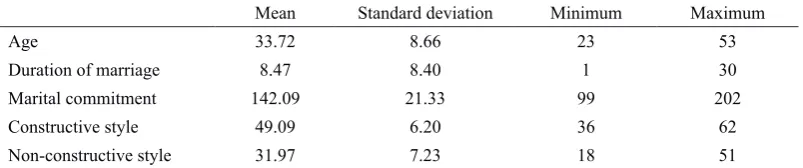
Descriptive information of the participants are shown in Table 1. The mean age and standard deviation of the participants was 33.72±8.66 and their duration of marriage was 8.47±8.40. The average marital commitment and constructive and non-constructive conflict resolution styles are also presented in the Table.
Table 1 Descriptive information of the participants
Mean Standard deviation Minimum Maximum
Age 33.72 8.66 23 53
Duration of marriage 8.47 8.40 1 30
Marital commitment 142.09 21.33 99 202
Constructive style 49.09 6.20 36 62
Non-constructive style 31.97 7.23 18 51
According to Table 2, the correlation between the constructive and non-constructive conflict resolution styles and the marital commitment is
significant (p<0.01) and this positive correlation indicates that couples with higher level of commitment use more conflict resolution styles. Table 2 The correlation matrix between the variables
Constructive style Non-constructive style commitmentMarital
Constructive style 1** 0.498** 0.335**
Non-constructive style 0.498** 1** 0.320**
Marital commitment 0.335** 0.320** 1**
**p<0.01
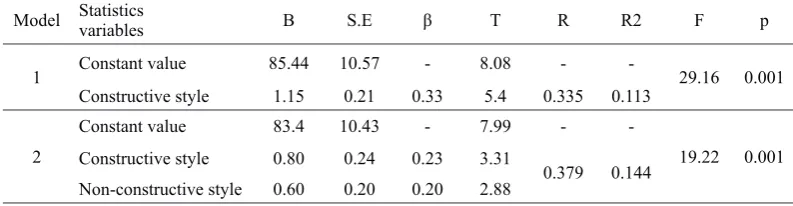
To use regression analysis assumptions normal distribution of errors, independence errors, and multicollinearity were investigated. Kolmogorov-Smirnov test for normality of the distribution of the errors showed that this distribution is normal (z=0.899,p>0.05). The Durbin – Watson (1.56) also confirmed the independence of errors. The tolerances achieved (0.75) also shows that multicollinearity between predictor variables less than that distort the results. According to abide by the assumptions of regression analysis results were presented in Table 3.
Table 3 shows the results of the stepwise regression analysis. In the first step, the
constructive conflict resolution style, and in the second step, the non-constructive conflict resolution style was entered into the regression model.
Table 3 The results of the stepwise multiple regression analysis on the prediction of marital commitment by the conflict resolution styles
Model Statisticsvariables B S.E β T R R2 F p
1 Constant value 85.44 10.57 - 8.08 - - 29.16 0.001 Constructive style 1.15 0.21 0.33 5.4 0.335 0.113
2
Constant value 83.4 10.43 - 7.99 -
-19.22 0.001 Constructive style 0.80 0.24 0.23 3.31
0.379 0.144
Non-constructive style 0.60 0.20 0.20 2.88
by constructive conflict resolution style. F and its significance level in the above table answer the question whether the variance explained by the predictor variables (conflict resolution styles) is statistically significant, or not? According to its value for the constructive style (F=29.16), it is significant at the p<0.01 and accordingly, the constructive conflict resolution style can predict the marital commitment. But in the second step that the non-constructive style entered the model, the values of multiple correlation and the coefficient of determination changed to 0.379 and 0.144, respectively. It means that about 14% of changes in marital commitment are explained by these two conflict resolution styles. Also, B and β denote not-standardized coefficient and standardized regression coefficient, respectively, indicating the impact of the predictor variable on the regression equation and according to the t-values, it is observed that the effect of the variables of constructive and non-constructive conflict resolution styles is significant in both steps in the regression equation (p<0.001). Since the value or magnitude of the regression coefficient is influenced by the variance of predictor variable, if other conditions are the same and the variances of independent variables are very different, the regression coefficient of the variable which has a greater variance compared to other variables becomes greater and thus, there will be the possibility of bias in the interpretation. To prevent this problem, the standardized regression coefficient is used, for calculation of which the standard scores of variables are used.
Discussion
The results of this study showed that constructive and non-constructive conflict
resolution styles explain 14.4% of changes in marital commitment and accordingly, the research hypothesis was confirmed. This is consistent with the results of Gottman’s study [13] that reported the relationship style of couples, especially when dealing with conflict, affects their duration of marriage and their satisfaction. It also matches with the study of Tang and Curran [4] that indicated couples who are successful in resolving their problems have stronger commitment, as well as the studies of Bayrami et al. [11] and Askari et al. [12]. For explaining the results obtained, it can be said that the ability of couples to manage and resolve conflicts can develop a strong relationship between couples and help them create an intimate relationship [18]. The constructive style for dealing with conflicts in marital relationship facilitates intimacy [19]. According to Weisz [20], positive interactive behaviors and patterns between couples, including positive attitude to each other, intimacy, encouragement, expressing emotions and paying attention to the feelings of each other, understanding each other’s needs, and supportive relationship in the family create intimacy between husband and wife, which is one of the components of the marital commitment.
their partner loves them and has adopted a fair behavior to please them increases satisfaction and quality of the marital relationship, and as a result, the level of commitment increases in them [21].
Strachman and Gobble [22] introduced two types of enthusiastic and moral commitments. Enthusiastic commitment means having interest in maintaining a marital relationship, enjoying the relationship, feeling comfortable in the married life, and taking responsibility for maintaining it. From this perspective, it can be stated that constructive conflict resolution styles lead to increased relationship satisfaction and accordingly, the person feels more satisfaction and pleasure in the relationship and tries to keep the relationship. Direct and adaptive verbal strategies help couples have a positive stance, express their emotions, seek the consent of the other party or agree on the issues, and have confidence in each other [13]. Therefore, they, as a team, will be able to experience the sense of accomplishment resulting from overcoming the problems together.
Good communication skills are among the most important factors of satisfaction in marital relationships. In fact, if couples learn how to communicate effectively, they will have more chances to experience satisfaction. Positive reactions often lead to vitality, happiness, and excitement in relationships. In contrast, incompatible couples think more about negative things, spend a lot of time on unpleasant aspects of their spouses, and have difficulty in understanding the positive and compensatory characteristics of their spouses and accordingly, they use non-constructive conflict resolution style [11]. The ability of the couples to resolve their conflicts is associated with maintaining the entire family system [23]. Therefore, as the couples function more efficiently, they will have better and more organized relationship. To the extent that couples are more successful in solving their conflicts, they will benefit from greater solidarity in their relationship. Accordingly, the power of factors causing conflicts is reduced and the couples move towards more positive
and effective interactions rather than conflicts [23].
Despite previous studies, in this study, a positive and significant correlation was found between non-constructive conflict resolution style and the marital commitment (r=0.32) indicating that conflict resolution (either positively or negatively) leads to the stability of the relationship. According to the systemic family therapy theories which state the negative feedbacks lead to maintaining the coupled system, non-constructive conflict resolution style is considered a negative feedback leading to the stability of the relationship.
Conclusion
Given that the family is one of the most important institutions in society, the health and stability of it can help to community health, so can influence the couple, who make up a family foundation, also had an impact on community health. As the results show that used couples of conflict resolution styles and particularly constructive style, leading to marital commitment and commitment is one of the most important components of a successful marriage, without which a marital relationship will be superficial and will have no direction. In this case, couples will not be able to experience the depth of intimacy and love created in the shadow of loyalty and commitment to the spouse and marriage. By teaching the couples problem solving skills for managing the conflicts and problems, we can increase the level of marital commitment in couples and thereby moved toward family and community health.
Acknowledgments
The authors wish to thank all participants who helped the researchers in the accumulation of data.
Contribution
Study design: MSH, KZ
Data collection and analysis: MSH, KZ, FM Manuscript preparation: MSH, KZ, FM
Conflict of Interest
"The authors declare that they have no conflict of interests.”
Funding
The author (s) received no financial support for the research, authorship and/or publication of this article.
References
1- Nelson JA, Kirk AM, Ane P, Serres SA. Religious and spiritual values and moral commitment in marriage: untapped
resources in couples counseling? Couns Values2011; 55(2): 228-46.
2- Johnson MP. The tripartite nature of marital commitment: personal, moral and structural reasons to stay married. J Marriage Fam1999; 61(1): 160-77.
3- Ramirez A. An examination of the tripartite approach
to commitment: An actor-partner interdependence model analysis of the effect of relational maintenance behavior. J Soc Pers Relat2008; 25(6): 943–65.
4- Tang CY, Curran MA. Marital commitment and perceptions
of fairness in household chores. J Fam Issues2012; 22(3):
1–25.
5- Olson B, Loreen N, Brathwaith Down O. If you hit me again, i, ll hit you and back: conflict management strategies of individuals experiencing aggression during conflict. Journal
of Communication Studies 2004; 55(2): 271-85.
6- Afzalur Rahim M. A measure of styles of handling
interpersonal conflict. Academy of Management Journal1983; 26(2): 368-76.
7- Haghighi H, Zareyi E, Ghaderi F. Study of factor structure and psychometric of conflict resolution styles scale in Iranian couples. Journal of Family Counseling and Psychotherapy2012; 1(4): 534-61.
8- Barrett LF. Conflict in adult close relationships: an attachment perspective. New York: Guilford press; 2004.
9- Parande A, Sirati Nir M, Khaghanizadeh M, Karimizarchi
AA. Comparison the effect of training of conflict resolution
and relaxation on quality of life’s spouses of war veterans affected Post traumatic stress disorder with major depression disorder. Journal of Fundamentals of Mental Health2007;
9(33): 67-76.
10- Siffert A, Schwarz B. Spouses' demand and withdrawal during marital conflict in relation to their subjective
well-being. J Soc Pers Relat2010; 28(2): 262–77.
11- Bayrami M, Babapour Khirodin J, Hashemi Nosratabad T, Esmali E, Bahadori Khosroshahi J. Prediction of marital
satisfaction on the basis of components of emotional
intelligence and conflict resolution styles. Journal of
Qazvin University of Medical Sciences2013; 17(3):20-7. 12- Askari M, Mohd Noah SB, Hassan SAB, Baba MB. Comparison the effects of communication and conflict
resolution skills training on marital satisfaction. Int J
Psychol Stud2012; 4(1): 182-95.
13- Dibajey Forooshani F, Emamipoor S, Mahmoodi GH. Relation between attachment styles and conflict styles on
woman marital satisfaction. Journal of Andishe va Rafter 2009; 3(11): 87-101.
14- Amoto PR. Studying marital interaction and
commitment with survey data. J Marriage Fam2004; 23(1): 53-70.
15- Adibrad N. The study of relation between couple burnout and career burnout in nurses. Journal of Counseling Research & Developments2006; 5(19): 35-47.
16- Heydari M, Hosseynpoor S. Effect of shift-work
in nurses marital satisfaction. Journal of Family
Research2006; 2(8): 341-54.
17- Abbasi Molid H. Study of effect of real therapy grouping education on marital commitment in KhomeyniShahr
[dissertation]. Isfahan: Isfahan University 2009; PP: 153.
18- Somohano VC. Mindfulness, attachment style and
conflict resolution behaviors in romantic relationships
[dissertation]. Humboldt State: Humboldt State University
2013; PP: 205.
19- Dildar S, Aisha S, Sumaira Y. Intimate enemies: marital conflicts and conflict resolution styles in dissatisfied married
couples. Middle-East Journal of Scientific Research2013; 15(10): 1433-9.
20- Weiss JM. Marital preparation, experiences, and personal qualities in a qualitative study of individuals in great marriages [dissertation]. Utah State: Utah State
University 2014; PP: 175.
21- Faramarzi S, Study of role of perceived fairness in marital quality in married staff of ahvaz departments state [dissertation]. Tehran: Shahid Chamran University 2009; PP: 161.
22- Strachman A, Gable SL. What you want (and do not
want) affects what you see (and do not see): avoidance
social goals and social events. Pers Soc Psychol Bull2006;
32(11): 1446–58.
23- Bakhshipour B, Asadi M, Kiani AR, Shiralipour A,
Ahmaddoost H. The relationship between family function
and marital conflictin couples who had decided to get