Please cite this article as: R. Jamshidi, M. Maadi, Maintenance and Work-rest Scheduling in Human-machine System According to Fatigue and Reliability, International Journal of Engineering (IJE), TRANSACTIONS A: Basics Vol. 30, No. 1, (January 2017) 85-92
International Journal of Engineering
J o u r n a l H o m e p a g e : w w w . i j e . i rMaintenance and Work-rest Scheduling in Human-machine System According to
Fatigue and Reliability
R. Jamshidi*, M. Maadi
School of Engineering, Damghan University, Damghan, Iran
P A P E R I N F O
Paper history:
Received 23 June 2016
Received in revised form 10 November 2016 Accepted 28 December 2016
Keywords: Maintenance Human Resource Fatigue Recovery Reliability
A B S T R A C T
Most manufacturers use human-machine systems to produce high-quality products. Dealing with human-machine systems is very complicated since not only machines should be utilized in proper condition but also appropriate environment should be provided for human resources. Most manufacturers have a maintenance plan for machines but many of them do not have a proper work-rest schedule for human resources. Considering this fact, we emphasis on human role in human-machine systems maintenance and propose a mathematical model that obtains the optimal work-rest schedule for humans based on fatigue-recovery models and the optimal maintenance policy for machines based on reliability level. The performance of proposed model was examined by some instances and the obtained results indicate this model can provide effective maintenance policy for human-machine systems.
doi: 10.5829/idosi.ije.2017.30.01a.11
1. INTRODUCTION1
To produce high-quality products we should consider machines and human resources simultaneously and study their interaction in a manufacturing systems. With respect to this fact researchers attempt to study the humans' performance in manufacturing systems and the effects of manufacturing systems on humans' performance.
Many researchers classify human resources in two common categories. In the first category, humans are known as a necessary resource to produce products which have no special difference with other resources such as equipment or raw materials.
Martorell et al. [1] studied the effect of human resources and spare parts on maintenance policy with RAM+C condition. Taylor [2] considered the human as an important resource in maintenance resource management (MRM). He believed that maintenance resources scheduling is a part of maintenance human factors which addresses the issues of management, organization and problem solving. AlsoTavakkoli-Moghaddam et al. [3], Ghodratnama et al. [4] and
1*Corresponding Author’s Email: [email protected](R.Jamshidi)
Miripour Fard et al. [5] investigated the human as a resource in manufacturing systems.
In the second category, human has been considered as an operator that influence the machines and products. Considering this fact many topics such as human factor, human reliability, human error classification, human error recognition, human error rate prediction and human error elimination have been proposed.
mathematical model to quantify human error factors such as fatigue and stress [13, 14].
It is obvious that by considering human like what was mentioned in the second category, the manufacturers confront machines failure and humans errors. Therefore, they have to schedule the machine maintenance and human work-rest time to decrease the machine failure cost, human error cost, human idleness cost and machine idleness cost.
Khalaquzzaman et al. [15] proposed a new method to consider human errors in component failure rate calculation for a digital plant protection systems. Kiassat et al. [16] presented a novel method to quantify the effects of human-related factors on the failure risk in manufacturing industries.Wang and Sheu [17] proposed a mathematical model to decrease the cost of some types of human errorsin production and maintenance policy. Carr and Christer [18] proposed a maintenance policy by considering human errors probability. Mahmoud and Moshref [19] proposed a model to determine maintenance policy, considering human errors in a two-unit cold standby system. Asadzadeh and Azadeh [20] proposed a simulation-optimization algorithm for a condition based maintenance scheduling problem with human errors. Azizi et al. [21] proposed a work-rest scheduling model for human resources based on human errors in a manufacturing system. Jamshidi and Seyyed Esfahani [22] proposed a mathematical model to obtain the proper work-rest time based on reliability of each human resources.
There are many papers in optimization of maintenance policy and human work-rest policy, but few of them tried to optimize the maintenance and human work-rest policy simultaneously. If there is no proper work-rest schedule for all involved human resources in manufacturing system, some human factors such as fatigue can reduce the human performance, on the other hand without an appropriate maintenance policy, the machines’ failure rate increases and manufacturers confront poor quality products.
In this paper we investigate the maintenance and work-rest scheduling according to machine reliability and human fatigue-recovery models. We first propose the important fatigue-recovery models and present a mathematical model to provide the optimal work-rest schedule for human resources and optimal maintenance policy. In this model, we aim to maintain the machines reliability and humans fatigue in a proper interval with regard to machines and humans' idleness cost and maintenance cost.We use some examples to show the model can obtain the optimal results effectively.
The remaining of the paper is organized as follows: Section 2 presents fatigue and recovery models. Section 3 proposes the problem statement, assumptions and mathematical model. Section 4 presents some instances with computational results to validate and verify the
proposed model. Finally, Section 5 concludes the paper and presents the future works.
2. FATIGUE AND RECOVERY MODELS
Fatigue is a loss of efficiency and a disinclination for any kind of effort [23]. Based on this definition, manufacturer should propose a proper work-rest schedule to maintain human fatigue in standard level since fatigue leads to a reduction of force generating, lower performance, reaction times increasing and slowing of the sensory abilities [24].
2. 1. Maximum Endurance Time There are some
models to quantify the fatigue value. These models use several factors to calculate the amount of fatigue for humans according to work type and its duration. Maximum Endurance Time (MET) is one of these factors that represents the maximum time which a muscle can tolerate a specific charge during an isometric impressment [25]. If human resource reaches to MET level, he has also reached 100% level of fatigue and is unable to continue his work without rest. MET is derived from Maximum Voluntary Contraction (MVC) that shows the maximum force produced by a muscle.
2. 2. Rest Allowance With respect to fatigue
definition, we can propose a definition for recovery. Recovery is an action that reduces the work-induced fatigue. Insufficient recovery may accelerate the fatigue process [26]. Rest Allowance (RA) was proposed to calculate the needed recovery after performing a specific work. RA is “time needed for adequate rest following a static exertion” [27]. Many researchers proposed models to calculate the RA such as Rose et al. [13] and Rohmert [14]. Table 1 presentsthe formulation for RA and MET that proposed by Rose et al. [13].
The FMVC is the fraction of MVC when performing a specific work. Relation (I) is used to calculate the fatigue caused by a specific work. This relation calculates the fraction of fatigue (ff) reached by the muscle after doing a specific work using the work duration and MET value. If the work duration is equal to MET the workers reaches to 100% of fatigue.
work duration ff
MET
(I)
TABLE 1. The MET general and Rest Allowance model presented by Rose et al. [13]
MET RA
Rose 4.16.fmvc
Similarly, the fraction of recovery (fr) received by a worker can be calculated based on rest duration and the needed rest (R) caused by doing a specific work as shown in Relation (II).
rest duration fr
R
(II)
The value of R is calculated as follows.
R RA* ( work duration ) (III)
Since worker cannot rest exactly after working time, other parameters are defined to calculate the accumulated fatigue (f) and the accumulated needed rest (ar), these parameters are calculated as follows [28].
f pf ff fr (IV)
arpar R fr (V)
In Relations (IV-V) (pf) is the primary accumulated fatigue and(par)is the primary accumulated needed rest.
3. PROBLEM STATEMENT
In this section, we formally describe the considered problem and its assumption. The aim of the proposed model is to obtain an optimal maintenance plan for machines and the best work-rest schedule for human resources. The reliability of machines and fatigue of human resources are the two important factors that used to determine the maintenance and work-rest policy. The operation horizon are divided into unit time positions and at each time position we calculate the machines' reliability to determine whether the machines should be repaired or not. It holds true for humans rest based on fatigue value.
3. 1. Objective Function The objective function of
the proposed model consists of four cost components as mentioned below.
Idleness cost of machines
Idleness cost of human resources
Cost of unpredictable failure
Cost of corrective maintenance
Since the manufacturer confronts machines and humans idleness, objective function aims to minimize the cost of humans and machines idleness. Also, cost of unpredictable failure has been considered since the reliability of machines is not always in perfect status
(100%) and manufacturer confronts machines
unpredictable failure.
3. 2. Assumptions Processing time of each task is
known
Each task has a predetermined MET
RA for each task is calculated based on Rose et al. [13]
The reliability of machine must be greater than a predetermined value (Rmin) in each time position
The worker has a specific maximum fatigue level (Fmax) and cannot work with a fatigue value greater than this fatigue limit.
The fatigue of human resources decreases in proportion with rest duration and RA value for each task
The maintenance actions decrease the failure rate of machine.
The machine is in useful life stage based on bathtub curve [29].
The worker cannot rest if his accumulated needed rest is lower than the amount of rest he receives at current time position.
The task interruption is not allowed.
The machine has exponential failure rate.
3. 3. Notations
3. 3. 1. Subscripts
i Index for task i (i =1, 2,…I)
k Index for time position (k=1, 2,…K)
3. 3. 2. Input Parameters
Pi Processingtime of task i
WID The unitary cost of worker idleness
MID The unitary cost of machine idleness
CMA The unpredictable failure cost of machine
CR The unitary maintenance cost of machine
METi The maximum endurance time for task i
RAi The rest allowance coefficient of task i
DF The primary fatigue of worker
DR The primary reliability value of machine
DAR The primary accumulation needed for recovery of worker
TI The time amount of each position time
Rmin The minimum reliability that machine should be repaired, if its reliability is less than this value. Fmax
µ
Maximum allowed fatigue of worker
The worker recovery rate caused by rest in each time position
3. 3. 3. Decision Variables
xi,k 1 if task i is done in position k; =0 otherwise
mk 1 if the machine is repaired in position k; =0 otherwise
rek 1 if the worker rests in position k; =0 otherwise
relk The reliability of machine in position k
ffk The amount of work-related fatigue produced in position k
frk The fraction of recovery received in position k
rk The needed rest time caused by working in position k
ark The accumulation of needed recovery in position k
fk The accumulation of fatigue in position k
rrk The amount of worker rest in position k
fsi The finish time of task i
ssi The start time of task i
Considering the above notations, the mathematical model can be formulated as mentioned in next subsection.
3.4. The Mathematical Model
min 𝑍: ∑𝐾𝑘=1(1 − 𝑟𝑒𝑙𝑘).𝐶𝑀𝐴 + ∑𝐾𝑘=1𝑚𝑘.𝐶𝑅 +
∑𝐾𝑘=1(1 − 𝑚𝑘). (1 − ∑𝐼𝑖=1𝑥𝑖,𝑘). 𝑀𝐼𝐷+∑𝐾𝑘=1(1 −
𝑟𝑒𝑘). (1 − ∑𝐼𝑖=1𝑥𝑖,𝑘). 𝑊𝐼𝐷
(1)
S.t.
∑𝐾𝑘=1𝑇𝐼. 𝑥𝑖,𝑘= 𝑃𝑖
∀𝑖; (2)
𝑥𝑖,𝑘≤ (1 − 𝑚𝑘). (1 − 𝑟𝑒𝑘) ∀𝑖, 𝑘; (3)
∑𝐼𝑖=1𝑥𝑖,𝑘≤ 1 ∀𝑘; (4)
𝑓𝑠𝑖= max𝑘{𝑘. 𝑥𝑖,𝑘}
∀𝑖 (5)
𝑠𝑠𝑖= 𝑚𝑖𝑛{𝑘. 𝑥𝑖,𝑘} ∀𝑖 (6)
𝑓𝑠𝑖− 𝑠𝑠𝑖= 𝑃𝑖+ 1 ∀𝑖 (7)
𝑟𝑒𝑙𝑘= 𝐷𝑅 ∀𝑘 ≤ 1; (8)
𝑟𝑒𝑙𝑘= 𝑒−𝜆. 𝑟𝑒𝑙𝑘−1. ∑𝐼𝑖=1𝑥𝑖,𝑘−1+
𝑒𝜆. 𝑟𝑒𝑙
𝑘−1. 𝑚𝑘−1+ 𝑟𝑒𝑙𝑘−1. (1 −
∑𝐼𝑖=1𝑥𝑖,𝑘−1). (1 − 𝑚𝑘)
∀𝑘 ≥ 2; (9)
𝑓𝑓𝑘= ∑
𝑇𝐼.𝑥𝑖,𝑘
𝑃𝑖.𝑀𝐸𝑇𝑖
𝐼
𝑖=1 ∀𝑘; (10)
𝑓𝑟𝑘=
𝑟𝑟𝑘
𝐷𝐴𝑅 ∀𝑘 ≤ 1; (11)
𝑓𝑟𝑘=𝑎𝑟𝑟𝑟𝑘
𝑘−1 ∀𝑘 ≥ 2; (12)
𝑟𝑘= ∑
𝑇𝐼.𝑥𝑖,𝑘.𝑅𝐴𝑖
𝑃𝑖
𝐼
𝑖=1 ∀𝑘; (13)
𝑎𝑟𝑘= 𝐷𝐴𝑅 + 𝑟𝑘− 𝑟𝑟𝑘 ∀𝑘 ≤ 1; (14)
𝑎𝑟𝑘= 𝑎𝑟𝑘−1+ 𝑟𝑘− 𝑟𝑟𝑘 ∀𝑘 ≥ 2; (15)
𝑓𝑘= (𝐷𝐹 + 𝑓𝑓𝑘). (1 − 𝑓𝑟𝑘) ∀𝑘 ≤ 1; (16)
𝑓𝑘= (𝑓𝑘−1+ 𝑓𝑓𝑘). (1 − 𝑓𝑟𝑘) ∀𝑘 ≥ 2; (17)
𝑟𝑟𝑘= 𝑇𝐼. 𝜇. 𝑟𝑒𝑘 ∀𝑘; (18)
𝑚𝑘≥ 𝑅𝑚𝑖𝑛− 𝑟𝑒𝑙𝑘 ∀𝑘; (19)
𝑟𝑒𝑘≥ 𝑓𝑘− 𝐹𝑚𝑎𝑥 ∀𝑘; (20)
𝑟𝑟𝑘≤ 𝑎𝑟𝑘−1 ∀𝑘 ≥ 2; (21)
𝑅𝑚𝑖𝑛≤ 𝑟𝑒𝑙𝑘≤ 1 ∀𝑘; (22)
As we mentioned in Section 3.1 the Relation (1) shows the objective function with four cost components. The first component calculates the cost of unpredictable failure. The more distance between machine reliability and ideal reliability (100%) leads to an increase in unpredictable failure cost. The second component provides the corrective maintenance cost. Third component calculates the machine idleness cost. If a machine does not work on any task and it's not under maintenance in each time position the cost of idleness is imposed to manufacturing system. Similarly the fourth component provides the idleness cost for worker.
position based on the amount of rest and accumulated needed rest. Relation (13) calculates the needed rest time caused by implementation of a task in each time position. The needed rest time should be considered if the worker performs one task. Needed rest is calculated based on rest allowance of implemented task. Relations (14-15) provide the accumulated needed rest in each time position. Relations (16-17) obtain the fatigue of the worker in each time position. If the worker can rest as much as accumulated needed rest time, the fr will be equal to 1 and worker can recover himself totally. Relation (18) shows that if the worker rests in a position time, he receives a rest that is equal to time amount of the position. Relation (19) assures that if machine reliability is lower than minimum required reliability, maintenance should be done. Similarly, Relation (20) assures that human should rest if his fatigue is greater than maximum allowed fatigue. Relation (21) shows that the worker could not rest if his accumulated needed rest is lower than the amount of rest he receives in current time position. Relation (22) shows the desirable interval for machine reliability.
4. NUMERICAL ILLUSTRATION
In this section we use the proposed mathematical model to determine the optimal work-rest schedule for human resources and maintenance schedule for machines. We propose two instances with different task numbers, processing time, machine failure rate and MET.
Instance 1: in this instance we have 3 tasks that their processing time and FMVC are shown in Table 2.
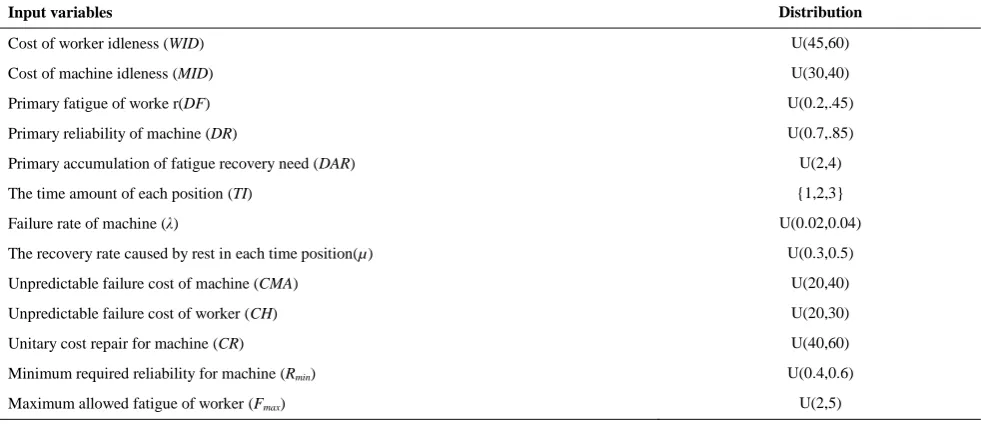
Other required parameters such failure rate, maintenance cost, machine idleness cost and human idleness cost are selected from proper distribution function as shown in Table 3.
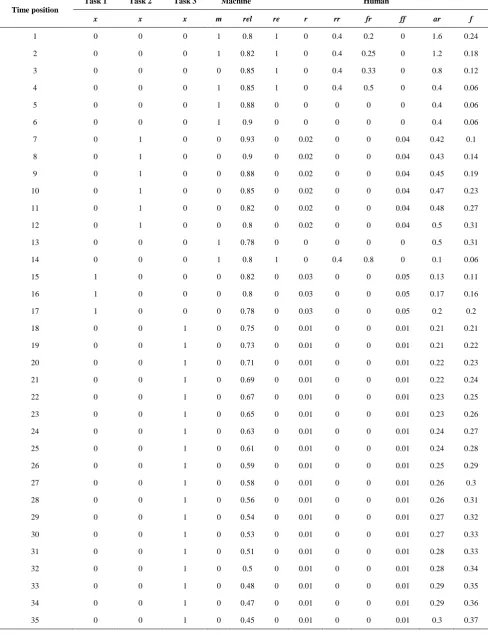
Using the proposed model to solve the instance 1, we can obtain the optimal maintenance and work-rest schedule for machine and human, respectively. Table 4 shows the optimal solution for instance 1.
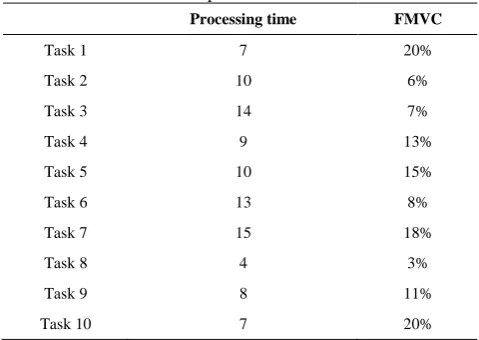
As could be seen, Table 4 proposed the maintenance and work-rest schedule for machines and workers. When a machine goes under maintenance, its reliability increases. For example since machine goes under maintenance its reliability increases in positions 1-6. On the other hand by working on tasks the machine's reliability decreases in positions 8-12. This fact holds true for worker fatigue, since the worker rests in positions 1-4 his fatigue decreases but in positions 8-12 his fatigue increases by working on tasks. The objective function of the proposed solution is proposed in Table 5. Instance 2: in this instance we have 10 tasks that their processing time and FMVC are shown in Table 6. Similar to instance 1 all required parameters are selected from the mentioned distribution function in Table 3. The objective function value and its components are mentioned in Table 7.
TABLE 2.The parameters for instance 1
Processing time FMVC
Task 1 3 3%
Task 2 6 17%
Task 3 18 7%
TABLE 3.Cost, fatigue and reliability parameters for proposed instances
Input variables Distribution
Cost of worker idleness (WID) U(45,60)
Cost of machine idleness (MID) U(30,40)
Primary fatigue of worke r(DF) U(0.2,.45)
Primary reliability of machine (DR) U(0.7,.85)
Primary accumulation of fatigue recovery need (DAR) U(2,4)
The time amount of each position (TI) {1,2,3}
Failure rate of machine (λ) U(0.02,0.04)
The recovery rate caused by rest in each time position(µ) U(0.3,0.5)
Unpredictable failure cost of machine (CMA) U(20,40)
Unpredictable failure cost of worker (CH) U(20,30)
Unitary cost repair for machine (CR) U(40,60)
Minimum required reliability for machine (Rmin) U(0.4,0.6)
TABLE 4. The results of proposed model for instance 1
Time position
Task 1 Task 2 Task 3 Machine Human
x x x m rel re r rr fr ff ar f
1 0 0 0 1 0.8 1 0 0.4 0.2 0 1.6 0.24
2 0 0 0 1 0.82 1 0 0.4 0.25 0 1.2 0.18
3 0 0 0 0 0.85 1 0 0.4 0.33 0 0.8 0.12
4 0 0 0 1 0.85 1 0 0.4 0.5 0 0.4 0.06
5 0 0 0 1 0.88 0 0 0 0 0 0.4 0.06
6 0 0 0 1 0.9 0 0 0 0 0 0.4 0.06
7 0 1 0 0 0.93 0 0.02 0 0 0.04 0.42 0.1
8 0 1 0 0 0.9 0 0.02 0 0 0.04 0.43 0.14
9 0 1 0 0 0.88 0 0.02 0 0 0.04 0.45 0.19
10 0 1 0 0 0.85 0 0.02 0 0 0.04 0.47 0.23
11 0 1 0 0 0.82 0 0.02 0 0 0.04 0.48 0.27
12 0 1 0 0 0.8 0 0.02 0 0 0.04 0.5 0.31
13 0 0 0 1 0.78 0 0 0 0 0 0.5 0.31
14 0 0 0 1 0.8 1 0 0.4 0.8 0 0.1 0.06
15 1 0 0 0 0.82 0 0.03 0 0 0.05 0.13 0.11
16 1 0 0 0 0.8 0 0.03 0 0 0.05 0.17 0.16
17 1 0 0 0 0.78 0 0.03 0 0 0.05 0.2 0.2
18 0 0 1 0 0.75 0 0.01 0 0 0.01 0.21 0.21
19 0 0 1 0 0.73 0 0.01 0 0 0.01 0.21 0.22
20 0 0 1 0 0.71 0 0.01 0 0 0.01 0.22 0.23
21 0 0 1 0 0.69 0 0.01 0 0 0.01 0.22 0.24
22 0 0 1 0 0.67 0 0.01 0 0 0.01 0.23 0.25
23 0 0 1 0 0.65 0 0.01 0 0 0.01 0.23 0.26
24 0 0 1 0 0.63 0 0.01 0 0 0.01 0.24 0.27
25 0 0 1 0 0.61 0 0.01 0 0 0.01 0.24 0.28
26 0 0 1 0 0.59 0 0.01 0 0 0.01 0.25 0.29
27 0 0 1 0 0.58 0 0.01 0 0 0.01 0.26 0.3
28 0 0 1 0 0.56 0 0.01 0 0 0.01 0.26 0.31
29 0 0 1 0 0.54 0 0.01 0 0 0.01 0.27 0.32
30 0 0 1 0 0.53 0 0.01 0 0 0.01 0.27 0.33
31 0 0 1 0 0.51 0 0.01 0 0 0.01 0.28 0.33
32 0 0 1 0 0.5 0 0.01 0 0 0.01 0.28 0.34
33 0 0 1 0 0.48 0 0.01 0 0 0.01 0.29 0.35
34 0 0 1 0 0.47 0 0.01 0 0 0.01 0.29 0.36
TABLE 5. The objective function with its detailed cost for instance 1
Objective function
value
Unpredictable failure cost
Machine maintenance
cost
Machine idleness
cost
Worker idleness cost
803.148 303.148 315 35 150
TABLE 6. The parameters for instance 2
Processing time FMVC
Task 1 7 20%
Task 2 10 6%
Task 3 14 7%
Task 4 9 13%
Task 5 10 15%
Task 6 13 8%
Task 7 15 18%
Task 8 4 3%
Task 9 8 11%
Task 10 7 20%
TABLE 7. The objective function with its detailed cost for instance 2
Objective function
value
Unpredictable failure cost
Machine maintenance
cost
Machine idleness cost
Worker idleness cost
2657.567 903 1089 138 527.567
5. CONCLUSIONS AND FUTURE WORKS
This paper presented a novel integer nonlinear model to optimize the maintenance and work-rest for machines and human resources, respectively. The main factor for machines maintenance is reliability and for humans' work-rest is the amount of fatigue.We combined the concept of reliability and fatigue to consider human and machine as two important factors in human-machine system and proposed the best policy for machine maintenance and human rest in regard to human and machine idleness cost. We tried to synchronize the maintenance and rest schedule to reduce the unnecessary stoppage during production period. The performance of proposed model was examined by 2 instances and the provided results indicated the model can obtain efficient and effective work-rest schedule and maintenance schedule.
We have included several assumptions which simplified the model and limited its applicability on real problems. Our future research will be towards incorporation of more complications in the model to
bring it much closer to practical scenario. Several issues which are considered for future research are: (i) Other failure distribution function for machine can be considered. (ii) The continuous time can be considered instead of discrete position. (iii) Since the model is non-linear, for large size instances meta-heuristic can be proposed. (iv) Benchmarking the model in real industrial settings.
6. REFERENCES
1. Martorell, S., Villamizar, M., Carlos, S. and Sanchez, A., "Maintenance modeling and optimization integrating human and material resources", Reliability Engineering & System Safety, Vol. 95, No. 12, (2010), 1293-1299.
2. Taylor, J. C., "The evolution and effectiveness of maintenance resource management (MRM)", International Journal of Industrial Ergonomics, Vol. 26, No. 2, (2000), 201-215. 3. Tavakkoli-Moghaddam, R., Makui, A., Khazaei, M. and
Ghodratnama, A., "Solving a new bi-objective model for a cell formation problem considering labor allocation by multi-objective particle swarm optimization", International Journal of Engineering-Transactions A: Basics, Vol. 24, No. 3, (2011), 249-258.
4. Ghodratnama, A., Tavakkoli-Moghaddam, R. and Baboli, A., "Comparing three proposed meta-heuristics to solve a new p-hub location-allocation problem", International Journal of Engineering-Transactions C: Aspects, Vol. 26, No. 9, (2013), 1043-1058.
5. Miripour, F. B., Bagheri, A. and Khoskbijari, A., "Receding horizon based control of disturbed upright balance with consideration of foot tilting (research note)", International Journal of Engineering-Transactions A: Basics, Vol. 26, No. 10, (2013), 1243-1254.
6. Horberry, T., Burgess-Limerick, R. and Steiner, L. J., "Human factors for the design, operation, and maintenance of mining equipment, CRC Press, (2016).
7. Tarakci, H., Tang, K. and Teyarachakul, S., "Learning effects on maintenance outsourcing", European Journal of Operational Research, Vol. 192, No. 1, (2009), 138-150.
8. Kim, J. and Park, J., "Reduction of test and maintenance human errors by analyzing task characteristics and work conditions", Progress in Nuclear Energy, Vol. 58, (2012), 89-99.
9. Strater, O. and Bubb, H., "Assessment of human reliability based on evaluation of plant experience: Requirements and implementation", Reliability Engineering & System Safety, Vol. 63, No. 2, (1999), 199-219.
10. Liu, H., Hwang, S., Liu, T. and Chen, K., "Assessment of human error based on evaluation of plant operations", IEA 2003, (2003).
11. Liu, H., Hwang, S.-L., Liu, T.-H. and Chen, G.-H., "Implementation of human error diagnosis (HED) system", Journal of the Chinese Institute of Industrial Engineers, Vol. 21, No. 1, (2004), 82-91.
12. Karaulova, T. and Pribytkova, M., "Reliability prediction for man-machine production lines", DAAAM International Scientific Book, (2009), 487-501.
14. Rohmert, W., "Problems in determining rest allowances: Part 1: Use of modern methods to evaluate stress and strain in static muscular work", Applied Ergonomics, Vol. 4, No. 2, (1973), 91-95.
15. Khalaquzzaman, M., Kang, H. G., Kim, M. C. and Seong, P. H., "Optimization of periodic testing frequency of a reactor protection system based on a risk-cost model and public risk perception", Nuclear Engineering and Design, Vol. 241, No. 5, (2011), 1538-1547.
16. Kiassat, C., Safaei, N. and Banjevic, D., "Choosing the optimal intervention method to reduce human-related machine failures", European Journal of Operational Research, Vol. 233, No. 3, (2014), 604-612.
17. Wang, C.-H. and Sheu, S.-H., "Determining the optimal production–maintenance policy with inspection errors: Using a markov chain", Computers & Operations Research, Vol. 30, No. 1, (2003), 1-17.
18. Carr, M. and Christer, A., "Incorporating the potential for human error in maintenance models", Journal of the Operational Research Society, Vol. 54, No. 12, (2003), 1249-1253. 19. Mahmoud, M. and Moshref, M., "On a two-unit cold standby
system considering hardware, human error failures and preventive maintenance", Mathematical and Computer Modelling, Vol. 51, No. 5, (2010), 736-745.
20. Asadzadeh, S. and Azadeh, A., "An integrated systemic model for optimization of condition-based maintenance with human error", Reliability Engineering & System Safety, Vol. 124,
(2014), 117-131.
21. Azizi, N., Liang, M. and Zolfaghari, S., "Modelling human boredom at work: Mathematical formulations and a probabilistic framework", Journal of Manufacturing Technology Management, Vol. 24, No. 5, (2013), 711-746.
22. Jamshidi, R. and Esfahani, M. M. S., "Human resources scheduling to improve the product quality according to exhaustion limit", TOP, Vol. 22, No. 3, (2014), 1028-1041. 23. Grandjean, E., "Fatigue in industry", British Journal of
Industrial Medicine, Vol. 36, No. 3, (1979), 175-186. 24. Ahsberg, E., "Perceived fatigue related to work, (1998).
25. Imbeau, D. and Farbos, B., "Percentile values for determining maximum endurance times for static muscular work", International Journal of Industrial Ergonomics, Vol. 36, No. 2, (2006), 99-108.
26. Swaen, G., Van Amelsvoort, L., Bultmann, U. and Kant, I., "Fatigue as a risk factor for being injured in an occupational accident: Results from the maastricht cohort study", Occupational and Environmental Medicine, Vol. 60, No. 6, (2003), 88-92.
27. Imbeau, D., "Comparison of rest allowance models for static muscular work", International Journal of Industrial Ergonomics, Vol. 39, No. 1, (2009), 73-80.
28. Perez, J., "Virtual human factors tools for proactive ergonomics: Qualitative exploration and method development", Theses and Dissertations. Paper, Vol. 475, (2011).
29. Smith, C. O., "Introduction to reliability in design, McGraw-Hill Companies, (1976).
Maintenance and Work-rest Scheduling in Human-machine System According to
Fatigue and Reliability
R. Jamshidi, M. Maadi
School of Engineering, Damghan University, Damghan, Iran
P A P E R I N F O
Paper history:
Received 23 June 2016
Received in revised form 10 November 2016 Accepted 28 December 2016
Keywords: Maintenance Human Resource Fatigue Recovery Reliability
ديكچ ه
ناسنا یاه متسیس زا تیفیک اب تلاوصحم دیلوت روظنم هب یدیلوت تاجناخراک زا یرایسب
اب ییورایور .دنرب یم هرهب نیشام
م دیاب هکلب دروآ مهارف تلاآ نیشام تیلاعف یارب یبسانم طیارش دیاب اهنت هن اریز تسا هدیچیپ تبسن هب اه متسیس نیا راک طیح
تاریمعت و یراد هگن یارب یا همانرب تاجناخراک زا یرایسب هچرگ .تشاد هگن لآ هدیا طیارش رد زین یناسنا عبانم یارب ار
رظن رد اب .دنا هدرکن یزیرحرط دوخ یناسنا یورین یارب یبسانم تحارتسا و راک همانرب اه نآ زا یرایسب اما دنراد تلاآ نیشام
رب ام عوضوم نیا نتفرگ ناسنا یاه متسیس رد یناسنا یورین شقن
هب یبایتسد روظنم هب یلدم و میا هدرک دیکات نیشام
دروم ییاه لاثم زا هدافتسا اب لدم نیا .میا هدومن هئارا یناسنا یورین تحارتسا و تلاآ نیشام تاریمعت یارب هنیهب یدنبنامز
م نآ بسانم یشخب رثا زا یکاح جیاتن و هتفرگ رارق یبایزرا .دشاب ی
![TABLE 1. The MET general and Rest Allowance model presented by Rose et al. [13]](https://thumb-us.123doks.com/thumbv2/123dok_us/211558.2015565/2.595.305.545.707.743/table-met-general-rest-allowance-model-presented-rose.webp)