Published online 2016 August 19. Research Article
Comparison of the Efficacy of Cognitive Behavioral Therapy and
Dialectical Skills Training on Symptoms of Men Suffering from
Borderline Personality Disorder
Mohammadkazem Zarabian,
1Mahdieh Salehi,
2,*Fatemeh Gholshani,
2and Fariba Hassani
31PhD Student of Psychology, Department of Psychology, Central Tehran Branch, Islamic Azad University, Tehran, IR Iran 2Assistant Professor in Psychology, Department of Psychology, Central Tehran Branch, Islamic Azad University, Tehran, IR Iran 3Assistant Professor in Counseling, Department of Psychology, Central Tehran Branch, Islamic Azad University, Tehran, IR Iran
*Corresponding author: Mahdieh Salehi, Department of Psychology, Central Tehran Branch, Islamic Azad University, Tehran, IR Iran. Tel: +98-9122347868, Fax: +98-2133788927, E-mail: [email protected]
Received2016 April 01;Revised2016 April 13;Accepted2016 April 16.
Abstract
Background:Borderline personality disorder (BPD) is a common disorder, associated with different biological and psychological parameters. However, further research is required to determine the optimal therapeutic methods and conditions, which can pro-duce better outcomes for BDP patients.
Objectives:This research aimed to compare the effects of cognitive behavioral therapy (CBT) and dialectical behavioral therapy (DBT) skills training on the symptoms of male patients with BPD.
Methods:This comparative quasi-experimental study was performed with a pre-test, post-test design on 3 groups (2 experimental and 1 control). The statistical population consisted of all male patients, hospitalized at Farshchian Psychiatric hospital, affiliated to Hamadan University of Medical Sciences from April to October 2016. Availability sampling method was applied to select the subjects, and simple random sampling was used for replacement of subjects. In this study, out of 36 selected patients, 27 were studied. The patients’ symptoms were evaluated, using BPD Severity Index (BPDSI). The study was carried out in 3 stages of initial assessment, therapeutic intervention, and follow-up. Drug therapy, along with CBT, was implemented for the experimental group 1, while DBT skills training and drug therapy were applied for the experimental group 2. To analyze the data, repeated measures ANOVA was performed, using SPSS.
Results:The findings showed that both CBT and DBT skills training could reduce the symptoms of BPD (F[2, 24], 42.276, P < 0.05).
Conclusions:With respect to the effect size measurements for CBT (Eta2, 0.67) and DBT skills training (Eta2, 0.85), it can be con-cluded that the effect size of DBT skills training was greater than CBT in reducing the symptoms of BPD.
Keywords:Cognitive Behavioral Therapy, Dialectical Skill Training, Borderline Personality Disorder
1. Background
Borderline personality disorder (BPD) is a common dis-order worldwide (1). Different symptoms of BPD include unstable relationship patterns (with fluctuations between 2 extremes of idealization and devaluation), unstable self-image, impulsive behaviors, repetitive self-mutilating or self-destructive behaviors, emotional instability due to mood reactions, and severe anger or paranoia relative to stress (2).
BPD is the most common personality disorder in psy-chiatric environments (3). In general, the prevalence of BPD has been estimated at 1.6% - 5.9%. In addition, the prevalence of BDP is 0.6% in primary care environments, 10% in mental health clinics, and 20% in clinical environ-ments. In general, about 75% of BDP patients are women (4). Moreover, suicide attempts have been reported in 84% of BPD patients (5), while successful suicide has been found
in nearly 10% of the patients (6). About 80% of BPD patients show self-mutilating behaviors (7). In addition, over 75% have reported experiences of sexual abuse in their child-hood (8).
There are numerous biological and psychological pa-rameters, related to BPD (9). BPD originates from the inter-actions of genetic, biological, social, and psychological fac-tors, disturbed family environment, parent’s pathologies, and inadequate parenting styles (7). Previous studies have shown that emotional dysregulation disturbs proper pro-cessing of emotions (10).
BPD comorbidity is mostly reported in patients with attention-deficit/hyperactivity disorder (ADHD) (11). In ad-dition, adults and youths with BPD show common eti-ologies and patheti-ologies (12). BPD patients, who have a higher education and more educated parents, show a bet-ter neuropsychological performance (13). On the other
hand, women with BPD have more unstable and hostile re-lationships with men (14). However, regular skills train-ing on emotional intelligence can be successfully imple-mented for inpatients with BPD and depression to improve both emotional intelligence and depression (15).
Today, there are different therapeutic approaches for BPD. Quoting Ganderson et al. Chapman and Gratz dis-cussed the scarcity of research on the efficacy of these ap-proaches with a random control system (1). In the past decade, cognitive behavioral therapy (CBT) has been the most common therapeutic method for BPD. Moreover, in recent years, use of dialectical behavioral therapy (DBT) has been highlighted (7).
CBT is based on 2 major principles. First, our cogni-tion has major effects on our behaviors and emocogni-tions, and second, our behavior or performance has strong effects on our thought patterns and emotions (16). The DBT skills in-clude mindfulness skills, interpersonal effectiveness skills, emotional regulation skills, and distress tolerance skills (trained individually or in groups) (17).
Several studies have confirmed the efficacy of CBT (18,
19), while some have revealed the effectiveness of DBT (1,3,
20,21). There is some evidence on the efficacy of DBT and CBT in BPD treatment (22). On the other hand, Verheul be-lieves that recent evidence on DBT does not support the ap-plicability of this method for BPD treatment (7). Moreover, some studies have reported conflicting results on the effi-cacy of CBT among patients (23).
2. Objectives
Some clinical evidence shows that CBT is an effective treatment for BPD, while several studies have reported con-flicting results. CBT and DBT skills training are found to be effective in BPD treatment; however, widespread research is required on the underlying requirements in different so-cieties and cultures. As these requirements can be deter-mined through controlled studies on the effects of treat-ment on the symptoms, the results of the present study can be used to select the most effective therapeutic method in Iranian populations.
The main aim of the present study was to compare the efficacy of CBT and DBT skills training on the symptoms of male patients with BPD. In addition, the applied aim of this study was to select the most effective method in hospital settings in order to reduce medical costs and length of hos-pital stay.
3. Methods
This quasi-experimental study was performed with a pre-test, post-test design on 3 groups, including 1 control
and 2 experimental groups. The statistical population con-sisted of all male patients, hospitalized at Farshchian Psy-chiatric Hospital, affiliated to Hamadan University of Medi-cal Sciences from April to October 2016. The patients had re-ceived no psychological therapy for BPD. Availability sam-pling method was used to select the subjects, and simple random sampling was applied to replace the subjects in the groups. Considering the possibility of dropout and conformity of the groups, the number of representative subjects was determined to be 12 per group (total, 36).
The inclusion criteria were as follows: 1) diagnostic signs of BPD based on the diagnostic and statistical man-ual of mental disorders (DSM-5); 2) diagnosis of BPD based on the protocol of clinical interview for DSM-5; 3) minimum education of junior high school; 4) age range of 18 -35 years; 5) no history of psychological therapy; 6) absence of markers for other mental disorders (except drug abuse); 7) absence of concomitant physical diseases; 8) absence of medical records at the psychiatric ward; and 9) suicide at-tempts before hospitalization.
On the other hand, the exclusion criteria were as fol-lows: 1) signs of other mental disorders; 2) BPD patients undergoing psychotherapy during hospitalization; 3) BPD patients avoiding psychological or drug therapy; and 4) discharge from hospital with personal consent during the study.
The symptoms were measured using BPD severity in-dex (BPDSI) in semi-structured interviews by therapists to evaluate the frequency and severity of specific signs of BPD. This index, which was first introduced by Weaver and Clus in 1993, contains items on 9 criteria of BPD. Arntz et al. ex-amined its reliability and validity in 2003 and made a few modifications. The Cronbach’s alpha was determined to be 82%. Moreover, Gisen-Bloo et al. reported the internal con-sistency and Cronbach’s alpha to be 96% and 85%, respec-tively. The construct validity and concurrent validity were acceptable for BPDSI. Moreover, Salavati used the split-half method for each scale of the translated Persian version and reported a reliability coefficient of 85% in the pre-test, post-test evaluation (1).
This research was carried out in 3 stages. The first stage was the initial assessment, in which each representa-tive subject from each group was interviewed using BPDSI, and the initial score was determined as the pretest score; the measurements were done before any therapeutic inter-vention such as drug therapy. The second stage included the therapeutic intervention. CBT was applied for the ex-perimental group 1, DBT for the exex-perimental group 2, and drug therapy for both the experimental and control groups. The second score was measured using BPDSI.
experimen-tal groups used drug therapy. CBT was applied, along with drug therapy for the experimental group 1, based on the brief CBT session structure in 12 weekly sessions (2.5 hours each), using Davidson’s CBT guidelines for personality dis-orders and group CBT protocol (24).
Group DBT skills training was implemented in 12 weekly sessions (2.5 hours each), along with drug therapy for the experimental group 2, based on the principles of DBT skills training, using Linhan’s protocols (1). In the third stage (follow-up), 1 month after treatment termina-tion, each subject was interviewed using BPDSI, and the third score was measured.
In this study, 3 subjects from the CBT group (2 before the follow-up and 1 in the follow-up), 2 subjects from the DBT group (1 before the follow-up and 1 in the follow-up), and 4 subjects from the control group (2 before the follow-up and 2 in the follow-follow-up) refused to participate in the study (9 subjects). As the score of each subject was calcu-lated in both experimental and control groups (with BPDSI in 3 stages), the scores of the groups could be compared. Repeated measures ANOVA and analysis of variance were performed to analyze the data, using SPSS. For ethical con-siderations, a written consent was obtained from all the participants.
4. Results
The summary of the participants’ age is presented in
Table 1.
Table 1.The Participants’ Age
Variables Groups N Mean±SD
Age
CBT 9 25.66±1.41 DBT 10 25.80±1.31 Control 8 25.62±1.40
The results showed that the mean pretest BPDSI score was 39.34 (SD, 4.22) in the CBT group. In addition, the mean BPDSI score in the pre-test was 39.73 (SD, 3.73) in the DBT group and 46.74 (SD, 4.34) in the control group. On the other hand, the results showed that the mean BPDSI score in the post-test was 16.58 (SD, 1.94) in the CBT group, 12.90 (SD, 1.81) in the DBT group, and 21.17 (SD, 1.76) in the control group. Moreover, the results showed that the mean BPDSI score in the follow-up was 20.49 (SD, 1.63) in the CBT group, 13.48 (SD, 1.81) in the DBT skills training group, and 27.22 (SD, 1.56) in the control group. The summary of the results of mixed ANOVA (between- and within-subjects) is presented inTable 2.
According to the results presented in Table 2 for between-subjects factors, stages, and groups, the F-value for the effect of stages (pre-test, post-test, and follow-up) was significant in the experimental and control groups at 0.05 (Eta2, 0.49; F, 11.28; P < 0.05). Therefore, there was a significant difference in the mean pre-test, post-test, and follow-up scores of BPDSI between the groups.
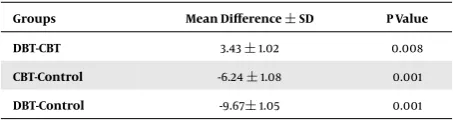
According to the results presented inTable 1for within-subject factors, the F-value was significant at 0.05 (Eta2, 0.49; F, 42.28; P < 0.05), showing a significant difference in the total mean score of BPDSI in the groups. Bonferroni correction was performed to explore the differences in the mean scores of the groups (Table 3).
The results presented inTable 3show that the BPDSI score in the control group was significantly different from the CBT and DBT skills training groups; there was also a sig-nificant difference between the CBT and DBT skills training groups. The comparison of adjusted means showed that the BPDSI score in the DBT skills training group (M, 22.04) was lower than the CBT group (M, 25.47); also, both groups obtained lower scores, compared to the control group (M, 31.71).
In total, 2 methods of CBT and DBT skills training in-fluenced the severity of BPD. The BPDSI scores reduced re-markably in the posttest and follow-up, compared to the pretest. Although the trend of changes was less variable in the follow-up than the posttest, a significant reduction was reported in the pretest, showing the efficacy of therapy in the experimental groups.
With respect to the effects of CBT and DBT skills train-ing on the severity of BPD, the efficacy of these methods was examined separately for the CBT (Eta2, 0.67) and DBT skills training (Eta2, 0.85) groups, compared with the con-trols. Based on the Cohen’s formula, Eta2 of 0.01 indicates a small size effect, 0.06 a medium effect size, and 0.14 a large effect size. Both CBT and DBT skills training were more effective in reducing the severity of BPD, compared with drug therapy; also, greater effects were attributed to DBT skills training.
5. Discussion
treat-Table 2.Summary of Mixed ANOVA Results for Between- and Within-Subject Factors
Factors Sources of Change Sum of Squares DF The Mean of Squares F P Value Partial Eta
Within-subjects
Therapeutic stages 9851.74 1.22 8086.83 1242.31 0.001 0.98
Intercept group 178.90 2.44 73.43 11.28 0.001 0.49
Error 190.32 29.24 6.51
Between-subjects Group 1261.67 2 630.84 42.28 0.001 0.78
Error 358.13 24 14.92
Table 3.The Results of Bonferroni Correction for the Groups
Groups Mean Difference±SD P Value
DBT-CBT 3.43±1.02 0.008
CBT-Control -6.24±1.08 0.001
DBT-Control -9.67±1.05 0.001
ment method for BPD (7). Similarly, some studies have re-ported contradictory results regarding the efficacy of CBT (23).
The efficacy of CBT and DBT skills training in reducing BPD symptoms shows that these methods can reduce the symptoms of this disorder. The literature review showed that dominant approaches for BPD treatment include pro-motion of interpersonal skills and self-efficacy and mas-tering the interpersonal aspects, as a major component of treatment. In some studies, DBT was effective in reducing impulsive behaviors, while in a study by Salavati, it was in-effective.
The high efficacy of DBT has been revealed in some studies against suicidal behaviors. Mcellan et al. showed that DBT is effective in reducing the symptoms of depres-sion and grief (1). Fatehizadeh et al. (22) also showed that this approach is effective in reducing the symptoms of se-vere depression and increasing compatibility. The results of this study are inconsistent with those reported by Skill in 2000, showing the inefficacy of DBT in reducing the symptoms of depression and frustration and promotion of life satisfaction (1).
The greater efficacy of DBT skills training in compari-son to standard approaches against BPD can be attributed to behavioral changes, along with emotional changes in this approach. In addition, DBT skills training is less cog-nitive than traditional CBT approaches, as it claims that thoughts are less important than regulation of emotions. In other words, focus on emotional dysregulation, as a ma-jor symptom of BPD, is necessary. As research on the effi-cacy of CBT against personality disorders is limited, com-parison of therapeutic approaches is necessary to
under-stand the course of BPD.
5.1. Conclusions
The results of this study showed that DBT skills training has a more significant effect on reducing the symptoms of BPD in male patients, compared to CBT. Therefore, the re-sults can be useful in the selection of proper methods in hospital settings by practitioners with the purpose of re-ducing the costs and duration of treatment.
One of the limitations of this study was that the find-ings were generalized to all hospitalized male patients, and similar implementation of drug protocols was not possible. As these patients are at risk of suicide and self-mutilating behaviors, it was not ethical to leave the control group without treatment. In addition, our inability to con-trol the confounding variables, such as memory, aptitude, intelligence, motivation, and socioeconomic status, is an-other limitation of this study.
The efficacy of CBT and DBT skills training approaches should be compared with other therapeutic approaches. In addition, it is necessary to consider the sustainability of treatment effects in longer periods. Comparison of the effi-cacy of these approaches in hospitalized women with BPD is also recommended.
Acknowledgments
We would like to thank the patients participating in this study and the staff and managers of Farshchian Psy-chiatric hospital in Hamadan province for their collabora-tion. This study was approved by the ethics committee of Hamadan University of Medical Sciences (No., p/16/35/9/96 on 19/07/2016).
References
1. Mazaheri M, Borjali A, Ahadi H, Golshani F. Effectiveness of dialecti-cal behavior therapy in treatment of borderlinepersonality disorder. Tehran: Science and Research Islamic Azad University; 2010. 2. Khosravi Z, Rahmatinejad P. The relationship between borderline
3. Jebreili S, Babapour Kheir al Din S, Mahmoud Alilou M. Effectiveness of Dialectical Behavior Therapy in Reducing Symptoms of Borderline Personality Disorder.J Clin Psychol Stud.2014;11:121–38.
4. American Psychiatric Association . Diagnostic and statistical manual of mental disorders. Washington: American Psychiatric Pub; 2013. 5. Lieb K, Vollm B, Rucker G, Timmer A, Stoffers JM.
Pharmacother-apy for borderline personality disorder: Cochrane systematic re-view of randomised trials. Br J Psychiatry. 2010;196(1):4–12. doi:
10.1192/bjp.bp.108.062984. [PubMed:20044651].
6. Akbaridehaghi A, Asgharnezhad A, Gharraee B. The Function of Auto-biographical Memory in Patients with Borderline Personality Disor-der.J Adv Cogn Sci.2009;1:30–9.
7. Mahmoudalilou M, Sharifi MA. Borderline Personality Disorder. Tehran: Arjmand; 2014.
8. Linehan MM. Skills Training Manual for Treating Borderline Personal-ity Disorder. Tehran: Arjmand; 2015.
9. Trull TJ, Sher KJ, Minks-Brown C, Durbin J, Burr R. Borderline person-ality disorder and substance use disorders: a review and integration. Clin Psychol Rev.2000;20(2):235–53. [PubMed:10721499].
10. Kuo JR, Fitzpatrick S, Metcalfe RK, McMain S. A multi-method labo-ratory investigation of emotional reactivity and emotion regulation abilities in borderline personality disorder.J Behav Ther Exp Psychiatry. 2016;50:52–60. doi:10.1016/j.jbtep.2015.05.002. [PubMed:26047310]. 11. Matthies S, Philipsen A. Comorbidity of Personality Disorders and
Adult Attention Deficit Hyperactivity Disorder (ADHD)–Review of Re-cent Findings.Curr Psychiatry Rep. 2016;18(4):33. doi:
10.1007/s11920-016-0675-4. [PubMed:26893231].
12. Winsper C, Lereya ST, Marwaha S, Thompson A, Eyden J, Singh SP. The aetiological and psychopathological validity of borderline per-sonality disorder in youth: A systematic review and meta-analysis. Clin Psychol Rev.2016;44:13–24. doi:10.1016/j.cpr.2015.12.001. [PubMed:
26709502].
13. Unoka Z, J. Richman M . Neuropsychological deficits in BPD patients and the moderator effects of co-occurring mental disorders: A meta-analysis.Clin Psychol Rev. 2016;44:1–12. doi:10.1016/j.cpr.2015.11.009. [PubMed:26708387].
14. Silberschmidt A, Lee S, Zanarini M, Schulz SC. Gender Differences
in Borderline Personality Disorder: Results From a Multina-tional, Clinical Trial Sample.J Pers Disord. 2015;29(6):828–38. doi:
10.1521/pedi_2014_28_175. [PubMed:25562535].
15. Jahangard L, Haghighi M, Bajoghli H, Ahmadpanah M, Ghaleiha A, Zarrabian MK, et al. Training emotional intelligence improves both emotional intelligence and depressive symptoms in inpatients with borderline personality disorder and depression.Int J Psychiatry Clin Pract.2012;16(3):197–204. doi:10.3109/13651501.2012.687454. [PubMed:
22873719].
16. Wright J, Basco M, Thase M. Learning Cognitive Behavior Therapy: An Illustrated Guide. Tehran: Arjmand; 2006.
17. Ghahari SH. Dialectical Behavior Therapy Skills. Tehran: Ghatreh; 2015.
18. Akbari J, AGHA MHR, GHANBARI HBA. Effect of cognitive behavioral therapy and pharmacotherapy on anxiety and impulsivity symptoms in men with borderline personality disorder.J Fundament Ment Health. 2009;40:317–23.
19. Perris C, McGorry PD. Cognitive psychotherapy of psychotic and per-sonality disorders: Handbook of theory and practice.J Psychiatr Ment Health Nurs.1999;6(5):411–2.
20. Lotfikashani F, Vaziri S. The Effect of Dialectical Behavioral Therapy in Decreasing the Symptoms of Borderline Personality Disorder.J Thought Behav Clin Psychol.2013;28.
21. Pasieczny N, Connor J. The effectiveness of dialectical behaviour therapy in routine public mental health settings: An Aus-tralian controlled trial. Behav Res Ther. 2011;49(1):4–10. doi:
10.1016/j.brat.2010.09.006. [PubMed:20970117].
22. Fatehizadeh M, Shafieabadi AE, Etemadi A, Delavar A. The compar-ison of the efficacy of dialectical behavior therapy and cognitive-behavior therapy methods in reduction of the symptoms of clients suffering from borderline personality disorder in isfahan.J Psychol Stud.2006;3:7–24.
23. Beck AT, Leahy AL, Freeman JS, Beck SJ, Holland R, Jallaly Mccloskey R, et al. Challenges of Cognitive Therapy. Tehran: Arjmand; 2010. 24. Bieling PJ, McCabe RE, Antony MM. Cognitive - Behaviorl Therapy in