Please cite this article as: M. R. Sheidaii, Sh. Jalili,Comparison of the Progressive Collapse Resistance of Seismically Designed Steel Shear Wall Frames And Special Steel Moment Frames, International Journal of Engineering (IJE), TRANSACTIONS C: Aspects Vol. 28, No. 6, (June 2015) 871-879
International Journal of Engineering
J o u r n a l H o m e p a g e : w w w . i j e . i rComparison of the Progressive Collapse Resistance of Seismically Designed Steel
Shear Wall Frames And Special Steel Moment Frames
M. R. Sheidaii*, Sh. Jalili
Department of Civil Engineering, Urmia University, Iran
P A P E R I N F O
Paper history: Received 28 August 2014
Received in revised form 02 April 2015 Accepted 30 April 2015
Keywords: Progressive Collapse Alternate Path Method Nonlinear Static Analysis Nonlinear Dynamic Analysis Steel Plate Shear Wall
A B S T R A C T
In this study, the progressive collapse potential of seismically designed steel plate shear wall (SPSW) systems is investigated using the alternate path method, and their performances are compared with those of the conventional special moment frame (SMF) systems. Nonlinear static and dynamic analyses are conducted to follow the progressive collapse of the structures, and their ability of absorbing the destructive effects of member loss is investigated. The obtained results show that when a corner or a middle column in the first story of the SPSWs is removed, the rest of the structure is not able to provide an appropriate alternative path for redistributing the generated loads caused by member loss, and therefore the structure presents a high potential for progressive collapse. However, by changing the lateral load resisting system of these buildings with the SMFs, the progressive collapse resisting capacity of the buildings increases significantly.
doi: 10.5829/idosi.ije.2015.28.06c.07
1. INTRODUCTION1
A steel plate shear wall is a lateral-load-resisting system consisting of vertical steel plate infills called web-plates, which are connected to the surrounding beams and columns as horizontal boundary elements (HBEs) and vertical boundary elements (VBEs), respectively. Experimental tests on shear walls under cyclic loading show that these systems possess large stiffness, sufficient strength, appropriate ductility, and large energy dissipating capacity against seismic lateral loads. Progressive collapse is the collapse of all or a large part of a structure precipitated by damage or failure of a relatively small part of the structure [1]. A progressive collapse can be initiated by causes such as design and construction errors and load events which are not considered by the structural engineer [2]. These so-called abnormal loads are outside the normal structural design basis.
As a historical perspective, the collapse of the Ronan Point Apartment building in London on May 16, 1968 was one of the first recorded incidents of progressive
*Corresponding Author’s Email: [email protected] (M. R. Sheidaii)
collapse [3]. Considering the collapse of the Ronan Point Apartment, the progressive collapse has been an important design consideration. Recently, interest in this topic has also increased due to terrorist attacks on the Alfred P. Murrah building in Oklahama City in 1995 and the World Trade Center in New York in 2001 [4].
Different codes and guidelines have investigated the progressive collapse and provide several solutions to design the structures against its destructive effects. The General Services Administration (GSA) Progressive Collapse Analysis and Design Guidelines [5] and the Department of Defense (DOD) Unified Facilities Criteria (UFC) [6], are two existing progressive collapse design guidelines. These two guidelines use the alternate path method to evaluate a structural system to determine its susceptibility to progressive collapse. The alternate path approach presumes that one critical or key member, typically a column, is damaged and rendered incapable of supporting load [7]. The analysing procedures for the alternate path method include both static and dynamic analyses. However, the key issue in progressive collapse is in understanding that it is a dynamic event [8] and the load redistribution effects will occur dynamically during the local collapse, so considering the dynamic effects are very important in
the evaluation of the structure’s susceptibility to progressive collapse.
Min Liu [9] used genetic algorithm to cost-effectively design of seismic two-dimensional steel moment frames and then assessed the progressive collapse potential of these frames using the alternate path method. He found that the structures with optimal weight design in which the seismic design guidelines are considered, are more vulnerable to progressive collapse. Moreover, they should be designed considering the progressive collapse loads. Kapil Khandelwal et al. [10] investigated the progressive collapse resistance of seismically designed steel braced frames. Two types of braced systems are considered, namely, special concentrically braced frames (SCBF) and eccentrically braced frames (EBF).The results show that while both systems benefited from locating the seismic systems on the perimeter of the buildings, the EBF designed for high seismic risk is less vulnerable to gravity-induced progressive collapse than the SCBF designed for moderate seismic risk. Jinkoo Kim and Taewan Kim [11] assessed the progressive collapse resisting capacity of steel moment frames. They found that nonlinear dynamic analysis provides larger structural responses and the results vary more significantly depending on the variables such as applied load, location of column removal, or number of building story. Jinkoo Kim et al. [12] investigated the progressive collapse resisting capacity of braced frames by performing nonlinear static and dynamic analyses. According to the results from dynamic analyses, they found that the model structures generally remained stable after the first story’s central column was suddenly removed. Nonlinear static pushdown analysis results showed that the model structures had inherent strength twice as high as the strength required by the GSA guideline. Exceptionally, the K-braced frame in which premature failure occurred due to column buckling.
Tavakoli and Kiakojouri [13] assessed influence of sudden column loss on dynamic response of steel moment frames under blast loading. In this paper, progressive collapse capacity of steel moment frames was first investigated using alternate load path method, then a nonlinear dynamic analysis was carried out to examine the response of the steel moment frames in blast and sudden column loss scenario. According to the results, progressive collapse potential are strongly dependent on location of column loss. The effect of local damage on energy absorption of steel frame buildings during earthquake is investigated by Parsaeifard and Nateghi-A [14]. The results showed that collapse pattern is in a way that the damaged frame as well as the nearby frames has the most participation in supporting lateral deformations, and by distancing away from the damaged frame, deformation of the frames decreases.
Recently, the studies on the relationship between the seismic design parameters of the building and its progressive collapse-resisting capacity are wildly carried out. However; much of the previous researches have been focused on moment-resisting frames and recently some of the studies have investigated the braced frames’ vulnerability to progressive collapse. Nevertheless, few studies have been done on steel shear wall frames’ potential for progressive collapse while these systems are wildly being used all over the world.
In this paper, the resistance of the special steel moment frames with special steel plate shear walls, to progressive collapse is investigated using the alternate path method which is described in the progressive collapse guidelines. Moreover, their performances are compared with those of the special moment-resisting frames designed with the same design load.
2. ANALYSIS PROCEDURES FOR PROGRESSIVE COLLAPSE
Among the different design methods against the progressive collapse, the guidelines typically advise the alternate path method (APM). In this method, the removal of a main and critical element is being investigated and the structures are then analyzed to identify the consequent effects. When a structural element is removed abruptly, the rest of the structure should be stable to bear the redistributed loads for a certain period of time.
The guidelines commonly recommend the following analysis procedures for the alternate path method: linear static (LS), linear dynamic (LD), nonlinear static (NS), and nonlinear dynamic (ND) methods. Since the nonlinear procedures are more accurate than the linear ones, nonlinear analysis procedures have been used in the present study.
predicting the yield of web-plates, the Von Mises criterion is determined.
Nonlinear static analyses are performed after removing the critical elements from the structural model. In each analysis only one critical element is removed. Figure 2a shows the imposed loads for progressive collapse in static analyses. As shown in this figure, all the structural bays are loaded by (DL+0.25LL) except the bay which is associated directly with the removed column. This bay is loaded by 2(DL+0.25LL). According to the GSA guidelines, the dynamic increase factor (DIF) 2 is used to apply the dynamic effects of the progressive collapse in the static procedures.
Figure 1. The plastic hinge model (FEMA, 2000).
(a) Static Analysis
(b) Dynamic Analysis
Figure 2. Imposed loads for progressive collapse analyses.
(a) Column Forces
(b) Gravity Loads
Figure 3. Time histories of imposed loads for dynamic
analysis.
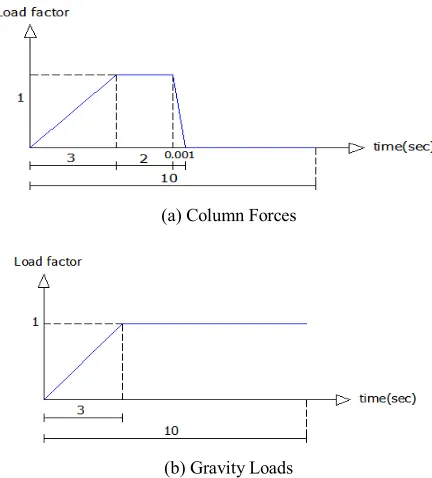
Nonlinear dynamic analyses are performed by removing one critical element in each analysis. The element is abruptly removed at the design load level and the dynamic response of the structure is identified. Figure 2b shows the imposed loads for progressive collapse in dynamic analyses. The time history functions which have been used in dynamic analysis are shown in Figure 3. For solving the equilibrium equation of motion, the β-Newmark numerical time-step method is used. In all the solution algorithms, the time step size must be selected significantly smaller than the time interval of the column removal [16]. For modeling the damping, the Rayleigh's method is applied. Damping ratio was assumed to be 5% of the critical damping.
3. ANALYTICAL MODELS
the buildings are shown in Figure 4.The below codes and guidelines are used in this study:
- The gravity and lateral loads based on ASCE7-05 [18]
- Designing of steel elements and connections based on AISC360 [19]and AISC341 [20]
- Progressive collapse analysis based on GSA2003 [5]
The design dead and live loads for the perimeter walls and floor areas are indicated in Table 1. These buildings are assumed to be located at a high risk seismic zone. Seismic spectral design values, SDS and SD1 are assumed to be equal to 1.13 and 0.853, respectively. The R-factor of 8 is used for all structures which was adopted from the ASCE7-05. Tables 2 and 3 show the member sizes of the analysed model structures. Plate material is ASTM A36 (Fy = 36ksi, Fu = 58ksi). Moreover, beam and column material is assumed to be ASTM A992 (Fy = 50ksi, Fu = 65ksi). On SPSWs, before any analysis can be conducted, preliminary sizes of web plates, VBEs, and HBEs must be selected. For preliminary design, as the size of HBEs and VBEs are not known, the web plates are assumed to resist the entire shear force in the frame [21]. The required web-plate thickness is calculated based on the equations 17-1 and 17-2 provided by AISC 341 [20]. Similarly, using the requirements given in the same code, the preliminary sections of the boundary elements are determined.
In this study the nonlinear analysis method is adopted for analyzing the SPSWs. Final web-plate thickness and boundary elements sections for the all model structures are provided in Table 3.
(a) SPSW System
(b) SMF System
Figure 4. Typical plan of model structures.
TABLE 1. Design loads in model structures.
Deck Dead Load (daN/m2) Deck Live load (daN/m2) Wall Dead Load (daN/m)
All stories except roof 250 250 600
Roof story 310 150 300
TABLE 2. Member sizes of model structures.
Beam section Column section (cm)
Load-resisting system Number of stories
W 6×12 HSS 12×12×1.0
SPSW 2 story
W 8×21 HSS 20×20×1.2
SMRF
W 8×15 HSS 20×20×1.4
Story 1 & 2 SPSW
4 story Story 3 & 4 HSS 15×15×1.0 W 6×12
W 12×50 HSS 32×32×2.2
Story 1 & 2 SMRF
W 12×35 HSS 28×28×1.8
Story 3 & 4
W 8×21 HSS 25×25×2.0
Story 1 to 4 SPSW
8 story Story 5 to 8 HSS 20×20×1.6 W 8×15
W 14×53 HSS 30×30×2.2
Story 1 to 4 SMRF
W 14×38 HSS 25×25×2.0
TABLE 3. Shear wall properties in model structures.
HBE section VBE section (cm)
Web-plate thickness (mm) Number of story
W 6×12 HSS 28×28×2.0
4 2 story
W 8×15 HSS 30×30×2.2
6 4 story
W 8×21 HSS 40×40×2.8
8 (for stories 1 to 4) 8 storya
W 8×15 HSS 30×30×2.4
6 (for stories 5 to 8)
aAt the 4th story roof level, where the web-plate thickness changes, the HBE section is W 18×311.
4. ANALYTICAL RESULTS
4. 1. Static Pushdown Analysis To carry out
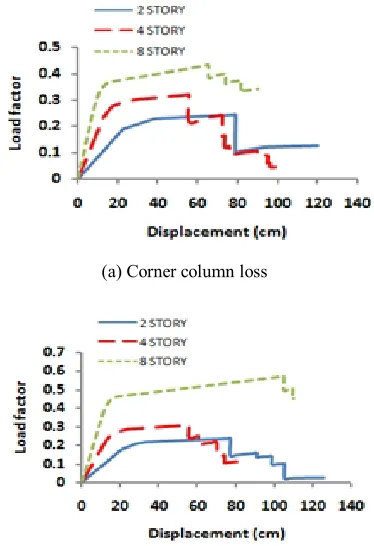
nonlinear static pushdown analysis, first the considered column is removed from the structural model, and then; the displacement of the top joint of the removed column is gradually increased. At every step during the push-down analysis, the ratio of the applied load and the GSA‐specified load combination is referred to as the
‘load factor’.The load factor-displacement diagram is determined by the pushdown analysis. If the maximum load factor in the diagram is less than 1.0 it means that the structure cannot resist the progressive collapse load, and shows a high potential for progressive collapse. However, if the maximum load factor reaches 1.0 and the member rotation and ductility do not exceed the maximum allowable criteria provided in the code, the structure will be considered as a progressive collapse resistant system.
Nonlinear pushdown analysis results for 2 story SPSW frames, for either corner or middle column loss, are shown in Figure 5. As it can be seen, the maximum value of load factor is less than 1.0 for removing either the corner or middle column. The results show that the rest of the structure cannot absorb the column loss and no alternate path is provided to redistribute the loads due to column removal. In fact, the beam sections which are directly associated with the removed column do not have the required strength to withstand the progressive collapse loads and some plastic hinges were formed in the members. By changing the building’s lateral load resisting system to special moment frame, the member sections become larger and so their progressive collapse resistance increases significantly. Figure 5 shows that the maximum load factors reached by the SMFs are much larger than those reached by the SPSW systems, but they still remain below 1.0.
By increasing the story numbers to 4 and 8 in the SPSW system and performing nonlinear pushdown analysis, as can be seen in Figures 6 and 7, the maximum load factor values are still less than 1.0 for removing either the corner or the middle column. However, the value of these factors increase by increasing the number of building stories. It means that as the building becomes taller, its progressive collapse resisting capacity increases.
(a) Corner column loss
(b) Middle column loss
Figure 5. Load-displacement diagram of the 2 story frame.
By increasing the story numbers, the number of elements participate the column loss increases significantly. When these buildings are designed with SMF system, their ability to absorb the column loss improves greatly and they can undergo the progressive collapse loading successfully, as shown in Figures 6 and 7. The comparison of maximum strength in SPSW system for buildings with different heights is shown in Figure 8. As it can be seen, the progressive collapse resisting capacity increases as the number of building story increases in all of the SPSW and SMF structural models.
withstand the redistributed forces via the shear wall system and its linkage with the beams and columns. Thus, the SPSW systems display a better performance against progressive collapse when the removed column belongs to the wall bay.
(a) Corner column loss
(b) Middle column loss
Figure 6. Load-displacement diagram of the 4 story frame.
(a) Corner column loss
(b) Middle column loss
Figure 7. Load-displacement diagram of the 8 story frame.
(a) Corner column loss
(b) Middle column loss
Figure 8. Comparison of maximum strength in SPSW system.
4. 2. Nonlinear Dynamic Time History Analysis
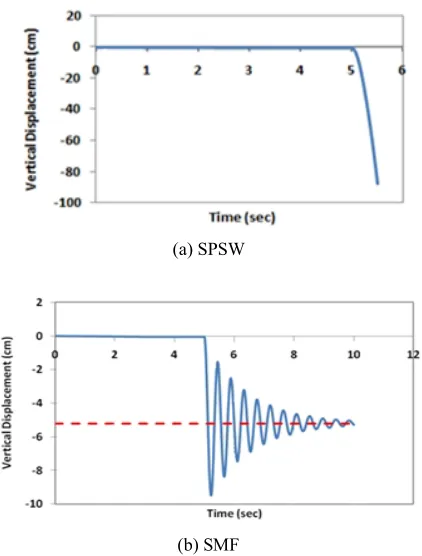
Nonlinear dynamic analysis is carried out to determine the structural response to the sudden column loss. Time histories of imposed dynamic loads are shown in Figure 3. As the progressive collapse load increases linearly, the removed column reactions increase linearly too. When these loads reach their maximum value, the reactions remain unchanged for a few seconds until the structure reaches a stable condition. Then, the removed column reactions decrease to zero abruptly to simulate the dynamic effects caused by the sudden column loss. The duration of removal must be less than one tenth of the period associated with the structural response mode for the vertical motion of the bays above the removed column, as specified in UFC2009 [22].
(a) SPSW
(b) SMF
Figure 9. Nonlinear dynamic analysis results for 2 story
buildings, corner column loss.
(a) SPSW
(b) SMF
Figure 10. Nonlinear dynamic analysis results for 2 story
buildings, middle column loss.
(a) SPSW
(b) SMF
Figure 11.Nonlinear dynamic analysis results for 4 story
buildings, corner column loss.
(a) SPSW
(b) SMF
Figure 12. Nonlinear dynamic analysis results for 4 story
(a) SPSW
(b) SMF
Figure 13. Nonlinear dynamic analysis results for 8 story
buildings, corner column loss.
(a) SPSW
(b) SMF
Figure 14. Nonlinear dynamic analysis results for 8 story
buildings, middle column loss.
5. CONCLUSIONS
The main purpose of this study was to investigate the progressive collapse capacity of steel shear wall frames and to compare with the conventional steel moment resisting frames. Nonlinear static and dynamic progressive collapse analysis were done on six different structural models. Two different lateral load resisting system including SMF and SPSW systems were chosen to investigate the effect of lateral load resisting system. Also, three buildings with different story numbers, i.e. 2, 4 and 8, are chosen to study the effect of building height. The alternate path method was used and either corner or middle column was removed from the structural models. According to nonlinear static and dynamic analyses results, the buildings with SPSW load resisting system have high potential to progressive collapse. The elements of these systems are not strong enough to resist the progressive collapse loads. However, the buildings which have been designed with SMF as the lateral load resisting system are more capable to resist the progressive collapse loads. Consequently, by removing either the corner or middle column, an alternate path is provided to absorb the column loss. Designing a building with SPSW system results in choosing small beam and column sections. Therefore; these sections are not capable to resist the progressive collapse load that is far greater than the normal gravity load acting on the structure. Therefore, compared with the SMF frames, the SPSW systems have high vulnerability to progressive collapse in spite of their proper performance to lateral earthquake loads. In all of the SPSW and SMF structural models, the progressive collapse resisting capacity increases as the number of building story increases. This is due to the increment of the structural elements which can absorb the column loss.
6. REFERENCES
1. Nair, R.S., "Preventing disproportionate collapse", Journal of Performance of Constructed Facilities, Vol. 20, No. 4, (2006), 309-314.
2. Ellingwood, B.R., "Mitigating risk from abnormal loads and progressive collapse", Journal of Performance of Constructed Facilities, Vol. 20, No. 4, (2006), 315-323.
3. Kaewkulchai, G. and Williamson, E., "Modeling the impact of failed members for progressive collapse analysis of frame structures", Journal of Performance of Constructed Facilities, Vol. 20, No. 4, (2006), 375-383.
4. Dusenberry, D.O. and Hamburger, R.O., "Practical means for energy-based analyses of disproportionate collapse potential",
Journal of Performance of Constructed Facilities, Vol. 20, No. 4, (2006), 336-348.
6. DOD, U., "Design of buildings to resist progressive collapse",
Unified Facilities Criteria, (2005).
7. Ruth, P., Marchand, K.A. and Williamson, E.B., "Static equivalency in progressive collapse alternate path analysis: Reducing conservatism while retaining structural integrity",
Journal of Performance of Constructed Facilities, Vol. 20, No. 4, (2006), 349-364.
8. Marjanishvili, S. and Agnew, E., "Comparison of various procedures for progressive collapse analysis", Journal of Performance of Constructed Facilities, Vol. 20, No. 4, (2006), 365-374.
9. Liu, M., "Progressive collapse design of seismic steel frames using structural optimization", Journal of Constructional Steel Research, Vol. 67, No. 3, (2011), 322-332.
10. Khandelwal, K., El-Tawil, S. and Sadek, F., "Progressive collapse analysis of seismically designed steel braced frames",
Journal of Constructional Steel Research, Vol. 65, No. 3, (2009), 699-708.
11. Kim, J. and Kim, T., "Assessment of progressive collapse-resisting capacity of steel moment frames", Journal of Constructional Steel Research, Vol. 65, No. 1, (2009), 169-179.
12. Kim, J., Lee, Y. and Choi, H., "Progressive collapse resisting capacity of braced frames", The Structural Design of Tall and Special Buildings, Vol. 20, No., (2011), 257-270.
13. Tavakoli, H. and Kiakojouri, F., "Influence of sudden column loss on dynamic response of steel moment frames under blast loading", International Journal of Engineering-Transactions B: Applications, Vol. 26, No. 2, (2012), 197.
14. Parsaeifard, N. and Nateghi-A, F., "The effect of local damage on energy absorption of steel frame buildings during earthquake", International Journal of Engineering-Transactions B: Applications, Vol. 26, No. 2, (2012), 143-152. 15. Council, B.S.S., "Prestandard and commentary for the seismic
rehabilitation of buildings", Report FEMA-356, Washington, DC, (2000).
16. Gerasimidis, S. and Baniotopoulos, C., "Steel moment frames column loss analysis: The influence of time step size", Journal of Constructional Steel Research, Vol. 67, No. 4, (2011), 557-564.
17. SAP2000, "Structural analysis program", in Computers and Structures, Berkeley. (2004).
18. ASCE., Minimum design loads for buildings and other structures., American Society of Civil Engineers, Reston, Virginia, (2006).
19. AISC and 360-05, A.A., "Specifications for structural steel buildings", in American Institute of Steel Construction Inc., Chicago., (2005).
20. ANSI, A., "Aisc 341-05: Seismic provisions for structural steel buildings", American Institute of Steel Construction Inc, American Institute of Steel Construction, Chicago, IL, , (2005). 21. Sabelli, R., Bruneau, M. and 20, A.D.G.N., "Steel plate shear
walls", in American Institute of Steel Construction. (2007). 22. (UFC)-DoD., U.F.C., "Design of buildings to resist progressive
collapse", (2010).
Comparison of the Progressive Collapse Resistance of Seismically Designed Steel
Shear Wall Frames And Special Steel Moment Frames
M. R. Sheidaii, Sh. Jalili
Department of Civil Engineering, Urmia University, Iran,
P A P E R I N F O
Paper history: Received 28 August 2014
Received in revised form 02 April 2015 Accepted 30 April 2015
Keywords: Progressive Collapse Alternate Path Method Nonlinear Static Analysis Nonlinear Dynamic Analysis Steel Plate Shear Wall
ﺪﯿﮑﭼ
بﺎﻗ ردهﺪﻧوﺮﺸﯿﭘﯽﺑاﺮﺧﻞﯿﺴﻧﺎﺘﭘ ﻪﻌﻟﺎﻄﻣ ﻦﯾارد هزﺮﻟ موﺎﻘﻣ يدﻻﻮﻓيﺎﻫ
يدﻻﻮﻓﯽﺷﺮﺑراﻮﯾدﻪﺑ ﺰﻬﺠﻣيا
(SPSW)
ﺎﺑ
نآدﺮﮑﻠﻤﻋوهﺪﺷﯽﺳرﺮﺑﻦﯾﺰﮕﯾﺎﺟﺮﯿﺴﻣشورزاهدﺎﻔﺘﺳا ﻢﺘﺴﯿﺳﺎﺑهﺪﻧوﺮﺸﯿﭘﯽﺑاﺮﺧﺮﺑاﺮﺑردﺎﻫ
هﮋﯾوﯽﺸﻤﺧبﺎﻗيﺎﻫ
ﺞﯾار
(SMF)
ﺖﺳاهﺪﺷﻪﺴﯾﺎﻘﻣ
.
ﻞﯿﻠﺤﺗ هزﺎﺳردهﺪﻧوﺮﺸﯿﭘﯽﺑاﺮﺧعﻮﻗوﺐﯿﻘﻌﺗياﺮﺑﯽﮑﯿﻣﺎﻨﯾدوﯽﮑﯿﺗﺎﺘﺳاﯽﻄﺧﺮﯿﻏيﺎﻫ ﺎﻫ
ﺖﺳاهﺪﺷﯽﺳرﺮﺑ،ﻮﻀﻋفﺬﺣبﺮﺨﻣتاﺮﺛابﺬﺟﺖﯿﻠﺑﺎﻗوهﺪﺷمﺎﺠﻧا
.
ﯽﻣنﺎﺸﻧهﺪﻣآﺖﺳﺪﺑﺞﯾﺎﺘﻧ ﮏﯾﻪﮐﯽﻧﺎﻣزﺪﻫد
ﻢﺘﺴﯿﺳزالواﻪﻘﺒﻃرد ﻊﻗاوﯽﻧﺎﯿﻣنﻮﺘﺳﮏﯾﺎﯾوﻪﺷﻮﮔنﻮﺘﺳ
SPSW
فﺬﺣ ﯽﻣ ﯽﻤﻧهﺪﻧﺎﻤﯿﻗﺎﺑهزﺎﺳ،دﻮﺷ ﺮﯿﺴﻣﺪﻧاﻮﺗ
هﺪﻧوﺮﺸﯿﭘﯽﺑاﺮﺧياﺮﺑارﯽﯾﻻﺎﺑﻞﯿﺴﻧﺎﺘﭘهزﺎﺳوﺪﯾﺎﻤﻧﻢﻫاﺮﻓﻮﻀﻋفﺬﺣزاﯽﺷﺎﻧيﺎﻫرﺎﺑﻊﯾزﻮﺗزﺎﺑياﺮﺑﯽﺒﺳﺎﻨﻣﻦﯾﺰﮕﯾﺎﺟ ﯽﻣنﺎﺸﻧ ﺪﻫد
.
زاهزﺎﺳﯽﺒﻧﺎﺟﺮﺑرﺎﺑﻢﺘﺴﯿﺳﺮﯿﯿﻐﺗﺎﺑﯽﻟو
SPSW
ﻪﺑ
SMF
هﺪﻧوﺮﺸﯿﭘﯽﺑاﺮﺧﺮﺑاﺮﺑردهزﺎﺳيﺮﺑرﺎﺑﺖﯿﻓﺮﻇ،
ﺑ ﯽﻣﺶﯾاﺰﻓايﺮﯿﮕﻤﺸﭼرﻮﻄ ﺪﺑﺎﯾ
.