VOLUME NO.6(2016),ISSUE NO.02(FEBRUARY) ISSN 2231-5756
A Monthly Double-Blind Peer Reviewed (Refereed/Juried) Open Access International e-Journal - Included in the International Serial Directories
Indexed & Listed at:
VOLUME NO.6(2016),ISSUE NO.02(FEBRUARY) ISSN 2231-5756
INTERNATIONAL JOURNAL OF RESEARCH IN COMMERCE, IT & MANAGEMENT
CONTENTS
Sr.
No.
TITLE & NAME OF THE AUTHOR (S)
Page
No.
1.
RURAL HEALTHCARE MANAGEMENT
BHARATHI N.R, N.SURESH & SUKANYA HEGDE
1
2.
CONSUMER DECISION MAKING STYLES: A REVIEW
POORNIMA D & DR. ASHOK D
7
3.
A STUDY ON SITUATIONAL FACTORS INFLUENCING PREFERENCE OF CUSTOMERS SHOPPING IN RETAIL
MALLS WITH REFERENCE TO COIMBATORE CITY
DR. K. SHANMUGA SUNDARAM & M. PARAMESWARI
12
4.
PARTICIPATION OF GUJJAR AND BAKERWAL IN JAMMU AND KASHMIR POLITICS (WITH SPECIAL
REFERENCE TO ANANTNAG AND KULGAM DISTRICTS)
AZHAR UD DIN & DR. JAGDISH NIGAM
16
5.
IMPACT OF INVESTOR AWARENESS PROGRAM ON PROSPECTIVE INVESTORS IN THE INDIAN STOCK
MARKET
S.PERIYASAMY & DR. M. ASHOK KUMAR
21
6.
BLACK MONEY IN INDIA: A SOCIAL PROBLEM IN INDIA
DR. NIKHIL RANJAN AGARWAL
24
7.
AN EMPIRICAL APPROACH TO INVENTORY COST REDUCTION
R. JAYARAMAN
27
8.
THE INFLUENCE OF BRAND LOYALTY TOWARDS THE PURCHASE OF COSMETICS IN CHENNAI
V. NITHYA & DR. A. KUMUDHA
39
9.
ROLE OF INFORMATION AND COMMUNICATION TECHNOLOGY (ICT) IN EFFECTIVE IMPLEMENTATION
OF CRM PRACTICES
DR. U. KANAKA RAO & DANDA. UDAYA SHEKHAR
44
10.
INDIAN BANK EMPLOYEES’ PERCEPTION OF E-BANKING: AN EMPIRICAL INVESTIGATION
DR. LAKSHMINARAYANA BHAT A
47
11.
WORK MOTIVATION OF B. Ed. COLLEGE TEACHERS IN RELATION TO SOME DEMOGRAPHIC VARIABLES
SHEIKH AABID AZAD & DR. P.N.NATARAJ
51
12.
IMPACT ASSESSMENT OF MICRO FINANCE ON WOMEN EMPOWERMENT
DEEPIKA GAUTAM & DR. O.P VERMA
54
13.
BRAND SELECTION CRITERIA FOR FMCG PRODUCTS: AN EMPIRICAL RESEARCH ON RURAL
CONSUMERS
DR. AJEET KUMAR SAHOO, AMIT ROY & DR. AMIT KUMAR
60
14.
FDI IN RETAIL: CHANGE AND CHALLENGE
SARVJOT DHUNNA
65
15.
TRAINING PROGRAMME IN PRACTICE IN THE INDIAN STEEL INDUSTRY: A COMPARATIVE ANALYSIS
DR. ITISHREE MOHANTY & DR. SMRUTI RANJAN RATH
68
16.
STAGES INVOLVED IN BAMBOO BASED ENTERPRISES IN DIMAPUR DISTRICT, NAGALAND
DITALAK MPANME & DR. KH. DEVANANDA SINGH
71
17.
OPPORTUNITIES AND CHALLENGES IN SUPPLY CHAIN MANAGEMENT IN SMEs: A CASE STUDY OF
TEXTILE SECTOR IN INDIA
YASER JEBRIL ALMATARNEH & SAAD BIN AZHAR
79
18.
A STUDY ON EDUCATIONAL ADJUSTMENT PROBLEMS OF ADOLESCENTS IN RELATION TO THEIR
ACADEMIC CLIMATE
SUMEET KHURANA
85
19.
GENDER EQUALITY: THE BATTLE FOR JUSTICE
HARPREET KAUR
89
20.
CONSUMER’S PERCEPTION TOWARDS MAGGI NOODLES WITH SPECIAL REFERENCE TO THE AREA OF
TUTICORIN
S. MUTHU LAKSHMI
91
VOLUME NO.6(2016),ISSUE NO.02(FEBRUARY) ISSN 2231-5756
CHIEF PATRON
PROF. K. K. AGGARWAL
Chairman, Malaviya National Institute of Technology, Jaipur
(An institute of National Importance & fully funded by Ministry of Human Resource Development, Government of India)
Chancellor, K. R. Mangalam University, Gurgaon
Chancellor, Lingaya’s University, Faridabad
Founder Vice-Chancellor (1998-2008), Guru Gobind Singh Indraprastha University, Delhi
Ex. Pro Vice-Chancellor, Guru Jambheshwar University, Hisar
FOUNDER PATRON
LATE SH. RAM BHAJAN AGGARWAL
Former State Minister for Home & Tourism, Government of Haryana
Former Vice-President, Dadri Education Society, Charkhi Dadri
Former President, Chinar Syntex Ltd. (Textile Mills), Bhiwani
FORMER CO-ORDINATOR
DR. S. GARG
Faculty, Shree Ram Institute of Business & Management, Urjani
ADVISORS
PROF. M. S. SENAM RAJU
Director A. C. D., School of Management Studies, I.G.N.O.U., New Delhi
PROF. M. N. SHARMA
Chairman, M.B.A., Haryana College of Technology & Management, Kaithal
PROF. S. L. MAHANDRU
Principal (Retd.), Maharaja Agrasen College, Jagadhri
EDITOR
PROF. R. K. SHARMA
Professor, Bharti Vidyapeeth University Institute of Management & Research, New Delhi
CO-EDITOR
DR. BHAVET
Faculty, Shree Ram Institute of Engineering & Technology, Urjani
EDITORIAL ADVISORY BOARD
DR. RAJESH MODI
Faculty, Yanbu Industrial College, Kingdom of Saudi Arabia
PROF. SANJIV MITTAL
University School of Management Studies, Guru Gobind Singh I. P. University, Delhi
PROF. ANIL K. SAINI
Chairperson (CRC), Guru Gobind Singh I. P. University, Delhi
DR. SAMBHAVNA
VOLUME NO.6(2016),ISSUE NO.02(FEBRUARY) ISSN 2231-5756
INTERNATIONAL JOURNAL OF RESEARCH IN COMMERCE, IT & MANAGEMENT
DR. MOHENDER KUMAR GUPTA
Associate Professor, P. J. L. N. Government College, Faridabad
DR. SHIVAKUMAR DEENE
Asst. Professor, Dept. of Commerce, School of Business Studies, Central University of Karnataka, Gulbarga
ASSOCIATE EDITORS
PROF. NAWAB ALI KHAN
Department of Commerce, Aligarh Muslim University, Aligarh, U.P.
PROF. ABHAY BANSAL
Head, Department of I.T., Amity School of Engineering & Technology, Amity University, Noida
PROF. A. SURYANARAYANA
Department of Business Management, Osmania University, Hyderabad
PROF. V. SELVAM
SSL, VIT University, Vellore
DR. PARDEEP AHLAWAT
Associate Professor, Institute of Management Studies & Research, Maharshi Dayanand University, Rohtak
DR. S. TABASSUM SULTANA
Associate Professor, Department of Business Management, Matrusri Institute of P.G. Studies, Hyderabad
SURJEET SINGH
Asst. Professor, Department of Computer Science, G. M. N. (P.G.) College, Ambala Cantt.
FORMER TECHNICAL ADVISOR
AMITA
Faculty, Government M. S., Mohali
FINANCIAL ADVISORS
DICKIN GOYAL
Advocate & Tax Adviser, Panchkula
NEENA
Investment Consultant, Chambaghat, Solan, Himachal Pradesh
LEGAL ADVISORS
JITENDER S. CHAHAL
Advocate, Punjab & Haryana High Court, Chandigarh U.T.
CHANDER BHUSHAN SHARMA
Advocate & Consultant, District Courts, Yamunanagar at Jagadhri
SUPERINTENDENT
VOLUME NO.6(2016),ISSUE NO.02(FEBRUARY) ISSN 2231-5756
CALL FOR MANUSCRIPTS
We invite unpublished novel, original, empirical and high quality research work pertaining to recent developments & practices in the areas of Computer Science & Applications; Commerce; Business; Finance; Marketing; Human Resource Management; General Management; Banking; Economics; Tourism Administration & Management; Education; Law; Library & Information Science; Defence & Strategic Studies; Electronic Science; Corporate Governance; Industrial Relations; and emerging paradigms in allied subjects like Accounting; Accounting Information Systems; Accounting Theory & Practice; Auditing; Behavioral Accounting; Behavioral Economics; Corporate Finance; Cost Accounting; Econometrics; Economic Development; Economic History; Financial Institutions & Markets; Financial Services; Fiscal Policy; Government & Non Profit Accounting; Industrial Organization; International Economics & Trade; International Finance; Macro Economics; Micro Economics; Rural Economics; Co-operation; Demography: Development Planning; Development Studies; Applied Economics; Development Economics; Business Economics; Monetary Policy; Public Policy Economics; Real Estate; Regional Economics; Political Science; Continuing Education; Labour Welfare; Philosophy; Psychology; Sociology; Tax Accounting; Advertising & Promotion Management; Management Information Systems (MIS); Business Law; Public Responsibility & Ethics; Communication; Direct Marketing; E-Commerce; Global Business; Health Care Administration; Labour Relations & Human Resource Management; Marketing Research; Marketing Theory & Applications; Non-Profit Organizations; Office Administration/Management; Operations Research/Statistics; Organizational Behavior & Theory; Organizational Development; Production/Operations; International Relations; Human Rights & Duties; Public Administration; Population Studies; Purchasing/Materials Management; Retailing; Sales/Selling; Services; Small Business Entrepreneurship; Strategic Management Policy; Technology/Innovation; Tourism & Hospitality; Transportation Distribution; Algorithms; Artificial Intelligence; Compilers & Translation; Computer Aided Design (CAD); Computer Aided Manufacturing; Computer Graphics; Computer Organization & Architecture; Database Structures & Systems; Discrete Structures; Internet; Management Information Systems; Modeling & Simulation; Neural Systems/Neural Networks; Numerical Analysis/Scientific Computing; Object Oriented Programming; Operating Systems; Programming Languages; Robotics; Symbolic & Formal Logic; Web Design and emerging paradigms in allied subjects.
Anybody can submit the soft copy of unpublished novel; original; empirical and high quality research work/manuscriptanytime in M.S. Word format after preparing the same as per our GUIDELINES FOR SUBMISSION; at our email address i.e. [email protected] or online by clicking the link online submission as given on our website (FOR ONLINE SUBMISSION, CLICK HERE).
GUIDELINES FOR SUBMISSION OF MANUSCRIPT
1. COVERING LETTER FOR SUBMISSION:
DATED: _____________
THE EDITOR IJRCM
Subject: SUBMISSION OF MANUSCRIPT IN THE AREA OF .
(e.g. Finance/Mkt./HRM/General Mgt./Engineering/Economics/Computer/IT/ Education/Psychology/Law/Math/other, please specify)
DEAR SIR/MADAM
Please find my submission of manuscript entitled ‘___________________________________________’ for possible publication in one of your journals.
I hereby affirm that the contents of this manuscript are original. Furthermore, it has neither been published elsewhere in any language fully or partly, nor is it under review for publication elsewhere.
I affirm that all the co-authors of this manuscript have seen the submitted version of the manuscript and have agreed to their inclusion of names as co-authors.
Also, if my/our manuscript is accepted, I agree to comply with the formalities as given on the website of the journal. The Journal has discretion to publish our contribution in any of its journals.
NAME OF CORRESPONDING AUTHOR :
Designation :
Institution/College/University with full address & Pin Code :
Residential address with Pin Code :
Mobile Number (s) with country ISD code :
Is WhatsApp or Viber active on your above noted Mobile Number (Yes/No) :
Landline Number (s) with country ISD code :
E-mail Address :
Alternate E-mail Address :
VOLUME NO.6(2016),ISSUE NO.02(FEBRUARY) ISSN 2231-5756
INTERNATIONAL JOURNAL OF RESEARCH IN COMMERCE, IT & MANAGEMENT
NOTES:a) The whole manuscript has to be in ONE MS WORD FILE only, which will start from the covering letter, inside the manuscript. pdf. version is liable to be rejected without any consideration.
b) The sender is required to mention the following in the SUBJECT COLUMNof the mail:
New Manuscript for Review in the area of (e.g. Finance/Marketing/HRM/General Mgt./Engineering/Economics/Computer/IT/ Education/Psychology/Law/Math/other, please specify)
c) There is no need to give any text in the body of mail, except the cases where the author wishes to give any specific message w.r.t. to the manuscript.
d) The total size of the file containing the manuscript is expected to be below 1000 KB.
e) Abstract alone will not be considered for review and the author is required to submit the complete manuscript in the first instance.
f) The journal gives acknowledgement w.r.t. the receipt of every email within twenty four hours and in case of non-receipt of acknowledgment from the journal, w.r.t. the submission of manuscript, within two days of submission, the corresponding author is required to demand for the same by sending a separate mail to the journal.
g) The author (s) name or details should not appear anywhere on the body of the manuscript, except the covering letter and the cover page of the manuscript, in the manner as mentioned in the guidelines.
2. MANUSCRIPT TITLE: The title of the paper should be bold typed, centered and fully capitalised.
3. AUTHOR NAME (S) & AFFILIATIONS: Author (s) name, designation, affiliation (s), address, mobile/landline number (s), and email/alternate email address should be given underneath the title.
4. ACKNOWLEDGMENTS: Acknowledgements can be given to reviewers, guides, funding institutions, etc., if any.
5. ABSTRACT: Abstract should be in fully italicized text, ranging between 150 to 300 words. The abstract must be informative and explain the background, aims, methods, results & conclusion in a SINGLE PARA. Abbreviations must be mentioned in full.
6. KEYWORDS: Abstract must be followed by a list of keywords, subject to the maximum of five. These should be arranged in alphabetic order separated by commas and full stop at the end. All words of the keywords, including the first one should be in small letters, except special words e.g. name of the Countries, abbreviations.
7. JEL CODE: Provide the appropriate Journal of Economic Literature Classification System code (s). JEL codes are available at www.aeaweb.org/econlit/jelCodes.php, however, mentioning JEL Code is not mandatory.
8. MANUSCRIPT: Manuscript must be in BRITISH ENGLISH prepared on a standard A4 size PORTRAIT SETTING PAPER. It should be free from any errors i.e. grammatical, spelling or punctuation. It must be thoroughly edited at your end.
9. HEADINGS: All the headings must be bold-faced, aligned left and fully capitalised. Leave a blank line before each heading.
10. SUB-HEADINGS: All the sub-headings must be bold-faced, aligned left and fully capitalised.
11. MAIN TEXT:
THE MAIN TEXT SHOULD FOLLOW THE FOLLOWING SEQUENCE: INTRODUCTION
REVIEW OF LITERATURE
NEED/IMPORTANCE OF THE STUDY
STATEMENT OF THE PROBLEM
OBJECTIVES
HYPOTHESIS (ES)
RESEARCH METHODOLOGY
RESULTS & DISCUSSION
FINDINGS
RECOMMENDATIONS/SUGGESTIONS
CONCLUSIONS
LIMITATIONS
SCOPE FOR FURTHER RESEARCH
REFERENCES
APPENDIX/ANNEXURE
VOLUME NO.6(2016),ISSUE NO.02(FEBRUARY) ISSN 2231-5756
12. FIGURES & TABLES: These should be simple, crystal CLEAR, centered, separately numbered & self explained, and titles must be above the table/figure. Sources of data should be mentioned below the table/figure. It should be ensured that the tables/figures are referred to from the main text.
13. EQUATIONS/FORMULAE: These should be consecutively numbered in parenthesis, horizontally centered with equation/formulae number placed at the right. The equation editor provided with standard versions of Microsoft Word should be utilised. If any other equation editor is utilised, author must confirm that these equations may be viewed and edited in versions of Microsoft Office that does not have the editor.
14. ACRONYMS: These should not be used in the abstract. The use of acronyms is elsewhere is acceptable. Acronyms should be defined on its first use in each section: Reserve Bank of India (RBI). Acronyms should be redefined on first use in subsequent sections.
15. REFERENCES: The list of all references should be alphabetically arranged. The author (s) should mention only the actually utilised references in the preparation of manuscript and they are supposed to follow Harvard Style of Referencing. Also check to make sure that everything that you are including in the reference section is duly cited in the paper. The author (s) are supposed to follow the references as per the following:
•
All works cited in the text (including sources for tables and figures) should be listed alphabetically.•
Use (ed.) for one editor, and (ed.s) for multiple editors.•
When listing two or more works by one author, use --- (20xx), such as after Kohl (1997), use --- (2001), etc, in chronologically ascending order.•
Indicate (opening and closing) page numbers for articles in journals and for chapters in books.•
The title of books and journals should be in italics. Double quotation marks are used for titles of journal articles, book chapters, dissertations, reports, working papers, unpublished material, etc.•
For titles in a language other than English, provide an English translation in parenthesis.•
Headers, footers, endnotes and footnotes should not be used in the document. However, you can mention short notes to elucidate some specific point, which may be placed in number orders after the references.PLEASE USE THE FOLLOWING FOR STYLE AND PUNCTUATION IN REFERENCES:
BOOKS
•
Bowersox, Donald J., Closs, David J., (1996), "Logistical Management." Tata McGraw, Hill, New Delhi.•
Hunker, H.L. and A.J. Wright (1963), "Factors of Industrial Location in Ohio" Ohio State University, Nigeria. CONTRIBUTIONS TO BOOKS•
Sharma T., Kwatra, G. (2008) Effectiveness of Social Advertising: A Study of Selected Campaigns, Corporate Social Responsibility, Edited by David Crowther & Nicholas Capaldi, Ashgate Research Companion to Corporate Social Responsibility, Chapter 15, pp 287-303.JOURNAL AND OTHER ARTICLES
•
Schemenner, R.W., Huber, J.C. and Cook, R.L. (1987), "Geographic Differences and the Location of New Manufacturing Facilities," Journal of Urban Economics, Vol. 21, No. 1, pp. 83-104.CONFERENCE PAPERS
•
Garg, Sambhav (2011): "Business Ethics" Paper presented at the Annual International Conference for the All India Management Association, New Delhi, India, 19–23UNPUBLISHED DISSERTATIONS
•
Kumar S. (2011): "Customer Value: A Comparative Study of Rural and Urban Customers," Thesis, Kurukshetra University, Kurukshetra. ONLINE RESOURCES•
Always indicate the date that the source was accessed, as online resources are frequently updated or removed. WEBSITESVOLUME NO.6(2016),ISSUE NO.02(FEBRUARY) ISSN 2231-5756
INTERNATIONAL JOURNAL OF RESEARCH IN COMMERCE, IT & MANAGEMENT
ROLE OF INFORMATION AND COMMUNICATION TECHNOLOGY (ICT) IN EFFECTIVE IMPLEMENTATION OF
CRM PRACTICES
DR. U. KANAKA RAO
ASSOCIATE PROFESSOR
DEPARTMENT OF BUSINESS MANAGEMENT
SWARNA BHARATHI INSTITUTE OF SCIENCE & TECHNOLOGY
KHAMMAM, TELANGANA, INDIA
DANDA. UDAYA SHEKHAR
ASST. PROFESSOR
DEPARTMENT OF BUSINESS MANAGEMENT
MADAWALABU UNIVERSITY
ETHIOPIA
ABSTRACT
In this present paper an attempt is made to understand and analyze Role of information and communication technology (ICT) in effective implementation of CRM practices Information and Communications Technology (ICT) is often used as an extended synonym for information technology (IT), but it is a more specific term that stresses the role of unified communications and the integration of telecommunications such as telephone lines and wireless signals, computers as well as necessary enterprise software, hard ware, storage, and audio-visual systems, which enable users to access, store, transmit, and manipulate the information. Retaining customers will lead to the creation of sustained competitive advantage and improved profitability for the company. Information technology acts as an enabler in the whole process.
KEYWORDS
ICT, CRM practices.
PRELUDE
CT (Information and Communications Technology - or Technologies) is an umbrella term that includes any communication device or application encompassing: radio, television, cellular phones, computer hardware and software, satellite systems and so on, as well as the various services and applications associated with them, such as video conferencing and distance learning. Information Technology has grown in various directions in the recent years on natural evolutionary path has been the development of the database industry and its functionalities. Data collection, data creation, data management including its storage and retrieval, database transaction processing and data analysis and data understanding has been the way in which it has progressed so far. The term ICT is now also used to refer to the convergence of audio-visual and telephone networks with computer networks through a single cabling or link system. There are large economic incentives to merge the audio-visual, building management and telephone network with the computer network system using a single unified system of cabling, signal distribution and management. The term Infocommunications is sometimes used interchangeably with ICT. In fact Infocommunications is the expansion of telecommunications with information processing and content handling functions on a common digital technology base. Any marketer will put in sincere efforts to maintain a long term relationship with the customers, which will ensure sustainable competitive advantage in the long run. As it is relatively easier to retain a customer than acquiring new customer, relationship marketing is becoming one of the major element of the corporate strategy for many organizations. Relationship marketing is concerned with the creative development, and enhancement of individualized customer relationships with target customers and customer groups resulting in maximizing the total lifetime value of the customer. The adoption of relationship is the essence of doing business in the modern times. But to achieve this, companies need to develop information enabled systems so as to have direct contact with customers. Retaining customers will lead to the creation of sustained competitive advantage and improved profitability for the company. Information technology acts as an enabler in the whole process.
USING INFORMATION AND COMMUNICATION TECHNOLOGY TO HANDLE CUSTOMER CALLS AND INQUIRES
Help desk: Organizations are flooded with inquiries from customers, sometimes thousand a day. Organizations can establish help desk to answer telephonic calls,
emails, fax and even face to face enquiries. Expert systems can have used to expedite helpdesk to facilitate customer search information and it also speed up the work of the help desk employee.
On-line client contact manger: It is a web based tool that helps a sales person to contact with the prospective customer either face-to-face meeting or a telephonic
call or email. Web based tools like emails and teleconferencing are used to communication and aid decision making.
Point of sale terminals: These provide faster customer checkout, identify customer preferences and also help to improve inventory content.
Electronic groups: E-groups created for salespersons, help each other to solve the problems. To reduce the load on the post-sales service teams, customers are
allowed to use online, the status of the service delivery cycle using a login and a password. Sophisticated software enable customer to find answers by themselves in the corporate database.
Telemarketing: Here, telecommunication and information technologies are used to execute a marketing program for customers who want to shop from their
home. It can be done by telephonic calls generated by the computer. Telemarketing being include generating sales leads, gathering information, providing information, improving cash flows, fostering customer service.
Intelligent agent: An intelligent agent is software that assists people to automate repetitive tasks, intelligently. It summarizes the complex data and even makes
recommendations. These agents provide greater customized services for customer helping business to market their products to a wider geographical area. They can send automatic email reply over 90% customer queries received. They work around the clock in different time zones and can converse language in which they are programmed. Web based intelligent agents can be used to customer with product and service, facilitating better service.
CAD/CAM (Computer Aided Design / Computer Aided Manufacturing): This allows products designed with CAD to be input an automated manufacturing system
that makes the products. This can be used to reduce the cost of customization of products and accurately meet the requirement of the customers.
SBR/IVR (Skill Based Routing / Interactive Voice Response Systems): Information technology finds its wide application in business process outsourcing. In BPO,
the right contact is very important. A technique called SBR – skill based routing is used where it quantifies the various skill sets of agents and matches them with the nature of enquiry. The call is passed to the agent who is best equipped to handle the call. IVR – interactive voice response systems which is used to relieve simple and monotonous calls.
VOLUME NO.6(2016),ISSUE NO.02(FEBRUARY) ISSN 2231-5756
ROLE OF INFORMATION TECHNOLOGY IN RELATIONSHIP MARKETING
There has been a paradigm shift in the approach towards marketing i.e., marketing is moving from a transaction based approach to a new paradigm called Relationship Marketing. The traditional activities which emphasized the role of customer acquisition as the primary role of marketing have been replaced by relationship marketing, which recognizes that marketing actually starts after the sale is complete. Information technology has an important role to play in the overall functioning of relationship marketing. According to Adrian Payne, “In considering how CRM should be implemented, information technology has a pivotal role to play in enabling companies to maximize profitability through more precise targeting of market segments and the micro segments within them”. In modern times, companies have a marketing, information regarding the consumers and channel partners is collected on an individual base and is used to design the products and services as per the individual requirement. Here, suppliers tend to cooperate with the distributors and retailers on an individual basis so as to serve the customers well.
The technology tools like databases, data warehouses, and data mining etc. which are available to the marketers to assist companies in increasing the customer value and company’s profitability. Information technology is of great help in gathering and managing data required not only for a better understanding of the customers but also in framing the appropriate relationship marketing strategies to be adopt as present and future. Moreover, IT can enable the companies to determine the importance of customer acquisition, customer retention and his lifetime value. Research studies have shown that 5% increase customer retention will lead to around 20% to 125% increase in profits. According to gronroos (1994), there are two essential elements of relationship marketing, promise and trust. These elements determine how a relationship is established, maintained and enhanced.
As a result of the profound developments in the field of information technology, the knowledge is slowly but surely replacing natural resources and capital as the basic requirement for running a business. Also, the access to an infinite source of information is aiding in the shifting of power from the marketers side to customers side. This is new state of the customers transforming the traditional marketing from a transaction orientation to a relational paradigm. The marketing dynamics are changing from product driven to customer driven. This in turn requires a good relationship among all the members of the channel, and customer. This IT is enabling the marketing to move towards relationship marketing the companies need to make use of appropriate technologies to improve customer acquisition, customer retention, and customer’s lifetime value. The primary job of the management is to develop proper relationship marketing strategy and then develop appropriate information technology base as per their requirements. They require a proper blend of databases, data marts, data warehouses and electronic commerce. The ultimate objective for the incorporation of information technology in the overall marketing strategy is to create opportunities for increasing the profitability with the aid of customer retention, acquisition.
RELATION BETWEEN IT AND RELATIONSHIP MARKETING
There is marked parallelism between the developments in information technology and transformation in the marketing process. This has led to the rise of new technologies like the World Wide Web, electronic commerce and so on. These technologies have arrived “just in time to assist the marketers in implementing the potential aspects of relationship marketing. Moreover technologies have become affordable which is enabling the marketers to deploy widely across a wide spectrum of customers. There exists a symbolic relationship or a virtue cycle between advancements in information technology and the change in marketing paradigm towards relationship marketing. Relationship marketing has grown because of the developments in information technology, some pitfalls of traditional marketing, the increased expectations of the consumers and rising competition.
TECHNOLOGIES OF CRM
In today's market place, attracting and keeping customers is critical to the continued existence of any business. Many companies look to customer relationship management, which is a business strategy focusing on acquiring, cultivating, managing and retaining customers, to help them manage all aspects of customer relations. CRM emerged in the early 1990s when software companies began developing applications to automate the sales process through contact management tools. CRM has evolved into a strategy that uses technology to achieve its goals.
OPERATIONAL CRM
An Operational CRM System involves the direct interaction with the customer (front-end). Operational CRM is the aspect of CRM dealing with the automation of
customer-facing, or “front office,” processes. These processes include sales, marketing and customer service. Since operational CRM involves the automation of customer-facing processes, it relies heavily on the use of computer technology to achieve its goals.
Sales Force Automation: Sales force automation uses software applications to automate sales activities. The activities automated include: lead management, sales
forecasting, contact management, and quotation and proposal generation. Lead management software allows businesses to qualify and assign sales leads, or opportunities. Sales forecasting software uses historical sales data to forecast future sales. Contact management software enables companies to manage customer communications from many sources, including websites, emails and faxes. Quotation generation software generates sales quotes from input data, and proposal generation software automates the process of producing sales proposals.
Marketing Automation: Marketing automation refers to the use of software applications to automate marketing campaign management and event-based
marketing. Campaign management applications enable targeted communications and offers through the use of customer-related data. Event-based marketing uses events, such as a purchase, to trigger communications and offers to customers.
Service Automation: Service automation enables companies to manage customer service interactions through the use of technology. Customer service automation
includes: issue management, inbound call management, queuing and routing, and service level management. Issue management software enables companies to manage customers' problems by storing information about a problem, routing it to the appropriate personnel for resolution and tracking its progress during resolution. Inbound call management software identifies incoming calls and retrieves historical information related to the call. Queuing and routing software manages customer service calls by ensuring that they are routed to appropriate personnel in the order received. Service level management software enables a company to monitor and manage the quality of service of its key performance indicators.
ANALYTICAL CRM
An Analytical CRM System uses customer behavior and perceptions in order to provide actionable business intelligence (back-end). Common elements includes:
Data Mining Data warehouses Decision support
On Line Analytical Processing (OLAP): The need for non static reporting systems has led to the development of online analytical processing (OLAP). Data is now
used in a proactive way that provides value for the firm. This approach uses computing power and graphical interfaces to manipulate data easily and quickly at the convenience of the user. The focus is showing data along several dimensions. The manager should be able to drill down into the ultimate detail of a transaction and zoom up for a general view.
OLAP has several strategies:
It is a powerful visualization tool It is an easy to use interactive tool
It can be used as a first step in understanding the data
It has also some limitations:
VOLUME NO.6(2016),ISSUE NO.02(FEBRUARY) ISSN 2231-5756
INTERNATIONAL JOURNAL OF RESEARCH IN COMMERCE, IT & MANAGEMENT
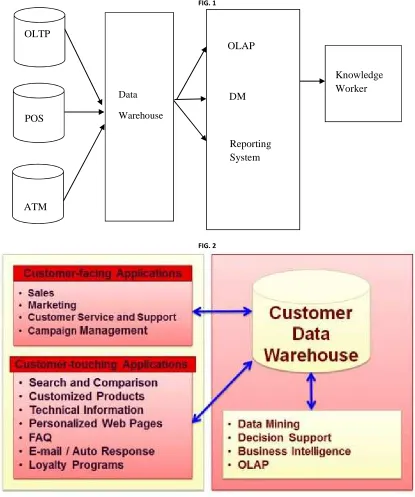
These limitations are actually the main strengths of DM. It appears from this analysis that data warehousing, OLAP, DM, and operational systems can be integrated in a single framework to serve the needs of knowledge workers. This model is shown in following fig:
FIG. 1
FIG. 2
CONCLUSION
Information Communication Technology helps in not only collecting data, analyzing it and learning about the markets and the customers but also assists in transmitting the right information at the right place, in right quantity and in right tempo. This may help the marketers in maintaining long term relationship with the customers. Every transaction with the customer is an opportunity to gather information, invest in relationship marketing and build shareholder value. Moreover, the real time communication enables the marketer to influence each transaction as and when it occurs. Thus, IT has a greater role to play in expanding the opportunities of marketing. The process of gathering information about the customers during each transaction helps the marketer to have complete knowledge about its customers and also build the relationship with the customer.
REFERENCES
1. Irma Becerra et.al. (2009), “Knowledge Management Challenges, Solutions, & Technologies”. Pearson Edition, 1st Edition, pp.286-287.
2. Munusamy K. (2011), “Role of IT in Business Services Management (BSM)”, PR Communication Age, Aug-2011, pp. 17-18.
3. Shweta Puneet (2007), “Business Value Enhancement through Technology in CRM”, Marketing Master Mind, ICFAI University Press,Dec-2007, PP. 11-13. 4. Tapati Bandophyay et.al (2007), “Outlining a Hybrid, Generic CRM Framework for Supporting the Role of Financial Advisors on Insurance Services”, Gitam
Journal of Management, Apr-2007, pp. 63 – 77.
5. Veenapani A. (2006), “Using Information Technology to Enhance Customer Service”, Indian Journal of Marketing, Jun-2006, pp. 36-38.
WEBSITES
6. http://en.wikipedia.org/wiki/Information_and_communications_technology: retrieving on 24-07-2012
7. http://searchcio.techtarget.com/definition/ICT-information-and-communications-technology-or-technologies: retrieving on 24-07-2012
OLAP
OLTP
Knowledge
Worker
Data
Warehouse
DM
POS
Reporting
System
VOLUME NO.6(2016),ISSUE NO.02(FEBRUARY) ISSN 2231-5756
REQUEST FOR FEEDBACK
Dear Readers
At the very outset, International Journal of Research in Commerce, IT & Management (IJRCM) acknowledges
& appreciates your efforts in showing interest in our present issue under your kind perusal.
I would like to request you to supply your critical comments and suggestions about the material published
in this issue as well as on the journal as a whole, on our E-mail
for further
improvements in the interest of research.
If you have any queries, please feel free to contact us on our E-mail
.
I am sure that your feedback and deliberations would make future issues better – a result of our joint effort.
Looking forward an appropriate consideration.
With sincere regards
Thanking you profoundly
Academically yours
Sd/-
Co-ordinator
DISCLAIMER
VOLUME NO.6(2016),ISSUE NO.02(FEBRUARY) ISSN 2231-5756