TECHNICAL NOTE
A COMPUTATIONAL STUDY OF METABOLISM IN SPRINTING
Narendra Kumar
MASS College of Engineering and Management, Aligarh, INDIA [email protected]
(Received: August. 4, 2007 – Accepted in Revised Form: October 5, 2009)
Abstract In this paper, we develop a mathematical model of sprinting in which anaerobic
metabolism is included. This model is simplified by considering the broad changes of energy level and the cyclic variation associated with the strike pattern. We consider the effect of the centre of mass to the overall energy balance along with force of resistance during initial motion of body. Results are obtained for the model from an event of a sprint championship. These computed results closely predict the overall average performance of the participants over the course of entire race.
Keywords Metabolism, Energy equations
هﺪﻴﻜﭼ
ﻲﻣﻪﺋارايزاﻮﻫﺮﻴﻏﻢﺴﻴﻟﻮﺑﺎﺘﻣﺎﺑﺖﻋﺮﺳ يودﻲﺿﺎﻳر لﺪﻣﻚﻳ،ﻪﻟﺎﻘﻣﻦﻳا رد دﻮﺷ
.
رد ﺎﺑلﺪﻣﻦﻳا ﺮﻈﻧ
تاﺮﻴﻴﻐﺗويژﺮﻧاﺢﻄﺳﻊﻴﺳوتاﺮﻴﻴﻐﺗﻦﺘﻓﺮﮔ زاﻲﺷﺎﻧ
ﻮﮕﻟا هدﺎﺳﻪﺑﺮﺿي يزﺎﺳ
ﻲﻣ دﻮﺷ
.
ﻖﻴﻘﺤﺗﻦﻳارد ﺰﻛﺮﻣﺮﻴﺛﺎﺗ
ﻞﻘﺛ ﺮﺑ ﺖﻛﺮﺣﻦﻴﺣردﺖﻣوﺎﻘﻣيوﺮﻴﻧداﺪﺘﻣاردﻲﻠﻛيژﺮﻧالدﺎﻌﺗ ﺖﺳاهﺪﺷﻪﺘﻓﺮﮔﺮﻈﻧردنﺪﺑﻪﻴﻟوا
.
ﺞﻳﺎﺘﻧ ﻦﻳا
لﺪﻣ زا يزﺎﺳ ﺖﺳا هﺪﻣآ ﺖﺳد ﻪﺑ ﺖﻋﺮﺳ يود ﻲﻧﺎﻣﺮﻬﻗ ﻪﻘﺑﺎﺴﻣ ﻚﻳ
.
ﺖﻛﺮﺷ ﻲﻠﻛ ﻂﺳﻮﺘﻣ نﺎﻣﺪﻧار ﺞﻳﺎﺘﻧ ﻦﻳا
ﻲﻣﻲﻨﻴﺑﺶﻴﭘﻲﺑﻮﺧﻪﺑارﻪﻘﺑﺎﺴﻣﺮﻴﺴﻣﻞﻛردنﺎﮔﺪﻨﻨﻛ ﺪﻨﻛ
.
1. INTRODUCTION
Several mathematical applications of bio-energetics for running have been studied. Numerous parameters affect running performance, but one factor among them is particularly important in the present context, when an athlete initiated running, the ability to move rapidly from the starting block depends critically on availability of energy by anaerobic metabolism. Position of centre of mass i.e., the shape of the body plays a vital role in sprinting. Theoretically, an increase in TCr (muscle total creatine) stores may provide an ergogenic effect during sprint exercise by enhancing the rate of ATP synthesis during muscle contraction and by improving the rate of PCr (phosphocretine) resynthesis during recovery, which may be beneficial for repeated sprint activity. The experimental evidence supporting an ergogenic effect for CrS (creatin supplements) is somewhat mixed. Several studies have demonstrated an improved high intensity exercise performance after CrS whereas several others have reported no beneficial effects. Some of the data
probably because the time required for muscle TCr to return to basal levels after CrS was unknown. Hultman et al [4] have demonstrated that this duration is negligible. An improved sprint performance after CrS may result from a more rapid rate of ATP synthesis during exercise. Few studies have examined this possibility. Muscle lactate accumulation, as well as ATP and PCr degradation, was unaltered after a 30-s sprint; this suggests that muscle anaerobic metabolism was unaffected by CrS. This may be misleading, however, because the total work performed during the 30-s bout was greater in the supplemented state, thus indicating that the anaerobic metabolite changes per unit work were actually attenuated by CrS. If this was in fact the case, the mechanism explaining such a phenomenon remains unexplained. Some studies have found that blood lactate and pH, measured during recovery from a sprint bout, were uninfluenced by CrS. It should be noted that CrS produced no cryogenic effect.
It has been suggested that any performance enhancement during intermittent, high-intensity exercise may be associated with an increased rate of PCr synthesis during the recovery periods. Hill [5] studied the relationship between sprint records and physiological data. Ward-Smith [6] found that 92-93% of chemical energy converted during a 100m running is from anaerobic sources. Spriet [7] gave a mathematical model describing the power relationship for oxygen independent glycolysis, phosphocreatine utilization and utilization of endogenous ATP. These mathematical models relate running performance to the physiological parameters by setting down the individual contribution to the whole body energy balance during sprinting. Moravec et al [8] obtain a result for the distance time history of elite sprinters measures at regular intervals over 100m.
The absolute measurement of anabolic power during a complex exercise is too much difficult and the idea of the kinetics as anaerobic metabolism using a computational approach was the motivation for the present work due to its difficulty in this region. The objective of this study is to develop a mathematical model of sprinting by using three-parameter model of anaerobic metabolism.
2. MATHEMATICAL MODEL
If the power contribution is expressed relative to basal metabolic rate, then the equation for sprinting, expressed in per unit body mass can be formed.
(1) Here the energy E is released by chemical reactions as the muscles passes through a number of intermediate stages and in conformity with the first law of thermodynamics is ultimately transformed into external work W, expanded on the centre of mass of the sprinter and rest part of it transformed into heat M. In the above equation, left hand side represents the rate of chemical energy conversion, while first, second and third term on right hand side are the rate of degeneration of mechanical energy into thermal energy, the rate of external mechanical work and variation of cyclic patterns respectively. If the mass of body is m and velocity over the ground is v, then contribution of two principal parts to the rate of external work, one is the rate of increase of kinetic energy of centre of mass of sprinter in horizontal direction,
dt
dv
v
(here, v = dx/dt) and other is rateof working against aerodynamic drag, Dv/m, where D is aerodynamic drag and if h be the distance of centre of mass from ground then the rate of work against gravity can be given as g
dt
dh
, combine these components and using Ward-Smith [9] model,
(2) Here the drag is
(3)
The rate of degeneration of mechanical energy by taking Ward-Smith [9] model in consideration.
Here β is the rate of degeneration of mechanical energy into heat energy per unit velocity and β can be described using Ward-Smith [6].
(5) In equation 5,
0,
1and
2 are positive constants and R is mechanical resistance parameter.The rate of conversion of chemical energy can be written as:
(6) If P is the maximum sustainable aerobic power and λ is a parameter governing the rate of aerobic energy release then the equations (7) turns to the aerobic energy released, according to the experiment done by Margaria [10], written in the form
(7)
(8)
On combining these result, we have
=
)
e
1
(
P
dt
dv
v
dt
dh
g
)
w
R
v
(
v
v
2 t
+
dt
dB
(9)
Here δ=
m
2
eA
(10)
The aerobic power under conditions of maximum exertion, consideration the model of bioenergetics of sprinting given by Lloyd [11], Ward Smith [9] etc., an e P dt dE m
an (11)
Where P
m represent the maximum anaerobic power
and λ
an is a parameter governing the rate of
anaerobic energy released. This expression is most suitable for the period when oxygen independent glycolysis is present there and used when t>0.
Now taking results from Fuller mathematical description of anaerobic metabolism application to small values of t proposed by Ward Smith [9]. If we use the suffix notation i= 1,2,3; where 1 relate to ATP utilization, 2 for Phosphocreatine utilization and 3 for oxygen-independent glycolysis. This power equation turns in the form of
(12)
In above equation P
i and (Pm)I represents the
instantaneous and maximum power of the ist component respectively, θ
i and αi are time
constants relating to the ith component and
Hence the anaerobic power takes the form
(13) and hence ] 1 [ ] ) ( [ 2 t an e P dt dE dt dh g w R v v v v i dt dv
(14) A relation between and
0is
m 2 eA0
0
Here e is the air density, w is wind velocity, Q is projected frontal area of the sprinter, C
D is drag
constant and A (=QC
D) is the drag area.
Here the nominal angle of sprinter’s torso relative to the horizontal can be given by using Ward- Smith [9]
(15) For a sprinter, the centre of mass is raised from its initial position, h
0 of 0.65 m in the blocks to about
1.0 m after some 5 meter have been run. In the present analysis the height of the centre-of-mass above the horizontal running surface, h′ is computed
h′=h
cmsinφ (16)
Where h
cm represent the height of the
centre-of-mass above the ground when sprinter is standing vertically, hence the increase in potential energy is E
h=g(h′-h0)
some of the computed values of h′ fell in the range h′ < 0.63m for these values E
h was taken
negligible.
There is a short delay of duration t
r from the
moment at which the starting gun and measuring equipment are simultaneously activated, Hence total running time t
t are related to tt = t + tr.
3. RESULTS AND DISCUSSION
Present model is free from the error, which are occurred in the previous mathematical models. This model is also free from distance time error
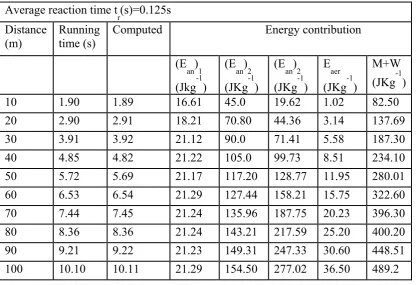
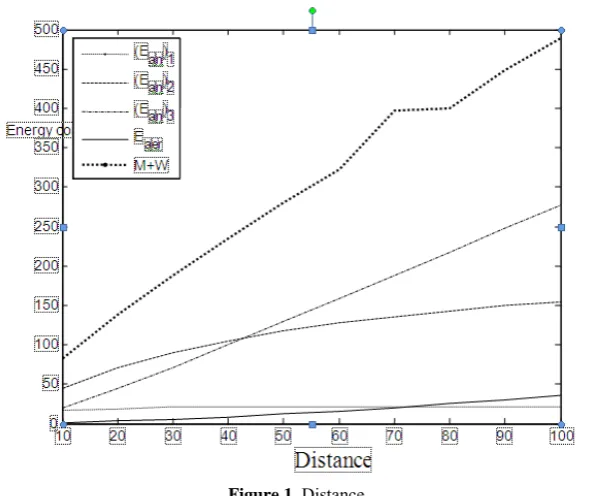
Table 1. Comparison of computed running times with measured running times. The contributions to the overall energy balance are also shown. Anaerobic energy contributions were calculated.
Average reaction time t
r
(s)=0.125s
Distance
(m)
Running
time (s)
Computed Energy contribution
(E
an
)
1(Jkg
-1)
(E
an)
2(JKg
-1)
(E
an)
2(JKg
-1)
E
aer(JKg
-1)
problem which was a major setback to previous research in this field. The data used in this model has been taken from Sports India, a magazine known for providing data of various sports activities. The calculation are within a limit of 0.00543 rms error and time .0054(in both way i. e. positive and negative). When a sprinter adopts the position on the starting block his center-of-mass is a distance h
h behind the starting line about 0.15 –
0.17m. Here we are taking a constant value for h
h
of 0.18m. Equation (14) solved by Milne’s methods, with a time step of 0.01 second and between the limits t=0, x = -h
h and t = tt, x = 100.
The following numerical values are used for computing sprinting performance. v
a =.96 ms -1
, A = 3.90Jkg-1 m-1, K
0 = .0027 m -1
, h
cm = 1.01 m. as
we analyze above model, we are considering some values as α
3 = .031 unit θ3= .32 unit, α2 = .20 unit,
θ
2=2.9 unit α1 = .9unit θ1= .19 unit
The maximum power developed by oxygen indep. Glycolysis, PC, utilization and endogenous ATP utilization were determined as 35, 31.1, and 16.7 respectively. The time at which these peaks occur
were evaluated as 7.0, 0.90, 0.10 seconds respectively.
Several aspects of the kinetics of anaerobic energy release during exercise. The ATP store followed by PCr utilization early stage of anaerobic metabolism, while the energy supplied by each process is in the reverse order.
4. NUMERICAL ILLUSTRATION
In this section, we present the numerical results to compare the computed running times with measured running times. The contributions to the overall energy balance are also shown. Anaerobic energy contributions are also shown in the simulation results. Computer program is developed in software MATLAB and run on Pentium IV.
5. REFERENCES
1. Casey, A., Constantin-Teodosiu, D., Howell, S. Hultman, E. and Greenhaff, P.L.(1996): Creatin ingestion favorably affects performance and muscle
metabolism during maximal exercise in humans. Am.
J.Physiol.(271), pp31-37.
2. Febbraio, M. A., Flanagan, T.R., Snow, R.J., Zhao, S. and Carey, M.F.(1995): Effect of creatin supplementation on intramuscular TCr, metabolism and performance during intermittent, super-maximal exercise in humans. Acta Physiol Scand (155). Pp
207-209.
3. Birch, R., Noble, D. and Greenhaff, P.L.(1994): The influence of dietary creatin supplementation on performance during repeated bouts of maximal isokinetic cycling in man. Euro. J Appl. Physiol.(69) pp 268-270.
4. Hultman, E., Soderlund, K., Timmons, J.A. Cederblad, G. and Greenhaff, .L.(1996): Muscle creatin loading in men. J. Appl. Physiol.(81)pp232-237.
5. Hill, A.V.(1925): The physiological basis of athletics records. Presidential address to the physiological section of British Association for the advancement of science.
Lancet 2, pp481-486.
6. Ward Smith, A.J.(1985): A Mathematical Theory of running based on the first law of thermodynamics and its applications to the performance of world class athletes. Journal of Biomechanics, vol-18, pp.337-349.
7. Spriet, L.L.(1995): Anaerobic metabolism during high intensity exercise. Human Kinetics Publications,
Champaign, pp 1-39.
8. Moravec, P., Ruzika, J., Susanka, P., Dostal, E., Kodejs, M. and Nosek, M.(1987): The 1987 International Athletic foundation/ IAAF scientific project
reports; time analysis of the 100 meters events at the II world championship in athletics. New studies in athletics.
9. Ward Smith, A.J.(1999): “New insight into the effect of blind assistance on sprinting performance”. Journal of
Sports Science, vol-17, pp325-324.