Please cite this article as: E. Mehdizadeh, A. Fatehi Kivi, Three Meta-heuristic Algorithms for the Single-Item Capacitated Lot-sizing Problem. International Journal of Engineering (IJE) Transactions B: Applications Vol. 27, No. 8, (2014): 1223-1232
International Journal of Engineering
J o u r n a l H o m e p a g e : w w w . i j e . i r
Three Meta-heuristic Algorithms for the Single-item Capacitated Lot-sizing Problem
E. Mehdizadeh*, A. Fatehi Kivi
Faculty of Industrial and Mechanical Engineering, Qazvin Branch, Islamic Azad University, Qazvin, Iran
P A P E R I N F O
Paper history: Received 04 October 2013
Received in revised form 22 February 2014 Accepted in 06 March 2014
Keywords:
Lot-sizing Safety stocks Simulated Annealing
Vibration damping Optimization Harmony Search
A B S T R A C T
This paper proposes a mixed integer programming model for single-item capacitated lot-sizing problem with setup times, safety stock, demand shortages, outsourcing and inventory capacity. Due to the complexity of problem, three meta-heuristics algorithms named simulated annealing (SA), vibration damping optimization (VDO) and harmony search (HS) have been used to solve this model. Additionally, Taguchi method is conducted to calibrate the parameters of the meta-heuristics and select the optimal levels of the algorithm’s performance influential factors. Computational results on a set of randomly generated instances show the efficiency of the HS against VDO and SA.
doi: 10.5829/idosi.ije.2014.27.08b.08
1. INTRODUCTION
1
Planning problem consists in deciding how to transform raw material into final goods as to satisfy demand at minimum cost. The lot-sizing problem (LSP) is a crucial step and well-known optimization problem in production planning in which involved time-varying demand for set of N items over T periods. It is a class of production planning problems in which the availability amounts of the production plan are always considered as decision variable. Two versions of the lot-sizing problems are capacitated and uncapacitated lot-sizing problem. The uncapacitated single-item version of the problem can be solved efficiently using dynamic programming [1]. Stadtler [2] changed the single-item uncapacited lot-sizing model considering the planning horizon theory. Aksen, et al [3] addressed a profit maximization version of the well-known Wagner– Whitin model for the deterministic single-item uncapacitated lot-sizing problem with lost sales. They proposed an O(T2) forward dynamic programming algorithm to solve the problem. Akbalik and Rapine [4]
*Corresponding Author’s Email: [email protected] (Esmaeil Mehdizadeh)
considered the uncapacitated lot sizing problem with batch delivery. Akbalik and Rapine [5] considered the single-item uncapacitated lot-sizing problem with batch delivery, focusing on the general case of time-dependent batch sizes. They showed that the problem is polynomially solvable in time O(T3), where T denotes the number of periods of the horizon.
In industrial applications, several factors may sophisticate making best decisions. For instance, capacity can be led to impossibility to satisfy demand. For this reason, the capacitated lot-sizing problem and its variations have received a lot of attention from academic researchers. Montgomery, et al. [6] Presented several single-echelon, single-item, static demand inventory models for situations in which, during the stock out period, a fraction b of the demand is backordered and the remaining fraction 1 - b is lost forever. On the other hand, backlogging, safety stocks and limited outsourcing are three complicating constraints to reach desired solutions in lot-sizing problem.
In addition, both deterministic and stochastic demands are considered. He considered only part of the fixed costs associated with decision making in improving programming in order to develop a model
which can cover periods beyond the planning horizon and can be applicable to a wide range of decision making models. He also proved that if the periods in the planning horizon are not fixed, dynamic optimum methods will not function non-optimally. Abad [7] considered the problem of determining the optimal price and lot-size for a reseller. He assumed that demand can be backlogged and that the selling price is constant within the inventory cycle. Karimi, et al. [8] considered single level lot-sizing problems, their variants and solution approaches. Berretta and Rodrigues [9]
developed methods based on evolutionary
metaheuristics to solve a complex problem in production planning, the multi-stage lot-sizing problem with capacity constraints. Brahimi, et al. [10] presented four different mathematical programming formulations of the Single-item lot-sizing problems. Robinson et al. [11] updates a 1988 review of the coordinated lot-sizing problem and complements reviews on the single-item lot-sizing problem and the capacitated lot-sizing problem. Akbalik and Penz [12] studied a special case of the single-item capacitated lot-sizing problem, where alternative machines are used for the production of a single-item. They proposed an exact pseudo-polynomial dynamic programming algorithm which makes it NP-hard in the ordinary sense. They also gave three mixed integer linear programming (MILP) formulations that we have found in the literature for the simplest case of the problem. Akbalik and Pochet [13] presented a new class of valid inequalities for the single-item capacitated lot-sizing problem with step-wise production costs. They proposed a cutting plane algorithm for different classes of valid inequalities introduced. Wang, et al. [14] addressed the single-item, dynamic lot-sizing problem for systems with remanufacturing and outsourcing. They proposed a dynamic programming approach to derive the optimal solution in the case of large quantities of returned product. Mikhail, et al. [15] proposed a straightforward O nLogn( ) time algorithm for the single-item capacitated lot-sizing problem with linear costs and no backlogging.
The capacitated lot-sizing problems encountered in real-life situations are generally intractable due to a number of practical constraints. The decision maker has to find a good feasible solution in a reasonable execution time rather than an optimal one. Tang [16] provides a brief presentation of simulated annealing techniques and their application in lot-sizing problems. Mokhtari and Kianfar [17] considered a production system in which the orders of several customers are produced in a single batch. The problem was to decide on batch size, due date of batch and lead time so that relevant costs are minimized. Production flow times are probabilistic which follow a probability distribution. The proposed model is solved using real-coded genetic algorithms. Jenabi et al. [18] considered the economic
lot and delivery scheduling problem in a two-echelon supply chains, where a single supplier produces multiple components on a flexible flow line and delivers them directly to an assembly facility. They developed a new mixed zero-one nonlinear mathematical model for the problem. Two meta-heuristic algorithms (HGA and SA) were proposed. Piperagkas, et al. [19] investigated the dynamic lot-size problem under stochastic and non-stationary demand over the planning horizon. They used three popular heuristic methods from the fields of evolutionary computation and swarm intelligence, namely particle swarm optimization, differential evolution and harmony search for solve the model. Chu, et al. [20] addressed a real-life production planning problem arising in a manufacturer of luxury goods. The problem modeled as a single-item dynamic lot-sizing model with backlogging, outsourcing and inventory capacity. They showed that this problem can be solved
in O(T4logT) time where T is the number of periods in
the planning horizon.
The main contribution of this paper is twofold. First, we develop a single-item capacitated lot-sizing model with demand shortage, safety stock, limited outsourcing and several manners for produce. Then, we use simulated annealing, vibration damping optimization and harmony search algorithms to solve the problem and compared them together.
The remaining of this paper is organized as follows: Section 2 describes a MIP formulation of the single-item capacitated lot-sizing problem with backlogging, safety stocks and limited outsourcing.
The solution approaches for solving the proposed model introduced in Section 3. The Taguchi method for tuning the parameters and computational experiments presented in Section 4. The conclusions and suggestions for future studies are included in Section 5.
2. PROBLEM FORMULATION
The single-item capacitated lot-sizing problem with backlogging, safety stocks and limited outsourcing is a production planning problem in which there is a time-varying demand for an item over T periods. In this section, we present a MIP formulation of the problem. First, the problem assumptions, parameters, and decision variables have thoroughly been introduced and then the proposed model has been defined.
2. 1. Assumptions Before the formulation is
presented, the following assumptions are made on the problem:
• The demand is considered deterministic.
• Shortage is backlogged.
• Raw material resource with given capacities are considered.
• The quantity of inventory and shortage at the beginning of the planning horizon is zero.
• The quantity of inventory and shortage at the end of the planning horizon is zero.
2. 2. Parameters
T: Number of periods in the planning horizon, t=1, …, T.
J: Number of production manner, j=1, …, J
rt: The selling price of each unit in the period t.
Cjt: The production cost of each unit in the period t
through the manner j.
Ajt: The setup cost of the production in the period t
through the manner j.
:
t
h+ The unit holding cost in the period t.
:
th
− Unitary safety stock deficit cost in period t.dt: The demand in the period t.
Lt: The quantity of the safety stock of product in the
period t.
:
t
∂ Unitary shortage cost in period t.
Bkt: The capacity of the K source at hand in the period t.
:
k
α The quantity of K source used by each unit of the
product.
fjk: The quantity of wasted K source produced through
the manner j.
:
t
γ Unit out-sourcing cost at period t.
:
v
Space need for per unit.:
t
ϕ The total available space in period t.
2. 3. Decision Variables
Xjt: Production quantity in the period t through the manner
j.
yjt: Binary variable; 1 if the produced in the period t
through the manner j, otherwise jt
y = 0.
Ut: Out-sourcing level at period t.
:
t
I− The quantity of shortage in the period t
:
t
S+ The quantity of overstock deficit in the period t.
: t
S− The quantity of safety stock deficit in the period t
2. 4. The Proposed Model
1 1 1
( ) ( )
T J J
t jt t jt jt jt jt tt t t t t t t
t j j
MaxZ r X U C X A y I− h S+ + h S− − γU
= = =
= + − − −∂ − − −
∑ ∑ ∑ (1)
Subject to:
1 1 1 1
1
J
t t t t jt t t t t t t
j
S+− S−− I−− I− X U S+ S− d L L−
=
− − + +
∑
+ = − + + −∀ t =1, 2,....,T
(2)
0 T
S+= (3)
0 T
I−= (4)
(
)
1
J
k jt jk jt kt j
X f y B
α
=
+ ≤
∑
∀ k =1, 2,...,K ,1, 2,....,
t= T
(5)
jt t jt
X ≤M y
∀
j =1, 2,....,J t =1, 2,....,T (6)t t
I−≤d
∀
t =1, 2,....,T −1 (7)t t
S−≤L
∀
t=1, 2,....,T (8)1 1
0 Ut It St dt Lt
− −
− −
≤ ≤ + + +
∀
t=1, 2,....,T (9)1
( )
J
jt t t
j
v X U ϕ
=
+ ≤
∑
∀
t=1, 2, ....,T (10){0,1} jt
y ∈
∀
j=1, 2,....,J , t =1, 2,....,T (11), , , 0
jt t t t
X I−S S− +≥
∀
j =1, 2,....,J , t =1, 2, ...T (12) The objective function (1) shows difference between selling price with the total cost. Constraints (2) are the inventory flow conservation equations through the planning horizon. Constraints 3 and 4 define respectively, the demand shortage and the safety stock deficit for item at end period is zero. Constraints 5 are the capacity constraints; the overall consumption must remain lower than or equal to the available capacity. If we produce an item at period t, then constraints 6 impose that the quantity produced must not exceed a maximum production level Mt. Mt could beset to theminimum between the total demand requirement for item on section [t, T] of the horizon and the highest quantity of item that could be produced regarding the capacity constraints, then Mt can be show as Equation
(13). Constraints 7 and 8 define upper bounds on, respectively, the demand shortage and the safety stock deficit for item in period t. Constraints 9 ensure that outsourcing level Ut at period t is nonnegative and
Constraints 11 and 12 characterize yjt is a binary
variable and the variable's domains: X jt,It ,St ,St
− − +
are non-negative for j ∈ J and t ∈ T.
1
, (13)
T
kt jk
t t
t k
B f
M Min d
α =
−
=
∑
(13)3. SOLUTION APPROACHES
3. 1. Simulated Annealing Algorithm Simulated
annealing (SA) was initially presented by Kirkpatrick, et al. [21]. The SA methodology draws its analogy from the annealing process of solids. This analogy can be used in combinatorial optimization in which the state of solid corresponds to the feasible solution. The energy at each state also corresponds to the improvement in the objective function and the minimum energy state will be the optimal solution. In this paper, we used simple SA algorithm which its pseudo-code is shown in Figure 1.
Two important issues that need to be defined when adopting this general algorithm to a specific problem are the procedures to generate both initial solution and neighboring solutions.
3. 1. 1. Representation Schema To design
simulated annealing optimization algorithm for mentioned problem, a suitable representation scheme that shows the solution characteristics is needed. In this paper, the general structure of the solution representation performed for running the simulated annealing for four periods with two production manners is shown in Figure 2.
Figure 1. Pseudo-code of the SA algorithm
Y24
Y14
Y23
Y13
Y22
Y12
Y21
Y11
1 0 0 1 0 1 1 0
Figure 2. Solution representation.
Figure 4. Pseudo-code of the VDO algorithm
3. 1. 2. Neighborhood Scheme At each temperature
level a search process is applied to explore the neighborhoods of the current solution. In this paper, we use mutation scheme. Figure 3 illustrates this operation on the four periods with two production manners.
3. 2. Vibration Damping Optimization
Recently, a
new heuristic optimization technique based on the concept of the vibration damping in mechanical vibration was introduced by Mehdizadeh and Tavakkoli-Moghaddam [22] named vibration damping optimization (VDO) algorithm. They utilized the algorithm to solve parallel machine scheduling problem. In this paper, we used simple VDO algorithm which its pseudo-code is illustrated in the Figure 4.
3. 3. Harmony Search Algorithms Harmony
search (HS) is a new heuristic method that mimics the improvisation of music players. HS was proposed by Geem et al. [23]. Inspiration was drawn from musical
1
0 0 1 0 1 1 0
1 0 1 1 0 1 1 0
Figure 3. An example of the neighborhood structure
Select an initial solution, X0
Xbest = X0, X = X0
While (T0 > Tf) Do
S = 0
While (S < L) Do
Generate solution Xn in the neighborhood of X,
( n) ( )
C C X C X
∆ = −
If ∆ ≤C 0 then Xbest = Xn
Else
Generate y →U
( )
0,1 RandomlyIf 1 0
C T
r e
∆ −
< − then
X = Xn
End if S = S + 1 End While End While T0 = α× T0
End While
0
0,
t = A=A
Select an initial solution, X0
Xbest = X0
While (t< tmax) Do
N = 0
While (N < Lmax) Do
Select a move randomly and run over Xn as: ( new) ( last)
E E X E X
∆ = −
If ∆ <E 0 then
Xbest =Xnew And Xn=Xnew
Else
Generate r→U[0,1]
If
2 2
( /2 )
1
Atr
< −
e
− σ thenXn =Xnew End if N = N + 1 End While
( /2)
0 t t
A =A e −γ
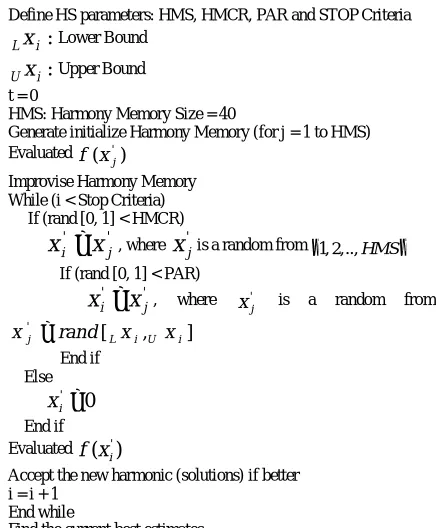
performance processes that occur when a musician searches for a better state of harmony, improvising the instrument pitches towards a better aesthetic outcome. The HS algorithm imposes fewer mathematical requirements and does not require specific initial value settings of the decision variables [24]. The pseudo-code of applied HS algorithm for the problem is shown in Figure 5.
4. COMPUTATIONAL RESULTS
In this paper, all tests are conducted on a notbook with Intel Core i5 Processor 2.53 GHz and 4 GB of RAM. The proposed algorithms namely SA, VDO and HS are coded in Visual Basic 2000.
4. 1. Parameter Calibration Appropriate design
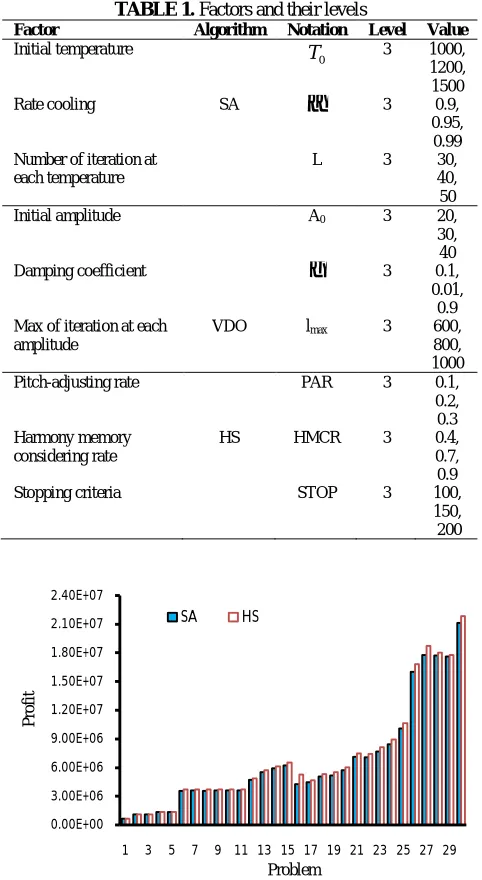
of parameters has significant impact on efficiency of meta-heuristics. In this paper, the Taguchi method applied to calibrate the parameters of the proposed methods namely SA, VDO and HS algorithms. The Taguchi method was developed by Taguchi [25]. This method is based on maximizing performance measures called signal-to-noise ratios in order to find the optimized levels of the effective factors in the experiments. The S/N ratio refers to the mean-square deviation of the objective function that minimizes the mean and variance of quality characteristics to make them closer to the expected values. For the factors that have significant impact on S/N ratio, the highest S/N ratio provides the optimum level for that factor. As mentioned before, the purpose of Taguchi method is to maximize the S/N ratio. In this subsection, the parameters for experimental analysis are determined. Table 1 lists different levels of the factors for SA, VDO and HS. In this paper, according to the levels and the number of the factors, the Taguchi method L9 is used
for the adjustment of the parameters.
Figures 6, 7 and 8 show S/N ratios. According to these figures 1000, 40, 0.99, 20, 0.1, 1000, 0.1, 0.7 and 150 are the optimal level of the factors T0, L, α, A0,
γ
,lmax, PAR, HMCR and STOP.
Figure 6. The SN ratios for Simulated Annealing
Figure 5. Pseudo-code of the HS algorithm
Figure 7. The SN ratios for Vibration Damping
Figure 8. The SN ratios for Harmony Search
3 2 1 133.05 133.00 132.95 3 2 1 3 2 1 133.05 133.00 132.95 Initial temperature M e an o f SN r a ti os Rate cooling
Max of iteration
Signal-to-noise: Larger is better
3 2 1 133.02 132.99 132.96 132.93 132.90 3 2 1 3 2 1 133.02 132.99 132.96 132.93 132.90 initial amplitude M e an o f SN r a ti o s
max of iteration
damping coefficient 3 2 1 135.17 135.16 135.15 135.14 135.13 3 2 1 3 2 1 135.17 135.16 135.15 135.14 135.13 PAR M ea n o f SN r a ti os HMCR STOP
Define HS parameters: HMS, HMCR, PAR and STOP Criteria :
Lxi Lower Bound
:
Uxi Upper Bound
t = 0
HMS: Harmony Memory Size = 40
Generate initialize Harmony Memory (for j = 1 to HMS) Evaluated '
( j)
f x
Improvise Harmony Memory While (i < Stop Criteria) If (rand [0, 1] < HMCR)
' '
i j
x =x , where x'jis a random from {1, 2,..,HMS} If (rand [0, 1] < PAR)
xi' =x'j, where '
j
x is a random from
'
[ , ]
j L i U i
x =ra n d x x
End if Else xi'=0
End if Evaluated f x( i')
Accept the new harmonic (solutions) if better i = i + 1
End while
TABLE 1. Factors and their levels
Factor Algorithm Notation Level Value Initial temperature
0
T 3 1000,
1200, 1500
Rate cooling SA
α
3 0.9,0.95, 0.99 Number of iteration at
each temperature
L 3 30,
40, 50
Initial amplitude A0 3 20,
30, 40
Damping coefficient
γ
3 0.1,0.01, 0.9 Max of iteration at each
amplitude
VDO lmax 3 600,
800, 1000
Pitch-adjusting rate PAR 3 0.1,
0.2, 0.3 Harmony memory
considering rate
HS HMCR 3 0.4,
0.7, 0.9
Stopping criteria STOP 3 100,
150, 200
Figure 9. Comparison between solution quality of the HS and SA
Figure 10. Comparison between solution quality of the HS and VDO
Figure 11. Comparison between solution quality of the SA and VDO
4. 2. Computational Results Computational
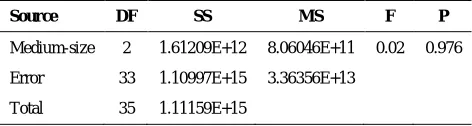
experiments are conducted to validate and verify the behavior and the performance of the meta-heuristic algorithms employed to solve the considered single-item capacitated lot-sizing problem with backlogging, safety stocks and limited outsourcing. We try to test the performance of the SA, VDO and HS in finding good quality solutions in reasonable time for the problem. For this purpose, 30 problems with different sizes are generated. These test problems are classified into three classes: small size, medium size and large size.
The number of manners and periods has the most impact on problem hardness. The proposed model coded with Lingo (ver.8) software using for solving the instances. The approaches are implemented to solve each instance in five times to obtain more reliable data. The best results are recorded as a measure for the related problem. Table 2 shows details of computational results obtained by solution methods for all test problems. The results of running SA, VDO and HS are compared with the optimal solution of the instances, obtained from Lingo software, in row 1 to 12 of Table 2.
The presented statistical analysis (the variance analysis outcome) were reported for problems with small, medium, and large dimensions, in Tables 3, 4 and 5. According to the values of the survey (or P-Value), we can reach to the conclusion that the SA, VDO and HS can find good quality solutions for all test problems because deference between solutions are small. Thus, we cannot chose the better algorithm using ANOVA related.
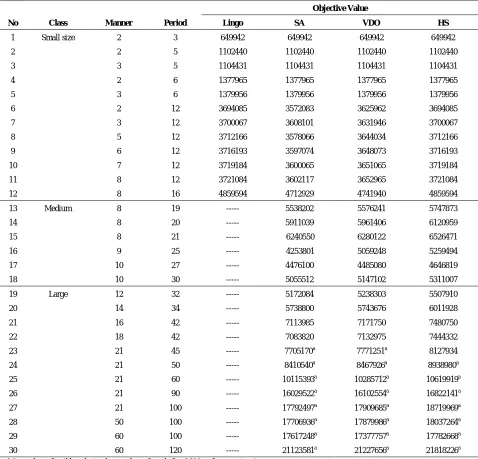
In addition, Figure 9 depicts comparison between solution quality of the SA and HS of the instances. Figure 10 depicts comparison between solution quality of the VDO and HS of the instances. Figure 11 depicts comparison between solution quality of the SA and VDO of the instances. A general review of the results in Table 2 and Figures 9, 10 and 11 is:
0.00E+00 3.00E+06 6.00E+06 9.00E+06 1.20E+07 1.50E+07 1.80E+07 2.10E+07 2.40E+07
1 3 5 7 9 11 13 15 17 19 21 23 25 27 29
P
ro
fit
Problem
SA HS
0.00E+00 3.00E+06 6.00E+06 9.00E+06 1.20E+07 1.50E+07 1.80E+07 2.10E+07 2.40E+07
1 3 5 7 9 11 13 15 17 19 21 23 25 27 29
P
ro
fit
Problem VDO HS
0.00E+00 3.00E+06 6.00E+06 9.00E+06 1.20E+07 1.50E+07 1.80E+07 2.10E+07 2.40E+07
1 3 5 7 9 11 13 15 17 19 21 23 25 27 29
P
ro
fit
o The HS can find optimal solutions for small size problems.
o The HS can find good quality solutions for all size problems.
o The objective values obtained by HS are equals to Lingo and also is better from SA and VDO results for all test problems.
o The SA, VDO and HS algorithm can solve all the test problems.
o The objective values obtained by SA and VDO are closes to each other.
o For small size test problems, SA and VDO have relatively the same results with other methods. However, its results will be worse when the problem size increases.
TABLE 2. Details of computational results for all test problems.
No Class Manner Period
Objective Value
Lingo SA VDO HS
1 Small size 2 3 649942 649942 649942 649942
2 2 5 1102440 1102440 1102440 1102440
3 3 5 1104431 1104431 1104431 1104431
4 2 6 1377965 1377965 1377965 1377965
5 3 6 1379956 1379956 1379956 1379956
6 2 12 3694085 3572083 3625962 3694085
7 3 12 3700067 3608101 3631946 3700067
8 5 12 3712166 3578066 3644034 3712166
9 6 12 3716193 3597074 3648073 3716193
10 7 12 3719184 3600065 3651065 3719184
11 8 12 3721084 3602117 3652965 3721084
12 8 16 4859594 4712929 4741940 4859594
13 Medium 8 19 --- 5538202 5576241 5747873
14 8 20 --- 5911039 5961406 6120959
15 8 21 --- 6240550 6280122 6526471
16 9 25 --- 4253801 5059248 5259494
17 10 27 --- 4476100 4485080 4646819
18 10 30 --- 5055512 5147102 5311007
19 Large 12 32 --- 5172084 5238303 5507910
20 14 34 --- 5738800 5743676 6011928
21 16 42 --- 7113985 7171750 7480750
22 18 42 --- 7083820 7132975 7444332
23 21 45 --- 7705170a 7771251a 8127934
24 21 50 --- 8410540a 8467926a 8938980a
25 21 60 --- 10115393a 10285712a 10619919a
26 21 90 --- 16029522a 16102554a 16822141a
27 21 100 --- 17792497a 17909685a 18719969a
28 50 100 --- 17706936a 17879986a 18037264a
29 60 100 --- 17617248a 17377757a 17782668a
30 60 120 --- 21123581a 21227656a 21818226a
— Means that a feasible solution has not been found after 3600 s of computing time.
a Means that finding the optimum solution requires more than 3600 s and the objective value at this time has been recorded.
[ 6 0 , 8 5 ]; [ 2 0 0 0 0, 3 0 0 0 0 ]; [1, 1 0 ]; [ 4 5 0 00 , 7 0 0 0 0 ]; [1, 4 ];
[1 4 ,1 9 ]; [1 2, 1 6 ]; [ 7 , 1 0 ]; [3 0 0 0 0 , 4 5 0 0 0 ]; 1; 2 0; 1 2
jt jt t t t
t t t t V t k t
C A d r L
h− h+ γ ϕ B
∈ ∈ ∈ ∈ ∈
∈ ∈ ∈ ∈ =
TABLE 3. Analysis of variance for test problems with small size
Source DF SS MS F P
Small-size 2 30801819025 15400909512 0.01 0.992
Error 33 6.74642E+13 2.04437E+12 Total 35 6.74950E+13
TABLE 4. Analysis of variance for test problems with medium size
Source DF SS MS F P
Medium-size 2 3.80847E+11 1.90424E+11 0.38 0.691 Error 15 7.52589E+12 5.01726E+11
Total 17 7.90674E+12
TABLE 5. Analysis of variance for test problems with large size
Source DF SS MS F P
Medium-size 2 1.61209E+12 8.06046E+11 0.02 0.976
Error 33 1.10997E+15 3.36356E+13 Total 35 1.11159E+15
5. CONCLUSION
In this paper, we propose a mathematical formulation of a new single-item capacitated lot-sizing problem with backlogging, safety stocks and limited outsourcing. This formulation takes into account several industrial constraints such as shortage costs, safety stock deficit costs and limited outsourcing. Due to the complexity of the problem, three meta-heuristic algorithms are used to solve problem instances. Additionally, an extensive parameter setting with performing the Taguchi method is conducted for selecting the optimal levels of the factors that effect on algorithm’s performance. Computational results on a set of randomly generated instances showed the efficiency of the HS against VDO and SA algorithms.
One straightforward opportunity for future research is extending the assumption of the proposed model for including real conditions of production systems such as limited inventory, fuzzy demands and etc. In addition, a new heuristic or meta-heuristic to construct better feasible solutions can be developed.
[1-25]
6. REFERENCES
1. Wagner, H.M. and Whitin, T.M., "Dynamic version of the economic lot size model", Management science, Vol. 5, No. 1, (1958), 89-96.
2. Stadtler, H., "Improved rolling schedules for the dynamic single-level lot-sizing problem", Management Science, Vol .46 ,No. 2, (2000), 318-326.
3. Aksen, D., Altınkemer, K. and Chand, S., "The single-item lot-sizing problem with immediate lost sales", European Journal of Operational Research, Vol. 147, No. 3, (2003), 558-566. 4. Akbalik, A. and Rapine, C., "Polynomial time algorithms for the
constant capacitated single-item lot sizing problem with stepwise production cost", Operations Research Letters, Vol. 40, No. 5, (2012), 390-397.
5. Akbalik, A. and Rapine, C., "The single item uncapacitated lot-sizing problem with time-dependent batch sizes: Np-hard and polynomial cases", European Journal of Operational Research, Vol. 229, No. 2, (2013), 353-363.
6. Montgomery, D.C., Bazaraa, M. and Keswani, A.K., "Inventory models with a mixture of backorders and lost sales " , Naval Research Logistics Quarterly, Vol. 20, No. 2, (1973), 255-263. 7. Abad, P.L., "Optimal price and order size for a reseller under
partial backordering", Computers & Operations Research, Vol. 28, No. 1, (2001), 53-65.
8. Karimi, B., Fatemi Ghomi, S .and Wilson, J., "The capacitated lot sizing problem: A review of models and algorithms", Omega, Vol. 31, No. 5, (2003), 365-378.
9. Berretta, R. and Rodrigues, L.F., "A memetic algorithm for a multistage capacitated lot-sizing problem", International Journal of Production Economics, Vol. 87, No. 1, (2004), 67-81.
10. Brahimi, N., Dauzere-Peres, S., Najid, N.M. and Nordli, A., "Single item lot sizing problems", European Journal of Operational Research, Vol. 168, No. 1, (2006), 1-16.
11. Robinson, P , Narayanan, A. and Sahin, F., "Coordinated . deterministic dynamic demand lot-sizing problem: A review of models and algorithms", Omega, Vol. 37, No. 1, (2009), 3-15. 12. Akbalik, A. and Penz, B., "Exact methods for single-item
capacitated lot sizing problem with alternative machines and piece-wise linear production costs", International Journal of Production Economics, Vol. 119, No. 2, (2009), 367-379. 13. Akbalik, A. and Pochet, Y., "Valid inequalities for the
single-item capacitated lot sizing problem with step-wise costs", European Journal of Operational Research, Vol. 198, No. 2, (2009), 412-434.
14. Wang, N., He, Z., Sun, J., Xie, H. and Shi, W., "A single-item uncapacitated lot-sizing problem with remanufacturing and outsourcing", Procedia Engineering, Vol. 15, No., (2011), 5170-5178.
15. Kovalyov, M.Y. and Pesch, E., "An algorithm for a single-item capacitated lot-sizing problem with linear costs and no backlogging", International Journal of Production Research, Vol., No. ahead-of-print, (2013) 4-1.
16. Tang, O., "Simulated annealing in lot sizing problems", International Journal of Production Economics, Vol. 88, No. 2, (2004), 173-181.
17. Mokhtari, G. and Kianfar, F., "Simultaneous due date assignment and lot sizing with uncertain flow times ," International Journal of Engineering Transactions A Basics, Vol. 20, No. 3, (2007), 263.
18. Jenabi, M., Ghomi, S.F. and Torabi, S., "Finite horizon economic lot and delivery scheduling problem: Flexible flow lines with unrelated parallel machines and sequence dependent setups", International Journal of Engineering, Vol. 21, (2008), 143-158.
20. Chu, C., Chu, F., Zhong, J. and Yang, S., "A polynomial algorithm for a lot-sizing problem with backlogging, outsourcing and limited inventory", Computers & Industrial Engineering, Vol. 64, No. 1, (2013), 200-210.
21. Brooks, S. and Morgan, B., "Optimization using simulated annealing", The Statistician, Vol., No., (1995), 241-257. 22. Mehdizadeh, E. and Tavakkoli-Moghaddam, R., "Vibration
damping optimization algorithm for an identical parallel machine scheduling problem", in Proceeding of the 2nd
International Conference of Iranian Operations Research Society. (2009), 20-22.
23. Geem, Z.W., Kim, J.H. and Loganathan, G., "A new heuristic optimization algorithm: Harmony search", Simulation, Vol. 76, No. 2, (2001), 60-68.
24. Yadav, P., Kumar, R., Panda, S.K. and Chang, C., "An intelligent tuned harmony search algorithm for optimisation", Information Sciences, Vol. 196, No., (2012), 47-72.
Three Meta-heuristic Algorithms for the Single-item Capacitated
Lot-sizing Problem
RESEARCH NOTE
E. Mehdizadeh, A. Fatehi Kivi
Faculty of Industrial and Mechanical Engineering, Qazvin Branch, Islamic Azad University, Qazvin, Iran
P A P E R I N F O
Paper history: Received 04 October 2013
Received in revised form 22 February 2014 Accepted in 06 March 2014
Keywords:
Lot-sizing Safety stocks Simulated Annealing
Vibration damping Optimization Harmony Search
هﺪﯿﮑﭼ
ﺖﯾدوﺪﺤﻣﻦﺘﻓﺮﮔﺮﻈﻧردﺎﺑﯽﻟﻮﺼﺤﻣﮏﺗشرﺎﻔﺳهزاﺪﻧاﻦﯿﯿﻌﺗﻪﻠﺌﺴﻣياﺮﺑﻂﻠﺘﺨﻣﺢﯿﺤﺻدﺪﻋلﺪﻣﮏﯾﻪﻟﺎﻘﻣﻦﯾارد نﺎﻣز،ﺖﯿﻓﺮﻇ هاريﺎﻫ
دﻮﺷﯽﻣﻪﺋارارﺎﺒﻧايﺎﻀﻓويرﺎﭙﺴﻧوﺮﺑ،دﻮﺒﻤﮐ،نﺎﻨﯿﻤﻃايدﻮﺟﻮﻣ،يزاﺪﻧا .
ﻪﻠﺌﺴﻣﯽﮔﺪﯿﭽﯿﭘﻪﺑﻪﺟﻮﺗﺎﺑ
ﻮﮕﻟاﻪﺳ اﺮﻓﻢﺘﯾر ﻪﺑهﺪﺷﻪﺋارالﺪﻣﻞﺣياﺮﺑﯽﻧﻮﻣرﺎﻫيﻮﺠﺘﺴﺟوشﺎﻌﺗراﯽﯾاﺮﯿﻣيزﺎﺳﻪﻨﯿﻬﺑ،ﺪﯾﺮﺒﺗيزﺎﺳﻪﯿﺒﺷيرﺎﮑﺘﺑا
ﯽﻣﻪﺘﻓﺮﮔرﺎﮐ ﺪﻧﻮﺷ
. ﻢﺘﯾرﻮﮕﻟايﺎﻫﺮﺘﻣارﺎﭘﻢﯿﻈﻨﺗرﻮﻈﻨﻣﻪﺑﯽﭼﻮﮔﺎﺗشورزاﻦﯿﻨﭽﻤﻫ اﺮﻓيﺎﻫ
ﻪﻨﯿﻬﺑحﻮﻄﺳبﺎﺨﺘﻧاويرﺎﮑﺘﺑا
نآ ﯽﻣهدﺎﻔﺘﺳاﺎﻫ دﻮﺷ
. ﻞﺣزاﯽﺗﺎﺒﺳﺎﺤﻣﺞﯾﺎﺘﻧ هﺪﺷﺪﯿﻟﻮﺗﯽﻓدﺎﺼﺗترﻮﺻﻪﺑﻪﮐيدﺪﻋيﺎﻫلﺎﺜﻣ
نﺎﺸﻧ،ﺪﻧا ﯽﻣ ﻪﮐﺪﻨﻫد
ﻪﯿﺒﺷﺪﯾﺮﺒﺗوشﺎﻌﺗراﯽﯾاﺮﯿﻣﺎﺑﻪﺴﯾﺎﻘﻣردﯽﻧﻮﻣرﺎﻫيﻮﺠﺘﺴﺟﻢﺘﯾرﻮﮕﻟا دراديﺮﺘﻬﺑدﺮﮑﻠﻤﻋهﺪﺷيزﺎﺳ
.
doi: 10.5829/idosi.ije.2014.27.08b.08