A b s t r a c t. One of the causes of the occurrence of mechanical damage to seeds during harvest and other technological processes is the effect of impact forces acting during the contact of seeds with moving elements of agricultural machinery. Seeds of winter rape cv. Californium and Bazyl and of spring rape cv. Start, and kernels of winter wheat cv. Rysa, Zawisza and of spring wheat cv. Jasna were subjected to the of impact forces. The effect of the seed and kernel moisture on the extent of impact damage was studied. The study was conducted under laboratory conditions, on a test stand designed at the IA, PAS, in Lublin. It was found that the relation between seed/kernel moisture content and impact damage was non-linear, and that there exists an optimum moisture level at which the minimum damage occurs under the effect of impact forces.
K e y w o r d s: rapeseed, wheat kernel, moisture content, impact strength
INTRODUCTION
Progressing intensification of cereals and rapeseed production resulted in an increase in the level of damage to the produced seeds and grain. Harvest, transport, storage and processing are the technological stages in which the damage occurs the most frequentlyeghigh level of damaged kernels was a significant problem encountered in the course of corn transport from the USA to foreign customers (Singh and Finner, 1983). Most authors admit that damage to seeds occurs mainly in the course of harvest and transport, where the seeds are subject to accidental impact. Studies by Szotet al. (1989) showed that in the course of rapeseed harvest the level of damage to seeds may reach as much as 15% and that the damage is due mostly to incorrect settings of the particular working subassemblies of the combine harvester that do not take into account the stage of ripeness and the moisture of the harvested crop. Szwed (2000) and Tyset al. (2002) are of the opinion that the susceptibility of rapeseed to damage is largely determined also by the conditions of its drying and storage.
Due to its anatomical-morphological structure and che-mical composition, rapeseed differs notably from cereal kernels and is characterized by particularly unfavourable mechanical properties. It is built of a seed cover containing a notable amount of cellulose, called the hull, and a soft germ. The hull may account for 12 to 20% of the seed mass. In the case of wheat kernel, the primary role in its sus-ceptibility to mechanical damage is played by its glassiness, proteins content, thickness of the involucre, and the size and shape of the groove. Therefore, the structural features, cha-racteristic for cereal kernels and seeds of various plant cultivars have a significant effect on their physical properties and impact strength.
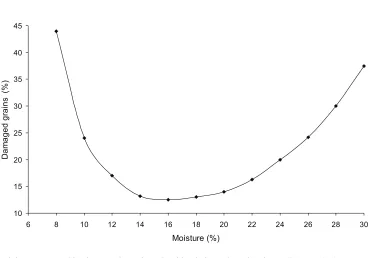
Another highly important factor that has a significant effect on the mechanical properties of seeds is their water content. In a field experiment conducted by Strona (1977), in the case of corn harvested with a combine the presented relation of damage to kernels to their moisture content varied along a line similar to the parabola (Fig. 1). The extent of damage of harvested kernels decreased with increasing moisture and reached a minimum at moisture level of about 16 to 22%. Further increase in kernel moisture, however, caused an increase in the amount of damaged kernels.
Water content in seeds affects their anatomical-morpho-logical structure only to slight degree (Dziki and Laskowski, 2007; Grzesiuk and Kulka, 1988), but plays a significant role in affecting their elastic properties. Dry biological material is little elastic and relatively brittle, and stress caused by external forces is more likely to disturb its inner structure. Higher moisture content increases the elasticity and deforma-bility of seeds. This feature may be important in the case of se-lecting the time of harvest, from the viewpoint of minimizing yield losses due to the share of damaged seeds.
Effect of rapeseed and wheat kernel moisture on impact damage
G. Szwed* and J. £ukaszuk
Institute of Agrophysics, Polish Academy of Sciences, Doœwiadczalna 4, P.O. Box 201, 20-290 Lublin 27, Poland
Received April 13, 2007; accepted May 21, 2007
© 2007 Institute of Agrophysics, Polish Academy of Sciences *Corresponding author’s e-mail: [email protected]
A A
Analysing an example of impact of elastic bodies, iso-tropic, with homogeneous structure, and applying certain simplifications in order to illustrate the process taking place, let us employ the law of energy conservation in the form (Walczak, 1967):
E1+ =U1 E2+U2. (1) The indexes of kinetic (E) and potential (U) energy used in the equation relate to the following stages of the process: – the moment of seed mass contact with the surface of the
obstacle,
– the moment when a seed loses its velocity and undergoes elastic deformation by valueÄd.
With relation to the potential energy (zero level), let us adopt the first stage as the reference level. In the expression for kinetic energy, let us delete the kinetic energy of the component elements of the morphological structure of the object subjected to impact. In accordance with the above assumption, using the energy conservation law, let us include in Eq. (1) the following arguments:
E mv U
E U P d d
1 2 1
2 2 2
1
2 0
0 1
2
1 2
= =
= = =
ü ý ïï
þ ï ï
;
; D kD
, (2)
where:m– seed mass,v– seed velocity, k – elastic constant, d– value of elastic deformation of seed subjected to impact, E1– kinetic energy of seed at the moment of impact,U2– po-tential energy of seed elasticity,P– impact force.
From the Eq. (2) it follows that: 1
2
1 2
2 2
mv = kDd , (3)
and:
Dd=v m
k . (4)
Substituting deformationDd= P
k , after transformations we obtain the relation of impact forcePto the kinetic energy of the object and elasticity of the system at the moment of impact:
P= 2kEk, (5)
where:k – elastic constant of the system,Ek – energy of impact.
As follows from Eq. (5), the value of forceP, at constant kinetic energy of impact, depends only on the elastic properties of the impacting objects. Obviously, the example under consideration relates to impact in which elastic deformation of the objects takes place, such as does not cause damage to the impacting objects.
The structure of plant materials differs from the struc-ture of rigid bodies that are the subject of consideration in the fundamental laws of dynamics. With a certain simplification could treat change in the moisture content of seeds as a factor affecting their elastic constant. Such a simplification per-mits the explanation why a change in seed moisture content causes a change in the mechanical properties of seeds that
10 15 20 25 30 35 40 45
6 8 10 12 14 16 18 20 22 24 26 28 30
Moisture (%)
D
a
m
aged
gr
ains
(%
)
can be expressed as variable susceptibility to impact damage. It is also of interest to determine whether seeds of plants with industrial significance behave in a similar manner.
Studies on the susceptibility of seeds to damage caused by momentary forces of impact are conducted on suitable test stations. A large group of those are testing devices with rotary striker bars with controlled impact velocity and adjus-table positioning of the seed tested with relation to the striker bar surface (Bilanski, 1966; £ukaszuk and Laskowski, 1995; Mitchell and Routhwaite, 1964; Sosnowski, 2006).
Apart from the purely cognitive aspect concerning expansion of general knowledge on the physical features of the objects studied, laboratory experiments concerned with the impact strength of seeds have also a number of practical aspects. Among other things, it is possible to test the seeds of new plant cultivars for their susceptibility to damage and to define those features that will determine the suitability of the seeds for the existing mechanized processes of harvesting and post-harvest processing. They also permit the determina-tion of appropriate settings and parameters of harvest techno-logy at which the extent of seed damage will be the lowest.
The objective of this study was to determine the effect of moisture content on the mechanical strength of rapeseed and wheat kernels, as reflected in the level of damage in the course of dynamic tests.
MATERIALS AND METHODS
The tests were conducted under laboratory conditions, using a test station designed and made at the Institute of Agrophysics, PAS, in Lublin (Tys et al., 1993). The test station permitted simultaneous impact testing of 10 seeds. The tests were made for seeds of winter rape cv. Californium and Bazyl and spring rape cv. Star, and for kernels of winter wheat cv. Rysa and Zawisza and of spring wheat cv. Jasna. The test material was obtained from experimental plots of the University of Agriculture in Lublin. Wheat kernels and rape seeds were wetted by soaking in water. Wetted samples were placed in sealed glass containers that were stored for a week at a temperature of 4°C.
Prior to the tests, in order to stabilize temperature, the con-tainers with samples were left for 8 h at room temperature for thermal soaking. Before each test, the seed or kernel moistu-re content was determined using the drier method (ASAE, 1982). For seeds of each tested plant cultivar a similar energy threshold at impact was adopted (for seeds of the same mass – the same impact velocity). The test consisted in striking 100 seeds or kernels (10 samples of 10 seeds each). The incomparably greater mass of the striker bar,mb, with relation to the mass of seeds subjected to impact, mn(mb>> mn, mb® ¥), permitted the inclusion – in the energy of impact – of the mass of the impacted seed, mn, and the linear velocity of the striker bar,vb.
The following impact conditions were applied: – for rapeseed, tangential velocity of striker bar of 22 m s-1, – for wheat kernels, tangential velocity of striker bar of 27 m s-1.
This speed range was chosen based on the preliminary tests with a view to evaluating a wide range of kernel strengths. For wheat kernels seven kernel moisture contents of 8, 12, 16, 20, 24, 28, and 32%, for rapeseeds moisture contents of 5, 7, 9, 11, 13, and 15% with three replications. Obviously, the application of similar impact conditions required prior selection of seeds of tested cultivar with similar mass.
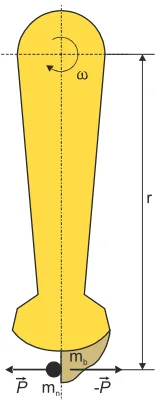
Figure 2 presents a kinematic diagram of the impact process. The working element is the striker bar which, with a suitable velocity, simultaneously strikes 10 seeds placed on the holder.
The procedure of the dynamic test included the following:
– taking approx. 20 dag of seeds and bringing them to required moisture content,
– isolation, using a set of screens, of the required size class of seeds,
– placing of 100 seeds on 10 kernel holders (10 seeds on each holder).
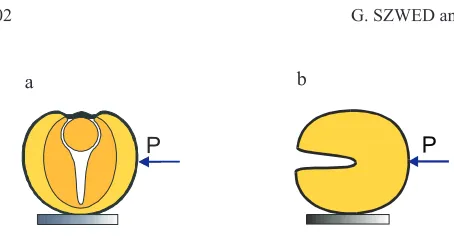
Seeds were placed on their respective holders is such a way that the impact was linear and central. On each holder 10 seeds or kernels were placed. The design of the holder permitted the seeds and/or kernels to be placed in the required orientation with relation to the frontal surface of the striker bar. Wheat kernels were struck from the spine side, and rape seeds near the cotyledons (Fig. 3). Following each test, for 100 seeds or kernels with suitable level of moisture, the number of damaged seeds/kernels was counted (surface
r
mb
mn
P -P
Fig. 2.Diagram of the striker bar: mb– mass of the striker bar, mn – rapeseed, r – radius of the sriker bar,w -tangential velocity,P
damage and broken/crushed seeds/kernels). The effects of impact (susceptibility to damage) were assessed visually on the basis of broken/missing fragments of seed cover, cracks, and damaged germs. The rate of damage,Su, was calculated from the relation:
S x
n
u= 100% , (6)
where:x– number of damaged seeds/kernels,n– number of seeds/kernels used for the test.
RESULTS AND DISCUSSION
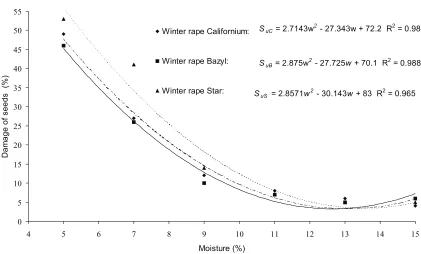
From the viewpoint of mechanics, the value of force, and therefore also of stress caused by the force at the point of its application, depends – among other things – on the current elasticity of the object impacted k (5), at comparable values of impact energy. As moisture content has a signi-ficant effect on the elastic properties of materials of plant origin, is also has a bearing on the effects of impacts. The effect of moisture content on the level of damage to the tested cultivars of wheat kernels and rapeseed is presented in Figs 4 and 5.
As follows from the relations presented in the figures, the number of damaged seeds decreases with increase in their moisture content. This may be related to a change in their elasticity at higher moisture level, which causes greater absorption of energy during the impact. However, exceed-ing a certain level of seed moisture content causes that their firmness increases (increase in the value of the elastic constant k), with concurrent increase in the impact forceP and in the value of critical stress. The shapes of the graphs in the figures show that the changes in seed/kernel damage rates plot parabolas with fairly significantly differing coefficients at variable moisture wfor wheat kernels and rapeseeds. The effect is more pronounced for the rapeseed than in the case of the wheat kernels (higher values at variablew2).
The relations of damage rate presented in Figs 4 and 5 are non-linear, and the appearance of minimum values of damage rates at certain moisture content ranges is a feature characteristic for the seeds/kernels of the tested cultivars of crop plants.
Singh and Finner (1983), in their studies on improvement of models of damage to corn kernels, arrived at the conclusion that from among a number of tested factors the strongest effect on the rate of damage was that of the speed of the impacter rotor of their apparatus and the change in the kernel moisture content. According to those authors, the best fitting of the course of damage has the form:
Su= 39.94 + 2.7189v- 0.062vw+ 0.022w2, (7)
R2= 96.3% (all the indexes were significant at the level of 99.5%),
where:Su– number of kernels damaged during the test (%); v – tangential velocity of the rotor (m s-1); w – kernel moisture content (%).
P
B
P
A
Fig. 3.Orientation of: a – rapeseed and b – wheat kernel during impact by the striker bar.
a b
0 5 10 15 20 25 30 35 40
4 8 12 16 20 24 28 32
Moisture (%)
D
a
mage
of
w
heat
(%
)
Winter wheat Rysa:
Winter wheat Zawisza:
Winter wheat Jasna:
SuR= 1.9048w2- 19.31w+ 51.429 R2= 0.994
SuZ = 1.3452w2- 14.655w + 44.286 R2= 0.987
SuJ= 1.5714w2- 18.071w + 53.714 R2= 0.992
The study presented herein was made in order to determine the relation between the moisture content and the susceptibility to mechanical damage of rapeseed and wheat kernels under the effect of impact forces. The seeds of those crops, in view of the area of their cultivation, are the most important agricultural crops in this country. The method applied in the study permits rapid and accurate estimation of the resistance of seeds to impact damage at varied seed moisture content. Varying the level of moisture of the tested seeds permitted, among other thing, modification of their elastic properties and also of their mechanical properties.
The apparatus applied for the dynamic tests is an accurate device for the determination of the susceptibility of seeds to mechanical damage. The tests can be made within a short time, for a variety of purposes, commercial as well as scientific.
CONCLUSIONS
1. The results of the study showed that the relation between seed damage and its moisture content is a parabola, the angle of inclination of its arms being related to a greater degree to the kind of seeds of tested plants than to their spring or winter forms.
2. There exists a certain optimum level of moisture content at which, under the effect of impact forces, there occurs a minimum of damage to the seeds. In the case of wheat kernels that optimum level of moisture is about 25-28%, and for rapeseed from 11 to 15%.
REFERENCES
ASAE,1982.Moisture Measurement – Grain and Seeds. Agric. Eng. Yearbook, ASAE, Standard ASAE, 347-352.
Bilanski W.K., 1966.Damage resistance of seed grains. Trans-actions of the ASAE, 9(3), 360-363.
Dziki D. and Laskowski J., 2007.Influence of moisture content on mechanical properties of rye kernels. Acta Agrophysica, 9(1), 39-48.
Grzesiuk S. and Kulka K., 1988.Biology of Cereal Grains (in Polish). PWN, Warszawa.
£ukaszuk J. and Laskowski J., 1995.Test station for grain testing under conditions of dynamic loading (in Polish). Zesz. Prob. Post. Nauk Roln., 424, 327-332.
Mitchell F.S. and Routhwaite T.E., 1964.Resistance of two va-rieties of wheat to mechanical damage by impact. J. Agric. Eng. Res., 9(4), 303-306.
Singh S.S. and Finner M.F., 1983. A centrifugal impacter for damage susceptibility evaluation of shelled corn. Trans-actions of the ASAE, 15(2), 1858-1863.
Sosnowski S., 2006. Causes for the occurrence of mechanical damage to bean seeds during harvest (in Polish). Acta Agrophysica, 130.
Strona L., 1977.Damage to Seeds – Causes and Prevention (in Polish). PWRiL, Warsaw.
Szot B., Szpryngiel M., Tys J., and Grochowicz M., 1989.
Causes for the occurrence of quantitative losses of rapeseed during harvest and method for their determination (in Polish). Zesz. Probl. IHAR, XV, 250-260.
0 5 10 15 20 25 30 35 40 45 50 55
4 5 6 7 8 9 10 11 12 13 14 15
Moisture (%)
D
a
m
a
ge
of
s
e
eds
(%)
Winter rape Californium:
Winter rape Bazyl:
Winter rape Star:
SuC= 2.7143w2- 27.343w + 72.2 R2= 0.984
SuB= 2.875w2- 27.725w+ 70.1 R2= 0.988
SuS = 2.8571w2- 30.143w+ 83 R2= 0.965
Szwed G., 2000.Formation of physical and technological pro-perties of rapeseeds in model storage conditions (in Polish). Acta Agrophysica, 27.
Tys J., £ukaszuk J., and Szwed G., 1993. A device for the simulation of damage to seeds (in Polish). Patent No. 170711.
Tys J., Sobczuk H., and Rybacki R., 2002. Influence of temperature drying on mechanical properties of rapeseed (in Polish). Roœliny Oleiste, IHAR, XXIII, 417-426.