
Knowledge management in distributed organisations: developing a meta-level framework
286
0
0
Full text
(2) *** I dedicate this work to Goddess Saraswathi, the mother of knowledge and wisdom ***. “Shrii Saraswathi namahstubhyam varade kaama ruupini twaam aham praarthane devii vidyaadaanam cha dehi me” “I bow to Goddess Saraswathi who fulfils the wishes of the devotees. I pray you to enlighten me with knowledge”.
(3) Abstract The emergence of the knowledge economy has necessitated many organisations to recognise knowledge as a crucial resource, and created an intricate managerial challenge – “knowledge management (KM)”. Because of the cultural, operational and other business complexities, this challenge is more acute for distributed organisations. In the last few years, several theories have been put forward for practising KM. However, given the abstract nature of the subject area, there is little consensus on the components and ways of knowledge management in distributed organisations. Much of the current research is carried out on one or a very few organisational elements of knowledge management. The critical and fundamental relationships between all the elements are often ignored. The need for empirical theories, principles and methods for knowledge management is widely acknowledged in the extant management literature. Thus, the primary motivation for this research is to develop a broad-based theory in the form of a holistic framework for managing enterprise knowledge in distributed organisations. This dissertation attempts to answer a complex research question: “how to manage enterprise knowledge in distributed organisations?”. The research study is carried with an interpretive paradigm to explore and describe. various. factors. influencing. knowledge. management. practice. in. distributed organisations. The empirical data is collected using the case study research strategy. In-depth case studies were conducted at six large distributed organisations in Germany, India, and the United Kingdom. The studied organisations. include. Alcatel,. Daimler. Chrysler,. Hewlett. Packard,. Oracle. Corporation, UK National Health Service, and Wipro Technologies. The empirical material that was collected was further analysed using grounded theory approach. This dissertation provides the findings of this study in the form of several factors influencing the knowledge management practice in distributed organisations. These factors include leadership, organisational structure, evangelisation, communities of practice, reward systems, time allocation, business processes, recruitment, infrastructure and physical attributes. Based on this study, the challenges, management strategies, and best practices are described for each of these KM factors. Consequently, a meta-level KM practice framework has been developed by combining the identified KM factors into four core organisational 1.
(4) dimensions; Business focus, Culture, Process and Infrastructure (BCPI). The BCPI framework is constructed by integrating the findings of this study with the current literature in the KM subject arena. The BCPI framework appreciates and describes. the. interrelationships. between. various. organisational. elements. impacting the knowledge management function.. 2.
(5) Acknowledgements. Accomplishing this PhD has been a monumental journey in my life. The last three years, in the cosmos of research, have changed my perspectives of the world and sparked powerful influence on my ambitions, directions and goals. This research work was accomplished with help and assistance from several people and esteemed organisations in the United Kingdom, Germany, and India. My foremost thanks go to my supervisor, Professor Stan Oliver, for his immense support, encouragement, and guidance throughout my PhD. I would also like to thank Professor Danny Morton for his help and advice. Many thanks to all the executives who have given me their valuable support and time for conducting case studies at their respective organisations which include Alcatel, Daimler Chrysler, Hewlett Packard, Oracle Corporation, UK National Health Service and Wipro Technologies. The knowledge gained through my research at these organisations has become the core of this PhD. A special thanks to Professor Rolf Richterich at Berufsakademie (Horb) for facilitating this research work in Germany. I would also like to thank my colleagues and friends at the University of Bolton, for their support and many intellectually stimulating discussions which have immensely contributed to this research. Thanks in particular to Kiran Maringanti, Alfred Charles Chinta, Lakshmi Narasimhan Vedanthachari, and John Walsh. I am grateful to all my friends and others for giving me comfort and support. I would like to express my gratitude to my family for providing me with this great opportunity to study. I am grateful to my parents for their infinite support which has enabled me to come this far. Finally, I express my gratitude to my wonderful wife, Haritha, for her absolute support, patience, and encouragement. Thank you for always being there for me.. 3.
(6) TABLE OF CONTENTS LIST OF TABLES ................................................................................................................................ 7 LIST OF FIGURES .............................................................................................................................. 8 LIST OF ABBREVIATIONS .................................................................................................................. 9 1. INTRODUCTION ................................................................................................................ 10 1.1 SETTING THE SCENE ............................................................................................................. 10 1.2 KNOWLEDGE MANAGEMENT IN DISTRIBUTED ORGANISATIONS ........................................ 11 1.3 MOTIVATION FOR THIS RESEARCH ...................................................................................... 11 1.4 RESEARCH PROBLEM ............................................................................................................. 13 1.5 RESEARCH GOAL AND OBJECTIVES ...................................................................................... 13 1.6 RESEARCH METHODOLOGY ................................................................................................... 14 1.7 RESEARCH FOCUS AND BOUNDARIES .................................................................................. 14 1.7.1 Positioning of the thesis ........................................................................................ 14 1.7.2 Related subject areas............................................................................................. 15 1.7.3 Applicability of the framework ............................................................................ 15 1.7.4 Holistic approach...................................................................................................... 15 1.7.5 Approach toward Technologies........................................................................... 15 1.8 THESIS STRUCTURE .............................................................................................................. 15 1.8.1 Chapter 2: Background ......................................................................................... 16 1.8.2 Chapter 3: Research methodology and design ............................................ 17 1.8.3 Chapter 4: Findings, Analysis and developing a KM framework............ 17 1.8.4 Chapter 5: Conclusion and further work ....................................................... 17 1.8.5 Appendix B: Research instrument..................................................................... 17 1.8.6 Appendix C: Selected paper ................................................................................ 18 SUMMARY ........................................................................................................................................ 18. 2. BACKGROUND .................................................................................................................... 19 INTRODUCTION ............................................................................................................................... 19 2.1 WHAT IS KNOWLEDGE?........................................................................................................ 19 2.1.1 Plato’s theory of knowledge................................................................................. 20 2.1.2 Rationalism................................................................................................................. 22 2.1.3 Empiricism .................................................................................................................. 23 2.1.4 Synthesis of Continental rationalism and British empiricism.................. 24 2.1.5 Positivism, Phenomenology, Pragmatism and Critical rationalism ....... 26 2.1.6 Contemporary definitions of knowledge and inadequacies...................... 28 2.1.7 A working definition for this thesis: A new theory of knowledge .......... 29 2.2 KNOWLEDGE MANAGEMENT IN DISTRIBUTED ORGANISATIONS ........................................ 30 2.2.1 What is knowledge management....................................................................... 30 2.2.2 Why knowledge management is important? ................................................. 31 2.2.3 Distributed organisations ...................................................................................... 32 2.2.4 KM problems and challenges in distributed organisations ....................... 33 2.3 KNOWLEDGE MANAGEMENT THEORIES AND FRAMEWORKS ................................................ 34 2.3.1 Nonaka & Takeuchi: Theory of knowledge creation: SECI and Ba ....... 35 2.3.2 Davenport & Prusak: Knowledge Markets ...................................................... 38 2.3.3 Wenger: Communities of Practice.................................................................... 40 2.3.4 Sveiby: IT-Track KM and People-Track KM .................................................. 41 2.3.5 Snowden: Story telling for knowledge management................................ 42 2.3.6 Other theories of knowledge management.................................................... 43 2.4 NEED FOR A COMPREHENSIVE KM FRAMEWORK FOR DISTRIBUTED ORGANISATIONS .... 44 2.4.1 Limitations in the current knowledge management theories.................. 44 2.4.2 A new meta-level knowledge management framework ............................ 46 2.5 RESEARCH QUESTIONS ......................................................................................................... 47 SUMMARY ........................................................................................................................................ 48. 4.
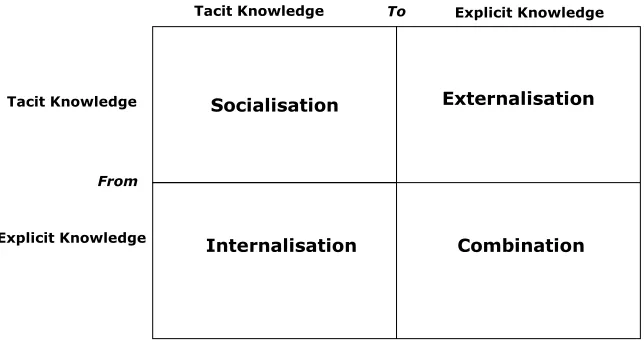
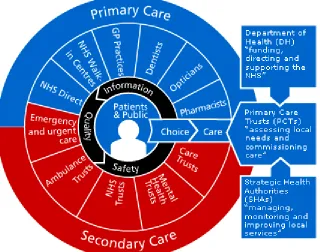
(7) 3. RESEARCH METHODOLOGY ........................................................................................ 49 INTRODUCTION ............................................................................................................................... 49 3.1 KM RESEARCH: PROBLEM, GOAL AND QUESTIONS ........................................................... 49 3.2 DETERMINATION OF RESEARCH PARADIGM ......................................................................... 50 3.2.1 Positivist ...................................................................................................................... 52 3.2.2 Critical theory ............................................................................................................ 53 3.2.3 Interpretivist.............................................................................................................. 54 3.3 DETERMINATION OF RESEARCH METHODOLOGY ................................................................. 56 3.3.1 Action research ......................................................................................................... 57 3.3.2 Ethnography............................................................................................................... 59 3.3.3 Grounded theory ...................................................................................................... 60 3.3.4 Case study .................................................................................................................. 61 3.4 RESEARCH DESIGN ............................................................................................................... 65 3.4.1 The units of analysis (cases) ............................................................................... 66 3.4.1.1 3.4.1.2 3.4.1.3 3.4.1.4 3.4.1.5 3.4.1.6. Case Case Case Case Case Case. A: Oracle Corporation....................................................................................68 B: UK National Health Service (NHS)......................................................70 C: Alcatel............................................................................................................72 D: Hewlett-Packard.......................................................................................73 E: Wipro..............................................................................................................74 F: Daimler Chrysler ........................................................................................75. 3.4.2 Data Collection.......................................................................................................... 77 3.4.3 Data analysis: Grounded theory approach .................................................... 79 3.4.3.1 3.4.3.2 3.4.3.3 3.4.3.4. Open Coding ................................................................................................................81 Axial Coding .................................................................................................................83 Selective Coding.........................................................................................................83 Coding for Process .....................................................................................................84. 3.4.4 Data analysis protocols: Data accuracy and triangulation....................... 85 3.5 RESEARCH ETHICS: CONSIDERATIONS AND PROTOCOLS .................................................. 86 SUMMARY ........................................................................................................................................ 87 4. ANALYSIS AND FRAMEWORK DEVELOPMENT................................................. 88 INTRODUCTION ............................................................................................................................... 88 4.1 FINDINGS, ANALYSIS, AND DISCUSSION ............................................................................ 88 4.1.1 Business focus........................................................................................................... 91 4.1.1.1 4.1.1.2 4.1.1.3 4.1.1.4 4.1.1.5 4.1.1.6. Knowledge dispersion (F1) .....................................................................................93 Employee turnover (F2) ..........................................................................................95 Market environment (F3) ........................................................................................99 Virtual working (F4) ................................................................................................ 103 Innovation (F5)......................................................................................................... 106 Value addition (F6).................................................................................................. 109. 4.1.2 Culture ....................................................................................................................... 114 4.1.2.1 4.1.2.2 4.1.2.3 4.1.2.4 4.1.2.5 4.1.2.6 4.1.2.7 4.1.2.8 4.1.2.9 4.1.2.10. Leadership (F7)......................................................................................................... 115 Knowledge accessibility (F8) ............................................................................... 118 Recruitment (F9)...................................................................................................... 121 Employee learning (F10)....................................................................................... 124 Reward systems (F11) ........................................................................................... 127 Time allocation (F12).............................................................................................. 132 Change management (F13) ................................................................................. 134 Evangelisation (F14)............................................................................................... 138 Communities of Practice (F15) ........................................................................... 141 Events (F16) ......................................................................................................... 146. 4.1.3 Process....................................................................................................................... 149 4.1.3.1 4.1.3.2 4.1.3.3 4.1.3.4 4.1.3.5 4.1.3.6 4.1.3.7. KM strategy & alignment (F17) .......................................................................... 149 Organisational structure (F18)............................................................................ 154 Piloting (F19) ............................................................................................................. 159 Knowledge creation and quality control (F20) .............................................. 162 Content management (F21) ................................................................................ 167 Knowledge sharing and reuse (F22)................................................................. 171 Business Processes (F23) ..................................................................................... 174. 5.
(8) 4.1.4 Infrastructure .......................................................................................................... 179 4.1.4.1 4.1.4.2. Technological infrastructure (F24) .................................................................... 181 Physical infrastructure (F25) ............................................................................... 186. 4.2 A META-LEVEL KM FRAMEWORK (BCPI MATRIX) ........................................................... 190 4.2.1 Phase-A: Developing knowledge culture with soft factors..................... 190 4.2.2 Phase-B: Developing knowledge culture with tangible factors ............ 192 4.2.3 Phase-I: KM strategy formulation ................................................................... 192 4.2.4 Phase-II: Establishment of an organisational structure for KM ........... 193 4.2.5 Phase-III: Initiation of formal KM programme with a pilot project .... 193 4.2.6 Phase-IV: Optimisation of Knowledge Intensive Processes (KIPs)..... 193 4.2.7 Phase-V: Establishment of technological and physical infrastructure194 4.2.8 Phase-VI: Establishment of content management systems.................. 194 4.2.9 Phase-VII: Development of Communities of Practice (CoPs) ............... 194 4.2.10 Phase-VIII: Development of knowledge creation, quality control, and sharing mechanisms ................................................................................................ 195 4.2.11 Phase-IX: Evaluation of business value provision from KM ........... 195 SUMMARY ...................................................................................................................................... 196 5. CONCLUSIONS ................................................................................................................. 197 INTRODUCTION ............................................................................................................................. 197 5.1 RESEARCH PROBLEM, GOAL, AND OBJECTIVES ................................................................. 197 5.2 THEORETICAL AND PRACTICAL CONTRIBUTIONS .............................................................. 199 5.2.1 A comprehensive list of KM factors................................................................. 199 5.2.2 Integration of KM factors and interrelationships ....................................... 200 5.2.3 BCPI Matrix for KM ................................................................................................ 202 5.3 RESEARCH METHODOLOGY AND VALIDITY OF FINDINGS .................................................. 202 5.4 LIMITATIONS ....................................................................................................................... 204 5.5 FURTHER RESEARCH ........................................................................................................... 205 5.5.1 Application of the findings .................................................................................. 205 5.5.2 Expansion and enrichment of the findings................................................... 205 5.5.3 Consecutive research survey............................................................................. 206 SUMMARY ...................................................................................................................................... 207. REFERENCES............................................................................................................................... 208 APPENDIX – A: SEMI-STRUCTURED QUESTIONNAIRE...................................... 232 APPENDIX – B: SELECTED JOURNAL PAPER............................................................ 249. 6.
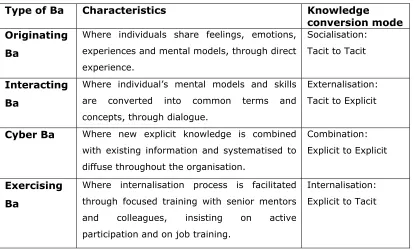
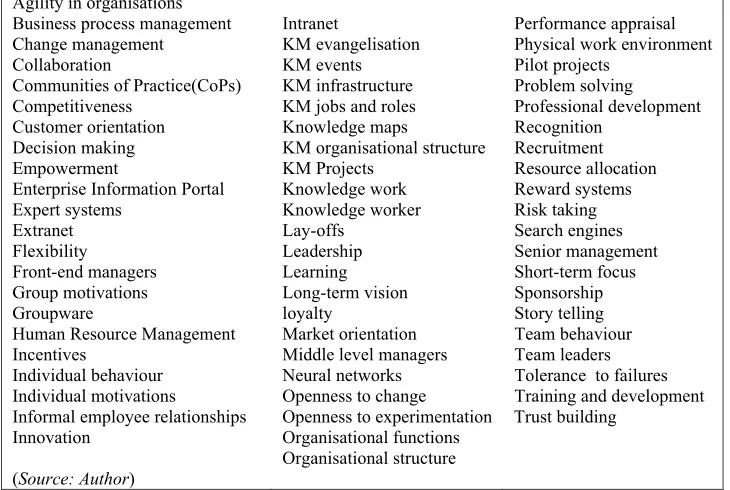
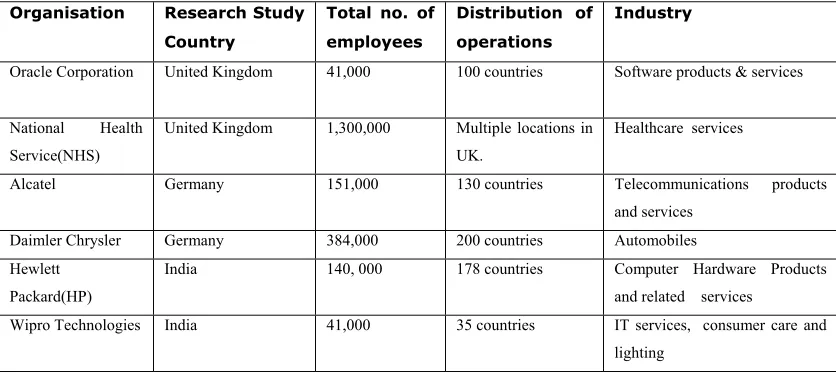
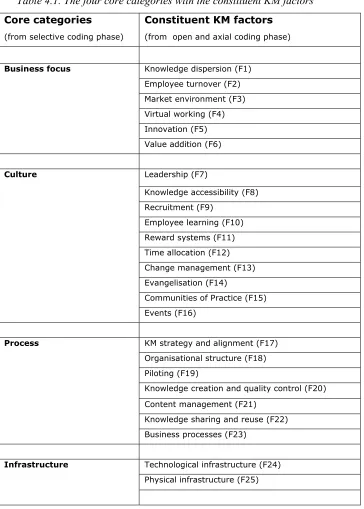
(9) List of Tables Table 2.1 A summary of four types of Ba or knowledge conversion modes…………..………37 Table 2.2 Organisational issues affecting KM in distributed organisations………………….46 Table 3.1 An overview of the case organisations…………………………………………………68 Table 3.2 Application of grounded theory coding techniques in the data analysis………….81 Table 4.1The four core categories with the constituent KM factors………………………….. 89 Table 4.3 Business Focus (Core category): Constituent factors and substantiating codes…92 Table 4.4 Knowledge dispersion (F1): Substantiating concepts and codes…………………..93 Table 4.5 Employee turnover (F2): Substantiating concepts and codes………………………96 Table 4.6 Market environment (F3): Substantiating concepts and codes………………….100 Table 4.7 Virtual Working (F4): Substantiating concepts and codes………………………...104 Table 4.8 Innovation (F5): Substantiating concepts and codes……………………………….109 Table 4.9 Value addition (F6): Substantiating concepts and codes………………………….111 Table 4.10 Culture (Core category): Constituent factors and substantiating codes……….114 Table 4.11 Leadership (F7): Substantiating concepts and codes……………………………..116 Table 4.12 Knowledge accessibility (F8): Substantiating concepts and codes……………..119 Table 4.13 Recruitment (F9): Substantiating concepts and codes……………………………122 Table 4.14 Employee learning (F10): Substantiating concepts and codes………………….125 Table 4.15 Reward systems (F11): Substantiating concepts and codes…………………..…128 Table 4.16 Time allocation (F12): Substantiating concepts and codes…………………..…133 Table 4.17 Change management (F13): Substantiating concepts and codes………………136 Table 4.18 Evangelisation (F14): Substantiating concepts and codes……………………….139 Table 4.19 Communities of Practice (F15): Substantiating concepts and codes…………...142 Table 4.20 Events (F16): Substantiating concepts and codes………………………………..147 Table 4.21 Process (Core category): Constituent factors and substantiating codes……….150 Table 4.22 KM strategy & alignment (F17): Substantiating concepts and codes………….153 Table 4.23 Organisational structure (F18): Substantiating concepts and codes…………...156 Table 4.24 Piloting (F19): Substantiating concepts and codes………………………………160 Table 4.25 Knowledge creation and quality control (F20): Substantiating concepts and codes……………………………………………………………………………………………….....163 Table 4.26 Content management (F21): Substantiating concepts and codes……………….168 Table 4.27 Knowledge sharing and reuse (F22): Substantiating concepts and codes……..172 Table 4.28 Business processes (F23): Substantiating concepts and codes………………….175 Table 4.29 Infrastructure (Core category): Constituent factors and substantiating codes..180 Table 4.30 Technological infrastructure (F24): Substantiating concepts and codes………182 Table 4.31 Physical infrastructure (F25): Substantiating concepts and codes……………..188 7.
(10) List of figures. Figure 1.1 An overview of research process…………………………………………………….. 16 Figure 1.1 Four modes of knowledge conversion………………………………………………...35 Figure 3.1 An overview of the functioning and organisation of the NHS…………………..…70 Fig.4.1 A thematic representation of the core KM categories and their interrelationships...90 Figure 4.2 A thematic representation of Hybrid organisational structure for KM………...158 Figure 4.3 A conceptual view of the ICT architecture for KM………………………………..186 Figure 4.4 The BCPI Matrix – A KM framework for distributed organisations……………191 Figure 4.5. A depiction of interrelationships between various KM factors…………………201. 8.
(11) List of abbreviations. AI = Artificial Intelligence BPCI = Business Focus, Culture, Process, and Infrastructure BPI = Business Process Innovation BPM = Business Process Management BPR = Business Process Reengineering CoP = Communities of Practice EIP = Enterprise Information Portal EKP = Enterprise Knowledge Portal ESOPS = Employee Share Options G = Goal of this dissertation GP – General Practitioner HP = Hewlett Packard HRM = Human Resource Management IC = Intellectual Capital ICT = Information and Communication Technologies IS = Information Systems IT = Information Technology KM = Knowledge Management MBTI = Myers-Briggs Type Indicator MIS = Management Information Systems NHS – National Health Service OB = Organisational Behaviour OL = Organisational Learning P = Research Problem of this dissertation Q1 = First research question of this dissertation Q2 = Second research question of this dissertation Q3 = Third research question of this dissertation. 9.
(12) 1 Introduction “The search for truth is in one way hard and in another way easy, for it is evident that no one can master it fully or miss it wholly. But each adds a little to our knowledge of nature, and from all the facts assembled there arises certain grandeur”. - Aristotle. 1.1 Setting the scene Emergence of the knowledge economy has changed the business dynamics in the industrial world. In many global economies, the conventional resources of competence are now replaced by knowledge (Drucker, 1993). World Bank (1998) in its development report notes that “for countries in the vanguard of the world economy, the balance between knowledge and resources has shifted so far towards the former that knowledge has become perhaps the most important factor determining the standard of living......today’s most technologically advanced economies are truly knowledge based”. The arrival and significance of knowledge economy is widely acknowledged in the academic and business spheres. Nonaka (1987) advocates knowledge as a sure source of lasting competitive advantage in an economy where the only certainty is uncertainty. Several other authors, in management sciences, have consistently emphasised that the major competitive advantage for a corporation lies in its knowledge (Drucker, 1968; Bell, 1973; Toffler, 1990, Nonaka, 1994). Quintas (2002) notes that today’s organisations need to continually regenerate and develop knowledge to address the gathering pace of change across several dimensions. including. markets,. competition,. globalisation,. technology. and. innovation. Many organisations across the world have realised the significance of knowledge and imparted strategic focus towards its effective management. For instance, Louis Gerstner (Hackett, 2000), Chairman of IBM, notes that:. “the age-old levers of competition—labour, capital, and land—are being supplemented by knowledge, and the most successful companies…..will be those that….exploit knowledge about the 10.
(13) customer behaviour, markets, economies, and technology faster and more effectively than their competitors. They will use knowledge to adapt quickly, seizing opportunities and improving products and services, of course, but just as important, renewing the ways they define themselves, think, and operate”. However, this recognition of knowledge as a core organisational resource in the last decade has created a grand business challenge – “knowledge management”. The challenge of knowledge management is intricate in distributed organisations because of their business characteristics.. 1.2 Knowledge management in distributed organisations Conventionally, an organisation is defined as a collection of people working together to achieve a common purpose. If an organisation has people working from various geographical locations it can be termed as a distributed organisation (Scott, 1998; Schermerhorn, 2005). Practising KM is a complex issue in distributed organisations because of several inherent characteristics. These include factors such as knowledge dispersion, cultural variances, organisational size, communication complexities, diverse systems, and business processes (Cramton, 2001; Davenport, 2000; Lam, 1997; Malhotra, 2004; O’Leary, 1998; Rumizen). Distributed organisations require specific concepts, theories and frameworks to address various inherent KM challenges. For example, O’Leary (1998) notes that managing knowledge in distributed organisations is a complex task because of geographical dispersion of knowledge workers. There is also a widespread recognition and agreement about the significance and need to manage enterprise knowledge in distributed organisations. However, the avenues of knowledge management for these organisations are inadequate and disparate. There is a lack of coherent understanding of the ways to manage this valuable organisational resource (Burton-Jones, 1999; Croasdell et al., 2002; Kluge et al., 2001; Malhotra, 2004b; Wilson, 2002).. 1.3 Motivation for this research During the last decade, KM has been witnessing significant interest from research communities and emerging as a formal discipline in organisational studies. The rising awareness of the emergence of global knowledge economy combined with its impact on the business organisations is contributing to an. 11.
(14) augmented attention towards knowledge management. Some major KM areas currently being researched encompass the Communities of Practice (CoP), Organisational Learning (OL), Intellectual Capital (IC), Organisational culture, Change. management,. Business. process. management,. Collaboration. technologies, and Content management, and Artificial Intelligence (AI). However, much of the current research is carried out on one of the organisational dimensions or elements of knowledge management such as organisational. culture,. technological. infrastructure,. human. resource. management, or process management (Lewis, 2002; Natarajan & Shekhar, 2000; Nissen et al., 2000; Remus & Schub, 2003; Sveiby, 2001). For instance, Natarajan & Shekar (2000) focus only on technology aspect of KM. Whereas, Nissen et al. (2000), addresses KM mainly through process dimension.. The. critical and fundamental relationships between various organisational elements are often ignored. While there is an apparent necessity for in-depth research along. the. above. individual. dimensions,. developing. theories. of. KM. by. appreciating the interrelationships between various organisational elements is also an immediate and important requisite. The need for the integrated empirical theories, principles, and methods for knowledge management is widely acknowledged in the extant management literature (Zack, 1999; Thoben et al., 2000; Bouthillier & Shearer, 2002; Tuomi,. 2002; Madanmohan & Navelkar,. 2003; Susman & Majchrzak, 2003;). KM practitioners and managers in organisations today need such theories for developing and implementing comprehensive KM strategies covering all organisational dimensions to achieve business value. Thus, the primary motivation for this research is to develop a broad-based theory in the form of a holistic framework for managing enterprise knowledge in distributed organisations. The proposed framework also aims to serve as a generic template for practicing KM in distributed organisations. This dissertation adopts a meta-level view of knowledge management focusing on a composite set of the factors influencing knowledge management function.. Through. empirical research, this dissertation will attempt to examine and find the key organisational. elements. and. their. interrelationships. impacting. knowledge. management. A further motivation is to contribute to the field of knowledge management in bridging the gap between theory and practice by developing principles, methods, and processes for practising KM and embedding them into the proposed framework. Therefore, the theoretical and practical contributions from this study would be closely integrated. 12.
(15) 1.4 Research problem This dissertation will study the ways of managing enterprise knowledge in distributed organisations by concentrating on the core organisational elements. The research problem has two major components; 1) finding the core organisational factors or elements for practising knowledge management and 2) developing a framework for managing enterprise knowledge based on the identified factors. Precisely this dissertation aims to answer the following research problem (P). “How to manage enterprise knowledge in distributed organisations while encompassing the fundamental organisational elements?”. 1.5 Research goal and objectives The goal (G) of this dissertation is to address the research problem (P) by developing a holistic framework for practising knowledge management in distributed organisations. Within this context, the following objectives are to be addressed in this research project. 1) To provide a critical literature review of various concepts, theories and frameworks of knowledge management. 2) To develop a group (based on literature review) of organisational elements which can influence knowledge management. 3) To conduct empirical studies at selected distributed organisations, with established knowledge management programmes, for understanding how various principal organisational elements can be managed in order to effectively manage the enterprise knowledge. 4) To evaluate and discuss the findings of this study against contemporary KM literature. 5) To develop a knowledge management framework based on the findings of an empirical study and the expertise gained from the current KM literature.. 13.
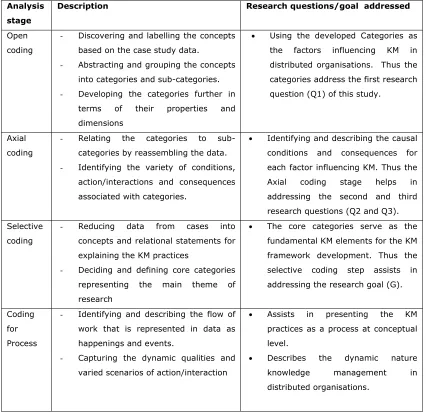
(16) 1.6 Research methodology Interpretivist research paradigm is adopted for this study to solve the defined research problem and to achieve the charted objectives. The data is collected using case study methodology. Case study methodology, a qualitative research approach, is often preferred in answering the ‘How’ and ‘Why’ questions (Yin 1994). There is also a widespread acknowledgement of qualitative research as a valuable. and. valid. approach. in. management. research.. The. qualitative. methodologies are often applied in KM and other related subject areas such as information systems and organisational learning (Ardichvilli, et al., 2003; Avison et al, 1999; Benbasat et al., 1987; Croasdell, 2002; Markus, 1997; Myers, 1997;). Grounded theory approach is employed to analyse the empirical material collected from the case organisations. Grounded theory is a widely recognised methodology for analysing qualitative data (Creswell, 1998; Charmaz, 2000; Hussey & Hussey, 1997; Strauss & Corbin, 1998). Various coding techniques of the grounded theory are used extensively to analyse the empirical data and to develop a meta-level KM framework for distributed organisations (Glaser & Strauss, 1967; Strauss & Corbin, 1998). A detailed description and rationale of the adopted research paradigm and methodologies are provided in chapter 3.. 1.7 Research focus and boundaries The following sub-sections provide a brief overview of the research focus, related subject areas, approaches, and perspectives adopted for this dissertation.. 1.7.1 Positioning of the thesis This dissertation focuses on developing a set of factors and a broad based framework for practicing knowledge management in distributed organisations. The proposed framework is intended to serve as a meta-level guiding theory for practising KM in these organisations. It would not concentrate on providing exhaustive steps for KM practice, intentionally leaving room for customised usage of the framework depending on the organisational specificities. However, the KM factors developed through this study aim to provide specific strategies, measures, and best practices to guide organisations in managing their enterprise knowledge.. 14.
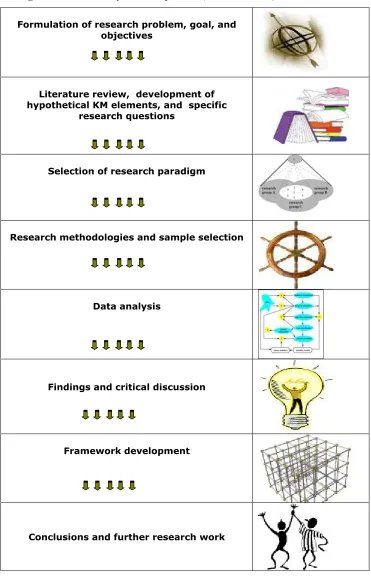
(17) 1.7.2 Related subject areas The related subjects such as organisational learning, information systems, and intellectual capital will be investigated in the perspective of knowledge management. In some other research contexts these issues may be treated as individual research subjects rather than being part of KM subject arena.. 1.7.3. Applicability of the framework. The knowledge management framework to be developed through this research project addresses the subject of knowledge management in the perspective of distributed organisations. Many of such organisations can be large scale business and some of them could be global conglomerates. Hence, certain aspects and components of the proposed framework might not be relevant for some small businesses operating from a single location. However, the framework might be applicable for small businesses with distributed work force (e.g. Sales force).. 1.7.4 Holistic approach The research project takes a holistic approach towards the constituent elements of knowledge management such as organisational culture, business process management, and technology, rather than taking an emphasis or orientation towards these individual elements.. 1.7.5 Approach toward Technologies This dissertation adopts a conceptual view of the knowledge management tools and technologies. As the technologies used in KM are evolving at rapid pace, taking a precision view of individual technologies would not be a practical approach.. Discussing each of the vendor technologies in detail may not be. possible and viable as there are numerous technological options for practicing KM.. Therefore,. wherever. possible,. the. Information. and. Communication. Technologies (ICT) will be discussed conceptually rather than concentrating on various vendors or versions.. 1.8 Thesis structure Figure 1.1 provides an overview of the process or workflow adopted for this research study. The following sub-sections provide the structure of this thesis by giving a brief description of the lay out and the content of the chapters.. 15.
(18) Fig. 1.1 An overview of research process (Source: Author) Formulation of research problem, goal, and objectives. Literature review, development of hypothetical KM elements, and specific research questions. Selection of research paradigm. Research methodologies and sample selection. Data analysis. Findings and critical discussion. Framework development. Conclusions and further research work. 1.8.1 Chapter 2: Background This chapter provides a critical review of current literature in the knowledge management landscape. This review will encompass books, refereed journals, conference papers, published case studies, and other literature in the KM subject 16.
(19) arena. This chapter provides a working definition for “knowledge” and “knowledge management” by reviewing various philosophical and authoritative views on the subject. The chapter discusses the rationale, recent developments, challenges, research directions and other important aspects of knowledge management in the perspective of distributed organisations. On the basis of a critical review, the chapter attempts to develop some hypothetical foundations and research questions for this empirical study.. 1.8.2 Chapter 3: Research methodology and design This chapter provides an in-depth discussion of the ontological, epistemological and methodological foundations for this research study. It provides arguments for the selection of research paradigm and methodologies for data collection and analysis. The chapter also presents the criteria for sample selection and provides a brief description for each of the organisations under study. It also gives an overview of the participants of this research study.. 1.8.3 Chapter 4: Findings, Analysis and developing a KM framework In this chapter the findings of the study are analysed, discussed, and critically appraised against the current KM literature. Here, the conceptual relationships would be established between the case study findings and the elements derived during literature review. Based on the analytic findings of the study, a comprehensive set of factors and a broad-based framework will be constructed for practising KM in distributed organisations.. 1.8.4 Chapter 5: Conclusion and further work This chapter provides a summary of findings of this research study with a critical discussion on its implications. It discusses the contributions made by this dissertation to KM discipline, and provides certain limitations of the findings. This chapter also outlines some directions for further research work to evaluate and enhance the findings of this empirical study.. 1.8.5 Appendix B: Research instrument A copy of the questionnaire instrument, used for this research study, is provided here.. 17.
(20) 1.8.6 Appendix C: Selected paper A copy of a journal paper, accepted in the Journal of Knowledge Management, is provided here.. Summary This. current. chapter provided. a. precise. background. to. the. knowledge. management arena by setting the scene for this dissertation. This chapter outlined the research problem and set the objectives, scope, and boundaries for this research study. It has also given a precise description of the research strategy adopted for this project.. 18.
(21) 2 Background “To repeat what others have said, requires education, to challenge it, requires brains”. - Mary Pettibone Poole. Introduction Based on a critical review of the current literature on epistemology, knowledge management and business studies, this chapter presents an in-depth discussion on the meaning of the term ‘knowledge’, and constructs a working definition for ‘knowledge. management’.. This. chapter. covers. the. rationale,. recent. developments, challenges, research directions, and other important aspects of knowledge management subject arena. It also attempts to explore the core organisational. elements. affecting. knowledge. management. in. distributed. organisations. These elements would serve as the hypothetical foundations for this research study. Based on the research problem and a critical review of the KM literature, the research questions are formulated for this study.. 2.1 What is knowledge? The Compact Oxford English Dictionary (Weiner & Simpson, 1991), states that knowledge is “the fact of recognising as something known about”.. Although. slightly variant, The Chambers 20th Century Dictionary (Kirkpatrick et al., 1983) provides similar but slightly varied description of knowledge. It describes knowledge as the “assured belief: that which is known”. However, all the major descriptions emphasise the meaning of knowledge on the first part of the term (know) and underscore the later part of the term (ledge) as a mere analytical pronunciation. The roots of the word “know” are generally traced from several ancient languages. The predecessors include Cnawan (in Old English), Kna (in Old Norse), Cnaan (in Old German), Gnoscere (in Latin), Gignoskein (in Greek) and Zna-ti (in Old Slavonic). Several meanings can be seen for the term ‘know’ which. include;. an. assured. belief,. acquaintance,. cognisance,. recognise,. information, instruction, enlightenment, learning and practical skill (Weiner & Simpson, 1991, Kirkpatrick et al., 1983 & Macmillan Dictionary, 2002).. 19.
(22) However, knowledge has a broader meaning and scope in the knowledge management landscape. This greater scope, rich meaning and complexity can be derived from the history of western philosophy. Much of the contemporary literature in knowledge management avoids a detailed philosophical discussion about the meaning and definition of knowledge. This persistent escapism caused a widespread confusion in the theory and practise of KM. The definition of “knowledge” remained contentious ever since the discussion of the term started in recorded history. Over the centuries the term attracted a great deal of attention from philosophers. The study of knowledge emerged as a broad discipline in philosophy known as Epistemology. Many philosophers including, Socrates, Plato, Aristotle, Descartes, Locke, Kant and Russell, attempted to provide various useful insights to the nature of knowledge. However the initial description of knowledge, provided by Plato, still remains as a widely accepted theory (Nonaka & Takeuchi, 1995).. 2.1.1 Plato’s theory of knowledge Plato (427-347 BC), an eminent Greek philosopher of the medieval times, was first to provide a formal description of the term “knowledge” in his work, the Theatetus. Plato’s theory of knowledge is based on the composition of the dialogues which had supposedly taken place during 4th Century B.C., between his teacher, Socrates and another scholar, Theatetus. This comprehensive dialogue conclusively defines knowledge as the “justified true belief” (Cornford, 1935). Justification, Truth and Belief (JTB) are the three criteria that are applied to examine whether a given proposition qualifies as knowledge. This traditional examination of propositions is known as JTB analysis (Nozick, 1981). According to this, an individual(S) knows a proposition (P) if and only if, (i). p is true;. (ii). S believes that p;. (iii). S is justified in believing that p. For example, John(S) knows that “there was an earth quake in Japan yesterday” (p). To consider p as knowledge, (i). The earth quake should have really occurred in Japan yesterday. (ii). John should believe that there was an earth quake in Japan yesterday. (iii). John should have justification for his belief that there was an earth quake in Japan yesterday 20.
(23) The first condition, that the proposition should be true is a basic criterion. In the above example, if there was no earth quake in Japan yesterday, then p cannot be considered as knowledge because it is not true. John may believe that there was an earth quake in Japan because some one wrongly told him. He might also have a justification that earth quakes occur frequently in Japan. The second condition requires an individual to believe in the proposition. For instance in the above example, if john does not believe that there was an earth quake in Japan yesterday, but casually says to his friend that there was an earth quake in Japan yesterday. As a mere coincidence if it turns out that there was really an earth quake in Japan yesterday, then p cannot be said as knowledge, even though john has justification for p. The third condition, the justification part of JTB analysis, is a more complex criterion. In the above example, if John has no justification or a valid reason for believing that an earth quake occurred in Japan yesterday then the proposition cannot be considered as knowledge even if it turns out to be true. While there is a widespread acceptance of the definition of knowledge as the “justified true belief”, there are fundamental differences among philosophers on the justification of beliefs. In the contemporary epistemological literature, Gettier’s (1963) counter examples for this definition of knowledge, insists that the JTB notion of knowledge is inadequate. However other philosophers argue that these counter examples arise because of the misinterpretation of justification and truth conditions of the definition (Goldman, 1967; Lehrer & Paxson, 1969; Nozick, 1981) Plato proposed that Justification is achieved by reasoning rather than by the sensory perception or experience. However this view is criticised by his student, Aristotle, who proposed that that all human knowledge comes at first from senses and experience. These divergent views of Plato and Aristotle later emerged as two distinct paths in Epistemology, the Rationalism and the Empiricism respectively. The rationalists assume that knowledge is gained through reasoning while the empiricists claim that the knowledge is gained through induction or sensory experience (Burnyeat, 1981).. 21.
(24) 2.1.2 Rationalism The platonic view of knowledge is further developed by René Descartes (15961650), who is widely regarded as the father of modern philosophy. Descartes, in his work, The Discourse on Method, proposed the following four laws of rationalism (Descartes & Cress, 1998; Haldane & Ross, 1911). •. To accept nothing as true that is not recognized by the reason as clear and distinct;. •. To analyze complex ideas by breaking them down into their simple constitutive elements, which reason can intuitively apprehend;. •. To reconstruct, beginning with simple ideas and working synthetically to the complex;. •. To make an accurate and complete enumeration of the data of the problem, using both induction and deduction methods.. Descartes' rationalism sees knowledge as accessible only by reason and not by the senses. He devised the “method of doubt”, for gaining certain and absolute knowledge. rationalism.. This. method. is. widely. recognised. as. Cartesian. method. of. Setting aside all former pre-suppositions, this method proposes. that we must doubt everything through reasoning until we reach certainty. Beginning in a free and simple way, Descartes questions the existence of everything including himself and says “I think therefore I am” (cogito ergo sum). He infers that his existence is certain as he cannot think or doubt something, without his existence. Making this as the first point of certain knowledge, he asserts that knowledge can be developed through deduction. Descartes made mathematics the model for all science, applying its deductive and analytical methods to all fields of knowledge. His method emerged as Continental rationalism, an approach to philosophy based on the thesis that human reason can in principle be the source of all knowledge (Broughton, 2002; Descartes & Cress, 1998; Haldane & Ross, 1911). The continental rationalism is furthered by Baruch Spinoza (1632-1677) and Gottfried Leibniz (1646-1716).. They both concurred that, in principle, all. knowledge, including scientific knowledge, could be gained through the use of reason alone. However, they accepted that in practise this was not possible for human beings except in specific subjects such as mathematics. Spinoza's rationalism does not proceed at the expense of empirical observation. His theory of knowledge suggests that the universe is a single substance, capable of infinite attributes, but known through two of them: physical “extension” and “thought.” 22.
(25) Spinoza viewed that “Adequate ideas” are a coherent logical association of physical experiences. In contrast to Spinoza, Leibniz returned to a concept of a transcendent God, much closer to the position held by Descartes.. Leibniz set. forth his concept of reality in his major work, Monadology. He describes monads as the unique metaphysical units of force that are not affected by external criteria. Although each monad develops individually, they are interrelated through a logical "pre-established harmony," involving a hierarchy of monads culminating in God, the monad of monads. Through his arguments, Leibniz stated that the God was responsible for the ordering of the monads into a rational universe which was "the best of all possible worlds”. The following extract from his work summarises his view that God was the basis of our knowledge (Leibniz, 1714; Mates, 1986). “…it is the knowledge of necessary and eternal truths which distinguishes us from mere animals, and gives us reason and the sciences, raising us to knowledge of ourselves and God. It is this in us which we call the rational soul or mind” His rationalistic epistemology was characterized both by a deductive process of argumentation, with special attention being given to mathematical methodology, and by the anchoring of all knowledge in the nature of God.. 2.1.3 Empiricism In variance to the deductive method of rationalists, the Empiricists propose induction as the logic of scientific discovery and gaining new knowledge. Francis Bacon (1561-1626), the founder of modern inductive method, pioneered logical systemisation and scientific procedure. He is commonly regarded as the originator of the saying “knowledge is power” (Russell, 1961). Bacon’s scientific method is quite different from the Cartesian method. He believed that there was a rigorous "organ," or method, for making scientific discoveries and proposed that knowledge is gained through observation and experience rather than reasoning and intuition. His method suggests that by using inductive logic one could develop lowest degree of general laws from the observations about particular cases. From a number of such laws he hoped to reach the next level of generality and so on. Thus one would finally develop the most fundamental and comprehensive laws of nature. This view that all the scientific knowledge is derived from observation alone is called empiricism (Bacon, 1605; Russell, 1961).. 23.
(26) John Locke (1632-1704), the founder of British empiricism, was also a major critic of the Cartesian rationalism. Through his work, the Essay Concerning Human Understanding, he gave a systematic expression to the empiricist doctrine expounded by Bacon (Locke, 1994). Locke's theory emphasizes the importance of the experience of the senses in pursuit of knowledge rather than intuitive speculation or deduction. He regarded the mind of a person at birth as a tabula rasa, a blank slate upon which experience imprints knowledge. He did not believe in the intuition or theories of innate conceptions. George Berkeley (1685-1553) also supported the empirical notion of knowledge, proposing that any knowledge of the empirical world is to be obtained only through direct perception. He suggested that our perceptions of objects are all perfectly accurate and objective and claimed that thinking about what we perceive can be erroneous. In his work, A Treatise concerning the Principles of Human Knowledge, Berkeley asserted that the ideal form of scientific knowledge is to be obtained by pursuing pure de-intellectualized perceptions. Through such perceptions, we would be able to obtain the deepest insights into the natural world. According to him, the goal of all science is to de-intellectualize or deconceptualize, and thereby purify, our perceptions (Luce, 1945). Influenced by Locke and Berkeley, David Hume (1711-1776), furthered the empiricist school of thought, proposing that knowledge can only come from previous experience. He rejected the idea of priori knowledge and believed that the reasoning alone cannot deduce true knowledge. Through his work, An Inquiry Concerning Human Understanding, Hume demonstrates that there is no way to rationally make any claims about future occurrences. His theory claims that all our ideas, which form the basis of our knowledge, are derived from impressions that we take in from the outside world. He grouped perceptions and experiences into one of the two categories; impressions and ideas. The ideas are memories of sensations but impressions are the cause of sensation. Hume suggested that ideas were just dull imitations of impressions. He intended to prove that reason and rational judgments are mere habitual associations of distinct impressions or experiences.. 2.1.4 Synthesis of Continental rationalism and British empiricism The two schools of epistemology, Continental rationalism and British empiricism, were brought together by Immanuel Kant (1724-1804). Initially a rationalist, Kant was later influenced by Hume’s work. Kant says “though all our knowledge. 24.
(27) begins with experience, it does not follow that it all arises from experience” (Kant & Kemp, 1965). In his work, The Critique of Pure Reason, Kant emphasizes that although our knowledge is derived from experience, it is possible to have knowledge of objects in advance of experience. By supporting the notion of a priori knowledge, Kantian philosophy tilts towards rationalism. A priori proposition is one that can be known to be true, or false, without reference to experience, except so far as experience is necessary for understanding its terms. In his doctrine, the transcendental idealism, Kant argues that the mind knows objects in the world only by means of sensible forms, space and time, which it produces itself. Without these forms, Kant argues, knowledge would not be possible because the mind would have no way to order or structure the data given to it by the senses. George W.F. Hegel (1770-1831) and Karl Marx (1818-1883) have also attempted to synthesise the concepts of rationalism and empiricism. Criticising the transcendental idealism of Kant, Hegel proposed that the Philosophy is about the knowing of the Absolute, in which all oppositions are overcome. In his work, The Phenomenology of Mind (1807), Hegel maintains that knowledge is not separated from or external to the absolute reality. He suggests that knowledge in itself is the reality, and that the reality is mental and spiritual. He argued that the reality is rational and logical. Knowledge reaches its goal when it arrives at the Absolute, and when it no longer has to search beyond itself, because in the Absolute it finds itself. For Hegel, knowledge begins with the sensory perception, which becomes more subjective and rational through the process of dialectic purification. Hegel viewed the dialectic as a process of achieving the absolute knowledge through the reconciliation of thesis and antithesis. The dialectic process retains what is rational by rejecting what is not rational to ultimately reach the absolute (Hegel & Baillie, 1967). Retaining the Hegelian dialectic, Marx proposed that knowledge results from the fact that copies, reflections, or photographs of matter are present in the mind. He argued that the matter determines consciousness, and knowledge must be conceived in a realistic fashion. For Marx, the true method of knowing consists solely in the science combined with technical practice. Though knowledge is essentially sense knowledge, rational thought is necessary to organise these experiential data. Marxist epistemology sets itself up as absolute naive realism of the empiricism. However, the peculiarity of Marxist materialism lies in the fact that it combines this realistic outlook with pragmatism. He says "It is not the consciousness of men that determines their being, but on the contrary, their 25.
(28) social being that determines their consciousness.". Marx believed that all. contents of our consciousness are determined by economic and social forces, particularly those related to means of production.. 2.1.5 Positivism, Phenomenology, Pragmatism and Critical rationalism Many other philosophical views of epistemology have emerged in the 19th and 20th centuries. Some prominent theories of knowledge include positivism, phenomenology, pragmatism and critical rationalism. Positivism was founded by Auguste Comte (1798-1857), the ‘Father of Sociology'. Positivism insists that all knowledge comes from the 'positive' information of the observable experiences of the natural world. Furthered by the Vienna. Circle,. the. positivistic. view. of. epistemology. strongly. supports. conventional empiricism and rejects metaphysical propositions. Positivists argue that logical reasoning and empirical experience are the only sources of knowledge. A.J. Ayer popularised logical positivism through his work Language, Truth, and Logic (Ayer, 1936). While continuing in the line of British Empiricism, he proposed the verification principle which states "A statement is literally meaningful if and only if it is either analytic or empirically verifiable." In contrast to the positivism, the phenomenology examines the questions of metaphysics and states that the Knowledge is discovered through open, unbiased description of experience, without any attribution of cause or other explanation. It claims to achieve knowledge about the nature of consciousness, a distinctive kind of first-person knowledge, through a form of intuition. Edmund Husserl, the founder of phenomenology, says that the Phenomenology can lead to a science that is not possible through natural philosophy because natural philosophy depends for all of its knowledge on knowledge of the existence of things in nature, in spite of the fact that physical being is not the only kind of being (Husserl, 1965). Launched in the first half of the 20th century, the philosophical tradition of phenomenology is furthered by Martin Heidegger, Maurice Merleau-Ponty, Jean-Paul Sartre and others. However,. pragmatism. takes. a. different. standpoint. on. knowledge.. For. pragmatists, what is important about knowledge is that it solves certain problems that are constrained both by the world and by human purposes. William James (1907) and John Dewey (1929) supported the pragmatic view of epistemology. The pragmatic school sees knowledge as a set of theories or 26.
(29) models that attempt to represent the environment in such a way as to maximally simplify problem-solving. However, pragmatism does not give a clear answer to the question where knowledge or models come from. One assumption is that these models are created from parts of other models and empirical data on the basis of experimentation combined with some intuition. It is also assumed that no model can ever hope to capture all relevant information, and even if such a complete model would exist, it would be too complicated to use in any practical way. Therefore, it suggests accepting the parallel existence of different models, even though they may seem contradictory. The model which is to be chosen depends on the problems that are to be solved. The basic criterion is that the model should be as simple as possible and produce correct predictions or problem-solutions that can be tested (Heylighen, 2000). The epistemic nature of pragmatism is characterized by its insistence on consequences, utility, and practicality of the knowledge. Pragmatists argue that what should be taken as true is that which most contributes to the human good over the longest course. True ideas work when applied to our experience, false ideas do not. Old ideas that no longer work are replaced by new ideas that work when applied to practical situations.. Pragmatism objects to the view that. human concepts and intellect represent reality, and holds that it is only in the struggle of intelligent organisms with the surrounding environment that theories and data acquire significance (Dewey, 1929; Heylighen, 2000; James, 1907). Supporting the pragmatic view that knowledge is meant to solve problems, the Critical rationalism proclaims the hypothetical nature of knowledge. Karl Popper coined the term ‘Critical rationalism’, and proposed that the systems of thought can be rationally criticized and evaluated, although concrete proof of such a system is impossible. In his works, The Poverty of Historicism (Popper, 1957) and The Open Society and its Enemies (Popper, 1966), Popper defended conventional rationalism. He suggested that human knowledge generally, is irreducibly hypothetical, and is generated by the creative imagination in order to solve problems that have arisen in specific social settings. He also noted that a verificationist approach is less likely to result in new discoveries, as it simply seeks to confirm the beliefs of the scientist. He developed falsifiability as his criterion of demarcation between what is and is not genuinely scientific knowledge. He advocated that a theory should be accounted scientific if and only if it is falsifiable. For a proposition to be falsifiable, it must be possible in principle to make an observation that would show the proposition to be false,. 27.
(30) even if that observation has not been made. For example, the proposition "All swans are white” would be falsified by observing one black swan.. 2.1.6 Contemporary definitions of knowledge and inadequacies Nonaka & Nishiguchi (2001) argue that the JTB definition of knowledge is an absolute, static and nonhuman view of knowledge and fails to address the relative, dynamic and humanistic dimensions of knowledge. Several other authors in the KM arena also disregard the epistemological theories, stating that these are impractical in present-day scenarios (Hislop, 2005). In contrast, the philosophical theories and definitions discussed above take a comprehensive view of knowledge and concentrate on many aspects. Exhaustive deliberations have been made in these theories about what knowledge means, how it is created, and its characteristics. However, the contemporary descriptions of knowledge often lack such in-depth treatment and concentrate only on a few aspects or dimensions of it. In the current KM literature several definitions were put forward to define and describe the nature of knowledge. Many KM theories and practice frameworks were developed based on these descriptions. Following are some widely referred definitions of knowledge in the contemporary KM literature. A). “A fluid mix of framed experience, values, contextual information and expert insight that provides a framework for evaluating and incorporating new experiences and information. It originates and is applied in the minds of knowers. In organisations, it often becomes embedded not only in documents or repositories but also in organisational routines, processes, practices and norms”. - Davenport & Prusak (2000). B). “A Dynamic human process of justifying personal belief toward the truth”. - Nonaka & Nishiguchi (2001). C). “Information in understanding”.. context. to. produce. an. actionable. - Rumizen (2002). D). Knowledge is information that changes something or somebody -- either by becoming grounds for actions, or by making an individual (or an institution) capable of different or more effective action". – Drucker (2003).. E). “Truths and beliefs, perspectives and concepts, judgments and expectations, methodologies and know-how”. - Wiig (1993). 28.
(31) The above definitions provide some important insights to the nature of knowledge. However, these may not stand logically valid when they are subjected to the rigorous epistemological treatment. For instance many of the above descriptions (A, C and D) treat knowledge as a type of information, without stating the qualifying criteria for knowledge. Many of these definitions do not mention how such information is created in the first place. Drucker (2003) provides a useful characteristic feature of knowledge in essence that knowledge changes something and causes an effective action. In case of B, the implicative features of knowledge are not mentioned, and it would be erroneous to assume a process itself as knowledge. Definition E is incomplete as it is difficult to consider all truths, beliefs, and perspectives as knowledge.. 2.1.7 A working definition for this thesis: A new theory of knowledge The inadequacies observed in various definitions call for a comprehensive theory and definition for the term “knowledge”. To address these challenges, this thesis proposes the “theory of rational imagination” and presents a working definition for the term. This definition adds a new dimension to knowledge and resonates with its contemporary usage. The proposed definition draws the themes from both rationalism and empiricism by encompassing the principles of Kantian philosophy, Pragmatism and Critical rationalism. The Theory of rational imagination defines knowledge as the, “Concepts, built through rational imagination, which can bring positive change to the universe of discourse”. The concepts(C) in the above definition can be ideas, theories, interpretations, beliefs, models, views or hypotheses. Rational(R) denotes that such concepts should have a sound logical reason. Without a valid reason, such concepts remain as mere beliefs and do not hold any epistemic value. The term Imagination (I) necessitates that C must be imagined or thought by the individual or a group of individuals proposing it. This condition is essential to differentiate between the new knowledge that is to be created and the knowledge that already exists. Such rationally imagined concepts should also be able to provide positive change (Pc) to the Universe of Discourse (UoD). The Pc in this context denotes the benefits that can be made possible by C. However, Pc is largely relative because a benefit or a positive change to an individual can be. 29.
(32) a potential detriment for others. This problem of relative nature of Pc can be addressed by supplementing the UoD element to the theory. Here the UoD represents the infinite and ever-expanding environment around us. Assuming that the majority of the individuals initially seek benefits for themselves, an individual’s UoD begins with himself. It can then expand to his family, organisation, society, nation, and so on. Yet, the possibility of concepts providing universal benefits cannot be ruled out. Ideally all knowledge should be focused towards bringing universal positive changes and all individuals should continually try to expand their Universe of Discourse. It can be argued that if all knowledge is created only through rational imagination, where does the knowledge created through empirical investigation fit in. It can be stated that all empirical investigations begin with a hypothesis that is resulting from rational imagination. These hypotheses can be based on the instances of individual experiences with the objective world. However, without imagination an individual cannot develop rational concepts or a hypothesis. Though many. scientific inventions and discoveries are based on. human experience with the objective world, such experiences alone cannot produce knowledge.. Knowledge is often created by developing, testing and. proving such hypotheses resulting from the objective experiences. Mere experiences without the rational imagination cannot create new knowledge nor have any epistemic value. For instance, many people have experienced or seen the objects falling on to the Earth. However, it was Isaac Newton, who first developed the concepts of gravitational force. If so many people had experienced the concept of gravitational force, why were they not able to produce the knowledge of Earth’s gravitation? The answer essentially lies in the rational imagination through which individuals develop concepts and theories. However, our understanding of the world and correlated experiences play a great role in the process of knowledge creation.. 2.2 Knowledge management in distributed organisations 2.2.1 What is knowledge management Conventionally, management is defined as the process of planning, organising, leading and controlling the use of resources to accomplish performance goals (Schermerhorn, 2005). organising. and. The first three management characteristics, planning,. leading,. hold. seamlessly. in. the. context. of. knowledge. management. However, control of knowledge is a complex issue, if not, an 30.
(33) impossible task in the knowledge management arena. Thus, there is a widespread criticism on the usage of the term, knowledge management (Sveiby, 2001,. Kontzer,. 2001. &. Wilson,. 2002).. However,. the. term. knowledge. management has been widely used in the field to denote several theories, concepts and practices and may not necessarily denote the controlling aspect. Davenport and Prusak (1998a), defines knowledge management as, “A method that simplifies the process of sharing, distributing, creating, capturing, and understanding of a company’s knowledge”. In. principle,. these. methods. deal. with. the. conscious. management. of. organisational knowledge through a set of all potential organisational initiatives. This research project adopts the above definition. Although the author agrees with the deficiency in the usage of the term knowledge management, this thesis continues with the notion of knowledge management because of its wider usage.. 2.2.2 Why knowledge management is important? Several issues have influenced organisations to recognise the significance of knowledge management. The emergence of the knowledge economy and globalisation are often cited as the prominent causes for this growing significance (Drucker, 2000; Prusak, 2001; Rumizen, 2002). Peter Drucker first described the characteristics of the knowledge economy in his renowned works, “The Landmarks of Tomorrow” and “The Age of Discontinuity” (Drucker, 1959; Drucker, 1969). He predicted that the major changes in society would be brought about by knowledge workers and the way people use information in their work. He says “to remain competitive, may be even to survive, businesses will have to convert themselves into organisations of knowledgeable specialists” (Drucker, 1987). These knowledgeable specialists, who are characterised by the level of their formal education, will become the largest working group. Thus, education and development, and to some degree training, will be the central concern of a knowledge society. Drucker (2001) also suggests that knowledge economy. and. knowledge. work. have. the. following. three. important. characteristics. •. Borderlessness, because knowledge travels even more effortlessly than money.. •. Upward mobility, available to everyone through easily acquired formal education.. 31.
Figure
+7

Related documents