Please cite this article as: Z. Zhuo, N. Zhong, X. Zhan,Sampling rate conversion in the discrete linear canonical transform domain, International Journal of Engineering (IJE), TRANSACTIONS B: Applications Vol. 29, No. 5, (May 2016) 615-620
International Journal of Engineering
J o u r n a l H o m e p a g e : w w w . i j e . i rSampling Rate Conversion in the Discrete Linear Canonical Transform Domain
Z. Zhuo*a, N. Zhongb, X. Zhana
a School of Information Communication Engineering, Beijing Information Science and Technology University, Beijing,China b China Youth University of Political Sciences Beijing, China
P A P E R I N F O
Paper history:
Received 09 November 2015
Received in revised form 28 December 2015 Accepted 04 March 2016
Keywords:
Sampling Rate Conversion Discrete Linear Canonical Transform Interpolation
Decimation
A B S T R A C T
Sampling rate conversion (SRC) is one of important issues in modern sampling theory. It can be realized by up-sampling, filtering, and down-sampling operations, which need large complexity. Although some efficient algorithms have been presented to do the sampling rate conversion, they all need to compute the N-point original signal to obtain the up-sampling or the down-sampling signal in the time domain. Most of the published papers about the sampling rate conversion require the signal to be band limited in the Fourier transform domain, and there are few paper published related to the SRC in the linear canonical transform (LCT) domain. This paper investigates how to perform the SRC in the discrete linear canonical transform (DLCT) domain for integer and fractional rate conversion. The simulations are performed to verify the correctness of the proposed results.
doi: 10.5829/idosi.ije.2016.29.05b.04
1. INTRODUCTION1
Sampling rate conversion (SRC) is one of important concepts in modern signal processing community. It can be realized by up-sampling,filteringanddown-sampling operations inthetime domain [1, 2], which need large computational complexity. Some efficient algorithms have been presented to do the sampling rate conversion. However, they all need to do it in the time domain. To reduce the computational load as well as saving the storage space, a novel kind of SRC in the FT domain has been studied in in detail recently. This method converts a discrete sequence into another discrete sequence with a different sampling rate in the spectrum, which is quite different from the process in [1, 2]. Usually, the SRC is performed by manipulating the FFT of a signal. We only need to formulate the sampling points after up-sampling or down-up-sampling, which largely reduced the computational costs. The method of [3] requires that the processed signal must be bandlimited in the FT domain. However, in real applications, for example in image zooming techniques, there are lots of signals which are non-bandlimited in the FT domain [3, 4], but bandlimited in the other transform domains. For these
1*Corresponding Author’s Email: [email protected] (Z. Zhuo)
signals, the above methods cannot be used, or it may leads to suboptimal conclusions. Therefore, it is interesting in theory and worthwhile in practice to perform the SRC in transform domains.
As a generalization of the classical Fourier transform and the fractional Fourier transform, the linear canonical transform is an integral transform with four parameters. Many transforms in signal processing community and applied mathematics fields, such as the Fourier transform, the fractional Fourier transform (FrFT), the Fresnel transform and scaling operations, are special cases of the LCT [5-8]. It has found many advantages and applications in radar signal processing, optical signal processing, image processing and many other areas [1-10]. Recently, the theories associated with sampling rate conversion in the LCT domain have also been presented by Zhao [11] as shown in Figure 1.
The method proposed in [11] discusses the SRC relation in the discrete time linear canonical transform domain (DTLCT). Unlike the method in [11], in this paper, we derive a new SRC operation related to the discrete linear canonical transform domain (DLCT) in this paper. This paper is organized as follows, in Section 2, we study the interpolation and decimation associating with LCT and the discrete LCT [12-15]. In Section 3, we propose the sampling rate conversion in the LCT domain. In Section 4, simulations are given to verify the achieved results. Finally, we make a conclusion in Section 5.
2. PRELIMINARY
2. 1. The Linear Canonical Transform The LCT
[1-7] of a signalx(t)with parameterA a b
c d
is
defined as:
2 2
2
(a/ 2 b) u (a/ 2 b) t
(1/b) ut
(cd/ 2) u L (x(t))(u)
1
(t) 2
, 0
(du), 0
A j j j je x e
j b
e dt b
d e x b
(1)
where, parametersa b c d, , , are real numbers and satisfy the relation of adbc1. In this paper, we consider the case of b0in the following sections.
The inverse transform of the LCT is proved to be a
LCT with parameterA 1 d b
c a
. Hence, we can
obtain the original signal x t
from LA x u
by the following equation.1
2 2
2
( a/2b) t (d/2b)u
(1/b)ut
(ca/2) t
(t) L [L [x](u)](t)
1
[x](u)e 2
, 0,
e [x](at), 0. A A j j A j j A x e L j b
e du b
a L b
(2)Most of the concepts and theories in the classical Fourier domain are generalized to the LCT domain by different researchers. For example, the sampling theories [16-23], the Wigner-Ville distribution [10, 24], the ambiguity function [25], the convolution and product theories [26, 27], and the uncertainty principle
[28], the spectral analysis [29] are well studied in the LCT domain. The eigen functions, speech recovery and Instantaneous frequency estimation are also studied in the LCT domain [30-36].
2. 2. Discrete LCT In order to investigate the SRC problems in the LCT domain, we need to define the discrete LCT (DLCT). Along with applications of the LCT in the signal processing community, the discrete LCT and its efficient algorithms are becoming hot research topics [12-15]. The exact relation between continuous and discrete LCTs is presented in [15]. We use the following discrete time LCT of x(n) of Equation (1).
2 2
2 (a/ 2b)n (1/b)un t
(d/ 2b)u (a,b,c,d)
1
(u) (n) .
2
j
j tx j xn
X e x e e
j b (3)
where, x n( ) is the sampled signal from the continuous signal ( )x t with the sampling periodtx. The DLCT can be defined as following:
2 2
2 1 (a/ 2b) n
(d/ 2b) m (a,b,c,d) 0 (2 nm/N) 1 (m) (n) 2
x N j t j n jX e x e
j b
e
(4)
3. MAIN REASULTS
We assume that the original signal ( )x t is band-limited in the LCT domain, i.e.,
, , , ( ) 0
a b c d
X u for u uc, where tx b/ |uc|. In the following part, we will discuss the SRC by performing the discrete sequence in the LCT domain.
3. 1. Integer Sampling Rate Increase Let us define ( )
X m to be the N point DLCT of the sequence x n( )and
( )
Y m to be the N1-point DLCT of the sequencey n( ), where N1IN. x n( ) is obtained by sampling x t( ) at sampling frequencies Fx.
Theorem 1. To increase the sampling rate by an integer factor I, it can be achieved by passing the original x n( ) through an I-fold expander. The sequence
( )
y n is:
(n/ I), n Ik, k Z, (n)
0, .
x y otherwise (5)
The sampling period of ( )y n is ty tx/I. Then, the DLCT of y n( ) is:
2 2 2
(k N 2 krN)
2 (d/ 2b)( )
(m), m N, (m)
(r), m kN r.
Proof. According to Equation (4), theDLCT ( ) Y m of
( )y n is:
2 1 2 2
(d/ 2 b)(bm 2 /Ni t ) (d/ 2 b)
0 (2 mn/NI) 1 (m) (n) 2
y y Nj j n t
n j
Y e y e
j b
e
whenmN,
2
2 2
2 bm 1 (d/ 2b)( )
(a/ 2b) 0 (2 mn/N) 1 (m) x(n) 2 (m)
x x N jN t j n t
n j
Y e e
j b
e X
(7)
elsemkNr,
2
2 2
2 2 2
2 (kN r) (d/ 2 b)( ) 1
(a/ 2 b) 0
2 (kN r) n
2 b
(d/ 2 b)( ) (k N 2 krN) N t 1 (m) x(n) 2 X(r)
y x x b j NNI t j n t
n
j N
j
Y e e
j b
e
e
(8)
Theorem 2. Based onX(k), (k)Y° the DLCT of output signal can be derived as
:
°
(k), 0 k , 2
(k) 0, k ,
2 2
(k IN N), k . 2 N IX N N Y NI N
IX NI NI
(9)
Proof. Let us defineY k°( )to be theN1-pointDLCT of
there constructed sequence%y(n)where 1N IN. Theorem1 shows that up-sampling creates an imaging effect. To remove the imaging effect, low-pass filtering is needed. The spectrum after filter is equal to insert
(I N1)-point zero sinX k( ).To get the same result of the filtering, the spectrum ( )X k can be used to form
°(k)
Y by inserting several zeros intoY k°( )’s frequency
region between/Iand 2 /Ias show in Equation (9). Meanwhile Equation (9) is not the only method to formY k°( ).We can choose other methods by inserting
(I1) N zeros into ( )Y k° ’s frequency region.
3. 2. Integer Sample Rate Decrease Theorem 3. To reduce the sampling rate by an integer factor D, it can be achieved by passing the original signal x n( )
through an Dfold decimator and the sequence y n( )is ( )y n x Dn( ). The sampling period of y(n)is ty D tx, then the DLCT ofy n( )is:
2 x
b 2 Ni 2mNi
1 (a/2b)( )2(( ) )
N t D D
0
1
(m) (m i)
D j
i
N
Y X e
D D
(10)Proof. According to Equation (4), the DLCT Y m( ) of
( )
y n is:
2 2
bm 2 (a/ 2b)( )
N t 1
(a/ 2b) n D
0 2
1
(m) ( )
2
y y j D j t i jmnD NY e X Dn e
j b
e
(11)
The right side of Equation (10) can be rewritten as
:
2 x 2 2 2 x 2 x
b 2 Ni 2mNi
1 (a/ 2b)( )2(( ) )
N t D D
0
b 2 1 1
( / 2b)( )
N t ( / 2b)k t
0 0 2
(m i)
1 b 2 ( / 2b)( )
N t ( / 2b)
0 1 (m i) 1 1 (k) 2 1 y(k) 2
D j i D N j d j d i k N jk D k Nj d D
j d
k N
X e
D D
e x e
D j b
e e e j b 2 2 k t 2 (m i) (m) N jk D k e Y (12)
Theorem 4. For our SRC, ( )Y k° ,is the N1-point DLCT
of the reconstructed sequence%y(m)where 1
N N
D can be
formulated by manipulatingX k( ). It can be presented as following.
° 1
(k), 0 k , 2
(k) ( ), k ,
2 2
1
(k N ), k .
2 N X D D N N Y X D
N N N
X
D D D D
(13)
Equation (13) is also not the only method to form ( )Y k°
.We can choose other points ofX k( )
to form
( )Y k°.
3. 3. Overlap Approach for Long Sequences The method described aboveis only suitable for short inputs equences due to the limitation of the maximum DLCT length for practical applications. For long input sequences, a widely used approach is to divide the long input sequence into many shorter segments, which are processed individually [3].
2L points, and from each segment an N-point X k
DLCT is computed. The previously described methods are then used to obtain an N1point ( )Y k° DLCT segment
for each X k( ) segment, whereN1 I
N D .
After performing an N1-pointinverse DLCT on each
°
( )Y k segment, the corresponding N1-point time-domain segments are obtained. As shown in Figure 2, the cascading operation with L1-point overlapping, where
1
/L LI D/ for each pair of adjacent time segments, is performed to recover the final y n( ) time-domain sequence with the desired Fy sampling frequency, where the shaded time samples are discarded.
4. SIMULATION RESULTS
A real function is used in the experiment; it can be seen as a bandlimited signal in the LCT domain. However, it is not a bandlimited signal in the FT domain. Under such circumstances, we can use the method proposed in this article to solve the problem.
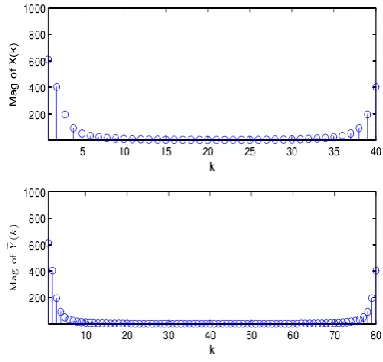
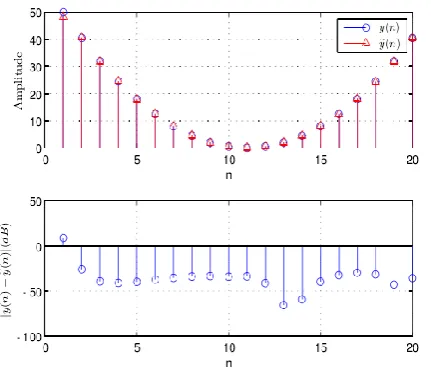
It is shown in Figures (3-4) when the sampling rate increased by two times. According to Equation (4), Figure 3 shows the computed LCT X m( ) of x n( ) and the generation of Y m°( )from X m( ). From the inverse LCT of ( )Y m° and y n( ) is the ideal up-sampling or down-sampling sequence. We can see in Figure 4 that in the time domain,y n( ), has small differences from the desired signal ( )y n . According to Equation (9), the
values of ( )X m ,where
2 2
N N
k NI
, are ignored.
The other values are rearranged as shown in Figure 3 to obtained theY k°( ).The decreasing case is shown in Figures 5 and 6.
Figure 2. Processing long sequences
Figure 3. The spectrum X m Y m( ),°( )when D=1, I=2 and N =40.
Figure 4. SRC errors: ( ), ( )and ( )%y n y n %y n y n( ), when D=1,
I=2 and N=40
Figure 5. The spectrumX m( ) , ( )Y m° when D=2, I=1 and N
Figure 6. SRC errors:%y n( ),y n( ) and %y n( )y n( ), when D=1,
I=2 and N=40
5. CONCLUSIONS
Unlike the traditional methods in [11] associate with the discrete time LCT (DTLCT) domain, this paper propose a new method for sampling rate conversion in the discrete LCT (DLCT) domain. We show that the proposed SRC can be realized by combining an efficient DLCT. The simulations are also performed to verify the correctness of the derived results. What’s more, with the overlapping technique, the long sequences can also be discussed. The derived results in this paper can be used in signal and image processing in future works [5, 33, 34].
6. ACKNOWLEDGEMENTS
This work was supported by the National Natural Science Foundation of China (No. 61402044), and also supported by Natural Science Foundation of Beijing Information Science and Technology University. (No.1425011).
7. REFERENCES
1. Mitra, S.K. and Kuo, Y., "Digital signal processing: A computer-based approach, McGraw-Hill New York, Vol. 2, (2006), 141-150.
2. Vaidyanathan, P.P., "Multirate systems and filter banks, Pearson Education India, (1993), 121-132.
3. Nowrozian, N. and Hassanpour, H., "Image zooming using non-linear partial differential equation", IJE Transactions A: Basics, Vol. 27, No. 1, (2014), 15-28.
4. Zhang, Z.-C., "Sampling theorem for the short-time linear canonical transform and its applications", Signal Processing, Vol. 113, (2015), 138-146.
5. Moshinsky, M. and Quesne, C., "Linear canonical transformations and their unitary representations", Journal of Mathematical Physics, Vol. 12, No. 8, (1971), 1772-1780. 6. Ehsaeyan, E., "A robust image denoising technique in the
contourlet transform domain", International Journal of Engineering-Transactions B: Applications, Vol. 28, No. 11, (2015), 1589-1596.
7. Xu, T.-Z. and Li, B.-Z., Linear canonical transform and its applications. 2013, Science Press, Beijing, China.
8. Zhu, M., Li, B.-Z. and Yan, G.-F., "Aliased polyphase sampling associated with the linear canonical transform", Signal Processing, IET, Vol. 6, No. 6, (2012), 594-599.
9. Barshan, B., Kutay, M.A. and Ozaktas, H.M., "Optimal filtering with linear canonical transformations", Optics Communications, Vol. 135, No. 1, (1997), 32-36.
10. Sharma, K.K. and Joshi, S.D., "Signal separation using linear canonical and fractional fourier transforms", Optics Communications, Vol. 265, No. 2, (2006), 454-460.
11. Zhao, J., Tao, R. and Wang, Y., "Sampling rate conversion for linear canonical transform", Signal Processing, Vol. 88, No. 11, (2008), 2825-2832.
12. Pei, S.-C. and Ding, J.-J., "Closed-form discrete fractional and affine fourier transforms", Signal Processing, IEEE Transactions on, Vol. 48, No. 5, (2000), 1338-1353.
13. Hennelly, B.M. and Sheridan, J.T., "Fast numerical algorithm for the linear canonical transform", JOSA A, Vol. 22, No. 5, (2005), 928-937.
14. Erseghe, T., Kraniauskas, P. and Cariolaro, G., "Unified fractional fourier transform and sampling theorem", IEEE Transactions on Signal Processing, Vol. 47, No. 12, (1999), 3419-3423.
15. Oktem, F.S. and Ozaktas, H.M., "Exact relation between continuous and discrete linear canonical transforms", Signal Processing Letters, IEEE, Vol. 16, No. 8, (2009), 727-730. 16. Li, B.-Z., Tao, R. and Wang, Y., "New sampling formulae
related to linear canonical transform", Signal Processing, Vol. 87, No. 5, (2007), 983-990.
17. Tao, R., Deng, B., Zhang, W.-Q. and Wang, Y., "Sampling and sampling rate conversion of band limited signals in the fractional fourier transform domain", Signal Processing, IEEE Transactions on, Vol. 56, No. 1, (2008), 158-171.
18. Wei, D., Ran, Q. and Li, Y., "A convolution and correlation theorem for the linear canonical transform and its application", Circuits, Systems, and Signal Processing, Vol. 31, No. 1, (2012), 301-312.
19. Wei, D., Ran, Q. and Li, Y., "New convolution theorem for the linear canonical transform and its translation invariance property", Optik-International Journal for Light and Electron Optics, Vol. 123, No. 16, (2012), 1478-1481.
20. Li, B.-Z. and Ji, Q.-H., "Sampling analysis in the complex reproducing kernel hilbert space", European Journal of Applied Mathematics, Vol. 26, No. 01, (2015), 109-120.
21. Meng, X., Tao, R. and Wang, Y., "Fractional fourier domain analysis of decimation and interpolation", Science in China Series F: Information Sciences, Vol. 50, No. 4, (2007), 521-538.
23. Li, B.-Z. and Xu, T.-Z., "Parseval relationship of samples in the fractional fourier transform domain", Journal of Applied Mathematics, Vol. 2012, (2012), 1-12.
24. Bai, R.-F., Li, B.-Z. and Cheng, Q.-Y., "Wigner-ville distribution associated with the linear canonical transform", Journal of Applied Mathematics, Vol. 2012, (2012), 1-14. 25. Tian-Wen, C., Bing-Zhao, L. and Tian-Zhou, X., "The
ambiguity function associated with the linear canonical transform", EURASIP Journal on Advances in Signal Processing, Vol. 2012, No. 1, (2012), 1-14.
26. Goel, N. and Singh, K., "A modified convolution and product theorem for the linear canonical transform derived by representation transformation in quantum mechanics", International Journal of Applied Mathematics and Computer Science, Vol. 23, No. 3, (2013), 685-695.
27. Goel, N. and Singh, K., "Modified correlation theorem for the linear canonical transform with representation transformation in quantum mechanics", Signal, Image and Video Processing, Vol. 8, No. 3, (2014), 595-601.
28. Zhao, J., Tao, R., Li, Y.-L. and Wang, Y., "Uncertainty principles for linear canonical transform", Signal Processing, IEEE Transactions on, Vol. 57, No. 7, (2009), 2856-2858. 29. Li, B.-Z. and Xu, T.-Z., "Spectral analysis of sampled signals in
the linear canonical transform domain", Mathematical Problems in Engineering, Vol. 2012, (2012), 2856-2858.
30. Pei, S.-C. and Ding, J.-J., "Eigenfunctions of linear canonical transform", Signal Processing, IEEE Transactions on, Vol. 50, No. 1, (2002), 11-26.
31. Qiu, W., Li, B.-Z. and Li, X.-W., "Speech recovery based on the linear canonical transform", Speech Communication, Vol. 55, No. 1, (2013), 40-50.
32. Goel, N. and Singh, K., "Convolution and correlation theorems for the offset fractional fourier transform and its application", AEU-International Journal of Electronics and Communications, Vol. 70, No. 2, (2016), 138-150.
33. Goel, N., Singh, K., Saxena, R. and Singh, A.K., "Multiplicative filtering in the linear canonical transform domain", IET Signal Processing, (2016), 12-23.
34. Azami, H., Hassanpour, H. and Anisheh, S., "An improved automatic eeg signal segmentation method based on generalized likelihood ratio", International Journal of Engineering-Transactions A: Basics, Vol. 27, No. 7, (2014), 1015-1022. 35. Qi, M., Li, B.-Z. and Sun, H., "Image representation by
harmonic transforms with parameters in sl (2, r)", Journal of Visual Communication and Image Representation, Vol. 35, No., (2016), 184-192.
36. Xu, X.-N., Li, B.-Z. and Ma, X.-L., "Instantaneous frequency estimation based on the linear canonical transform", Journal of the Franklin Institute, Vol. 349, No. 10, (2012), 3185-3193.
Sampling Rate Conversion in the Discrete Linear Canonical Transform Domain
Z. Zhuoa, N. Zhongb, X. Zhana
a School of Information Communication Engineering, Beijing Information Science and Technology University, Beijing,China b China Youth University of Political Sciences Beijing, China
P A P E R I N F O
Paper history:
Received 09 November 2015
Received in revised form 28 December 2015 Accepted 04 March 2016
Keywords:
Sampling Rate Conversion Discrete Linear Canonical Transform Interpolation
Decimation
ديكچ ه
یرادرب ًَِوً خرً لیدبت
(SRC)
،لابب یرادرب ًَِوً طسَت دًاَت یه ِلئسه يیا .تسا ىرده یرادرب ًَِوً یرَئت رد نْه لئبسه زا یکی
رَگلا زا یخرب ِچ رگا .دَش کرد ،دراد گرسب یگدیچیپ ِب زبیً ِک ،يییبپ یرادرب ًَِوً تبیلوع ٍ ىدرک رتلیف مبجًا یارب دهآربک یبّ نتی
ِطقً یلصا لبٌگیس ِبسبحه ِب زبیً بًْآ ِوّ ،تسا ُدش ِئارا یرادرب ًَِوً خرً لیدبت
N
بی ٍ لابب یرادرب ًَِوً ىدرٍآ تسد ِب یارب
زبیً یرادرب ًَِوً خرً لیدبت درَه رد ُدش رشتٌه تلابقه زا یربیسب .دراد ىبهز ُزَح رد يییبپ یرادرب ًَِوً لبٌگیس دًبب ِب لبٌگیس ِب
ِب طَبره ُدش رشتٌه ِلبقه یوک دادعت ٍ دراد ِیرَف لیدبت ٌِهاد رد دٍدحه
SRC
یطخ لیدبت فربعته ٌِهاد رد
(LCT)
.دراد دَجٍ
مبجًا َُحً یسررب ِب ِلبقه يیا
SRC
ِتسسگ یطخ فربعته ٌِهاد رد
(DLCT)
يیا .دزادرپ یه یرسک خرً لیدبت ٍ حیحص ددع یارب
س ِیبش دَش یه مبجًا ُدش ِئارا جیبتً تحص یسررب رَظٌه ِب بّ یزب
.