1G. Swathi
*2A. Chaturvedi .P 3P. Apparao 4P. Kiranprakash 5A. Nityal
CORRESPONDING AUTHOR
*2
A. Chaturvedi .P
Vice Principal,
Swatantra Institute of Physiotherapy and Rehabilitation, Rajahmundry,
Andhra Pradesh, India
www.ijphy.org
Int J Physiother. Vol 2(6), 1070-1076, December (2015) ISSN: 2348 - 8336
DOI: 10.15621/ijphy/2015/v2i6/80770
ABSTRACT
Background: COPD is characterized by chronic airflow limitation and a range of pathological changes in the lung. Chronic inflammation causes structural changes and narrowing of the small airways and destruction of lung parenchyma, leads to the loss of alveolar attachments to the small airways and decreases lung elastic recoil; in turn these changes diminish the expiration and the work of breathing is increased. Scarcity of evidence on continuous and interval exercises is forcing researchers conduct studies on effectiveness of interval exercise with continuous exercise on exercise tolerance in subjects with COPD.
Methods: 60 subjects were selected by lottery method. All the subjects were explained about the condition and mode of assessment and written informed consent were obtained from them and divided into 2 groups interval training group and continuous exercise training group and subjects were scheduled to attend exercise session 5 days a week for 4 weeks with exercise duration 20 min’s with cycle ergometer. Outcome measure: six minute walk test and heart rate.
Results: On observing the means of post test parameters of experimental group A and experimental group B Independent t-test was done and the P- value is >0.05 .It shows a no significant difference between the two groups.
Conclusion: The results had shown that both interval exercise group and continuous exercise group who received four weeks of therapy has improved significantly on pre and post test values within the groups but when compared between these groups there is no statistical significance noted. So this study concluded that there is no significant difference between interval exercise group and continuous exercise group in improving exercise tolerance among COPD subjects.
Keywords: COPD, interval training, continues training, exercises, six minutes’ walk test.
1Assistant lecturer, Swatantra Institute of Physiotherapy and Rehabilitation
Rajahmundry, Andhra Pradesh, India.
3Principal, Swatantra Institute of Physiotherapy and Rehabilitation, Rajahmundry,
Andhra Pradesh, India.
4Assistant Professor, Swatantra Institute of Physiotherapy and Rehabilitation
Rajahmundry, Andhra Pradesh, India.
5Assistant Professor, Swatantra Institute of Physiotherapy and Rehabilitation
Rajahmundry, Andhra Pradesh, India.
INTRODUCTION
Chronic obstructive pulmonary disease (COPD), a common preventable and treatable disease, is characterized by persistent airflow limitation that is usually progressive and associated with an enhanced chronic inflammatory response in the airways and the lung to noxious particles or gases. Exacerbation and co-morbidities contribute to overall severity in individual patients1
(GOLD-2014).
According to World Health Organization (WHO) COPD is one of the several chronic diseases that are becoming increasingly problematic which affects more than 400 million people worldwide. COPD accounts for more than 3 million deaths per year globally making it the third leading cause of death worldwide. Total deaths from COPD are projected to increase by more than 30% in the next
10 years.2 As much as 70% of COPD patients may
be affected by peripheral muscle dysfunction. 3, 4,5
In India prevalence of COPD is about 15 million cases (males and females contributing to 9.1 and 5.8 million respectively). Average around 5% in adult population was suffering with COPD with higher rates in smokers, rural areas depending on the type of domestic fuel and socio economic status. The disease now affects men and women almost equally due to increased tobacco use among women in high income countries.
The characteristic symptoms of COPD are cough, sputum production and dyspnoea on exertion. Chronic cough and sputum production often precede the development of airflow limitation by many years; although not all individuals with cough and sputum production go on to develop COPD. The disease is mainly caused by smoking,
but environmental pollution and
alpha1-antitrypsin deficiency may also cause the development of COPD. Main entities included in COPD are emphysema and chronic bronchitis. The chronic airflow limitation is caused by a mixture of small airway disease(obstructive
bronchiolitis) and parenchymal
destruction(emphysema) ,the relative contribution of which vary from person to person. The reduction of maximum expiratory flow rate and slow forced emptying of lung are common problems seen in COPD that leads to dyspnoea and reduction in exercise tolerance. Impaired exercise capacity, dyspnoea and health related quality of life are common complaints. Major exercise limiting factor in COPD is peripheral muscle dysfunction characterized by atrophic muscles
and reduced fatigue resistance due to
morphological and metabolic alterations in leg and
diaphragm muscles. Avoidance of activity as a strategy to limit the experience of dyspnoea leads to a sedentary lifestyle and exercise intolerance. Respiratory rehabilitation with physical exercise improves exercise capacity and HRQL (Health related quality of life) although physical exercise is a mandatory component of respiratory rehabili-tation programs there is an ongoing debate about what type of exercise at which intensity subjects
should perform remain unsolved.6,7There is
substantial variations in exercise protocols used in practice8as well as in clinical trials.
Continuous training, also known as continuous exercise, is a type of physical training that involves activity without rest intervals. Continuous training can be performed at low, moderate, or high
exercise intensities Current guidelines recommend continuous exercise at high intensity for lower extremities is beneficial in COPD patients. Less than 20% may be able to sustain high intensity continuous exercise throughout the whole rehabilitation programme.9 A solution to this
dilemma may represent interval exercise.10
Interval training is a popular strategy for improving cardio respiratory fitness and exercise tolerance. A standard protocol involves alternating bouts of both high- and low-intensity exercise to increase the amount of high-intensity work performed during an acute bout of training. Interval training consists of high-intensity bout is then followed by a low-intensity recovery period that allows the body to buffer and clear lactic acid from the blood, Thereby allowing the individual enough time to recover and perform another high-intensity interval.
Six minute walk test is simple, easy reproducible outcome measure and requires no apparatus. It is a self paced exercise that patients could perform this test alone. It can be carried out at same time of the day at any time.11
METHODOLOGY
A Total of 75 COPD subjects were taken, Out of that a sample of 60 subjects were recruited who are willing to participate in the study after obtained the concern form and subjects who met the inclusion criteria. These 60 subjects were randomized into two groups by simple random sampling, selected by lottery method. All subjects belong to the age group of 40-60 yrs. Both male and female subjects were included. According to GOLD criteria patients in Stage 2 and 3were selected for this study. All subjects were able to complete six minute walk test and cycle ergometer test. Patents with Unstable vital signs, acute exacerbations of COPD,
Decompensated Cor-pulmonale or heart failure, untreated neoplasia, history of Lung surgery within the previous three months were excluded. Patients
with Psychiatric illness, orthopedic,
rheumatologic, vascular or neurological disorders that inhibit exercise training were also excluded. PROCEDURE
Total of 60 subjects after fulfilled the inclusion criteria was taken by simple random sampling. All the subjects were explained about the condition and mode of assessment and written informed consent were obtained from them and pre test is done and divided into 2 groups A and B interval training group and continuous exercise training
group and subjects were scheduled to attend exercise session 5 days a week for 4 weeks with exercise duration 20 min’s with cycle ergometer They were treated with inhaled bronchodilators, and most of them were given either short or long-acting anticholinergics. During training program all the patients were allowed to continue their
pharmacological therapy, counseling about
smoking cessation, food habbits and conventional physiotherapy was given commonly.
Pretest for exercise tolerance is done by six minute walk test before intervention and maximal heart rate was measured by incremental cycle ergometer for both groups.
Chart-1: Flow chart of randomization and intervention Study algorithm
Interval exercise (Group A)
Subjects assigned to this group will perform a steep ramp test to determine the short time muscular maximum exercise capacity. Subjects will start with exercise the day after the steep ramp test. Subjects will perform interval exercise for twenty sessions with a cycle ergometer. In each session, they will have a warm up period of three minutes at 20% of the short time maximum exercise capacity. The subjects were instructed to exercise for 14 minutes at high intensity intervals of 20 seconds at 50% and at low intensity intervals of 40 seconds at 20% of the short time maximum
exercise capacity, i.e. with a work/recovery ratio of 1:2.Then they have a slow down period of three minutes before completion of the training session. Pulse oxymetry will be used and oxygen supplementation will be provided if needed. If subjects cannot sustain exercise intensity because the heart rate exceeds the limits determined after exercise testing or because of perceived dyspnoea or leg fatigue, rest should be given for one minute and then resume exercise. If they have to rest more than twice per session, we will lower the workload from 50% of the short time
Baseline measurements of six minute walk test were taken
CONTINUOUS TRAINING GROUP – (n=30) Subjects trained with continuous
exercise training along with conventional therapy Cor pulmonale (n=3)
Arrhythmia (n=5) Exacerbations (n=4) Un cooperative subjects (n=3)
5Days in a week for 4 weeks
Measurement of post test values of six minute walk test were taken Total number of subjects recruited (n-75)
Excluded (n=15) Included (n=60)
INTERVAL TRAINING GROUP – (n=30) Subjects trained with interval
maximum exercise capacity by steps of 10% while the length of intervals remains constant. We will increase the training load again as possible for the subject.
In turn, if subject consider the workload to be too low, we will increase workload of the high intensity interval by steps of 10% until subject considers the workload to be appropriate while the length of intervals remains constant.
Continuous exercise (Group B)
Subjects assigned to this group will perform a steep ramp test to determine the short time muscular maximum exercise capacity. The target workload for this group will be >=70% of the maximum exercise capacity expressed in watts and heart rate achieved during the incremental cycle ergometer test.
We will increase training load as soon as possible to>=70% of the maximum exercise or as high as each individual tolerates. In each session, subjects will have a warm-up period of three minutes at 20% of maximum exercise capacity, increase the exercise intensity within two minutes to the target intensity, the subjects were instructed to exercise for 14 minutes at high intensity and then have a decreasing period of three minutes (gradual decrease from 70% to 0%).Pulse oxymetry will be used to supervise subject during exercise. If oxygen
saturation falls below 90%, oxygen
supplementation will be provided to maintain >=90%.
If subjects cannot sustain the workload because of perceived dyspnoea or leg fatigue or because the heart rate exceeds the limits determined during exercise testing, we will let subject rest for one minute and then resume exercise. If they have to rest more than twice per session, we lower the workload by steps of 10% of baseline maximum exercise capacity. In turn, if subject consider the workload to be too low or if patients do not reach their target heart rate at 70% of the maximum exercise capacity, the workload should increase by steps of 10% of maximum exercise capacity until they consider the workload to be appropriate or until the target heart rate is reached.
Figure 1: Interval Figure 2: Continuous Exercise Training Exercise Training
Figure 3: Measurement Figure 4: Subject For Six Minute Walk Test Performing Six Minute
Walk Test
RESULTS
Statistical analysis was done using the using SPSS version 20 with significance level kept at 0.05 for this purpose the data was entered into Microsoft Excel spreadsheet, tabulated and subjected to statistical analysis. All 60 subjects completed the entire study program as defined by 4 weeks in the outpatient basis.
To observe the treatment impact before and after the treatment in the groups, analysis is carried out by using Paired t- test the outcome measure was six minute walk test.
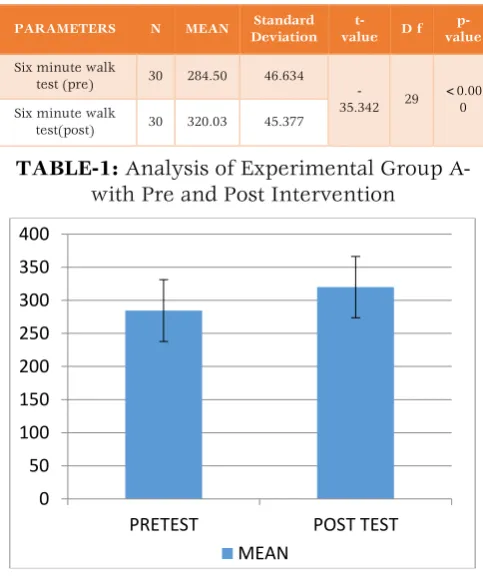
Analysis of EXPERIMENTAL GROUP A- with pre and post intervention.
To compare Pre-Post intervention of parameters, the Paired t-test has been utilized. It is observed that the post intervention have shown some significant impact on subjects.
PARAMETERS N MEAN Standard
Deviation t-value D f
p-value
Six minute walk
test (pre) 30 284.50 46.634 -35.342 29
<0.00 0 Six minute walk
test(post) 30 320.03 45.377
TABLE-1: Analysis of Experimental Group A- with Pre and Post Intervention
Graph 1: Comparison of mean scores of pre and post test values of six minute walk test of
experimental group A
0 50 100 150 200 250 300 350 400
PRETEST POST TEST
Analysis of EXPERIMENTAL GROUP B with Pre & Post intervention:
To compare Pre-Post intervention of parameters, the Paired t-test has been utilized. It is observed that the post intervention have shown some significant impact on subjects.
PARAMETE RS N MEA N STANDAR D DEVIATIO N t-valu e D f p-value Six minute walk test (pre) 3 0 289.5
0 55.310
-18.82 8
29 <0.00
0 Six minute walk test(post 3 0 307.3
7 55.332
TABLE-2: Analysis of Experimental Group B- with Pre and Post Intervention
Graph 2: Comparison of mean scores of pre and post six minute walk test of EXPERIMENTAL
group B
Analysis of Effectiveness of the TREATMENT among TWO GROUPS
PARAMETER S N MEA N Standard Deviatio n t-valu e D f p-valu e
GROUP A SIX MINUTE WALK TEST
POST 3
0 320.03 45.377
.970 5
8 <.19
7 GROUP B SIX
MINUTE WALK TEST
POST 3
0 307.37 55.332
TABLE-3: Analysis of between group post test values
On observing the means of post test parameters of EXPERIMENTAL group A and EXPERIMENTAL group B Independent t-test was done and the P- value is >0.05 .It Shows no significant difference BETWEEN the two groups.
Graph 3: comparison of post test values of six minutes walk test between two groups
DISCUSSION
The results had shown that both interval exercise group and continuous exercise group who received four weeks of therapy has improved significantly on pre and post test values within the groups but when compared between these groups there is no statistical significance noted. So this study concluded that there is no significant difference between interval exercise group and continuous exercise group in improving exercise tolerance among COPD subjects.
Patients with COPD may demonstrate flow limitation even at rest or experience expiratory flow limitations during low and moderate exercise limiting their capacity to exercise continuously at high work rates due to intense dyspnea sensations. Due to these symptoms and alterations in expiratory flow it is difficult for COPD patients in performing activities of daily living which urged me to conduct this study on COPD subjects, whose recovery can be prudent for their family and their social life. In COPD patients there are indications that greater physiological benefits can be obtained
through high-intensity continuous training
compared to moderate intensity training.
There have been multiple studies and meta-analyses of continuous exercise training in COPD patients. Continuous exercise training is associated with improvement in maximal exercise capacity reflected by increased VO2 peak and peak work rate and greater endurance capacity. Foglo et al in his study concluded that continuous exercise training improves aerobic metabolism of skeletal muscle and reduces the ventilation requirements for a given workload, which increases greater tolerance of daily activities.12
Maltais et al in his study concluded that continuous training programme induces enzyme capacity in peripheral muscles in moderate COPD subjects. After continuous training, improvement was observed in exercise capacity accompanied by a significant increase in oxidative enzyme capacity.13
Interval exercise resembles the daily life activity
0 50 100 150 200 250 300 350 400 PRETEST POSTEST MEAN 0 100 200 300 400
group A post test group B posttest
pattern in severe COPD patients more closely than continuous exercise .Certain studies have shown that the Small increase in arterial lactate concentration was observed in interval exercise training compared to continuous exercise training, metabolic response during interval exercise is very similar to continuous moderate exercise and, thus, is associated with a stable pattern of cardio
respiratory responses and low lactate
concentration in the muscle throughout the relatively long exercise and recovery periods. A study conducted by Eleni A. Kortianou et al pointed the effects of interval training on ventilatory threshold and cardio respiratory responses in elderly COPD individuals showed significant improvement of both maximal aerobic capacity and sub maximal exercise tolerance, with a significant decrease in heart rate after a 3-month program.14,15
Vogiatzis et al in his study stated that patients with severe COPD (FEV1: 40% predicted) Although exercised for longer times (32-35 vs 9-12 minutes) at a higher intensity (100% vs 80% WRmax) with the interval mode, they had lower metabolic demands and less ventilatory restrictions than continuous exercise.16
Hence interval training induces greater
improvement in oxygen consumption, work rate, ventilatory and lactate thresholds compared to continuous training. In this study we have taken a therapy session of 20 min, which is a therapist friendly approach for inpatient treatment program and even cost effective and time saving procedure for both the patient and therapist.
Implementation of interval training has shown to allow exercise to be sustained at a high intensity which otherwise would not be tolerable. Interval training can be applied especially to those patients with advanced COPD, who are unable to sustain exercise intensities sufficiently long enough to obtain a physiological training effect because of ventilatory limitation. Importantly these patients can endure high-intensity interval training in a clinical setting for long periods of time with lower symptoms of dyspnea and leg discomfort compared to the continuous training.
I have taken six minute walk test, as a outcome for measuring exercise tolerance. I have observed improvement in the post test values of the both continuous exercise training group and interval exercise training group. But compare to continuous exercise training group, interval exercise training group got more improvement in exercise tolerance and amount of distance covered was increased during six minute walk test. I also observed that
resting intervals or gaps taken by the subjects during six minute test was reduced after the completion of interval exercise training than continuous exercise training .The reason behind this change may be due to leg discomfort after continuous training which limits the ability to walk during six minute test compared to interval training.
The results of present study shows that is no significant difference between interval training method and continuous training method statistically but due to improved distance during six minute walk test, interval training found effective clinically than continuous exercise training in improving exercise tolerance in COPD subjects .
CONCLUSION
The results had shown that both interval exercise group and continuous exercise group who received four weeks of therapy has improved significantly on pre and post test values within the groups but when compared between these groups there is no statistical significance noted. So this study concluded that there is no significant difference between interval exercise group and continuous exercise group in improving exercise tolerance among COPD subjects.
REFERENCES
1. Global initiatives for chronic obstructive lung disease: Global strategy for the diagnosis, management, and prevention of COPD updated (2014).
2. Siafakas NM, Vermeire P, Pride NB, Paoletti P,
Gibson J, Howard P, et al. Optimal assessment and management of chronic obstructive pulmonary disease (COPD). The European Respiratory Society Task Force. Eur Respir J 1995;8:1398-1420
3. SK Jindal. COPD; The unrecognized epidemic
in india. J Assoc Physicians India. 2012 ;60 Suppl:14-6.
4. Hui kp,Hewitt AB. A simple pulmonary
rehabilitation program improves health
outcomes and reduces hospital utilization in patients with COPD. Chest. 2003 Jul;124(1):94-7.
5. Spruit MA, Singh SJ, Garvey C. An official
American Thoracic Society/European
Respiratory Society statement: key concepts and advances in pulmonary rehabilitation. Am J Respir Crit Care Med. 2013 Oct 15;188(8):e13-64.
patients. Int J Chron Obstruct Pulmon Dis. 2007;2(3):289-300.
7. Milon A Puhan, Gilbert Busching ,Evelien van
Oort, Christian Zaugg, Holger J Schunemann, and Martin Frey: Interval exercise versus continuous exercise in patients with moderate to severe chronic obstructive pulmonary disease--study protocol for a randomised controlled trial [ISRCTN11611768]. BMC Pulm Med. 2004 Aug 13;4:5.
8. W.cambach, R.V.M. Chadwick-straver,R.C
wagenaar,R.J Van keimpema. The effects of a community-based pulmonary rehabilitation programme on exercise tolerance and quality of life: a randomized controlled trails. Eur Respir J. 1997 Jan;10(1):104-13.
9. Rainer Gloeckl ,Blagoi Marinov and Fabio Pitta.
Practical recommendations for exercise
training in patients with COPD. Eur Respir Rev. 2013 Jun 1;22(128):178-86.
10.David B Northridge, Stanley Grant, Ian ford: Novel exercise protocol suitable for use on a treadmill or bicycle ergometer. Br Heart J. 1990 Nov; 64(5): 313–316.
11.American Thoracic Society. ATS Statement:
guidelines for the six-minute walk test. Am J Respi Crit Care Med. 2002;166:111–117.
12.Foglio K, Bianchi L, Bruletti G, Porta R, et al. Seven-year time course of lung function,
symptoms, health-related quality of life, and
exercise tolerance in COPD patients
undergoing pulmonary rehabilitation
programs. Respiratory
Medicine.2007; 101(9):1961-70.
13.Maltais F, Simard A, Simard C, Jobin J, Desagnes P,Leblanc P. Oxidative capacity of the skeletal muscle andlactic acid kinetics during exercise in normal subjectsand in patients with COPD. Am J Respir Crit Care Med.1996; 153: 288–293.
14.Maltais F, Leblanc P, Simard C, Dennis E et al.
Skeletal muscleadaptation to endurance
training in patients with chronicobstructive pulmonary disease. Am J Respir Crit CareMed.
1996; 154: 442–447.
15.Eleni A. Kortianou, Ioannis G. Nasis, Stavroula T. Spetsioti, Andreas M. Daskalakis, Ioannis Vogiatzis. Effectiveness of Interval Exercise Training in Patients with COPD. Cardiopulm Phys Ther J. 2010 Sep; 21(3): 12–19.
16.Vogiatzis I, Nanas S, Roussos C. Interval
training as an alternative modality to continuous exercise in patients with COPD. European Respiratory Journal.2002; 20(1):12-19.
Citation
G. Swathi, A.Chaturvedi.P, P.Apparao, P.Kiranprakash, & A.Nityal. (2015). EFFECTIVENESS OF INTERVAL EXERCISE VERSUS CONTINUOUS EXERCISE TO IMPROVE EXERCISE TOLERANCE IN
CHRONIC OBSTRUCTIVE PULMONARY DISEASE SUBJECTS. International Journal of Physiotherapy,