journal homepage: http://civiljournal.semnan.ac.ir/
Effect of Organic and Inorganic Matrix on the
Behavior of FRP-Wrapped Concrete Cylinders
A. Sadrmomtazi1*, M. Khabaznia2 and B. Tahmouresi3 1. Associate Professor, Department of Civil Engineering, University of Guilan, Rasht, Iran 2. M.Sc., Structural Engineering, Campuses2, University of Guilan, Rasht, Iran
3. M.Sc., Structural Engineering, University of Guilan, Rasht, Iran
Corresponding author:[email protected]
ARTICLE INFO ABSTRACT
Article history:
Received: 26 November 2016 Accepted: 01 February 2017
There is an increased use of fiber reinforced polymer composites (FRPC) in a wide area of engineering fields for various reasons including, ease of transportation and installation, high strength to weight ratio and favorable durability in different conditions. On the other hand, the use of this material as confining shells has been an interesting matter for retrofit, strengthening and construction of quasi-structural column systems. In this research, concrete cylinders with 150 mm diameter and 300 mm height were made, and effect of organic (epoxy-based) and inorganic (cementitious-based) matrices on strength behavior and ductility of cylinders wrapped in one and two-ply carbon, basalt and glass fabrics were studied. Results show that compressive strength of wrapped cylinders was 1.11 to 2.42 times higher than unwrapped ones. Also, there was a considerable 10 times increase in cylinders’ ultimate strain. Effects of confinement upgrade (from one to two-ply) were 3% to 26% increase for compressive strength and 17% to 41% for failure strain. Fabrics’ quantity performance was Carbon > Basalt > Glass.
Keywords: Fabric, Confinement, Ductility, Organic matrix, Inorganic matrix.
1. Introduction
Many structures may need repair or retrofit due to overloading or exposing to corrosive conditions. Also, some of them need strengthening for reasons such as low quality construction materials; damage caused by earthquakes or storms as well as codes updates. Strengthening of structural elements
First research in confined concrete was performed by Richard in 1928 [1]. In that research, concrete was exposed to different uniform, multilateral (active) pressures by fluid. Results show that confined concrete strength increases with increased multilateral pressure.
Columns confinement is performed by various forms. (a) circular/spiral reinforcements, (b) concrete jackets, (c) steel jackets are among first methods of confinement; and the new type is FRP material. Steel and concrete jackets are not considered favorable for high weight, unfavorable performance in corrosive conditions or durability reasons. In contrast, FRP materials are considered excellent composites for structural elements strengthening for including features such as high strength to weight ratio, corrosive strength, short-time curing, fairly cost-effective and easy to install [2-6]. In recent years, Basalt fiber reinforced polymer (BFRP), Glass fiber reinforced polymer (GFRP), and Carbon fiber reinforced polymer (CFRP) composites are used in different shapes such as fabrics, chopped fiber, bands, nets and bars with various kinds of matrices for strengthening. Furthermore, the use of FRP-wrapped concrete elements has earned wide interest for considerable load bearing capacity as well as ductility and post-peak improvement behavior [7-10]. Different studies by researchers [11-15] show that compressive strength, elasticity module and lateral deformation increases in FRP-wrapped columns, under uniaxial compressive loads. In their study of ‘’ Design-oriented stress–strain model for FRP-confined concrete’’, Lam and Teng [16] evaluated development of a stress-strain model. Results of model prediction are in
good accordance with experimental results. Lim and Ozbakkaloglu [17] studied the influence of silica fume on stress–strain behavior of FRP-confined High Performance Concrete (HPC) and observed that stress-strain curve (up to maximum load bearing capacity point) for wrapped concrete had nearly uniform ascendance; and demonstrates stress /load bearing endurance in post-peak and post-cracking. Berthet and et al. [18] studied Compressive behavior of concrete externally confined by composite jackets and reported the following results: (a) Ultimate strength and strain had considerable increase with confinement system upgrade. (b) Transition zone curve and start time of strain-hardening/softening was dependant on jacket’s stiffness. (c) Ultimate capacity of confined concrete (considering ultimate strength and axial strain) depends on confinement pressure in failure, such that mechanical efficiency of confined elements had gradual decrease compared to plain concrete.
According to performed studies, efficiency of bond between concrete surface and cement-based composites in confined mode is acceptable [24].
Accordingly, different experiments and methods by researchers [25 and 26] has been performed on inorganic matrices as more adaptable, more cost-effective and eco-friendly substitutes. In their research ‘’ Study of Behavior of FRP-confined concrete after high temperature exposure’’ Al-Salloum and et al. [27] observed that epoxy matrix demonstrates high sensitivity to temperature changes, such that its matrix strength and bond quality with concrete surface decreases considerably in temperature beyond Tg. Study by Di Ludovico and et al. [19] on Structural upgrade using basalt fibers for concrete confinement showed this strengthening method can be a good and promising solution for handling some strengthening limitations with epoxy-based matrix. Colajanni and et al [24] studied Concrete columns confined with fiber reinforced cementitious mortars. They reported the use of cementitious mortars instead of epoxy system leads to “latency” phenomenon in activation of wrapped system, and activates after reaching to peak-point, hence leading to increased toughness. y Basalo and et al. [11] studied Fiber reinforced cement-based composite system for concrete confinement. They used two types of inorganic matrix. First type was hydraulic cement-based and the latter, modified acrylic resins of Portland cement-based origin. Results showed that axial compressive strength and ductility increased considerably, despite the weak saturation of fibers with cement matrix. Results by Kurtz and Balaguru [28] also showed inorganic matrix (made from Aluminosilicate powder and a water-based active) as a substitute for
epoxy resin has a positive effect on increased strength and toughness of reinforced concrete beams strengthened with CFRP.
1.1. Stress-strain behavior analysis
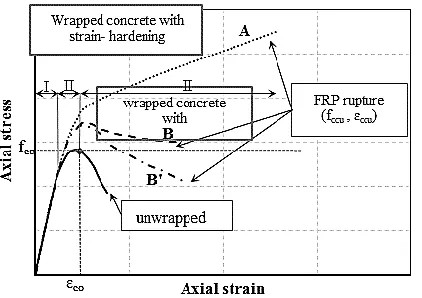
Fig. 1 shows a stress-strain curve schematic of concrete cylinders behavior with or without hardening/softening post-peak region. According to Lim and Ozbakkaloglu [17], stress-strain curve can be divided into three regions: (I) linear elastic branch, (II) transition branch, and (III) stain-hardening/softening branch.
Lam and Teng [16] shows there are totally three forms of stress-strain curves for various ratios of confined to unconfined concrete strength. In case FRP materials exceed a certain level, stress-strain curve of confined concrete demonstrates an ascending bilinear behavior in post-peak region, which expresses favorable concrete confinement. In this type of curves, concrete reaches its ultimate compressive strength and strain at the same time, and their values have been improved considerably. Curve A demonstrates this behavior in Fig. 1.
Fig. 1. Typical stress–strain responses of FRP- wrapped
1.2. Research significance
There is passive nature in confined and normal concrete columns. Passive confinement level might be invariable or variable during axial loading. Invariable confinement develops while the confining material acts plastically (confinement effect resulting from stirrup in normal reinforced concrete columns. Variable confinement develops when confining matter is hard enough such as FRP or metal jackets with elastic mode. The main objective of this research is (a) effectiveness evaluation of inorganic (cementitious-based) matrix on strength behavior and ductility of cylinders wrapped and its bond with concrete surface, (b) performance comparison to organic matrix using fabrics and various techniques. For this purpose, 52 concrete cylinders with 150 mm diameter and 300 mm height were wrapped in one and two-ply carbon, basalt and glass fabrics. 48 out of 52 cylinders were divided and wrapped into sixteen-batch (3 batches) groups. The four remaining specimens were used as control (unwrapped). Also, analytical expressions were presented for prediction of confinement effects.
2. Experimental Program.
2.1. Concrete
Portland cement I-42.5 type - according to ASTM C33- was used in concrete mixture. Used gravel and sand had density 2.68 and 2.61 (maximum size 19 mm) respectively. Mix design weight ratio (cement: sand: gravel) was 1:1.8:3 respectively.
2.2. Fabric
One and two- ply Fabrics (carbon, basalt and glass) were used in 300×550 mm and 300×1020 mm, respectively. In each confined specimen by one and two-ply, an overlap length of 80 mm was provided in order to prevent premature failure of fibers due to debonding. The properties of fabrics (obtained from Iran Composite Company) are presented in Table 1.
Table 1. Properties of fabrics
Carbon Basalt Glass Tensile strength
(Mpa) 3900 2800 2100
Elasticity module
(GPa) 330 93 71
Thickness (mm) 0.168 0.2 0.22 Elongation (%) 1.8 2.8 2.6 Weight per unit
area (gr/m2) 245 220 192
2.3. Matrix
Organic matrix was double portions with weight ratios (resin: hardener, 10:1.25) and tensile strength 62 MPa; elasticity module 3.1 GPa.
super plasticizer) 10:2.5:2:0.01, respectively. Organic matrix mixture contains fine
materials (due to suitable
penetration/infiltration into fabric texture) as well as low viscosity and water: cement ratio (due to higher strength and suitable performance in long-term). Organic and inorganic matrices were introduced as EM and CM.
2.4. cylinders strengthening
Cylinders were covered by a plastic layer to prevent fresh concrete humidity evaporation after casting in molds. After 24 hours, cylinders were demolded and were cured – according to ASTM C192- in water until the testing day.
After 56 days, cylinders were out of water for organic system strengthening and, after 10 days of room temperature exposure, were prepared for strengthening. Before strengthening, their surfaces were treated by a wire brush to create mild roughness and improved bond. Resin and hardener were blended by a mixer for 5 to 7 minutes. Then, cylinders were impregnated with organic matrix and strengthened by pre-impregnated fabrics. For ensuring sufficient curability, cylinders were put to test after 7 days.
For strengthening with inorganic matrix system, cylinders were out of water after 28 days and similar treatment operation was done. Next, an inorganic matrix mixture was impregnated to cylinders surface; and after that, pre-impregnated fabrics were wrapped around cylinders, too. (for better permeability of matrix into fabrics, vibration table was used. After initial setting of inorganic matrix (7-15 min), cylinders were packed in plastic for 24 hours. Then, they were laid in water for 28days. Finally, they were out of water
and put to test in room temperature after 10 days.
2.5. Test setup
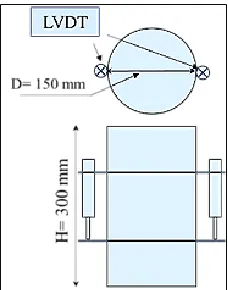
According to ASTM C39, compressive strength of concrete cylinders under uniaxial loading (loading rate: 0.005 mm/s) using digital SOIL TEST machine - loadcell capacity: 3000 KN – were evaluated. To measure axial strain, two LVDT were attached along cylinder. (Fig. 2) Note that before testing, top and bottom of cylinders, according to ASTM C617-94, were capped.
Fig. 2. Test setup and instrumentation
3. Results
Results of the test are summarized as diagrams and stress-strain curves. Results of three cylinders were considered as average mechanical strength. The results summary of compressive strength (fcc), wrapped cylinder
to control strength ratio (fcc/fcu), strain corresponding to maximum compressive strength (ɛc), rupture strain (ɛccu), rupture
strain to strain corresponding to maximum compressive strength of control cylinder (ɛccu
/ɛco), absorbed energy (AE), and initial
elasticity module (Ec) are presented in Table
Table 2. Summary results of the mechanical properties of concrete cylinders
EC (GPa) AE (kJ/m3)
ɛccu/ɛco ɛccu (%)
ɛ CC (%)
fcc/fc0
fc (MPa) MIX ID 28.26 36 1.18 0.185 0.14 -27.3 Ctrl 33.41 528 8.57 1.201 -1.90 52 C-EM-1 35.22 793 10.10 1.414 -2.42 66 C-EM-2 30.37 145 3.21 0.45 0.257 1.28 35 C-CM-1 30.38 240 4.28 0.607 0.293 1.54 42 C-CM-2 32.5 230 6.3 0.883 0.243 1.35 37 B-EM-1 33.05 330 7.55 1.058 0.287 1.64 44.6 B-EM-2 31.01 131 3.01 0.42 0.187 1.17 32 B-CM-1 31.5 161 3.7 0.52 0.218 1.28 35 B-CM-2 31.06 195 3.78 0.53 0.16 1.17 31.5 G-EM-1 31.5 280 4.7 0.66 0.189 1.28 35 G-EM-2 28.01 86 1.83 0.257 0.15 1.11 31 G-CM-1 28.87 73 2.3 0.321 0.154 1.21 33 G-CM-2
3.1 unwrapped cylinders (control)
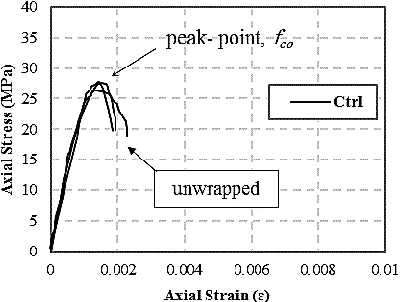
Fig. 3 shows stress-strain curves for unwrapped cylinders. Average compressive strength is 27.3 MPa and corresponding strain is 0.14%. Brittle behavior under uniaxial loading is observed during cylinders rupture.
Fig. 3. Stress–strain curves for unwrapped concrete cylinders (Ctrl)
3.1. Wrapped cylinders
Fig. 4 shows stress-stain curves for concrete cylinders wrapped in jackets made from
carbon fabrics and organic/inorganic matrices. In all wrapped cylinders, compressive strength and stain increased compared to unwrapped cylinders. Carbon fabrics create higher confinement due to higher tensile strength (higher elasticity module) compared to other fabrics (basalt and glass).
In Fig. 4(a), average compressive strength of cylinders wrapped in one or two ply carbon/organic matrix increased 1.9, 2.42 times, and 8.57, 10.1 times for rupture stain, respectively (compared to unwrapped cylinders). Second portion slope of stress-strain curve has ascending trend and confinement upgrading causes increased slope for this portion. This result demonstrates improved confinement performance at higher levels.
and post-yield behavior also could be observed.
Fig. 4. Stress–strain curves for wrapped concrete cylinders with one or two layer of Carbon: (a)
Organic matrix, (b) Inorganic matrix. Fig. 5 shows stress-strain curve for cylinders wrapped in jackets made from basal fabrics and organic/inorganic matrices.
In Fig. 5(a), average compressive strength of cylinders wrapped in one or two ply basalt/organic matrix increased 1.35, 1.64 times, and 4.23, 5.17 times for rupture stain, respectively (compared to unwrapped cylinders). Confinement Upgrading turns wrapped cylinders behavior from quasi-plastic into strain- hardening. One of the cylinders wrapped in two-ply basalt fabric and organic matrix revealed strain-softening
behavior which the beginning of micro cracks development before load transfer to jacket can explain it.
In Fig. 5(b), average compressive strength of cylinders wrapped in one or two ply basalt/inorganic matrix increased 1.24, 1.28 times, and 3.01, 3. 7 times for rupture stain, respectively (compared to unwrapped cylinders).
Fig. 5. Stress–strain curves for wrapped concrete cylinders with one or two layer of Basalt: (a)
Organic matrix, (b) Inorganic matrix. Fig. 6 shows stress-strain curve for cylinders wrapped in jackets made from glass fabrics and organic/inorganic matrices.
glass/organic matrix increased 1.17, 1.28 times, and 3.78, 4. 7 times for rupture stain, respectively (compared to unwrapped cylinders). Curve for Cylinders wrapped in one ply fabrics has slight drop approximately in strain point corresponding to peak-point of unwrapped cylinders, and then again, resumes an ascending trend that lag in confinement action can explain it.
In Fig. 6(b), average compressive strength of cylinders wrapped in one or two ply glass/inorganic matrix increased 1.11, 1.21 times, and 1.83, 2.30 times for rupture stain, respectively (compared to unwrapped cylinders). Looking at stress-strain curves in Fig. 6, it seems that impression ratio of organic matrix on rupture strain is higher than compressive strength.
Stress-strain curve for cylinders strengthened by organic matrix is nearly bilinear; while, cylinders strengthened by inorganic matrix had similar behavior of unwrapped cylinder or those confined with reinforcement. Initially, the curves were linear and then, non-linear up to peak-point. In post-peak region, a gradual descending branch was observed that dropped when fracture of the jacket occurred.
Absorbed energy or toughness is an important factor in evaluation of confinement effect on post-peak behavior. In Table 1, cylinders’ absorbed energy (AE) is shown up to strain- rupture point. Absorbed energy of CFRP-wrapped cylinders is 2.39 and 5.28 times higher, compared to BFRP/GFRP-wrapped cylinders, respectively. Also, this value is 2.3 times higher for BFRP compared to GFRP. Inorganic matrix had positive effects on absorbed energy in CFRP/BFRP-wrapped post-peak region.
In strain-hardening portion, elasticity module (E) decreases, which this may cause instability of slender columns as global buckling (with no increase in strength driven by columns confinement) [29].
Fig. 6. Stress–strain curves for wrapped concrete cylinders with one or two layer of Glass: (a)
Organic matrix, (b) Inorganic matrix.
3.2. Failure Mode
In Fig. 8, failure modes of wrapped cylinders are illustrated. In Fig. 8(a-c), failure of cylinders impregnated by organic matrix are shown in which fibers elongation is visible. In Fig. 8(d-f), failure of cylinders impregnated by inorganic matrix is also demonstrated in which failure has occurred mainly due to longitudinal cracks driven by tensile.
In some cylinders, failure occurred due to developing shear-inclined cracks at top, which seems firstly: friction between cylinder surfaces with steel fixtures; and secondly: insufficient fabrics in this region (top of cylinders) explain it.
Fig. 9 shows debonding between cementitious jackets and concrete cylinder surface. Lack of appropriate bond between cylinder surface and inorganic matrix indicates this fact. In some concrete cylinders impregnated with inorganic matrix, failure with vertical tearing of fibers (along loading) occurred due to insufficient permeability of inorganic matrix in that region. Applying suitable operations (adding slender bands at top and bottom, matrix injection into fabrics warp and woof) can prohibit these types of failures.
Fig.7. Failure modes of unwrapped concrete cylinders
Fig.8. Failure modes of wrapped- concrete cylinders with: Organic matrix, (a) Basalt, (b) Carbon, (c)
Glass and Inorganic, (d) Basalt, (e), Glass, (f) Carbon.
a b
c d
Cylinders impregnated with epoxy matrix in post-peak region demonstrated fairly flexible behavior. Although, cylinders impregnated with inorganic matrix suffered from gradual decrease in strength after reaching ultimate stress (peak point) and
finally, experienced softer rupture. Three cases of wrapped cylinders had slight or less strength increase compared to control ones. The reason was cylinder’s failure before activation of wrapping system.
Fig. 9. FRCM jacket detached from failed wrapped specimen (C-CM-1): (a) side view, (b) top view.
4. Results Modelling
In order to present analytical interpretation of compressive strength behavior, ultimate strain and ductility of FRP-wrapped cylinders
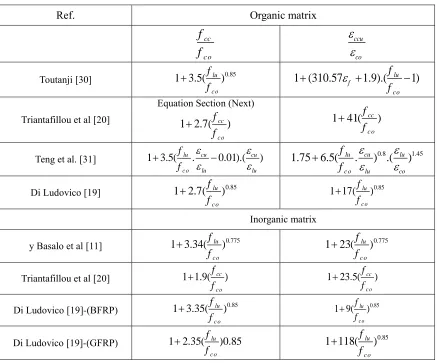
have been indicated in some models in different studies. To compare results of this study with other studies, some suggested confinement models (organic/inorganic-based matrices) are shown in Table 3.
Table. 3. Suggested models of ultimate strength, confinement pressure and ultimate strain
Organic matrix Ref. ccu co
cc c o f f1 (310.57 1.9).( lu 1) f c o f f 0.85
1 3.5( lu )
c o f f
Toutanji [30]
1 41( cc)
c o f f
Equation Section (Next)
1 2.7( cc)
c o
f f
Triantafillou et al [20]
0.8 1.45
1.75 6.5( lu . cu) .( lu)
c o lu co
f f
1 3.5( lu . cu 0.01).( cu)
c o lu lu
f f
Teng et al. [31]
0.85
1 17( lu) c o
f f 0.85
1 2.7( lu )
c o f f
Di Ludovico [19]
Inorganic matrix
0.775
1 23( lu )
c o f f
0.775
1 3.34( lu)
c o f f
y Basalo et al [11]
1 23.5( cc)
c o f f
1 1.9( cc) c o
f f Triantafillou et al [20]
0.85 1 9( lu)
c o f f
0.85
1 3.35( lu) c o
f f Di Ludovico [19]-(BFRP)
0.85
1 118( lu )
c o
f f 1 2.35( lu )0.85
c o
Common method for modeling or prediction of the highest concrete confinement strength fcc and the corresponding strain ɛccu, which depends directly on jacket’s performance, is illustrated in Eq. 1 and 2. [4, 6,11, 17, 20 and 31].
Eq (1)
1( )
m
c c l u
c o c o
f f
A K
f f
Eq (2)
2( )
n
ccu l u
co c o
f B K
f
Where, A, B, k1, k2, m and n are experimental constants, affected by fabric and matrix type, number of layers. In some studies, modeling are assumed based on relationship linearity of confinement strength, ultimate strain and unconfined strength (m=n=1) and in some others, it is considered non-linear (m=n <1). flu ultimate
confined pressure is according to Eq. 3 and 4:
Eq (3)
. .
2
f f u f l u e
E
f k
Eq (4)
4. .f
f
n t D
Where Ef: fibers elasticity module, ɛfu: strain
corresponding to ultimate confined pressure (flu) in FRP, ρf: volumetric confinement ratio,
n: number of layers, tf: FRP layer thickness,
and D: diameter of concrete cylinder.
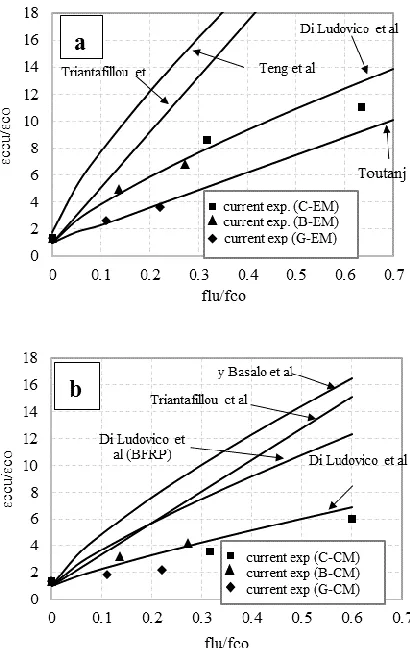
Fig. 10 shows the relationship fcc/fco and
flu/fco. Fig 10(a, b) relate to cylinders wrapped
with organic and inorganic matrix, respectively. Ultimate confinement pressure is calculated using Eq. 3 in which ɛfu,
according to manufacturer claim, is calculated for carbon, basalt and glass. Fig11. shows relationship fcc/fco and ɛccu / ɛco. Fig 11(a, b) relate to cylinders wrapped with
organic and inorganic matrix, respectively. In this research, ɛco was assumed 0.0014. Comparison between experimental results and theoretical prediction show there is fairly good accordance in models related to organic matrix (Fig. 10a). in Fig. 11(a), it is observed that model prediction in research Di Ludovico, et al. [19] and Teng, et al. [31] 2009) offers a good estimation, compared to results of this research. But in research Triantafillou and et al. [20] results are assumed conservative and overestimated. In models relating to inorganic matrix (Figs. 10b, 11b) as inorganic matrix composition, unlike organic matrix, is heterogeneous and compositions used in this research are different from others, results from this research are in less accordance with prediction models. Although it seems the curves have fairly equal growth rates.
Fig. 10. Relationship fcc/fco and flu/fco for: (a)
Fig. 11. Relationship ɛccu/ɛcoand flu/fcofor: (a)
Organic matrix, (b) Inorganic matrix
Fig. 12. Comparisons between prediction and values of experimental ultimate strength: (a)
Organic matrix, (b) Inorganic matrix
Fig. 13. Comparisons between prediction and values of experimental ultimate strain: (a)
Organic matrix, (b) Inorganic matrix
y = 0.9334x + 0.1014 R² = 0.9334
0 0.5 1 1.5 2 2.5 3
0 0.5 1 1.5 2 2.5 3
P
re
d
.
fccu
/fco
Exp. fccu/fco +20
-20% a
y = 0.9232x + 0.0957 R² = 0.9232
0 0.5 1 1.5 2 2.5 3
0 0.5 1 1.5 2 2.5 3
Pr
ed
.
fccu
/fco
Exp. fccu/fco
-20% +20
b
y = 0.8689x + 0.7297 R² = 0.8689 0
2 4 6 8 10 12
0 2 4 6 8 10 12
Pr
ed
. ɛcc /ɛco
Exp. ɛcc/ɛco
+20
-20%
a
y = 0.8675x + 0.4225 R² = 0.8675 0
2 4 6 8 10 12
0 2 4 6 8 10 12
Pr
ed
. ɛcc /ɛco
Exp. ɛcc/ɛco +20
-20%
Comparisons between results of this research and others (Fig. 10,11) show that suggested models may not present an accurate estimation for strength and strain, and even in some cases, results and experimental observations are too much different from estimation relationships. Predicted confined pressure and strain versus experimental results are shown in Figs. 12 and 13, (using Eq. 1-4 and drawing linear regression); good correlation with ±20% error limit is observed.
5. Conclusion
In this research, the effect of organic and inorganic matrix on strength behavior and ductility of concrete cylinders wrapped in carbon, basalt and glass fabrics was studied from which following results are extractible: • Carbon fabric-wrapped/organic matrix-impregnated cylinders experienced 2.4 and 10 times increase in compressive strength and ultimate strain, respectively. Inorganic matrix also increased compressive strength and failure strain 1.54 and 4.28 times, respectively.
• Behavior of cylinder wrapped with organic matrix at post-peak region was strain-hardening or strain-softening. This indicates suitability and sufficiency of confinement level. Inorganic matrix-impregnated cylinders suffered from gradual strength decrease after reaching ultimate stress (peak point) and experienced subsequent softer rupture. (Rupture mode for jackets like FRP or debonding, depends on tensile strength of inorganic matrix). In all cases, inorganic matrix increased strength and strain and its effect depends on materials type, treatment conditions and mechanical properties.
• Compressive strength or failure strain for basalt fabric-wrapped or organic matrix was 1.64 and 5.18 times higher compared to unwrapped ones. Compressive strength of cylinders wrapped with one or two ply fabrics/ organic matrix was 22% and 24% lower strength, respectively. These values were 28% and 40% for failure strain, respectively.
• confinement upgrade caused increased absorbed energy in post-peak region and it had positive effect by delaying in crack development start time.
• The effect of confinement by glass fabrics in organic matrix-impregnated cylinders on failure strain (in post-peak region) was higher than compressive strength. Also, inorganic matrix had similar behavior.
• Numerical analysis and using models for results prediction as well as issues related to optimization and economic advantages might be useful. The models suggested by other researchers were in fairly good accordance with current results. This was true for epoxy matrix-impregnated cylinders, but it had some differences with inorganic matrix that construction material and mechanical properties can explain it.
Finally, regarding little information about basalt fabric cementitious composites in expressed literature, the current study could be used for future researches as a reference.
Acknowledgements
This research was done with the financial support provided by concrete and building materials laboratory at university of Guilan. The authors also, are grateful of efforts of Mr. Sina Mohammadi Bousari for his collaboration in experimental work.
REFERENCE
[1] Richard, F.E., Brandtzaeg, A., Brown, R.L. (1928). “A study of the failure of concrete under combined compressive stresses”. University of Illinois at Urbana Champaign, College of Engineering. Engineering Experiment Station.
[2] Kheyroddin, A., Naderpour, H. and Ahmadi, M. (2014). “Compressive Strength of Confined Concrete in CCFST Columns”. Journal of Rehabilitation in Civil Engineering, Vol. 2, NO. 1, pp.106-113. [3]. Fanggi, B.A.L., and Hadi, M.N. (2011). “The
Behaviour of Carbon Fibre Reinforced Polymer Confined Concrete Cylinders under High Temperature Exposure”. Concrete Building a Sustainable Future, pp. 1-9.
[4]. Campione, G., La Mendola, L., Monaco, A., Valenza, A. and Fiore, V. (2015). “Behavior in compression of concrete cylinders externally wrapped with basalt fibers”. Composites Part B: Engineering, Vol. 69, pp.576-586.
[5] Sadeghian, P., Fam, A. (2014). “A rational approach toward strain efficiency factor of fiber-reinforced polymer-wrapped concrete columns”. ACI Structural Journal. Vol.
111, No. 1, pp.135.
[6] Wu, G., Lü, Z.T., Wu, Z.S. (2006). “Strength and ductility of concrete cylinders confined with FRP composites”.
Construction and building materials, Vol. 20, NO. 3, pp.134-148.
[7] Karabinis, A.I., and Rousakis, T.C. (2001). “A model for the mechanical behaviour of the FRP confined columns”. In Proceedings of the International Conference on FRP Com‐posites in Civil Engineering, pp. 317-326.
[8] Li, Y.F., Lin, C.T., and Sung, Y.Y. (2003). “A constitutive model for concrete confined with carbon fiber reinforced plastics”. Mechanics of Materials, Vol. 35, NO. 3, pp.603-619.
[9] Ozbakkaloglu, T., and Saatcioglu, M. (2006). “Seismic behavior of high-strength concrete columns confined by fiber-reinforced polymer tubes”. Journal of Composites for Construction, Vol. 10, No. 6, pp. 538-549.
[10] Abbasnia, R., Ahmadi, R., and Ziaadiny, H. (2012). “Effect of confinement level, aspect ratio and concrete strength on the cyclic stress–strain behavior of FRP-confined concrete prisms”. Composites Part B: Engineering, Vol. 43, No. 2, pp.825-831.
[11] y Basalo, F.J.D.C., Matta, F., and Nanni, A. (2012). “Fiber reinforced cement-based composite system for concrete confinement”. Construction and Building Materials, Vol. 32, pp.55-65.
[12] Seible, F., Priestley, M.N., Hegemier, G.A., and Innamorato, D. (1997). “Seismic retrofit of RC columns with continuous carbon fiber jackets”. Journal of composites for construction, Vol. 1, No. 2, pp.52-62.
[13] Matthys, S., Toutanji, H., and Taerwe, L. (2006). “Stress–strain behavior of large-scale circular columns confined with FRP composites”. Journal of Structural Engineering, Vol. 132, No. 1, pp.123-133. [14] Karam, G., and Tabbara, M. (2005).
“Confinement effectiveness in rectangular concrete columns with fiber reinforced polymer wraps”. Journal of Composites for Construction, Vol. 9, No. 5, pp.388-396. [15] Shahawy, M., Mirmiran, A., and Beitelman,
carbon-wrapped concrete columns”. Composites Part B: Engineering, Vol. 31, No. 6, pp.471-480.
[16] Lam, L., and Teng, J.G. (2003). “Design-oriented stress–strain model for FRP-confined concrete”. Construction and building materials, Vol. 17, No. 6, pp.471-489.
[17] Lim, J.C., and Ozbakkaloglu, T. (2014). “Influence of silica fume on stress–strain behavior of FRP-confined HSC”. Construction and Building Materials, Vol. 63, pp.11-24.
[18] Berthet, J.F., Ferrier, E., and Hamelin, P., (2005). “Compressive behavior of concrete externally confined by composite jackets. Part A: experimental study”. Construction and Building Materials, Vol. 19, No. 3, pp.223-232.
[19] Di Ludovico, M., Prota, A., and Manfredi, G. (2010). “Structural upgrade using basalt fibers for concrete confinement. Journal of composites for construction”. Vol. 14. No. 5,pp.541-552.
[20] Triantafillou, T.C., Papanicolaou, C.G., Zissimopoulos, P., and Laourdekis, T. (2006). “Concrete confinement with textile-reinforced mortar jackets”. ACI Structural Journal, Vol. 103, No. 1, p.28. [21] Kodur, V.K.R., and Bisby, L.A. (2005).”
Evaluation of fire endurance of concrete slabs reinforced with fiber-reinforced polymer bars”. Journal of structural engineering, Vol. 131, No. 1, pp.34-43. [22] Bisby, L.A., Green, M.F., and Kodur,
V.K.R. (2005). “Modeling the behavior of fiber reinforced polymer-confined concrete columns exposed to fire”. Journal of Composites for Construction, Vol. 9, No. 1, pp.15-24.
[23] Wang, Y.C., Wong, P.M.H., and Kodur, V.K.R. (2003). “Mechanical properties of fibre reinforced polymer reinforcing bars at elevated temperatures”. SFPE/ASCE Specialty Conference: Designing Structures for Fire, Baltimore, MD., pp. 183-192.
[24] Colajanni, P., De Domenico, F., Recupero, A., and Spinella, N. (2014). “Concrete
columns confined with fibre reinforced cementitious mortars: experimentation and modelling”. Construction and Building Materials, Vol. 52, pp.375-384.
[25] Reddy, D.V., Sobhan, K., and Young, J. (2006). “Effect of fire on structural elements retrofitted by carbon fiber reinforced polymer composites”. In 31st conference on our world in concrete & structures, pp. 16-17.
[26] Trapko, T. (2013). “Fibre reinforced cementitious matrix confined concrete elements”. Materials & Design, 44, pp.382-391.
[27] Al-Salloum, Y.A., Elsanadedy, H.M., and Abadel, A.A. (2011). “Behavior of FRP-confined concrete after high temperature exposure”. Construction and Building Materials, Vol. 25, No. 2, pp.838-850. [28] Kurtz, S., and Balaguru, P. (2001).
“Comparison of inorganic and organic matrices for strengthening of RC beams with carbon sheets”. Journal of Structural Engineering, Vol. 127, No. 1, pp.35-42. [29] Cree, D., Chowdhury, E.U., Green, M.F.,
Bisby, L.A., and Bénichou, N. (2012). “Performance in fire of FRP-strengthened and insulated reinforced concrete columns”. Fire safety journal, Vol. 54, pp.86-95.
[30] Toutanji, H. (1999). “Stress-strain characteristics of concrete columns externally confined with advanced fiber composite sheets”. ACI materials journal,
Vol. 96, No. 3, pp.397-404.