Microcontroller Based Wastewater Management
System
Rhowel Dellosa, Jon Edward Hernandez, Richard Mangay, Rockie Robles
Abstract: The researchers aimed to design a system that is capable of filtering the contaminants in water. The system provides better tasting and better smelling drinking water by removing chlorine and bacterial contaminants. The system also removes the unwanted color of the water. In terms of accuracy for determining the desired volume of water in the container, the system was set to a specified period for how long it is designed to stop and switch the source of water. The water per container cannot overflow. The machine is a fully automatic filtered drinking water vending machine, offering a touch less faucet that you can use it without a switch. Furthermore, by the use of the Microcontroller Based Wastewater system, accuracy is obtained. It is an automated device that can provide a safe, affordable and readily available drinking water.
Index Terms: Microcontroller, Wastewater, filtration, arduino, conservation, accuracy, potable
————————————————————
1
INTRODUCTION
The human body is roughly 65% water and it needs constant hydration for it to function properly. It is good news that the water supply is boundless. 70% of the world is composed of water, salt and sea. However, due to human consumption and irresponsibility, water pollution was inevitable thus limiting the supply of potable water. The aforementioned problems also occur in water resources which will be the basis of the study. In order to address these problems, the researchers decided to design a microcontroller device that can recycle wastewater in the house to provide potable water and serves for conserving water for the next generation. The proposed system describes a modern technology that can automatically filter the wastewater coming from the sink.
1.1Conceptual Framework
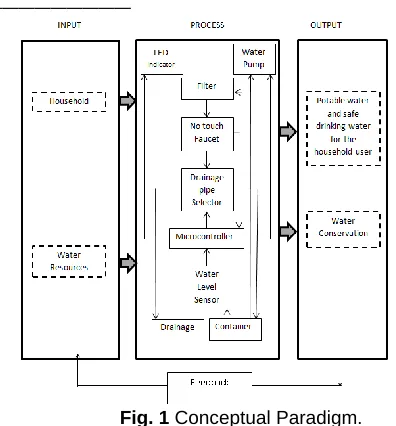
Recycling of water is the purpose of the system. This usage result as for recycling use water into clean water that can be used for safe drinking, hand wash and other consumptions at home or even public areas that have wastewater management system. The following diagram reveals the conceptual paradigm of the study
Fig. 1 Conceptual Paradigm.
The concept of the study is to recycle the wastewater of the household through filtration process. In filtering water it required water from the faucet that will use by the household and it provide a wastewater when water was used.
1.2 Objectives of the Study
The main objective of this study is to design a system that will help to manage the wastewater.
Specifically the study aims:
1. to expedite the possibility of application of technology to help conserve water.
2. to design a system that will manage wastewater. 3. to test and evaluate the prototype in terms of
acceptability following the ISO 9126 evaluation.
1.3 Significance of the Study
The results of this study categorically benefited from many private and public sectors by providing information that can result awareness to everyone who suffer from water shortage and widespread pollution. Among the persons and institutions who will be directly or indirectly benefited are the household consumer, department of environment and natural resources, local government units and future researchers.
1.4 Scope and Delimitation of the Study
The study is focused on the designing and constructing a microcontroller based Automatic wastewater management ______________________________
system and for its development. This machine is automatically recycled the wastewater and then dispose when it recycled twice. The machine can perform the operation within 24 hours. It can produce a low pressure of water based on the water pump pressure. It can select automatically water source based on the water level of two containers. It has an ultrasonic sensor that accepts a range of not more than 6 inches. It has a carbon filtration technology that removes the contaminants on the tap water. It has also a sediment ceramic filter that remove sediments and makes the water same taste. It requires 220 volts supply for the machine to operate. There is an LED light indicator that shows the status of the machine whether it uses recycled water or the water source. The study is purely based on water filtering, switching source and dispending. The maintenance and sanitary of the machine will be done automatically or manually. The water can only recycled twice and the water will go to drainage in in third use of water. The wastewater from sink are the only the focus of the recycling method. Other factors that may arise during the development of the study is not part of the study are the water quality sensing, pH sensing, and temperature sensing. Containing soap and shampoo are not parts of the water can be recycled.
2
L
ITERATURE REVIEWThe “Water Quality Testing and Water Use Assessment” project undertaken by the MIT team began in response to a request by the Provincial Health Office (PHO) in Capiz Province, Philippines for expert advice to support its drinking water quality testing, specifically the type of water quality tests that should be performed and the overall research design. Civil and Environmental Engineering Department Senior Lecturer, Susan Murcott, recommended specific state-of-the-art test methods for quantification of E.coli in drinking water as well as the involvement of a Masters of Engineering team in collaboration with the test program [1]. Solar water pumps were first introduced for water provision in off-grid areas. The technology has developed around many different designs and in some water pumps the reliability and maintenance requirements have improved over the initial pumps introduced to the market [2]. The proper management of wastewater and its reuse is crucial in order to reduce hazards and maintain a variety of benefits. The merits of improvements in wastewater management are particularly high where effective wastewater treatment is not in place and completely untreated wastewater is reused. This setting applies to many developing countries. There is a need to study the trade-off between benefits and costs of the use of wastewater to establish efficient water management. Moreover, successful water management needs to take the individual incentives of stakeholders into account [3]. The major benefits of slow sand filtration are due to the microbiology of the filter. The microbiological community must be kept alive for the filter to be effective. In a conventional slow sand filter, oxygen is supplied to the organisms through dissolved oxygen in the water. Consequently, they are designed to be operated continuously [4]. The availability of clean drinking water is significant concern in many rural communities around the world. The contamination of water is dangerous to health of the people and also animals. That effects like diarrhea and other gastrointestinal disease. Potential solution such as sand filtration, chlorination and solar disinfection are effective water purification technologies.
areas and small town in the Philippines. Starting in the 1970s; the Philippine Government introduced certain developmental practices and concepts to strengthen the water sector and expand its coverage of the population. These led to the improved overall sustainability of water utilities, the establishment of more small water systems, the institutionalization of support for all water service levels, and increase in commitments of development funds to maintain the positive impetus that had been created. While these practices and concepts were applied initially to advance sector-wide objectives, lessons learned are relevant today in conceptualization, planning, strategy-setting, operation and expansion of individual small utility. they can be implement the use of Demand-Based Design, Phased Design, Updated Technology, Operation Autonomy, Tariff Design and Public Consultation, Institutional Development Practice, and Monitoring system [13]. All of the mentioned studies are useful and carefully examined by the researchers. Wastewater management will be of great help in conservation of water especially in the near future. Many researches are focus on environmental concerns because of the possible potable water shortage in the near future. The abovementioned literature will also lead the researchers to widen their knowledge on wastewater system and possible effect of the application of technology in environmental concern.
3
M
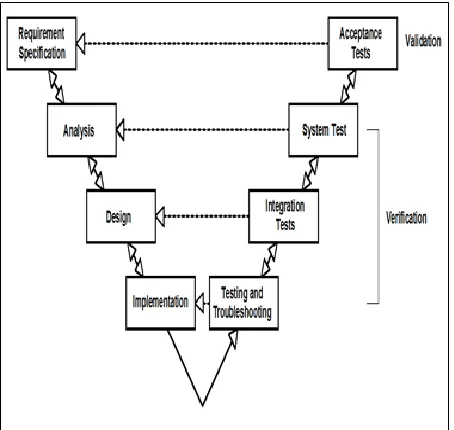
ETHODOLOGYThe researchers used developmental method of research. A prototyping and V-Shape Model were also utilized in developing, testing and evaluating the prototype. The fabrication, testing and evaluation of the prototype was made and conducted in Calamba City, Laguna Philippines. The respondents include households, registered electronics engineers, computer engineers and a registered microbiologist.
3.1 Project Design
The figure below reveals the method used to develop the system.
Fig. 2 V- Shape Model.
3.2 Block Diagram
The researchers prepared the block diagram that will serve as framework of the system as shown in figure 3, that illustrate the flow of the of Microcontroller Based wastewater Management System. The microcontroller is the main components of the system. It serves as a controller of the entire process.
Fig. 3 Block Diagram of the Wastewater Management System.
3.3 Project Evaluation
In evaluating the system, the researchers used the ISO/IEC 9126 to examine and evaluate its performance. The Evaluation Process Procedure consists of quality requirements definition, evaluation preparation and evaluation procedure.
4
R
ESULTS ANDD
ISCUSSIONSThe prototype, system components, capabilities and limitations and observations are presented on the following information.
4.1 The Project
The complete system prototype of the Microcontroller Based Waste Water Management System was shown in Figures 4 and 5. The Microcontroller Based Waste Water Management System can be used by the household to help them in managing the wastewater.
Fig.5 Faucet Module.
4.2 System Components
1. Infrared(IR) Distance Measuring Sensor : IR Distance Measuring Sensor break-out board can measure distances up to 10 - 150 cm. It features an analog output proportional to the distance measured. Typical applications are for proximity sensing, mobile robots, and alike. This kind of sensor is used by the proponent in detecting a hand or glass below the faucet. This sensor is one of the components that responsible in the start the processing of water filtration.
2. 24V Relay Driver: Has built-in driver that will allow microcontrollers and logic devices to operate on relays without the need for additional circuit elements. Potter & Brumfield relay 16A 277VAC/28VDC, 1HP at 220VAC SPDT contact. This kind of module is used by the proponent in controlling the water pump using normally open and normally close of switch. It can switch on or off based on the logic input coming from the arduino.
3. Ultrasonic sonar sensor (US100): Triggering the US-100 and then measuring the echo time indicated by the pulse width output of the sensor. Temperature compensated for accurate ranging even on varying ambient temperatures.
4. Microcontroller: A microcontroller (MCU) is a functional computer system on a chip. It is designed to perform a specific task and it contains a processor core, memory, and programmable input/output peripherals. Microcontrollers are used in automatically controlled products and devices. A gizduino + ATMega644 has a PL2303 MCU was used that serves as the heart of the device for all the commands are programmed in it. It controls all the activities done in the machine in relation to the different components connected to it.
4.3 Capabilities and Limitations
The system can operate within 24 hours a day, It can automatically dispense water without touching the faucet, It can dispense coming from water source and filtered water, The system can filter the wastewater of the household, It has a capability to sense the water level, It can recycle water twice and it can drain the water in the tank easily. However the activated carbon filter and sediment filter should be replaced within a month, the maintenance of the system should be done manually, the system cannot recycle water
with soap and the machine cannot operate if there is no power and water.
4.4 Evaluation Results
In evaluating the system, the researchers used different evaluation methods such as Hardware Evaluation, Water Testing, and Evaluation using ISO 9126. In hardware assessment, the researchers used this method to evaluate both minor and major components of the system. Prior to the development of the system, the researchers listed down all the materials to be used in the development. After gathering all the materials, the researchers conduct the evaluation and testing to check its functionality. It has been conducted to ensure that the materials are properly working upon integration. A registered electronic engineer, microbiologist from Alpha Laboratory Calamba City ,Philippines evaluated the system and the result of water in terms of its potability after the process. All of the result are acceptable in terms of potability and system functionality. Through series of tests, the researchers were able to observe the following:
1. The possible ways in conserving water: One of the most popular man’s problems is the safety of the water they drink. Although there are several source of fresh water in the country and yet, there is no assurance of its safety because of polluted water resources. Also the improper management of wastewater are cause of it and the most of the people are not aware of it. Most of people use the traditional way like boiling water at least 5 minutes to kill bacteria before drinking. Another way is some people used to buy mineral drinking water to the water refilling station but not everyone can afford it because of its high cost and some urban areas has not water refilling station.
2. The revival of polluted water resources like river: Designing the appropriate policy and institutional framework and action programs about importance of water, and wastewater management are the possible ways in conserving water. Wastewater management is the best way in conserving water. We can manage the wastewater through recycling it. Water recycling is the best ways in conserving water.
3. The Microcontroller Based Wastewater Management system was able to recycle the used water or wastewater and provide a safe and readily available drinking water: The device can save twice water because of two times recycling method of the device. 4. Managing wastewater in household consumer: Improper management of wastewater can cause pollution in our water resources like river and ocean. Some people like household are not aware in the wastewater that they produce by several activities that use water. Some people know that wastewater goes through the river or ocean but they do not know how to avoid it.
using Microcontroller Based Wastewater Management system we can apply the technology in conserving water resources for the next generation. To recycle water automatically without much effort we can combine different kinds of technology like water filtrations, water level detection, mechanical process, and automation process. Estimated each household uses about 80-100 gallons of water per day. But using technology of recycling water it can save approximately 40-60 gallons per day or 14,609.68 to 21,914.52 gallons per year. In that case the technology can help to conserve water for the next generation.
5
C
ONCLUSION ANDR
ECOMMENDATIONS5.1 Conclusion
The threat of wastewater in water resources coming from the household that can cause pollution can no longer reasonably ignored. The water can contain harmful contaminants because of it. The threat of harmful contaminants in drinking water can no longer be reasonably ignored. The connection between contaminated drinking water and many significant diseases and health problems is far too strong to discount. There are many home treatment alternatives that can purify drinking water to a greater extent than city treatment plants. Reverse osmosis and distillation, two of these alternatives, are moderately successful at removing some contaminants, but they are expensive and wasteful. Wastewater management are very promising, especially for household in rural areas and other locations where large areas of inexpensive land are available. Great cost reductions are possible with systems such as rapid infiltration and aerated lagoons, compared to other mechanical water treatment systems of similar environmental effectiveness. Bottled water, besides being expensive and highly unfeasible as a main drinking water source, is not under the same government regulations as municipal water systems and may actually contain more contaminants than tap water. The absolute best technology now available for treating water and removing undesirable contaminants is water filtration. Water filters, when compared to any other water treatment alternative, will remove more contaminants and provide safer, healthier drinking water. Therefore wastewater can be recycling using water filtration and can produce a safe drinking water.
5.2 Recommendations
For further study the future researchers would consider the capabilities and limitations of the system operations, the water leakage, regular replacement of carbon filters, closing of faucet, improvement of the sensor, inclusion of filtration method of the prototype, automation of drain, ventilation, backup power in case of brownout and the possibility of prototype production and further testing for possible product development.
A
CKNOWLEDGMENTThe researchers would like express sincere appreciation to their families love ones. Jesus Christ who is the source of wisdom and skills.
R
EFERENCES[1] Chuang, Patty, Patrick Jessica Molly, Trottier Stephanie, and John Milspaugh.“Water Quality Testing and Water Use Assessment in Capiz Province,” Thesis, Massachusetts Institute of Technology, United States of America, 2010.
[2] Desai, Amit, “Application of Solar PV Based Pumping for Irrigation,” Thesis, Indian Institute of Technology Bombay, India, December 2012
[3] Gengenbach , Michael F. “Incentives in the Water Chain: Wastewater Treatment and Reuse in Developing Countries,” Thesis, Wageningen University, Netherlands,2010
[4] Abudi, ZaidunNaji. “The Effect of Sand Filter Characteristics on Removal Efficiency of Organic Matter from Grey Water,”Al-Qadisiya Journal for engineering sciences,Vol. 04, No. 02, 2011, pp. 1-13.
[5] Abulencia, James Patrick, Susan Gallardo, NithinAbrahamm, Anne Caraccio, Nicholas Ruffini, Kevin McDonnell, and Francis Tañala, “Sustainability of Water Resources for the Poor,” The Journal of Sustainable Development, Vol. 04, Issue. 1, 2010, pp. 155-166.
[6] Arias, Michelle R. “Developing Criteria and Metrics for Assessing Recycled Water Program Effectiveness,” Thesis, San Jose State University, United States of America. December 2011.
[7] Center for Advance Philippines Studies, Vol. 01, No. 02, October 2010, pp. 1-6.
[8] David, Cristina C., and Arlene B. Inocencio. “Understanding Household Demand for Water: The Metro Manila Case,” Economy and EnvironmentProgram for Southeast Asia, Vol. 02, No. 02, 2011, pp. 1-10.
[9] Israel, Danilo C. ”Local Service Delivery of Potable Water in the Philippines: National Review and Case Analysis,” Philippine Institute for Development Studies, Series No 2009-38, December 2009, pp. 1-5.
[10] Kremer, Michael, Alex Peterson-Zwane, and Amrita Ahuja.“Providing Safe Water: Evidence from Randomized Evaluations,” Harvard Environmental Economics ProgramVol. 01, No. 02, 2010, pp. 10-23.
[11] Muaña, Rolando R. ”Private Sector Initiative in the Estero De Paco Project: A Case Study on Manila Waterways Urban Redevelopment Plan,” Urban and Regional Policy and Planning,Vol 4, February 2013, pp. 1-18.
[12] Sepe, Marlon B., Rudy D. Lange, and JobertC.Porras, “Impact of Biosand Filter on Access to Safe Drinking water in the Rural Communities of the Philippines,”UIC Research Journal,Vol. 02, No. 17, 2011, pp. 1-22.