
University of Pennsylvania
ScholarlyCommons
Publicly Accessible Penn Dissertations
1-1-2012
Combinatorial Structures and Generating
Functions of Fishburn Numbers, Parking
Functions, and Tesler Matrices.
Paul Levande
University of Pennsylvania, [email protected]
Follow this and additional works at:http://repository.upenn.edu/edissertations Part of theMathematics Commons
This paper is posted at ScholarlyCommons.http://repository.upenn.edu/edissertations/657
For more information, please [email protected]. Recommended Citation
Levande, Paul, "Combinatorial Structures and Generating Functions of Fishburn Numbers, Parking Functions, and Tesler Matrices." (2012).Publicly Accessible Penn Dissertations. 657.
Combinatorial Structures and Generating Functions of Fishburn
Numbers, Parking Functions, and Tesler Matrices.
Abstract
This dissertation reflects the author's work on two problems involving combinatorial structures.
The first section, which was also published in the Journal of Combinatorial Theory, Series A, discusses the author's work on several conjectures relating to the Fishburn numbers. The Fishburn numbers can be defined as the coefficients of the generating function
begin{align*}
1+sum_{m=1}^{infty} prod_{i=1}^{m}(1-(1-t)^{i}).
end{align*} Combinatorially, the Fishburn numbers enumerate certain supersets of sets enumerated by the Catalan numbers.
We add to this work by giving an involution-based proof of the conjecture of Claesson and Linusson that the Fishburn numbers enumerate non-$2$-neighbor-nesting matchings. We begin by proving that a map originally defined by Claesson and Linusson gives a bijection between non-$2$-neighbor-nesting matchings and $textbf{(2-1)}$-avoiding inversion tables. We then define a set of diagrams, which we call Fishburn diagrams, that give a natural interpretation to the generating function of the Fishburn numbers. Using an involution on Fishburn diagrams, we then prove that the Fishburn numbers enumerate $textbf{(2-1)}$-avoiding inversion tables. By using two variations of this involution on two subsets of Fishburn diagrams, we then give a visual proof of the conjecture of Remmel and Kitaev that two bivariate refinements of the
generating function of the Fishburn numbers are equivalent. In an appendix, we give an inductive proof of the conjecture of Claesson and Linusson that the distribution of left-nestings over the set of all matchings is given by the second-order Eulerian triangle.
The conjecture of Remmel and Kitaev was independently proved by Jelin'ek and by Yan with a matrix interpretation defined by Dukes and Parviainen. Bijections surveyed by Callan can lead to a similar proof of the conjecture of Claesson and Linusson giving the distribution of left-nestings over matchings, using a result on the Stirling permutations due to Gessel and Stanley. This work was done independently.
The second section, some of which was presented at the Formal Power Series and Algebriac Combinatorics conference (FPSAC), discusses the author's work on several conjectures relating to parking functions and to Tesler matrices. Parking functions are combinatorial objects which generalize both permutations and Catalan paths. Haglund and Loehr conjectured that the generating functions of two statistics, $area$ and $dinv$, over the set of parking functions (the $q, t$-parking functions) gives the Hilbert series of the diagonal coinvariants. Haglund recently proved that this Hilbert series is given by another generating function over the set of matrices with every hook sum equal to one (``Tesler matrices''). We prove several structural results on parking functions inspired by Tesler matrices, including a near-recursive generation of the $q, t$-parking functions. We also give consistent bijective proofs of several special cases of Haglund's Tesler function
Degree Type
Dissertation
Degree Name
Doctor of Philosophy (PhD)
Graduate Group
Mathematics
First Advisor
James Haglund
Keywords
ascent sequences, Fishburn numbers, generating functions, parking functions, Tesler matrices
Subject Categories
COMBINATORIAL STRUCTURES AND GENERATING
FUNCTIONS OF FISHBURN NUMBERS, PARKING
FUNCTIONS, AND TESLER MATRICES.
Paul Levande
A DISSERTATION
in
Mathematics
Presented to the Faculties of the University of Pennsylvania in Partial
Fulfillment of the Requirements for the Degree of Doctor of Philosophy
2012
James Haglund, Professor of Mathematics
Supervisor of Dissertation
Jonathan Block, Professor of Mathematics
Graduate Group Chairperson
Dissertation Committee:
Martha Yip, Lecturer of Mathematics (Chair)
James Haglund, Professor of Mathematics
Acknowledgments
First and foremost, I would like to thanks my advisor, James Haglund, for his endless support and ideas; as well as my partner, Bryce Payne, and my family members David Levande, Joanna Levande, Lynne and Chris Longo, and Marian Mastro and Charles Rodriguez, for their emotional and material encouragement and help, without which I could never have done work at this level. As soon as I saw the kinds of problems that my future advisor discussed in MA 508, I knew that there was a discipline of mathematics that I could work in, and that was an enormous help in adjusting to the expectations of a research program.
and myself, where I first wondered about the connections between Tesler matrices and parking functions. The first section came from fascinting conjectures by Anders Claesson and Svante Linusson, which they were generous enough to discuss with me even though I was a stranger to them.
Outside of my specific field of algebraic combinatorics, I was greatly helped in being able to complete this work by the network of graduate students within the University of Pennsylvania Department of Mathematics, including Shanshan Ding, Elaine So, Lee Kennard, Jonathan Kariv, Justin Curry, Tyler Kelly, Ryan Eberhart, Ryan Manion, and (back in my field) David Lonoff.
ABSTRACT
COMBINATORIAL STRUCTURES AND GENERATING FUNCTIONS OF FISHBURN NUMBERS, PARKING FUNCTIONS, AND TESLER MATRICES.
Paul Levande James Haglund
This dissertation reflects the author’s work on two problems involving combina-torial structures.
The first section, which was also published in the Journal of Combinatorial Theory, Series A, discusses the author’s work on several conjectures relating to the Fishburn numbers. The Fishburn numbers can be defined as the coefficients of the generating function
1 +
∞
X
m=1 m
Y
i=1
(1−(1−t)i).
function of the Fishburn numbers. Using an involution on Fishburn diagrams, we then prove that the Fishburn numbers enumerate (2-1)-avoiding inversion tables. By using two variations of this involution on two subsets of Fishburn diagrams, we then give a visual proof of the conjecture of Remmel and Kitaev that two bivariate refinements of the generating function of the Fishburn numbers are equivalent. In an appendix, we give an inductive proof of the conjecture of Claesson and Linusson that the distribution of left-nestings over the set of all matchings is given by the second-order Eulerian triangle.
Contents
1 Introduction: Fishburn Numbers 1
2 A bijection between factorial matchings and inversion tables 6
3 The main generating function 15
3.1 Fishburn diagrams . . . 15 3.2 A weighted sum over Fishburn diagrams . . . 16 3.3 An Involution on Fishburn Diagrams . . . 18
4 The refined generating functions of the Fishburn numbers 30
4.1 The simpler refined generating function . . . 31 4.2 Three ways of defining F∗
n,d . . . 33
4.3 The more complicated refinement . . . 38
5 Further Research Directions 54
6 Introduction: Parking Functions 57
6.2 Parking Functions as labeled Dyck paths . . . 59
6.2.1 Statistics on parking functions: area . . . 60
6.2.2 Statistics on parking functions: dinv . . . 61
6.2.3 Symmetry? . . . 62
6.3 Tesler Matrices . . . 63
6.4 Our Results . . . 65
7 Structural Results 67 7.1 A near-recursive generation . . . 67
7.1.1 dinv Distributions . . . 80
7.1.2 Symmetry . . . 81
8 The t= 0 Special Case 85 8.0.3 Introduction . . . 85
8.0.4 Decoding Tesler matrices . . . 86
8.0.5 Filled Tesler Arrays . . . 96
8.0.6 A sign-reversing involution . . . 98
9 The q= 1 Special Case 104
10 The tn-positivity conjecture 107
Chapter 1
Introduction: Fishburn Numbers
Let [m] be the set of integers from 1 tom. Let a matching on [2n] be an involution on [2n] with no fixed points, or equivalently a partition of [2n] into disjoint pairs. Let a nesting in a matching X on [2n] be a pair of pairs (a, b) and (c, d) in X such that a < c < d < b.
It is well-known that the Catalan numbers Cn enumerate the set of non-nesting
matchings on [2n]. Let aneighbor nesting in a matchingXbe a nesting (a, b)(c, d)∈
X such thatc=a+ 1 or d=b+ 1. Non-neighbor-nesting matchings can be seen as a superset of non-nesting matchings. Letfnbe the number of non-neighbor-nesting
matchings on [2n]. The numbers f1, f2, . . . are known as the Fishburn numbers
The Fishburn numbers can also be defined as the coefficients of the following generating function (see Zagier [5] and Stoimenow [4]):
∞
X
n=0
fntn = 1 +
∞
X
m=1 m
Y
i=1
(1−(1−t)i). (1.0.1)
Bosquet-M´elou et al. [9] proved that the Fishburn numbers enumerate the fol-lowing sets. Each set can be seen as a superset of aCatalan set, or a set enumerated by the Catalan numbers:
• The set of (2+2)-avoiding posets with n elements. This can be seen as a superset of the Catalan set of (2+2)- and (3+1)-avoiding posets with n
elements.
• The set of permutations π =π1π2· · ·πn of [n] such that there exist no i < j
with πj =πi−1 andπi+1 > πi. This can be seen as a superset of the Catalan
set of 231-avoiding permutations of [n].
• The set ofascent sequences of lengthn, where an ascent sequence is a sequence of non-negative integers x1x2· · ·xn such that x1 = 0 andxi+1 is less than or
equal to the number of ascents in the first i terms. This can be seen as a superset of the Catalan set of sequences of non-negative integers x1x2· · ·xn
such that x1 = 0 andxi+1 < xi+ 1.
Let a k-neighbor-nesting on a matching X be a nesting (a, b)(c, d) ∈ X such that c−a≤k. Claesson and Linusson [13] recently conjectured that the Fishburn numbers also enumerate the set of non-2-neighbor-nesting matchings on [2n].
Letfn,dbe the number of ascent sequences with preciselydzeroes. The bivariate
generating function of fn,d was recently proved by Remmel and Kitaev [12] to be:
∞
X
n=0 n
X
d=1
fn,dtnzd = 1 +
∞
X
k=0
zt
(1−zt)k+1 k
Y
i=1
(1−(1−t)i). (1.0.2)
Remmel and Kitaev conjectured that the bivariate generating function of fn,d
has the following simpler form:
∞
X
n=0
fn,dtnzd = 1 +
∞
X
m=1 m
Y
i=1
(1−(1−t)i−1(1−zt)). (1.0.3)
(Note that Equation (1.0.3), unlike Equation (1.0.2), is trivially seen to reduce to Equation (1.0.1) at z = 1.)
In the following article, we will prove both conjectures and show how they are related:
• First, we will give a simple bijection (a restriction of a bijection from [13]) between the set of non-2-neighbor-nesting matchings on [2n] and the set of
(2-1)-avoiding inversion tablesa1a2· · ·anof lengthn, where the pattern(2-1)
is said to occur if there exists a p < q such thatap =aq+ 1.
• We will then give an involution-based proof that the generating function of
• We will then restrict this involution to prove that the bivariate generating function of (2-1)-avoiding inversion tables with respect to length and the number of ai =i−1 is given by Equation (1.0.3).
• Finally, we will use a variation of this involution to prove that the bivariate generating function of (2-1)-avoiding inversion tables is also given by Equa-tion (1.0.2). This will prove the conjecture of Remmel and Kitaev.
Let a left-nesting of a matching X be a nesting (a, b)(c, d) ∈ X such that c =
a + 1. Claesson and Linusson [13] also conjectured that the distribution of left-nestings over the set of all matchings is given by the second-order Eulerian triangle. In an appendix, we will give a short inductive proof of this conjecture.
9
4 6
1 2 3 5 7 8 10
Figure 1.1: The matching (1,4)(2,9)(3,6)(5,10)(7,8) on [10].
Chapter 2
A bijection between factorial
matchings and inversion tables
Recall that amatching on [2n] is a partition of [2n] into a disjoint pairs. Throughout this article, we will specify a matching on [2n] with a list ofndisjoint ordered pairs. We will illustrate the matching (a1, b1)(a2, b2)· · ·(an, bn) on [2n] with a diagram of
the n semicircular arcs joiningai tobi for all i. For example, the diagram of 5 arcs
in Figure 1.1 illustrates the matching (1,4)(2,9)(3,6)(5,10)(7,8) on [10]. Note that the arcs do not have to be labeled for the diagram to illustrate a unique matching. For a matchingX on [2n] and an integer ain [2n], letX(a) be the partner of a, i.e., the other integer in the same pair inX asa. For example, ifX is the matching in Figure 1.1, then X(2) = 9. Note thatX(X(a)) =a for all a. Leta be an opener
Figure 2.1: Matchings on [6] and [8]
of the matching in Figure 1.1 are 1,2,3,5,7 and the closers are 4,6,8,9,10. When referring to a pair (a, b) in a matching X, we will always mean that the first integer is the opener and the second integer is the closer, so we assume without loss of generality that a < b.
Given a matching X on [2n] and an integer k in [2n+ 1], let a matching X′
on [2n + 2] be constructed from X and k by adding the arc (k,2n + 2) to X
and re-labeling if necessary. For example, if X is the matching on the left-hand side of Figure 2.1, then the matchings on the right-hand side of Figure 2.1 are constructed from X and 7,6,5,4,3,2,1, respectively. Alternately, let a matching
X′ be constructed fromX and k if and only if it consists of the pair (k,2n+ 2) and
the pairs
• (a, b) if (a, b) ∈ X and b < k. Then let (a, b) in X′ be the corresponding arc
• (a, b+ 1) if (a, b) ∈ X and a < k ≤ b. Then let (a, b+ 1) in X′ be the
corresponding arc of (a, b) in X.
• (a+ 1, b+ 1) if (a, b) ∈ X and a ≤ k. Then let (a+ 1, b+ 1) in X′ be the
corresponding arc of (a, b) in X.
Clearly every matching on [2n+ 2] is constructed from a matching on [2n] and an integer in [2n+ 1]. Note that if X′ is a matching on [2n+ 2] constructed from X
and k then every arc in X′ except for (k,2n+ 2) corresponds to an arc in X.
Recall that a left-nesting of a matching X is a pair of pairs (a, b)(a + 1, d) in X with d < b. For example, (2,9)(3,6) is the only left-nesting in Figure 1.1. Claesson and Linusson [13] proved that there are n! non-left-nesting-matchings on [2n]. In fact, they proved a deeper structural connection between non-left-nesting matchings and permutations, which requires a few more definitions to state. Let an
inversion table of length n be a sequence of non-negative integers a1a2· · ·an such
that ai ≤i−1.
Let the functionφ from the set of non-left-nesting matchings on [2n] to the set of inversion tables be defined as follows:
Given a non-left-nesting matching X on [2n], let c1 < c2 < . . . < cn be the
increasing arrangement of the closers ofX. For eachiin [n], letai be the number of
closers ofX to the left of the partner of thei-th closer ofX. Letφ(X) =a1a2· · ·an.
matchings on the right half of Figure 2.2 from top to bottom. Alternately, letting
c0 = 0 and cn+1 =n, let ai =j if and only if cj < X(ci)< cj+1.
Note that the closers of the matching X on the left-hand side of Figure 2.2 are 3,5,7,8, and that the matchings on the right-hand side are constructed from
X and the integers 9,8,7,5,3. This suggests the structural relationship between non-left-nesting matchings and inversion tables proved by Claesson and Linusson.
Claim 2.0.1. Let X be a non-left-nesting matching on[2n]. Let c1 < c2 < . . . < cn be the increasing arrangement of the closers of X. Let φ(X) =a1a2· · ·an. Let the
matching X′ on [2n+ 2] be constructed from X and the integer k in [2n+ 1].
1. X′ is a non-left-nesting matching if and only ifkis a closer ofX ork = 2n+1.
2. If k = ci, then φ(X′) = a1a2· · ·an(i− 1). If k = 2n + 1, then φ(X′) =
a1a2· · ·an(n).
Therefore, by induction, φ is a bijection between non-left-nesting matchings on [2n]
and inversion tables of length n. In particular, there are n! non-left-nesting
match-ings on [2n].
Proof. 1. Ifkis not an opener ofX, then the corresponding arcs of a left-nesting
of X′ form a left-nesting of X, and vice-versa. Since X is a non-left-nesting
matching, so isX′. Ifk is an opener ofX, then (k,2n+ 2)(k+ 1, X(k) + 1) is
a left-nesting of X′. Therefore X′ is a non-left-nesting matching if and only
2. Adding the arc (k,2n+2) toX adds a new opener,k, to the integers from 1 to 2n. This does not change how many closers are before the partners of the first
n closers ofX. Therefore the first n entries of φ(X′) are a
1a2· · ·an. If k =ci
for some iin [n], then there arei−1 closers to the left of k, the partner of the (n+ 1)-st closer 2n+ 2, and thereforeφ(X′) =a
1a2· · ·an(i−1). Ifk = 2n+ 1,
then there are n closers to the left of k, and therefore φ(X′) =a
1a2· · ·an(n).
This exhausts all n+ 1 possible choices fork. By induction, this proves that
φ is a bijection between non-left-nesting matchings and inversion tables.
Let ak-neighbor-nesting be a nesting (a, b)(c, d) with c−a≤2. If (a, b)(c, d) is a 2-neighbor-nesting and c−a= 1, then (a, b)(c, d) is a left-nesting. Therefore the set of matchings on [2n] with no 2-neighbor-nestings is a subset of the matchings on [2n] with no left-nestings. We can therefore restrict the bijection φ to the set of non-2-neighbor-nesting matchings.
Let the inversion table a1a2· · ·an have a j-occurrence of the pattern (2-1) for
a fixed integer j if there exist integers p < q such that ap =j+ 1 and aq =j. Let
an inversion table be (2-1)-avoiding if it does not have a j-occurrence of(2-1)for any j. Let Tn be the set of(2-1)-avoiding inversion tables of length n.
Theorem 2.0.2. Let X be a non-left-nesting matching on [2n].
2. If φ(X)∈/ Tn, then X has at least one 2-neighbor-nesting.
Therefore φis a bijection between non-2-neighbor-nesting matchings on[2n]andTn.
Proof. Let c1 < c2 < . . . < cn be the closers ofX. Let φ(X) =a1a2· · ·an.
1. Assume X has at least one 2-neighbor-nesting. This 2-neighbor-nesting must be of the form (v, cb)(v+ 2, cd) withv+ 2< cdand d < b. Ifv+ 1 is an opener
of X, then there are two possibilities, as X(v+ 1) cannot equal cb:
• cb > X(v+ 1), and so the pair (v, cb)(v+ 1, X(v+ 1)) is a left-nesting of
X, or
• X(v + 1) > cb > cd, and so the pair (v + 1, X(v + 1))(v + 2, cd) is a
left-nesting ofX.
Thereforev+ 1 must be a closer ofX. Letci =v+ 1. Therefore there arei−1
closers less than v =X(cb) and i closers less than v+ 2 = X(cd). Therefore
ad =i, ab = i−1, and there is an (i−1)-occurrence of (2-1) in a1a2· · ·an,
so φ(X)∈/ Tn.
2. Assume φ(X)∈/ Tn. Then for some p < q and some j, ap =j+ 1 andaq=j.
Thereforecj < X(cq)< cj+1 < X(cp). Therefore every integer in the intervals
[X(cq) + 1, cj+1−1] and [cj+1+ 1, X(cp)−1] is an opener.
X(cq)+1. IfX(X(cq)+1) < cq, then the pair (X(cq), cq)(X(cq)+1, X(X(cq)+
1)) is a left-nesting ofX. ThereforeX(X(cq) + 1)> cq. Similarly, the
second-smallest integer in the interval is X(cq) + 2. IfX(X(cq) + 2) < X(X(cq) + 1),
then the pair (X(cq) + 1, X(X(cq) + 1))(X(cq) + 2, X(X(cq) + 2)) is a
left-nesting of X. Therefore X(X(cq) + 2) > X(X(cq) + 1) > cq. By repeating
this argument up to the largest integer in the interval, cj+1−1, we have that
X(cj+1 −1) > X(cj+1 −2) > . . . > X(X(cq) + 2) > X(X(cq) + 1) > cq.
Therefore X(cj+1−1)> cq.
We now examine the partners of the integers in the interval [cj+1+1, X(cp)−1].
The largest integer in the interval is X(cp)−1. If X(X(cp)−1) > cp, then
the pair (X(cp)−1, X(X(cp)−1))(X(cp), cp) is a left-nesting ofX. Therefore
X(X(cp)−1) < cp. Similarly, the second-largest integer in the interval is
X(cq)−2. IfX(X(cp)−2)> X(X(cp)−1), then the pair (X(cp)−2, X(X(cp)−
2))(X(cp)−1, X(X(cp)−1)) is a left-nesting ofX. ThereforeX(X(cp)−2)<
X(X(cp)−1)< cp. By repeating this argument down to the smallest integer
in the interval, cj+1 + 1, we have that X(cj+1 + 1) < X(cj+1+ 2) < . . . <
X(X(cp)−2)< X(X(cp)−1)< cp. Therefore X(cj+1+ 1)< cp.
By combining these two inequalities, we have that X(cj+1 + 1) < cp < cq <
X(cj+1−1). Therefore the pair (cj+1−1, X(cj+1−1))(cj+1+ 1, X(cj+1+ 1))
is a 2-neighbor-nesting of X. Therefore, if φ(X) ∈/ Tn, then X has at least
Chapter 3
The main generating function
In this section, we will prove that the Fishburn numbers enumerate the set of(2-1) -avoiding inversion tables. In particular, we will prove that
n
X
n=0
|Tn|tn= 1 +
∞
X
m=1 m
Y
i=1
(1−(1−t)i).
First, we will define a class of diagrams with statistics that will give a visual in-terpretation to the right-hand-side of this equation. Next, we will define a statistic-preserving signed involution on this class of diagrams such that there is a trivial bijection between the set of fixed points and Tn. This will complete our proof.
3.1
Fishburn diagrams
Figure 3.1: A Fishburn diagram {0} {1} {0,2} {0,1,2} ∈ F7 with signed t-weight
(−1)3t7.
least one dot. See Figure 3.1 for an example with the staircase partiton (1,2,3). Let F be the set of all Fishburn diagrams, with Fn the subset of F consisting of
Fishburn diagrams with precisely n dots. Alternately, let F be the set of sequences of sets A=A1A2· · ·Am, with m unfixed, such that, for alli, Ai ⊂ {0,1, . . . , i−1}
and Ai 6=∅. LetFnbe the subset ofF consisting of Fishburn diagramsA1A2· · ·Am
such that Pmi=1|Ai| = n. We will use these definitions interchangeably using the
obvious correspondence that the Fishburn diagram in Figure 3.1 corresponds to the sequence {0} {1} {0,2} {0,1,2}.
Note that Fishburn diagrams in Fn with precisely one dot per column must
have length n, and that Ai = {ai} gives a trivial bijection between the set of such
Fishburn diagrams and the set of inversion tables of length n.
3.2
A weighted sum over Fishburn diagrams
Let the two statistics dots and columns on F be defined as follows: If A =
A1A2· · ·Am is a Fishburn diagram in F, then let dots(A) =
Pm
columns(A) =m. Let the signedt-weight ofAbe given bytdots(A)(−1)dots(A)−columns(A),
or, by (−t)dots(A)(−1)columns(A). We can think of the unsigned t-weight as the
num-ber of dots in the Fishburn diagram. We can think of the sign as the parity of the number of “extra” dots beyond the minimum of one per column. For example, the signed t-weight of the Fishburn diagram in Figure 3.1 is (−1)3t7.
We can now interpret the right-hand-side of Equation (1.0.1) as a weighted sum over F, using the following lemma.
Lemma 3.2.1.
X
A∈F
tdots(A)(−1)dots(A)−columns(A) =
∞
X
n=0
X
A1A2···Am∈Fn
tn(−1)n−m
= 1 +
∞
X
m=1 m
Y
i=1
(1−(1−t)i).
Proof. The first equality is trivial.
For any fixed integer m, consider the weighted sum of all Fishburn diagrams with m columns. Begin by assigning each column a weight of−1. A given column
Ai hasi squares, each of must contain either nothing, contributing a weight of 1, or
a dot, contributing a weight of −t. These choices are made independently, with the only condition being that Ai cannot be empty. Therefore the weighted sum over all
possible choices forAi is 1−(1−t)i, with the 1 serving to cancel out the possibility
that Ai is empty.
Taking the product of these weighted sums, we have that
(−1)m X
A1A2···Am∈F
(−t)|A1|+|A2|+···+|Am|=
m
Y
i=1
Taking the summation over m on each side, we have that
∞
X
m=0
(−1)m X A1A2···Am∈F
(−t)|A1|+|A2|+···+|Am| = 1 +
∞
X
m=1 m
Y
i=1
(1−(1−t)i).
By changing the order of summation, and using the fact that (−t)n(−1)m=tn(−1)n−m,
we have that
∞
X
m=0
(−1)m X A1A2···Am∈F
(−t)|A1|+|A2|+···+|Am|=
∞
X
n=0
X
A1A2···Am∈Fn
tn(−1)n−m.
This proves the lemma.
3.3
An Involution on Fishburn Diagrams
We can now prove that the Fishburn numbers enumerate (2-1)-avoiding inversion tables. Extending our earlier definitions, let a Fishburn diagram A =A1A2· · ·Am
have a j-occurrence of the pattern (2-1) if there exist integers p < q such that
j + 1 ∈ Ap and j ∈ Aq. Let a Fishburn diagram be (2-1)-avoiding if it does not
have a j-occurrence of (2-1)for any j.
Given A =A1A2· · ·Am ∈ Fn, let the function ψn on Fn be defined as follows:
If A is (2-1)-avoiding and has precisely one dot per column, then let ψn(A) = A.
Otherwise, let j be the smallest integer such that at least one of the following two conditions hold:
Figure 3.2: ψ16({0} {0} {2} {2,3} {0} {1,3,5} {1,3,5,6} {2,4,6}) =
{0} {0} {2} {2,3} {2,4} {0} {1} {2,4,6,7} {3,5,7}.
Figure 3.3: ψ9({0} {0} {2} {3} {2} {3,4,5} {0}) = {0} {0} {2} {2,3} {2,3,4} {0}.
let Ai be the leftmost such column. Alternately, i is the smallest integer such
that j ∈Ai and |Ai|>1.
• There is at least one j-occurrence of (2-1). In this case, let the q-th column be the rightmost column containing j. Let the p-th column be the rightmost column to its left containing j+ 1. Alternately, q is the largest integer such that j ∈Aq and p is the largest integer less than q such that j+ 1 ∈Ap.
We distinguish the two possible cases:
Case 1: There is at least one column in A containing j and at least one other integer, with Ai the leftmost such column. We will construct a new Fishburn
By minimality, j is the smallest integer in Ai. Let j +R be the
second-smallest integer in Ai. Let B = B1B2· · ·Bm+1 be the Fishburn diagram
defined as follows: Add a new column Bi−R+1 in between the (i−R)-st and
(i−R+1)-st columns of the original Fishburn diagramA. Move the dots inAi
above height j to this new column, lowering them if necessary so that the dot originally at height j+RinAi is now at height j+ 1 inBi−R+1. Add a blank
row at height j+ 1 in between Bi−R+1 andAi (includingAi), moving any dots
at height j + 1 or above up one row. Add a blank row at height j after Ai,
moving any dots at height j or above up one row. Let B =B1B2· · ·Bm+1 be
the resulting Fishburn diagram. Let ψn(A) =B.
For example, see Figure 3.2. The Fishburn diagram on the left is
A={0} {0} {2} {2,3} {0} {1,3,5} {1,3,5,6} {2,4,6} ∈F16.
Then the smallest integer j such that there is either a column containing j
and at least one other integer or a j-occurrence of (2-1) is 1. There is a column containing 1 and at least one other integer, with A6 the leftmost such
column. Because 3 is the second-smallest integer in A6, R = 2. We add a
new column B5 in between A4 and A5 and move the dots 3 and 5 from A6
into this column, lowering them so the dot originally at height 3 in A6 is now
at height 2 in B5 (and therefore the dot originally at height 5 in A6 is now
at height 4 in B5). We add a blank row at height 2 in between B5 and A6
as it happens there are no such dots here. We also add a blank row at height 1 after A6, moving any dots at height 1 or above up one row, so A7 becomes
{2,4,6,7} and A8 becomes {3,5,7}. Let B = B1B2· · ·B9 be the resulting
Fishburn diagram, which is on the right-hand side of Figure 3.2. Then
ψn(A) =B ={0} {0} {2} {2,3} {2,4} {0} {1} {2,4,6,7} {3,5,7} ∈F16.
Alternately, the sets BL are defined as follows for each L∈[m+ 1]:
• BL =AL for L∈[1, i−R].
• BL ={s−R+ 1 :s ∈Ai, s6=j}for L=i−R+ 1.
• BL = {s:s∈AL−1, s < j+ 1} ∪ {s+ 1 :s∈AL−1, s≥j + 1} for L ∈
[i−R+ 2, i].
• BL ={j}for L=i+ 1.
• BL ={s:s ∈AL−1, s < j} ∪ {s+ 1 :s∈AL−1, s≥j}forL∈[i+ 2, m+
1].
Let B =B1B2· · ·Bm+1. Let ψn(A) =B.
Case 2: There are no columns in A containing j and at least one other integer. Therefore there is at least one j-occurrence of (2-1), with Aq the rightmost
Because there is at least one j-occurrence of (2-1), with Aq the rightmost
column containing j, A has a blank at height j after Aq. Remove this blank
row, moving any dots at heightsj+1 or higher down one row. The columnAp
is the rightmost column to the left ofAq containing j+ 1. Therefore there is a
blank row inA at height j+ 1 in betweenAp and Aq (including Aq). Remove
this blank row, moving any dots at heights j+ 2 or higher down one row. By minimality, j + 1 is the smallest integer in Ap. Move the dots in Aq to Ap,
raising them if necessary so that the dot originally at heightj+ 1 inAp is now
at height j+q−pinAq. Remove the column Ap. Let B =B1B2· · ·Bm−1 be
the resulting Fishburn diagram.
For example, see Figure 3.3. The Fishburn diagram on the left is
A={0} {1} {2} {3} {2} {3,4,5} {0} ∈F9.
Then the smallest integer j such that there is either a column containing j
and at least one other integer or a j-occurrence of (2-1) is 2. There are no columns containing 2 and at least one other integer. Therefore we need to find the rightmost column containing 2 and the rightmost column to its left containing 3. The rightmost column containing 2 is A5. The rightmost
column containing to its left containing 3 is A4. Therefore we remove the
blank row at height 2 after A5 and the blank row at height 3 in between A3
and A4 (including A4). We then move the dot 3 from A4 into A5, and in this
{2,3}. Finally, we remove the (now-empty) column A4. Let B the resulting
Fishburn diagram. Let B = B1B2· · ·B6 be the resulting Fishburn diagram,
which is on the right-hand side of Figure 3.3. Then
ψ9(A) =B ={0} {1} {2} {2,3} {2,3,4} {0}.
Alternately, the sets BL are defined as follows for each L∈[m−1]:
• BL =AL for L∈[1, p−1].
• BL = {s:s∈AL+1, s < j+ 1} ∪ {s−1 :s ∈AL+1, s > j + 1} for L ∈
[p, q−2].
• BL ={s+p−q−1 :s∈Ap} ∪ {j} for L=q−1.
• BL ={s:s ∈AL+1, s < j} ∪ {s−1 :s∈AL+1, s > j}for L∈[q, m−1].
Let B =B1B2· · ·Bm−1. Let ψn(A) =B.
(See Figure 4.2 and Figure 4.6 for two other examples of ψ.)
The Fishburn diagram ψn(A) has the same number of dots as A in every case.
Therefore ψn is a map fromFn to Fn.
Let Fix(ψn) be the set of fixed points ofψn. Let the functionψ onF be defined
by ψ(A) =ψn(A) forA ∈Fn. Let Fix(ψ) =∪Fix(ψn) be the set of fixed points of
ψ.
• A Fishburn diagram A∈Fix(ψn)if and only if it is (2-1)-avoiding and has precisely one dot per column.
• If A = A1A2· · ·Am ∈/ Fix(ψn) and ψn(A) = B = B1B2· · ·Br, then
r=m±1.
Therefore |Tn|=|Fix(ψn)|.
2. A Fishburn diagram is therefore either fixed by ψ or paired with another
Fish-burn diagram with the same unsigned t-weight but with the opposite sign.
Therefore we have that
∞
X
n=0
|Tn|tn =
∞
X
n=0
|Fix(ψn)|tn= 1 +
∞
X
m=1 m
Y
i=1
(1−(1−t)i).
Therefore the Fishburn numbers enumerate(2-1)-avoiding inversion tables, and
therefore also enumerate non-2-neighbor-nesting matchings.
Proof. 1. We need only prove that ψn is an involution on Fn, or that, if A =
A1A2· · ·Am ∈/ Fix(ψn) and ψn(A) =B =B1B2· · ·Br, then ψn(B) = A. Let
j again be the smallest integer such that A has a column containing j and at least one other integer or a j-occurrence of (2-1). For each of the two possible cases, we will prove that j is also the smallest integer such that B
has a column containing j and at least one other integer or a j-occurrence of
(2-1), and that thereforeψn(B) = A.
again be the leftmost column containingj and at least one other integer, with j + R again the second-smallest integer in Ai. By construction,
Bi+1 = {j} and Bi−R+1 contains j + 1. Therefore there is at least one
j-occurrence of (2-1) in B. Also, the distribution of dots at heights lower thanj is unchanged by ψn fromA toB, except that some dots at
height j in A may now be at height j + 1 in B. This cannot add any new occurrences of (2-1) with an integer less than j or columns with more than one dot and an integer less than j. Therefore j remains the smallest integer such that B has a column containing j and at least one other integer or a j-occurrence of (2-1).
As a result, we can calculate ψn(B): Recall that, by construction, Ai
is the leftmost column containing j and at least one other integer. To construct B, a blank row is added at height j after Ai, so there is no
column after Bi+1 containing j. The columns to the left of Ai in A are
unchanged in B except for the addition of Bi−R+1 and the blank row
after it at height j + 1. Therefore no column in B contains j and at least one other integer. Therefore, to calculate ψn(B), we need to find
the rightmost column inB containingj and the rightmost column to its left containing j+ 1.
By construction, the rightmost column inB containing j isBi+1 and the
construct ψn(B) by removing the blank row at height j+ 1 in between
Bi−R+1 and Bi+1 (moving any dots at height j + 2 or higher down one
row) and the blank row at heightj afterBi+1 (moving any dots at height
j + 1 or higher down one row). We then move the dots in Bi−R+1 to
Bi+1, raising them if necessary so that the dot at height j+ 1 inBi−R+1
is now at height j+ (i+ 1)−(i−R+ 1) = j +R in Bi+1. Finally, we
remove the now-empty columnBi−R+1. The resulting Fishburn diagram
is ψn(B). These operations simply reverses the construction of B from
A, and therefore ψn(B) =A.
Case 2: If there is no column inAcontainingj and at least one other integer, then r = m−1, so ψn(A) = B = B1B2· · ·Bm−1. Let Aq again be the
rightmost column containingj andAp again be the rightmost column to
its left containing j+ 1. By construction the smallest integer in Bq−1 is
j and the second-smallest integer isj+q−p. ThereforeB has a column containingj and at least one other integer. Also, the distribution of dots at heights lower than j is unchanged by ψn from A to B, except that
some dots at heightj+ 1 inAmay now be at heightj inB. This change cannot add any new columns with more than one dot and an integer less than j.
We need only verify that this change cannot add new occurrences of
heights lower thanjis unchanged, the only possibility is that there might be a new (j−1)-occurrence of(2-1)inB formed by a dot at heightj+ 1 inA which is now at height j inB and a dot at height j−1 in B to its right. Assume there is such a (j −1)-occurrence of (2-1) in B. Then there exist integers X < Y such that j ∈ BX and j −1 ∈ BY with
j + 1 ∈ AX+1 and j −1 ∈ AY+1. Since the dot at height j ∈ BX was
at height j + 1 in A, it must have been pushed down one row by the operation ofψn. Since there was a blank row at height j+ 1 between Ap
and Aq, this dot must have been to the right ofAq. However, the dot at
height j −1 in AY+1, to its right, would then form a (j−1)-occurrence
of (2-1)in A along with the dotj ∈Aq. By the minimality ofj, this is
impossible. Therefore j remains the smallest integer such that B has a column containing j and at least one other integer or a j-occurrence of
(2-1).
As a result, we can calculateψn(B): Recall that, by construction,A has
no columns containingj and at least one other integer. The columnBq−1
contains j and at least one other integer. The columns to the left of Aq
in A are unchanged in B, except that Ap has been removed, as has the
blank row in betweenAp and Aq at height j+ 1. Therefore the leftmost
column in B containing j and at least one other integer is Bq−1. The
by adding a new (q−1−(q −p) + 1)-st column, or p-th column, and moving the dots above j inBq−1 to it, lowering them if necessary so the
dot originally at heightj+q−pinBq−1 is now at height j+ 1. We then
add a blank row at heightj+1 in between the newp-th column andBq−1
(theq-th column of the new diagram), moving any dots at heightj+ 1 or higher up one row, and a blank row at height j after Bq−1, moving any
dots at height j or higher up one row. The resulting Fishburn diagram isψn(B). These operations simply reverse the construction ofB fromA,
and therefore ψn(B) =A.
This proves that ψn is an involution on Fn.
2. Clearly, if ψn is an involution on Fn, then ψ is an involution on F. For all
A ∈ F, we have proved that dots(ψ(A)) = dots(A) and, if A /∈ Fix(ψ), then columns(ψ(A)) = columns(A)±1. This proves that a Fishburn diagram is therefore either fixed by ψ or paired with another Fishburn diagram with the same unsigned t-weight but with the opposite sign.
Therefore we have that
X
A∈F
tdots(A)(−1)dots(A)−columns(A)= X
A∈Fix(ψ)
tdots(A)(−1)dots(A)−columns(A).
If A∈Fix(ψ), then columns(A) = dots(A), and therefore
X
A∈Fix(ψ)
tdots(A)(−1)dots(A)−columns(A) = X
A∈Fix(ψ)
tdots(A) =X
n
By Lemma 3.2.1, we have that
X
A∈F
tdots(A)(−1)dots(A)−columns(A) = 1 +
∞
X
m=1 m
Y
i=1
(1−(1−t)i).
Therefore
X
n
|Tn|tn =
X
n
|Fix(ψn)|tn= 1 +
∞
X
m=1 m
Y
i=1
(1−(1−t)i).
Chapter 4
The refined generating functions
of the Fishburn numbers
LetTn,d be the subset ofTn consisting of(2-1)-avoiding inversion tables a1a2· · ·an
such that ai = i −1 for precisely d integers i. Using variations of the proof of
Theorem 3.3.1 we will prove that
∞
X
n=0 n
X
d=1
|Tn,d|tnzd=
∞
X
m=1 m
Y
i=1
(1−(1−t)i−1(1−zt)), (4.0.1)
and also that
∞
X
n=0 n
X
d=1
|Tn,d|tnzd = 1 +
∞
X
k=0
zt
(1−zt)k+1 k
Y
i=1
(1−(1−t)i). (4.0.2)
4.1
The simpler refined generating function
We begin with a proof of the first refinement, Equation (4.0.1). Let Fn,d be the set
of Fishburn diagrams A with n dots, precisely d of which are on the top diagonal. For example, both Fishburn diagrams in Figure 3.2 are in F16,5 and both Fishburn
diagrams in Figure 3.3 are inF9,4. Alternately, letFn,dbe the subset ofFnconsisting
of Fishburn diagrams A=A1A2· · ·Am such that i−1∈Ai for precisely dintegers
i. The natural bijection Ai = {ai} between Tn and the subset of Fn consisting
of (2-1)-avoiding Fishburn diagrams with precisely one dot per column is also a bijection between Tn,d and the subset ofFn,d consisting of (2-1)-avoiding Fishburn
diagrams with precisely one dot per column.
Let A ∈ F be a Fishburn diagram. Let the statistic diagonal be defined by diagonal(A) = | {i:i−1∈Ai} |. We can think of diagonal(A) as the number of
dots on the top diagonal of A. Let the signed t, z-weight ofA be
tdots(A)zdiagonal(A)(−1)dots(A)−columns(A).
We can now interpret the right-hand-side of Equation (4.0.1) as a weighted sum over F, using the following lemma.
Lemma 4.1.1.
X
A∈F
tdots(A)zdiagonal(A)(−1)dots(A)−columns(A) =
∞
X
n=0
X
A1A2···Am∈Fn,d
tnzd(−1)n−m
= 1 +
∞
X
m=1 m
Y
i=1
Proof. This proof is identical to the proof of Lemma 3.2.1, except that a dot placed at the top of its column now contributes a weight of −tz instead of a weight of−t.
We can now prove Equation (4.0.1). Let ψn,d be the restriction of ψn to Fn,d.
Let Fix(ψn,d) be the set of fixed points of ψn,d.
Theorem 4.1.2. 1. ψn,dis an involution onFn,d, and therefore|Tn,d|=|Fix(ψn,d)|.
2. A Fishburn diagram A is therefore either fixed by ψ or paired with another
Fishburn diagram with the same unsigned t, z-weight but with the opposite
sign. Therefore we have that
∞
X
n=0 n
X
d=1
|Tn,d|tnzd =
∞
X
n=0 n
X
d=1
|Fix(ψn,d)|tnzd=
∞
X
m=1 m
Y
i=1
(1−(1−t)i−1(1−zt)).
Proof. We need only prove that ψn,d is an involution on Fn,d, as the proof of the
rest is identical to the proof of Theorem 3.3.1. Because ψn is an involution, we can
assume that A = A1A2· · ·Am ∈ Fn,d and ψn(A) = B = B1B2· · ·Bm+1. Then we
need only prove that B ∈ Fn,d. In other words, we need only consider one of the
two cases in the proof of Theorem 3.3.1.
Once again, let j be the smallest integer such that A has a column containingj
and at least one other integer or a j-occurrence of (2-1). By assumption,ψn(A) =
B = B1B2· · ·Bm+1. Therefore, by the proof of Theorem 3.3.1, A has a column
containing j and at least one other integer. Let Ai again be the leftmost column
the top of its column inB if and only if there is a dot at the top of the corresponding column in A, letting Bi−R+1 correspond to Ai, with no column in A corresponding
to the column Bi+1 (since Bi+1 ={j}, there cannot be a dot at the top, so we do
not need a corresponding column in A). Alternately, L−1∈BL if and only if
• L−1∈AL and 1≤L≤i−R, or
• i−1∈Ai and L=i−R+ 1, or
• L−2∈AL−1,L=6 i+ 1, and i−R+ 2≤L≤m+ 1.
SinceA has d dots on the top diagonal, B does as well, and thereforeB ∈Fn,d.
Therefore ψn,d is an involution on Fn,d, and the rest follows.
This proves Equation (4.0.1).
4.2
Three ways of defining
F
n,d∗We will now turn our attention to proving Equation (4.0.2). We will begin by defining a setF∗
n,dthat will give a visual interpretation to the right-hand side of the
equation. LetF∗
n,dbe the subset ofFn,dconsisting of Fishburn diagramsAsuch that
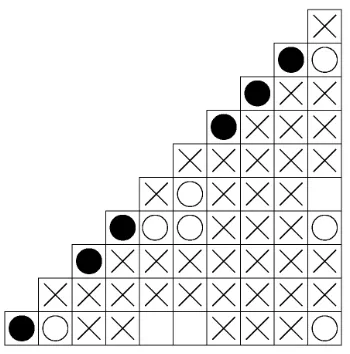
no dot on the top diagonal ofA contributes to a column with more than one dot or to an occurrence of (2-1). For example, Figure 4.1 shows the Fishburn diagram
Figure 4.1: {0} {0} {2} {3} {3} {3,4} {6} {7} {8} {0,3,8} ∈F∗
13,6.
The 6 dots on the top diagonal have been colored black and the 7 other dots have been colored white. We have placed anX in any square in every square below a black dot and in every square one row below, and to the right of, a black dot. Placing any dots in these squares would result in a Fishburn diagram that is not in
F∗
n,d.
Alternately, let F∗
n,d be the subset of Fn,d consisting of Fishburn diagrams A =
A1A2· · ·Am ∈ Fn,d such that, for all L, if L−1 is in AL, then AL={L−1} and,
if i > L, then L−2∈/ Ai.
Note that the squares in Figure 4.1 without anXor a black dot form a staircase partition (1,2,3,4). In particular, the 4 indexes of columns without a dot at the top are 2,5,6, and 10, and there is anX in every square of of these columns except at the heights 0,3,4 and 8. This suggests the following claim, which will allow an alternative definition of the set F∗
Claim 4.2.1. Let A =A1A2· · ·Am be a Fishburn diagram in Fn,d∗ . Let d1 < d2 <
. . . < dm−d be the increasing rearrangement of the m−d indexes of columns of A
without a dot at the top. Then s∈Adi only if s+ 2 ∈ {d1, d2,· · · , di}.
In particular, a given column Adi can only have dots at the i possible heights
d1−2, d2−2, . . . , di−2, and these squares form a Fishburn diagram within A.
Proof. Let s be an integer in Adi for some fixed s and i. Because A is a Fishburn
diagram, s ≤di−1. Because di is, by definition, the index of a column without a
dot at the top, s ≤di−2. Therefore s+ 2∈ {/ di+1, di+2, . . . , dm−d}.
Assume that s + 2 6= di. Then s ≤ di − 3. Therefore Adi is to the right
of As+2. Since s ∈ Adi, s appears to the right of As+2. Further assume that
s+ 2∈ {/ d1, d2,· · · , di−1}. Then s+ 2 cannot be the index of any column without a
dot at the top. Therefore it must be the index of a column with a dot at the top. Therefores+1∈As+2andsappears to the right ofAs+2, so there is ans-occurrence
of (2-1) in A. This contradicts the assumption that A ∈ F∗
n,d. Therefore either
s+ 2 =di ors+ 2 ∈ {d1, d2, . . . , di−1}. More concisely, s+ 2 ∈ {d1, d2, . . . , di}.
We can use Lemma 4.2.1 to give another alternative definition of the set: LetG∗
n,d
be the set of ordered pairs (α, A∗) such that α= (α
1, α2, . . . , αk+1) is a composition
of dinto k+ 1 parts with α1 nonzero and A∗ =A∗1A∗2· · ·A∗k is a Fishburn diagram
in Fn−d.
A = A1A2· · ·Am ∈ Fn,d∗ , let d1 < d2 < . . . < dm−d again be the increasing
rear-rangement of the m−d indexes of columns of A without a dot at the top. Let
α = (α1, α2, . . . , αm−d+1) be the distribution of dots on the top diagonal ofA, with
αi the number of dots between Adi+1 and Adi+2, all of which must be on the top
diagonal. There is a (m−d)-column Fishburn diagram withinAconsisting of the in-tersection of the columnsAd1, Ad2, . . . , Adm−dand the rowsd1−2, d2−2, . . . , dm−d−2.
Let A∗ be this Fishburn diagram. Let f
n,d(A) = (α, A∗). For example, if A is the
Fishburn diagram in Figure 4.1, then
f13,6(A) = ((1,2,0,3,0),{0} {1} {1,2} {0,1,3}).
Alternately, letα1 =d1−1, letαi =di−di−1−1 for allifrom 2 tom−d, and let
αm−d+1 =m−dm−d. Letα= (α1, α2, . . . , αm−d+1). LetA∗i ={r−1 :dr−2∈Adi}
for all iin [m−d]. Let A∗ =A∗
1A∗2· · ·A∗m−d. Let fn,d(A) = (α, A∗).
Claim 4.2.2. fn,d is a bijection between Fn,d∗ and G∗n,d.
Proof. Let A = A1A2· · ·Am be a Fishburn diagram in Fn,d∗ . Let d1 < d2 < . . . <
dm−d again be the increasing rearrangement of the m−d indexes of columns of A
without a dot at the top. Let fn,d(A) = (α, A∗). The diagram A∗ =A∗1A∗2· · ·A∗m−d
is a Fishburn diagram with one dot for every dot in A other than the d dots on the top diagonal. Therefore A∗ ∈ F
n−d. The composition α is a composition of d
into m−d+ 1 parts. By definition, 0 ∈/ Ad1, and sinceA1 must equal {0} for any
We need only define an inverse map gn,d : G∗n,d → Fn,d∗ to prove that f is a
bijection. Let (β, B∗) be an ordered pair inG∗
n,d with β = (β1, β2,· · · , βk+1). Begin
with a staircase partition with k+d columns. Place β1 dots into the top diagonal,
beginning with the left-hand-corner. Skip one square of the top diagonal, then place
β2 dots on it. Continue in this fashion until all d dots have been placed according
to α. Place an X in every square below a dot on the top diagonal and in the same column, as well as in every square one row below, and to the right of, a dot on the top diagonal. The remaining squares form a staircase partition withkcolumns. Put
B∗ onto this staircase partition. Let g
n,d(β, B∗) be the resulting Fishburn diagram.
Alternately, letei =β1+β2+· · ·+βi+ifor alliin [k]. LetB∗ =B1∗B2∗· · ·Bk∗. Let
sets Bi be defined as follows for alliin [k+d]: If i /∈ {e1, e2, . . . , ek}, then letBi =
{i−1}. If i ∈ {e1, e2, . . . , ek}, then let i = ej. Let Bej =
er−2 :r−1∈Bj∗ .
Let B =B1B2· · ·Bk+d=gn,d(β, B∗).
There aredindexes not in{e1, e2, . . . , ek}, so diagonal(B) =d. There areddots
in the columns with thesedindexes and n−d dots in the columns with the indexes
e1, e2, . . . , ek, so dots(B) =n. Therefore B ∈Fn,d.
By construction, if i−1 ∈ Bi, then Bi = {i−1}. If Bi = {i−1} and i−2
were in a column to the right ofBi, then it could not be at the top. Thereforei−2
could only be in Bej for some j. The integer i−2∈Bej if and only if, for some r,
i =er and r∈ Bj∗. However, i−1∈ Bi, so i cannot equal er for any r. Therefore
that gn,d and fn,d simply reverse the operations of each other, and therefore fn,d is
a bijection between F∗
n,d and G∗n,d.
For conciseness, if fn,d(A) = (α, A∗), then we will sometimes refer to the latter
as the “ordered pair interpretation” of A.
4.3
The more complicated refinement
We can now prove Equation (4.0.2). Let F∗ = ∪
n,dFn,d∗ . Let f(A) = fn,d(A) for
A ∈ F∗
n,d. Let Comp M
1 be the set of compositions with M parts, the first of which
is nonzero. Along the lines of the previous proofs of Equation (1.0.1) and Equation (4.0.1), we can now interpret the right-hand side of Equation (4.0.2) as a weighted sum over F∗:
Lemma 4.3.1. 1. Let A be a Fishburn diagram in F∗. Let f(A) = (α, A∗).
Then diagonal(A) = |α|, dots(A) = dots(A∗) + |α|, and columns(A) =
columns(A∗) +|α|.
2. Therefore,
X
A∈F∗
tdots(A)zdiagonal(A)(−1)dots(A)−columns(A) = 1 +
∞
X
k=0
zt
(1−zt)k+1 k
Y
i=1
(1−(1−t)i).
Proof. 1. IfA=A1A2· · ·Am ∈Fn,d∗ andf(A) = (α, A∗)∈G∗n,d, then diagonal(A) =
d=|α|, dots(A) =n= (n−d) +d= dots(A∗) +|α|, and columns(A) =m =
2. By the first part of this lemma, and by Claim 4.2.2, we have that
X
A∈F∗
tdots(A)zdiagonal(A)(−1)dots(A)−columns(A)
= X
(α,A∗)∈G∗
tdots(A∗)+|α|z|α|(−1)dots(A∗)−columns(A∗).
Since G∗ can be seen as ∪∞
k=0 Compk+11 × {A∗ ∈F : columns(A∗) =k}
, we have that
X
(α,A∗)∈G∗
tdots(A∗)+|α|z|α|(−1)dots(A∗)−columns(A∗)=
∞
X
k=0
X
α∈Compk+1 1
(zt)|α|
X
columns(A∗)=k
tdots(A∗)zcolumns(A∗)(−1)dots(A∗)−columns(A∗)
.
By standard generating functions, we have that
X
α∈Compk+1 1
(zt)|α|= zt
(1−zt)k+1.
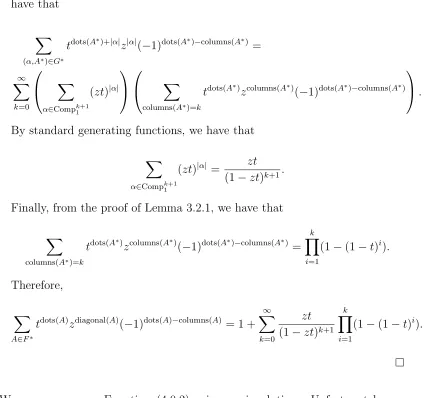
Finally, from the proof of Lemma 3.2.1, we have that
X
columns(A∗)=k
tdots(A∗)zcolumns(A∗)(−1)dots(A∗)−columns(A∗)=
k
Y
i=1
(1−(1−t)i).
Therefore,
X
A∈F∗
tdots(A)zdiagonal(A)(−1)dots(A)−columns(A) = 1 +
∞
X
k=0
zt
(1−zt)k+1 k
Y
i=1
(1−(1−t)i).
We can now prove Equation (4.0.2) using an involution. Unfortunately, we cannot use ψn,d, since ψn,d is not a map from Fn,d∗ to itself. To illustrate this, see
Figure 4.2: ψ10,5({0} {0} {2} {0} {4} {1} {6} {0} {1} {9}) =
{0} {0} {2} {0} {4} {5} {0,2} {0} {8}.
A={0} {0} {2} {0} {4} {1} {6} {0} {1} {9} ∈F10,5.
Note thatA=A1A2· · ·A10∈/ F10,5∗ , because 2∈A3 and 1∈A6. However,
ψ10,5(A) ={0} {0} {2} {0} {4} {5} {0,2} {0} {8},
which is the Fishburn diagram on the right-hand side of Figure 4.2. The Fish-burn diagram ψ10,5(A) ∈ F10,5∗ . Since ψn,d is an involution, it follows that ψn,d is
not, in general, a map from F∗
n,d to itself.
Therefore, we must define a new involution on F∗
n,d. To ensure that the new
involution is a map from F∗
n,d to itself, we will use the ordered-pair interpretations
of Fishburn diagrams in F∗
n,d. First, we must understand the ordered pair
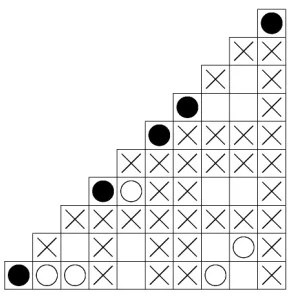
Figure 4.3: The(2-1)-avoiding ((1,0,1,2,0,1),{0} {0} {2} {0} {1})∈F∗
10,5.
For example, Figure 4.3 shows the Fishburn diagram
A={0} {0} {0} {3} {3} {5} {6} {0} {1} {9}.
Let the ordered pair interpretation of A be
(α, A∗) = ((1,0,1,2,0,1),{0} {0} {2} {0} {1}).
Note that A∗ =A∗
1A∗2A∗3A∗4A∗5 has precisely one dot per column but also has a
1-occurrence of (2-1), since 2 ∈ A∗
3 and 1 ∈ A∗5. However, because α3 > 0, there
is a row in A (with an X in every square) in between the white dot corresponding to the 2 ∈ A∗
3 and the white dot corresponding to the 1 ∈ A∗5. This breaks up
the occurrence of (2-1), so A is both (2-1)-avoiding and has precisely one dot per column.
Lemma 4.3.2. Let A = A1A2· · ·Am be a Fishburn diagram in Fn,d∗ with ordered pair interpretation (α, A∗) ∈ G∗
n,d. Let α = (α1, α2, . . . , αm−d+1) and let A∗ =
A∗
1A∗2· · ·A∗m−d.
1. A has precisely one dot per column if and only if A∗ has precisely one dot per
column.
2. A is (2-1)-avoiding if and only if αi+2 > 0 for all i such that there is an
i-occurrence of (2-1) in A∗.
Proof. 1. Each column inAwith a dot at the top has no other dots, and|Adi|=
|A∗
i|for all iin [m−d].
2. Assume that there is a j-occurrence of(2-1)inA. Because A∈F∗
n,d, the dot
at height j + 1 must not be at the top of its column. Therefore there exist integers p < q with j+ 1 ∈ Adp and j ∈ Adq. By Claim 4.2.1, there exist Y
and Z such that dY −2 = j and that dZ−2 = j+ 1, with Y −1∈ A∗q and
Z−1∈A∗
p. Therefore dZ =dY + 1, soZ =Y + 1 and Y ∈A∗p. Since Y ∈A∗p
and Y −1 ∈ A∗
q, A∗ has a (Y −1)-occurrence of (2-1). We also have that
dY+1 =dZ =dY + 1. By definition, αY+1 =dY+1−dY −1, and so αY+1 = 0.
Therefore, ifAhas an occurrence of(2-1), then there exists an integerY such that A∗ has a (Y −1)-occurrence of (2-1)and α
Y+1 = 0.
Similarly, let i be such that there is an i-occurrence of (2-1) and αi+2 = 0.
Then there exist integers R < S such that i+ 1 ∈ A∗
Figure 4.4: ψ∗
12,5((2,1,0,1,0,1,0),{0} {1} {2} {2,3} {0} {0}) =
((2,1,0,0,1,0,1,0),{0} {1} {2} {3} {2} {0} {0}).
di+2 −2 ∈ AdR and di+1 −2 ∈ AdS. Because αi+2 = di+2 − di+1 −1 = 0,
we have that di+2 = di+1 + 1. Therefore di+2 −2 = di+1 − 1 ∈ AdR and
di+1−2∈ AdS. Therefore A has a (di+1−2)-occurrence of (2-1). Therefore
A is (2-1)-avoiding if and only if αi+2 > 0 for all i such that there is an
i-occurrence of (2-1) inA∗.
We can now proceed to prove Equation (4.0.2) using an involution. Let the function ψ∗
n,d be defined on Fn,d∗ as follows:
Let A be a Fishburn diagram in F∗
n,d with ordered pair interpretation (α, A∗),
with α = (α1, α2, . . . , αk+1) and A∗ =A∗1A∗2· · ·A∗k. If A∗ has precisely one dot per
column and αi+2 >0 for alli such that there is ani-occurrence of(2-1)inA∗ then
let ψ∗
Otherwise, let j be the smallest integer such that at least one of the following two conditions hold:
• There is a column in A∗ containing j and at least one other integer. In this
case, let A∗
i be the leftmost such column.
• There is at least one j-occurrence of (2-1) inA∗ with α
j+2 = 0. In this case,
let A∗
q be the rightmost column containing j. Let the A∗p be the rightmost
column to its left containing j+ 1.
We distinguish the two possible cases:
Case 1: There is at least one column in A∗ containing j and at least one other
integer, with A∗
i the leftmost such column. By minimality, j is the smallest
integer in A∗
i. Let j +R be the second-smallest integer in A∗i. Let β =
(α1, α2, . . . , αj+1,0, αj+2, . . . , αk+1). To construct a Fishburn diagramB∗ from
A∗, perform the same operation on A∗ that ψ
n−d would, except using this j
(which might lead to a different result, see below): Add a new columnB∗
i−R+1
in between the (i−R)-st and (i−R+ 1)-st columns of A∗. Move the dots in
A∗
i above height j to this new column, lowering them if necessary so that the
dot originally at height j +R inA∗
i is now at height j + 1 in Bi∗−R+1. Add a
blank row at height j + 1 in between B∗
i−R+1 and A∗i (including A∗i), moving
any dots at height j+ 1 or above up one row. Add a blank row at height j
after A∗
i, moving any dots at height j or above up one row. Let B∗ be the
resulting Fishburn diagram. Let ψ∗
For example, see Figure 4.4. Let the ordered pair interpretation of the Fish-burn diagram on the left-hand side be
(α, A∗) = ((2,1,0,1,0,1,0),{0} {1} {2} {2,3} {0} {0})∈F12,5∗ .
The minimal j such that there exists a column in A∗ with j and at least one
other integer or a j-occurrence of (2-1) in A∗ with α
j+2 = 0 is j = 2. The
Fishburn diagramA∗ has a column containing 2 and at least one other integer,
with A∗
4 the leftmost such column. Therefore, letβ = (2,1,0,0,1,0,1,0). To
construct a Fishburn diagramB∗ fromA∗, we perform the same operation on
A∗asψ
7, except that we usej = 2. More explicitly, the second-smallest integer
inA∗
4 is 3. Therefore we insert a new columnB4∗ intoA∗ and move the dot at
height 3 fromA∗
4 into this new column, and it is not necessary to lower it. We
add an blank row at height 3 in between the new columnB∗
4 andA∗4(including
A∗
4) and a blank row at height 2 afterA∗4. LetB∗ ={0} {1} {2} {3} {2} {0} {0}
be the resulting Fishburn diagram. Thenψ∗
12,5(α, A) = (β, B∗). The Fishburn
diagram with ordered pair interpretation (β, B∗) is on the right-hand side of Figure 4.4.
Alternately, let the sets B∗
L be defined as follows for each L∈[k+ 1]:
• B∗
L =A∗L for L∈[1, i−R].
• B∗
L ={s−R+ 1 :s ∈A∗i, s6=j}for L=i−R+ 1.
• B∗
L =
s:s∈A∗
L−1, s < j+ 1 ∪
s+ 1 :s ∈A∗
[i−R+ 2, i].
• B∗
L ={j}for L=i+ 1.
• B∗
L =
s:s∈A∗
L−1, s < j ∪{s+ 1 :s∈∗ AL−1, s≥j}forL∈[i+2, k+
1].
Let B∗ =B∗
1B2∗· · ·Bk+1∗ . Let ψn,d∗ (α, A∗) = (β, B∗).
Case 2: There are no columns in A∗ containing j and at least one other integer. Therefore there is at least onej-occurrence of(2-1)inA∗ withα
j+2 = 0, with
A∗
q the rightmost column containingj andA∗p the rightmost column to its left
containing j + 1. Let β = (α1, α2, . . . , αj+1, αj+3, . . . , αk+1). To construct a
Fishburn diagram B∗ from A∗, perform the same operation on A∗ that ψ
n−d
would, except using this j: There is a blank row in A∗ at height j after A∗
q.
Remove this blank row, moving any dots at heights j + 1 or higher down one row. There is a blank row in A∗ at height j + 1 in between A∗
p and A∗q
(including A∗
q). Remove this blank row, moving any dots at heights j + 2 or
higher down one row. By minimality, j+ 1 is the smallest integer inA∗
p. Move
the dots in A∗
q to A∗p, raising them if necessary so that the dot originally at
height j+ 1 in A∗
p is now at height j+q−p in A∗q. Remove the column A∗p.
Let B∗ be the resulting Fishburn diagram. Letψ∗
n,d(α, A∗) = (β, B∗).
Fish-Figure 4.5: ψ∗
10,5((1,0,1,2,0,1),{0} {0} {1} {0} {1}) =
((1,1,2,0,1),{0} {0} {0,1} {0}).
burn diagram on the left-hand side be
(α, A∗) = ((1,0,1,2,0,1),{0} {0} {1} {0} {1})∈F10,5∗ .
The minimal j such that there exists a column in A∗ with j and at least one
other integer or a j-occurrence of (2-1) in A∗ with α
j+2 = 0 is j = 0. The
Fishburn diagram A∗ does not have a column containing 0 and at least one
other integer. Therefore, let β = (1,1,2,0,1). The rightmost column in A∗
containing 0 is A∗
4. The rightmost column to its left containing 1 is A∗4. To
construct a Fishburn diagram B∗ from A∗, we perform the same operation
on A∗ as ψ
5, except that we use j = 0. More explicitly, we remove the blank
row at height 0 after A∗
3 and the blank row at height 1 in between A∗3 and A∗4
(including A∗
4). We then move the dot 1 fromA∗3 into A∗3, and in this case it
is not necessary to lower it so that it is at height 1 inA∗
4. Finally, we remove
the (now-empty) column A∗
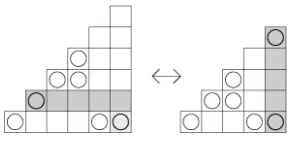
Figure 4.6: ψ7({0} {1} {2} {2,3} {0} {0}) = {0} {1} {1,2} {0} {0,4}.
Fishburn diagram. Then ψ∗
10,5(α, A) = (β, B∗). The Fishburn diagram with
ordered pair interpretation (β, B∗) is on the right-hand side of Figure 4.5.
(Note that the Fishburn diagram on the right-hand side of Figure 4.5 is also the Fishburn diagram on the right-hand side of Figure 4.2.)
Alternately, let the sets B∗
L be defined as follows for each L∈[k−1]:
• B∗
L =A∗L for L∈[1, p−1].
• B∗
L =
s:s∈A∗
L+1, s < j+ 1 ∪
s−1 :s∈A∗
L+1, s > j+ 1 for L ∈
[p, q−2].
• B∗
L =
s+p−q−1 :s ∈A∗
p ∪ {j} for L=q−1.
• BL∗ =
s:s∈A∗L+1, s < j ∪s−1 :s ∈A∗L+1, s > j forL∈[q, k−1].
Let B∗ =B∗
1B2∗· · ·Bk∗−1. Let ψn,d∗ (α, A∗) = (β, B∗).
In every case, the composition part ofψn,d(α, A∗) has the same sum asα, and the
Fishburn diagram part of ψn,d(α, A∗) has the same number of dots asA∗. Therefore
Note that the smallest j such that A∗ has a column with j and at least one
other integer or a j-occurrence of (2-1)with αj+2 = 0 is not necessarily the
small-est j such that A∗ has a column with j and at least one other integer or a j
-occurrence of (2-1). In other words, ψ∗
n,d is not simply an alternate description of
ψn−d. To illustrate the difference, compare Figure 4.4 to Figure 4.6. Recall that the
ordered pair interpretation of the Fishburn diagram on the left-hand side of Fig-ure 4.4 is (α, A∗), with α = (2,1,0,1,0,1,0) and A∗ = {0} {1} {2} {2,3} {0} {0}.
Recall also that ψ∗
12,5(α, A) = (β, B∗), with β = (2,1,0,0,1,0,1,0) and B∗ =
{0} {1} {2} {3} {2} {0} {0}.
However, ψ7(A∗) 6= B∗. The left-hand side of Figure 4.6 shows A∗ alone. The
minimal j such that A∗ has a column with j and at least one other integer or a
j-occurrence of (2-1) is j = 0. Following the construction of ψ, we have that
ψ7(A∗) = {0} {1} {1,2} {0} {0,4}, the Fishburn diagram on the right-hand side of
Figure 4.6. Let Fix(ψ∗
n,d) be the set of fixed points of ψn,d∗ . Let the function ψ∗ on F∗ be
defined by ψ∗(A) = ψ∗
n,d(A) for A ∈ Fn,d∗ . Let Fix(ψ∗) = ∪n,dFix(ψn,d∗ ) be the set
of fixed points of ψ.
Theorem 4.3.3. 1. ψ∗
n,d is an involution on Fn,d∗ such that, if (α, A∗) is a
Fish-burn diagram in F∗
n,d with α= (α1, α2, . . . , αk+1), then
• (α, A∗) is inFix(ψ∗
![Figure 1.1: The matching (1, 4)(2, 9)(3, 6)(5, 10)(7, 8) on [10].](https://thumb-us.123doks.com/thumbv2/123dok_us/9312806.1466166/16.612.190.455.82.194/figure-matching.webp)
![Figure 2.1: Matchings on [6] and [8]](https://thumb-us.123doks.com/thumbv2/123dok_us/9312806.1466166/18.612.196.452.80.243/figure-matchings-on-and.webp)
![Figure 2.2: The non-left-nesting matching (1, 3)(2, 5)(4, 8)(6, 7) on [8] and the non-](https://thumb-us.123doks.com/thumbv2/123dok_us/9312806.1466166/19.612.180.470.231.459/figure-non-left-nesting-matching-non.webp)
![Figure 11.1: Matchings on [6] and [8]](https://thumb-us.123doks.com/thumbv2/123dok_us/9312806.1466166/123.612.194.455.79.239/figure-matchings-on-and.webp)
![Address [on EU-US relations] to the American-European Community Association (AECA) New York chapter by Mr. Pieter Dankert, President of the European Parliament. New York, 31 October, 1983.](data:image/gif;base64,R0lGODlhAQABAIAAAP///wAAACH5BAEAAAAALAAAAAABAAEAAAICRAEAOw==)