Cloud
Services
Ranking
by
measuring
Multiple
Parameters
using
AFIS
Sagheer Abbas
1, Tahir Alyas
2, Atifa Athar
3, Muhammad Adnan Khan
1,*, Areej Fatima
1,2,
Waseem Ahmad Khan
11DepartmentofComputerScience,NCBA&E,Lahore,Pakistan
2DepartmentofComputerScience,LahoreGarrisonUniversity,Lahore,Pakistan 3DepartmentofComputerScience,CUI,Lahore,Pakistan
Abstract
Assigning a level to a number of choices is referred to as ranking. The concept of ranking is applied in many situations, wherein, team rankings, player rankings, university rankings, and country rankings are commonly used these days. Similarly, in cloud standardization, ranking the web services is a principal concern, as it is a relatively new approach, assigning ranks to cloud facilities has gained significant attention from researchers across the globe. Furthermore, cloud services standardization is an important idea as it is necessary if it is required to assign ranking for cloud services. There are few limitations in cloud standardization as there is no technique to check valid services and its classifications, wherein, the standardization of cloud services will play a major role in controlling the redundancy of cloud services. In this article, a new cloud service ranking method is proposed using an Adaptive Fuzzy Inference System (AFIS).
Received on 25 April 2019; accepted on 20 May 2019; published on 04 July 2019
Keywords: Web Services, Cloud Services, Ranking, AFIS
Copyright © 2019 Sagheer Abbas etal., licensed to EAI. This is an open access article distributed under the terms of the Creative Commons Attribution license (http://creativecommons.org/licenses/by/3.0/), which permits unlimited use, distribution and reproduction in any medium so long as the original work is properly cited.
doi:10.4108/eai.13-7-2018.159354
1. Introduction
Standardization in cloud computing services is a developing concept. However, with time, the concept of standardization is getting importance because of the exploration of new services now and then. Many standards exist today; they all make implicit reference to cloud computing. Some of the standards are quite new; however, still, there are some deficiencies. Therefore, there exist a lack of maturity in this perspective. Cloud services activities take a technology-driven approach that focuses on various challenges like portability, efficiency and information security (Alkalbani & Shenoy, 2015). An automated method of cloud ranking is the key element in the field of cloud services standardization. The objective is to offer a standardized service provider, considering the
∗
Corresponding author. Email:[email protected]
to execute this task, a framework needs to complete these responsibilities. This framework must have the aptitude of getting data from users and decide on the superlative service. This ranking framework must evaluate the facilities and determine their importance. In cloud computing perspective, there are many cloud providers by whom facilities of different features are being offered, with different characteristics such as efficiency and cost, etc. It is normal, that when you have many options, the decision of choosing only one option is very difficult. Similarly, when there are many service providers, the decision of choosing only one cloud computing service is a tough and challenging job. It is obvious that before having an efficient ranking system, its standards should be considered first. It is important to select an optimum algorithm for service ranking, and it is equally important to measure all qualitative values of the services. In this research, we focus on reviewing these approaches. As the value of cloud computing is increasing day by day, therefore many tech giants such as Google, IBM, HP, and Amazon started offering cloud services as well. However, it is very difficult to identify whether a cloud service is good to use or not. That is the reason it is a challenging task to select the best cloud service among various cloud services. The selection at times becomes difficult to deliver (Qu & Buyya, 2014). Computational Intelligence has four branches, Fuzzy (Atta et al., 2018), (Iqbal et al., 2018), Swarm (AsadUllah et al., 2018), Evolutionary (Umair et al., 2015) and Neural (Peng & Zhang 2018). The hybrid structures of these approaches play a very vital role in different domains like wireless communication, cloud Computing (Wang et al., 2016), (Sun et al., 2015), (Mahmood et al., 2015), image processing, health, extraction (Jiang et al., 2018) etc. The organization of this article is as follows; in section 2; Cloud Indexing is presented, section 3 provides the indexing controller methodology followed in this article while section 4 elaborates the results and discussion. A summary of the article is provided in the Conclusion Section.
2. Materials and Methods
2.1. Cloud Indexing
Giving ranks mean assigning some value and then sorting that choice according to its value, wherein, normally the lowest value represents the best choice. The lowest the value, the best rank it will be. Ranking in cloud services is getting fame as the days pass on. However, in a cloud infrastructure, ranking is slightly different because of the naming convention and the existing cloud infrastructure. Nowadays cloud infrastructure connects with new cloud services (Alkalbani & Shenoy, 2015). User’s point of view matters a lot, according to the user’s demand, CSP offers services with different names. It is a complex procedure
to know if a certain service is best fulfilling the user’s demands or not. Due to this complex nature, right now there is no dedicated framework for automatically assigning the indexing and ranking of cloud services (Ghahramani et al., 2017). Furthermore, there are different levels of quality of service in cloud computing (Jelassi et al., 2017).
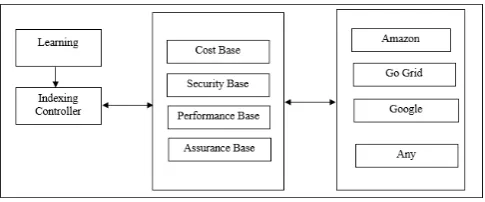
(i) Cost base;
(ii) Security base;
(iii) Performance base;
(iv) Assurance base;
Figure 1. Indexing Manage
When the indexing procedure is going on in cloud services, the key factor is that the requirement of the user should be satisfied. Such kind of framework is desired that will fulfil these requirements. In Fig. 1. It is presented how to manage the indexing. By looking on to the above figure, it is known that indexing manager will receive the information and after that, process it according to the ranking parameters like performance, usability, and cost. Indexing Manager will consider it for the best service as desired by user necessities. Indexing Administrator will also be answerable for other activities as well, i.e. taking characteristics for ranking, the track record of characteristic value, and ranking result.
2.2. Indexing Controller
Figure 2. Cloud Mapping Module
2.3. Inference Engine
Characterizes administrators and defuzzifier utilized as a part of the surmising procedure.
2.4. Membership Functions
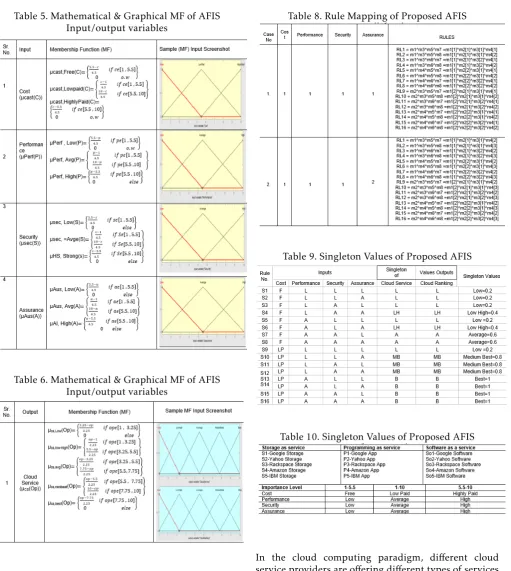
Participation work characterizes what degree the fluffy component has a place with the corresponding fuzzy set. In fuzzy inference system, four inputs like cost shown in table 1, performance in table 2, security in table 3, assurance in table 4 and output variable in table 5 has its arrangement of enrolment capacities. Mathematical & Graphical representation of the above mentioned I/O MF of AFIS Input variables are shown in table 5.
2.5. Rule Base
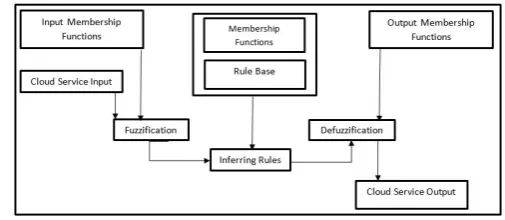
It is a set of “If-Then” rule set that characterizes the derivation demonstrate. The control structure resembles: "If cloud parameter Then what is ranking of cloud”. The deduction process, for the most part, includes five noteworthy steps as shown in Fig. 3:
2.5.1. Fuzzification. Input cloud services value into membership functions obtained equivalent member-ship degrees of to each input variable concerning exact, fuzzy set.
2.5.2. Applying Fuzzy Processes. Get the membership degree of cloud services using “AND” and “OR” operators
2.5.3. Implication. Get the fuzzy set of each law using the well-defined implication operator.
2.5.4. Aggregation. Aggregate yield fuzzy sets of full rules using well-defined aggregation administrator as shown in table 7.
2.5.5. Defuzzification. Convert aggregated fuzzy set into cloud ranking value as shown in table 6 by distinct defuzzification procedure (Qu & Buyya, 2014).
Figure 3. Fuzzy Inference Module
3. Experiment & Result
Four parameters are being used to rank any cloud service provided by different service providers. The Cost parameter is further divided into four types of cost like Virtual Machine Cost, Storage cost, Data Transfer cost, and total time which is taken to perform a service as shown in table 1,2,3 & 4. Following are the membership functions
Table 2. Performance
Table 7. Fuzzifier output and Linguistic values of Proposed FIS
3.1. Different types of services provided by Cloud
Providers
There are three types of cloud service providers are chosen for ranking of cloud computing as shown in given below table 10. The fuzzy inference apparatus consists of three steps: in the first stage, the values of the numerical inputs are plotted by a membership function, this process is called fuzzification. In the 2nd stage, the fuzzy system works under the guidelines with the firing strengths of the inputs.
In the 3rd stage, the subsequent fuzzy values are transformed into numerical values; this process is so-called defuzzification. This technique makes the use of fuzzy classes in representation concepts following human beings in explanation of the decision-making process. In the same way, Artificial Neural Networks (ANN), as one of the computational intelligence systems structured after human intellect, begun to
be produced in 1943 in the paper of McCulloch and Pits. From that point forward, they are being developed and deployed in multidimensional contexts, so the computational insight in light of the learning hypothesis upgraded the likelihood of utilizing earlier learning (utilizing master frameworks and fuzzy logic) and information (through ANN) for complex data handling. In this progression, the test information is put into the AFIS, utilizing MATLAB AFIS editor. In the wake of running MATLAB AFIS module, testing and preparing information were contrasted to test the model’s performance as shown in Fig. 4. It also describes the Rule view of the proposed system for building the model of cloud ranking. These rules are based on the intensities of the variables. The 3D surface plot provided in Fig. 5 delineates the relationship among specific information sources i.e. Advancement Source, Development Technique, Development Culture and the yield Scholarly Capital acquired by the created AFIS framework, where different data sources are settled at a specific value. Furthermore, The Required Gun Positioning and required Shoulder Positioning are being provided in Table 10 and Table 11. According to the inference engine’s results.
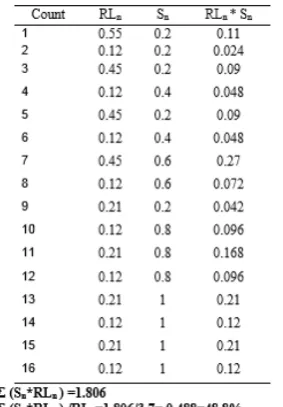
P
RLn =R1 +R2 +R3 +R4 +R5 +R6 +R7 +R8 +R9 +
R10 +R11 +R12 +R13 +R14 +R15 +R16 = 3.7 Rule mapping table will consist of 64 combinations. Here are the graphs for the four inputs.
RL1 =m1∩m3∩m5∩m7 =m1[1]∩m2[1]∩m3[1]∩
m4[2] = 0.79∩0.55∩0.55∩0.88 = 0.55
RL2 =m1∩m3∩m5∩m8 =m1[1]∩m2[1]∩m3[1]∩
m4[3] = 0.79∩0.55∩0.55∩0.12 = 0.12
RL3 =m1∩m3∩m6∩m7 =m1[1]∩m2[1]∩m3[2]∩
m4[2] = 0.79∩0.55∩0.45∩0.88 = 0.45
RL4 =m1∩m3∩m6∩m8 =m1[1]∩m2[1]∩m3[2]∩
m4[3] = 0.79∩0.55∩0.45∩0.12 = 0.12
RL5 =m1∩m4∩m5∩m7 =m1[1]∩m2[2]∩m3[1]∩
m4[2] = 0.79∩0.45∩0.55∩0.88 = 0.45
RL6 =m1∩m4∩m5∩m8 =m1[1]∩m2[2]∩m3[1]∩
m4[3] = 0.79∩0.45∩0.55∩0.12 = 0.12
RL7 =m1∩m4∩m6∩m7 =m1[1]∩m2[2]∩m3[2]∩
m4[2] = 0.79∩0.45∩0.45∩0.88 = 0.45
RL8 =m1∩m4∩m6∩m8 =m1[1]∩m2[2]∩m3[2]∩
m4[3] = 0.79∩0.45∩0.45∩0.12 = 0.12
RL9 =m2∩m3∩m5∩m7 =m1[2]∩m2[1]∩m3[1]∩
m4[2] = 0.21∩0.55∩0.55∩0.88 = 0.21
RL10 =m2∩m3∩m5∩m8 =m1[2]∩m2[1]∩m3[1]∩
m4[3] = 0.21∩0.55∩0.55∩0.12 = 0.12
RL11 =m2∩m3∩m6∩m7 =m1[2]∩m2[1]∩m3[2]∩
m4[2] = 0.21∩0.55∩0.45∩0.88 = 0.21
RL12 =m2∩m3∩m6∩m8 =m1[2]∩m2[1]∩m3[2]∩
m4[3] = 0.21∩0.55∩0.45∩0.12 = 0.12
RL13 =m2∩m4∩m5∩m7 =m1[2]∩m2[2]∩m3[1]∩
m4[2] = 0.21∩0.45∩0.55∩0.88 = 0.21
RL14 =m2∩m4∩m5∩m8 =m1[2]∩m2[2]∩m3[1]∩
Table 5. Mathematical & Graphical MF of AFIS Input/output variables
Table 6. Mathematical & Graphical MF of AFIS Input/output variables
RL15 =m2∩m4∩m6∩m7 =m1[2]∩m2[2]∩m3[2]∩
m4[2] = 0.21∩0.45∩0.45∩0.88 = 0.21
RL16 =m2∩m4∩m6∩m8 =m1[2]∩m2[2]∩m3[2]∩
m4[3] = 0.21∩0.45∩0.45∩0.12 = 0.12
4. Conclusion
Cloud ranking mechanism uses different parameters and determines their priority on given parameters.
Table 8. Rule Mapping of Proposed AFIS
Table 9. Singleton Values of Proposed AFIS
Table 10. Singleton Values of Proposed AFIS
Figure 4. Rule Viewer of Proposed AFIS
Figure 5. Surface Viewer of Proposed AFIS
Table 11. Cloud Service and Ranking of Proposed
AFIS.
the system will respond in the result of the best cloud services.
Table 12. Error Rate of Proposed AFIS
5. References
[1] Alkalbani, A., & Shenoy, A., Design, and Implemen-tation of the Hadoop-based Crawler for SaaS Service Discovery. 29th International Conference on Advanced Information Networking and Applications, IEEE, 2015; 785-781.
[2] Anjali, Sadhwani, A., & Saxena, N., A New Approach to Ranking Algorithm Custom Personalized Searching. IEEE, 2015; 130-134.
[3] Armaghani, D. J., An Adaptive Fuzzy inference system for predicting unconfined compressive strength and Young’s modulus: a study on Main Range granite. Bulletin of Engineering Geology and the Environment, 2014; 1301–1319.
[4] Bahrami, M., & Singhal, M., A Cloud-based Web Crawler Architecture. 18th International Conference on Intelligence in Next Generation Networks, 2015; 216-224.
[5] Bhaskaran, S., Suryanarayana, G., Basu, A., & Joseph, R., Cloud-enabled search for disparate healthcare data: A case study. In Cloud Computing in Emerging Markets (CCEM), International Conference on, IEEE, 2013; 1-8. [6] Ghadimi, N., An adaptive neuro-fuzzy inference system for islanding detection in wind turbine as dis-tributed generation. Complexity, 2015; 21(1):10-20. [7] Ghahramani, M. H., Zhou, M., & Hon, C. T., Toward cloud computing QoS architecture: Analysis of cloud systems and cloud services. IEEE/CAA Journal of Auto-matica Sinica, 2017; 4(1):6-18.
[8] Gong, S., & Mong, K., CB-Cloudle and Cloud Crawlers. IEEE, 2014; 9-13.
[9] Jelassi, M., Ghazel, C., & Saïdane, L. A., A survey on the quality of service in cloud computing. In Frontiers of Signal Processing (ICFSP), 3rd International Confer-ence on IEEE, 2017; 63-67.
[10] Kadhim, Q. K., Yusof, R., Mahdi, H. S., Al-shami, S. S. A., & Selamat, S. R., A Review Study on Cloud Computing Issues. In Journal of Physics: Conference Series, IOP Publishing. 2018; 1018(1):012006.
[11] Kisi, O., Haktanir, T., & Ardiclioglu, M., Adaptive Fuzzy computing technique for suspended sediment estimation. Advances in Engineering Software, 2009; 438–444.
[13] Massaro, D. W., & Cohen, M. M., Fuzzy logical model of bimodal emotion perception: Comment on “The perception of emotions by ear and by eye” by de Gelder and Vroomen. Cognition and Emotion, 2010; 313-320.
[14] Mohammadkhanli, L., & Jahani, A., Ranking Approaches for Cloud Computing Services Based on Quality of Service. ARPN Journal of Systems and Soft-ware, 2014; 50-58.
[15] Nauck, D., Foundations of Neuro-Fuzzy Systems. New York. 1997 [16] Noureldin, A., & El-Shafie, A., Optimizing neuro-fuzzy modules for data fusion of vehicular navigation systems using temporal cross-validation. Engineering Applications of Artificial Intel-ligence, 2007; 49–61.
[17] Ortega, M., Cano, A., & Carpio, J., Neuro-fuzzy controller for a gas turbine in a biomass-based electric power plant. Electric Power Systems Research, 2002; 123–135.
[18] Paiva, R. P., Interpretability and learning in neuro-fuzzy systems. Fuzzy Sets and Systems, 2004; 17-38. [19] Polat, K., An expert system approach based on prin-cipal component analysis and Adaptive Fuzzy inference system to the diagnosis of diabetes disease. Digital Signal Processing, 2007; 702-710.
[20] Pradhan, B., A comparative study on the predictive ability of the decision tree, support vector machine and neuro-fuzzy models in landslide susceptibility mapping using GIS. Computers & Geosciences, 2013; 350–365.
[21] Atta, A., Abbas, S., Khan, M. A., Ahmed, G., & Farooq, U. An adaptive approach: Smart traffic conges-tion control system. Journal of King Saud University-Computer and Information Sciences, 2018.
[22] Iqbal, K., Khan, M. A., Abbas, S., Hasan, Z., &
Fatima, A., Intelligent Transportation System (ITS) for Smart-Cities using Mamdani Fuzzy Inference System. INTERNATIONAL JOURNAL OF ADVANCED COM-PUTER SCIENCE AND APPLICATIONS, 9(2), 94-105, 2018.
[23] AsadUllah, M., Khan, M. A., Abbas, S., Athar, A., Raza, S. S., & Ahmad, G. (2018). Blind Channel and Data Estimation Using Fuzzy Logic-Empowered Oppo-site Learning-Based Mutant Particle Swarm Optimiza-tion. Computational Intelligence and Neuroscience, 2018.
[24] Khan, M. A., Umair, M., & Choudhry, M. A. S., GA based adaptive receiver for MC-CDMA system. Turkish Journal of Electrical Engineering & Computer Sciences, 23(Sup. 1), 2267-2277, 2015.
[25] Wang, H., Yi, X., Bertino, E. and Sun, L., 2016. Protecting outsourced data in cloud computing through access management. Concurrency and computation: Practice and Experience, 28, 3, pp.600-615.
[26] Sun, L., Ma, J., Wang, H., Zhang, Y. and Yong, J., 2015. Cloud service description model: an extension of USDL for cloud services. IEEE Transactions on Services Computing, 11, 2, pp.354-368.
[27] Kabir, E., Mahmood, A., Wang, H. and Mustafa, A., 2015. Microaggregation sorting framework for k-anonymity statistical disclosure control in cloud com-puting. IEEE Transactions on Cloud Comcom-puting. [28] Jiang, H., Zhou, R., Zhang, L., Wang, H. and Zhang, Y., 2018. Sentence level topic models for associated topics extraction. World Wide Web, pp.1-16.