GSJ: Volume 7, Issue 5, May 2019, Online: ISSN 2320-9186
www.globalscientificjournal.com
A Technology Transfer Model for Renewable Energy
Based Agro-processing Technologies
S. N. Ndirangu
1C. L Kanali
1, U. N. Mutwiwa
1, G. M. Kituu
11
Agricultural and Biosystems Engineering Department, Jomo Kenyatta University of
Agriculture and Technology, P.O. Box 62000-00200, Nairobi, Kenya
Corresponding Author
:
[email protected]
May, 2019
Key Words
Model, Technology Transfer, Renewable Energy,
ABSTRACT
The term technology transfer has been viewed different by different writers and researchers. One wider encompassing view is where Technology Transfer (TT) begins during the development of an innovation, continues through its dissemination, and extends into its early implementation. A distinction is also made between horizontal and vertical transfer. This paper is developed based on technology transfer from vertical integration and from a wider perspective that includes; technology development, dissemination, and adoption. Technology transfer is one of the ingredients for development of technological capabilities of enterprises. Most Small and Medium Enterprises (SMEs) including those using renewable energy and agro-processing technologies lack technological capabilities and require effective technology transfer.
Some of potential renewable energy based agro-processing technologies for use by SMEs in Kenya are solar drying and evaporative cooling. The two technologies have not been effectively introduced or adopted due to various technical and socio-economic reasons, and adoption and usage still remain low in Africa. One major challenge to their use is poor transfer efforts. Review of various models show they are diverse in their visualisation of technology transfer, and one need to consider characteristic variation of involved institutions and technologies at each of the stages of development and commercialization.
1.0 INTRODUCTION
1.1 Background
Technology development institutions have multiple tasks in which research organisations such as universities carry out training and research; with commercial opportunities as one of the by-product of their activities. These institutions have many innovation and invention products which can be commercialised to maximize value. This calls for optimal methods to achieve commercialisation without compromising on the quality of the institutions main products. One way to enhance commercialisation is through effective Technology Transfer (TT). This study analysis existing models of TT and attempts to develop a practical TT model of renewable energy based agro-processing technologies.
Innovation, Diffusion, Dissemination and Technology Transfer
Technology transfer has been viewed differently by different authors and researchers. [21], defines Technology transfer as the process by which commercial technology is disseminated. [6], considers technology transfer as the handing-off of intellectual property rights from the university to the commercial sector for purposes of commercialization. According to [7] TT, also referred to as knowledge transfer or knowledge sharing, is the process of converting scientific findings from research organisations into useful products by the commercial sector. The author notes that TT can take three main forms namely: The creation of new companies or spin-outs, collaboration between universities, research organisations and industry notably via research contracts; and licensing of Intellectual Properties (IP).
Technology transfer can also be viewed as multidimensional process that intentionally promotes the use of an innovation [15]. Technology transfer begins during the development of an innovation, continues through its dissemination, and extends into its early implementation. According to [15] this process requires multiple stakeholders and resources, and involves activities related to the translation and adoption of an innovation. Technology transfer is designed to accelerate the diffusion of an innovation.
[22], takes a similar wider view of technology transfer, but makes a distinction between vertical and horizontal transfer; where vertical transfer refers to technology being transferred from research to development and then production and follows the progressive stages of invention, innovation and development, with the technology becoming more commercialised as it proceeds through each stage. On the hand, horizontal transfer refers to an established technology being transferred from one operational environment to another, in which the technology is already commercialised and the purpose is to disseminate the technology and extend its application into other contexts.
This research adopts the wider view of technology transfer taken by [15] and [22]. The paper attempts to develop an appropriate TT model that could be used for transfer of renewable energy based agro-processing technologies in Kenya. When properly implemented, such a framework would support technology development, skills improvement, dissemination and adoption of targeted technologies.
1.2 Statement of the Problem
Most Governments today regard renewable and agro-processing technology integration in agricultural and related sectors as key to enhancing high growths of these sectors. In addition, diffusion and adoption of such technologies is an important route to increased competitiveness, especially for the SMEs. However, SMEs have disadvantages related to the lack of technological and financial capability which can lead not only to problems in their ability to source technology but also in their ability to absorb it into their organization and diffuse it into their industrial sector [15].
challenges contributing to this includes; technical inadequacies including limitations in capacities and low efficiencies, poor promotion efforts, and financial limitations [16]. One potential solar drying technology is the greenhouse dryer which if optimally designed can help overcome a number of challenges with most drying systems. Another potential renewable agro-processing system is the charcoal cooler, an evaporative based system that can be used to help preserve vegetables and fruits [12], [23], [17]. Despites their potential in reducing post-harvest losses, these systems have not well been adopted.
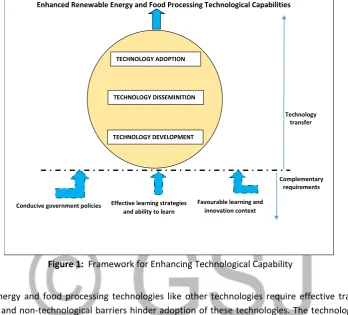
Figure 1: Framework for Enhancing Technological Capability
Renewable energy and food processing technologies like other technologies require effective transfer. Both technological and non-technological barriers hinder adoption of these technologies. The technological factors include; inappropriate technological push, appropriate technologies which are either too big, expensive, or laboratory level. Other technological factors include lack of adequate training to recipient of technology and lack of maintenance. Non-technological factors include lack appropriate policies, limited access to credit among others. There is therefore need to utilize appropriate models to develop and transfer technologies.
Technology transfer is one of the ingredients for the development of technological capabilities of SMEs and other enterprises, but it cannot by itself develop them. Other complementary requirements are: conducive government policies; effective learning strategies and ability to learn at the level of enterprises. In addition, favourable learning and innovation context such as local clusters of competitors, suppliers and customers, active trade associations, supporting institutions for training, development and application of technology and financing limits technological capabilities [22].
1.3 Review of Existing Models from Literature
Several models have been developed for conceptualizing technology transfer; normally referred to as Technology transfer (TT) models. The traditional models earlier developed included; the Appropriability Model; The Dissemination Model; The Knowledge Utilization Model and the Communication Model [20]. Modern models have later been conceptualized; one such model being the Sung and Gibson’s Model [20]. This model indicates that Technology Transfer (TT) consists of three levels of involvement: which are Technology Development at the first level, Technology Acceptance at the second level, and Technology Application which is the third level. Technology Development is considered as the most important level where the transfer process is viewed as passive through transfer means such as research reports, journal articles, and computer tapes. This level relates to the appropriability model, where the emphasis is on the importance of quality of research and
Enhanced Renewable Energy and Food Processing Technological Capabilities
TECHNOLOGY ADOPTION
TECHNOLOGY DISSEMINITION
TECHNOLOGY DEVELOPMENT
Conducive government policies Effective learning strategies and ability to learn
Favourable learning and innovation context
Complementary requirements
competitive market pressure in achieving technology transfer. In the Technology Acceptance level, the technology developer is responsible for availability of the technology to receptors who can understand and potentially use the technology. This level of involvement relates to the dissemination model, where the concentration is on disseminating innovations to individual users. Technology Application level is the most involved level of TT and includes commercializing the use of technology in the marketplace and other applications such as intra-firm processes. This level compares with knowledge utilization model: where emphases is on the critical element of interpersonal communication between technology developers and users, and the organizational barriers and facilitators of TT.
According to [5], the technology transfer can be visualized from three perspective; Technology development, technology dissemination and technology adoption. On the other hand, [8] proposes a model for technology transfer, and thus industry-relevant research, in which transfer involves more than research, publications and reports preparation. Their models propose identifying potential improvement areas based on industry needs, and formulating a research agenda using several assessments methods to find research topics. This is followed by formulating problem statements while studying the field and the domain; formulating a candidate solution in cooperation with industry and conducting lab validation through lab experiments. The final stage of the model involves performing static validation through interviews and seminars; performing dynamic validation through pilot projects and controlled small tests; and releasing the solution step by step while remaining open to smaller changes and addition.
A review on various models by [19] isolates the various elements of popular technology transfer models. The elements include models that; integrates organisation arrangement and technology components; use of process approach and planning; an approach that recognises a provider who possesses a certain technology and the will to transfer it; a mechanism to affect the transfer; and a user who is willing to receive the technology. The review also recognises the presence of organisation with strategic thrust that works with other organisation to deliver technology transfer. Other elements include; need for selection phase, detailed engineering study through development and refinement of technology, use of local skills and adoption of technology to local condition, and in the adoption of common practice. It further identifies an evaluation stage as the starting point in technology transfer, mainly through pre-investment and feasibility assessment, and where needs and solutions are prioritised. In addition, it recognises two types of technology source which are research and development, and existing technologies; but doesn’t emphasize the reverse engineering aspects of technology transfer. It further emphasises on the need for a feedback mechanism to the organisation and the research team on developed technology and its usage to help adjust on the technology. The review also notes the need for market planning, transfer environment scanning and supplier selection, packaging of product and services, and for a promotion development mechanism. Capacity building of all stakeholders involved in the technology transfer process is also emphasised. The review does not highlight role of financial linkages, the inputs in the technology development, the need for a technology transfer office, the options to enhance capacity of users such as incubation and the need to factor in the IP component aspects that are critical in technology transfer.
[3], proposes an appropriate organizational structure for TT that include a specialized and decentralized Technology Transfer Office (TTO) with sufficient autonomy to develop relationships with industry. It also emphasis the Intellectual Property (IP) process in technology transfer; protection and licencing of technology. The model only concentrates on technology invention part of technology transfer.
[7], stated that technology transfer often involves a formal transfer of rights to use and commercialise new discoveries and innovations resulting from scientific research to another party. The study shows that TT process also covers funded research, innovation disclosure, patents, licensing and sometimes new start-up. The model recognises the need for funding requirements and the TTO.
on various kinds of modalities and is done for various motivations. [3], noted that a generalizable model of technology transfer is difficult to find, and one that accurately depicts the subtleties of how knowledge and technology are transferred in practice is arguably non-existent. This study seeks to develop a consolidated model that takes note of these deficiencies by combing the various elements identified in this review.
2. MODEL DEVELOPMENT
2.1. Analysis of Some Selected Models in Kenya.
Activities of stakeholders who participated in stakeholders’ consultative forum for Renewable Energy for Food (RE4FOOD) project on March 20, 2014. held at Jomo Kenyatta University of Agriculture and Technology JKUAT, and which are involved in renewable energy technology development and transfer were analysed. This was carried out with the aim of isolating the unique elements that could be factored into a consolidated TT model for renewable energy-based technology transfer. The analysis first identified two broad model of technology transfer; the public and the private sector models. The two models identified were as described below.
General Public Sector Model is a model in which the trigger of the intervention is need based and emanating
from an emerging problem or government policy and through needs assessment study. The technology development builds on new knowledge, existing knowledge and socio-economic information to develop designs. The process of technology transfer is basic and includes; design, prototype type production, user trials, modification of tested technology, final trials, and dissemination to users and fabricators. It also includes cost benefit analysis. The technology is released through training of artisans for mass production or through sale by either the innovators and developers or trained fabricators. This model has been partly applied in public organisations such as Kenya Industrial Research Development Institute (KIRDI), Universities like JKUAT, the Rural Technology Development Centres of the Ministry of Agriculture [13], and Kenya Agricultural and Livestock Research Organization (KALRO).
The general Private Sector Model involves a number of elements as in public sector model. However, it has
variation in the trigger mechanism that is based on potential assessed demand by the organisation or request by users. The solution to the problem is through technology development or importation. In this model, the imported technologies could be modified for local use, but are normally sold directly. In addition, the technology could be availed to users by distributors. This model is common with private sector organisations such as DK Engineering, Muharata Enterprise, Kijito (Wind) Company, Asami Ltd (plastic bags biogas) sales company and dealers such as Brazafric, Hubei Ltd, and Marina Machineries.
Other analysed models and their elements included: Sustainable Community Development Services (SCODE) Model. The models have unique aspects that include; participatory approach to technology transfer to overcome social barriers, working with local suppliers and producer for capacity building and marketing of products; use of social marketing campaigns and networking activities to create demand; working with research institutions and the private sector in test-marketing new products and improving marketing strategies; technology standardization; benefits focused promotion; and gender mainstreaming. The TT incorporates capacity building and technical assistance.
The Songa Mbele Community Development Initiative (SoMCoDI) organisation has a model that involves modifying existing technologies, and mobilization and utilization of locally available resources. The model has a component of incubation of budding enterprises [17].
established organisations such as Kenya National Federation of Agricultural Producers (KENFAP) and Improved Stoves Association of Kenya (ISAK) to transfer technologies. The user of the technology is financed directly or through direct payment of the supplier.
2.2 Consolidated Model of Technology Transfer
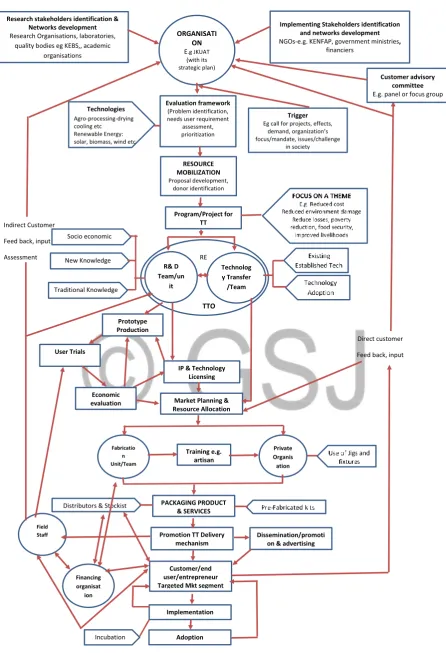
The model developed as shown in Figure 2 borrows elements from the models discussed in in 2.1 and also incorporates input from models reviewed in literature. It illustrates a possible TT model for renewable energy based agro-processing technology.
Figure 2: Proposed consolidated model
Technolog y Transfer /Team R& D Team/un it Indirect Customer
Feed back, input
Assessment RE
TTO
Direct customer
Feed back, input ORGANISATI
ON E.g JKUAT
(with its strategic plan)
Evaluation framework
(Problem identification, needs user requirement
assessment, prioritization RESOURCE MOBILIZATION Proposal development, donor identification
Research stakeholders identification & Networks development
Research Organisations, laboratories, quality bodies eg KEBS,, academic
organisations
Implementing Stakeholders identification and networks development
NGOs-e.g. KENFAP, government ministries,
financiers
IP & Technology Licensing
New Knowledge
Traditional Knowledge
Market Planning & Resource Allocation Private Organis ation Fabricatio n Unit/Team PACKAGING PRODUCT & SERVICES
Distributors & Stockist
Promotion TT Delivery mechanism
Dissemination/promoti on & advertising Customer/end
user/entrepreneur Targeted Mkt segment Field Staff Implementation Adoption Training e.g. artisan Financing organisat ion User Trials Prototype Production Program/Project for TT Trigger
Eg call for projects, effects, demand, organization’s focus/mandate, issues/challenge
in society
Customer advisory committee
E.g. panel or focus group
Socio economic Economic evaluation Technologies Agro-processing-drying cooling etc Renewable Energy: solar, biomass, wind etc
2.3 Framework of the Proposed Model
The framework of the proposed model considered that there is an organization under which the TT implementation will be undertaken. This organization has its thrust in relation to what it intends to transfer; this could build out of the organization’s mandate or internal policies like technology development and revenue generation. The following are the phases of the model.
1. Planning:Most organisations will have established networks and collaboration with other stakeholders or
organisations in the area of focus; for this study the focus being renewable and agro processing. For this model, such stakeholders would include government institutions engaged in research such as KIRDI, Rural Technology Development Centres of Ministry of agriculture, Universities, KALRO and Energy centres of Ministry of energy. Other stakeholders would include NGOs as SoMCODI and KENFAP and private companies such as Muharata, and banks. It is ideal that all such organisations and the TT organization continue to enhance and broaden collaboration through participation in TT. The implementing organization has its strategic plan well spelt out in relation to TT. An advisory committee need be in place to assist in the planning and liaising with stakeholders.
2. Technology evaluation:There must be a trigger to initiate the thinking of aspect to be handled through TT;
the trigger could be the organisations mandate, or demand for solution-based interventions. The problems and needs should be identified and prioritized. The solutions to these needs should also be prioritized.
3. Resource mobilization:Once the idea has been prioritized the organization will mobilize the resources within
itself or through external finding; one way being to develop a fund seeking proposals. This will lead into a project or program. The focus for such need to be brought out to relate with the donors mandate or organization areas of focus. The developed interventions should also have an embedded approach such as participatory engagement, energy mix with multiple packages, technology standardization, incubation, reverse engineering and gender mainstreaming.
4. Technology development:Ideally the activities related to technology development in the model are handled
by the technology transfer office (TTO). Every stage in the technology identification and development should involve the users. Technology for TT will be available through R&D or through existing technologies. Once the technology has been developed the initial prototype will be tested at laboratory level and after confirming performance, final prototypes will be tested through users’ trial with potential users in different regions. There is need for economic evaluation of the technology after such trials. The technology needs to be modified after users’ trial and then go through the IP process. The patenting and licensing could also be immediately after R&D and laboratory testing. Technology development could also entail reverse engineering where existing technologies are modified. The existing technologies such as those imported could either be tested with users before modification or immediately be modified to suit local conditions.
5. Technology dissemination and adoption: Market planning and resource allocation for technology
dissemination starts with visualizing who will spread the technology and who will undertake the activities that follow. Such responsibility would be through the parent organisation’s fabrication unit or through private organisations who will be trained. Market planning is also meant to have the product in actual market place and also identifying who the user will be. The products should be well packaged in a way suitable to be received by users and audience through user manuals, videos or pre-fabricated kits. Back up services such as distribution, and appropriate delivery should be in place. Promotion of the product could be through exhibitions, demonstrations or training forums that target the users or the entrepreneur. Promotion could also be through field teams led by parent organization. Such teams should draw people from parent organization and other key players such as extension staff, and researchers.
6. Implementation: There is need to have continuous dialogue between users and providers, like to have
continuous supportive services being provided to users. One key area of implementation is to assist groups to familiarize with technology; this could be undertaken through incubation or practical training of end users.
7. Adoption:This occur when measurable change takes place when practice is affected or when wide spread
use of technology has been achieved. The user feedback is crucial at this stage and the organization needs to be aware of such feedback. Feedback could be directly or indirectly; through users or field staff respectively. The field staff gives feedback to R&D team or to the parent organization. The feedback helps on continuous improvement of the technologies and enhancing adoption.
3. CONCLUSION
A general model has been developed that can be used for transferring renewable energy based agro-processing technologies. The formulated technology transfer model has three components; planning component that emphasise the need to have stakeholders involved and the need to have and follow organisational strategic direction; the technology development part that highlights an ideal process of technology development and which calls for the need of a technology transfer office, the need for user trials and need for economic evaluation; and the dissemination and adoption part that emphasises the need to identifying responsible players, the packaging of the product, the need for incubation and linkages with suppliers and financing organisations.
4. ACKNOWLEDGMENT
The authors would like to thank RE4Food-JKUAT project and the Department for International Development (DFID), Engineering and Physical Sciences Research Council (EPSRC), Department of Energy and Climate Change (DECC), and Newcastle University for the financial support during the stakeholders forum where organisations whose models are analysed were participants. Thanks also to the organisation that participated; KWFT, BIMAS, Ministry of Agriculture, SCODE, SoMCoDI and all other stakeholders who contributed during the workshop.
REFERENCES
[1] Akarslan F. (2012).“Solar-Energy Drying Systems”. Department of Textile Engineering, Engineering and
Architectural Faculty, Süleyman Demirel Univercity, Isparta Turkey
[2] Bassey, M.W. and Schmidt O.G. (1987). “Solar Drying in Africa”: Proceedings of a Workshop Held in
Dakar, Senegal, 21—24 July 1986. IDRC, Ottawa, Ont., Ix, (286) ill. International Development Research
Centre 1987.
[3] Bradley R. B., Hayter S. C, Link N. A. (2013). “Models and Methods of University Technology Transfer”.
Department of Economics Working Paper Series: Working Paper 13-10.
[4] Chavda T. V. and Kumar N. (2009). “Solar Dryers for High Value Agro Products at Spreri Sardar Patel
Renewable Energy Research Institute”. P.B.No. 2, Vallabh Vidyanagar– 388 120. International Solar Food Processing Conference 2009.
[5] Cramb, R.A. (2000). “Processes Affecting the Successfull Adoption of New Technologies by
Smallholders.”
[6] COGR (2000). A Tutorial On Technology Transfer In U.S. Colleges And Universities.
(online-https://tulane.edu/ott/upload/TT_Tutorial-2.pdf)
[7] Darcy J, Kraemer-Eis H., Debande O. and Guellec D. (2009). Financing Technology. Transfer. Working
Paper 2009/002. EIF Research & Market Analysis
[8] Gorschek T., Wohlin C, Garre P., Larsson S. (2006). “A Model for Technology Transfer in Practice. IEEE
Software”. Published by the IEEE Computer Society 0740-7459/06
[10] JKUAT (2014). Business Initiatives and Management Assistance Services (BIMAS) Model. Research Project Papers, RE4Food Kenya
[11] JKUAT (2014). Kenya Women Finance Trust (KWFT) Business Model. Research Project Papers, RE4Food
Kenya
[12] JKUAT (2014). Renewable Energy and Technology Implementation in Kenya. Research Project Papers,
RE4Food Kenya
[13] JKUAT (2014). Value Added Products Business Models, MOALF. Research Project Papers, RE4Food
Kenya
[14] JKUAT (2014). Value Addition Model for SoMCoDI. Research Project Papers, RE4Food Kenya
[15] Jones-Evans D. (1998). SMEs and Technology Transfer Networks - Project Summary. Pontypridd, Welsh
Enterprise Institute, University of Glamorgan
[16] Karekezi S. (2003). “Renewable Energy Development”. Paper presented in The Workshop for African
Energy Experts on Operationalizing the NEPAD Energy Initiative; Operationalizing the NEPAD Energy Initiative
[17] Liberty T.J, W.I Okonkwo. I.W., and E.A Echiegu A.E (2013) “Evaporative Cooling: A Postharvest
Technology for Fruits and Vegetables Preservation”. International Journal of Scientific & Engineering
Research, Volume 4, Issue 8. ISSN 2229-5518
[18] Pagar S, A. Khivansara1, P. Pagar, M. Gandhi and S. Jondhale (2014). Review Article on Technology Transfer. International Journal of Pure & Applied Bioscience. 2 (3): 145-153
[19] Reisman A. (2004). “Transfer of technologies: a cross-disciplinary taxonomy”. Omega, the
International Journal of Management Science 33 (2005) 189 – 202. Elsevier Ltd. Available online
www.sciencedirect.com
[20] Sazali, A.W, Haslinda, A., Jegak, U, Raduan, C. R (2009). “Evolution and Development of Technology
Transfer Models and the Influence of Knowledge-Based View and Organizational Learning on
Technology Transfer”. Research Journal of International Studies Issue No1
[21] Unctad (2001). Transfer of Technology. United Nations Conference on Trade and Development
(UNCTAD) IIA issues paper series.
[22] UNIDO (2002). Innovative Technology Transfer Framework Linked to Trade for UNIDO Action. UNIDO
and the World Summit on Sustainable Development
[23] Wayua O. F, Okoth W.M., Michael W. Okoth, and Wangoh J. (2012). “Design and Performance
Assessment of a Low Cost Evaporative Cooler for Storage of Camel Milk in Arid Pastoral Areas of
Kenya”. International Journal of Food Engineering. Volume 8, Issue 1, Article 16
[24] Welch LS, Russell D1, Weinstock D1, Betit E (2015). Best practices for health and safety technology
transfer in construction. Am J Ind Med. 58(8):849-57
[25] Weiss W and Buchinger J. (2001). “Solar Drying”. AEE INTEC, Australian Development Cooperation