Weight Regain Prevention
Christina Garcia Ulen; Mary Margaret Huizinga, MD, MPH; Bettina Beech, DrPH; and Tom A. Elasy, MD, MPH
O
besity has reached epidemic proportions in the United States. In 2005–2006, > 72 million adults, or 34% of the population > 20 years of age, were obese (BMI ≥ 30 kg/ m2).1 Obesity is significantly correlatedwith hypertension, hyperlipidemia, dia-betes, and infertility; yet, a 5% reduction in weight can translate into clinically significant improvements in health.2,3
Lifestyle and pharmacological interven-tions are effective at inducing clinically significant levels of weight loss.4–6
However, maintaining weight loss over a period of years has proved more challenging and has lead to the classifi-cation of obesity as a chronic, relapsing disease.7 Respective systematic reviews
of pharmacological-, behavioral-, and diet-based weight loss treatments con-clude, however, that continued therapy is essential for minimizing weight regain after weight loss.8–12
This conceptual review of the weight regain phenomenon analyzes the efficacy and clinical utility of formal weight loss and weight loss maintenance programs and highlights factors underlying weight regain and weight loss maintenance. Although weight regain prevention remains a challenge, there is room for optimism; a nationally representative survey estimates that 20% of individuals attempting weight loss are able to achieve and maintain 5% weight reductions for at least 1 year.13 Among
successful weight losers, various stud-ies indicate that more than 60, 35, and 19% of individuals are able to maintain
10% weight reductions for 1, 3, and 5 years, respectively.14–16
Methods
The first section presents the scope of the weight regain phenomenon by ana-lyzing the long-term efficacy of weight loss programs. Data have been gathered from systematic and meta-analytical reviews of randomized controlled trials of nonsurgical weight loss therapy pro-grams. Weight loss surgery is an option for some patients with obesity; a discus-sion of the risks and benefits of surgery is beyond the scope of this article and will not be considered here.
The second section presents the efficacy of weight loss maintenance programs to support weight reduction and prevent weight regain. The goal is to identify best practices for weight regain prevention. Data are from randomized controlled trials in which program duration was longer than 6 months and the efficacy of a mainte-nance program was assessed relative to no follow-up support, placebo, or a comparative maintenance intervention group. Trials were identified through a keyMesh search on PubMed for “weight loss maintenance” and “weight regain prevention” and bibliography reviews of identified articles. The outcomes reported are statistically significant group differences in weight reduction, percentage of initial weight loss maintained, and net effect of the intervention on percentage of weight reduction. If not reported, percentage of weight reduction was calculated from baseline weight and the amount of weight lost; the percentage of weight loss maintained was calculated from initial weight lost and amount of weight loss maintained; and the intervention effect was calculated as the arithme-tic mean difference in percentage of weight reduction. Baseline weight was not reported in three studies, and weight loss in kilograms was presented instead.
The third section identifies risk factors for weight regain and strate-gies used by successful weight loss maintainers. Data are from reports based on population surveys includ-ing the National Health and Nutrition
I n B r I e f
Examination Survey (NHANES) for 1999-2002,14,17 Consumer Reports,18
and Consumer and Health Styles
2004;19,20 the National Control Registry
for Weight Control (NWCR), a longitu-dinal database containing information on > 4,000 self-selected individuals who have maintained a weight loss ≥ 13.6 kg for at least 1 year;21 and
post-hoc analyses of randomized controlled trials.
Long-Term Efficacy of Weight Loss Programs
The mainstays of weight loss therapy include diet, exercise, behavioral therapy, and pharmacological therapy. Although the duration of programs var-ies, maximal weight loss occurs in the first 6 months of therapy.22,23 The short-
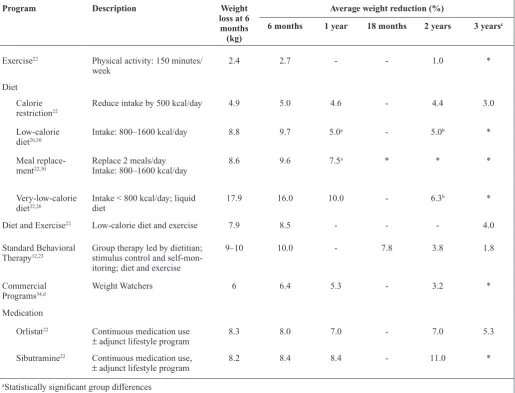
and long-term efficacy of weight loss programs is presented in Table 1. With the exception of continuous
pharma-cological therapy, the pattern of weight regain is evident from 6 months on.
Diet restriction
Calorie restriction programs restrict caloric intake by 300–500 kcal/day and fat calories to < 30% of daily caloric consumption. The expected rate of weight loss is 0.5–1.0 lb/week. In a review of 51 diet restriction programs, weight reductions at 6 months averaged 5% of baseline weight.22 By 2 and 3
Table 1. Long-Term Outcomes of Randomized Controlled Trials for Nonsurgical Weight Loss: Results From Meta-analyses and Systematic Reviews
Program Description Weight
loss at 6 months
(kg)
Average weight reduction (%)
6 months 1 year 18 months 2 years 3 yearsc
Exercise22 Physical activity: 150 minutes/
week 2.4 2.7 - - 1.0 *
Diet Calorie
restriction22 Reduce intake by 500 kcal/day 4.9 5.0 4.6 - 4.4 3.0
Low-calorie
diet26,30 Intake: 800–1600 kcal/day 8.8 9.7 5.0
a - 5.0b *
Meal
replace-ment22,30 Replace 2 meals/dayIntake: 800–1600 kcal/day 8.6 9.6 7.5
a * * *
Very-low-calorie
diet22,26 Intake < 800 kcal/day; liquid diet 17.9 16.0 10.0 - 6.3
b *
Diet and Exercise22 Low-calorie diet and exercise 7.9 8.5 - - - 4.0
Standard Behavioral
Therapy12,23 Group therapy led by dietitian; stimulus control and self-mon-itoring; diet and exercise
9–10 10.0 - 7.8 3.8 1.8
Commercial
Programs34,d Weight Watchers 6 6.4 5.3 - 3.2 *
Medication
Orlistat22 Continuous medication use
± adjunct lifestyle program 8.3 8.0 7.0 - 7.0 5.3
Sibutramine22 Continuous medication use,
± adjunct lifestyle program 8.2 8.4 8.4 - 11.0 *
aStatistically significant group differences bNonstatistically significant group differences
cBehavioral therapy value is based on an average of 4.3 years follow-up dBased on the results from one randomized controlled trial
years, weight reductions averaged 4.4 and 3%, respectively.
Diet and exercise
Diet-only programs have proven more effective than exercise-only programs for inducing clinically significant levels of weight loss.22 Yet, exercise
can enhance the amount of weight loss achieved from dieting.22,24 A
meta-analysis of 17 trials demonstrates that average weight reductions for combined programs are 8.5% at 6 months and 4% at 4 years.22 Nonetheless, reversion to
baseline weight is predicted by 5.5 years; a steady rate of regain is observed from 6 months on.25 The pattern of weight
regain is slower in patients without diabetes and in those participating in induction programs that recommend fewer calories per day.
Low-calorie diets
Low-calorie diets (LCDs) restrict caloric intake to 800–1600 kcal/day. A meta-analysis of formalized LCD programs estimates average weight loss at 6 months to be 9.7% of baseline weight.26
By 1 and 2 years, weight reductions average 5%. Altering the macronutrient composition of LCDs to be very-low-fat or low-carbohydrate diets has not enhanced long-term weight loss outcomes.27,28
Meal replacements
Meal replacement (MR) programs are often prescribed by physicians, but trials examining their efficacy have only emerged in the past 10 years.29 During
weight loss, all or the majority of meals are replaced. In the maintenance phase of care, meal replacements are gradually titrated down and replaced with a sensi-ble diet. Although calories are restricted within the range of LCD programs, MRs are thought to improve diet adherence by removing calorie counting and portion control from the patient’s control. In a review of MR programs with a duration of 3 months or longer, weight losses at 6 months and 1 year averaged 9.6 and
7.5% of baseline weight, respectively.30
Two meta-analyses have demonstrated that MR programs are more effective than LCDs for maintaining weight loss at 1 year;22,30 the net difference in weight
loss maintained at 1 year was 2.6 kg in favor of MR.30
Very-low-calorie diets
Very-low-calorie diets (VLCDs) are intensive diet programs that must be supervised by a physician.31 Daily
caloric intake is restricted to 400–800 kcal/day, often via a liquid diet for up to 4 months. VLCDs are associated with rapid weight loss—16% weight reductions are commonly observed at 6 months—followed by rapid weight regain.22,26,32 Six trials have directly
compared the efficacy of VLCD to LCD programs for weight loss. In these programs, continuous use of an LCD was compared to a sequential regimen of a VLCD followed by an LCD. A meta-analysis of these studies demonstrates that the initial net benefit derived from a VLCD diminishes over time such that group differences were not statistically significant at 2 years.26
Behavioral therapy
Behavioral therapy, in combination with diet and exercise, is highly effective at inducing weight loss.6 The goal of
behavioral therapy is to promote weight loss through changes in diet and activity level. Standard behavioral therapy (SBT) programs are generally provided in a group setting, led by a dietitian or health psychologist, and focused on stimulus control, self-monitoring of diet, physi-cal activity and weight, and nutrition counseling, among other topics.23
Average duration of SBT programs is 4–6 months. In a review of nine programs, weight reductions averaged 10% at 6 months and 8% at 18 months.23
Follow-up data are sparse. A separate study found that that at 2 and 4 years, weight reductions approached 3.8 and 1.8 kg, respectively.12
Commercial weight loss programs Weight Watchers is the only commercial program to report data from random-ized controlled trials.33 In a multicenter
trial, participants randomly assigned to a Weight Watchers program lost sig-nificantly more weight than a self-help control group.34 For the Weight Watchers
group, weight reductions of 4.6% were maintained at 1 year, and reductions of 3% were maintained at 2 years. Between-group differences in percent-age of weight reduction averpercent-aged 3% at both time points. In a second study, individualized support from a dietitian greatly enhanced weight outcomes among Weight Watchers participants; 60% of those receiving dietitian support achieved 10% weight reductions at 1 year.35 Follow-up data are not available.
Weight loss medication
Orlistat and sibutramine are the only two drugs approved by the Food and Drug Administration (FDA) for long-term treatment of obesity.36 A recent
trial demonstrated that the efficacy of pharmacological treatment for obesity is enhanced when medication use is combined with a lifestyle program focused on diet, exercise, and behavioral therapy.37 Published meta-analyses,
however, pool data from trials that provided adjunctive lifestyle programs and those that did not. In a meta-analysis of 20 trials, pharmacological therapy ± adjunctive support induced an 8% body weight reduction by 6 months.22 Weight
loss hit a plateau at 6 months. With continued medication use, however, 7–11% body weight reductions were maintained for up to 3 years. A second meta-analysis demonstrated that phar-macologically treated patients were three times as likely as those solely relying on lifestyle programs to maintain clinically significant weight losses for 1–2 years.24
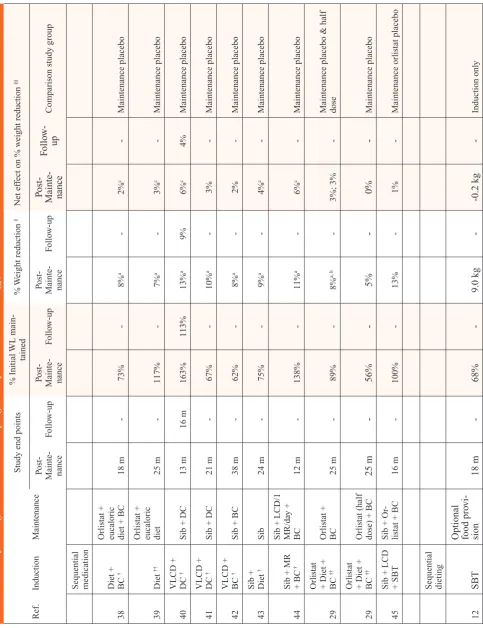
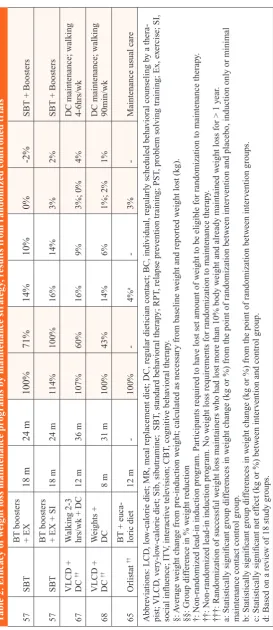
Weight Loss Maintenance Programs The goal of weight loss maintenance programs is to prevent weight regain after weight loss. Programs can be classified by approach: sequential medication use, sequential dieting, individualized follow-up support, or group-based follow-up support. This section provides an overview of the long-term outcomes of randomized con-trolled trials of weight regain prevention programs (Table 2).
Sequential medication
Sequential medication use appears to be an effective strategy for delaying rapid weight regain. In each of the eight trials identified, maintenance-phase medica-tion use improved end-of-program weight loss maintenance outcomes over placebo.29,38–44 Weight reductions
averaged 2–6% greater among those receiving maintenance-phase medica-tion compared to placebo. Sequential medication use induced additional weight loss in three trials.39,40,44 and
slowed the pattern of weight regain in the other five trials.29,38,41–43 Neither
the type of induction therapy nor the amount of weight initially lost appears to explain this differential effect. Most troubling, however, is that intervention effects appear to diminish rapidly after medication discontinuation,40 and dose
reduction does not appear to be an effec-tive alternaeffec-tive.29 Incidentally, addition
of a second weight loss medication during the maintenance phase does not appear to produce a synergistic effect.45
Sequential dieting
Although sequential dieting is common in the literature— low-calorie diets often follow very-low-calorie diets; partial meal replacements often follow meal replacement diets— few trials have accessed the efficacy of sequential dieting for prevention of weight regain. Findings from one trial suggest that optional food provision is not an effec-tive weight regain prevention strategy.12
Three other trials have assessed the
relative efficacy of sequential dieting approaches for preventing weight regain. Within the context of group follow-up sfollow-upport, sequential dieting with a low-carbohydrate diet was equally as effective as a low-fat diet;46 an MR was
equally effective as orlistat;47 and an
MR was equally effective as an LCD48
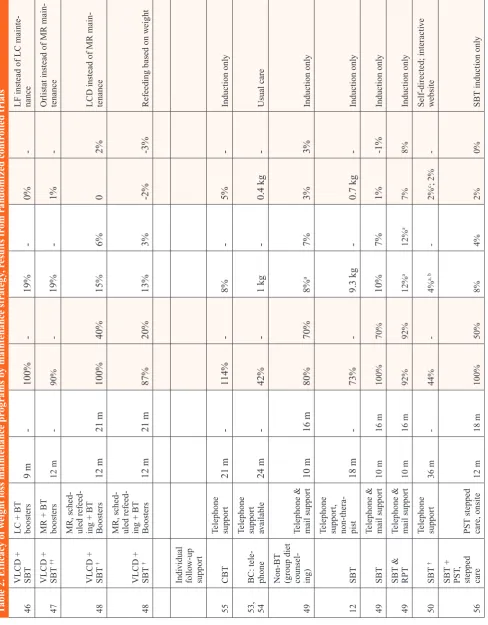
for supporting weight regain prevention at program completion. In all of these trials, 90–100% of initial weight losses were maintained at program completion.
Given the multi-component design of these trials, it is difficult to assess the relative contribution of sequential dieting to weight regain prevention. Moreover, follow-up data are only available from one trial, and significant weight regain was evident after discon-tinuation of maintenance support.48
Individual follow-up support
In terms of individual follow-up support, telephone contact has received the most attention in the literature and appears to be effective, especially after group induction therapy and when provided by a therapist. In all identified trials, the trend was for telephone support to improve weight loss maintenance outcomes over no maintenance contact. Group differences only reached statisti-cal significance in three of the seven study groups identified.49,50 In these
programs, end-of-program weight reduc-tions averaged 2–7% greater for those receiving telephone support compared to no maintenance care. Telephone maintenance support after relapse prevention training produced the largest benefit over usual maintenance care, and benefits were sustained 6 months after discontinuation of maintenance contact.49
In contrast to traditional behavioral therapy, relapse prevention training (RPT) acknowledges that lapses in self-care behavior are inevitable.51 The
focus of RPT is thus to teach anticipa-tory planning and coping techniques.52
It is hypothesized that individualized follow-up support enhances outcomes
by enabling new skill assimilation.49
Telephone support after group-based induction, including behavioral therapy and nonbehavioral therapy, have also enhanced weight loss maintenance outcomes.49,50 Notably, nontherapist
contact12 and telephone contact after a
telephone-based induction program53,54
or individualized cognitive behavioral therapy55 have not proven effective for
supporting weight regain prevention. In addition to the telephone, other routes of delivery of individualized follow-up support have been explored in the weight regain prevention litera-ture. One trial assessed the efficacy of an onsite stepped-care approach; after a group-based induction program, participants were eligible to receive individualized problem solving train-ing durtrain-ing the maintenance phase of care if they regained > 1% of baseline weight.56 Although the stepped-care
program did prevent weight regain per se, among those who regained > 1%, those who received individualized problem-solving training greatly ben-efited from the stepped-care approach. Other trials found that an interactive website50 and mail-based maintenance
support53,54 were no more effective than
a self-directed maintenance program or usual care for supporting weight regain prevention.
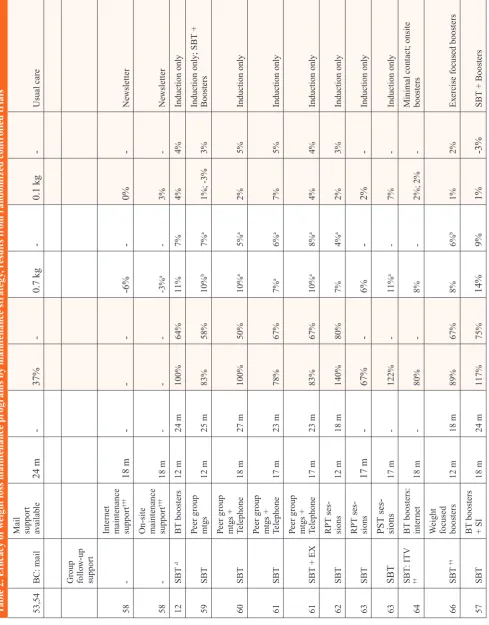
Group follow-up support Group follow-up support has been explored after weight loss induction via medication, group behavioral therapy, and very-low-calorie diets. It has additionally been provided to support weight regain prevention among successful weight loss maintainers, that is, individuals that had lost and successfully maintained > 10% weight reductions for at least 1 year. Compared to induction only or usual maintenance care, the trend in all trials was for group follow-up support to enhance weight loss maintenance outcomes at both program completion and thereafter.12,57–65
T
ab
le 2
. E
ffi
ca
cy o
f w
ei
gh
t l
os
s m
ai
nt
en
an
ce p
ro
gr
am
s b
y m
ai
nt
en
an
ce s
tr
at
eg
y, r
es
u
lt
s f
ro
m r
an
do
m
iz
ed c
on
tr
ol
le
d t
ri
al
s
Ref. Induction
Maintenance
Study end points
% Initial
WL main
-tained
%
W
eight reduction
§
Net ef
fect on % w
eight reduction
§§
Post- Mainte
-nance
Follo
w-up
Post- Mainte
-nance
Follo
w-up
Post- Mainte
-nance
Follo
w-up
Post-Mainte
-nance
Follo
w-up
Comparison study g
roup
Sequential medication
38
Diet + BC
†
Orlistat + eucaloric diet + BC
18 m
-73%
-8%
a
-2%
c
-Maintenance placebo
39
Diet
††
Orlistat + eucaloric diet
25 m
-117%
-7%
a
-3%
c
-Maintenance placebo
40
VLCD + DC
†
Sib + DC
13 m
16 m
163%
113%
13%
a
9%
6%
c
4%
Maintenance placebo
41
VLCD + DC
†
Sib + DC
21 m
-67%
-10%
a
-3%
-Maintenance placebo
42
VLCD + BC
†
Sib + BC
38 m
-62%
-8%
a
-2%
-Maintenance placebo
43
Sib + Diet
†
Sib
24 m
-75%
-9%
a
-4%
c
-Maintenance placebo
44
Sib + MR + BC
†
Sib
+
LCD/1
MR/da
y +
BC
12 m
-138%
-11%
a
-6%
c
-Maintenance placebo
29
Orlistat + Diet + BC
††
Orlistat + BC
25 m
-89%
-8%
a, b
-3%; 3%
-Maintenance placebo & half dose
29
Orlistat + Diet + BC
††
Orlistat (half dose) + BC
25 m
-56%
-5%
-0%
-Maintenance placebo
45
Sib + LCD + SBT
Sib + Or
-listat + BC
16 m
-100%
-13%
-1%
-Maintenance orlistat placebo
Sequential dieting
12
SBT
Optional food pro
vi
-sion
18 m
-68%
-9.0 kg
--0.2 kg
-Induction onl
T
ab
le 2
. E
ffi
ca
cy o
f w
ei
gh
t l
os
s m
ai
nt
en
an
ce p
ro
gr
am
s b
y m
ai
nt
en
an
ce s
tr
at
eg
y, r
es
u
lt
s f
ro
m r
an
do
m
iz
ed c
on
tr
ol
le
d t
ri
al
s
46
VLCD + SBT LC + BT boosters
9 m
-100%
-19%
-0%
-LF instead of LC mainte
-nance
47
VLCD + SBT
††
MR + BT boosters
12 m
-90%
-19%
-1%
-Orlistat instead of MR main
-tenance
48
VLCD + SBT
†
MR, sched
-uled refeed
-ing + BT Boosters
12 m
21 m
100%
40%
15%
6%
0
2%
LCD instead of MR main
-tenance
48
VLCD + SBT
†
MR, sched
-uled refeed
-ing + BT Boosters
12 m
21 m
87%
20%
13%
3%
-2%
-3%
Refeeding based on w
eight
Indi
vidual
follo
w-up
suppor
t
55
CBT
Telephone suppor
t
21 m
-114%
-8%
-5%
-Induction onl
y
53, 54
BC: tele
-phone
Telephone suppor
t
av
ailab
le
24 m
-42%
-1 kg
-0.4 kg
-Usual care
49
Non-BT (group diet counsel
-ing)
Telephone & mail suppor
t
10 m
16 m
80%
70%
8%
a
7%
3%
3%
Induction onl
y
12
SBT
Telephone suppor
t,
non-thera
-pist
18 m
-73%
-9.3 kg
-0.7 kg
-Induction onl
y
49
SBT
Telephone & mail suppor
t
10 m
16 m
100%
70%
10%
7%
1%
-1%
Induction onl
y
49
SBT & RPT Telephone & mail suppor
t
10 m
16 m
92%
92%
12%
a
12%
a
7%
8%
Induction onl
y
50
SBT
†
Telephone suppor
t
36 m
-44%
-4%
a, b
-2%
c; 2%
-Self-directed; interacti
ve
w
ebsite
56
SBT + PST
,
stepped care PST stepped care, onsite
12 m
18 m
100%
50%
8%
4%
2%
0%
SBT induction onl
T ab le 2 . E ffi ca cy o f w ei gh t l os s m ai nt en an ce p ro gr am s b y m ai nt en an ce s tr at eg y, r es u lt s f ro m r an do m iz ed c on tr ol le d t ri al s 53,54 BC: mail
Mail suppor
t av ailab le 24 m -37% -0.7 kg -0.1 kg -Usual care
Group follo
w-up suppor t 58 -Inter net
maintenance suppor
t ††† 18 m --6% -0% -Ne wsletter 58
-On-site maintenance suppor
t ††† 18 m --3% a -3% -Ne wsletter 12 SBT d BT boosters 12 m 24 m 100% 64% 11% 7% 4% 4% Induction onl y 59 SBT Peer g roup mtgs 12 m 25 m 83% 58% 10% b 7% a 1%; -3% 3% Induction onl
y; SBT +
Boosters
60
SBT
Peer g
roup
mtgs + Telephone
18 m 27 m 100% 50% 10% a 5% a 2% 5% Induction onl y 61 SBT Peer g roup
mtgs + Telephone
17 m 23 m 78% 67% 7% a 6% a 7% 5% Induction onl y 61
SBT + EX
Peer g
roup
mtgs + Telephone
17 m 23 m 83% 67% 10% a 8% a 4% 4% Induction onl y 62 SBT RPT ses -sions 12 m 18 m 140% 80% 7% 4% a 2% 3% Induction onl y 63 SBT RPT ses -sions 17 m -67% -6% -2% -Induction onl y 63 SBT PST ses -sions 17 m -122% -11% a -7% -Induction onl y 64 SBT : ITV ††
BT boosters: inter
net 18 m -80% -8% -2%; 2%
-Minimal contact; onsite boosters
66
SBT
††
W
eight
focused boosters
12 m 18 m 89% 67% 8% 6% b 1% 2% Ex
ercise focused boosters
57
SBT
BT boosters + SI
18 m 24 m 117% 75% 14% 9% 1% -3%
T ab le 2 . E ffi ca cy o f w ei gh t l os s m ai nt en an ce p ro gr am s b y m ai nt en an ce s tr at eg y, r es u lt s f ro m r an do m iz ed c on tr ol le d t ri al s 57 SBT
BT boosters + EX
18 m 24 m 100% 71% 14% 10% 0% -2%
SBT + Boosters
57
SBT
BT boosters + EX + SI
18 m 24 m 114% 100% 16% 14% 3% 2%
SBT + Boosters
67
VLCD + DC
†† W alking 2-3 hrs/wk + DC 12 m 36 m 107% 60% 16% 9% 3%; 0% 4%
DC maintenance; w
alking
4-6hrs/wk
68
VLCD + DC
†† W eights + DC 8 m 31 m 100% 43% 14% 6% 1%; 2% 1%
DC maintenance; w
alking
90min/wk
65
Orlistat
††
BT + euca
-loric diet 12 m -100% -4% a -3%
-Maintenance usual care
Abbre
viations: LCD
, lo
w-calorie diet; MR, meal replacement diet; DC, re
gular dietician contact; BC, indi
vidual, re
gularl
y scheduled beha
vioral counseling b
y a thera
-pist; VLCD , v er y-lo
w-calorie diet; Sib, sib
utramine; SBT
, standard beha
vioral therap
y; RPT
, relapse pre
vention training; PST
, prob
lem solving training; Ex, e
xercise; SI,
social influence; ITV
, interacti ve tele vision; CBT , co gniti ve beha vioral therap y. §: A verage w
eight change from pre-induction w
eight; calculated as necessar
y from baseline w
eight and repor
ted w
eight lost (kg).
§§: Group dif
ference in % w
eight reduction
†: Non-randomized lead-in induction pro
gram. P
ar
ticipants required to ha
ve lost set amount of w
eight to be eligib
le for randomization to maintenance therap
y.
††: Non-randomized lead-in induction pro
gram. No w
eight loss requirements for randomization to maintenance therap
y.
†††: Randomization of successful w
eight loss maintainers w
ho had lost more than 10% body w
eight and already maintained w
eight loss for > 1 y
ear
.
a: Statisticall
y significant g
roup dif
ferences in w
eight change (kg or %) from the point of randomization betw
een inter
vention and placebo, induction onl
y or minimal
maintenance contact control g
roup.
b: Statisticall
y significant g
roup dif
ferences in w
eight change (kg or %) from the point of randomization betw
een inter
vention g
roups.
c: Statisticall
y significant net ef
fect (kg or %) betw
een inter
vention and control g
roup.
d: Based on a re
vie
w of 18 study g
roups.
significance in six of the 11 study groups identified (P > 0.05 for group differences in weight change). In these studies, end-of-program weight reductions averaged 2–7% greater for those receiving group-based maintenance support compared to no support. Peer group meetings with individualized therapist contact60,61 and
problem-solving training63 produced the
greatest benefit over usual care, although behavioral therapy booster meetings were also effective.12 Programs of
com-parable duration have yet to determine the relative efficacy of these programs for supporting weight regain prevention.
Maintenance programs based on relapse prevention training and peer group meetings produced a delayed benefit.59.62 Although no effect was
demonstrated at program completion, 6–12 months later, weight reductions were significantly greater among those who previously received maintenance support than among those who had not. A weight-focused maintenance program similarly produced a delayed benefit over an exercise-focused main-tenance program.66
Internet delivery of group follow-up support has yet to be validated in the literature. In one trial, Internet-based booster meetings delivered via Internet chatrooms appeared to enhance weight loss maintenance outcomes compared to a minimal contact and an onsite booster group.64 Group differences
did not reach statistical significance, however. In another trial, group-based Internet support offered to successful weight losers effectively decreased the proportion of participants who regained weight; however, only onsite support proved effective for minimiz-ing the amount of weight regained compared to a newsletter control group (P < 0.05).58
The utility of supplemental exer-cise programming during group-based maintenance support has been assessed in three trials.57,67,68 In each of these
exercise was introduced as a key strat-egy for weight loss maintenance. In addition to group-based maintenance support, participants in these pro-grams were encouraged to meet energy expenditure goals via participation in supervised and independent exercise programs. Exercise expenditure goals were moderate in nature (1,000 kcal/ week) and focused on walking, cycling, and/or weight resistance training. Although the trend was for supplemen-tal exercise programming to enhance weight loss maintenance outcomes compared to nonsupplemented main-tenance support, group differences did not reach statistical significance in any study.
Given the likelihood of rapid weight regain after medication discontinua-tion and the desire of many patients to not use weight loss medications indefinitely, there is a need to identify maintenance programs to be used after medication discontinuation. One trial has addressed this ques-tion.65 Compared to usual maintenance
care, group follow-up support after pharmacological treatment of obesity enhanced weight loss maintenance outcomes at program completion (P < 0.05); weight reductions averaged 3% greater for those who received group follow-up support compared to usual maintenance care.65 Moreover,
100% of initial weight losses were maintained by those receiving group-based follow-up support.
The trials identified in this review appear to support the assertion that continued therapy, be it based on maintenance-phase medication, sequential dieting with group follow-up support, individualized telephone sup-port, or group-based follow-up supsup-port, is effective for slowing or delaying weight regain. Only one program identified—telephone support after relapse prevention training—supported weight regain prevention during the life of the maintenance program and new weight stabilization thereafter.
The long-term efficacy of other seemingly effective weight regain prevention programs, such as group-based problem solving training or sequential medication, is uncertain, because follow-up data have not been reported. Preliminary evidence, how-ever, suggests that rapid regain occurs after discontinuation of maintenance medication.
In terms of relative efficacy of maintenance approaches, research is limited. One trial demonstrated that within the context of a multi-compo-nent program, sequential dieting with an MR was as effective as sequential medication for supporting weight regain prevention. Further research on the relative efficacy of maintenance approaches for supporting weight regain prevention and new weight stabilization are needed.
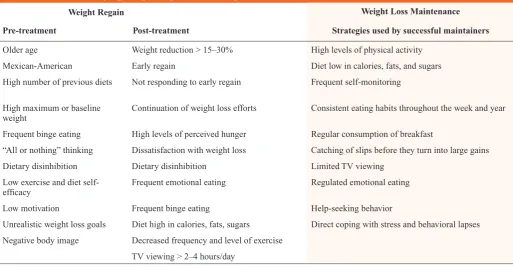
Factors Underlying Weight Regain and Weight Loss Maintenance Some individuals are better able than others to maintain weight losses. Factors underlying weight regain and weight loss maintenance have been identified, and the former can be classified along a time axis (Table 3). Factors are clinical, psychological, and behavioral in nature.
Weight regain
Pre-treatment indicators of future weight regain include older age;69
Mexican-American ethnicity;70 frequent previous
diet attempts;71,72 high baseline or
maxi-mum weight;73–75 nonmedical triggers for
weight loss induction;76 binge eating;77
dietary disinhibition (loss of control while eating);77,78 “all or nothing”
think-ing;79 perceived barriers to exercise,
including “too tired,” “too hard,” “not enough time,” and “no companion”; per-ceived barriers to diet, including “high cost of healthy foods” and “eating away from home too often”;19,20 and lacking
self-efficacy, motivation, realistic weight loss goals, and a strong body image.80
Post-weight loss indicators of weight regain include weight loss
> 15–30% of baseline weight;14,81
early regain;82 not responding to
early regain;78 perceptions of
hun-ger;83 dissatisfaction with achieved
weight loss;80 dietary disinhibition;81
emotional eating;78 binge eating;
consuming a diet high in calories, fats, and sugars;14 frequent consumption of
fast food (> 2–3 times per week);20 a
sedentary lifestyle or decreased fre-quency and level of physical activity;14
and viewing more than 2–4 hours of television a day.14 Although somewhat
counterintuitive, continuation of weight loss efforts is also associated with weight regain.16,73
Weight loss maintenance
Studies of the NWCR of successful weight loss maintainers provide insight into the transient course of successful weight loss maintenance. Among suc-cessful weight loss maintainers, modest weight regain and weight fluctuations are common, and recovery from regain > 2.6 kg is difficult.81,84 During the
first years of weight loss maintenance, continued effort and attention to weight control is essential. By 2 years, how-ever, maintainers report less reliance on weight loss strategies and reduced attention and effort to weight control, perhaps reflecting new habit assimila-tion.85 Furthermore, maintenance of
weight loss for ≥ 2 years is protective against subsequent regain; by 2 years the likelihood of regaining 2.6 kg in the coming year is only 50%; by 5 years the likelihood drops to 27%.81 Evidence
from the NHANES survey similarly supported the contention that among successful weight loss maintainers, years from maximal weight loss is protective against weight regain.14
Studies of the NWCR identify eight behavioral strategies important for weight loss maintenance.21,77,86 These
maintaining a consistent eating pattern throughout the week and year; reign-ing in emotional eatreign-ing; frequently monitoring weight; and catching slips before they turn into large-scale weight gains. A Consumer Reports survey additionally identified direct coping, (i.e. with stress and lapses in behavior) as opposed to avoidance or emotional eating and help-seeking as important behaviors for successful weight loss maintenance.18
Clinical Implications
The obesity literature has identified numerous weight loss induction pro-grams that are effective at inducing clinically significant levels of weight loss. Diet and exercise, low-calorie diets, meal replacement, behavioral therapy, and pharmacological agents are generally effective at inducing 8–10% weight reductions by 6 months. VLCDs have demonstrated the capacity to induce even larger weight losses. For all programs, maximal weight loss occurs in the first 6 months of therapy. For all nonpharmacological programs, weight
regain begins shortly thereafter. On average, weight losses at 2 years range between 3 and 6% for nonpharmacologi-cal therapies and between 7and 8% for pharmacological therapies. For individu-als at risk, these outcomes are within the range known to induce improvements in cardiovascular risk factors and prevent type 2 diabetes.2,3
Weight loss maintenance programs identified in this review demonstrate that sequential medication use and individual and group follow-up support are effective for improving weight loss maintenance outcomes, predomi-nantly by slowing the pattern of weight regain. Only one program, telephone contact after relapse prevention train-ing, produced clinically significant benefits that were sustained well after discontinuation of maintenance contact. Although the ideal outcome of weight loss maintenance programs would be new weight stabilization, delayed onset of weight regain is a second-best outcome. The cardiovas-cular and metabolic health benefits associated with weight reduction
accrue in a dose-dependent fashion. Noncurative therapies are streamlined into the treatment of hypertension and dyslipidemia; acceptance of continuous models of care for obesity may also be necessary.12
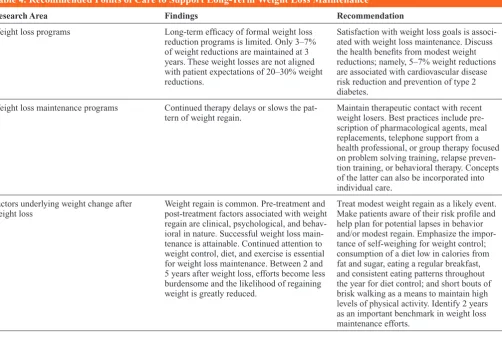
Potential points of care to support weight regain prevention are high-lighted in Table 4. Patients often expect to lose 20–30% of body weight.87–89 On
average, patients are only achieving half of this goal and are not sustaining it for much longer than 6 months. The impact of unrealistic weight loss goals on weight loss maintenance is uncer-tain.80.87.89–92 Satisfaction with weight
loss attained, however, predicts weight loss maintenance success.79,92,93 Patient
education on the health benefits from modest weight reductions may serve to promote patient satisfaction with weight loss achieved, and in turn, sup-port weight loss maintenance.
Presenting the phenomenon of weight regain as a likely event in the course of weight loss maintenance may also support weight loss mainte-nance. Those at greater risk of weight Table 3. Factors Underlying Weight Regain After Weight Loss
Weight Loss Maintenance
Pre-treatment Post-treatment Strategies used by successful maintainers
Older age Weight reduction > 15–30% High levels of physical activity
Mexican-American Early regain Diet low in calories, fats, and sugars
High number of previous diets Not responding to early regain Frequent self-monitoring
High maximum or baseline
weight Continuation of weight loss efforts Consistent eating habits throughout the week and year
Frequent binge eating High levels of perceived hunger Regular consumption of breakfast
“All or nothing” thinking Dissatisfaction with weight loss Catching of slips before they turn into large gains
Dietary disinhibition Dietary disinhibition Limited TV viewing
Low exercise and diet
self-efficacy Frequent emotional eating Regulated emotional eating
Low motivation Frequent binge eating Help-seeking behavior
Unrealistic weight loss goals Diet high in calories, fats, sugars Direct coping with stress and behavioral lapses
Negative body image Decreased frequency and level of exercise
TV viewing > 2–4 hours/day
regain—those who lost a large amount of weight initially, have a history of dieting, are older, are not exercising, and tend to eat in response to their emotions—should be made aware of their risk profile and encouraged to seek help when behavior reversion or early regains occur. It may be neces-sary to emphasize that, although they are no longer dieting per se, continued attention to weight, diet, and exercise is essential for successful weight loss maintenance. Given that the risk of regain declines with time, 2–5 years should be presented as a benchmark for successful weight loss maintenance.
In support of patient efforts, physi-cians should emphasize the importance of weight control, diet, and exercise. The NWCR and the Stop Regain program demonstrate that frequent self-weighing is associated with weight
loss maintenance.21,58 Moreover, a
decline in the frequency of self-weigh-ing is independently associated with weight regain.94 Self-weighing whether
daily or weekly enables pattern rec-ognition, provides an opportunity for positive reinforcement, and is thought to promote self-regulation of behav-ior. Although some have expressed concerns that self-weighing may negatively affect the psyche, a follow-up study to the Stop Regain program found that frequency of self-weighing was actually associated with a decline in depressive symptoms, increased dietary restraint, and decreased dietary disinhibition.95
A balanced and consistent diet is essential for weight loss maintenance. In support of good habit formation, diets should obtain limited calories from fat and sugar,17,21 and be
consis-tent throughout the day, week, and year.21 Often, successful weight losers
report consuming less variety in all food groups with the exception of fruits.96 However, flexible control, as
opposed to rigid diet restriction of cer-tain food groups, is recommended as a means to support weight loss mainte-nance.97 Other dietary strategies used
by successful weight loss maintainers include self-recording of intake, plan-ning meals, regulating portion size, consuming more than five servings of fruits and vegetables a day, and limit-ing intake of fast food.19,20,28
Exercise is central to weight loss maintenance. Correlational studies demonstrate that frequent exercisers are more likely to maintain weight losses. Randomized control trials sup-port this finding as well.98–100 Although
the Centers for Disease Control and
Table 4. Recommended Points of Care to Support Long-Term Weight Loss Maintenance
Research Area Findings Recommendation
Weight loss programs Long-term efficacy of formal weight loss
reduction programs is limited. Only 3–7% of weight reductions are maintained at 3 years. These weight losses are not aligned with patient expectations of 20–30% weight reductions.
Satisfaction with weight loss goals is associ-ated with weight loss maintenance. Discuss the health benefits from modest weight reductions; namely, 5–7% weight reductions are associated with cardiovascular disease risk reduction and prevention of type 2 diabetes.
Weight loss maintenance programs Continued therapy delays or slows the
pat-tern of weight regain. Maintain therapeutic contact with recent weight losers. Best practices include pre-scription of pharmacological agents, meal replacements, telephone support from a health professional, or group therapy focused on problem solving training, relapse preven-tion training, or behavioral therapy. Concepts of the latter can also be incorporated into individual care.
Factors underlying weight change after
weight loss Weight regain is common. Pre-treatment and post-treatment factors associated with weight regain are clinical, psychological, and behav-ioral in nature. Successful weight loss main-tenance is attainable. Continued attention to weight control, diet, and exercise is essential for weight loss maintenance. Between 2 and 5 years after weight loss, efforts become less burdensome and the likelihood of regaining weight is greatly reduced.
Prevention recommends 150 minutes/ week for weight control.101 studies of
successful weight loss maintainers suggest that higher levels of physical activity are necessary for weight regain prevention. The American College of Sports Medicine recommends 60–90 minutes of moderate activity per day.102
Exercise prescriptions do not have to be daunting. The relationship between activity levels and weight loss maintenance appears to be dose-dependent.99,103,104 Randomized trials
suggest that total energy expendi-ture and not intensity or duration of physical activity is most important for weight loss maintenance.104,105
Home-based exercise programs with or without the provision of home exercise equipment and/or focusing on short bouts of exercise are more effective for improving exercise adherence than is supervised group exercise, provid-ing personal trainers, or emphasizprovid-ing long bouts of exercise.12,106 Moreover,
brisk walking is the most common form of exercise reported by success-ful weight loss maintainers in the NWCR,21,107 and research shows that
an increase in leisure activity and steps per day are associated with weight loss maintenance.19,108,109 Moderate
physical activity achieved through lifestyle activity, intermittent bouts of exercise, and increased steps taken per day are easy recommendations for exercise adherence and weight loss maintenance.105
Much attention in the literature has been given to identifying effective treatments for obesity. The strength of the present review is its focus on weight regain prevention and analysis of data from randomized controlled trials. It is limited by the fact that the review was nonexhaustive and based on reported and calculated data, including the use of arithmetic mean group differences to define net effect. Nonetheless, the review provides an important overview of the weight regain phenomenon and identifies
translatable points of care for primary care physicians.
Conclusion
Long-term maintenance of weight loss is an important, but often elusive, goal.
Evidence from this review and others cited in the literature find that continued therapy from a health professional is essential for weight loss maintenance success. In support of weight loss maintenance, physician-patient interactions should include a discussion of patient goals, the weight regain phenomenon, decision points in self-care and help-seeking behavior, and conclude with advice about self-monitoring, diet, and exercise.
REFERENCES
1Ogden CL, Yanovski SZ, Carroll MD,
Flegal KM: The epidemiology of obesity.
Gastroenterol 132:2087–2102, 2007
2Knowler WC, Barrett-Connor E, Fowler
SE, et al.: Reduction in the incidence of type 2 diabetes with lifestyle intervention or met-formin. N Engl J Med 346:393–403, 2002
3Pi-Sunyer FX: A review of long-term
studies evaluating the efficacy of weight loss in ameliorating disorders associated with obesity.
Clin Ther 18:1006–1035; discussion 1005, 1996
4Shepherd TM: Effective management of
obesity. J Fam Pract 52:34–42, 2003
5Shaw K, Gennat H, O’Rourke P, Del Mar
C: Exercise for overweight or obesity. Cochrane
Database Syst Rev CD003817, 2006
6Shaw K, O’Rourke P, Del Mar C, Kenardy
J:. Psychological interventions for overweight or obesity. Cochrane Database Syst Rev
CD003818, 2005
7Orzano AJ, Scott JG: Diagnosis and
treatment of obesity in adults: an applied evidence-based review. J Am Board Fam Pract
17:359–369, 2004
8O’Meara S, Riemsma R, Shirran L, Mather
L, ter Riet G: A systematic review of the clinical effectiveness of orlistat used for the manage-ment of obesity. Obes Rev 5:51–68, 2004
9Rucker D, Padwal R, Li SK, Curioni C, Lau
DC: Long-term pharmacotherapy for obesity and overweight: updated meta-analysis. BMJ
335:1194–1199, 2007
10Ayyad C, Andersen T: Long-term efficacy
of dietary treatment of obesity: a systematic review of studies published between 1931 and 1999. Obes Rev 1:113–119, 2000
11Saris WH: Very-low-calorie diets and
sustained weight loss. Obes Res 9 (Suppl. 4):295S–301S, 2001
12Perri MG: Improving the maintenance of
weight lost in behavioral treatment of obesity. In
Handbook of Obesity Treatment. Wadden TA,
ed. New York, Guilford Press, 2002, p. 357–379
13McGuire MT, Wing RR, Hill JO: The
prevalence of weight loss maintenance among American adults. Int J Obes Relat Metab Disord
23:1314–1319, 1999
14Weiss EC, Galuska DA, Kettel Khan L,
Gillespie C, Serdula MK: Weight regain in U.S. adults who experienced substantial weight loss, 1999–2002. Am J Prev Med 33:34–40, 2007
15Lowe MR, Miller-Kovach K, Phelan
S: Weight-loss maintenance in overweight individuals one to five years following suc-cessful completion of a commercial weight loss program. Int J Obes Relat Metab Disord
25:325–331, 2001
16Wadden TA, Frey DL: A multicenter
evaluation of a proprietary weight loss program for the treatment of marked obesity: a five-year follow-up. Int J Eat Disord 22:203–212, 1997
17Weiss EC, Galuska DA, Khan LK, Serdula
MK: Weight-control practices among U.S. adults, 2001–2002. Am J Prev Med 31:18–24, 2006
18Dohm FA, Beattie JA, Aibel C,
Striegel-Moore RH: Factors differentiating women and men who successfully maintain weight loss from women and men who do not. J Clin Psychol
57:105–117, 2001
19Kruger J, Blanck HM, Gillespie C: Dietary
and physical activity behaviors among adults successful at weight loss maintenance. Int J
Behav Nutr Phys Act 3:17, 2006.
20Kruger J, Blanck HM, Gillespie C: Dietary
practices, dining out behavior, and physical activity correlates of weight loss maintenance [Abstract]. Prev Chronic Dis 5:A11, 2008
21Wing RR, Phelan S: Long-term weight
loss maintenance. Am J Clin Nutr 82 (1 Suppl.):222S–225S, 2005
22Franz MJ, VanWormer JJ, Crain AL,
Boucher JL, Histon T, Caplan W, Bowman JD, Pronk NP. Weight-loss outcomes: a systematic review and meta-analysis of weight-loss clinical trials with a minimum 1-year follow-up. J Am
Diet Assoc 107:1755–1767, 2007
23Wadden TA, Crerand CE, Brock J:
Behavioral treatment of obesity. Psychiatr Clin
North Am 28:151–170, ix, 2005
24Douketis JD, Macie C, Thabane L,
Williamson DF: Systematic review of long-term weight loss studies in obese adults: clinical sig-nificance and applicability to clinical practice.
Int J Obes (Lond) 29:1153–1167, 2005
25Dansinger ML, Tatsioni A, Wong JB,
Chung M, Balk EM: Meta-analysis: the effect of dietary counseling for weight loss. Ann Intern Med 147:41–50, 2007
26Gilden Tsai A, Wadden TA: The evolution
of very-low-calorie diets: an update and meta-analysis. Obesity (Silver Spring) 14:1283–1293, 2006
27Strychar I: Diet in the management of
weight loss. CMAJ 174:56–63, 2006
28Tangney CC, Gustashaw KA, Stefan TM,
29Davidson MH, Hauptman J, DiGirolamo
M, Foreyt JP, Halsted CH, Heber D. Weight con-trol and risk factor reduction in obese subjects treated for 2 years with orlistat: a randomized controlled trial. JAMA 281:235–242, 1999
30Heymsfield SB, van Mierlo CA, van der
Knaap HC, Heo M, Frier HI: Weight manage-ment using a meal replacemanage-ment strategy: meta and pooling analysis from six studies. Int J Obes
Relat Metab Disord 27:537–549, 2003
31National Institutes of Health: Clinical
guidelines on the identification, evaluation, and treatment of overweight and obesity in adults: the evidence report. Obes Res 6 (Suppl. 2):51S–209S, 1998
32Anderson JW, Konz EC, Frederich RC,
Wood CL: Long-term weight-loss maintenance: a meta-analysis of US studies. Am J Clin Nutr
74:579–584, 2001
33Tsai AG, Wadden TA, Womble LG,
Byrne KJ: Commercial and self-help programs for weight control. Psychiatr Clin North Am
28:171–192, ix, 2005
34Heshka S, Anderson JW, Atkinson RL, et
al. Weight loss with self-help compared with a structured commercial program: a randomized trial. JAMA 289:1792–1798, 2003
35Djuric Z, DiLaura NM, Jenkins I, Darga
L, Jen CK, Mood D, Bradley E, Hryniuk WM. Combining weight-loss counseling with the weight watchers plan for obese breast cancer survivors. Obes Res 10:657–665, 2002
36Bray GA: Drug treatment of obesity.
Psychiatr Clin North Am 28:193–217, ix–x, 2005
37Wadden TA, Berkowitz RI, Sarwer DB,
Prus-Wisniewski R, Steinberg C: Benefits of lifestyle modification in the pharmacologic treatment of obesity: a randomized trial. Arch
Intern Med 161:218–227, 2001
38Hill JO, Hauptman J, Anderson JW, et al.
Orlistat, a lipase inhibitor, for weight mainte-nance after conventional dieting: a 1-y study. Am
J Clin Nutr 69:1108–1116, 1999
39Sjostrom L, Rissanen A, Andersen T,
Boldin M, Golay A, Koppeschaar H, Krempf M. Randomized placebo-controlled trial of orlistat for weight loss and prevention of weight regain in obese patients. Ter Arkh 72:50–54, 2000
40Apfelbaum M, Vague P, Ziegler O, Hanotin
C, Thomas F, Leutenegger E: Long-term main-tenance of weight loss after a very-low-calorie diet: a randomized blinded trial of the efficacy and tolerability of sibutramine. Am J Med
106:179–184, 1999
41Mathus-Vliegen EM: Long-term
mainte-nance of weight loss with sibutramine in a GP setting following a specialist guided very-low-calorie diet: a double-blind, placebo-controlled, parallel group study. Eur J Clin Nutr 59 (Suppl. 1):S31–S38; discussion S39, 2005
42Richelsen B, Tonstad S, Rossner S, et al.
Effect of orlistat on weight regain and cardiovas-cular risk factors following a very-low-energy diet in abdominally obese patients: a 3-year randomized, placebo-controlled study. Diabetes Care 30:27–32, 2007
43James WP, Astrup A, Finer N, Hilsted J,
Kopelman P, Rossner S., Sarris WH, Van Gaal LF. Effect of sibutramine on weight maintenance
after weight loss: a randomised trial. Lancet
356:2119–2125, 2000
44Early JL, Apovian CM, Aronne LJ,
Fenstrom MH, Frank A. Sibutramine plus meal replacement therapy for body weight loss and maintenance in obese patients. Obesity (Silver
Spring) 15:1464–1472, 2007
45Wadden TA, Berkowitz RI, Womble LG,
Sarwer DB, Arnold ME, Steinberg CM: Effects of sibutramine plus orlistat in obese women fol-lowing 1 year of treatment by sibutramine alone: a placebo-controlled trial. Obes Res 8:431–437, 2000
46Lecheminant JD, Gibson CA, Sullivan DK,
et al. Comparison of a low carbohydrate and low fat diet for weight maintenance in overweight or obese adults enrolled in a clinical weight management program. Nutr J 6:36, 2007
47LeCheminant JD, Jacobsen DJ, Hall MA,
Donnelly JE: A comparison of meal replace-ments and medication in weight maintenance after weight loss. J Am Coll Nutr 24:347–353, 2005
48Agras WS, Berkowitz RI, Arnow BA,
Telch CF, Marnell M, Henderson J, Morris Y, Wilfley DE. Maintenance following a very-low-calorie diet. J Consult Clin Psychol 64:610–613, 1996
49Perri MG, Shapiro RM, Ludwig WW,
Twentyman CT, McAdoo WG: Maintenance strategies for the treatment of obesity: an evaluation of relapse prevention training and posttreatment contact by mail and telephone. J
Consult Clin Psychol. 52:404–413, 1984
50Svetkey LP, Stevens VJ, Brantley PJ, Appel
LJ, Hollis JF, Loria CM. Comparison of strate-gies for sustaining weight loss: the weight loss maintenance randomized controlled trial. JAMA
299:1139–1148, 2008
51Marlatt GA, George WH: Relapse
preven-tion: introduction and overview of the model. Br
J Addict 79:261–273, 1984
52Larimer ME, Palmer RS, Marlatt GA:
Relapse prevention: an overview of Marlatt’s cognitive-behavioral model. Alcohol Res Health
23:151–160, 1999
53Jeffery RW, Sherwood NE, Brelje K,
Pronk NP, Boyle R, Boucher JL, Hase K. Mail and phone interventions for weight loss in a managed-care setting: Weigh-To-Be one-year outcomes. Int J Obes Relat Metab Disord
27:1584–1592, 2003
54Sherwood NE, Jeffery RW, Pronk NP,
Boucher JL, Hansen A, Boyle R. Mail and phone interventions for weight loss in a managed-care setting: weigh-to-be 2-year outcomes. Int J Obes
(Lond) 30:1565–1573, 2006
55Leibbrand R, Fichter MM: Maintenance of
weight loss after obesity treatment: is con-tinuous support necessary? Behav Res Ther
40:1275–1289, 2002
56Carels RA, Darby L, Cacciapaglia HM,
et al. Applying a stepped-care approach to the treatment of obesity. J Psychosom Res
59:375–383, 2005
57Perri MG, McAllister DA, Gange JJ,
Jordan RC, McAdoo G, Nezu AM: Effects of four maintenance programs on the long-term
management of obesity. J Consult Clin Psychol
56:529–534, 1988
58Wing RR, Tate DF, Gorin AA, Raynor
HA, Fava JL: A self-regulation program for maintenance of weight loss. N Engl J Med
355:1563–1571, 2006
59Perri MG, McAdoo WG, McAllister DA,
Lauer JB, Jordan RC, Yancey DZ, Nezu AM. Effects of peer support and therapist contact on long-term weight loss. J Consult Clin Psychol
55:615–617, 1987
60Perri MG, McAdoo WG, Spevak PA,
Newlin DB: Effect of a multicomponent main-tenance program on long-term weight loss. J
Consult Clin Psychol 52:480–481, 1984
61Perri MG, McAdoo WG, McAllister DA,
Lauer JB, Yancey DZ: Enhancing the efficacy of behavior therapy for obesity: effects of aerobic exercise and a multicomponent maintenance program. J Consult Clin Psychol 54:670–675, 1986
62Baum JG, Clark HB, Sandler J: Preventing
relapse in obesity through posttreatment main-tenance systems: comparing the relative efficacy of two levels of therapist support. J Behav Med
14:287–302, 1991
63Perri MG, Nezu AM, McKelvey WF,
Shermer RL, Renjilian DA, Viegener BJ: Relapse prevention training and problem-solving therapy in the long-term management of obesity.
J Consult Clin Psychol 69:722–726, 2001
64Harvey-Berino J, Pintauro S, Buzzell
P, Gold EC: Effect of internet support on the long-term maintenance of weight loss. Obes Res
12:320–329, 2004
65Woo J, Sea MM, Tong P, Ko GT, Lee Z,
Chan J, Chow FC. Effectiveness of a lifestyle modification programme in weight maintenance in obese subjects after cessation of treatment with Orlistat. J Eval Clin Pract 13:853–859, 2007
66Leermakers EA, Perri MG, Shigaki CL,
Fuller PR: Effects of exercise-focused ver-sus weight-focused maintenance programs on the management of obesity. Addict Behav
24:219–227, 1999
67Fogelholm M, Kukkonen-Harjula K,
Nenonen A, Pasanen M: Effects of walking training on weight maintenance after a very-low-energy diet in premenopausal obese women: a randomized controlled trial. Arch Intern Med
160:2177–2184, 2000
68Borg P, Kukkonen-Harjula K, Fogelholm
M, Pasanen M: Effects of walking or resistance training on weight loss maintenance in obese, middle-aged men: a randomized trial. Int J Obes
Relat Metab Disord 26:676–683, 2002
69Hansen D, Astrup A, Toubro S, et al.
Predictors of weight loss and maintenance during 2 years of treatment by sibutramine in obesity. Results from the European multi-centre STORM trial. Int J Obes Relat Metab Disord
25:496–501, 2001
70Weiss EC GD, Khan LK, Gillespie C,
Serdula MK: Weight regain in U.S. adults who experienced substantial weight loss, 1999-2002.
71Passman WJ SW, Westerterp-Plantenga
MS: Predictors of weight maintenance. Obes Res 7:43–50, 1999
72Texiera PJ GS, Houtkooper LB, Cussler
EC, et al.: Pretreatment predictors of attrition and successful weight management in women.
Int J Obes 28:1124–1133, 2004
73Lavery MA Identifying predictive
variables for long-term weight change after par-ticipation in a weight loss program. J Am Diet
Assoc 93:1017–1018, 1993
74Hansen D AA, Tourbro S, Finer N, et al,
for the Storm Study Group: Predictors of weight loss and maintenance during 2 years of treat-ment by sibutramine in obesity. Results from the European multi-centre STORM trial. Int J Obes
Relat Metab Disord 25:496–501, 2001
75Byrne SM CZ, Fairburn CG: Psychological
predictors of weight regain in obesity. Behav Res Ther 42:1341–1356, 2004
76Gorin AA, Phelan S, Hill JO, Wing RR:
Medical triggers are associated with better short- and long-term weight loss outcomes. Prev Med 39:612–616, 2004
77Niemeier HM, Phelan S, Fava JL, Wing
RR: Internal disinhibition predicts weight regain following weight loss and weight loss mainte-nance. Obesity (Silver Spring)15:2485–2494, 2007
78Lavery MA, Loewy JW: Identifying
predictive variables for long-term weight change after participation in a weight loss program. J
Am Diet Assoc 93:1017–1024, 1993
79Byrne SM, Cooper Z, Fairburn CG:
Psychological predictors of weight regain in obesity. Behav Res Ther 42:1341–1356, 2004
80Teixeira PJ, Going SB, Houtkooper
LB, Cussler EC, Metcalfe LL, Blew RM. Pretreatment predictors of attrition and success-ful weight management in women. Int J Obes
Relat Metab Disord 28:1124–1133, 2004
81McGuire MT, Wing RR, Klem ML, Lang
W, Hill JO: What predicts weight regain in a group of successful weight losers? J Consult
Clin Psychol 67:177–185, 1999
82Poston WS 2nd, Ericsson M, Linder J,
Nilsson T, Goodrick GK, Foreyt JP: Personality and the prediction of weight loss and relapse in the treatment of obesity. Int J Eat Disord
25:301–309, 1999
83Pasman WJ, Saris WH,
Westerterp-Plantenga MS: Predictors of weight maintenance. Obes Res 7:43–50, 1999
84Phelan S, Hill JO, Lang W, Dibello JR,
Wing RR: Recovery from relapse among suc-cessful weight maintainers. Am J Clin Nutr
78:1079–1084, 2003
85Klem ML, Wing RR, Lang W, McGuire
MT, Hill JO: Does weight loss maintenance become easier over time? Obes Res 8:438–444, 2000
86Raynor DA, Phelan S, Hill JO, Wing
RR: Television viewing and long-term weight maitenance: results from the National Weight Control Registry. Obesity (Silver Spring)
14:1816–1824, 2006
87Foster GD, Wadden TA, Vogt RA,
Brewer G: What is a reasonable weight loss? Patients’ expectations and evaluations of obesity treatment outcomes. J Consult Clin Psychol
65:79–85, 1997
88Jeffery RW, Wing RR, Mayer RR: Are
smaller weight losses or more achievable weight loss goals better in the long term for obese patients? J Consult Clin Psychol 66:641–645, 1998
89Linde JA, Jeffery RW, Finch EA, Ng
DM, Rothman AJ: Are unrealistic weight loss goals associated with outcomes for overweight women? Obes Res 12:569–576, 2004
90Cooper Z, Fairburn CG: A new cognitive
behavioural approach to the treatment of obesity.
Behav Res Ther 39:499–511, 2001
91Jeffery RW, Kelly KM, Rothman AJ,
Sherwood NE, Boutelle KN: The weight loss experience: a descriptive analysis. Ann Behav Med 27:100–106, 2004
92Finch EA, Linde JA, Jeffery RW, Rothman
AJ, King CM, Levy RL: The effects of outcome expectations and satisfaction on weight loss and maintenance: correlational and experimental analyses: a randomized trial. Health Psychol
24:608–616, 2005
93Foster GD, Phelan S, Wadden TA, Gill
D, Ermold J, Didie E: Promoting more mod-est weight losses: a pilot study. Obes Res
12:1271–1277, 2004
94Butryn ML, Phelan S, Hill JO, Wing RR:
Consistent self-monitoring of weight: a key com-ponent of successful weight loss maintenance.
Obesity (Silver Spring) 15:3091–3096, 2007
95Wing RR, Tate DF, Gorin AA, Raynor
HA, Fava JL, Machan J: STOP regain: are there negative effects of daily weighing? J Consult
Clin Psychol 75:652–656, 2007
96Raynor HA, Jeffery RW, Phelan S, Hill
JO, Wing RR: Amount of food group variety consumed in the diet and long-term weight loss maintenance. Obes Res 13:883–890, 2005
97Westenhoefer J, von Falck B, Stellfeldt A,
Fintelmann S: Behavioural correlates of suc-cessful weight reduction over 3 y. Results from the Lean Habits Study. Int J Obes Relat Metab
Disord 28:334-335, 2004
98Wing RR: Physical activity in the
treat-ment of the adulthood overweight and obesity: current evidence and research issues. Med Sci
Sports Exerc 31(11 Suppl.):S547–S552, 1999
99Hill JO, Wyatt HR: Role of physical
activ-ity in preventing and treating obesactiv-ity. J Appl
Physiol 99:765–770, 2005
100Catenacci VA, Wyatt HR: The role of
physical activity in producing and maintaining weight loss. Nat Clin Pract Endocrinol Metab
3:518-529, 2007
101Pate RR, Pratt M, Blair SN, Haskwell
WL, Macera CA, Bouchard C, Buchner D, Ettinger W, Heath GW, King AC. Physical activ-ity and public health: a recommendation from the Centers for Disease Control and Prevention and the American College of Sports Medicine.
JAMA 273:402-407, 1995
102Jakicic JM, Clark K, Coleman E, et al.,
American College of Sports Medicine position stand: appropriate intervention strategies for weight loss and prevention of weight regain for adults. Med Sci Sports Exerc 33:2145–2156, 2001
103Jakicic JM, Marcus BH, Gallagher KI,
Napolitano M, Lang W: Effect of exercise dura-tion and intensity on weight loss in overweight, sedentary women: a randomized trial. JAMA
290:1323–1330, 2003
104Jeffery RW, Wing RR, Sherwood NE,
Tate DF: Physical activity and weight loss: does prescribing higher physical activity goals improve outcome? Am J Clin Nutr 78:684–689, 2003
105Jakicic JM, Otto AD: Physical activity
recommendations in the treatment of obesity.
Psychiatr Clin North Am 28:141–150, ix, 2005
106Jakicic JM, Wing RR, Butler BA,
Robertson RJ: Prescribing exercise in multiple short bouts versus one continuous bout: effects on adherence, cardiorespiratory fitness, and weight loss in overweight women. Int J Obes
Relat Metab Disord 19:893–901, 1995
107Catenacci VA, Ogden LG, Stuht J, Phelan
S, Wing RR, Hill JO, Wyatt HR. Physical activity patterns in the National Weight Control Registry. Obesity (Silver Spring) 16:153–161, 2008
108Villanova N, Pasqui F, Burzacchini S,
et al. A physical activity program to reinforce weight maintenance following a behavior pro-gram in overweight/obese subjects. Int J Obes
(Lond) 30:697–703, 2006
109van Baak MA, van Mil E, Astrup AV,
Finer N, Van Gaal L, Hilsted J, Kopelman PG. Leisure-time activity is an important deter-minant of long-term weight maintenance after weight loss in the Sibutramine Trial on Obesity Reduction and Maintenance (STORM trial). Am
J Clin Nutr 78:209–214, 2003