2019 volume 36
Review Board 2019 Amanda Alexander University of Texas, Arlington Dan Barney
Brigham Young University Terry Barrett
University of North Texas Cala Coats
Arizona State University Tyler Denmead
University of Illinois, Urbana-Champaign Michelle Bae Dimitriadis
Buffalo State College Laura Hetrick
University of Illinois, Urbana-Champaign Lisa Hochtritt
Chicago Art Institute Ami Kantawala
Teachers College, Columbia University J. Celeste Kee
Boston University Dana Kletchka The Ohio State University Pamela Lawton
Virginia Commonwealth University
Maria Lim
University of North Carolina, Greensboro
Jorge Lucero
University of Ilinois, Urbana-Champaign
Mindi Rhoades The Ohio State University James Sanders III The Ohio State University Stacy Salazar MICA Shari Savage The Ohio State University Manisha Sharma University of Arizona Kryssi Staikidis Northern Illinois University Laura Trafí-Prats
University of Wisconsin, Milwaukee Sarah Travis
University of Illinois, Urbana-Champaign Courtnie Wolfgang
Virginia Commonwealth University Lori Santos (Invited Reviewer) Wichita State University Senior Editors
Joni Acuff, The Ohio State University Associate Editors
Amanda Alexander University of Texas, Arlington Cala Coats
Arizona State University
Editorial Assistant Sharbreon Plummer The Ohio State University USSEA President Fatih Benzer
Missouri State University Past Editors
Karen Hutzel, The Ohio State University Ryan Shin, University of Arizona
Publication:
Once a year by the United States Society for Education through Art (USSEA).
Subscriptions:
jCRAE is an open-source online publication of USSEA. While access is free, readers and people interested in supporting the mission and activities of the journal and of USSEA are encouraged to join USSEA (for more information about the organization, please visit www.ussea.netU). Annual membership dues are $25 and include issues of the Newsletter. Check or money orders should be made payable to USSEA and sent to:
Nanyoung Kim Jenkins Fine Art Center East Carolina University Greenville, NC 27858 [email protected]
Editorial Office:
Joni Acuff, Senior Editor Associate Professor and
Department of Arts Administration, Education and Policy
1813 N High St, 2nd floor Columbus, OH 43210 [email protected]
Copyright:
United States Society for Education through Art, 2011-2014. All rights reserved.
Permission:
Individual must request permission from the editor to reproduce more than 500 words of journal material.
Cover:
Jennifer Combe, Caucasian Flesh Tone For more information, please refer to the article by Jennifer Combe in this issue.
Layout:
jCRAE
2019 Volume 36Journal of Cultural Research
in Art Education
The Journal of Cultural Research in Art Education is published through generous support from United States Society for Education through Art
(USSEA), The Ohio State Univerisy, and The University of Arizona.
USSEA was founded in 1977 to promote multicultural and cross-cultural research in art education. It is an independent organization affiliated with the International Society for Education through Art (InSEA) and the
National Art Education Association (NAEA).
Past Editors
jCRAE
Volumes 1-4
Volumes 5-8
Volumes 9-12
Volume 13
Volumes 14-18
Volumes 19-22
Volumes 23-25
Volumes 26, 27
Volumes 28, 29
Volumes 30-32
Volumes 33-35
Larry Kantner 1982-1986
University of Missouri
Rogena Degge 1986-1990
University of Oregon
Volume 6 Guest Editors: Paul Bolin, Doug Blandy, & Kristin Congdon Ronald W. Neperud 1990-1994 Douglas Marschalek
University of Wisconsin-Madison
Ronald W. Neperud 1994-1995 Don H. Krug
University of Wisconsin-Madison
Don H. Krug 1995-1999
The Ohio State University
Volume 18 Guest Editor: Patricia L. Stuhr
Tom Anderson 2000-2004
Florida State University
Enid Zimmerman 2004-2007
Indiana University
Kristin G. Congdon 2008-2009 University of Central Florida
Dipti Desai 2010-2012
New York University
Elizabeth Garber 2012-2015
New York University
Karen Hutzel 2016-2018
The Ohio State University Ryan Shin
8
13
14
29
56
73
90
100
122
jCRAE
2019 Volume 36Contents
Editorial - Whiteness and Art Education
Joni Acuff
American History Elevator Pitch
Dionne Custer Edwards
The White Supremacy of Art Education in the United States: My Complicity and Path Toward Reparation Pedagogy
Courtnie N. Wolfgang
“The Team is All White”: Reflections of Art Educators of Color on Whiteness
Hannah Kim Sions Amber C. Coleman
On Whiteness and Becoming Warm Demanders
Kim Cosier
Pre-service art education: Examining Constructions of Whiteness in/ through Visual Culture
Gloria J. Wilson
The Invisible Standard of White Skin
Jennifer Combe
Exploring Manifestations of White Supremacy Culture in Art Museum Education and Interpretation
Daniela A. Fifi Hannah D. Heller
Displacing Whiteness in the Arts and Education: Dialogues in Action
Reflecting on a Paradigm of Solidarity? Moving from niceness to dismantle whiteness in art education Marit Dewhurst
Editorial: Whiteness and Art Education
Joni Boyd Acuff, PhDThe Ohio State University
Whiteness is a racial discourse, whereas the category “white people” represents a socially constructed identity, usually based on skin colour. (Leonardo, 2009, p.169). White-ness, in this sense, refers to a set of assumptions, beliefs, and practices that place the interests and perspectives of White people at the center of what is considered normal and everyday. Critical scholarship on Whiteness is not an assault on White people themselves, it is an assault on the socially constructed and constantly reinforced power of White identifications, norms, and interests (Ladson-Billings & Tate, 1995).
because, as a field1, we have yet to explicitly name Whiteness as a central structure that needs to be disrupted. There needs to be a paradigm shift in which art educators simultaneously prioritize the interrogation of Whiteness, as well as action oriented investments that centralize voices of color in curriculum, pedagogy, and research. To destabilize white supremacy, the art education field has to identify itself as a racialized site at all times, and especially because it is predominantly White. The Journal of Cultural Research in Art Education (jCRAE) call for papers on the theme “Whiteness and Art Education” was an attempt at this destabilization, as it aimed to shift the critical gaze, as well as the theoretical and empirical focus, from racially subordinate groups to the racially dominant group (Delgado & Stefancic,1997; Frankenberg, 1993). Such a shift lifts some of the weight off of the shoulders of people of color doing race work and places the onus on those who benefit from systems of White supremacy, and thus have the primary responsibility to “interrupt Whiteness” (Bell, 2014).
“Whiteness and Art Education” yielded a record number of research and creative submissions. To me, the breadth of personal narratives, investigative inquiries, and immediate calls to action that were submitted was evidence that the art education field is ripe for attending to the unmarked nature of Whiteness. Such that, the conversations initiated in this volume must not be static and cannot end on the last page of volume 36 of jCRAE. The art education field has the responsibility to be intentional in its discussion about race, specifically Whiteness, and revisit it again and again with rigor and passion so that actionable steps to destabilize its normativity can be developed, enacted and sustained. To model continuous dialogue on the topic of Whiteness and art education, this mini-theme will be distributed in 3 consecutive issues that forthrightly name, center and challenge the standard of Whiteness in art education. Further, please note that the research, creative essays and artworks in each issue are not traditionally categorized and separated. All of the contributions engage with one another, comfort each other, push one another and show solidarity in intention and commitment.
Whiteness and White supremacy. Wolfgang offers anti-racist arts pedagogy as a step towards being an accomplice in de-centering White orientations and ways of being that are at the forefront of art education.
Noting issues like microaggressions and the internalization of Whiteness, Sions and Coleman use duoethnography and Critical Race Theory as frameworks to share and analyze personal lived experiences that illustrate the ways Whiteness emotionally and psychologically impacts students of color in our art education classrooms, specifically at the university level. Following these intimate narratives, both Kim Cosier and Gloria Wilson offer new (to art education) pedagogical and curricular tools that support preservice art teachers’ journey in reflecting on and critiquing Whiteness. Introducing the concept of “warm demanders” to the field of art education, Cosier vulnerably shares her precarious effort to guide her preservice art education students to a place of race (White) consciousness. Then, describing an art-based project that she completed with her predominately White preservice art teachers, Wilson introduces film and the “circuit of culture” as a framework to bring to light the social and cultural investment in White supremacist ideologies.
Jennifer Combe shares artwork that illustrates her ongoing critical reflection and analysis of Whiteness in the arts and art education. From a critique of paint manufacturers to an experimentation with adhesive bandages, Combe’s artwork aims to capture and question the complexities of race, especially the concept of “Caucasion” skin color and its connection to power in the art world. Daniela A. Fifi and Hannah D. Heller present research that attends to the impact of Whiteness on interpretive practices in art museums in the US and abroad (Caribbean). The co-authors feature Afro-Carribean art in a case study that analyzes the global impact of White supremacist culture on the arts. Tania Cañas, Odette Kelada and Mariaa Randall join forces with South African artist Sethembile Msezane in a discussion entitled “Art & Action: Displacing Whiteness in the Arts.” The transcript presents musings and strategies shared by arts professionals and practitioners of color that focus on decentering and destabilizing Whiteness within the field.
Issue I of “Whiteness and Art Education” wraps with Marit Dewhurst’s pointed self reflection in which she wrangles with Whiteness and its inescapable privileges. Dewhurst is transparent in her writing, as she shares not only her conflicts, struggles and negotiations with trying to exist outside of Whiteness in her work in the museum and art education field, but she also shares her challenges in real time as she transparently includes editorial
her writing. Dewhurst draws from antiracist work to reiterate specific values and practices that may help the art education field move “towards a paradigm of solidarity.”
Volume 36 of jCRAE forefronts a discussion about what happens to Whiteness once it has been made visible to White people. What happens to Whiteness when its normality has been interrupted (Bell, 2014)? The authors share personal reflections, paths of exploration, and even actionable items that may be able to assist the art education field in establishing a new way to talk about race and engage in transformative practices that call out and challenge the pervasiveness of Whiteness in art education.
References
Acuff, J. B. (2018). Smog in the air: Passive positions,deracialization, and erasure in arts education. In Kraehe, A., M., R.
Gaztambide-Fernández, S.B. Carpenter, (Eds.), The Palgrave handbook on race and the arts in education (pp. 515-533). Cham, Switzerland:Palgrave Macmillan.
Ballengee Morris, C. (2013). Critical race, multicultural art education In N. Addison & L. Burgess (Eds.), Debates in art and design education (pp. 43-50). New York, NY: Routledge.
Bell, M. (2017). Whiteness interrupted: Examining the impact of racialized space on White racial identity. (Doctoral Dissertation). Retrieved from https://surface.syr.edu etd/769/
Daniel, V. A., & Stuhr, P. L. (2006). Voices of color: Art and society in the Americas. Studies in Art Education, 47(4), 363-377. Delgado, R., & Stefancic, J. (1997). Critical White Studies: Looking
behind the mirror. Philadelphia, PA: Temple University Press. Desai, D. (1996). Multicultural art education and the social reality of
race: A historical perspective. Journal of Multi-cultural and Cross-cultural Research in Art Education, 14, 19-39.
Desai, D. (2010). The challenge of new colorblind racism in art education, Art Education, 63(5), 22-28.
Frankenberg, R. (1993). Displacing Whiteness: Essays in social and cultural criticism. Durham, NC: Duke University Press. Gillborn, D. (2015). Intersectionality, Critical race theory and the
primacy of racism: Race, class, gender, and disability in education. Qualitative Inquiry, 21(3), 277-287.
Herman, Jr. D. & Kraehe, A. M. (2018). Toward a counter-visual education: Cinema, race and the reorientation of white visuality. In Kraehe, A. M., R. Gaztambide-Fernández, S.B. Carpenter, (Eds.), The Palgrave handbook on race and the arts ineducation (pp. 227-246). Cham, Switzerland:Palgrave Macmillan.
The Journal of Social Theory inArt Education, 26(1), 323-347. Kraehe, A. M., Gaztambide-Fernández, R., Carpenter, S. B. (2018).
The Palgrave handbook on race and the arts in education. Cham, Switzerland:Palgrave Macmillan.
Lawton, P. (2018). Where is the color in art education? In Kraehe, A. M., R. Gaztambide-Fernández, S.B. Carpenter, (Eds.), The Palgrave handbook on race and the arts in education (pp. 515 533). Cham, Switzerland:Palgrave Macmillan.
Rolling, J. H. (2018). Empire archeologies: The symbolic interaction of stereotype and new self-representation. In Kraehe, A. M., R. Gaztambide-Fernández, S.B. Carpenter, (Eds.), The Palgrave handbook on race and the arts in education (pp. 247 264). Cham, Switzerland:Palgrave Macmillan.
Stuhr, P., Ballengee Morris, C., & Daniel, V. A. H. (2008). Social justice through curriculum: Investigating issues of diversity. In R. Mason & T. Esca (Eds.), International dialogues in art education (pp. 81-95). Bristol, England: Intellect Books. Wilson, G. (2018). Navigating “crooked rooms”: Intersections of race
and arts participation. In Kraehe, A. M., R. Gaztambide Fernández, S.B. Carpenter, (Eds.), The Palgrave
American History Elevator Pitch Dionne Custer Edwards
One day we will talk about ghosts. Find a way to miracle.
Name a once-river a sober row. A hybrid: sweet shiny lie with plastics, long crawl down a halfway magic, a trouble the shape of spades. For now, we call it home. This land of fertile knot of self and star-like wounds. A small debt of death and heat
in our throats. Swallow of hot iron cruel. And in fairness, a curtain of kindness. Notice the manner of kindness: at dinner parties, on front porches, across the street, around cubicle walls. When we unearth this soil, we loosen the soothe. Stumble on the silence. I wait.
Give my American history elevator pitch: A few strangers, heavy hands on land, on people. A concoction of pecking orders, feuds and sparks. They called it freedom. Some sorted details, time, peril left out. This country spread its long thick spine between the oceans.
The White Supremacy of Art Education in the United States: My Complicity and Path Toward Reparation Pedagogy Courtnie N. Wolfgang, Ph.D.
Virginia Commonwealth University
ABSTRACT
In this paper, the author discusses legacies of white supremacy in the United States of America and the effects on art education. Through personal reflection and resourcing the ongoing work to right the
misinformation acquired through inherently white-privileged educational experiences, the author suggests the possibility of actively anti-racist arts pedagogies and pedagogies of justice in the arts.
KEYWORDS: Culturally sustaining pedagogies, anti-racist arts pedagogy, equity and justice
Teachers are often among the group most reluctant to acknowledge the extent to which white supremacist thinking informs every aspect of our culture including the way we learn, the content of what we learn, and the manner in which we are taught.
bell hooks, 2003, p. 25
This essay includes embedded resources throughout. I have found these and others helpful in exploring white supremacy, confronting my part in white supremacy, acknowledging the unearned privilege I enjoy, and developing language with which to discuss related issues with students, with colleagues, with family, and with friends. Lesson one that I have been taught is that we (white and white presenting people) have to do the work. Whenever possible I am relying on scholarship that is open access, acknowledging the institutional privilege of academic scholarship and restricted access that is rooted in systems of oppression. So I am sharing in my learning, but I am not doing all the work for you. In doing this, I hope my fellow white art educators in school, museum, and community spaces will read with open hearts and understand this not as a character assassination. Rather, this is our opportunity to acknowledge how legacies of racism and violence continue to deeply impact curriculum and pedagogy in the arts; to make space where we have failed in the past; and to reconsider pedagogy as a step toward reparation or mitigating the effects of white supremacy in Art Education on our students, our colleagues, and our communities. White Supremacy and Rhetoric of Whiteness
Race is a construct and, according to Alexander (2010), a historically recent development “owing largely to European Imperialism” (p.23). She continues, “Here, in America, the idea of race emerged as a means of reconciling chattel slavery- as well as the extermination of American Indians- with the ideas of freedom preached by whites in the new colonies” (p.23). We can point to a historical emergence of white supremacy following Bacon’s rebellion in 1675. A white property owner in Jamestown, Virginia, USA, Nathaniel Bacon, successfully united enslaved Blacks, indentured servants, and poor whites against planter elite in the American colony. The rebellion effectively failed to overthrow the planter elite. In efforts to preserve their power, the planter elite extended privileges to poor whites to “drive a wedge between them and black slaves” (p. 25), eliminating future alliances between enslaved Blacks and poor whites and establishing white supremacy as poor whites sought to expand their racial privilege (Alexander, 2010).
consider the history of the construction of race, and the reasoning behind its construction as a maintenance of power for white, wealthy landholders in the 17th century, then we can begin a process of
unraveling the white supremacist power maintenance of “race” as it is intentionally violent toward Black and Brown bodies.
White supremacy assumes an intersectional erasure of women, disabled bodies, and queer bodies. I will not approach a discussion of the violences committed upon Black and Brown bodies without acknowledgement of those intersections (you should probably also read this). Instead, I wish to weave the tapestry of violence that white supremacy enacts, and how without actively anti-violent pedagogies and curricular reconsideration, the field of art education continues to reinforce narratives that exclude and harm.
Intent vs. Impact
Simply put, one’s intention does not govern the response. If something one says or does hurts another person, that pain is not erased because one did not intend to hurt another. “Do no harm” is only an effective strategy when one can identify the harm one is doing. White supremacy relies on the cloaking of violence toward non-white persons as normalized. White supremacy in art/education relies on the normalization of whiteness in arts curriculum and pedagogy: a normalization that is inherently violent (Ighodaro and Wiggins, 2013). White people, if we are not willing to critically analyze what and how we were taught about the world, our intentions do not matter. If we are not willing to acknowledge that what we achieve is always at least in part to our unearned privilege of whiteness, our intentions do not matter. White teachers, if we cannot be truthful with ourselves about how white supremacy has influenced our teaching in order to actively combat the negative impact of white supremacy in art/education, we continue to enact violence on our students.
Who Am I?
person born to non-racist (but not actively anti-racist) white parents in the south-eastern corner of Alabama, being white dramatically shaped my perception of self and the world around me. However, because we didn’t talk about whiteness as a race or racism in general, I lived without explicit acknowledgment of how the construction of race benefitted me and others like me, in spite of experiencing casual racism almost daily. Now, as an adult who is owned by my Southerness in many ways, I am actively learning new strategies to undo the damages of explicit and implicit bias in my professional and personal lives.
What We Need to Begin the Conversation
Engaging in difficult discussions about race requires some agreements between participants. Side by side with one of my students, we adapted these guidelines from Lynn Weber’s Guidelines for Classroom Discussion:2
1. We believe that in order to honestly and thoughtfully have this discussion, we must acknowledge that institutional oppression- including but not limited to racism, ableism, classism, sexism, genderism, transphobia, and heterosexism- exists.
2. That we are taught misinformation about our own groups and others.
3. That we agree not to blame ourselves for misinformation that we were given and to accept responsibility for not repeating it once we’ve learned otherwise.
4. To always do the best we can. 5. To actively seek information.
6. To not demean or devalue people for their experiences. 7. To actively combat myths and stereotypes.
8. To be brave and vulnerable and honor the space during discussion- including not repeating information outside of the conversation if asked not to do so.3
Legacies of Racism and White Supremacy in My Learning Examples of Content I Did/Didn’t Receive from my (Mostly) White Teachers :
I DID receive content that slavery was abolished.
I DIDN’T explicitly receive content about legacies of racism that continue to oppress Black, Indigenous, and people of color (BIPOC) or that the concept of race as we understand it in the USA was 2 I use Weber’s guidelines when working with university students and with adult learners, however students have frequently asked for a version that might be more accessible in language in particular for younger audiences.
constructed to preserve white supremacy (Alexander, 2010). I DID receive content about the Pilgrims and the first Thanksgiving. I DIDN’T explicitly receive content about genocide and ongoing erasure of Native identity in the United States of America. I DID receive content about “equal rights”.
I DIDN’T explicitly receive content about what colorblind racism (Desai, 2010) is.
Figure 2: Clarke County, Georgia: location of the University of Georgia, where the author received her undergraduate and master’s degrees.
This, of course, does not absolve one of one’s personal responsibility, rather encourages us to understand racial injustice as deeper
and more complicated than the singular action. Put another way, one’s actions are a result of histories of myths and misinformation regarding race. Part of my work is to be honest about times where the legacies of racism have influenced my interaction with students. This story is hard for me to tell, and I’m going to tell it anyway:
It was my second or third year as a high school teacher. I could say I was young (an excuse often presented when white people commit violence, but never for POC) but I was still an adult, degreed, and working as a professional. One of my brightest and most dedicated students was a Black girl who I will call L. She wanted to go to art school. She came in before school and stayed after to work in our classroom. I felt close to her and I think she felt close to me. For most of the year, she wore her hair short and natural. One morning, she came in with long braids and proudly asked me what I thought of her hair. I thoughtlessly made what I considered a harmless joke about her new hair being a liability in a hallway fight. Typing these words right now brings me so much shame. She said nothing and I carried along in my day thinking absolutely nothing about it until the next morning when L came in before school started and asked to speak with me. She told me how hurt and embarrassed she felt by my comment. And she called me on my racism. Of course I apologized. And I meant it. And yet I was so eager to convince her of my anti-racism that I did the thing that many of us do when challenged on our white privilege or white supremacy: I failed to fully hear her. Or to fully acknowledge the ways I upheld white supremacy outside of that singular moment for which I was apologizing.
Figure 3: Gwinnett County, Georgia, where L was a student and the author taught at a public high school.
Regrettably, the narrative I learned about teaching- either explicitly or implicitly- was that “being there” was simply enough: that teaching art in a space with Black bodies didn’t require me to do any of the work to better understand legacies of white supremacy in education. That myth went unchallenged for much of my early career as an art educator. Unchallenged myths about race are a product of white supremacy, as are the histories of suppression in educational spaces for Black, Indigenous, and people of color (BIPOC).
institutional values” (p.3). They continue:
A curriculum forms a discourse of power and culture, where the interests of dominant groups or power elites are stated and then served through a dominant curriculum and where, in the curriculum process, less powerful groups are not allowed to enter the dialogue. (p. 3)
This discourse of power in educational spaces Ighodaro and Wiggan refer to as curriculum violence. Because, historically, Black people were considered as property in the United States, schools “purposely suppressed and denied the intellectual heritage of these groups” (Ighodaro and Wiggin, 2013, p. 6). Ighodaro and Wiggin contend that the legacies of exclusion and denial of culture are present in education today.
So how does one make space for anti-racist pedagogy where we have previously failed? To start, I posit that an ongoing and reflexive practice of developing culturally sustaining pedagogies is necessary. A culturally sustaining pedagogy “seeks to perpetuate and foster- to sustain- linguistic, literate, and cultural pluralism of schooling for positive social transformation” (Paris & Alim, 2017, p. 1). If you made a Venn diagram of how and what you consider essential to teach at the end of the second decade of the 21st century, and how and what you were taught, directly or indirectly, to teach where would the overlaps be? I echo Ladson-Billings (1994) in claiming that we teach what we value. Put another way, we communicate to our students what we value through the artists, the content, the questions, and the processes we bring into spaces of art education. I also argue that inclusion is not demonstrating value. Our students don’t need to be taught about Blackness or Brownness through inclusion of artists of color. They need to be taught that we value Blackness and Brownness as much as we value our whiteness. And how do/are we doing that in a culture that has taught each of us, Black, Brown, or white, that whiteness has inherent and superior cultural value? One way is to consider what Stewart (2017) calls the language of appeasement. Are we adopting language of diversity and inclusion in our approach to curriculum in art education or of equity and justice?
• Diversity asks, “Who’s in the room?” Equity responds: “Who is trying to get in the room but can’t? Whose presence in the room is under constant threat of erasure?”
• Inclusion asks, “Has everyone’s ideas been heard?” Justice responds, “Whose ideas won’t be taken as seriously because they aren’t in the majority?”
identity group do we have this year than last?” Equity responds, “What conditions have we created that maintain certain groups as the perpetual majority here?”
• Inclusion asks, “Is this environment safe for everyone to feel like they belong?” Justice challenges, “Whose safety is being sacrificed and minimized to allow others to be comfortable maintaining dehumanizing views?”
• Diversity asks, “Isn’t it separatist to provide funding for safe spaces and separate student centers?” Equity answers, “What are people experiencing on campus that they don’t feel safe when isolated and separated from others like themselves?” • Inclusion asks, “Wouldn’t it be a great program to have a
panel debate Black Lives Matter? We had a Black Lives Matter activist here last semester, so this semester we should invite someone from the alt-right.” Justice answers, “Why would we allow the humanity and dignity of people or our students to be the subject of debate or the target of harassment and hate speech?”
• Diversity celebrates increases in numbers that still reflect minoritized status on campus and incremental growth. Equity celebrates reductions in harm, revisions to abusive systems and increases in supports for people’s life chances as reported by those who have been targeted.
• Inclusion celebrates awards for initiatives and credits itself for having a diverse candidate pool. Justice celebrates getting rid of practices and policies that were having disparate impacts on minoritized groups. (Stewart, 2017)
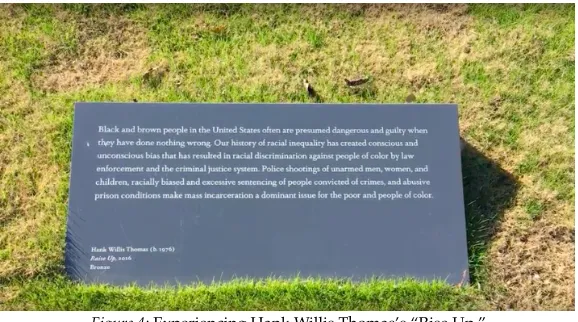
Figure 4: Experiencing Hank Willis Thomas’s “Rise Up.” (video taken by author)4
and Brown artists. Instead, it would be a curriculum that de-centers whiteness by explicitly naming histories of harm, erasure, and exoticization of Black and Brown bodies in the arts. De-centering whiteness in art education would involve, for many of us, filling in the gaps that formal education in the arts left us with: gaps in our knowledge of non-western art; gaps in our knowledge of indigenous art; gaps in the knowledge we acquired about what to value in the art world.
In 2017, white artist Dana Schutz’s “Open Casket,” a painting of Emmett Till, a child and victim of a terror lynching in Mississippi in 1955, was included in the Whitney Biennial. There was much debate following the opening of the Biennial regarding Schutz’s inclusion of the portrait (Till is depicted in his open casket, as the title of the piece suggests), in particular of the subject matter. Was the story of Till’s death one for a white, successful artist to further profit from? The capital-A Art World responded predictably, in my opinion, with rallying cries of censorship and artistic freedom. The New Yorker ran an essay in April 2017, titled “Why Dana Schutz Painted Emmett Till”, that described Schutz as a painter of “enigmatic” stories and with a voice that is “high and childlike.” After a detailed description of Schutz’s career and accomplishments, the matter of “Open Casket” is discussed. The article concludes:
to you, and to fail, or never to engage with it at all? I just couldn’t do it any other way.’ (Tompkins, 2017) First, to describe the story of Emmett Till’s murder as “enigmatic” dangerously dilutes the horrors of terror lynchings in the United States. Second, the rhetoric employed to describe Schutz, her voice as “high and childlike,” reinforces an innocence of whiteness; what Kuykendall (2017) has referred to as the logic of whiteness, the “justification on which whiteness rests” (p. 296. Finally, for Schutz to speak of “risks” and not of reflection on cultural appropriation or possible mishandling of the story of the violent death of a Black child- brought on by the false accusation of a white woman- is inadequate and, again, dangerous.
As a white person studying art, I received a lot of liberal signaling as to what determined art and artists as credible. As white teachers moving toward a culturally sustainable pedagogy of art, we must engage in active skepticism of the historic gatekeepers of culture, which include museums, schools of art, canons of art history, and, yes, art education as a field. Are you one to resist in engaging in socio-political content via social media? If so, you must believe that you get all the information you need about the world while engaging in other forms of media. Social media and forms of popular media are valuable, I would argue essential, sources for Black and Brown scholarship and cultural content. If you aren’t following Black Twitter, if you aren’t following BIPOC artists on Instagram, if you aren’t actively seeking sources of information and art that weren’t signaled to you as “valuable” or “credible” I would encourage you to question why.
Arts Pedagogy as an Act of Reparation
During a panel discussion in Richmond, Virginia, in the spring of 2018, art educator Joni Acuff was asked how we could support BIPOC high school students in pursuing degrees in art and art education. Her response, in effect, was that if we wait until high school it is too late. I have considered her words many times since then, and challenged myself to reconfigure my “pedagogies too late” into pedagogies for a more just future. By the time BIPOC students get to high school, if they have not been nurtured as artists, have not seen their lives represented in the examples shown in class, if they have not seen their lives valued in the art and processes and histories we bring into our spaces of learning and making, it is too late for them to consider the world of art as one that embraces them.
Whatever we are doing now, it’s not enough: no backpatting, no congratulating. We’re working within centuries of white supremacy and Black suppression that can’t be undone through a single well-meaning gesture or even a series of them. White supremacy relies on our sense of accomplishment when we include Black artists in our curriculum for Black History Month and do not question why the canon of artists is exclusive of Black and Brown voices or we conveniently overlook Gauguin’s exploitation of his famous Tahitian women.
It’s not about “right” language. It’s about working toward “just” language; to be prepared to have our ways of knowing challenged and to be willing to listen and make changes; to actively seek new ways of knowing instead of becoming complacent with what we already know; to acknowledge that there is much we do not know, but more so to acknowledge that we have, every one of us, been fed myths and misinformation about our own groups and groups which we are not a part of. And those myths need undoing.
We must look directly at the ways in which this racist ideology of white supremacy, this idea that white equals better, superior, more worthy, more credible, more deserving, and more valuable actively harms anyone who does not own white privilege. And we must look at the ways that this plays out at an individual, personal, intimate level - within you as a person. It is so easy to blame the system ‘out there’ for creating this oppression. But the system was created by individual people, and it is upheld by individual people (whether knowingly or unknowingly). (Saad, 2018, pp. 18-19)
and to a more just future of art education.
Figure 5: City, county, and state memorials for the victims of terror lynching in the United States of America-church bells tolling in the distance (video taken by author)5
References
Alexander, M. (2012). The new Jim Crow: Mass incarceration in the age of colorblindness. New York, NY: The New Press.
Desai, D. (2010). The challenge of a new colorblind racism in art education. Art Education, 63(5), 22-28
Guinier, L., & Torres, G. (2003). The miner’s canary: Enlisting race, resisting power, transforming democracy. Cambridge, Mass: Harvard University Press.
hooks, b. (2003). Teaching community: A pedagogy of hope. New York: Routledge.
Ighodaro, E. & Wiggan, G. (2013). Curriculum violence: America’s new civil rights issue.New York, NY: Nova Science Publishers. Kuykendall, R. (2017). Whiteness as antidialogical. In Kennedy, T. M.,
Middleton, J. I., & Ratcliffe, K. (Eds.) Rhetorics of Whiteness: Postracial Hauntings in Popular Culture, Social Media, and \ Education (p. 295-309). Carbondale, IL: Southern Illinois
University Press.
Ladson-Billings, G. (1994). The dreamkeepers. San Francisco: Jossey Bass PublishingCo.
Love, J., Gaynor, T. & Blessett, B. (2016). Facilitating difficult
dialogues in the classroom: A pedagogical imperative. Administrative Theory & Praxis, 38(4), 227-233.
Morris, M. (2016). Pushout: The criminalization of black girls in schools New York, NY:The New Press.
Paris, D. & Alim, D. (2017). Culturally sustaining pedagogies: Teaching and learning for justice in a changing world. New York, NY: Teachers College Press.
Saad, L. (2018). Me and white supremacy workbook. Retrieved from https://www.meandwhitesupremacybook.com/book/ Spillane, S. (2015). The failure of whiteness in art education: A
personal narrative informed by critical race theory. Journal of Social Theory of Art Education, 35, 57-68.
Stewart, D-L. (2017). Language of appeasement. Inside Higher
Ed. Retrieved from https://www.insidehighered.com
views/2017/03/30/colleges-need-language-shift-not-one you-think-essay
Tompkins, C. (2017). Why Dana Schutz painted Emmett Till.
“The Team is All White”: Reflections of Art Educators of
Color on Whiteness
Hannah Kim Sions, Ph.D.
Virginia Commonwealth University Amber C. Coleman
University of Arizona
ABSTRACT
In this article, we utilize duoethnography and Critical Race Theory (CRT) to address the state of Whiteness in art education and our own experiences; both concepts share the importance of including diverse narratives and challenging the dominant ones imposed by the construct of Whiteness. Through duoethnography, our narratives address instances of microaggressions, internalized racism and assimilation, as well as the lack of representation of diverse artists. We reflect on these experiences and the impact of Whiteness in our own lives. Through CRT, we are able to unpack the impact of our lived experiences and further discuss the implications for the future of our field.
KEYWORDS: Critical Race Theory, duoethnography, art education, diversity, critical consciousness, representation
of marginalized voices in pedagogy, curriculum, and teacher demographics. In doing so, we envision a future for art education that recognizes these kinds of racist experiences and challenges their indoctrination in the field.
This article begins with the statement of the problem, which describes the impact of White teacher demographics and White, Eurocentric curricula on students of color. Next, we introduce duoethnography as our methodology and CRT as the theoretical lens through which we provide context to and unpack our narratives. The following duoethnography addresses three different topics through our personal narratives: microaggressions; internalized racism and assimilation; and the need for diverse representation. Finally, the article concludes with implications of this duoethnography and recommendations for the field of art education.
Statement of the Problem
Although race is a social construct, Whiteness has been mobilized as a demarcation for racial privilege, a marker of normality, and a set of presumed social practices that reinforce White supremacy, a belief, perception, and social structure that deems White people as inherently superior to people of other races and/or ethnic backgrounds (Acuff, 2018b; Liu & Pechenkina, 2016). This reinforcement of White supremacist ideas is ingrained throughout our society and institutions in a variety of ways; one of these societal institutions is our system of education. In recognizing the construct and impact of Whiteness in education, there is a notable difference between the lack of diversity in teacher demographics versus the wealth of diversity in student demographics (Ladson-Billings, 2005). Data shows that on a national level, 81.9% of teachers are White, while only 6.8% of teachers are Black (Anderson, 2018). To adequately represent the student population, the number of Black teachers would have to more than double (Anderson, 2018). Ladson-Billings (2005) makes an analogy for education that “the team is all White” (p. 233). She explains that this means that White educators are on a different team from people of color; this particular team hosts the referees and officials (those in power), who are also not on the same side as the players (educators and students of color).
Whiteness in education
Brown v. Board of Education, schools slowly became desegregated, but desegregation did not address or change the larger problem of racism in the country (Bell, 1995). The perpatuation of racist thought and practices has impacted teachers and students of color alike. For instance, racist and/or separatist ideas fueled new waysto further segregate and discriminate against people of color, such as teacher testing and educational testing (Hatcher, 1975). Moreover, racist practices to systematically standardize the profession included tracking systems and superficial bases of quality controlling, which contributed to the South losing almost 10,000 Black teachers in the first 20 years after Brown (Hatcher, 1975). The loss of Black educators and other educators of color signaled changes in educational quality for students of color (Lash & Ratcliff, 2014). They were “less likely to have access to high quality curriculum,” and “systematically denied the educational opportunities that would lead to college and university admissions,” which then prevented them from entering the teaching profession (Ladson-Billings, 2005, p. 230). With the perpetuation of a predominantly White teaching force, students of color did not often have educator role models who looked like them (Lutz, 2017).
Moreover, White educators may perpetuate trauma through their implicit biases toward students of color (Brooks, 2012; Dovido & Gaertner, 2004). Students of color may experience trauma if these biases manifest in the form of prejudice and oppression, which many White educators have not experienced (Ladson-Billings, 2005). These educators usually are not willing to confront their biases as they are either unaware or trying to deny their negative feelings towards students of color to preserve their own self-image. Unfortunately, this dissociation between thought and practice does little to protect the students who fall victim to the projection of negative stereotypes and biases (Dovido & Gaertner, 2004).
Whiteness in art education
As students and educators of color, we, the authors, have been constantly aware of the influence and impact of Whiteness in our art educational experiences. Whiteness is visible within all areas of art education, from the population of the teaching force to classroom curricula. In art education, the most visible influence of Whiteness is in the curriculum where White, Eurocentric ideas of who an artist can be and what art looks like prevails; from the beginnings of public school art education, most pedagogy of art education within the United States was modeled after European standards (Efland, 1990). These standards have reinforced White European males as the masters of art, with artists of color incorporated sparingly throughout the occasional “multicultural” lesson.
In the 1970s, multicultural art education was introduced into public school curricula through the urging of marginalized communities. The goal was to provide a more equitable learning experience for students of color (McCarthy, 1994). An early analysis of art education literature by Tomhave (1995) identified several approaches to
in curriculum that believes inclusion can be achieved by “merely injecting a few folk customs and ethnic heroes” (Grant & Sleeter, 1993, p. 9). In these shallow attempts with multiculturalism, art education misses the mark and further perpetuates the hegemony of Whiteness in our field. Through implementation of duoethnography, we hope to provide firsthand accounts of navigating Whiteness in art education and use CRT to further unpack these experiences.
Methodology
This paper utilizes duoethnography as a means of providing two different narratives that address three problematic instances that are a result of the impact of Whiteness in our field: personal accounts of racial microaggressions; internalized racism manifesting in attempts to assimilate; and the lack of accurate and contemporary representation of racially/culturally diverse artists in curricula. The themes for these narratives have been identified as they relate to the realities of racism that people of color experience. CRT has often pointed out the occurrences of microaggressions, internalized racism and assimilation, and the dire need for diversity. These occurrences impact the everyday lives of people of color and have (and continue to) impact the lives of the authors. CRT further helps us unpack these experiences to fully comprehend the impact of Whiteness in art education.
Duoethnography
Norris and Sawyer (2017) suggest that there is a need to reject the “manufacturing model” (p. 4) of education where students are merely consumers of the knowledge given to them by teachers; by engaging students’ prior experiences, the insertion of personal narratives creates connections between public and private knowledge. Therefore, personal narratives are important in interrogating and challenging dominant metanarratives in the educational context. Krammer and Mangiardi (2012) note that William Pinar’s autobiographical method of currere relates to duoethnography in relation to people’s natural tendencies toward being storytellers and story-makers; this process entails creating and recreating ourselves and the world around us. We use duoethnography in a similar manner where our stories
[embody] a living, breathing curriculum. Our life histories become the site of research. Within our personal curriculum we become engaged with ourselves through the other as we interrogate our past in light of the present with hope to transform our future. (Brown & Barrett, 2017, p. 87)
Thus, in a sense, the telling of stories through duoethnography allows the participants to create a conversational structure, which allows for knowledge construction between two individuals over time (Krammer & Mangiardi, 2012). Just like a curriculum, which creates a structure for knowledge construction to occur between the educator and learners, our storytelling aided us in structuring this article as we engage with our personal narratives; the public knowledge of society and our field; the private knowledge that has been shared through CRT and various scholars; and the merger of narrative and knowledge in our interpretations of the impact of Whiteness in art education. The telling of our stories adds to other stories of people of color who have been impacted by the negative consequences of the team being all White in art education. It also opens these kinds of experiences to become a part of the conversation of how to address and dismantle the hegemonic structures of Whiteness in our field. As Kramer and Mangiardi (2012) declare, we hope that sharing our duoethnography does more than expose the “hidden curriculum” (p. 44) and personal impact of Whiteness in art education; our stories and others must also be comprehended in order to work toward any real sense of social justice.
Critical race theory as a critique of Whiteness
is built on a foundation that benefits White Americans (Crenshaw et al., 1995). CRT recognizes that this foundation necessitates and perpetuates the oppression of people of color, as “race continues to be a significant factor in determining inequality in the United States” (Ladson-Billings & Tate, 2017, p. 12). In education, White Americans benefit from a carefully constructed notion of “knowledge,” one that highlights the perspective of a select group of individuals while silencing others. The selectiveness of scholarship has a political agenda, which is based on White supremacist ideas (Crenshaw et al., 1995) and hopes to maintain current power structures (Acuff, 2015). CRT challenges White supremacist perspectives by providing the narratives of people of color to challenge “truths” based
around the understandings of White lives. CRT acknowledges the importance of counternarratives of people of color, who challenge dominant narratives (Crenshaw et al., 1995; Sleeter, 2017). CRT compliments duoethnography as both use narratives to provide different perspectives. Both can be viewed as a means to challenge the dominant narratives of Whiteness and push us to reflect and share personal stories within a public platform.
Narratives
In this article, duoethnography and CRT also engage in a form of dialogue as they both provide counternarratives to traditional, dominant narratives (Calmore, 1995; Sawyer & Norris, 2013). The following narratives address three themes, which emerged as we began analyzing our experiences through a critical race lens: instances of microaggressions, internalized racism and assimilation, and the need for diverse representation. Each narrative begins with literature that illustrates the negative impact of Whiteness on art education. Then, the narratives of each author are shared to illustrate this impact through our lived experiences. Finally, each narrative concludes with a summary of our duoethnographic experiences and a discussion on how CRT helped us further unpack these experiences.
Narrative one: Instances of microaggressions
on an individual basis (Brooks, 2012). Through the construction of certain knowledges, race and racism exist to maintain existing power structures (Acuff, 2015; Ladson-Billings, 2012), including within the education system. Recognizing the connection between race and education, educators are in a unique position to disrupt the influence of racism in education by being critically aware (Acuff, 2015). It is important for White educators to seek out resources such as The Palgrave Handbook of Race and the Arts in Education (Kraehe, Gaztambide-Fernández, & Carpenter II, 2018) to work toward critical consciousness and transformative action by recognizing the lived experiences of their students and other people of color around them. Furthermore, White educators may not recognize the privileges that have been awarded to them. These are privileges that their students of color do not share, which can inhibit their academic success. Even in circumstances where White educators express a commitment to diversity, these commitments can be empty promises as they do not face the same consequences of racial inequity as their students of color or their fellow educators of color (Ladson-Billings, 2005). When the demographics of educators and curricula predominantly reflect Whiteness, how often are White educators able to understand the lived experiences of students of color? How often do White educators recognize the oppression that students of color face within and outside of the classroom? How often do White educators question the impact that they may have on their students?
“How do you speak English so good (sic)?” Unfortunately, that was not the last time someone made quick judgements about my cultural background based on my race.
Throughout my academic and professional career, I have been asked everything, from “did you choose your English name?” to “do you still speak your native language?” by educators. At the time, I assumed that these interactions were the norm: well-meaning individuals who couldn’t help but judge a book by its cover. To them, an East Asian-American who was fluent in English was an anomaly. I truly believed that their misunderstandings were not their fault, and that the fault was mine: mine for being Asian-American (why couldn’t I be White?), mine for being different (why couldn’t I embody more Asian stereotypes?), and most importantly, mine for being hurt by these remarks (why couldn’t I understand that they were just curious?). My well-meaning White friends assured me as much, constantly reminding me that people were just curious, didn’t mean harm, and even suggested that maybe I did have an accent after all.
As an academic, I realize that the problem is not mine and, at the same time, that many of these individuals did not recognize the impact of their words. However, it was still problematic that I was facing microaggressions and subtle racism from individuals who were all educators. These educators were not meaning to harm or hurt; many of them were just curious. However, in the same breath, they did not begin to question what their comments implied, or that, by making judgement calls based on my skin color, they were being racist. While they may have been able to address some of their personal curiosities, I walked away feeling like an outsider, angry at myself for not “fitting in” better.
with my racial difference. While I did feel their support, it felt like they could only support me to the extent of their cultural understanding. Once I wanted to embrace more “Black” things, it felt like their understanding or advice ended at general notions because they were not familiar with that particular intersection of experiences.
I have to admit that I feel as though I have experienced micro- and macro-aggressions, but I lacked the awareness of what these encounters meant or how to respond to them in the moment. There are three different instances during my education that come to mind. The first is when I had an art professor who constantly asked me to “do more” with my artwork with little instruction on what would enhance it. I was often frustrated as I did not feel like she asked for the same amount of changes from other students in the course. I did not know if there could be anything done about this situation as I was “the student” and she was “the professor.” I found out later (after she was implicated in a macroaggression against a person of color) that she also did this with the students of color in the other art courses. Moreover, in an art history course, I remember wondering why the professor never provided us with any contemporary examples of artwork by Black people or people of color. The art history courses centered heavily on European or White (male) artists while artists of color were not granted the same considerations. The syllabi for these courses would sometimes state that we would cover the artworks of artists of color; on other occasions, they would not be mentioned at all. When I thought that we might discuss artists of color, they were either addressed hurriedly or skipped over. When this happened, it seemed like there was no time left in the course to ask the professor to include these artists.
to be concerned about me, one of the few people of color in the program, when making a decision about their academic career and interests. I wonder if this professor considered whether they would be as concerned about a White student changing programs and leaving the other (many) White students in the program. I think not.
In reflecting on these experiences, I often thought that I had to play the “game of school,” which is predicated on the team being all White and necessitates that people of color have to go along with these norms. I didn’t see myself as having power to change anything in these moments, or the ability to address these situations without backlash. I now find myself questioning even more the way things are or the way things have always been, but not always knowing if there’s another answer to the situation.
While the term “microaggression” might lead one to think that these instances of racism are inconsequential, they are only considered of little harm by the perpetrators, not the victims. Furthermore, it is the hegemony of Whiteness that creates the conditions for
microaggressions to occur (Bridges, 2019). Our narratives demonstrate microaggressions and othering that we have both felt during our educational experiences. Hannah’s narrative speaks of how educators made assumptions about her cultural background due to her
race; they questioned her when she failed to fit their stereotypical understanding of an East Asian. Her race was used as a marker to separate her from the rest of her peers and colleagues. Amber shares how she felt about professors being either overly critical of her work or only showing artists that she did not feel connected to. Furthermore, Amber’s professors never explicitly mentioned her race, but she recognized that their actions reflected how they conceptualized the inclusion of Black people and other people of color in their practices. In these cases, as Bridges (2019) quotes Derald Wing Sue,
Through a critical race lens, we recognize that these kinds of microaggressions are a frequent form of racism that marginalizes people of color by separating people of color from Whites in an “us vs. them” attitude and reinforcing social, institutional, and personal racism (Calmore, 1995). Each narrative displays a different angle to the same problem that students of color face—the constant reminder that they are somehow viewed as “different” in an education system that allegedly provides an equal opportunity for all students. These experiences, while not entirely the same, demonstrate instances that we were othered because of our race in the education system.
Narrative two: Internalized racism and assimilation
Further expanding the gap between White educators and their students of color is the institutionalized school system that is biased in favor of White students (Ighodaro & Wiggan, 2013). When left unchecked, the effects of such educational structures can have adverse effects on students of color where they internalize feelings of oppression. Internalized oppression can be defined as the process where:
Members of the target group are emotionally, physically, and spiritually battered to the point that they begin to actually believe their oppression is deserved, is their lot in life, is natural and right, and that it doesn’t even exist. The oppression begins to feel comfortable, familiar… (Yamato, 1995, p. 72)
As students of color, we both have had experiences of internalizing Whiteness and its corresponding racism. Sometimes these
interactions were small and fleeting—microaggressions instead of macroaggressions. However, regardless of how big or small these circumstances may seem, the impact that they have had on us are long lasting and unforgettable. By interpreting, and then internalizing, the meanings from encounters of Whiteness and racism, we pushed ourselves to either assimilate, downplay our “differences,” or attempt to reject our racial/cultural backgrounds altogether.
Hannah: To be quite honest, it is difficult for me to talk
appreciate myself in the last three years, I cannot forget how I struggled with my racial identity for a large portion of my life. An examination of some self-portraits from my past begins to paint a picture of how I externalized (non) Whiteness.
From elementary school and throughout my bachelor’s degree, I was taught that great artists were White (men). Held up as the standard for “good art” were artists such as: Rembrandt, Michelangelo, Van Gogh, Klimt, Matisse, Warhol, Pollock, Haring, and O’Keefe. In these lessons, women were usually subjects of the artworks, not the painters –glorified objects to be consumed and appreciated by the viewer. These idealized women represented beauty standards that were based on European features. Supporting this problematic “ideal woman” narrative was the visual culture that surrounded me—young, pale-skinned, White girls were plastered all over the magazines I read and the advertisements I saw. I never realized how much this affected me, until I recently revisited some of my older self-portraits:
Figure 1: The Moon (2016) Glass beads on Digital Canvas Print
Figure 2: Self Portrait (2013) Digital Photograph
Before I was able to unpack the complicated nature of these images, I always assumed that my editing style was an aesthetic choice. A lighter skin tone contrasted better on a dark background, or the composition looked better with my eyes cropped out. However, I soon realized that my portraits were composed in a way that (tried to) erased my Asian-ness. Through makeup or compositional choices, I framed the images in a way that made me unrecognizable. This was confirmed by my friends who always responded with “that’s you?” every time I showed them a new photograph. One could argue that this was an unfortunate coincidence, but all of my other portraits featured White models (save myself). Many of them were also photoshopped to be lighter than their actual skin. This feeling, of not feeling acceptable unless I denied my “otherness,” is not a phenomenon unique to me. By lightening my skin, cropping out my eyes, hiding behind makeup, and introducing myself as “practically White,” I was trying to become “raceless” by adhering to White supremacist standards (Collins, 2012). I was attempting to assimilate into a mold that I could never fit into. I did not feel comfortable to present myself as I am because I believed that “as I am” was not a good thing to be. Even within the art classroom, the successful artists that were presented to me were always White (males), and the women who were viewed as the embodiment of beauty were also White. With all those things considered, it is understandable that I felt the (unfortunate) need to lighten my skin and hide my race for viewers to take me (and my artwork) seriously.
exclusion from other Black people when I did not enact or possess those things. It was like being between two cultural spaces, but not feeling like you fit completely within either. Luckily, I was able to find “homeplaces” (hooks, 1990) with other Black/students of color who were also having these experiences.
It was not until I went to college, especially graduate school, that I began to fully recognize my compelling need to embrace a sense of connectivity to the Black community and to carve out space for my own Blackness. I felt like my Blackness had previously been dictated by my upbringing and the spaces that I had occupied. Although college opened up new possibilities for exploration of my racial identity, my art education could still be considered one of those spaces where I also explored by identity. I should note that there was a huge gap in my art education. I had art classes in elementary school, but I did not have them again until my undergraduate study. In between that time, I engaged in art as an occasional hobby.
Figure 4: #BlackGirlsLivesMatter (2017) Mixed Media Collage
(from the group exhibition, To Be Black and Female: Reflecting on Black Feminism and
Figure 5: From the installation Welcome to Our Living Room (2017) Mixed Media Collage (from the group exhibition, To Be Black and Female: Reflecting on Black Feminism and
African American Women’s Art in Museums)(Photograph courtesy of Mikael Coleman)
While we both have felt pressure to assimilate as a response to our educational experiences, we have had different journeys healing. These journeys have allowed us to reject pressures to assimilate, as we came to embrace our “difference” and lived realities. We believe this is an important turning point, as our journeys have allowed us to share our unique experiences with the field, especially since assimilation, from a colorblind perspective, erases diversity as it removes positive aspects of cultural diversity in favor of homogeneity (Gotanda, 1995). Our attempts to assimilate were different, but we both struggled with finding our place and self-worth in a White supremacist world. Hannah’s revelation about her own artwork helped her confront and unpack her attempts at assimilation. Amber was able to abandon her attempts to assimilate and find her unique identity as a Black woman by connecting with others who shared a similar lived experience. Both of our narratives demonstrate the healing that we had to do to unlearn the pressures of assimilation, countering the hegemonic narrative that was asking us to whitewash our cultural diversity.
Narrative three: Diversity needed
subjugation, or the idea that one group’s cultural knowledge is superior to another’s” (Acuff, 2018a, p. 36). This use and engagement with critical multiculturalism requires the recognition and
incorporation of diverse voices in art education. These voices are present, but are not often reflected in the demographics, pedagogical practices, and curricula in art education.
Hannah: During my position as a graduate teaching
assistant, a practicum student shared a story about their interaction with an elementary student that I found noteworthy. I share it here with their permission. So, during a 1st grade lesson, the practicum student showed images of Pascale Marthine Tayou and his artwork to the class. At the end of their presentation, one student stated, “Hey! That artist is Brown!” The practicum teacher was taken aback at first, but confirmed this observation. The student then responded, “I’m Brown, too. Does that mean I can be an artist too?” While this interaction was short and fleeting, it displays the impact that visual representation can have on a student of color. I believe this recognition and empowerment can also be experienced by other underrepresented groups such as gender, social class, sexual orientation, or religion. The same practicum student told me of another instance where they introduced a contemporary Egyptian artist to a class of 2nd graders, and a student exclaimed in surprise, “People still live in Egypt?!” This comment further demonstrates how inadequate representation can perpetuate outdated stereotypes that suspend cultures within a certain time period in young students (Chin, 2011).
a critical pedagogical experience for a few Black women, including myself, to explore their identities and experiences through art-making and holding an exhibition. One of the most interesting aspects of the project for me was seeing how it transformed the other participants’ perspectives on seeing the museum as a space where they felt included and valued. I was also surprised by how the visitors to the exhibition, Black and non-Black, were moved by the display of Black women’s experiences and desired to continue the call for empowerment on behalf of Black women. The artworks became a context for the participants to creatively consider their own lived experiences while the exhibition audience had the opportunity to contemplate experiences outside of their own.
It is imperative that we utilize culturally inclusive pedagogy and create curricula that prioritize the backgrounds and lived experiences of the students (Freire, 1970). It is equally important to present an inclusive population of artists to our students. Representation is paramount, as it may only take one exemplar for students to believe that they can be successful with art (Wilson, 2017). Showing artists that come from similar communities and cultural backgrounds as the student population acknowledges the diversity in the classroom and can help students connect to the curricular content on a more personal level (Hunter-Doniger, 2018; Wilson, 2017). Representation must also be contemporary or else it can fall into the same trappings as superficial multiculturalism. Without contemporary representation, young students may not be able to connect historical contexts and cultures to contemporary times (Chin, 2011). Like the example given by Hannah, some students may believe that either some cultures no longer exist or that people within those cultures still exist in the historical context of which they were taught.