Stakeholder’s analysis in e-learning software process development
L.J. Romero
1,*, L.C. Ballejos
2, M.M. Gutiérrez
2and M.L. Caliusco
21 Universidad Nacional del Litoral, Facultad de Ciencias Hídricas, Ciudad Universitaria. Ruta Nacional N° 168 - Km 472,4. Santa Fe , Argentina.
2 Universidad Tecnológica Nacional, Facultad Regional Santa Fe, CIDISI research center, Lavaisse 610, Santa Fe, Argentina
Abstract
The success of an e-learning project depends largely on the quality of applications and tools used to support the learning process. Meanwhile, the quality of software depends largely on proper stakeholders’ identification in the requirements stage during the development process. Although some studies exist which have identified key stakeholders in e-learning domain, most of them do not perform a deep analysis of the stakeholders and their contexts, necessary to consider educational and cultural issues in this type of environment. The aim of this paper is to present the application of a method for the identification and analysis of stakeholders, which is adapted to e-learning domain. This method was used in a case study considering university environments.
Keywords: stakeholder; e-learning; Learning Management System.
Received on 14 October 2014, accepted on 15 January 2015, published on 17 March 2015
Copyright © 2015 L.J. Romeroet al., licensed to ICST. This is an open access article distributed under the terms of the Creative Commons Attribution licence (http://creativecommons.org/licenses/by/3.0/), which permits unlimited use, distribution and reproduction in any medium so long as the original work is properly cited.
doi: 10.4108/ el.2.5.e4
*Corresponding author. Email:[email protected]
1. Introduction
In the last decade, e-learning has increasingly been adopted by universities and educational institutions. Therefore the main challenge is the development of e-learning software that not only allows users to develop and customise learning objects, but also it is flexible enough to execute in dynamic and heterogeneous environments. In this context, the Web has become a virtual world continually evolving, where educational systems must be adapted in order to generate new didactic structures appropriate for this technological environment [1]. Thus, to plan, design and implement e-learning programs and subject, it is need to take into account the widespread problems generated by universal access with strong cultural differences.
Technology supplies distributed environment, such as e-learning, where the learning content can be transmitted with the help of the growing spread of tool that assist in these new way of learning. Despite the difficulties that e-learning brings, this approach solve limitations of availability and scope of traditional learning context [2]. The challenges go in the direction of achieving adaptive environment according to user’s requirement and flexible and friendly interfaces.
As regards the successful adoption of e-learning by educators, the e-learning tools need to provide services to design and generate valid and reliable
learning objects from a technical and pedagogical point of view [3]. In other word, the technological environment needs to guarantee the correct balance among teaching, learning and use of technologies. In a pedagogical way, teaching in an open environment, such as e-learning, demand high customization and efficiency in order to provide a good guide for students and individual access. People accessing educational resources have different characteristics. They require that strategies will be developed to help in the access to artifacts [4].
From the point of view that e-learning environments are software, this work focuses on software development process. Then, the first step in this process is to identify stakeholder in order to analyze their requirement. The better identification of stakeholder, the better understanding of software requirement and responsibilities, thus it promotes the successful use of the software in e-learning environment.
This step influences the successes of e-learning software project, as much as the analysis of stakeholders in the context where the development take place, does.
L.J. Romero et al.
the proposals lack a method to guide the execution of this step, essential to guarantee the success.
This work presents the analysis of stakeholders in software projects for e-learning context following the method proposed in [7]. This method has been adapted in order to consider the special characteristics of e-learning contexts.
The article is organized as follows. The next section presents the method to identify and analyze stakeholders. In Section 3 the context in which the software process takes place is described. Section 4 shows the execution of the method for the context proposed. Finally, the conclusions are presented and future works are submitted.
2. Method for stakeholder identification
Ballejos and Montagna (2008) describe a method for performing the identification of stakeholders for an interorganizational software project. The goal of this method is to assist project managers in deciding on the people to be involved all over the project.
In the method, diverse dimensions are analyzed:
organizational, which considers goals and interests of each particular organization, interorganizational,
for representing the network interests, many times differing from those of individual organizations, and
external, in order to consider necessary external points of view or interests for this project.
Some issues, such as stakeholders’ roles and interest in the project, are also addressed in this approach. Figure 1 shows the steps proposed by the method.
Fig. 1. Stakeholder identification method steps.
By executing the first step, diverse stakeholders’ attributes are analyzed, such as: performed functions, hierarchical levels, abilities or knowledge, and geographical location. Types will be determined considering individuals inside organizations, groups, or whole organizations.
The method also proposes a set of analysis criteria in order to cover different points of view and requirements. These criteria are:
-Functional: task that will be affected in a direct or indirect way. This criterion analyzes the main activities undertaken, which are the based for the collaboration among ION members.
-Geographical distribution: geographic area that must be taking into account. This criterion allows
developers consider stakeholders from diverse locations still with different languages and cultures.
-Knowledge/capacities: knowledge or capacities on the domain under consideration related with the system development and implementation.
-Hierarchical level: hierarchical levels affected by the system under development.
As result of this step, a profile characterization of stakeholders to be involved is obtained.
Step 2 determines the roles that stakeholders may play along the project lifecycle. It is important for the project team because its results set the scope, characteristics, and participation of each particular role in the project. This stage can be performed simultaneously with Step 1.
Step 3 is devoted to selecting the concrete stakeholders that will represent the diverse interests in the project. By analyzing the characteristics of the criteria in each dimension, concrete stakeholders must be identified that match the profile. Besides stating an identifier and a stakeholder name, a brief description must be provided. The associated criteria and dimensions are also documented. This is important since the same entity may be selected even analyzing different criteria and dimensions.
Then, step 4 performs the matching between stakeholders and roles specified in previous steps. The goal is to restrict the set of roles associated with each stakeholder, so as to make future analysis and decisions easier for the project team.
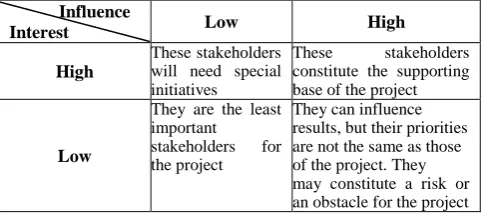
Finally, step 5 provides tools for analyzing the influence and interest each of them may have in relation to the project and its success. Determining whether stakeholders in a position of strong influence hold negative interests may be critical to project success. Interest is a measure often derived from the relation between stakeholder needs and project goals or purposes. This method adopts a simple division. A matrix is proposed, where combination of influence and interest values is reduced to four quadrants in order to facilitate the analysis, as shown in Table 1.
Table 1. Stakeholders interest and influence matrix. Influence
Interest Low High
High
These stakeholders will need special initiatives
These stakeholders constitute the supporting base of the project
Low
They are the least important stakeholders for the project
3. The context
In software projects, more specifically in the requirements elicitation task, it is necessary to identify the general context and the scope in which the software will be developed. In this step the information source and stakeholders must be recognized.
3.1. Operational environment
A Learning Management System (LMS) [8] offers a set of functions oriented not only to transmit, trace, inform and manage learning content, but also to trace the student´s progress and their interaction with the learning objects. A LMS can be applied to either a simple subject manager or a high complex distributed learning environment.
In general, LMS manages user access, activities and licences such as enrolment, management of accessed content, assessment score, report generation and statistics among others. Furthermore, it can be provided communication tool both synchronous such as chat, video conference, real time help, and asynchronous such as blogs, advertisement board, forums among others.
LMS is limited to implement classical assessment strategies, which in many cases, are not proper for customization, but are considered broad characteristics of users [9]. Learning based on this model spreads the classic model allowing users to customize LMS according with their capacities and necessities [10].
A software project for e-learning can both address the development of a LMS and simpler tools that can be integrated with it.
3.2. Case study
This work has been developed in High Education context both undergraduate and postgraduate subjects and it considers three modes of learning: conventional, blended and distance learning. The scenario involves three universities: Universidad Nacional del Litoral Facultad de Ingeniería y Ciencias Hídricas (UNL FICH), Universidad Tecnológica Nacional Facultad Regional Santa Fe (UTN FRSF) and Universidad Católica de Santiago del Estero Regional Rafaela (UCSE), Argentina. Authors work at those Universities as professors and researchers. Universities all together make an inter-organizational net (ION), where each one has its objectives and interests but cooperate with one another in order to reach common goals. This ION has proper characteristics because members are
educational institutes and some of these are not profit public Universities.
There are laws and policies that govern the operation of National Universities dictated by national department like Ministerio de Educación de la Nación and Ministerio de Ciencia y Tecnología de la Nación. Further, each University has its inside rules implemented in documents, resolutions and laws. In order to develop software for learning, these rules must be considered.
4. Stakeholders identification for
e-learning context
Stakeholders are the main source of information. They can be customers, users, domain expert, authorities, professors, learner among others. From the point of view of software developer, a stakeholder is any person, group or organization that influences or is influenced by a system under study, both in a positive and negative way [11]. They affect, directly or indirectly, the system requirement specification.
The success of a software project depends on the correct identification of stakeholders. Accordingly, it is essential to develop this step in a methodical and systematic way, mostly when it is a ION involved.
In this work, it was adopted the method proposed by Ballejos & Montagna [7] explained in section 2. Although this method is appropriated for ION, it was modified in order to be adapted for particular organization like universities considered in this work.
Next sub-sections explain the application of each step defined in the method to e-learning context.
Step 1: Identify stakeholders type
Each software project involves different stakeholders type, each of one has at least one role associated. Type is specified by domain, environment and organizations. It is a classification for a set of stakeholders that share the same properties and attributes. On the one hand a stakeholder from an organization represents the needs of a particular institution. On another hand, an interorganizational stakeholder represents the network (ION) needs, in this case the universities net mentioned previously.
L.J. Romero et al.
regulates the action performed by Universities. In this way, the method considers two dimensions: internal and external.
For each dimension, it is considered diverse criteria: functional, geographical dispersion, knowledge/capabilities and hierarchical level.
This work adds a new category for internal dimension, suitable for this environment: e-learning internal dimension. It evaluates IT supported teaching-learning processes, and its dynamics which involves specific contents design, teachers training in the use of e-learning technology, among others. For instance, in UNL there is a specific department responsible for distance education depending on academic secretary. It has a coordinator in charge to coordinate, organize, command, and make rules in this area. This department is not present in other members of the ION considered.
UCSE has the UCSE SEM-system whose main objective is to promote distance education in UCSE. This system was created to define lines of action aimed at designing the organizational structure of the distance education institution through the redefinition of academic offerings, and thus, enhance the integration into university institutional networks.
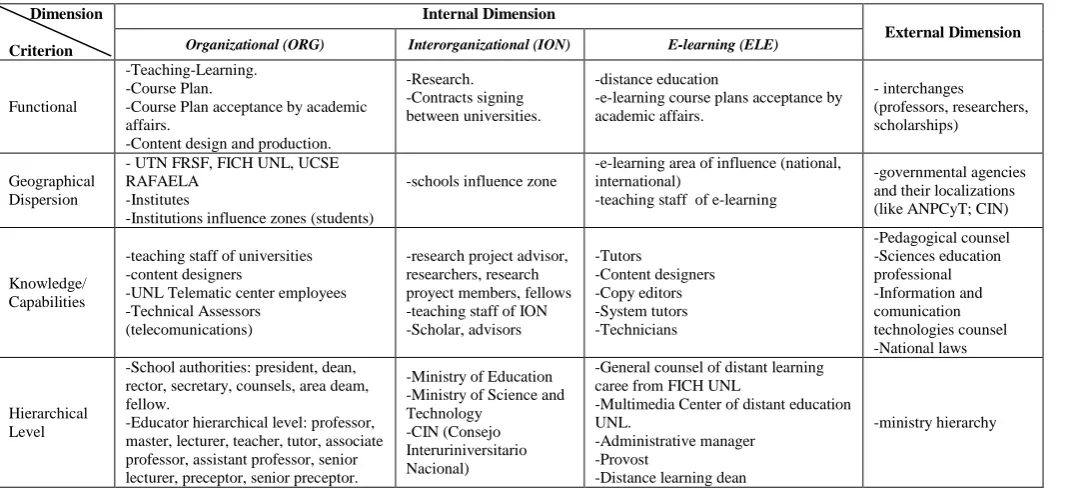
Table 2 shows stakeholders type identified for the case study, according to analysis criteria and dimensions. Rows show the criteria adopted, as it was mentioned before it was considered functional, geographical dispersion, knowledge and capabilities and hierarchical criteria. As regard dimension it was considered two dimensions: internal and external,
where internal dimension has three sub-dimensions: organizational (ORG), interorganizational (ION) and e-learning (ELE).
First row shows tasks affected by the system under consideration. As regards ORG internal dimension, it was considered activities in order to perform traditional learning, for instance course planning, course plan acceptance and content design and production. As regards ELE internal dimension, it was considered distance education, e-learning course planning using ICT and e-learning course plans acceptance. As regards ION internal dimension, it was considered research activities and contracts signing. As regards external dimension the professor interchanges among universities it was considered.
In the geographical criterion row, the ORG internal dimension considers the area of influence of each university. For instance UNL influence on Santa Fe and Entre Ríos states of Argentina. Instead ELE internal dimension shows a growing area of influence covering not only the area proper of ORG but also national and international areas.
Step 2: Specification of stakeholders’ roles
A stakeholder role is a set of attributes that characterize a group of stakeholder and their relation with the ION. This work takes into consideration a subset of roles proposed by the method. Some roles presented in the article for software project development, were adapted for the domain under study:
Table 2. Stakeholders type specification
Dimension
Criterion
Internal Dimension
External Dimension
Organizational (ORG) Interorganizational (ION) E-learning (ELE)
Functional
-Teaching-Learning. -Course Plan.
-Course Plan acceptance by academic affairs.
-Content design and production.
-Research. -Contracts signing between universities.
-distance education
-e-learning course plans acceptance by academic affairs.
- interchanges (professors, researchers, scholarships)
Geographical Dispersion
- UTN FRSF, FICH UNL, UCSE RAFAELA
-Institutes
-Institutions influence zones (students)
-schools influence zone
-e-learning area of influence (national, international)
-teaching staff of e-learning
-governmental agencies and their localizations (like ANPCyT; CIN)
Knowledge/ Capabilities
-teaching staff of universities -content designers
-UNL Telematic center employees -Technical Assessors
(telecomunications)
-research project advisor, researchers, research proyect members, fellows -teaching staff of ION -Scholar, advisors
-Tutors
-Content designers -Copy editors -System tutors -Technicians
-Pedagogical counsel -Sciences education professional -Information and comunication technologies counsel -National laws
Hierarchical Level
-School authorities: president, dean, rector, secretary, counsels, area deam, fellow.
-Educator hierarchical level: professor, master, lecturer, teacher, tutor, associate professor, assistant professor, senior lecturer, preceptor, senior preceptor.
-Ministry of Education -Ministry of Science and Technology
-CIN (Consejo Interuriniversitario Nacional)
-General counsel of distant learning caree from FICH UNL
-Multimedia Center of distant education UNL.
-Administrative manager -Provost
-Distance learning dean
Consultant: they are organizations or persons that give professional advice to companies belonging to ION.
Developer: organizations or persons involved in system development. Usually they are external and have specific knowledge and skills.
Functional beneficiary: someone that is helped by the system under development through its functionalities.
Politician beneficiary: authority that get benefit of promoting the system under development.
Responsible: someone having the job or taking care of the system under development in all steps.
Decider: make a choice about process
development in order to reach agreement.
User: someone that will use and interact with the system under development and apply its results.
Expert: someone knowing the implementation domain. He/She can collaborate in the requirement elicitation.
Step 3: Stakeholders selection
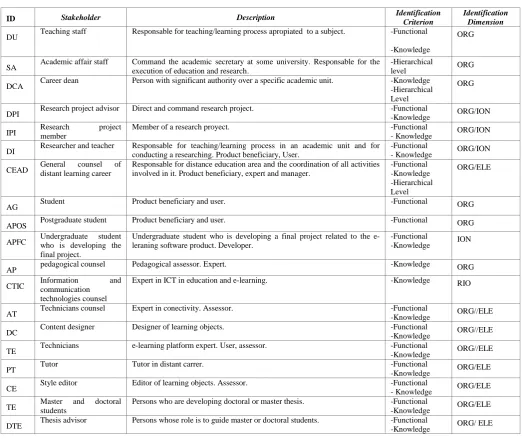
This step guides the correct stakeholder’s selection that meets the characteristics set on dimension criteria mentioned in step 1. The selection was performed based on table 2 where criteria and dimension were set.
Table 3 Stakeholders selection
ID Stakeholder Description Identification
Criterion
Identification Dimension
DU Teaching staff Responsable for teaching/learning process apropiated to a subject. -Functional
-Knowledge
ORG
SA Academic affair staff Command the academic secretary at some university. Responsable for the execution of education and research. -Hierarchical level ORG
DCA Career dean Person with significant authority over a specific academic unit. -Knowledge -Hierarchical Level
ORG
DPI Research project advisor Direct and command research project. -Functional -Knowledge ORG/ION
IPI Research member project Member of a research proyect. -Functional - Knowledge ORG/ION
DI Researcher and teacher Responsable for teaching/learning process in an academic unit and for conducting a researching. Product beneficiary, User. -Functional - Knowledge ORG/ION
CEAD General distant learning career counsel of Responsable for distance education area and the coordination of all activities involved in it. Product beneficiary, expert and manager. -Functional -Knowledge
-Hierarchical Level
ORG/ELE
AG Student Product beneficiary and user. -Functional ORG
APOS Postgraduate student Product beneficiary and user. -Functional ORG
APFC Undergraduate who is developing the student
final project.
Undergraduate student who is developing a final project related to the e-leraning software product. Developer.
-Functional
-Knowledge ION
AP pedagogical counsel Pedagogical assessor. Expert. -Knowledge ORG
CTIC Information communication and
technologies counsel
Expert in ICT in education and e-learning. -Knowledge RIO
AT Technicians counsel Expert in conectivity. Assessor. -Functional -Knowledge ORG//ELE
DC Content designer Designer of learning objects. -Functional -Knowledge ORG//ELE
TE Technicians e-learning platform expert. User, assessor. -Functional -Knowledge ORG//ELE
PT Tutor Tutor in distant carrer. -Functional -Knowledge ORG/ELE
CE Style editor Editor of learning objects. Assessor. -Functional - Knowledge ORG/ELE
TE Master students and doctoral Persons who are developing doctoral or master thesis. -Functional -Knowledge ORG/ELE
L.J. Romero et al.
The results are shown in table 3. Rows represent entities and the columns are: id, stakeholder name, short description, criteria and dimension. For instance, first row shows a university teacher (DU), which is responsible for the teaching-learning process. The criteria used in the identification were
functional and knowledge and the dimension is
internal organization. The difference between DU and PT (row 16) is that PT represents teachers in distance education. This is the reason why the identification dimension column value is ORG/ELE. A university teacher can be motivated to implement e-learning, either university suggestion, by the need to achieve increase number of students or want to take advantage of technology [5]. Note that in case of distant learning the use of technology is mandatory. Teacher has a new challenge in learning the use of that technology. While technology opens up new possibilities for teaching, it demands more time to develop learning objects (LO) suitable for e-learning environment. Even more, teacher must expend time to manage the LO available in the e-learning environment.
A challenge to overcome in e-learning context is the development of a learning environment with two main characteristics: to make easy the design of flexible and customizable LO and to guarantee the LO interchange and reuse. In some case, there is a context designer that help teacher in the development of LO appropriated to different learning context, and suggest correct style for a better communication with students.
Other stakeholders influenced by technology in teaching-learning process are students. They are consumers of e-learning [5].
Through the use of technology, students are encouraged to explore, self-express and feel their influence on the teaching-learning process. It favours communication and cooperation between teachers and students. It makes teaching-learning process more flexible. Students must learn by building knowledge using resources given by teachers. This way of learning is different to the traditional way in which students are passive receptor of lesson.
Table 3 Influences and interest analysis. Stakeholders and roles relationship
Roles
Dimension Criterion stakeholder
Ben
ef
ici
a
ry
R
es
p
o
n
si
b
le
D
ec
ide
r
R
eg
u
la
to
r
Us
er
Ex
p
ert
Co
n
sul
ta
n
De
vel
o
p
er
In
te
rn
al
OR
G
-Functional
-Knowledgment
Teaching staff (Lecturer, preceptor, professor, senior lecturer, senior preseptor, visiting faculty, associated professor, assistant professor, visiting lecturer, etc.)
√ √ √
-Hierarchical L. Academic affairs staff √
EL
E
-Functional -Knowdledge -Hierarchical L.
e-learning area dean √ √ √ √ √
-Functional -Knowdledge
Tutors √ √
-Functional -Knowledge -Hierarchical l.
Administrative manager for e-learning education
√ √ √ √
-Functional -Knowdledge
Content designer √ √
-Functional -knowledge
Style editor √ √
RI
O
-Functional -Knowledge
Research project advisor √ √ √ √
-Functional -Knowledge
Research project member √ √ √
-Functional -Knowledge
Researcher √ √ √
Ex
te
rn
al -Functional -knowledge
Experts on Information and comunication technologies
Through e-learning, students have access to interactive and multimedia courses in web format. The communications technology allows students and teachers interact with each others, in this way they can collaborate and discuss on line a LO concerning to some domain subject. Further, with e-learning, experts can supervise the students’ progress performing a tracing improvement.
With the different systems implemented and support centers, universities look for provide technical assistance to the different actors involved in an e-learning situation on issues related to different forms of education supported by ICT, particularly distance education. Thus, Universities wants to facilitate and coordinate the implementation of courses and careers and enhance partnerships with other national and international organizations.
As result of the use of different tool in e-learning, it has LO in different technological format that are hart to reuse. As a consequence, is necessary to manage LO in order to handle the heterogeneity [12].
In e-learning context interoperability is a main factor to be considered due to the necessity to work with heterogeneous information from autonomous and dynamic sources. In this context, to achieve interoperability is essential identify common conceptualizations in order to define structures that promotes sharing and re utilization of LO.
D. Linking roles with stakeholder
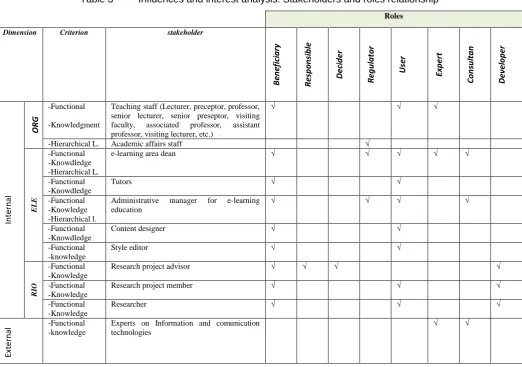
Table 4 shows the links between roles and stakeholders identified. Each stakeholder can have more than one role associated. For each stakeholder identified in previous section classified according to dimension and criteria, there is a tick in the linked role. Ticked cells will represent the existence of a relationship between a particular stakeholder and its associated roles, according to the characteristics and attributes that define the type. For instance, teacher will take advantage of software system because it provides functionalities that make easy some teacher’s tasks such as LO development. Mainly in public universities like UTN and UNL, where it is involve lot of students given as result a massive environment. Event though private universities like UCSE has not mass problem, teachers from this university can take advantage of technology too, because it improves teaching-learning process. Teachers play different roles because they are user and domain expert. From their experience released artifacts taking into account in software development.
E. Analyzing stakeholders’ influences and interest
Once the stakeholders were identified, them the influences and interest of they must be set. Influence means the stakeholders related power in the project. Interest is the measure of relation between the stakeholder necessity and project’s goals and purpose. Table IV shows the influences and interest.
Table 4: Influences and interest analysis
Influence
Low High
In
te
re
st
low CE SA
DCA CTIC
high
AG – AP- APFC-APOS
TE
DPI – IPI – DI - CEAD PT
AP DC
5. Conclusion and future work
Through stakeholders analysis it is possible identified interest and influences of parts involved in teaching-learning process. The correct stakeholder identification maximizes the probability of e-learning success in high education institutions.
This work has shown the application of a method for stakeholder analysis in the requirement elicitation step when a software project development is considered. The analysis involves different aspect, criteria and dimensions that help in the correct identification of stakeholders and their roles. Using a method makes stakeholder identification task be systematized. Further it gives criteria and a guide in software development step.
It was shown the tasks proposed by the method and their modification in order to be applied in e-learning software development for high education level institutions. A case study was developed where different universities were involved. It was evidenced that the method and the proposed modification are appropriated for e-learning tool development due to this method was design for Organization network.
Acknowledgements.
L.J. Romero et al.
References
[1] Gama, J., Gomes de Olivera, J. Da Silva, E. (2003) La evaluación del aprendizaje en los programas de educación a la distancia: Construcción de procesos y alcance de calidad. Universidade do Estado de Rio de Janeiro. Etic@net .ISSN: 1695-324X. Año II Número 4.
[2] Cristea, V., Trausan-Matu, S., Udrea, O. (2003) Sintec e-learning collaborative environment. Proceedings of CSCS14, vol. 2, pp. 63-67. oan Dumitrache (ed.).
[3] Sun, P., Tsai, R., Finger, G., Chen, Y. Yeh, D. (2008). What drives a successful e-Learning? An empirical investigation of the critical factors influencing learner satisfaction. Computer and education. Elsevier, Vol 50, pp 1183-1202.
[4] Guárdia Ortiz, L., Sangrà Morer. A. (). Diseño instruccional y objetos de aprendizaje; hacia un modelo para el diseño de actividades de evaluación del aprendizaje online. Red. Revista de educación a distancia, julio, año/vol. IV, número monográfico OIV. Universidad de Murcia.
[5] Wagner, N., Hassanein, K., Head, M. (2008). Who Is Responsible for E-Learning Success in Higher Education? A Stakeholders' Analysis. Educational Technology & Society, 11(3),
26-36. Retrieved February 17, 2014
from http://www.editlib.org/p/75266.
[6] Ellis, R., Hubble, T., Applebee, A., Peat, M. (2006). Perspectives of stakeholders on eLearning in science education at university. Proceedings of The 23rd Annual Conference of the Australasian
Society for Computers in
Learning in Tertiary Education ASCILITE Who's Learning? Whose Technology?
[7] Ballejos, L., Montagna, M. (2008). Method for stakeholder identification in interorganizational environments. Requirements Eng. vol 13 pp. 281-297. DOI 10.1007/s00766-008-OO69-1. Springer-Verlag.
[8] SCORM 2004. 3rd edition. Sharable Content Object Referente Model. Overview. Versión 1.0. 2006. Advanced Distributed Learning.
[9] Chenti-Belcadhi, C., Henze, L., Rafik-Braham, N. (2004). An assessment Framework for eLearning in the Semantic Web. Proceedings of the Twelfth GI-Workshop on Adaptation and User Modeling in interactive Systems (ABIS 04).
[10] Scalise, K., Gifford, B. (2006). Computer-Based Assessment in E-Learning: A framework for Constructing “Intermediate Constraint” Questions and Tasks for Technology Plataforms. The Journal of Technology, Learning and Assessment. A Publication of the Technology and Assessment Study Collaborative Caroline A.& Peter S. Lynch School of Education, Boston Colege.Volumen 4, número 6. ISSN 1540-2525.
[11] Alexander, I., Robertson, S. (2004). Understanding project sociology by modeling stakeholders. IEEE Software IEEE Computer Society 21(1): pp. 23–27.