91
© Global Society of Scientific Research and Researchers
http://ijcjournal.org/
Multi Agents Classification System with Reliable Measure
of Generalization
Mohammed A. Mohammed
a*, Dr. Ban N. Dhannoon
ba,b
Dept. Computer Science, Al-Nahrain University, Baghdad, Iraq
aEmail: [email protected]
b
Email: [email protected]
Abstract
In this paper an efficient classification system using hierarchal multi_agent's technology based on neural
network is introduced, where each agent implements as a neural network (trained using back propagation
learning algorithm). The system consist of two layers of agents, the top layer contain one agent works as control
agent, its responsibility is to select the right agent from the agents in the lower layer to classify the related
pattern depending on data’s features. Two techniques were used (regularization and earlier stopping criteria) to
select the best one for each data set depending . The system provides a degree of generalization with the ability
to improve it if there is a need for more generalization. The developed system was tested using different
standard datasets obtained from the (University of California, Irvine) UCI Machine Learning Repository for the
empirical analysis of machine learning algorithms. These are (User Knowledge Level, iris, and Banknote
Authentication Dataset).
Keywords: Multi-agent System (MAS); Neural Network (NN); Back Propagation (BP); Classification;
Generalization.
1. Introduction
When agents interacts with each other within a single system, this is called multi_agent system (MAS), which is
a branch of artificial intelligence (AI). Classification is one of the most often encountered decision making tasks
of human action. A classification problem occurs when an entity needs to be assign into a predefined collection
or class depend on a number of observed features associated to that entity and many problems in industry,
science, business, and medicine can be treated as classification problems [1].
---
92
The data classification tasks can be doing by using neural networks. Neural network is a collection of
interconnected units that learn from their environment (data), to get essential nonlinear and linear trends in a
data, so that it supply dependable predictions for new cases including even partial and noisy information [2].
Generalization is one of the most important concepts at any classification system; it is refer to estimating the
value of correct outputs where there is no example [3].
In the developed system, there are multiple agents’ implements as neural networks. These agents work together
as a hierarchal multi-agent system to perform classification task on multiple datasets in optimal time and with
some degree of generalization, it is adopted one of two techniques (regularization or earlier stopping criteria)
depending on analysis the results obtained from experiments for each agent separately.
2. Multi agent systems
Agents are seldom stand-alone systems. In many situations they coexist and interact with other agents in several
different ways. Multi-Agent Systems are becoming popular in the mainstream of development because an agent
tries to process tasks intelligently and autonomously. To take advantage of autonomous control and decrease
running costs. Multi-agent systems have become a chosen paradigm to model and solve real-world problems [4].
3. Artificial Neural Network
Artificial neural networks are systems for information processing that have certain computational properties
similar to those which have been assuming for biological neural networks [5]. ANNs can learn where, they use
knowledge to improve their performance. When exposed to an enough number of training patterns, ANNs can
generalize to others they have not yet seen [6].
The architecture of NN can be of single layer or multilayer. In single layer Neural Network, only one input layer
and one output layer is there, while in multilayer neural network, there can be one or more hidden layer [7]. The
real power of a neural network comes from its pattern recognition capabilities. The neural network should be
able to produce the desired output even if the input has been slightly distorted [8].
4. Learning and Generalization
Learning is a hyper surface reconstruction based on existing examples, while generalization means estimating
the value on the hyper surface where there is no example. Mathematically, the learning process is a nonlinear
curve-fitting process, while generalization is the interpolation and extrapolation of the input data.
The goal of training neural networks is not to learn an exact representation of the training data itself, but rather
to build a statistical model of the process which generates the data. The generalization capability of a network is
jointly determined by the size of the training pattern set, the complexity of the problem, and the architecture of
the network. There are many techniques to improve and measure generalization such as generalization by
93
5. The Developed System
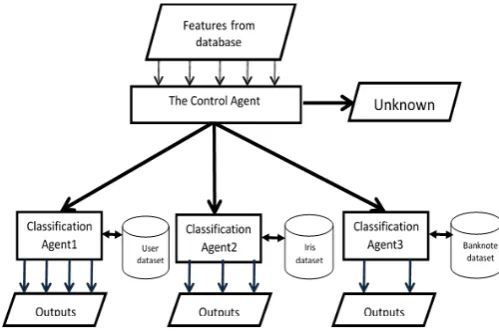
The structure of the developed system is consisting of two hierarchal layers of agents as shown in figure (1).
The neural network that represent each agent composed of three layers with z, c, and p nodes acts as input,
output and hidden layer nodes where p can be computed using equation (1).
p = (z + c) / 2 (1)
for the control agent, the number of nodes in input layer equal to the largest number of the dataset's features,
while its output layer equal to the number of classification agents.
Figure 1: Show the general structure of developed system.
5.1 Train and test the system
Back propagation learning algorithm with pattern mode will be used to train each agent in the system; two
techniques were used to estimate the generalization of the agents, and then picked the best one of them for each
agent. The first one is generalization by earlier stopping criterion and the second one is generalization by
regularization. Noises are added to estimate the generalization, the noise will be generated randomly and take
range suitable to each dataset depending on nature of the data.
5.1.1 Generalization by Earlier Stopping Criteria
Each classification agent will be trained on 60% of dataset, 20% validation set, and 20% test set; Training
should stop at the suitable stopping point according to the validation set error (The generalization error), then
noise will added to test set to estimate the generalization.
5.1.2 Generalization by Regularization
Each classification agent will be trained on 80% of dataset and 20% test set. The cross validation selection
model will be used to select the best training set and testing set, then the noise will be added to the selected test
94
6. Experimental Results
6.1 Classification Agent1
This agent train and test on user knowledge level dataset, overall accuracy of testing classification agent1 by
earlier stopping criteria is shown in table 1, the overall accuracy of testing classification agent1 by regularization
technique is shown in table 2, the generalization was estimated to both techniques and the results were
compared to select the best technique for agent1 as shown in Figure 5 and table 3, where each percent in table3
represents average of five experiments.
Table 1: Overall accuracy agent1 (earlier stopping criteria).
Number of patterns Overall Accuracy Error Rate
81
95.06%
(77 patterns)
4.93%
(4 patterns)
Table 2: Overall accuracy agent1 (regularization technique).
Number of
patterns Overall Accuracy False rate
81 97.53 % (79 patterns) 2.47% (2 patterns)
Table 3: compare the generalization of earlier stopping criteria and regularization technique (agent1).
Noise range earlier stopping
criteria
regularization
technique
0_0.03 92.60% 96.45%
0_0.05 91.36% 94.31%
0_0.07 86.42% 94.81%
0_0.09 83.95% 93.08%
0_0.1 85.20% 90.11%
This comparison demonstrates that the regularization technique is superior to earlier stopping criteria, where the
generalization degree in regularization technique is larger than earlier stopping criteria at all amounts of noise.
95
generalization and the results of analysis shown that the regularization technique by adding noise to enhance
generalization is the best, as indicated by this investigation, regularization technique will be adopted for
classifying agent1.
Figure 5: Comparison earlier stopping criteria and regularization technique (agent1).
6.2 Classification Agent2
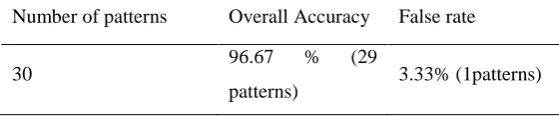
This agent train and test on Iris dataset, overall accuracy of testing classification agent2 by earlier stopping
criteria is shown in table 4, the overall accuracy of testing classification agent2 by regularization technique is
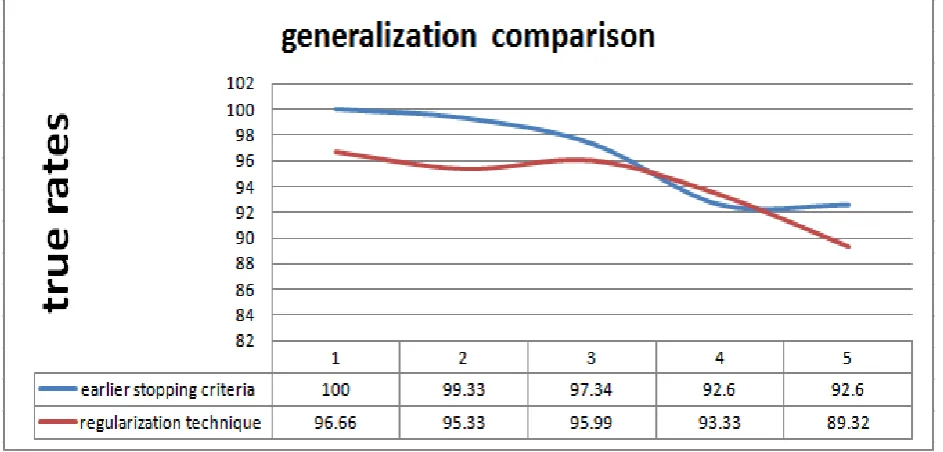
shown in table 5, the generalization was estimated to both techniques and the results were compared to select the
best technique for agent2 as shown in figure 6 and table 6, where each percent in table 6 represents average of
five experiments.
Table 4: Overall accuracy agent2 (earlier stopping criteria).
Number of patterns Accuracy Error Rate
30
100%
(30 patterns)
0.0%
(0 patterns)
Table 5: Overall accuracy agent2 (regularization technique).
Number of patterns Overall Accuracy False rate
30 96.67 % (29
96
Table 6: compare the generalization of earlier stopping criteria and regularization technique (agent2).
Noise range earlier stopping
criteria
regularization
technique
0.05_0.1 100% 96.66%
0.05_0.2 99.33% 95.33%
0.05_0.3 97.34% 95.99%
0.05_0.4 92.60% 93.33%
0.05_0.5 92.60% 89.32%
Figure 6: Comparison earlier stopping criteria and regularization technique (agent2).
This comparison demonstrate that the earlier stopping criteria technique is superior to regularization, where the
generalization degree in regularization technique is less than earlier stopping criteria at most amounts of noise,
this critical condition is adopted to pick the best technique to construct agent2. As indicated by this
investigation, earlier stopping criteria technique will be adopted for classifying agent2.
7. Classification Agent3
This agent train and test on banknote authentication dataset, overall accuracy of testing classification agent3 by
earlier stopping criteria is shown in table 7, the overall accuracy of testing classification agent3 by regularization
technique is shown in table 8, the generalization was estimated to both techniques and the results were
compared to select the best technique for agent3 as shown in figure 7 and table 9, where each percent in table 9
97
Table 7: Overall accuracy agent3 (earlier stopping criteria).
Number of patterns Accuracy Error Rate
274
100%
(274 patterns)
0.0%
(0 patterns)
Table 8: Overall accuracy agent3 (regularization technique).
Number of patterns Overall Accuracy False rate
274 98.91 %( 271 patterns) 1.09 % (3 patterns)
Table 9: compare the generalization of earlier stopping criteria and regularization technique(agent3).
Noise range earlier stopping
criteria Adding noise
0.05_0.1 100% 99.04%
0.05_0.2 99.63% 98.90%
0.05_0.3 98.68% 98.39%
0.05_0.4 97.95% 97.29%
0.05_0.5 95.25% 94.67%
Figure 7: Comparison earlier stopping criteria and regularization technique (agent3).
98
generalization degree in regularization technique is less than earlier stopping criteria at all amounts of noise,
Now critical condition which adopt to choose the best technique to build the agent is the capability to
generalization and the results of analysis above shown that the earlier stopping criteria technique is better one,
according to this analysis will adopted this technique to build classification agent3.
8. The control agent
The results above are shown the best training sets of each agent, these sets will be taken as training set to the
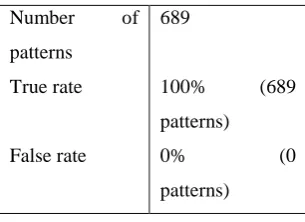
control agent as shown in table 10, while test sets of all agents and validation set of (agent2 and agent3) are
represent test set of control agent as shown in table 11. The results in table 10 and 11 shown that the control
agent give 100% accuracy for each training and testing sets.
Table 10: control agent’s training.
Number of patterns 1235
accuracy 100% (1235 patterns)
error rate 0% (0 pattern)
iterations 162
time 3.166805s
Net error 0.00498
Table 11: Overall accuracy of control agent.
Number of
patterns
689
True rate 100% (689
patterns)
False rate 0% (0
patterns)
9. Conclusion
This paper attempts to improve the efficiency of a classification system by using a hierarchal multi_agent's
technology based on neural network, where each agent implements as a neural network (trained using back
propagation learning algorithm). The system consist of two layers of agents, the top layer contain one agent
works as control agent, its responsibility is to select the right agent from the agents in the lower layer to classify
the related pattern depending on data’s features, it classifies a collection of datasets effectively with some degree
of generalization, when the pattern is belong to the one of datasets, the system reduces the time to (m + n),
where m is the time in control agent, n is the execution time of selected agent. If the pattern is not belonging to
99
were used (regularization or earlier stopping criteria) to select the best one for each data set depending. The
system provides a degree of generalization with the ability to improve it if there is a need for more
generalization. The developed system was tested using different standard datasets obtained from the (University
of California, Irvine) UCI Machine Learning Repository for the empirical analysis of machine learning
algorithms. These are (User Knowledge Level, iris, and Banknote Authentication Dataset).
References
[1] Zhang, G.P., "Neural Networks for Classification: A Survey", Systems, Man, and Cybernetics, Part
C: Applications and Reviews, IEEE Transactions on Vol. 30, No.4, Nov2000.
[2] R. J. Brachman, Yahoo Research, “Synthesis Lectures on Artificial Intelligence and Machine
Learning”, Intelligent Autonomous Robotics, Peter Stone 2007.
[3] S. Russel, Peter Norving, "Artificial intelligence modern approach", 2010.
[4] J. Hao · Ho-fung Leung, “Interactions in Multiagent Systems: Fairness, Social Optimality and
Individual Rationality”, Higher Education Press, Beijing and Springer-Verlag Berlin Heidelberg
2016.
[5] Farooq A.," Biologically Inspired Modular Neural Networks ", Ph.D. thesis, Virginia Polytechnic
Institute and State University, 2000.
[6] M. Negnevitsky., "Artificial Intelligence A Guide to Intelligent Systems", Second Edition Pearson
Education Limited 2005.
[7] A. G., KostaY.P., Gaurang P., Chintan G., “ Initial Classification Through Back Propagation In a
Neural Network Following Optimization Through GA to Evaluate the Fitness of an Algorithm”,
International Journal of Computer Science & Information Technology (IJCSIT), Vol. 3, No. 1, Feb
2011.
[8] D. Gries and Fred B. Schneider, “Fundamentals of the New Artificial Intelligence”, Springer-Verlag
London Limited 2008.
[9] K.Lin Du · M. N. S. Swamy., “Neural Networks and Statistical Learning”, _ Springer-Verlag