21
PREFERRED FORMAT OF TEACHING
TUTORIALS
Nitza Davidovitch, Shmuel E. Schacham, Yuri Ribakov Ariel University Center of Samaria, Ariel, Israel Email: [email protected]; [email protected]; [email protected]
Abstract
Tutorials are an essential part of the academic teaching process. They play an important role in students’ understanding of the material and have a direct infl uence on their fi nal marks. Selection of proper tutoring policy for improving students’ success in engineering disciplines is a subject investigated all over the world. It is common to think that effi ciency of tutorials in smaller groups is higher. However fi nancial considerations limit sub-division of classes into small groups. This paper is focused on the issue of the preferred teacher of these sessions – lecturer (faculty member) or teaching assistant. The current study examines the effect of this administrative decision on students’ performance, as measured by ratings of their teachers, and also by students’ fi nal grades. The infl uence of additional factors like class size, students’ grades, or majors is also examined. Our fi ndings show that there is no signifi cant advantage of tutorials taught by teaching assistants in small groups over those taught by lecturers in plenum.
Keywords: tutorials, teacher ratings, effective learning.
Introduction
In recent years, the Israeli high education system has experienced a dramatic “revolution” through the establishment of a large number of academic colleges. Until a few years ago, the national educational system was based on a relatively small number of rather exclusive universities. After the “revolution” the number of undergraduate students in Israeli colleges has signifi cantly surpassed the number of university students. An important aspect of this transformation is the opportunity given to a larger number of students to complete academic degrees, fi nd better jobs, and improve their potential quality of life. However, to increase access to higher education, colleges have defi ned more lenient and fl exible admission requirements, and have found that students frequently lack a strong scholastic background and deep understanding, especially in the fi eld of natural sciences that form a basis for further successful undergraduate studies at faculties of engineering.
22 a clearer understanding of the problem.
It is common to think that effi ciency of tutorials and laboratory works in smaller groups is higher. Box et al. (2001) have reported on development of a suite of computer-based tutorials as part of teaching laboratory and tutorial classes in Engineering Materials to fi rst year mechanical engineering students. They have demonstrated that dividing an original group of twenty-fi ve into two groups of about twelve increased student activity during the two-hour period. However fi nancial considerations restrain sub-division of classes into small groups.
The Faculty of Engineering at the Ariel University Center of Samaria in Israel has initiated a program for undergraduate students, based on extensive investments in introductory courses, in the form of various preparatory programs and extended teaching hours during the fi rst years of studies. In most engineering courses and in the obligatory “service” courses, required for engineering students, teaching assistants were assigned to teach tutorials. This decision was based on the expectation that teaching assistants could provide more individual assistance and explanations in a small-group set-ting, and would ultimately contribute to students’ achievements in these courses.
An alternative way to improve the students’ success in a course is teaching tutorials by the course lecturer, who has more experience compared to teaching assistants. In this case in order to avoid higher cost of the tutorials, the group is not divided into small subgroups. This paper deals with the effect of the tutorials’ preferred teacher – the course lecturer teaching in plenum or teach-ing assistant teachteach-ing in a small group. The paper is based on students’ ratteach-ings of their teachers and their fi nal grades.
Importance of Tutorials
The rationale behind tutorial sessions is the understanding that certain subjects require more than passive attendance of a frontal lecture. Problems’ solving and drills are essential for the study of engineering disciplines, exact sciences, and all the mathematics-based subjects. Preferably, students should have access to a feedback system, in which their homework is corrected and graded or solved in class. At engineering faculties, where courses are of a more technical nature, tutorials are designed to aid students attain an acceptable level of competence in the technical components of the relevant disciplines and help them with their general understanding of the course material.
Tutorials are a structured opportunity for students to receive additional assistance, when the material that was taught in the frontal lecture is not suffi ciently understood. In this case the tutori-als are aimed to yield deeper feeling of the subject. Tutoritutori-als are tutori-also designed to expand students’ grasp and understanding of the material by providing an opportunity to clarify concepts that must be mastered in order to cope with the course. Good tutorials should include suffi cient time allotted to discussion and accepting students as partners (Ravens, Nitsche, Haag and Dobrev, 2002).
Research literature attests to the essential contribution of tutorials to courses and the teaching assistant is perceived as essential to the success of the course (Hativa, 1997). There is a wide con-sensus that tutorials are basically designed to enhance effective learning (Condravy, 1995; Hawley & Valli, 2000) through the implementation of the principles of retention and application. Condravy (1995) has reported that effective learning is the complete understanding of the material so that it can be applied to situations or new material in the future.
Davis (1996) has suggested that good experiences of teaching and learning in the early stages of an academic education program can have positive and lasting effects on students’ approach to learning, retention and academic success. Studying with graduate teaching assistants (GTAs) is particularly signifi cant for fi rst year students, who are relatively vulnerable to such effects; this vulnerability is even greater for students from minority groups, particularly ethnic minorities (Barrington, 1999). The increase in the number of GTAs in American and UK universities (Barrington, 1999) exposes a large number of students to their teaching.
Models of Tutorials
23 Volume 10, 2009 supplemental instruction (SI) programs). One common model is in which problems pertaining to
homework assignments are dealt with separately, outside of the lectures, in a separate drill session or tutorial. According to this model, the same individual who teaches the lectures also conducts the tutorial sessions for the same class, irrelevant of its size. There may be several drawbacks to this arrangement: group size may be too large to allow effective discussion, or the lecturer may tend to “steal” some of the tutorial time to complete teaching of subjects from the lecture.
In another model, which is widespread in the Israeli academia and around the world, separate tutorial classes are devoted to drills. Larger classes are divided into smaller groups. In addition to problem solving and presentation of more examples these sessions enable the participant to discuss diffi cult issues in smaller groups, thus greatly enhancing the understanding of the material. This is true for most students and particularly for students with a weaker foundation in the subject matter.
Tutorials are designed to facilitate implementation and clarifi cation of the subject matter, and provide a more in-depth understanding by permitting students to discuss the material and ask ques-tions about subjects that they did not fully understand during the lecture. The small group setting allows tutors to establish and maintain more close personal contact with the students.
In the second model several teachers are required to teach relatively small tutorial classes. These teachers, known as teaching assistants or GTAs, are usually graduate students studying towards their master or doctoral degrees at the same institution or adjunct teachers working in the industry and having big professional experience. There are several advantages to employing teaching assistants as teachers for tutorials. One advantage is economical. Teaching costs are reduced, since the cost of a teaching assistant (and even several teaching assistants) is lower than that of a faculty member. Secondly, the teaching experience that the assistants gain may benefi t the institute in the future, since many assistants intend to pursue an academic career and eventually join the faculty. Employ-ing qualifi ed specialists as teaching assistants has also the advantage that students learn important aspects from professionals and get examples not just from the literature, but from the leading en-terprises in their fi eld.
Indeed, proven success as a teaching assistant is known to be an important factor for the career advancement of graduate students, who seek work in the academia after completing their graduate and doctoral degrees (Hativa, 2003). Furthermore, an experienced GTA may have a heightened aware-ness of students’ needs, or the ability to present the material in a manner more easily understood by the students, compared to the professor. Teaching assistants can substitute for the professor in case of emergency, and assist him or her in checking assignments and examinations as well.
Importance of Coordination Between Lecturer and Assistant
Effi cient use of tutorials to promote students’ course learning requires considerable efforts and an ongoing dialogue on part of both lecturer and tutor. It requires lecturers and their teaching assistants to maintain a relationship of interdependence, in which their performance is linked to one another (Davidovitch, 2003). In courses where the tutorials are taught by teaching assistants, there is an important interrelationship between the course lecturer and the teaching assistants, with the functioning of one affecting the functioning of the other (Jane, 2002). Coordination between lecturers and tutors regarding lesson content, level of understanding, type of explanations and illus-trations used and other teaching elements is extremely important (Smith & Walpole, 1998; Martin et al., 1995). Practical methods for enhancing such coordination have also been suggested (Hativa, 1997). Effective utilization of the tutorial for promoting the students’ learning requires that both the professor and the teaching assistant invest considerable time and effort to keep each other up to date on a regular basis.
Attributes of Effective Teaching Assistants
independ-24 ent thinking in the students (Feletti et al., 1982). The teaching assistant should display a positive attitude towards the students (Menges and Mathis, 1988).
Comparing Expert and Non-expert Tutors
The issue of the tutor’s necessary level of expertise has received extensive attention in the lit-erature on the role of the tutor in problem-based learning. The underlying assumption in the tutoring literature is that tutoring is the most effective method of instruction and that expert tutors are better than less skilled ones. Barrows and Tamblyn (1980) and Barrows (1988) state that ideally, tutorial groups are best guided by experts who are competent in subject-matter and in tutoring skills. In a review of studies by Schmidt and Moust (2000) obtained inconclusive results when comparing the academic achievements of students studying with expert staff tutors and non-expert staff tutors, and cited the contradictory results of a large number of empirical studies on this issue.
However, according to Schmidt and Moust (2000), our knowledge of expert tutors is rather lim-ited for several reasons. One of them is that most tutoring studies include typical or less experienced tutors rather than expert ones. There are only a handful of studies in which expert tutors are the focus of the analyses. Other reasons have to do with the expert tutoring studies themselves. It is diffi cult to generalize the results to all expert tutors. It is also the case the there is considerable variability in what constitutes an expert tutor. Graduate students who are paid to work in a university tutoring program may be considered experts tutors in some studies but typical, non-expert tutors in others.
Student Evaluations of Tutorials
Studies show that satisfaction from lecturing in large classes is signifi cantly lower than in small ones (Nevo and Ben Shaul, 2002). On the other hand, most teaching assistants have limited teach-ing experience, and their knowledge of the subject material is usually limited. Research has shown that the faculty members obtain their teaching skills mainly through trial and error. Lecturers with more extensive teaching experience are usually ranked higher by their students than novice lecturers (Hativa, 2001). Therefore, one can expect the students’ satisfaction from inexperienced teaching as-sistants to be lower than their satisfaction from their more experienced lecturers. On the other hand, the younger teaching assistants may present a different perspective of the study material, or offer a superior understanding of students’ needs, leading to higher student satisfaction. These opposing arguments raise the question: Which type of tutorial induces the greatest student satisfaction, and which is most effective?
Methodology of Research
Our research is based on students’ performance as manifested by the fi nal grades, and their satisfaction as refl ected on their feedback surveys. Many faculty members question the validity of these surveys on the grounds that the students’ satisfaction does not necessarily refl ect their learn-ing experience. They claim that frequently the students do not have the capability of assesslearn-ing the lecturers’ contribution to their learning. Therefore, in addition to examining the students’ satisfaction from their teachers of the tutorials, it is also important to examine the relative contribution of each type of tutorial teacher to students’ learning and understanding of the study material, as manifested in their fi nal grade.
On the basis of the aforementioned surveys, the study concentrates on two types of tutorials: taught by lecturers in the class plenum (generally in large classes);
a.
taught by teaching assistants in small groups. b.
Our research questions were formulated are as follows:
Is there a difference in the evaluations given by students for the different types of tutorials? 1.
Is there a difference in the students’ mean grades for the different types of tutorials? 2.
Are there differences between the various academic disciplines with regard to the fi rst 3.
25 Volume 10, 2009 Method and instrument
The study is based on a survey questionnaire (teaching feedback), distributed to the students of the Ariel University Center of Samaria in Israel. The questionnaire comprised the following fi ve items, which the students were requested to evaluate for each course, on a scale of 1-5:
(1) Overall evaluation of the course instructor; (2) Course structure and organization; (3) Clarity of lectures;
(4) Instructor’s attitude to the students; (5) Overall evaluation of the course tutor;
(6) The degree of coordination between course instructor and tutor.
Students were also given space to add their unstructured comments as they desired. In courses, in which lecturers have taught also the tutorial, the students evaluated all seven items (although the last question was irrelevant). In tutorials given by teaching assistants the students evaluated only the two items pertaining to the tutor.
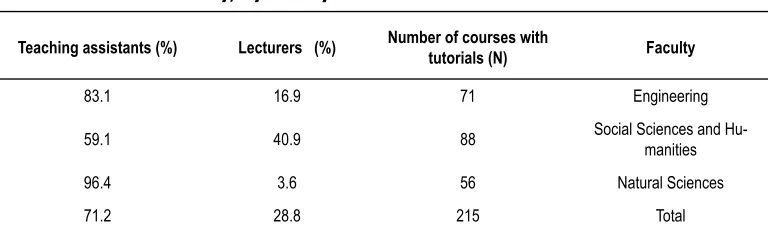
The following data pertains only to courses that were accompanied by a tutorial session. At the time the survey was conducted, there were 222 courses that included tutorial classes. The students in these courses completed 6,319 evaluation questionnaires pertaining to 113 tutors, teaching assistants or lecturers, who also taught tutorials. These results are presented in Table 1, by faculty.
Table 1. Tutor identity, by faculty.
Teaching assistants (%) Lecturers (%) Number of courses with tutorials (N) Faculty
83.1 16.9 71 Engineering
59.1 40.9 88 Social Sciences and Hu-manities
96.4 3.6 56 Natural Sciences
71.2 28.8 215 Total
The table indicates that the vast majority of the tutorials (over three quarters) were conducted by teaching assistants. The exception is the Faculty of Social Sciences and Humanities, where the percentage of tutorials taught by lecturers is signifi cantly higher.
The questionnaire was administered to students in their classrooms during class time, over the fi nal three weeks of the semester. It was explained to the students that the data would be used solely for the purpose of evaluating the lecturers and courses. The questionnaire was anonymous and the time allotted for completion was unlimited. In practice, students completed the questionnaires in approximately 10-15 minutes.
The questionnaires, fi lled by the students of the Faculty of Engineering, were compared to those fi lled by the students at other faculties. The highest percentage of tutorials, taught by teaching assistants, were found in the faculties of engineering and sciences, compared to social sciences, in which one third of all course tutorials are taught by the course lecturers themselves.
Statistical procedures
We used three items from the Students Survey of Faculty (overall evaluation of instructor, overall evaluation of tutor, and extent of coordination between instructor and tutor). We compared students’ achievements and faculty evaluations in courses in which instructors also function as tutors with courses in which lectures and tutorials were given by different individuals.
26
Results of Research
The fi rst research question pertained to the difference between the student evaluations of lecturers, who taught the tutorials (in large classes), and of teaching assistants (in smaller classes). The evaluations were performed on the “general evaluation of the tutor” item. A bidirectional vari-ance analysis was performed, by tutorial teacher and faculty. Tutors were rated on a scale of 1 to 5, where 1 represents the lowest evaluation and 5 represent the highest one. The mean evaluations, by tutorial type and faculty, are presented in Table 2, where N is the number of courses, in which the questionnaires were fi lled by the students. The table also includes the results of the variance analysis of tutors’ evaluations.
Table 2. Variance analysis of evaluation of tutors by tutorial type and faculty.
Tutorial staffi ng
Faculty
Total Lecturers Teaching Assistants
SD Mean N SD Mean N SD Mean N
0.82 4.00 71 0.70 4.21 12 0.84 3.80 59 Engineering
0.85 3.99 88 0.69 4.18 36 0.92 3.80 52 Social Sciences and Humanities
0.71 3.72 56 0.53 3.80 2 0.72 3.64 54 Natural Sciences
0.81 3.91 215 0.68 4.06 50 0.82 3.75 165 Total
The variance analysis indicates that no signifi cant statistical differences were found between evaluation of tutorials taught by the lecturer and those taught by a teaching assistant (F (1,209) =2.13, p>0.05). No differences were found in the analysis by faculty (F (2,209) =0.43, p>0.05), nor was any statistically signifi cant interaction found in the analysis between tutorial type and faculty (F (2,209) =0.09, p>0.05). It is important to note that the number of teaching assistants and lecturers in each faculty is different, and it was taken into consideration in the variance analysis examining the differences by faculty and by tutorial type.
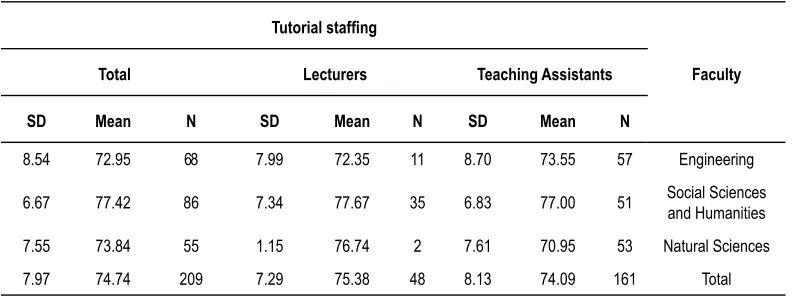
The second research question pertained to the difference in students’ mean grades in courses where the lecturers taught the tutorials and those where the tutors were teaching assistants. A bidi-rectional variance analysis was performed over the students’ fi nal grades, according to tutorial type and faculty. The results are presented in Table 3.
Table 3. Students’ mean grades as percentages, by tutorial type and faculty.
Tutorial staffi ng
Faculty
Total Lecturers Teaching Assistants
SD Mean N SD Mean N SD Mean N
8.54 72.95 68 7.99 72.35 11 8.70 73.55 57 Engineering
6.67 77.42 86 7.34 77.67 35 6.83 77.00 51 Social Sciences and Humanities
7.55 73.84 55 1.15 76.74 2 7.61 70.95 53 Natural Sciences
27 Volume 10, 2009 Table 3 indicates that no differences were found in the students’ grades by tutorial type F (1,203)
=0.39, p>0.05). According to results of a Scheffe test, the differences between the average grades in the various faculties) F (2,209) =4.74, p<0.01) were signifi cant. In the Faculty of Social Sciences and Humanities, the average grade was higher (M=77.42) than at either the Faculty of Engineering (M=72.95) or the Faculty of the Natural Sciences (M=73.84). However, no interaction was found between the course grade by tutorial type and the faculty (F (2,203) =0.71, p>.05).
Conclusions
Tutorials are intended to add clarifi cation, enhance in-depth understanding and the ability to apply the material in the future, as well as to provide an opportunity to respond to and discuss stu-dents’ questions. Therefore, in contrast to lectures attended by dozens and sometimes hundreds of students, tutorials take place in small groups. The tutor’s job is to identify and elucidate the topics, in which students encounter diffi culties, introduce problematic issues in a manner, which is distinct from the lecture presentation, or discuss sources and literature, requiring reading. Tutors – when they are teaching assistants - also function as mediators between students and the lecturer. In engineering courses, and in the natural science courses, such as mathematics and physics, providing background for engineering students, tutorials play an important role in enhancing students’ understanding of the material, and their ability to progress to more advanced and challenging levels of study. Compared to courses at other faculties, engineering and science tutorials are typically taught by teaching assist-ants rather than by the course lecturer in a plenum. Therefore it was interesting to compare students’ evaluations and achievements in these two types of tutorials.
The fi ndings of this study surprisingly show that students do not give higher rating to their experience in tutorials, taught by teaching assistants, compare to tutorials, taught in a plenum by the course instructors themselves. Neither was any signifi cant difference in students’ grades found when comparing both types of tutorials. This fi nding is especially pertinent in engineering and natural science courses, where we expected teaching assistants’ work to have a more signifi cant impact on the students’ outcomes and evaluations.
Like many other academic colleges in Israel and around the world, the Ariel University Center has opened its gates to increase access to higher education for populations who did not traditionally proceed to academic education, due to their failure to meet admission requirements. When we take this fact into account, the fi ndings becomes even more surprising since we would expect teaching assistants in small-group tutorials to be a signifi cant contributor to the achievements and evaluations of students with a frequent lack of a strong scholastic knowledge in natural sciences.
The academic establishment maintains a distinction between the role of the course lecturer and the role of the tutor: While the goal of the course lecturer is to teach at a level that is appropriate for the majority of students in the course, the tutor’s goal is to aid the students in clarifying the material or add a new perspective on diffi cult to understand topics raised in the lecture. Tutorials taught in small groups offer the added advantage of a personal approach, good integration of the study mate-rial, and solving students’ problems of understanding, as well as the fi nancial saving on salaries. Some critics therefore argue that tutorials conducted by course lecturers may not adequately fulfi ll their purpose.
In view of the academic and budgetary considerations, involved in tutorial staffi ng policy and tutorial group size selection, we examined the differences in the students’ evaluations of the tutors who are lecturers in tutorial classes taught in the plenum, and tutors who are teaching assistants in small tutorial classes, and compared students’ grades in courses accompanied by each type of tuto-rial. Our hypothesis was that teaching assistants’ unique understanding of students’ diffi culties would be manifested in students’ higher course grades. We estimated that the importance that the students attach to the tutorials would also be manifested in their satisfaction as refl ected in the student evalu-ation questionnaires.
28 the mean grade between the faculty and the tutorial type. The differences between the faculties in terms of the mean grade for the course are related to other reasons like differences between facul-ties, class size, etc.
The fi ndings of this study indicate that there is no academic justifi cation for dividing course work between lecturers and teaching assistants, since lecturers are equally effective as tutors. The distribution of the work between lecturers and teaching assistants may, however, involve a budgetary advantage and an advantage in terms of training junior faculty members for teaching.
In order to assess the contribution of tutorials to students’ understanding, additional studies should be conducted at a variety of academic institutions using various research methods, including qualitative studies employing interviews, observation and lesson analysis. It is important to study this issue in order to develop an in-depth and well-established approach to staffi ng policy of tutorial classes in the academic curriculum, with special consideration of the diversity of students studying at institutions of higher learning.
References
Barrington, E. (1999). Catching academic staff at the start: professional development for university tutors. HERDSA Annual International Conference, Melbourne, 12-15 July.
Barrows, H.S. (1988). The tutorial process. Springfield, Ill: Southern Illinois University, School of Medi-cine.
Barrows, H.S., & Tamblyn, R.M. (1980). Problem-based learning – an approach to medical education. New York: Springer Publishing.
Bergeron, A. and Paquette, G. (1990). Discovery environments and intelligent learning tools. in Frasson, C. and Gauthier, G. (eds.), Intelligent Tutoring Systems: At the Crossroads of Artificial Intelligence and Educa-tion. Norwood, NJ: Ablex Publishing Corporation.
Box, V.J. Munroe, P.R., Crosky, A.C., Hoffman, M.J., Krauklis, P. and Ford, R.A.J. (2001). Increasing student involvement in materials engineering service subjects for mechanical engineers”, International Journal of Engineering Education, 17(6), 529-537.
Condravy, J. (1995). Tutors learning about learning: An assessment. Research and Teaching in Developmental Education, 11, 2.
Davidovitch, N. (2003). Teaching with quality – study of instructors assessments as a derivative of students background data, curriculum, structure and instructor employment status. The Academic College of Judea and Samaria, Research Authority, Ariel [in Hebrew].
Davis, C. (1996). Teaching support for sessional staff. Proceedings of the 2nd Pacific Rim Conference on the First Year in Higher Education, University of Melbourne, July.
Feletti, G.I., Doyle, E., Petrovic, A. & Sanson-Fisher, R. (1982). Medical students’ evaluation of tutors in a group-learning curriculum. Medical Education, 16(6), 319-325.
Gibbs, G. (1981). Teaching students to Learn, Open University Press, Philadelphia, PA.
Guilherme, A. (2004). Teaching formats for small group philosophy tutorials. Philosophy Pathways 77, 8 Feb.
Hawley, W.D. & Valli, L. (2000). Learner-centered professional development. Research Bulletin No. 27, Au-gust. Phi Delta Kappa Center for Evaluation, Development and Research. Internet: www.pdkintl.org/edres/ resbul27.htm
Hativa, N. (1997) The right teaching practice at university: from theory to practice. Tel Aviv: Tel Aviv Uni-versity, Ramot Publications. [in Hebrew].
Hativa, N. (2001). Teaching for effective learning in higher education. Dordrecht, the Netherlands: Kluwer Academic Publishers.
Hativa, N. (2003). Tips for good instruction at universities and colleges (pp. 157-160). Tel Aviv: Academic publishers for the promotion of teaching staff [in Hebrew].
29 Volume 10, 2009 for Research in Education, Hobart, Tasmania. Internet: www.aare.edu.au/95pap/marte95179.txt
Menges, R.J., & Mathis, C.B. (1988). Key resources on teaching, learning, curriculum, and faculty develop-ment. San Francisco: Jossey-Bass Publishers.
Nevo, B., & Ben Shaul, B. (2002). What can be learned from a satisfaction survey of first year instruction at the University of Haifa? Al Hagova, 1, 25-27, [in Hebrew]
Park, S.E., Susarla, S.M., Cox, C.K., Da Silva, J., & Howell, T.H. (2007). Do tutor expertise and experience in-fluence student performance in a problem-based curriculum? Journal of Dental Education, 71(6), 819-824. Pek, P.K. & Poh, K.L. (2002). Formulation of tutoring policy for maximizing student learning using a decision-theoretical approach. International Journal of Engineering Education, 18 (6), 652-666.
Ravens, U., Nitsche, I., Haag, C. & Dobrev, D. (2002). What is a good tutorial from the student’s point of view? Evaluation of tutorials in a newly published PBL block course Basics of Drug Therapy. Naunyn Schmiedebergs Archives of Pharmacology, 366(1), 69-76.
Schmidt, H.G, & Moust, J.H.C. (2000). Factors affecting small-group tutorial learning: a review of research. In D.H. Evensenm & C.E. Hmeilo (Eds.), Problem-based learning: a research perspective on learning inter-actions (pp. 19-52). Mahwah, NJ: Lawrence Erlbaum.
Smith, A & Walpole., M. (1998). An Australasian experience of the use of selected technologies in the delivery of a legal education program - Some Lessons for faculties and educational program planners. The Journal of Information, Low and Technology, 3. Internet: http://elj.warwick.ac.uk/jilt/98-3/smith.html.
Adviced by Gabi Liberman, Ariel University Center of Samaria, Israel
Nitza Davidovitch Head, Academic Development & Assessment Unit, Ari’el University Centre, Ari’el Israel. E-mail: [email protected]
Website: http://www.ariel.ac.il
Shmuel E. Schacham Dean, Faculty of Engineering, Ariel University Center of Samaria, Ariel, 40700, Israel. Email: [email protected]
Website: http://www.ariel.ac.il
Yuri Ribakov Senior Lecturer, Department of Civil Engineering, Ariel University Center of Samaria, Ariel, 40700, Israel.