Open Access
Methodology
Methods for analyzing cost effectiveness data from cluster
randomized trials
Max O Bachmann*
1, Lara Fairall
2, Allan Clark
1and Miranda Mugford
1Address: 1School of Medicine, Health Policy and Practice, University of East Anglia, Norwich, UK and 2Lara Fairall, Research Fellow, University of
Cape Town Lung Institute, University of Cape Town, Cape Town, South Africa
Email: Max O Bachmann* - [email protected]; Lara Fairall - [email protected]; Allan Clark - [email protected]; Miranda Mugford - [email protected]
* Corresponding author
Abstract
Background: Measurement of individuals' costs and outcomes in randomized trials allows uncertainty about cost effectiveness to be quantified. Uncertainty is expressed as probabilities that an intervention is cost effective, and confidence intervals of incremental cost effectiveness ratios. Randomizing clusters instead of individuals tends to increase uncertainty but such data are often analysed incorrectly in published studies.
Methods: We used data from a cluster randomized trial to demonstrate five appropriate analytic methods: 1) joint modeling of costs and effects with two-stage non-parametric bootstrap sampling of clusters then individuals, 2) joint modeling of costs and effects with Bayesian hierarchical models and 3) linear regression of net benefits at different willingness to pay levels using a) least squares regression with Huber-White robust adjustment of errors, b) a least squares hierarchical model and c) a Bayesian hierarchical model.
Results: All five methods produced similar results, with greater uncertainty than if cluster randomization was not accounted for.
Conclusion: Cost effectiveness analyses alongside cluster randomized trials need to account for study design. Several theoretically coherent methods can be implemented with common statistical software.
Background
Cluster randomized trials are commonly used to evaluate the effectiveness and cost effectiveness of interventions in health care, health promotion and health professional education. Groups of individuals, such as doctors' patients or schools' pupils, are allocated together to receive different interventions or to follow usual practice. One key advantage of randomly allocating groups rather than individuals is that it permits inferences about the intervention's effects on service providers as well as on
users. For example, in a trial of an educational interven-tion aimed at doctors, allocating doctors together with their patients permits inferences about the intervention's effects on doctors as well as on their patients. But cluster randomization tends to reduce the statistical power and precision of trials because of similarities between individ-uals within each cluster, compared to individindivid-uals in other clusters. This similarity, or non-independence, is expressed as an intra-cluster, or intra-class, correlation coefficient (ICC) [1]. The ICC is the proportion of
Published: 6 September 2007
Cost Effectiveness and Resource Allocation 2007, 5:12 doi:10.1186/1478-7547-5-12
Received: 14 May 2007 Accepted: 6 September 2007
This article is available from: http://www.resource-allocation.com/content/5/1/12
© 2007 Bachmann et al; licensee BioMed Central Ltd.
response variance that occurs between clusters, as a pro-portion of the total variance (within and between clus-ters) [1]. Statistical methods for comparing outcomes in cluster randomized trials are now well developed [1,2]. But there has been little methodological research on appropriate methods for jointly analyzing cost and effec-tiveness data from cluster randomized trials [3,4].
Cost effectiveness analysis with individual level costs and outcomes is more complex than analysis of effects or costs alone, because differences in costs and differences in out-comes need to be analysed together. Uncertainty about cost effectiveness estimates can be quantified as confi-dence intervals for incremental cost effectiveness ratios (ICERs), or probabilities that interventions are cost effec-tive, using two general approaches [5]. One approach combines cost and effect data on a two dimensional cost effectiveness plane (for example, Figure 1) [5-7]. It models the cost difference in one dimension and the outcome dif-ference in the other, taking into account their variances and covariance and producing a cost effectiveness ellipse. The other approach combines cost and outcome measures for each individual by calculating net benefits, which are then compared between trial arms [4,8,9]. Both general approaches can be used for cluster randomized trials [3,4].
Clustering of costs and of outcomes is often neglected in economic evaluations alongside cluster randomized trials that have individual cost data. Several economic evalua-tions alongside cluster randomized trials have used boot-strapping to deal with asymmetrically distributed costs [10-12], but without specifying whether they sampled individuals or clusters. If they simply sampled individuals then cluster randomization design effects would not have been accounted for. Other studies adjusted for clustering using hierarchical regression models to estimate cost dif-ferences and outcome difdif-ferences and their variances [13,14]. They then used these values to plot confidence ellipses. But neither of these two studies estimated ICER confidence intervals or considered correlations between costs and effects. Others have adjusted for clustering when comparing costs and comparing outcomes, but without estimating ICERs or probabilities that the intervention was cost effective [15].
In this paper we describe several appropriate methods for analyzing cost effectiveness data from cluster randomized trials. We show how to apply these methods using data from one such trial [16].
Example
This cluster randomized trial evaluated an educational intervention aimed at improving the management of lung disease in adults attending South African primary care
clinics [16]. Forty clinics were randomized to intervention or control arms. In each clinic 50 patients were inter-viewed at baseline and 3 months later. The trial outcome, indicating appropriate care, was defined as present if a patient was 1) newly diagnosed as having tuberculosis or 2) treated with inhaled corticosteroids for asthma or 3) referred for higher level care in the presence of defined indicators of severe illness. Health service costs were measured for each subject and included costs of clinic and hospital attendance, investigations, drugs, ambulance transport and the educational intervention. Complete data were available on 1856 patients. The prevalence of desirable outcome was 21% in the intervention arm and 11% in the control arm (odds ratio 2.2, 95% CI adjusted for clustering 1.5–3.2, ICC = 0.061). Costs were positively skewed, with mean costs of 220 South African Rand (ZAR) (median 159, interquartile range 77–266) in the interven-tion arm and ZAR 205 (median 140, interquartile range 70–218) in the control arm, and ICCs of 0.01 in each arm. The point estimate for the incremental cost effectiveness ratio was thus ZAR150 per unit or effect ((ZAR 220–205)/
Cost effectiveness plane from bootstrap sampling of individu-als, or clusters then individuals
Figure 1
Cost effectiveness plane from bootstrap sampling of individu-als, or clusters then individuals.
Individuals sampled
-60 -40 -20 0 20 40 60 80
0 0.02 0.04 0.06 0.08 0.1 0.12 0.14 0.16 0.18 0.2
Outcome difference
Cos
t di
ff
er
enc
e
Clusters then individuals sampled
-80 -60 -40 -20 0 20 40 60 80
0 0.02 0.04 0.06 0.08 0.1 0.12 0.14 0.16 0.18 0.2
Outcome difference
C
o
st
di
ff
er
en
(21%–11%)). Net benefits were not normally distributed. At willingness to pay of zero they were, by definition, the negative of costs, that is, with negative values and nega-tively skewed. At higher willingness to pay levels, net ben-efits were bimodal, depending on whether subjects had experienced the outcome or not. The ICC for net benefits ranged from 0.01 (at willingness to pay of zero) to 0.036 (at willingness to pay of ZAR2000). These ICCs indicated that clustering of costs and outcomes needed to be accounted for. The remainder of this paper shows how this can be done. For each method we outline the analytic principles, describe how they were implemented with Stata [17] or WinBUGS [18] software, and show the results.
Methods
1. Joint modelling of costs and effects
1.1 Bayesian parametric model
Nixon and Thompson have shown how to model costs and effects jointly for individually randomized trial data [7]. We have adapted the model to cluster randomized tri-als. We assume that we have two treatments which we
wish to compare. In general, we assume that cost (C) and
effectiveness (E) have distributions which can be
charac-terised by their means and variances:
where is the mean cost for the ith the individual in the
jth cluster in arm k of the trial and is the standard
devi-ation of the cost. Similarly is the mean effectiveness
for the ith the individual in the jth cluster in arm k of the
trial and is the standard deviation of the
effective-ness. We assume that we can model the mean cost and effectiveness as a linear combination:
In equation (2), αC is the average cost for the control
treat-ment and is the additional cost for treatment k (by
default = 0); is the deviation from the average cost
of centre j. It is possible to extend this model to allow for
covariates [7]. Similarly, in equation (3) αE is the average
effect, or outcome, for the control treatment and is the
additional effect of treatment k (by default = 0); is
the deviation from the average effectiveness of centre j. βk
is a parameter which allows for the relationship between
costs and effects, φj and allows this to vary between
clus-ters. From this model we can define the ICER as:
We also define the probability that the intervention is cost
effective (for a given willingness to pay, say λ) as Pr(eλ– c
> 0), where e is the effect and c is the difference in cost.
In our example we shall compare two models, one ing a normal distribution for the costs and another assum-ing a gamma distributions for the costs. Both models will assume a Bernoulli distribution for the effectiveness since this was a binary outcome measure. In both the normal and gamma distribution models we shall assume a linear link function (although traditionally a log link function would be used for the gamma distribution in order to ensure that the mean was estimated to be above zero). For the Bernoulli model we shall assume a logit link function since this is the standard model for effectiveness in clinical trials with binary outcome data. None of these models allow for individual (or cluster) level covariates.
In order to complete the Bayesian specification of the model we must assign prior distributions to all the unknown parameters. The particular priors that we shall use are:
All other parameters are assumed to follow a normal dis-tribution with large variance.
1.2 Non-parametric bootstrapping
We can apply the bootstrap to the model defined by equa-tion (1) whilst allowing both for the relaequa-tionship between the cost and the effectiveness and for the non-independ-ence of the cost and the effectiveness due to clustering of the data. This method has the advantage of not assuming a specific distribution for either the cost or the effective-ness [19].
The following algorithm will construct a bootstrap sample
of K replications with m clusters each of size w. However
this particular algorithm is only applicable in the situa-tion where each cluster is of the same size; alternative algorithms are appropriate when this assumption is not
c
e
ijk ijkC ijkC
ijk ijkE ijkE
~ , )
~ , )
Dist(
Dist(
µ σ µ σ
µijkC
σijkC
µijkE
σijkE
µijkC =αC+τkC+ηCj ,
µijkE =αE+τkE+ηjE+(βk+φj)(cijk−µijkC),
τkC
τ1C ηjC
τkE
τ1C ηCj
ICER
C
E = τ
τ
2
2 .
η σ η σ
β σ φ σ
η η
β φ
j E
E Cj C
k j
N N
N N
~ ( , ) ~ ( , )
~ ( , ) ~ ( , )
0 0
0 0
2 2
true [19,24]. The relationship between costs and effective-ness is retained due to their joint sampling.
Bootstrap algorithm
1. For the observed data set estimate the ICER, say ICER0;
2. For i in 1 to K
a. For j in 1 to m
i. Randomly select (with replacement) a cluster centre, say
kj
ii. Within that cluster randomly select (with replacement)
w sets of costs and effectiveness, these must be selected
together in order to preserve the relationship between costs and effectivess.
b. Estimate the ICER on the basis of the bootstrap sample
constructed in part a (say ICERi), as the difference
between treatment and control groups in mean costs, divided by the difference in mean outcomes.
Confidence intervals can then be constructed for the ICER in various ways [22]. We shall use the bias corrected accel-erated percentile method [17]. We also estimated the probability that the intervention was cost effective. This was the proportion of iterations in which the effect, mul-tiplied by the corresponding willingness to pay per effect, was greater than the cost difference.
2. Regression-based models of net benefits
The calculation of net benefits reduces costs and effective-ness to a single variable which can be used in standard
regression analyses [5]. We define the net benefit (nb) as,
nbijk = eijkλ– cijk,
Where, as before, eijk is the effectiveness on the ith person
in the jth cluster in arm k, λis the money society would be
willing to pay for a unit of effectiveness, and cijk is the cost.
Net benefit is expressed in monetary terms and so is also called net monetary benefit.
In a standard simple linear regression model with net ben-efit as the outcome variable and trial arm as the explana-tory variable, the regression coefficient for the treatment term represents the incremental net benefit attributable to the intervention, for that level of willingness to pay. Will-ingness to pay is explored for a range of levels because it is usually not known. To estimate the corresponding incre-mental net benefit, 95% confidence limits and P values, a separate regression analysis is done at each willingness to pay level.
The intervention is defined to be cost effective, at a given willingness to pay level, if the corresponding incremental net benefit is greater than zero. Therefore the probability that the intervention is cost effective at a given willingness to pay level is the probability that the incremental net benefit is greater than zero. If the coefficient is greater than zero, then the probability that the intervention is cost effective is one minus half the one sided P value for the treatment term. If the coefficient is less than zero, then the probability that the intervention is cost effective is half the one sided P value. In Bayesian models the probability that the intervention is cost effective is the predictive probabil-ity that the net benefit is greater than zero. If the model is estimated using the Markov chain Monte Carlo method this is simply estimated as the proportion of iterations for which the incremental net benefit is greater than zero.
The ICER and its confidence limits can also be estimated
from these regression results because the values of λ at
which the 95% confidence intervals of the incremental net benefit estimate are equal to zero are thus the 95% confidence intervals of the ICER [5]. These can be esti-mated from the estiesti-mated incremental net benefits, and their confidence limits.
Net benefit regression has previously been used to analyse cost effectiveness data from multi-centred trials [4,9], and can be adapted to account for cluster randomization in various ways. We detail three possible methods.
2.1 Least squares regression of net benefits with robust estimates of standard errors
The standard error from the traditional regression model will be inaccurate and lead to an underestimation of the standard errors of the parameter estimates, but it is possi-ble to compensate for this by using the Huber-White sand-wich estimator [17]. The Huber-White sandsand-wich estimator accounts for the non-independence of observa-tions within each cluster. However, because it adjusts the standard errors post estimation the likelihood-ratio test statistics are not applicable.
2.2 Least squares regression of net benefits with a hierarchical model
Hierarchical (multi-level) linear regression models account for clustering of net benefits by modelling indi-viduals at the first level and clusters at the second. We used Stata's xtmixed procedure [17] to specify a hierarchical model with net benefit as outcome, with trial arm as explanatory variable and with coefficients and intercepts varying randomly between clusters. In particular, we con-sider a model of the form:
nbijk = µijk + εijk
Where µ is the overall mean net benefit, τ2 is the addi-tional net benefit associated with the treatment arm (by
default τ2 = 0), θj is the deviation in net benefit due to the
jth clusters centre and vj,k is the deviation in net benefit in
centre j (by default all v1,k are zero).
2.3 Net benefit regression with a Bayesian hierarchical model
Spiegelhalter [24] described a Bayesian two level linear regression model for comparing continuous outcomes in cluster randomized trials, defined as follows:
nbijk~ N (µijk, σ2),
µijk = µ+ τk + θj,
Where, µis the mean net benefit for the control arm; τ2 is
the additional net benefit associated with the treatment
arm (by default τ1 = 0); and θj is the deviation in net
ben-efit due to the jth clusters centre. In order to complete the
model description we shall use the following prior distri-butions:
τ2 ~ N(0,100000)
µ~ N(0,100000)
This model must be estimated separately for each level of willingness to pay. It could be extended by including an additional random effect of incremental net benefit by centre.
Results
Joint models of cost and effect
The joint models were fitted using WinBUGS. In particu-lar we ran the Bernoulli-Normal and Bernoulli-Gamma models with random intercept defined by equations 2 and 3. We ran the models for 10,000 iterations, using the first 5,000 as burn-in and the remaining 5,000 were thinned at an interval of 5 in order to give an approximately inde-pendent sample. We found that the best fitting model, as indicated by the smallest deviance information criterion,
was the Bernoulli-Gamma model including φj. This model
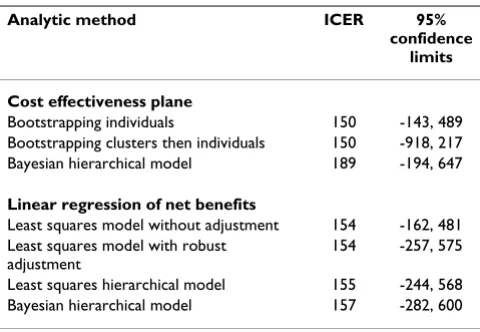
gave an ICER of 189 (95% CI -194 to 647) (Table 1) with probabilities of being cost effective as shown in Figure 2.
All of these models gave similar probabilities of being cost effective.
The non-parametric bootstrap was carried out with 1,000 bootstrap replications and gave an ICER of 150 (95% CI -918 to 217), the results are shown in Table 1 and in Figure 2. Applying the bootstrap while ignoring the clusters and simply randomly selecting individuals and costs resulted in the same estimated ICER but with much narrower con-fidence intervals. These results are summarised in Table 1 and Figure 2. The long left tail of the ICER distribution was due to bootstrap samples that produced moderate (negative) differences in costs accompanying small effects, resulting in large negative ICERs.
θj ~N( ,0σθ2)
vjk ~N( ,0σ2jk)
θj ~N( ,0σθ2)
σθ2~ ( ,U 0 100000)
Cost effectiveness acceptability curve: probability that the intervention was cost effective for different levels of willing-ness to pay and with different analytic methods
Figure 2
Cost effectiveness acceptability curve: probability that the intervention was cost effective for different levels of willing-ness to pay and with different analytic methods.
0 0.1 0.2 0.3 0.4 0.5 0.6 0.7 0.8 0.9 1
0 100 200 300 400 500 600 700 800 900 1000
Willingness to pay for an effect
Pr
o
b
ab
il
it
y th
at
in
te
rven
ti
o
n
i
s
co
st
ef
fect
iv
e
Cost effectiveness plane from bootstrap of individuals
Cost effectiveness plane from bootstrap of clusters then individuals
Cost effectiveness plane from Bayesian hierarchical model
Net benefit regression with least squares model and robust adjustment
Net benefit regression with least squares hierarchical model
Net benefit regression with Bayesian hierarchical model
Table 1: Incremental cost effectiveness ratios (ZAR). Incremental cost effectiveness ratios (in South African Rand)
Analytic method ICER 95%
confidence limits
Cost effectiveness plane
Bootstrapping individuals 150 -143, 489
Bootstrapping clusters then individuals 150 -918, 217
Bayesian hierarchical model 189 -194, 647
Linear regression of net benefits
Least squares model without adjustment 154 -162, 481
Least squares model with robust adjustment
154 -257, 575
Least squares hierarchical model 155 -244, 568
Bayesian hierarchical model 157 -282, 600
Net benefit models
The standard linear regression model gave an estimated ICER of 154 (95% CI -162 to 481); once the robust stand-ard errors were taken into account the confidence interval for the ICER increased to (-257 to 575). The least squares hierarchical model resulted in an estimated ICER of 155 (95% CI -244 to 568) and the Bayesian hierarchical model had an estimated ICER of 157 (95% CI -282,600). These results are contained in Table 1 and Figures 2 and 3.
Discussion
We have demonstrated how individual cost and outcome data from cluster randomized trials can be analysed in var-ious ways with widely available software. In our example different appropriate methods produced similar results. Predictably, adjusting for clustering resulted in greater uncertainty about ICERs, and lower probabilities that the intervention was cost effective, compared to methods that ignored clustering. Of all our results, the ICER confidence intervals from 2 stage bootstrapping differed most from confidence intervals from other methods. ICER point esti-mates were similar (150–157) except for the Bayesian hierarchical joint model of costs and effects (189) because the latter assumed a gamma distribution of costs.
To be able to interpret ICER confidence intervals that include zero, one needs to plot uncertainties about differ-ences in costs and effects on a cost effectiveness plane (Fig-ure 1). This is because, if the cost effectiveness ellipse extends to non-adjacent quadrants, a negative ICER confi-dence interval is uninterpretable. This is because it com-bines information about dominant situations with greater
costs and worse outcomes, and situations with lower costs and better outcomes [5]. But in this example the negative ICER represented the latter situation only (Figure 1). That is, even if society was willing to pay up to these amounts
(the lower confidence limits in Table 1) to avoid one unit
of effect, the intervention would still be cost effective because of cost saving. So the lower confidence limit, which is reassuring, is here of less interest than the upper confidence limit, which shows how much might have to be paid for an effect.
Our example of one trial has limited generalizability, which would be enhanced by comparing these methods using different data from other trials and from simula-tions. Problems could potentially occur with fewer clus-ters or with varying numbers of individuals per cluster. For example, Flynn and Peters used simulated data to show that, with 24 or fewer clusters per arm, Stata's boot-strap ICER estimates may be spuriously precise [3]. They also found that Stata's robust adjustment performed bet-ter than its bootstrap procedures in estimating cost differ-ences [23]. Net benefit regression may be invalid with small samples if net benefits are not normally distributed. In this example, however, estimates from net benefit regression were similar to nonparametric bootstrap esti-mates, as predicted by the central limit theorem. The boot-strap methods we describe may be inappropriate if cluster sizes vary [3,20], in which case more sophisticated meth-ods might be needed [24]. Net benefit regression models and Nixon's and Thompson's two dimensional model [7] need not assume equal cluster size. Nixon's and Thomp-son's model has several other advantages. It can accom-modate various cost distributions, does not need to be repeated at different willingness to pay levels, does not need separate regression analyses to estimate ICER confi-dence intervals, and can produce the cost effectiveness ellipse needed to interpret a negative ICER. Two stage bootstrapping has similar advantages, but we found its results to be unreliable over repeated analyses, even with 10000 iterations. A pragmatic approach is to check the robustness of the primary analysis by also using another method, especially if there are few clusters or if their sizes vary.
Competing interests
The author(s) declare that they have no competing inter-ests.
Authors' contributions
MOB conceived of the paper, chose the statistical meth-ods, carried out the Stata analyses, and was lead writer of the paper and co-investigator of the randomised trial and economic evaluation. LF carried out Stata analyses and was principal investigator of the trial and the economic evaluation. AC helped choose the Bayesian models and
Incremental net benefit at different levels of willingness to pay per unit of effect: 95% confidence limits estimated with different regression models
Figure 3
Incremental net benefit at different levels of willingness to pay per unit of effect: 95% confidence limits estimated with different regression models.
-75 -25 25 75 125
0 100 200 300 400 500 600 700 800 900 1000
Willingness to pay for an effect
In
c
re
m
e
n
ta
l n
e
t b
e
n
e
fit
Mean
Publish with BioMed Central and every scientist can read your work free of charge "BioMed Central will be the most significant development for disseminating the results of biomedical researc h in our lifetime."
Sir Paul Nurse, Cancer Research UK
Your research papers will be:
available free of charge to the entire biomedical community
peer reviewed and published immediately upon acceptance
cited in PubMed and archived on PubMed Central
yours — you keep the copyright
Submit your manuscript here:
http://www.biomedcentral.com/info/publishing_adv.asp
BioMedcentral
carried out and described the WinBUGS analyses. MM was a co-investigator on the economic evaluation. All authors contributed to writing the paper and read and approved the final manuscript.
Acknowledgements
We are grateful our colleagues in the Practical Approach to Lung Health in South Africa team whose data we used for this study: Merrick Zwarenstein, Eric Bateman, Carl Lombard, Rene English, Bosielo Majara, Gina Joubert, Angeni Bheekie, Pat Mayers, Annatjie Peters and Ronald Chapman. Merrick Zwarenstein and Gina Joubert commented on the manuscript. We thank the reviewers, Andrew Willan and Terry Flynn for their comments.
References
1. Donner A, Klar N: Design and Analysis of Cluster Randomization Trials in Health Research London: Hodder Arnold; 2000.
2. Special Issue: Design and Analysis of Cluster Randomized Tri-als. Stat Med 2001, 20:329-496.
3. Flynn TN, Peters TJ: Cluster randomized trials: another prob-lem for cost-effectiveness ratios. Int J Technol Assess Health Care
2005, 21:403-9.
4. Manca A, Rice N, Sculpher MJ, Briggs AH: Assessing generalisabil-ity by location in trial-based cost-effectiveness analysis: the use of multilevel models. Health Econ 2005, 14:471-85. 5. Drummond MF, Sculpher MJ, Torrance GW, O'Brien B, Stoddart :
Methods for the Evaluation of Health Care Programmes 3rd edition. Oxford: Oxford University Press; 2005:247-268.
6. Briggs A: Handling uncertainty in economic evaluation and presenting the results. In Economic Evaluation in Health Care. Merg-ing Theory with Practice Edited by: Drummond M, McGuire A. Oxford: Oxford University Press; 2001:172-214.
7. Nixon RM, Thompson SG: Methods for incorporating covariate adjustment, subgroup analysis and between-centre differ-ences into cost-effectiveness evaluations. Health Econ 2005,
14:1217-1229.
8. Hoch JS, Briggs AH, Willan AR: Something old, something new, something borrowed, something blue: a framework for the marriage of health econometrics and cost-effectiveness anal-ysis. Health Econ 2002, 11:415-430.
9. Willan AR, Briggs AH, Hoch JS: Regression methods for covari-ate adjustment and subgroup analysis for non-censored cost-effectivenessdata. Health Econ 2004, 13:461-475.
10. Sullivan SD, Lee TA, Blough DK, Finkelstein JA, Lozano P, Inui TS, Fuhlbrigge AL, Carey VJ, Wagner E, Weiss KB: A multisite rand-omized trial of the effects of physician education and organ-izational change in chronic asthma care: cost-effectiveness analysis of the Pediatric Asthma Care Patient Outcomes Research Team II (PAC-PORT II). Arch Pediatr Adolesc Med
2005, 159:428-34.
11. Goodacre S, Nicholl J, Dixon S, Cross E, Angelini K, Arnold J, Revill S, Locker T, Capewell SJ, Quinney D, Campbell S, Morris F: Rand-omized controlled trial and economic evaluation of a chest pain observation unit compared with routine care. BMJ 2004,
328:254.
12. Gilbert FJ, Grant AM, Gillan MG, Vale LD, Campbell MK, Scott NW, Knight DJ, Wardlaw D, Scottish Back Trial Group: Low back pain: influence of early MR imaging or CT on treatment and out-come-multicenter randomized trial. Radiology 2004,
231:343-51.
13. Johnston K, Gray A, Moher M, Yudkin P, Wright L, Mant D: Report-ing the cost-effectiveness of interventions with nonsignifi-cant effect differences: example from a trial of secondary prevention of coronary heart disease. Int J Technol Assess Health Care 2003, 19:476-89.
14. Morgan K, Dixon S, Mathers N, Thompson J, Tomeny M: Psycholog-ical treatment for insomnia in the regulation of long-term hypnotic drug use. Health Technol Assess 2004:8.
15. Venning P, Durie A, Roland M, Roberts C, Leese B: Randomized controlled trial comparing cost effectiveness of general prac-titioners and nurse pracprac-titioners in primary care. BMJ 2000,
320:1048-53.
16. Fairall L, Zwarenstein M, Bateman EB, Bachmann MO, Lombard C, Majara B, Joubert G, English R, Bheekie A, Mayers P, Peters A, Chap-man R: Educational outreach to nurses improves tuberculosis case detection and primary care of respiratory illness: a pragmatic cluster randomized controlled trial. BMJ 2005,
331:750-754.
17. StataCorp: Stata Statistical SoFtware: Release 9 College Station, TX; 2005.
18. Spiegelhalter D, Thomas A, Best N, Lunn D: WinBUGS User Manual. Version 1.4.1 [http://www.mrc-bsu.cam.ac.uk/bugs].
19. Davison AC, Hinkley DV: Bootstrap Methods and Their Application
Cambridge: Cambridge University Press; 1997:100-102.
20. Barber JA, Thompson SG: Analysis of cost data in randomized trials: an application of the non-parametric bootstrap. Stat Med 2000, 19:3219-36.
21. Carpenter J, Bithell J: Bootstrap confidence intervals: when, which, what? A practical guide for medical statisticians. Stat Med 2000, 19:1141-64.
22. Spiegelhalter DJ: Bayesian methods for cluster randomized tri-als with continuous responses. Stat Med 2001, 20:435-452. 23. Flynn TN, Peters TJ: Use of the bootstrap in analysing cost data
from cluster randomized trials: some simulation results. BMC Health Services Res 2004, 4:33.