R E S E A R C H
Open Access
Microbial contamination of toothbrushes during
treatment with multibracket appliances
Johanna Eichenauer
1, Julia von Bremen
2*and Sabine Ruf
2Abstract
Introduction:It was aimed to assess the retention of caries-associated microorganisms on two different manual toothbrushes (conventional and tapered) and to evaluate the influence of multibracket appliances (MB) on the microbial contamination of the brush head.
Methods:50 MB-patients and 50 subjects without MB received a toothbrush (elmex® interX medium short head or meridol®) plus toothpaste (elmex®) for exclusive use and an information sheet with standardised brushing
instructions. After 14 days of regular tooth brushing, the brushes were collected and sluiced in Sputasol solution. The suspension was incubated on selective agar plates and the amount of Streptococcus mutans, lactobacilli and Candida albicans for each brush head was assessed.
Results:Regarding the retention of microorganisms, no differences could be detected between the two bristle designs. However, the amount of S. mutans was significantly higher on brushes used by MB-patients (p < 0.005) than on the brushes of subjects without MB. The number of Lactobacilli and C. albicans was minimal in all cases and below statistical evaluation.
Conclusions:During treatment with MB appliances, toothbrushes were contaminated more intensely with S. mutans independent of bristle design. A more frequent replacement of toothbrushes may thus be recommended for patients undergoing MB-treatment.
Keywords:Microbial contamination, Toothbrush design, Multibracket therapy
Introduction
As a result of increasing health consciousness and de-mand for an aesthetic dentition with ideal function the total amount of patients undergoing orthodontic treat-ment has increased during the last years. According to the guidelines of health care systems over one third of adolescents require orthodontic therapy nowadays [1] and the majority of these treatments is performed with multibracket (MB) appliances. However, particularly treat-ment with MB appliances is challenging with regard to oral hygiene, which is why white spot lesions remain to be the most frequent undesired side effect of orthodontic treatment. The insertion of fixed appliances alters the oral microbiological profile, thus increasing the risk for caries and gingivitis considerably [2-4]. Furthermore, caries and gingivitis prevention demands greater efforts in
toothbrushing, since brushing becomes more complicated as substantial parts of the tooth surface are covered with attachments [5].
An ideal design for toothbrushes used during ortho-dontic treatment is not yet agreed on [6]. Repeatedly suspected advantages of electrical toothbrushes couldn´t be confirmed [6,7], so it remains mainly up to the pa-tient what kind of toothbrush he or she prefers and is able to use effectively. For the last couple of years man-ual toothbrushes with soft conical filaments (tapered bristles) have been available on the market. These are recommended in particular for patients with periodontal problems or after oral surgery. Barnes et al. [8] commen-ted on superior approximal and subgingival cleaning efficacy of brushes with tapered bristles. Furthermore tapered brushes have been shown to be superior to bru-shes with conventional cylindrical filaments [9,10]. Thus, it can be assumed that MB-patients using brushes with ta-pered filaments might reach an improved cleaning efficacy * Correspondence:[email protected]
2
Department of Orthodontics, Justus-Liebig-University, Schlangenzahl 14, 35392 Giessen, Germany
Full list of author information is available at the end of the article
compared to patients using brushes with conventional cy-lindrical filaments, since areas which are hardly accessible, such as the region between bracket and gingiva, might be reached and cleaned more easily.
Already after the single use of a toothbrush, but even more after the daily usage for weeks or months, the brush head becomes colonised by bacteria of the oral cavity [11-13]. Due to the narrow arrangement of the fine fila-ments in tapered toothbrushes the retention of moisture and debris is facilitated. In turn, increased microbial con-tamination of tapered toothbrushes seems likely.
A common risk, especially in adolescent orthodontic patients, is a sucrose-rich nutrition and inadequate oral hygiene, which may lead to a rapid development of de-calcifications and an increase of the intraoral amount of
S. mutans[14]. Since about 50 years, streptococci of the
mutans-group have been considered essential bacteria
for inducing caries [15], but lactobacilli and Candida
albicans are also held responsible for the initiation and
progress of dental decay [16,17]. These germs also fa-vour a high-carbohydrate diet and increase in numbers depending on the presence of retentive areas in the mouth [16]. As the development of caries or white spot lesions is common during MB treatment [18], it would be desirable to recommend toothbrushes to orthodontic patients, which retain as little caries-associated microor-ganisms on the brush heads as possible.
Therefore, it was the aim of the present investigation to evaluate the retention of three caries-associated micro-organisms (S. mutans, lactobacilli and Candida albicans) on two manual toothbrushes differing in their filament design (conventional cylindrical vs. fine tapered) and to assess the influence of a multibracket appliance on the mi-crobial contamination of the brush head.
Materials and methods
Two patient samples were analysed
Group MB (multibracket): 50 multibracket (MB)-patients undergoing treatment at the Department of Orthodontics
(University of Giessen) with attachments on≥20 teeth
(mean age 13.5 years, 14 male, 29 female).
Group nMB (non-multibracket): 50 undergraduate dental students (University of Giessen) without fixed orthodontic appliances (mean age 24.5 years, 12 male, 32 female).
Further inclusion criteria were a healthy or conserva-tively treated permanent dentition. Subjects with systemic diseases, mental or physical disabilities, caries, periodontic problems or long-term medication were not included. The use of antibiotic or other anti-infective agents was not allowed during the trial. Before beginning, ethical approval was obtained from the ethic committee (University of Giessen, No.140/08). All participants had to give prior written informed consent. If subjects were under 18
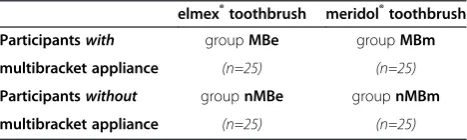
years of age, an additional parental consent was ob-tained. Subsequently subjects were pseudonymised and randomly assigned either a manual toothbrush with ta-pered filaments (meridol®) or a toothbrush with conven-tional cylindrical bristles (elmex®). Thus, four groups with 25 participants each were formed: MB-subjects using the elmex® brush (MBe), MB-subjects using the meridol® brush (MBm) and subjects without MB using either the elmex® (nMBe) or meridol® brush (nMBm) (Table 1).
Both toothbrushes were multi-tufted, constructed with staple-set tufting and differed in filaments´ shape and diameter. The elmex® toothbrush head was comprised of 27 tufts with nylon filaments of 0.175 and 0.2 mm, which were end-rounded and medium stiff. In contrast the meri-dol® toothbrush had 37 tufts with conical soft bristles ran-ging from 0.18 mm at the base to 0.05 mm at the top (GABA, Lörrach, Germany) (Figure 1).
At the start of the trial all subjects received the same toothpaste (elmex®) for exclusive use together with their toothbrush. At the same time point a resealable poly-thene bag and an instruction sheet were distributed to each participant. Subjects were requested to use the brush twice a day for three minutes, in the morning and evening, for 14 consecutive days. After brushing, the brush head had to be cleaned with running tap water for about 5 seconds. The toothbrush was stored head up until the next brushing sequence. The use of mouthwash was not allowed, whereas the additional use of dental floss or interdental brushes was permitted. Two weeks later the toothbrushes were returned in the sealed polythene bags, and germ isolation was performed immediately. The exa-miner evaluating the amount of colony-forming units (CFU) was blinded for subjects (group assignment) and toothbrush type.
Together with the used toothbrush the completed ques-tionnaires were returned. Using dichotomous questions (“yes” or“no”), participants were asked whether they had suffered from any illness during the course of the study, if they had taken any medication or if they had used any other toothbrush than the assigned trial brush. If an-tibiotic or anti-infective medication had been used, this resulted in retrospective exclusion of the study. By means of 100 mm visual analogue scales (VAS), subjective per-ceptions concerning bleeding tendency, pain and cleaning efficacy were assessed.
Table 1 Allocation of the experimental study groups
elmex®toothbrush meridol®toothbrush
Participantswith groupMBe groupMBm
multibracket appliance (n=25) (n=25)
Participantswithout groupnMBe groupnMBm
The isolation of microorganisms was performed ac-cording to the method described by Wetzel et al. [19] and Nies et al. [20]. Brush heads were placed in small glass containers with 10 ml Sputasol solution (Oxoid, Basingstoke, England), sealed with parafilm and sluiced at 25°C, facilitated by ultrasound, for 15 minutes. Follo-wing centrifugation of 1 ml at 13000 rpm for 10 minutes,
800 μl supernatant were discarded and the remaining
200 μl were mixed on a vortexer. For selective
detec-tion ofS. mutansand lactobacilli, CRT® bacteria (Ivoclar Vivadent, Schaan, Liechtenstein) was used, which con-tains a two-side base plate with Mitis Salivarius and
Rogosa agars on each of which 20 μl of the solution
were plated. Another 20 μl were spread on Sabouraud
agar for cultivatingCandida species. After 72 hours of
incubation at 36°C, the colony forming units (CFU) were counted with the aid of an experienced medical laboratory assistant.
Statistics
The study was designed in collaboration with the Institute for Medical Informatics (University of Giessen). Sub-jects were allocated to either one of the toothbrushes by using a randomisation list. As a normal distribu-tion of values could not be assumed, non-parametric methods (Wilcoxon- and Median test) were applied. The distribution of the parameters was thus described by means of minimum, maximum, median as well as first and third quartiles. To allow for a better comparabil-ity with literature, mean scores and standard deviation were additionally determined. Statistical significance was set at p < 0.05. A possible interaction between toothbrush design and multibracket treatment was assessed using the H-test and logistical regression.
Results
After 14 days, 87 subjects, 26 male and 61 female, com-pleted the trial according to the inclusion criteria, resulting in a dropout-rate of 13%. The reasons for the dropouts are listed in Table 2. Microbial analyses thus were conducted for 87 brushes. Illness during the brushing interval was stated by 18 subjects, but in these cases a possible use of medication was in accordance with the inclusion criteria. An impact of transient health
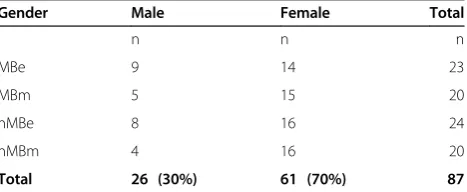
restrictions on our investigation could not be validated (p = 0.3190). No gender-related difference could be de-termined with respect to microbial colonisation of the brushes (p = 0.5421). In total the elmex® toothbrush was used by 47 patients (23 MB, 24 nMB), the meridol® brush by 40 participants (20 MB, 20 nMB) (Table 3).
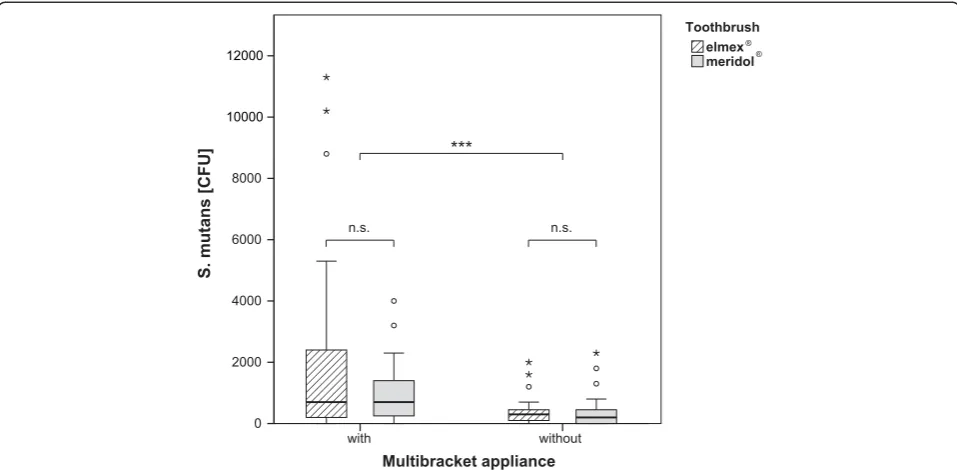
84% of the toothbrushes showed colonisation with
S. mutans, but no difference was found between the two
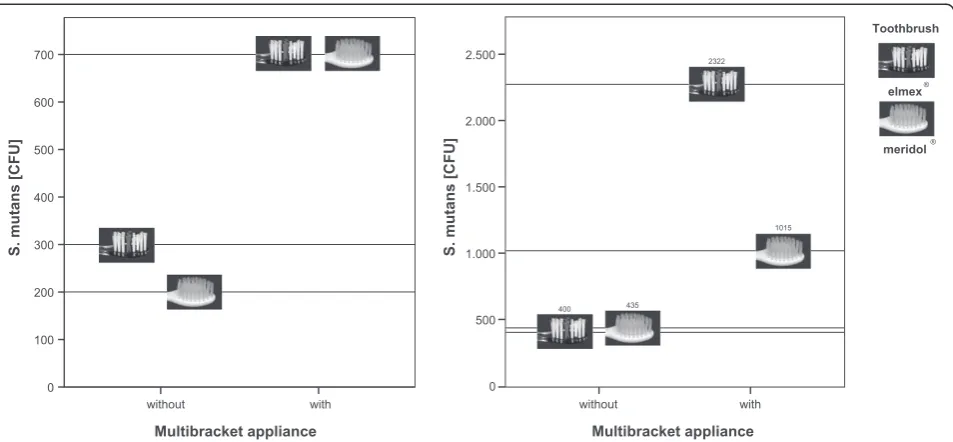
bristle designs (p = 0.6655). However, subjects with MB had significantly higher bacterial counts, independent of brush type (p = 0.0003) than subjects without MB (Figure 2). The highest percentage of contaminated brushes (96%) was found in group MBe, the lowest in group nMBm (70%) (Table 4). Regarding median num-bers, subjects without MB harboured 200 (nMBm) and 300 (nMBe) CFU, whereas subjects with MB exhibited 700 CFU (MBm and MBe), respectively (Table 5 and Figure 3). Thus, multibracket appliances appear to en-hance the retention of microorganisms on manual tooth-brushes significantly. Regarding the mean values, the greatest difference was found between nMBe (400 CFU) and MBe (2322 CFU) (Figure 3). A growth of lactobacilli
was observed on only 4 brushes and Candida could not
be found on any brush. Hence no statistical analysis could be performed for these two microorganisms.
Participants with fixed appliances reported an in-creased subjective bleeding tendency (p = 0.0065), which didn´t seem to be influenced by a certain toothbrush (p = 0.6018). The perception of pain could neither be related to orthodontic appliances (p = 0.6544) nor to a certain bristle design (p = 0.8639), as was the case when Figure 1Design of toothbrush heads of brand-new elmex®
(left) and meridol® toothbrushes (right).
Table 2 Dropout reasons
Reason n
termination by subjects 3
irregular use of toothbrush 2
return of brush≥24h late 2
use of antibiotics 5
mould growth on agar plate 1
Total 13
Table 3 Number and gender of subjects in the four experimental groups
Gender Male Female Total
n n n
MBe 9 14 23
MBm 5 15 20
nMBe 8 16 24
nMBm 4 16 20
Total 26 (30%) 61 (70%) 87
asking for the perceived cleaning efficacy (p = 0.3036 and p = 0.6975) (Figure 4) in all groups.
Discussion
The aim of the present study was to evaluate the extent to which caries-associated microorganisms adhere to two manual toothbrushes differing in their bristle design and to analyze the impact of multibracket appliances on microbial retention. Despite the different background and age of the subjects, the groups seem comparable with regard to their oral hygiene habits. A higher con-sciousness for oral prophylaxis, as might be expected in dental students, could not be verified in previous studies [21]. On the other hand, one might also expect ortho-dontic patients to have a higher motivation for a good oral hygiene, implying a higher frequency of tooth bru-shing and thus more debris on the tooth brushes. Unfor-tunately, it is not possible to assure an identical brushing
situation in all patients, resulting in a remaining degree of uncertainty as to whether or not oral hygiene habits were comparable between and within the two groups. As the inclusion criteria required a healthy or conser-vatively treated permanent dentition, it can be assumed that all participants had similar microbial conditions con-cerning caries-related germs and thus only differed in the presence of a MB appliance [22,23]. The gender distribu-tion was not homogenous, which doesn´t seem unusual bearing in mind that the request for orthodontic treat-ment, as well as for studying dentistry is much higher in females [24,25]. As no gender-related difference in the mi-crobial load of the brushes could be determined, a possible influence of this factor seems negligible.
Colonisation with S. mutans was found on 84% of
the brushes, revealing the greatest variance between the groups MBe (96%) and nMBm (70%). The bristle design seemed to have no impact on the number of germs re-tained on the brush head. However, a significant difference became obvious when comparing brushes from subjects Multibracket appliance
without with
S. mutans [CFU]
12000
10000
8000
6000
4000
2000
0
***
. s . n .
s . n
meridol elmex Toothbrush
® ®
Figure 2Microbial colonisation with S. mutans in colony forming units (CFU) in patients with and without multibracket appliances using two types of toothbrushes.
Table 4 Number and percentage of colonised toothbrushes in the four experimental groups
Microorganisms S. mutans Lactobacilli Candida
n % n % n %
MBe 22 96 4 17 0 0
MBm 18 90 0 0 0 0
nMBe 19 79 0 0 0 0
nMBm 14 70 0 0 0 0
Total 73 84 4 5 0 0
(MBe= MB and elmex® toothbrush, MBm= MB and meridol® toothbrush, nMBe= no MB and elmex® toothbrush, nMBm= no MB and meridol® toothbrush) and for the three microorganisms analysed.
Table 5 Numbers of microorganisms in colony forming units (CFU) per brush head in the four experimental groups
CFU per brush head Minimum Maximum Median Mean SD
MBe 0 11300 700 2322 3400
MBm 0 4000 700 1015 1108
nMBe 0 2000 300 400 514
nMBm 0 2300 200 435 645
with MB to those without MB, indicating that brushes used by orthodontic patients with fixed appliances tend to harbor more microorganisms. A comparison of the pre-sent results to previous data in literature proved to be dif-ficult due to the varying methods and study designs applied. Up to now, all microbial studies on toothbrushes were performed in vitro or in vivo on subjects without MB, so that only the amounts of microorganisms of the nMB groups are suitable for comparison. Only two
authors refer to the number ofS. mutans per brush head
[23,26]. After single use of new toothbrushes by patients with periodontal problems, Quirynen [26] isolated 2×10⁶ CFU, whereas the use of toothpaste reduced these num-bers to 1,8x10³CFU, which is in accordance to the num-bers ofS. mutansin our study.
A further explanation for the comparatively low
num-bers of S. mutans might be the reduction of germs
achieved by drying during the intervals in which the brushes weren´t used. The extent to which the number of germs may be reduced varies: After 8 hours of air dry-ing, Spolidorio et al. [27] weren´t able to detect any
re-maining S. mutans, whereas Svanberg [28] found the
same bacteria even after 24 hours to the magnitude of
104CFU. To prevent reduction of germs due to drying
after the brushes´ last use, sealable plastic bags were distributed, so brushes were gained under standardized conditions.
Wetzel et al. [19] compared different principles of filament anchoring and related the usual “multi-tufted” technique to an increased microbial retention, which is Multibracket appliance
with without
S. mutans [CFU]
700
600
500
400
300
200
100
0
Multibracket appliance with without
S. mutans [CFU]
2.500
2.000
1.500
1.000
500
0
Toothbrush
elmex®
meridol® 2322
1015
435 400
Figure 3Median (left) and mean numbers (right) of S. mutans in colony forming units (CFU) in patients with and without multibracket appliances using two types of toothbrushes.
Multibracket appliance
with
without
Pain
100 80 60 40 20
0 mm
intensive not at all
Multibracket appliance
with
without
Bleeding
100 80 60 40 20 0
**
mm e v i s n e t n i ll
a t a t o n
Multibracket appliance
with
without
Cleaning efficacy
100 80 60 40 20 0
meridol
elmex
Toothbrush
® ®
mm d a b y r e v d
o o g y r e v
in accordance with Glass´ [29] statement that bacterial contamination may be decreased with less bristles per tuft and less tufts per brush head. Despite this, we didn´t find any microbial disadvantage of the meridol® tooth-brush, which features an even more compact tufting than the elmex® brush. On the contrary, the elmex® toothbrush tended to be microbiologically inferior. Again this might be caused by the use of toothpaste, because brushes with many fine filaments, such as the meridol® toothbrush, not only harbor more bacteria but also more toothpaste [30] which maintains the antimicrobial effect among the bris-tles and perhaps leveled the differences between the two toothbrush-types in our investigation.
Retrospectively, it would have been helpful to have a baseline assessment of saliva samples. According to Jordan and LeBlanc [31] plaque and saliva samples correlate in terms of number and type of microorganisms. If a participant, for instance, provided low saliva counts of
S. mutans, it would be hardly surprising if only few germs
were found on his toothbrush. The present randomised study design, however, ensured a homogenous distribution of subjects with differing germ quantities and qualities, so a baseline-assessment did not seem indispensable.
Only 5% of the toothbrushes were colonized with lac-tobacilli, all of them belonged to group MBe, though the low percentage didn´t allow for statistical analysis. The rare incidence of these bacteria is surprising, regarding the fact that during MB-treatment the amount of lacto-bacilli are reported to increase considerably [32], which is mainly associated with the many retention sites a mul-tibracket appliance offers [33]. Nies et al. [20] investiga-ted the microbial contamination on 70 toothbrushes and found a consistent colonization with lactobacilli. Since we employed the same method, the frequent isolation of lactobacilli described by Nies et al. might be due to their subject materials, which were children with carious den-titions, whereas caries was an exclusion criterion in the present study.
Candida species were not found in any of our
speci-mens, although an average oral prevalence ofC. albicans
is described to be between 25 to 75% [34]. About 20% of
patients treated with MB becomeCandida-carriers which
is probably caused by interaction between orthodontic ap-pliance, virulence and host factors [3,34]. Several authors
report on isolating C. albicans from toothbrush heads
[12,20] and emphasize its good ability to colonize [35], whereas others also came upon very few, if any CFU [11]. As mentioned above, a baseline assessment might have been advantageous for explaining the absence of
C. albicans on the brush heads in our investigation.
For assessing individual perceptions, such as brushing comfort, gum bleeding and cleaning efficacy of the bru-shes, a questionnaire with VAS was used, which is regar-ded superior to verbal methods when evaluating personal
sensations [36]. By means of VAS there was no indication, that bristle design or the presence of MB affects the ex-perience of pain during tooth brushing. Also the perceived cleaning efficacy was not correlated to one of these deter-minants. An observable bleeding during brushing, how-ever, was related to fixed appliances, but not to the kind of brush used. The discussion in literature about what kind of toothbrush is best for use during orthodontic treatment is controversial. Electric toothbrushes are often compared with manual brushes, but generally are not regarded as su-perior, although they may provide a better approximal cleaning with reduction of the bleeding in this area [6,7]. The enhanced bleeding tendency in patients with MB dur-ing tooth brushdur-ing coincides with the clinical appearance: although the salivary flow and intraoral pH increase, which both counteracts the development of caries, gingi-vitis is common and often hard to prevent.
Since the intraoral perception of a toothbrush depends on their design and bristle consistency [37], the meridol® brush is likely to convey a soft and pleasant feeling, al-though subjects described no difference concerning the cleaning efficacy of both brushes. Moreover conical and fine filaments are attributed to a better cleaning efficacy at the gingival margin and in approximal regions [8], which seems to be correlated to the flexibility of the fila-ments that may easily access the areas around the brackets and below the archwire. This should be assessed in future studies.
Conclusion
Since toothbrushes of MB-patients, independent of their bristle design, had a higher microbial load than those of subjects without MB, a more frequent replacement of toothbrushes during MB treatment may be advisable.
Due to no differences between the two bristle designs, the recommendation for toothbrush-type should be made according to personal preferences of the patients, since it can be assumed that patients use a toothbrush more in-tensely when brushing with it is comfortable.
Competing interests
The authors declare that they have no competing interests.
Authors’contributions
JE carried out the collection of samples, the analysis and interpretation of data and drafted the manuscript. JvB participated in the design and coordination of the study and revised the manuscript. SR participated in the design of the study and gave final approval of the version to be published. All authors read and approved the final manuscript.
Author details 1
Private practice, Pestalozzistraße 27, 61231 Bad Nauheim, Germany. 2Department of Orthodontics, Justus-Liebig-University, Schlangenzahl 14, 35392 Giessen, Germany.
References
1. Glasl B, Ludwig B, Schopf P:Prevalence and development of KIG-relevant symptoms in primary school students from Frankfurt am Main.J Orofac Orthop2006,67:414–423.
2. Arslan SG, Akpolat N, Kama JD, Özer T, Hamamci O:One-year follow-up of the effect of fixed orthodontic treatment on colonization by oral Candida.J Oral Pathol Med2008,37:26–29.
3. Hägg U, Kaveewatcharanont P, Samaranayake YH, Samaranayake LP:The effect of fixed orthodontic appliances on the oral carriage of Candida species and Enterobacteriaceae.Eur J Orthod2004,26:623–629. 4. Petti S, Barbato E, Simonetti D´Arca A:Effect of orthodontic therapy
with fixed and removable appliances on oral microbiota: a six-month longitudinal study.New Microbiol1997,20:55–62.
5. Faltermeier A, Bürgers R, Rosentritt M:Bacterial adhesion of Streptococcus mutans to esthetic bracket materials.Am J Orthod Dentofacial Orthop 2008,133:99–103.
6. Thienpont V, Dermaut LR, van Maele G:Comparative study of 2 electric and 2 manual toothbrushes in patients with fixed orthodontic appliances.Am J Orthod Dentofacial Orthop2001,120:353–360.
7. Hickman J, Millett DT, Sander L, Brown E, Love J:Powered vs manual tooth brushing in fixed appliance patients: a short term randomized clinical trial.Angle Orthod2002,72:135–140.
8. Barnes CM, Covey DA, Shi X, Yankell SL:Laboratory evaluations of a bi-level, extremely tapered bristled toothbrush and a conventional uniform bristled toothbrush.Am J Dent2009,22:84–88.
9. Yankell SL, Shi X, Emling RC:Laboratory evaluations of two toothbrushes for removal of artificial plaque above, around and below the gingival margin.J Clin Dent2003,14:19–22.
10. Dörfer CE, von Bethlenfalvy ER, Kugel B, Pioch T:Cleaning efficacy of a manual toothbrush with tapered filaments.Oral Health Prev Dent2003, 1:111–118.
11. Verran J, Leahy-Gilmartin AA:Investigations into the microbial contamination of toothbrushes.Microbios1996,85:231–238.
12. Noga K, Lange DE, Alai-Omid W:Mykologische Untersuchungen an Zahnbürsten.Dtsch Zahnärztl Z1976,31:396–398.
13. Glass RT, Jensen HG:More on the contaminated toothbrush: the viral story.Quintessence Int1988,19:713–716.
14. Aas JA, Griffen AL, Dardis SR, Lee AM, Olsen I, Dewhirst FE, Leys EJ, Paster BJ:Bacteria of dental caries in primary and permanent teeth in children and young adults.J Clin Microbiol2008,46:1407–1417.
15. Fitzgerald RJ, Keyes PH:Demonstration of the etiologic role of
streptococci in experimental caries in the hamster.J Am Dent Assoc1960, 61:9–19.
16. Badet C, Thebaud NB:Ecology of lactobacilli in the oral cavity: a review of literature.Open Microbiol J2008,2:38–48.
17. Hossain H, Ansari F, Schulz-Weidner N, Wetzel WE, Chakraborty T, Domann E:Clonal identity of Candida albicans in the oral cavity and the gastrointestinal tract of pre-school children.Oral Microbiol Immunol2003, 18:302–308.
18. Pancherz H, Mühlich DP:Entwicklung von Karies bei kieferorthopädischer Behandlung mit festsitzenden Apparaturen–Ein Vergleich von Zähnen mit und ohne Kariesvorschädigungen.Kieferorthop1997, 11:139–144.
19. Wetzel WE, Schaumburg C, Ansari F, Kröger T, Sziegoleit A:Microbial contamination of toothbrushes with different principles of filament anchoring.J Am Dent Assoc2005,136:758–765.
20. Nies SM, Kröger T, Ansari F, Schaumburg C, Wetzel WE:Keimbesiedlung an Zahnbürsten mit unterschiedlichen Borstenbündelbesteckungen.
Oralprohylaxe Kinderzahnheilkd2008,30:54–60.
21. Lang NP, Cumming BR, Löe HA:Oral hygiene and gingival health in Danish dental students and faculty.Community Dent Oral Epidemiol1977, 5:237–242.
22. Percival RS, Challacombe SJ, Marsh PD:Age-related microbiological changes in the salivary and plaque microflora of healthy adults.J Med Microbiol1991,35:5–11.
23. Kozai K, Iwai T, Miura K:Residual contamination of toothbrushes by microorganisms.ASDC J Dent Child1989,56:201–204.
24. Krey KF, Hirsch C:Frequency of orthodontic treatment in German children and adolescents: influence of age, gender, and socio-economic status.Eur J Orthod2012,34:152–157.
25. Wheeler TT, McGorray SP, Yurkiewicz L, Keeling SD, King GJ:Orthodontic treatment demand and need in third and fourth grade schoolchildren.
Am J Orthod Dentofacial Orthop1994,106:22–33.
26. Quirynen M, De Soete M, Pauwels M, Goossens K, Teughels W, van Eldere J, van Steenberghe D:Bacterial survival rate on tooth- and interdental brushes in relation to the use of toothpaste.J Clin Periodontol2001, 28:1106–1114.
27. Spolidorio DM, Goto E, Negrini Tde C, Spolidorio LC:Viability of Streptococcus mutans on transparent and opaque toothbrushes.J Dent Hyg2003,77:114–117.
28. Svanberg M:Contamination of toothpaste and toothbrush by Streptococcus mutans.Scand J Dent Res1978,86:412–414.
29. Glass RT:Toothbrush types and retention of microorganisms: how to choose a biologically sound toothbrush.J Okla Dent Assoc1992,82:26–28. 30. Dyer D, Addy M, Newcombe RG:Studies in vitro of abrasion by different
manual toothbrush heads and a standard toothpaste.J Clin Periodontol 2000,27:99–103.
31. Jordan C, LeBlanc DJ:Influences of orthodontic appliances on oral populations of mutans streptococci.Oral Microbiol Immunol2002, 17:65–71.
32. Peros K, Mestrovic S, Anic-Milosevic S, Slaj M:Salivary microbial and nonmicrobial parameters in children with fixed orthodontic appliances.
Angle Orthod2011,81:901–906.
33. Kupietzky A, Majumdar AK, Shey Z, Binder R, Matheson PB:Colony forming unit levels of salivary Lactobacilli and Streptococcus mutans in orthodontic patients.J Clin Pediatr Dent2005,30:51–53.
34. Hibino K, Wong RW, Hägg U, Samaranayake LP:The effects of orthodontic appliances on Candida in the human mouth.Int J Paediatr Dent2009, 19:301–308.
35. Bunetel L, Tricot-Doleux S, Agnani G, Bonnaure-Mallet M:In vitro evaluation of the retention of three species of pathogenic microorganisms by three different types of toothbrush.Oral Microbiol Immunol2000,15:313–316. 36. Huskisson EC:Measurement of pain.Lancet1974,2:1127–31. 37. Golding PS:The development of the toothbrush. Part 2. The modern
toothbrush.Dent Health1982,21:10–15.
doi:10.1186/1746-160X-10-43
Cite this article as:Eichenaueret al.:Microbial contamination of toothbrushes during treatment with multibracket appliances.Head & Face Medicine201410:43.
Submit your next manuscript to BioMed Central and take full advantage of:
• Convenient online submission
• Thorough peer review
• No space constraints or color figure charges
• Immediate publication on acceptance
• Inclusion in PubMed, CAS, Scopus and Google Scholar
• Research which is freely available for redistribution