R E S E A R C H A R T I C L E
Open Access
Correlates of intimate partner violence
against women during a time of rapid social
transition in Rwanda: analysis of the 2005 and
2010 demographic and health surveys
Dana R. Thomson
1,2, Assiatou B. Bah
2, Wilson G. Rubanzana
1,3and Leon Mutesa
4*Abstract
Background:In Rwanda, women who self-reported in household surveys ever experiencing intimate partner violence (IPV) increased from 34 % in 2005 to 56 % in 2010. This coincided with a new constitution and majority-female elected parliament in 2003, and 2008 legislation protecting against gender-based violence. The increase in self-reported IPV may reflect improved social power for women, and/or disruptions to traditional gender roles that increased actual IPV.
Methods:This is a cross-sectional study of IPV in 4338 couples interviewed in the 2005 and 2010 Rwanda
Demographic and Health Surveys (RDHSs). Factors associated with physical or sexual IPV in the last 12 months were modeled using manual backward stepwise logistic regression. Analyses were conducted in Stata v13 adjusting for complex survey design.
Results:Risk factors for IPV in 2005 (p< 0.05) were: experiencing emotional IPV (OR = 18.1), beating husband/partner unprovoked (OR = 12.3), witnessing IPV against mother (OR = 1.82), husband/partner consumes alcohol often (OR = 3.13), and polygynous marriage (OR = 1.51), whereas having a husband/partner with secondary education (OR = 0.43) was protective. Factors associated with increased IPV in 2010 (p< 0.05) were husband/partner (OR = 1.30) or woman
(OR = 1.36) believes IPV is justified, husband/partner has sex with non-marital partners (OR = 2.52), bottom wealth quintile (OR = 1.25), polygynous marriage (OR = 2.29), having a son (OR = 2.05) or only daughters (OR = 2.58) versus no children, and having a husband/partner employed with in-kind versus cash compensation (OR = 1.58). In 2010, woman being involved with her own health (OR = 0.79) or earnings (OR = 0.57) decision-making was protective against IPV. Several variables were not available in the 2010 RDHS.
Conclusions:Our results may provide evidence of both increased self-reporting of IPV and social power disruption. Rwanda’s Isange One Stop Center project, with medical, legal, and psychosocial services for domestic violence victims, is currently scaling to all 44 district hospitals, and police station gender desks reduce barriers to legal reporting of IPV. Additional support toAbunzimediators to hear IPV cases in communities, and involvement of men in grassroots efforts to redefine masculinity in Rwanda are suggested. Additional research is needed to understand why self-reported IPV has increased in Rwanda, and to evaluate effectiveness of IPV interventions.
Keywords:Violence against women, Gender based violence, Domestic violence, IPV, GBV, DHS, Africa, Physical, Sexual
* Correspondence:[email protected]
4
College of Medicine and Health Sciences, University of Rwanda, PO Box 945, Kigali, Rwanda
Full list of author information is available at the end of the article
Background
Intimate partner violence (IPV) describes physical, sex-ual, or psychological harm by a current or past partner. Not only does IPV compromise survivors’ basic human rights, physical and sexual assault can result in direct physical harm, sexually transmitted infections, or preg-nancy, and all IPV can result in long-term mental and physical health problems [1, 2]. While IPV occurs in het-erosexual and same-sex couples and is perpetrated by both women and men, the majority of cases are perpe-trated by male partners against female partners world-wide [3]. A World Health Organization (WHO) analysis combining data from 77 studies across 56 countries esti-mated that, in Africa, 37 % of women have ever experi-enced physical or sexual IPV [3]. These rates were similar to the Eastern Mediterranean (37 %) and South-East Asia (38 %), and higher than the Americas (30 %), Europe (25 %), and Western Pacific (25 %) [3].
Within region and country, however, experiences of IPV vary widely, underscoring differences in national histories, institutional policies, cultural identities, re-sources, and other factors. When comparable measures and methods are used to measure lifetime prevalence of physical and sexual violence across national surveys [4–7], they show that lifetime prevalence of physical or sexual violence ranges from 64 % in Democratic Republic of Congo and Bolivia, to 6 % in Canada [3]. In national sur-veys, physical violence includes such actions as being beat, hit, kicked, choked, burned, or threatened with a weapon. Sexual violence is defined as being physically forced or threatened to have sex or to do something sexually de-grading. Two such national surveys in Rwanda found that a woman’s experience of physical or sexual IPV in her life-time almost doubled from 34 % in 2005 [8] to 56 % in 2010 [9] placing Rwanda among the countries with the high rates of IPV against women in the world.
Rwanda is a small, densely populated country that has undergone rapid demographic, social, and economic transition in the last 20 years since the Tutsi Genocide that killed around 1 million people. In the period be-tween 2005 and 2010, fertility rates fell from 6.1 to 4.6 children per woman, child mortality was halved from 152 to 76 deaths per 1000 live births, and the percent of women completing secondary school increased from 1.6 to 4.3 % [8, 9]. Meanwhile, representation of women in parliament has increased dramatically from 18 % before the Genocide, to 26 % during the post-genocidal transi-tional government (1994–2003), to 56 % in the 2008 elec-tions when Rwanda became the first and only country in the world with a majority woman parliament.
Women’s political representation and legal protection is an important step toward gender equity. Several factors may contribute to women’s political representation in Rwanda; foremost, Rwanda’s government has prioritized
women’s political inclusion. In 2003, new legislation re-served 24 of 80 parliamentary seats for women-only par-liamentarians to be filled by women-only voters [10]. While the evidence is mixed about whether more women representation changes policy outcomes overall [10], key pieces of legislation in Rwanda have certainly been shaped and shepherded by women parliamentarians including the 2008 law (No. 59/2008) on Prevention and Punishment of Gender-Based Violence (GBV). Some have suggested that Rwanda’s population, which is currently comprised of more women than men as a result of men being targeted during the genocide, has contributed to women’s political representation [10], as well as additional leadership roles by women within households [11]. Many assume that these gains in women’s representation and protections re-flect women’s empowerment, which makes the dramatic rise in self-reported IPV against women between 2005 and 2010 particularly striking.
Violence in intimate partnerships is a common phenomenon worldwide, and is partially attributed to couples spending lots of time with each other [12]. Time exposure, however, does not explain why women and not men are most often the target of IPV. Feminist and socio-culture explanations provide frameworks to understand IPV against women. Power theory explains increases in IPV that coincide with women’s empower-ment as a result of disruptions in traditional gendered roles [13]. Social learning theory adds that violence against women is learned through witness of IPV against women in childhood, and early experiences that cement these ‘lessons’ [14]. Background/situation modeling builds on this by adding that historical and socio-cultural context further normalizes violence in relationships [14].
Adding household-level triggers for violence such as fi-nancial stress or alcohol abuse can further increase risk of IPV [14, 15].
Gender roles in Rwanda are in the midst of rapid tran-sition, and the implications for IPV are not well under-stood. In a qualitative study in Rwanda after 2003, women described experiencing greater respect by family and community members, new confidence to speak in public forums, more autonomy and opportunities, as well as increased friction with their brothers and hus-bands, perceptions that men were withdrawing from politics, and feelings that the institution of marriage had been disrupted due to rapid changes in conventional gender roles [18]. A 2010 qualitative study on the same topic found that laws protecting women’s rights were perceived by women and men as having led to loss of women’s values and respect for men, thus provoking husbands to resort to violence to re-establish order in their households; this type of violence is believed by many woman and men as normal and even necessary [19, 20]. The large increase in self-reported IPV between 2005 and 2010 may reflect greater empowerment of women to speak about a high level of violence that already existed, or it could reflect a real increase in experiences of IPV. The present paper identifies factors associated with physical or sexual IPV in Rwanda in 2005 and 2010 that might inform hypotheses and further research about IPV against women in Rwanda.
Methods
Data
This analysis is based to the 2005 and 2010 Rwanda Demographic and Health Surveys (DHSs), which are na-tionally and sub-nana-tionally representative two-stage cluster samples, conducted every 5 years to monitor demographic, socioeconomic, and health indicators [8]. In both surveys, primary sampling units (PSUs) were randomly selected from a recent census listing, and urban PSUs were oversampled to increase precision of urban estimates. Questionnaires were translated into Kinyarwanda, back translated into English, and field tested before implementation. Women aged 15 to 49 were the primary respondents, answering detailed questions about themselves, their households, and their children. Men aged 15 to 59 were secondary re-spondents, selected from every 3rd household in 2005, and every 2nd household in 2010. Both surveys were im-plemented by the National Institute of Statistics-Rwanda with technical support from Macro International, Inc. and funding from USAID, and in both surveys the all-female interviewing teams received the same standardized training [8, 9].
Of the 11,321 and 13,671 women interviewed in 2005 and 2010, respectively, 4066 and 5008 were randomly
selected and agreed to complete a special module about domestic violence. Only one woman per household was selected for the domestic violence module to ensure that no one else in the household knew about sensitive ques-tions that could compromise her safety, and to minimize the total number of women asked to describe traumatic events. Female interviewers received special training to conduct secure, confidential interviews in respondents’ homes and administered the domestic violence module in face-to-face interviews; they were supposed to skip the module if a confidential interviewing environment was not possible. According to the DHS datasets, 100 % of women in 2005 and more than 99 % of women in 2010 who were selected for the domestic violence mod-ule completed it. Of the 9074 women interviewed across the two surveys, 4338 had husbands/partners who were interviewed in the men’s survey. In this analysis of 4338 couples (2005: 1888; 2010: 2450), we link women’s self-reports of intimate partner violence in the last 12 months with husband/partner’s survey responses based on wife-ID in the men’s questionnaire.
In the domestic violence module, women were asked directly about their experiences of physical and sexual vio-lence in the last 12 months and this outcome was mod-eled as a binary variable. In the 2005 survey only, women reported emotional IPV, physical violence perpetrated against her husband/partner when he was not already physically hurting her, history of her father beating her mother, and frequency of husband/partner’s alcohol usage, all of which are key risk factors for IPV against women [14, 21–25]. In both years, men and women were asked about their own demographic, education, and employ-ment characteristics, as well as their perceptions of vio-lence against women, and who makes decisions about their own health care and earnings. An adult in the hold answered an additional questionnaire about house-hold assets, and demographics of each househouse-hold member including their age, sex, and household membership.
Ethics
Both the 2005 and 2010 DHSs were reviewed and ap-proved by the Macro International Internal Review Board, Rwanda’s National Institute of Statistics, and the National Ethics Committee of Rwanda. We were granted permission by Macro International, Inc. to use these de-identified data for this analysis.
Data analysis
women not in the study (because their partner was not interviewed) and divorced or separated women. Then we defined 25 potential covariates and tested bivariate Chi-square distributions among women who had, and had not, experienced physical or sexual IPV in the last 12 months. Non-collinear (Pearson correlation r< 0.5) variables associated with IPV (at p< 0.1) were retained for multivariable model building. Finally, we used manual backward stepwise logistic regression, first removing vari-ables that were least associated with IPV and retaining those variables that were associated with IPV (p< 0.05). Separate models were fit for 2005, for 2005 using the re-duced set of variables available in 2010, and for 2010. The analysis was carried out in Stata version 13 using survey commands to apply sampling probability weights, account for clustering and stratification in the sample design, and perform subpopulation analysis in couples only. We pre-sented final models as odds ratios (ORs) with 95 % confi-dence intervals.
Results
Self-reported IPV in the last 12 months among married/ partnered women doubled from 24.1 % to 49.5 % be-tween 2005 and 2010. In 2005 and 2010, the married/ partnered women in our study were slightly younger, less educated, and less likely to work than women whose husbands/partners were not interviewed or who were di-vorced or separated (p< 0.05 for all) (Table 1). There was a sizable increase in the percent of women who say a man is justified to beat his wife for at least one reason from 46.5 % in 2005 to 57.0 % in 2010 (Table 1).
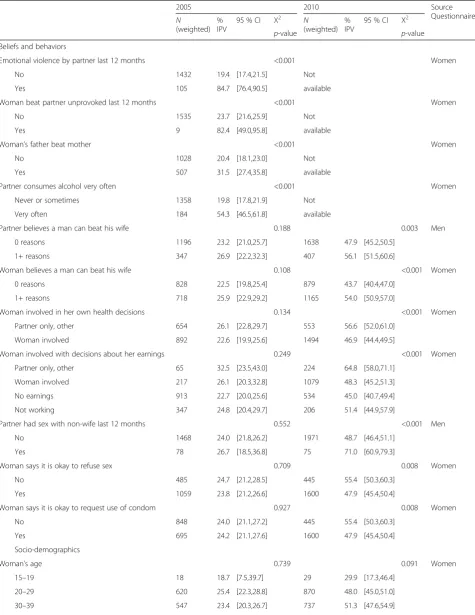
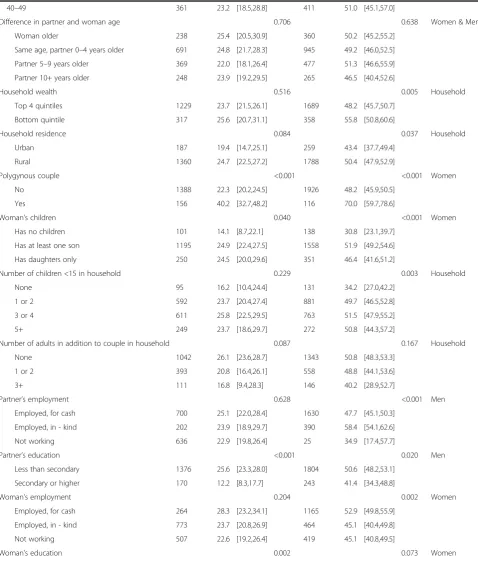
In bivariate analysis in 2005, sexual or physical IPV was associated with emotional IPV (84.7 %), witnessing physical violence by father against mother as a child (31.5 %), and having a partner who consumes alcohol often (54.3 %) (p< 0.001 for all) (Table 2). IPV was also high in relationships where the wife reported beating her husband/partner when he was not already hurting her (82.4 %, p< 0.001), though only nine women (<1 %) re-ported this behavior. No other beliefs or behaviors were associated with IPV in 2005. A number of socio-demographic factors were associated with IPV in 2005 (p< 0.1) including rural residence, polygynous marriage, having any children, there being no adults other than the couple in the household, having a husband/partner with less than secondary education, and the woman hav-ing less than secondary education.
In 2010, many of the same socio-demographic factors were associated with IPV, however, a number of beliefs and behaviors were newly associated with IPV (p< 0.1) including partner believes a man can beat his wife, woman believes a man can beat his wife, woman is not involved with her own health decision-making, woman is not involved with decision-making about her earnings,
husband/partner has sex with non-wife partner(s), and the woman says she cannot refuse sex with her partner or request use of a condom.
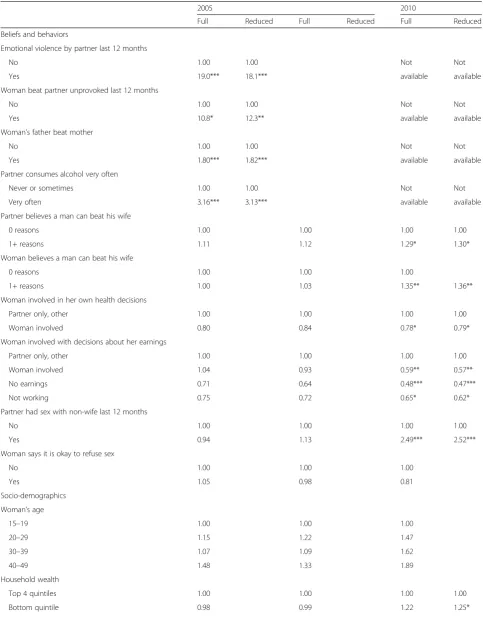
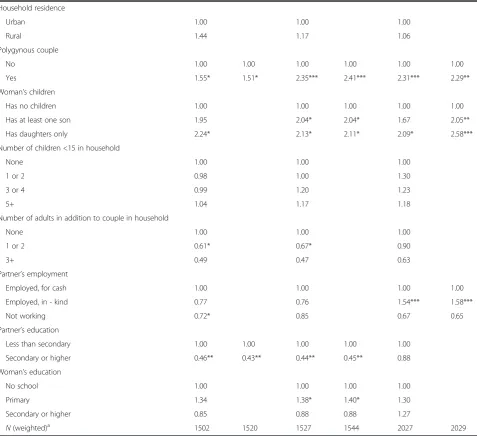
In the 2005 multivariable analysis, two factors stand out as being strongly associated with IPV (Table 3). Women who experienced emotional IPV in the last year had 18 times the odds (p< 0.001) of sexual or physical IPV, and women who reported beating their husband/ partner unprovoked had 12 times the odds (p< 0.01) of sexual or physical IPV. Having a partner that consumes alcohol very often (OR = 3.13, p< 0.001), witnessing physical IPV against her mother in childhood (OR = 1.82, p< 0.001), and being in a polygynous marriage (OR = 1.51, p< 0.05) were also associated with increased odds of sexual or physical IPV. Women who had a part-ner with secondary or higher education had lower odds of IPV (OR = 0.43, p< 0.01). When emotional violence, woman beats husband/partner unprovoked, woman wit-nessed IPV against mother in childhood, and husband/ partner consumes alcohol often were removed from the model to make it comparable to the 2010 analysis, two additional demographic characteristics were associated with IPV: women’s primary education versus no educa-tion (OR = 1.40, p< 0.05), and woman has at least one son (OR = 2.04, p< 0.05) or daughters only (OR = 2.11,
p< 0.05) versus no children.
Several beliefs and behaviors that were not associated with IPV in 2005 were significant in the 2010 multivari-ate analysis. Partner believes a man is justified to beat his wife (OR = 1.30, p< 0.05), woman believes a man is justified to beat his wife (OR = 1.36, p< 0.05), and part-ner has sex with non-wife partpart-ner(s) (OR = 2.52, p< 0.001) were all associated with greater odds of IPV. Fur-thermore, woman being involved with decisions about her own health (OR = 0.79, p< 0.05) or about her own earnings (OR = 0.57, p< 0.05) versus her partner alone were protective against IPV. Being a household in the bottom wealth quintile (OR = 1.25, p< 0.05), being in a polygynous marriage (OR = 2.29, p< 0.01), having a son (OR = 2.05, p< 0.01) or only daughters (OR = 2.58, p< 0.001) versus no children, and having a partner employed with in-kind versus cash earnings (OR = 1.58,
p< 0.001) were associated with greater odds of IPV.
Discussion
Table 1Distribution of key women socioeconomic characteristics and beliefs by marital status and inclusion criteria
Interviewed about domestic violence
Included
% In union, partner interviewed
% In union, partner not interviewed
% Divorced, separated
X2
p-value % Widowed
% Never in union
2005
Woman’s age <0.001
15–19 1.1 0.1 0.7 0.0 60.0
20–29 39.9 30.9 30.5 3.0 33.7
30–39 35.4 38.1 32.5 27.4 4.6
40–49 23.5 30.9 36.4 69.5 1.6
Woman’s education 0.014
No school 28.3 34.1 34.1 40.6 8.6
Primary 64.0 55.5 60.0 46.3 78.7
Secondary or higher 7.7 10.4 5.9 13.1 12.7
Woman’s employment 0.033
Employed, for cash 17.0 18.0 24.7 24.9 19.6
Employed, in - kind 50.0 51.4 46.2 42.9 26.2
Not working 33.0 30.7 29.1 32.2 54.2
Household wealth 0.103
Top 4 quintiles 79.6 76.2 74.5 71.2 80.9
Bottom quintile 20.4 23.8 25.5 28.8 19.1
Household residence 0.013
Urban 12.0 14.6 17.6 19.9 21.6
Rural 88.0 85.4 82.4 80.1 78.4
Woman believes a man can beat his wife
0.822
0 reasons 53.5 51.7 52.2 57.2 52.9
1+ reasons 46.5 48.3 47.8 42.8 47.1
Total 100.0 100.0 100.0 100.0 100.0
N(unweighted) 1888 448 378 157 1195
2010
Woman’s age <0.001
15–19 1.4 1.4 3.0 0.0 54.5
20–29 42.5 30.0 30.4 5.2 39.7
30–39 36.0 38.5 35.8 21.0 4.5
40–49 20.1 30.1 30.8 73.8 1.3
Woman’s education 0.054
No school 19.4 19.4 27.3 36.4 6.1
Primary 71.2 68.6 64.4 53.3 66.4
Secondary or higher 9.4 12.1 8.4 10.3 27.5
Woman’s employment 0.005
Employed, for cash 56.9 52.8 65.9 60.5 34.6
Employed, in - kind 22.7 28.3 16.2 18.8 23.6
witnessed IPV as a child [21–24], or who were violent toward their husband/partner [26] were more likely to self-report IPV in the last year is consistent with other studies. The huge differential in experience of IPV among women versus male partners in 2005 suggests that violence against women is normalized. This is sup-ported by surveys from around the world that find a high proportion of women and men believe that IPV against women is justified [17, 25]. We discuss two po-tential hypotheses for the sharp rise in self-reported IPV in Rwanda, and ways that individuals and commu-nities might address IPV against women. Since women in this study were somewhat different from other part-nered women, particularly divorced or separated women, caution should be used when generalizing these results.
Individuals and couples
In our study, IPV was associated with high alcohol usage by husbands/partners, which is consistent with findings from diverse settings including Brazil, Kenya, and India [24, 27–29]. Other studies found that both woman’s and men’s alcohol usage was an important factor for IPV [22, 24]. Alcohol use directly affects cognitive and phys-ical function, reducing self-control and leaving individ-uals less capable of negotiating a non-violent resolution to conflicts within relationships [30]. Excessive drinking by one partner can exacerbate financial difficulties, child abuse, infidelity or other stressful situations, which may fuel conflicts between partners. Because alcohol de-pendency is linked to numerous health and social prob-lems for drinkers, their families, and communities [31], alcohol dependency is estimated to account for 4 % of global disability adjusted life years (DALYs) [32]. Re-sponsible drinking campaigns, alcohol advertising bans, drinking and driving laws, and increased pricing of alcohol can be implemented by governments to deter drinking,
and training of health, social, and legal professionals to support individuals who seek alcohol treatment can help to address IPV risk within couples [31].
Our 2010 finding that IPV was associated with hus-bands/partners who earned in-kind rather than cash compensation may provide evidence of social power dis-ruptions within relationships as a source of increased in-cidence of IPV in Rwanda. In-kind rather than cash compensation may be related to the husband/partner having low education [21, 22, 33] which limits income potential, job security, and contributes to financial stress at home, a trigger for violence [28], whereas men who attend secondary school are typically exposed to ideas of human rights and gain skills for self-expression, which can reduce tolerance of IPV [28, 34]. In Rwanda, men have traditionally been heads of household, the primary cash earners, and decision-makers about household re-sources, however this has changed rapidly in recent years. Qualitative research about the impacts of Rwanda’s improved opportunities for women found that, in addition to numerous positive outcomes, non-submissive, inde-pendent women experienced increased conflict within their relationships when husbands felt their own roles were challenged or that their wives where skirting home responsibilities [18]. In India, South Africa, and elsewhere, increases in IPV have been linked with rapid changes in gender roles, including changes in husband/partner em-ployment [31, 35]. In these settings, involvement of men in redefining masculinity has been important toward shifting public opinion about IPV and reducing incidence of IPV [34, 36]. The rise in reported acceptance of IPV among women in Rwanda suggests that women, too, are in need of involvement and support to redefine gender roles.
Certain family dynamics such as polygynous marriage and having children are slow to change in response to women’s changing roles in society, and it is therefore not surprising that these two factors remained significantly
Table 1Distribution of key women socioeconomic characteristics and beliefs by marital status and inclusion criteria(Continued)
Household wealth <0.001
Top 4 quintiles 82.5 74.3 68.7 74.2 86.2
Bottom quintile 17.5 25.7 31.3 25.8 13.8
Household residence 0.697
Urban 12.7 13.7 14.4 17.7 18.3
Rural 87.3 86.3 85.6 82.3 81.7
Woman believes a man can beat his wife
0.165
0 reasons 43.0 43.8 36.7 43.4 47.7
1+ reasons 57.0 56.2 63.3 56.6 52.3
Total 100.0 100.0 100.0 100.0 100.0
Table 2Bivariate associations of physical or sexual IPV in the last 12 months with behavioral and socio-demographic characteristics
2005 2010 Source
Questionnaire
N
(weighted) % IPV
95 % CI X2 N
(weighted) % IPV
95 % CI X2
p-value p-value
Beliefs and behaviors
Emotional violence by partner last 12 months <0.001 Women
No 1432 19.4 [17.4,21.5] Not
Yes 105 84.7 [76.4,90.5] available
Woman beat partner unprovoked last 12 months <0.001 Women
No 1535 23.7 [21.6,25.9] Not
Yes 9 82.4 [49.0,95.8] available
Woman’s father beat mother <0.001 Women
No 1028 20.4 [18.1,23.0] Not
Yes 507 31.5 [27.4,35.8] available
Partner consumes alcohol very often <0.001 Women
Never or sometimes 1358 19.8 [17.8,21.9] Not
Very often 184 54.3 [46.5,61.8] available
Partner believes a man can beat his wife 0.188 0.003 Men
0 reasons 1196 23.2 [21.0,25.7] 1638 47.9 [45.2,50.5]
1+ reasons 347 26.9 [22.2,32.3] 407 56.1 [51.5,60.6]
Woman believes a man can beat his wife 0.108 <0.001 Women
0 reasons 828 22.5 [19.8,25.4] 879 43.7 [40.4,47.0]
1+ reasons 718 25.9 [22.9,29.2] 1165 54.0 [50.9,57.0]
Woman involved in her own health decisions 0.134 <0.001 Women
Partner only, other 654 26.1 [22.8,29.7] 553 56.6 [52.0,61.0]
Woman involved 892 22.6 [19.9,25.6] 1494 46.9 [44.4,49.5]
Woman involved with decisions about her earnings 0.249 <0.001 Women
Partner only, other 65 32.5 [23.5,43.0] 224 64.8 [58.0,71.1]
Woman involved 217 26.1 [20.3,32.8] 1079 48.3 [45.2,51.3]
No earnings 913 22.7 [20.0,25.6] 534 45.0 [40.7,49.4]
Not working 347 24.8 [20.4,29.7] 206 51.4 [44.9,57.9]
Partner had sex with non-wife last 12 months 0.552 <0.001 Men
No 1468 24.0 [21.8,26.2] 1971 48.7 [46.4,51.1]
Yes 78 26.7 [18.5,36.8] 75 71.0 [60.9,79.3]
Woman says it is okay to refuse sex 0.709 0.008 Women
No 485 24.7 [21.2,28.5] 445 55.4 [50.3,60.3]
Yes 1059 23.8 [21.2,26.6] 1600 47.9 [45.4,50.4]
Woman says it is okay to request use of condom 0.927 0.008 Women
No 848 24.0 [21.1,27.2] 445 55.4 [50.3,60.3]
Yes 695 24.2 [21.1,27.6] 1600 47.9 [45.4,50.4]
Socio-demographics
Woman’s age 0.739 0.091 Women
15–19 18 18.7 [7.5,39.7] 29 29.9 [17.3,46.4]
20–29 620 25.4 [22.3,28.8] 870 48.0 [45.0,51.0]
Table 2Bivariate associations of physical or sexual IPV in the last 12 months with behavioral and socio-demographic characteristics
(Continued)
40–49 361 23.2 [18.5,28.8] 411 51.0 [45.1,57.0]
Difference in partner and woman age 0.706 0.638 Women & Men
Woman older 238 25.4 [20.5,30.9] 360 50.2 [45.2,55.2]
Same age, partner 0–4 years older 691 24.8 [21.7,28.3] 945 49.2 [46.0,52.5]
Partner 5–9 years older 369 22.0 [18.1,26.4] 477 51.3 [46.6,55.9]
Partner 10+ years older 248 23.9 [19.2,29.5] 265 46.5 [40.4,52.6]
Household wealth 0.516 0.005 Household
Top 4 quintiles 1229 23.7 [21.5,26.1] 1689 48.2 [45.7,50.7]
Bottom quintile 317 25.6 [20.7,31.1] 358 55.8 [50.8,60.6]
Household residence 0.084 0.037 Household
Urban 187 19.4 [14.7,25.1] 259 43.4 [37.7,49.4]
Rural 1360 24.7 [22.5,27.2] 1788 50.4 [47.9,52.9]
Polygynous couple <0.001 <0.001 Women
No 1388 22.3 [20.2,24.5] 1926 48.2 [45.9,50.5]
Yes 156 40.2 [32.7,48.2] 116 70.0 [59.7,78.6]
Woman’s children 0.040 <0.001 Women
Has no children 101 14.1 [8.7,22.1] 138 30.8 [23.1,39.7]
Has at least one son 1195 24.9 [22.4,27.5] 1558 51.9 [49.2,54.6]
Has daughters only 250 24.5 [20.0,29.6] 351 46.4 [41.6,51.2]
Number of children <15 in household 0.229 0.003 Household
None 95 16.2 [10.4,24.4] 131 34.2 [27.0,42.2]
1 or 2 592 23.7 [20.4,27.4] 881 49.7 [46.5,52.8]
3 or 4 611 25.8 [22.5,29.5] 763 51.5 [47.9,55.2]
5+ 249 23.7 [18.6,29.7] 272 50.8 [44.3,57.2]
Number of adults in addition to couple in household 0.087 0.167 Household
None 1042 26.1 [23.6,28.7] 1343 50.8 [48.3,53.3]
1 or 2 393 20.8 [16.4,26.1] 558 48.8 [44.1,53.6]
3+ 111 16.8 [9.4,28.3] 146 40.2 [28.9,52.7]
Partner’s employment 0.628 <0.001 Men
Employed, for cash 700 25.1 [22.0,28.4] 1630 47.7 [45.1,50.3]
Employed, in - kind 202 23.9 [18.9,29.7] 390 58.4 [54.1,62.6]
Not working 636 22.9 [19.8,26.4] 25 34.9 [17.4,57.7]
Partner’s education <0.001 0.020 Men
Less than secondary 1376 25.6 [23.3,28.0] 1804 50.6 [48.2,53.1]
Secondary or higher 170 12.2 [8.3,17.7] 243 41.4 [34.3,48.8]
Woman’s employment 0.204 0.002 Women
Employed, for cash 264 28.3 [23.2,34.1] 1165 52.9 [49.8,55.9]
Employed, in - kind 773 23.7 [20.8,26.9] 464 45.1 [40.4,49.8]
Not working 507 22.6 [19.2,26.4] 419 45.1 [40.8,49.5]
associated with IPV across years in our study. The prac-tice of polygyny in Rwanda is illegal, uncommon, and may be falling [32]. In 2005, 12 % of married women were in a polygynous union, and in 2010, 8 % of women reported being in polygynous union [9]. Hypothesized links between polygyny and IPV are that the presence of more than two spouses contributes to more marital dis-agreement [37], and that the practice of polygyny reflects acceptance of male dominance in intimate partnership [38]. The link between having a child and increased risk of IPV among women could reflect that men who act violently toward their spouse/partner are also likely to act violently toward children [39]. Our finding that num-ber of children in the household was not associated with IPV suggests that IPV in the context of having children is not instigated by economic or parenting stressors alone. Other studies found that in households with mul-tiple forms of domestic violence including violence to-ward children, the level of violence against women sometimes increased if the woman directed aggression or neglect toward the child, or if she intervened in vio-lence toward the children [40].
Communities
While there is great variability in risk factors for IPV across countries, IPV beliefs and behaviors are com-monly associated with IPV incidence [41, 42]. The addition of numerous belief and behavioral risk factors for IPV in the 2010 analysis may be evidence of im-proved reporting of IPV. Imim-proved self-reporting during the time of this study is expected as a result of new laws and programs. Several laws passed between 1998 and 2008 addressed sexual violence used during the Geno-cide, the 2003 constitution created gender quotas and promoted gender equality, and the 2008 law on Preven-tion and Punishment of GBV made domestic violence il-legal. To help overcome fears by women victims of IPV that their reports of violence will not be taken seriously, nearly all police stations staff a gender desk with trained, usually female, personnel. In 2009, the Rwanda National Police in partnership with the Ministry of Health and with the technical and financial support of UN agencies, namely UNICEF, UNWOMEN and UNFPA, launched the One Stop Center project that offers free, integrated
medical, psycho-social, and legal services to victims of IPV and child abuse. In 2014, Isange One Stop Center Scale Up Project was launched with an aim of establish-ing this multidisciplinary service in all 44 district hospitals.
Given the complexity of IPV and the mixed evidence in this analysis, the higher incidence of IPV in 2010 may have resulted from both improved self-reporting and in-creased incidence of IPV due to social disruption. As such, we recommend multiple avenues to address IPV in Rwanda at a social-level. To the extent that prevalent violence against women already existed due to entrenched social, cultural, or historical norms, or has been inflamed by disrupting those norms, we recom-mend improved legal systems to protect women against violence, and campaigns to reduce acceptance of IPV and to redefine gender roles.
Extending legal protections An alternative to the One Stop Center program is the Abunzi community medi-ation system [36] which was introduced in 2004 to deal with a backlog of cases in the court system, and has since been formalized with the creation of an Abunzi
Secretariat which oversees mediator training and coord-ination with the Ministry of Justice. Like the gacaca
courts, which heard genocide cases, the Abunzi system is a hybrid of traditional and modern methods of conflict resolution, and is perceived by many as more accessible and responsive than legal courts. Each Abunzi commit-tee is comprised of at least 12 members, 30 % of whom are supposed to be women, and serve a local group of villages. While the Abunzisystem may present fewer so-cial barriers to victims of IPV than the justice system, manyAbunzicommittees do not maintain 30 % + women representation, mediations are public, and mediators are often unfamiliar with existing laws and turn to customary laws that may be prejudiced against women [41]. The
Abunzi system may be a positive forum for certain IPV cases, especially if the victim is comfortable with the process, and the system is able to support couples to ef-fectively communicate through differences that prevent future violence. However, better support and training of
Abunzimediators is needed to appropriately protect vic-tims of domestic violence according to national law.
Table 2Bivariate associations of physical or sexual IPV in the last 12 months with behavioral and socio-demographic characteristics
(Continued)
No school 438 22.5 [18.9,26.6] 396 48.3 [43.1,53.5]
Primary 988 26.1 [23.5,29.0] 1458 50.8 [48.1,53.5]
Secondary or higher 121 13.2 [8.6,19.6] 193 42.1 [35.2,49.2]
IPV overalla 1546 24.1 [22.0,26.3] 2047 49.5 [47.2,51.8]
a
Table 3Multivariable odds ratios between risk factors and sexual or physical IPV in the last 12 months
2005 2010
Full Reduced Full Reduced Full Reduced
Beliefs and behaviors
Emotional violence by partner last 12 months
No 1.00 1.00 Not Not
Yes 19.0*** 18.1*** available available
Woman beat partner unprovoked last 12 months
No 1.00 1.00 Not Not
Yes 10.8* 12.3** available available
Woman’s father beat mother
No 1.00 1.00 Not Not
Yes 1.80*** 1.82*** available available
Partner consumes alcohol very often
Never or sometimes 1.00 1.00 Not Not
Very often 3.16*** 3.13*** available available
Partner believes a man can beat his wife
0 reasons 1.00 1.00 1.00 1.00
1+ reasons 1.11 1.12 1.29* 1.30*
Woman believes a man can beat his wife
0 reasons 1.00 1.00 1.00
1+ reasons 1.00 1.03 1.35** 1.36**
Woman involved in her own health decisions
Partner only, other 1.00 1.00 1.00 1.00
Woman involved 0.80 0.84 0.78* 0.79*
Woman involved with decisions about her earnings
Partner only, other 1.00 1.00 1.00 1.00
Woman involved 1.04 0.93 0.59** 0.57**
No earnings 0.71 0.64 0.48*** 0.47***
Not working 0.75 0.72 0.65* 0.62*
Partner had sex with non-wife last 12 months
No 1.00 1.00 1.00 1.00
Yes 0.94 1.13 2.49*** 2.52***
Woman says it is okay to refuse sex
No 1.00 1.00 1.00
Yes 1.05 0.98 0.81
Socio-demographics
Woman’s age
15–19 1.00 1.00 1.00
20–29 1.15 1.22 1.47
30–39 1.07 1.09 1.62
40–49 1.48 1.33 1.89
Household wealth
Top 4 quintiles 1.00 1.00 1.00 1.00
Redefining the roles of women and men in society Pressure on men to change their behaviors and percep-tion of themselves as men without well-formed alterna-tive models of masculinity will not lead to sustained reductions in violence [28, 42]. This is likely true of women in terms of femininity, as well. As such, effective IPV policies and programs require men’s participation in redefining masculinity. Although much work has already taken place in Rwanda to redefine gender roles, it has happened relatively recently mostly through top-down approaches [14]. Successes include the 2008 law against gender-based violence which was brought to parliament by four women and four men who effectively fostered
buy-in from the mostly male parliament at that time [43]. Other programs to prevent and respond to gender-based violence have been implemented within the Rwanda National Police and the Rwanda Defense Force, and gender quotas have been adopted for UN peace keeping forces [20]. Among the only grassroots initia-tives on this issue in Rwanda, however, is the Men’s Re-source Centre (RWAMREC) which is run by men who advocate for gender equity and promotion of non-violent ideals of masculinity [20].
Perhaps as a result of atypically top-down approaches, Rwandans overall hold highly inequitable attitudes about gender roles; for example, 61 % of Rwandan men
Table 3Multivariable odds ratios between risk factors and sexual or physical IPV in the last 12 months(Continued)
Household residence
Urban 1.00 1.00 1.00
Rural 1.44 1.17 1.06
Polygynous couple
No 1.00 1.00 1.00 1.00 1.00 1.00
Yes 1.55* 1.51* 2.35*** 2.41*** 2.31*** 2.29**
Woman’s children
Has no children 1.00 1.00 1.00 1.00 1.00
Has at least one son 1.95 2.04* 2.04* 1.67 2.05**
Has daughters only 2.24* 2.13* 2.11* 2.09* 2.58***
Number of children <15 in household
None 1.00 1.00 1.00
1 or 2 0.98 1.00 1.30
3 or 4 0.99 1.20 1.23
5+ 1.04 1.17 1.18
Number of adults in addition to couple in household
None 1.00 1.00 1.00
1 or 2 0.61* 0.67* 0.90
3+ 0.49 0.47 0.63
Partner’s employment
Employed, for cash 1.00 1.00 1.00 1.00
Employed, in - kind 0.77 0.76 1.54*** 1.58***
Not working 0.72* 0.85 0.67 0.65
Partner’s education
Less than secondary 1.00 1.00 1.00 1.00 1.00
Secondary or higher 0.46** 0.43** 0.44** 0.45** 0.88
Woman’s education
No school 1.00 1.00 1.00 1.00
Primary 1.34 1.38* 1.40* 1.30
Secondary or higher 0.85 0.88 0.88 1.27
N(weighted)a 1502 1520 1527 1544 2027 2029
***p< 0.001, **p< 0.01, *p< 0.5 a
agree with the statement“changing diapers, giving kids a bath and feeding kids are the mother’s responsibility” [44], and DHSs show increasing rather than decreasing tolerance for IPV. More bottom-up approaches may be needed in Rwanda. Grassroots approaches that have proven successful to shift attitudes about gender and IPV in other African contexts include single-sex group trainings with dialogues [45]. Although RWAMREC sensitizes communities to IPV laws during umaganda, the monthly national day of service, and facilitates dia-logues about IPV inumugoroba w’abashakanyeevening meetings of five to ten couples [20], further initiatives like these, along with time, may be needed to shift atti-tudes toward gender roles in Rwanda.
The doubling in self-reported IPV in Rwanda between 2005 and 2010 is deeply concerning, and further investiga-tions of reasons for this increase are urgently needed. This study summarizes trends, correlates, and broad hypoth-eses for IPV, however, the cross-sectional nature of the DHS does not allow us to draw causal conclusions about predictors or consequences of IPV. Furthermore, meas-urement of physical and sexual IPV in household surveys is subject to under-reporting due to interviewer traits and difficulty securing privacy in smaller, densely populated homes [46]. We find it unrealistic that privacy was secured in 100 % (2005) and >99 % (2010) of interviews, and sus-pect that under-reporting of IPV occurred in both surveys. Finally, the 2010 DHS did not ask about emotional vio-lence, IPV witnessed in childhood, woman’s violence against her husband/partner, and alcohol usage, all of which are important risk factors for IPV that could not be tested in our 2010 analysis.
The 2015 DHS was recently completed but not released at the time of this writing, and results from that survey might provide important insight about trends in IPV. Pre-liminary results of the 2015 DHS indicate continued rapid economic development in Rwanda, which is expected to correlate with a drop in IPV [12, 17]. We recommend add-itional research to tease out to what extent-increased self-reports of IPV are due to increased incidence of IPV versus greater empowerment by women to report violence. Re-searchers should investigate how changes in gender roles in Rwanda, and the unique demographic distribution of women and men in Rwanda, may relate to experiences of IPV. Furthermore, research is needed to evaluate the effect-iveness of IPV interventions such as police station gender desks, district hospital Isange One Stop Centers toward re-ducing incidence of IPV. Concerns about how wellAbunzi
mediators are able to address IPV should be investigated. Campaigns that involve men and women in redefining gen-der roles could be an important contribution to the gengen-der equality agenda moving forward in Rwanda, and the effects of these campaigns on IPV and IPV perceptions should be systematically evaluated.
Conclusions
Rwanda has one of the highest self-reported rates of in-timate partner violence against women worldwide, and multiple forms of current or past violence are reported by the same women. Doubling in self-reported violence between 2005 and 2010 coincided with major political and social gains. While the Rwandan health and legal sectors have multiple initiatives to support victims, add-itional campaigns may be needed to shift public percep-tion and perpetrapercep-tion of intimate partner violence. The impact of these programs, and changes in reported vio-lence, need further investigation.
Competing interests
WR is overseeing the scale-up of One Stop Center program to all of Rwanda’s district hospitals for the Ministry of Health. The authors declare no other competing interests.
Authors’contributions
All authors conceived this study. Initial literature review was performed by ABB. Analysis was performed by DRT with regular feedback from LM and WR. The text was mainly drafted by DRT and LM. All authors reviewed and approved the final text.
Acknowledgments
We thank Shafiga Murebwayire, Coordinator of the Isange One Stop Center project, for her insights to the daily experiences of women and men reporting intimate partner violence, and Bethany Hedt-Gauthier and Daniel Corsi for their valuable input about statistical methodologies. We also thank Mara Goldman and Kristin Dunkle for their very helpful reviews and suggestions to improve this manuscript.
Author details
1School of Public Health, College of Medicine and Health Sciences, University
of Rwanda, Kigali, Rwanda.2Department of Global Health and Social Medicine, Harvard Medical School, Boston, MA, USA.3Isange One Stop
Center Scale up Project, Rwanda National Police, Kigali, Rwanda.4College of Medicine and Health Sciences, University of Rwanda, PO Box 945, Kigali, Rwanda.
Received: 19 February 2015 Accepted: 19 October 2015
References
1. Campbell JC. Health consequences of intimate partner violence. Lancet. 2002;359:1331–6. doi:10.1016/S0140-6736(02)08336-8.
2. Ellsberg M, Jansen HA, Heise L, Watts CH, Garcia-Moreno C, WHO Multi-country Study on Women’s Health and Domestic Violence against Women Study Team. Intimate partner violence and women’s physical and mental health in the WHO multi-country study on women’s health and domestic violence: an observational study. Lancet. 2008;371:1165–72.
doi:10.1016/S0140-6736(08)60522-X.
3. World Health Organization (WHO): Global and regional estimates of violence against women: prevalence and health effects of intimate partner violence and non-partner sexual violence. WHO. 2013. http://
www.who.int/reproductivehealth/publications/violence/9789241564625/ en/. Accessed 2 Feb 2015.
4. International ICF. Demographic and health surveys methodology -questionnaires: Household, woman’s, and man’s. MEASURE DHS phase III. Calverton, MD: ICF International; 2011.
5. World Health Organization (WHO). WHO multi-country study on women’s health and life events. Questionnaire v9.9. Geneva: WHO; 2005.
6. Reproductive health surveys: Global Health Data Exchange, Seattle. 2014. http://ghdx.healthdata.org/series/reproductive-health-survey-rhs. Accessed 26 Sept 2014.
8. Institut National de la Statistique du Rwanda (INSR), ORC Macro. Rwanda demographic and health survey 2005. Calverton, MD: INSR and ORC Macro; 2006. 9. National Institute of Statistics of Rwanda (NISR) [Rwanda], Ministry of Health (MOH) [Rwanda], ICF International. Rwanda demographic and health survey 2010. Calverton, MD: NISR, MOH, and ICF International; 2012.
10. Devlin C, Elgie R. The effect of increased women’s representation in parliament: The case of Rwanda. Parliam Aff. 2008;61:237–54. doi:10.1093/pa/gsn007.
11. Women’s Commission for Refugee Women and Children (WCRWC). Rwanda’s women and children: The long road to reconciliation. New York: WCRWC; 1997.
12. Bowman CG: Theories of domestic violence in the African context. Cornell Law Faculty Publications. 2003. http://scholarship.law.cornell.edu/facpub/ 131. Accessed 18 Feb 2015.
13. Burrill E, Roberts R, Thornberry E. Domestic violence and the law in colonial and postcolonial Africa. Athens, OH: Ohio University Press; 2010. 14. Wallace C, Haerpfer C, Abbott P. Women in Rwandan politics and society.
Int J Sociol Fam. 2008;38:111–25. doi:10.2753/IJS0020-7659380406. 15. Sugarman DB, Frankel SL. Patriarchal ideology and wife assault: A
meta-analytic review. J Fam Violence. 1996;11:13–40.
16. Kohlman S, Baig A, Balice G, DiRubbo C, Plancencia L, Skale K, et al. Contribution of media to the normalization and perpetuation of domestic violence. Austin J Psychiatry Behav Sci. 2014;1:e6.
17. Uthman OA, Lawoko S, Moradi T. Factors associated with attitudes towards intimate partner violence against women: a comparative analysis of 17 sub-Saharan countries. BMC Int Health Hum Rights. 2009;9:14. doi:10.1186/1472-698X-9-14.
18. Burnet JE: Women have found respect: gender quotas, symbolic representation, and female empowerment in Rwanda. Politics & Gender. 2011; doi: 10.1017/S1743923X11000250.
19. Slegh H, Richters A. Masculinity and gender-based violence in Rwanda: The potential contribution of community-based strategies to make change. In: Freedman J, editor. Engaging men in the fight against gender violence: Case studies from Africa. New York: Palgrave Macmillan; 2012. 20. Carlson K, Randell S. Gender and development: Working with men for
gender equality in Rwanda. Agenda. 2013;27:114–25. doi:10.1080/10130950.2013.796075.
21. Islam TM, Tareque MI, Tiedt AD, Hoque N. The intergenerational
transmission of intimate partner violence in Bangladesh. Glob Health Action. 2014;7:23591. doi:10.3402/gha.v7.23591.
22. Abeya SG, Afework MF, Yalew AW. Intimate partner violence against women in western Ethiopia: prevalence, patterns, and associated factors. BMC Public Health. 2011;11:913. doi:10.1186/1471-2458-11-913. 23. Rada C. Violence against women by male partners and against children
within the family: prevalence, associated factors, and intergenerational transmission in Romania, a cross-sectional study. BMC Public Health. 2014;14:129. doi:10.1186/1471-2458-14-129.
24. Vieira EM, Perdona Gda S, Santos MA. Factors associated with intimate partner physical violence among health service users. Rev Saude Publica. 2011;45:730–7.
25. Rani M, Bonu S. Attitudes toward wife beating: a cross-country study in Asia. J Interpers Violence. 2009;24:1371–97. doi:10.1177/0886260508322182. 26. Zacarias AE, Macassa G, Svanstrom L, Soares JJF, Antai D. Intimate partner
violence against women in Maputo city, Mozambique. BMC Int Health Hum Rights. 2012;12:35. doi:10.1186/1472-698X-12-35.
27. Moore TM, Stuart GL, Meehan JC, Rhatigan DL, Hellmuth JC, Keen SM. Drug abuse and aggression between intimate partners: a meta-analytic review. Clin Psychol Rev. 2008;28:247–74.
28. Jewkes R. Intimate partner violence: causes and prevention. Lancet. 2002;359:1423–9.
29. Makayoto LA, Omolo J, Kamweya AM, Harder VS, Mutai J. Prevalence and associated factors of intimate partner violence among pregnant women attending Kisumu District Hospital, Kenya. Matern Child Health J. 2013;17:441–7. doi:10.1007/s10995-012-1015-x.
30. Zawacki T, Norris J, George WH, Abbey A, Martell J, Stoner SA, et al. Explicating alcohol’s role in acquaintance sexual assault: complementary perspectives and convergent findings. Alcohol Clin Exp Res. 2005;29:263–9. 31. Rocca CH, Rathod S, Falle T, Pande RP, Krishnan S. Challenging assumptions
about womens empowerment: social and economic resources and domestic violence among young married women in urban South India. Int J Epidemiol. 2009;38:577–85. doi:10.1093/ije/dyn226.
32. African Centre for Gender and Social Development: Violence against women in Africa: a situational analysis. United Nations Economic Commission for Africa. 2010. http://www1.uneca.org/Portals/awro/ Publications/21VAW%20in%20Africa-A%20situational%20analysis.pdf. Accessed 2 Feb 2015.
33. Martin SL, Tsui AO, Maitra K, Marinshaw R. Domestic violence in northern India. Am J Epidemiol. 1999;150:417–26.
34. Boyle MH, Georgiades K, Cullen J, Racine Y. Community influences on intimate partner violence in India: women’s education, attitudes towards mistreatment and standards of living. Soc Sci Med. 2009;69:691–7. doi:10.1016/j.socscimed.2009.06.039.
35. Krishnan S, Rocca CH, Hubbard AE, Subbiah K, Edmeades J, Padian NS. Do changes in spousal employment status lead to domestic violence? Insights from a prospective study in Bangalore, India. Soc Sci Med. 2010;70:136–43. doi:10.1016/j.socscimed.2009.09.026.
36. Mutisi M. Local conflict resolution in Rwanda: the case of abunzi mediators. In: Kasaija P, Rothbart D, Tsuma W, editors. Integrating Traditional and Modern Conflict Resolution Experiences from selected cases in Eastern and the Horn of Africa. Durban, South Africa: Accord; 2012. p. 41–74.
37. Lawoko S, Dalal K, Jiayou L, Jansson B. Social inequalities in intimate partner violence: A study of women in Kenya. Violence Vict. 2007;22:773–84. doi:10.1891/088667007782793101.
38. Strauss G. Is polygamy inherently unequal? Ethics. 2012;122:516–44. doi:10.1086/664754.
39. O’Leary DK, Smith Slep AM, O’Leary SG. Co-occurrence of partner and parent Aggression: Research and treatment implications. Behav Ther. 2000;31:631–48. doi:10.1016/S0005-7894(00)80035-0.
40. Jouriles EN, McDonald R, Slep AMS, Heyman RE, Garrido E. Child abuse in the context of domestic violence: Prevalence, explanations, and practice implications. Violence Vict. 2008;23:221–35. doi:10.1891/0886-6708.23.2.221. 41. Knox A: Abunzi capacity assessment. Rwanda LAND Project. 2012.
http://rwandapedia.rw/content/abunzi-reports. Accessed 2 Feb 2015 42. Sideris T.“You have to change and you don’t know how!”: Contesting what
it means to be a man in a rural area of South Africa. Afr Stud. 2004;63:29–49. doi:10.1080/0002018042000226148.
43. Powley E, Pearson E. Gender is society: Inclusive lawmaking in Rwanda’s parliament. Critical Half. 2007;5:15–9.
44. Barker G, Contreras JM, Heilman B, Singh AK, Verma RK, Nascimento M: Evolving men: Initial results from the International Men and Gender Equality Survey (IMAGES). 2011. http://promundoglobal.org/wp-content/uploads/ 2014/12/Evolving-Men-Initial-Results-from-IMAGES.pdf. Accessed 15 Jul 2015. 45. Seedat M, Van Niekerk A, Jewkes R, Suffla S, Ratele K. Health in South Africa
5 Violence and injuries in South Africa: prioritising an agenda for prevention. Lancet. 2009;374:1011–22.
46. Ellsberg M, Heise L, Pena R, Agurto S, Winkvist A. Researching domestic violence against women:methodological and ethical considerations. Stud Fam Plann. 2001.doi:10.1111/j.1728-4465.2001.00001.x.
Submit your next manuscript to BioMed Central and take full advantage of:
• Convenient online submission
• Thorough peer review
• No space constraints or color figure charges
• Immediate publication on acceptance
• Inclusion in PubMed, CAS, Scopus and Google Scholar
• Research which is freely available for redistribution