Miniaturised Impressed Current
Corrosion Protection Systems
AN APPLICATION
FOR PLATINUM CLAD NIOBIUM
By
Robert Baboian
Texas Instruments Inc., Attleboro, Massachusetts, U.S.A.
The development of platinum coated refractory metal anodes for impress- ed current corrosion protection will be recorded in the history of
technology as an event of extreme importance. The progress recently made in electronics technology has enabled further new developments in corrosion protection, leading now to miniaturised systems.
The need for corrosion protection of metals in aggressive environments is well recognised. One of the important ways of providing this corrosion resistance is by cathodic protection. With impressed current corrosion protection (ICCP), the metal structure to be protected is polarised cathodically by means of an impress- ed current between the structure and a stable anode. Today, ICCP is used extensively in such applications as ship hulls, oil and gas drill rigs, marine structures such as docks, power plant heat exchangers, buried pipelines and storage tanks, and bridge decks.
The wide range of applications for ICCP is due mainly to the development of platinum clad anodes which perform efficiently in corrosive environments. Initial attempts to use platinum coatings on metals such as lead, copper and silver failed due to corrosion of the substrate. Thicker platinum coatings made to ensure a pinhole-free protective covering for the underlying metal were tried but these anodes were not economical. In 1913, the possibility of using platinum in conjunction with chemically resistant “valve metals” was first recognised
( I ) . Tantalum, niobium and titanium have rec- tifying characteristics in that when anodised in aqueous environments, an insulating oxide film is formed on the surface. Thus, when surfaced with platinum, these metals will form protec- tive oxide films where exposed, and the anodic electrochemical reaction will occur on the
platinum. The development of economic pro- cesses for the production of these rectifier metals, combined with the development of in- genious methods of applying thin layers of platinum on them-such as electrodeposition and cladding-led to the development of the stable platinum clad anode. The potential for the use of this anode for ICCP was first recognised by Cotton in 1958 (2). Since that
time, the performance and development of various platinum surfaced anodes has been widely covered in the literature (3-1 I ) .
Miniaturised Systems
To date, impressed current corrosion protec- tion has been used almost exclusively for the protection of relatively large structures. However, the need for small, economical systems has increased through the years. In the case of hot water storage tanks, potable waters have become more corrosive in recent years due to increased acidity and aggressive ions. Another example involves the more stringent requirements for reliability in water pumps, valves and other plant equipment which has re- quired the use of more expensive materials. An economic miniaturised impressed current cor- rosion protection system (Mini-ICCP) can now be used in these applications, as well as in a wide range of others (12).
Recent developments in electronics technology for corrosion engineering, along
Electronic Control " " k t
Platmum clad
mobium S t r i p
Plastic support
and inlet tube
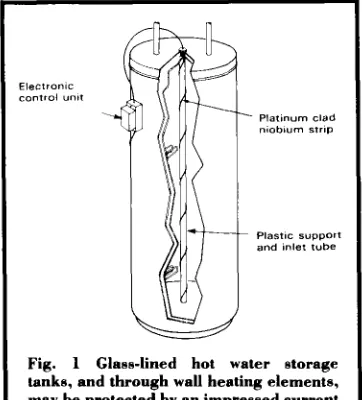
Fig. 1 Glass-Lined hot water storage tanks, and through wall heating elements, may be protected by an impressed current corrosion protection eystern, the tank well (cathode) and the platinum clad niobium anode being connected to a power source through an electronic control unit. The anode consists of a strip of platinum clad niobium spiralled around a plastic support
tube which extends the full length of the tank, and which serves as the water inlet
with the development of platinum clad anodes, have allowed the miniaturisation of ICCP systems (13). These Mini-ICCP systems can now be used in applications where small, con- trolled currents are required. The miniaturised circuitry has been made possible through the development of sophisticated integrated cir- cuits. The cost of these devices has been reduc- ed so that small controllable power sources can be produced at competitive prices.
Hot
Water Storage Tanks
Use of the best available technology has resulted in a hot water storage tank which is constructed of glass-lined, welded steel shell. However, the glass coating is not always free from imperfections, especially in the weld areas. Thus, additional corrosion protection is necessary, normally through the use of magnesium sacrificial anodes (14). In recent years premature failure of the magnesium anodes has led to an increased failure rate of hot
water storage tanks. Manufacturers have sear- ched for a universal cathodic protection system that is effective regardless of the corrosivity of the water. This has led to the development of a Mini-ICCP system for hot water storage a d s , as well as for a wide range of equipment requiring small protection currents and miniaturised components.
In order to protect the interior surface of a glass-lined steel tank, as shown in Figure I , the system must be capable of providing uniform protection over the entire surface. Crevices formed by welds at the top and bottom of the shell are the most likely areas for defects in the glass lining, although such holidays may occur in other areas of the tank wall. In electrically heated tanks, the through wall heating elements may also need protection. These factors require that the anode extends over the full length of the tank to provide uniform cathodic protec- tion. In Figure I , the tank wall (cathode) and the platinum clad niobium anode are connected through a control circuit to the I 10 volt or 220
volt AC power source.
The anode must be designed to have a long predictable life in the hot water storage tank en- vironment. Platinum clad niobium has suitable properties for this environment, including high breakdown potential (>120 volts versus the S.C.E.) for the niobium substrate, a uniform platinum cladding, a sound metallurgical bond that prevents platinum spalling, and ease of fabrication (4, 5 , 7, 9). The platinum consump- tion rate is extremely low and predictable in this environment, so that the design of the platinum clad niobium anode is highly reliable
(10). The anode consists of a strip of platinum
clad niobium, spirally wound on a plastic sup- port tube which extends from the top to the bottom of the tank. The support tube also
serves as the water inlet tube.
In order to be universally effective, the Mini-
ICCP system must be capable of providing the necessary protection current in corrosive waters while not impressing too much current in less corrosive waters. In addition, an adequate pro- tection current must be maintained regardless of the water resistivity. The key to this is the
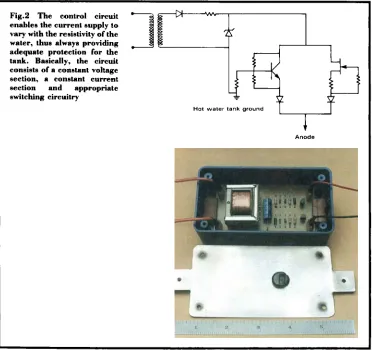
Fig.% The control circuit enables the current supply to
vary with the resistivity of the
water, thus always providing adequate protection for the tank. Basically, the circuit consists of a constant voltage section, a constant current section and appropriate switching circuitry
Hot water tank ground
E
0 1.00'
Q,
> 0.75.
v)
t
;
0.50.I-
5
0.25-r
3
Anode
\
\ .M
\ Magnesium
4
7;.
::;
C
Mini - I C C P
'.
>.
- 5 O..
-_
development of the control circuit, shown in Figure 2 , which provides the protection current
as a function of water resistivity, see Figure 3. For a state-of-the art Mini-ICCP system in a commercial hot water storage tank, the curve of protection current versus water resistivity shown in Figure 3 has three regions. The region of low resistivity and high corrosivity requires maximum protection current. The region of in- termediate resistivity exists whereby the cur- rent decreases with increasing resistivity. The third region of high resistivity and low cor- rosivity requires minimum protection current. Included in Figure 3 is the curve for a magnesium anode in the commercial hot water tank. Notice that at low resistivities (high cor- rosivity) the protection current is extremely high, which can lead to rapid corrosion and premature failure of the magnesium anode. At
Platinum Metals Rev., 1986, 30, (2) 65
high resistivities, the current is very low which could possibly lead to under protection.
The regulating nature of the control circuit in Figure 2 provides the output which conforms to
the curve in Figure 3. The circuit consists of a constant voltage section, a constant current sec- tion, and appropriate switching circuitry.
Source of water
Well Well Reservoir
Well Reservoir
Field Trials and Service
Performance
Field trials have been conducted in areas hav- ing documented corrosion failures where tanks had failed in less than three years. They includ- ed sites with well waters, waters with high con- centration of sulphides or chlorides, and acid waters. Impressed current corrosion protection systems conforming to production specifica-
Water PH resistivity
ohm cm
8000 5.5 3200 4.9 3500 7.1 7100 6.9 1000 8.4
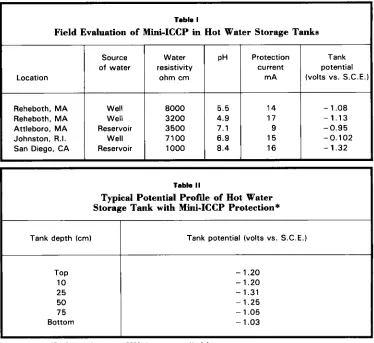
tions were installed at each site. Water condi- tions, protection currents and tank potentials were measured periodically. Table I gives specific data from selected sites on water resistivity, pH
,
protection current, and tank potential. These potentials are all in the protec- tion region for steel indicating that the proper protection current is being supplied by the Mini-ICCP system.A typical potential profile for a hot water storage tank is given in Table I1 to show that the protection is distributed throughout the in- side tank wall. The absence of tank failure after
5 years at sites where failure had previously oc-
curred with magnesium anodes after only three years, provides conclusive evidence of the effec- tiveness of the Mini-ICCP system in the in-
Protection current
mA
Table I
Field Evaluation of Mini-ICCP in Hot Water Storage Tanka
Tank potential (volts vs. S.C.E.
Location
14 17 9 15 16
Reheboth, M A Reheboth, M A Attleboro, M A Johnston, R.I. San Diego, CA
- 1.08 -1.13 -0.95 -0.102
- 1.32
Table II
Typical Potential Profile of Hot Water Storage Tank with Mini-ICCP Protection*
Tank depth (cm)
TOP 10 25 50 75
Bottom
Tank potential (volts vs. S.C.E.)
- 1.20
- 1.20
- 1.31 - 1.25 - 1.05 - 1.03
* 1 Year service, 1 5 mA protection current, 3500 ohmcm water, pH = 5 . 2
creasingly aggressive hot water storage tank en- vironments now encountered.
Summary
Advances in electronics and materials technologies have led to the development of miniaturised impressed current protection systems. The system described here was developed for the protection of glass-lined steel hot water storage tanks. It consists of a platinum clad niobium anode strip which ex- tends the full length of the tank, and an elec- tronic control unit. The stability of platinum
clad niobium has been well documented such that the design of the anode for long life is en- sured. The control unit was designed to provide optimum cathodic protection current for the tank in all water conditions. Service perfor- mance of the Mini-ICCP system has shown that problems encountered with other protection methods are overcome with this device. The system has applicability in other environments including water pumps, valves, water cooled devices and a wide range of plant equipment where small protection currents and inexpen- sive miniaturised circuitry is necessary.
References
I R. H. Stevens, U.S. Patent 1,077,920; 1913 8 L. L. Shreir, Platinum Metals Rev., 1977, 21, z J. B. Cotton, Platinum MetalsRev., 1958,2, (2), 45
3 R. M. Skomoroski, R. Baboian, R. G . Zobbi 9 R. Baboian, Mater. Perform., 1979, 18, (I), 9
and E. K. Camp, Plating, 1973, 60, 1 1 1 5 10 R. Baboian, Marer. Perform., 1983, 22, (IZ), 15 4 R. Baboian, Chlorine Bicentennial, The Electro- 1 1 R. Baboian, Mater. Perform., 1984, 23, (9), 31
chemical SofietY, Princeton, N.J.9 1974, P. 158 1 2 R. Baboian and G. Haynes, U.S. Patent 4,407,
5 R. Baboian, Proceedings of the 4th Inter- 711; 1983 and Mater Perform., 1983, 22, (101, 15
national Congress on Marine Corrosion and 13 R. Baboian, L. McBride, R. Langlais and G.
Fouling, 1976, p. 51 Haynes, Mater. Perform., 1979, 18, (IZ), 40 6 M. A. Warne and P. C. S. Hayfield. Mater. I4 H. H. UNig, “Corrosion and Corrosion
Perform., 1976, 15, (31, 39 Control”, 2nd Edn., Wiley, New York, 1971,
p. 218
(4), 110 and 197% 22, (I), I4
7 R. Baboian, Mater. Perform., 1977, 16, (3), 20
Palladium-C opper Composite Contacts
Electrical contacts form a necessary part of a very wide variety of components used, for example, by the telecommunications and automotive industries. Essential requirements of such contacts are that, on activation, they will consistently close the circuit, carry the current and then break the circuit, for at least the specified number of operations. The reliability of performance depends upon the electrical and mechanical operating conditions, and also upon the chemical and physical pro- perties of the contact.
Although copper-palladium alloys containing
I 5 or 40 weight per cent copper have been used successfully for electrical contacts for many years, none-the-less work continues to develop materials that combine the different properties in more advantageous ways. A recently pub- lished communication from the laboratory of R.
Rau G.m.b.H., Pforsheim, and the Institute for Materials Technology of the Technical Univer- sity Berlin deals with the manufacture of copper/palladium composites, and compares
the properties of these new materials with those of conventional copper-palladium contact alloys, (K. Miiller, D. Stockel and
H.
Claus,Metall, 1986, 40, ( I ) , 33-37).
As the palladium content of a copper- palladium alloy is increased to improve resistance to tarnishing, so the electrical con- ductivity is decreased and the hardness in- creased due to solid solution effects. However composite materials can be made from these two metals in ways that hinder solid solution formation. One of the three methods suggested is to draw down bundles of copper-clad palladium wire. By repeated bundling and drawing as many as 5 0 0 0 wires may be reduced
to a diameter of 0.5 to 2mm.
These ductile composite materials can be fabricated in a cost effective manner into bimetallic rivet-headed contacts. Electrical con- ductivity may be higher by a factor of ten, and contact resistance lower than that of con- ventional alloy contacts of the same overall composition.