Contagion Effect Of Decrease In Auditor Quality
And Earnings Management
Nanda Fito Mela
Abstract: This research aimed at examining the contagion effect of a decrease in auditor quality on the earnings management practices. The number of research samples was 79 companies within 2012-2015. The earnings management was measured using Jones Modified Model. The decrease in auditor quality is measured by the misstatement of financial statements. Based on the results of the regression analysis, the contagion effect of a decrease in auditor's quality in the previous period and the current period, increasing the practice of earnings management. These results indicate that the contagion effect of a decrease in auditor quality indicates misstatement that provides a gap for companies to practice earnings management. The misstatement was carried over to the following financial reporting period, there by improving earnings management practices in the following period. The misstatement was carried over to the financial statement of other companies with the same auditor. Accordingly, it increases the earnings management Index Terms— Contagion Effect; Auditor Quality, Earnings Management, Misstatement
—————————— ——————————
1 INTRODUCTION
The financial statement becomes a media for the company to deliver the performance of company management to the party using financial statements. The main purpose of financial statements is to provide information about the financial position, financial performance, and corporate cash flows that are beneficial for most of the report users in economic decision making (Ikatan-Akuntan-Indonesia, 2013, para. 7)One of the information in the financial statement is the information regarding the company earnings. Earnings is an indicator used to measure the operational performance of a company. Statement of Financial Accounting Concept (SFAC) number 1 on ―Objectives of Financial Reporting by Business Enterprises‖ explains that the earnings information is an important factor to assess the performance, managerial responsibility, assisting the owner or other parties to conduct interpretation on the earning power of the company in the future. The importance of earnings information for the financial statement users make the entrepreneurs strive to improve their earnings. This motivates companies to report earnings that do not reflect the actual condition of the company. Companies report earnings that do not reflect the actual condition of the company through earnings management. This is increasing because of the company as an internal party which provides the financial statement information has more information compared to the external financial statement users. Earnings management is important to be studied due to the existence of several cases related to earnings manipulation. One of the cases of earnings management in Indonesia is the case of PT. Kimia FarmaTbk. In 2001, the financial statement of PT. Kimia FarmaTbk reported a net income of IDR 132 billion.
The Capital Market Supervisory Agency (BAPEPAM) considers that the net earnings are too large and contains elements of engineering. Financial statements of PT. Kimia FarmaTbk is re-audited. Financial statement of PT. Kimia FarmaTbk was restated. On the new financial statement, the earnings presented was only IDR 99.56 Billion, IDR 32.6 Billion less (24.7% from the previous earnings reported) (Ahmad, 2011).Another case of earnings management also occurred in foreign companies namely the cases of Enron, WorldCom, and Merck Co Companies. Enron company is a company in the field of the energy industry. The Enron company made earnings management by reporting profits of US $ 600 million and covering actual losses (Ahmad, 2011).
The WorldCom company is one of the largest
telecommunications companies in the United States. WorldCom companies do financial manipulation by covering the expenditure of US $ 3.8 billion to convince investors that the company generates profits and covers existing losses (Ahmad, 2011). The Merck Co company is the biggest pharmaceutical company in the United States. Merck Co company did an income markup as much as US$ 14.1 Billion for 3 years (Ahmad, 2011). The Enron case impacted on the loss, even the bankruptcy of the Enron company. The auditor role is significantly important in detecting the earnings management. The audit process is beneficial to detect and reveal the practice of manipulation performed by a company (Lin, Liu, & Wang, 2009). One of the manipulation acts which can be prevented by the auditor is accrual earnings management. Accrual earnings management is an earnings management by the company management through the utilization of weakness of the applicable accounting standard. (Roychowdhury, 2006). According to the main objective of the audit which is to ensure the financial reporting in accordance with accounting applicable standards, then the auditor can detect and decrease the practices of accrual earnings management. One of the aspects determining whether the auditor is able to detect and decrease the practices of earnings management is the quality of an auditor. The high-quality of an auditor can decrease the practice of earnings management, on the other hand, the low-quality auditor can
increase the earnings management. Danayani and
Warsono(2013) state that quality auditors are specialist auditors with high reputation; investment in high recruitment, training, information technology, and audit technology, and the ability to detect high manipulations. Previous research states that in 29 countries, auditors who have a high reputation are ___________________________
Nanda Fito Mela (Corresponding Author) Nanda Fito
MelaLecturer, Faculty of Economic and Bussiness, University of Riau, Indonesia
E-mail: [email protected]
755
able to reduce earnings management practices
(Kanagaretnam, Lim, & Lobo, 2010). In Turkey, the high-quality of the audit is shown by the big-four auditor who is more capable of detecting the earnings management compared to the non-big four auditors(Memiş&Çetenak, 2012; Yaşar, 2013). In Indonesia, auditors with industrial specialties are capable of reducing the level of earnings management (Christiani & Nugrahanti, 2014; Pujilestari & Herusetya, 2013).The research focused on the decrease in the auditor quality, as well as the impact on the earnings management. Cassell et al.(2012) state that the supervision of the management of the company is more focused on reducing auditor quality compared to improving the quality of the auditors. This study discusses the existence of contagion effects from a decrease in auditor quality. Contagion effect of a decreasing audit quality shows that auditors who have low quality cause misstatement and bring the impact of the misstatement to the following year (Li, Qi, Tian, & Zhang, 2017) or causes the same misstatement on other companies audited by the same auditor (Du & Lai, 2018; Francis & Michas, 2013; Gul, Lim, Wang, & Xu, 2015). Contagion effect of a decrease in the audit quality causes the increase in the practices of earnings management. This occurs since the existence of misstatement describes the inability of the auditor in detecting and reducing the earnings management.
2
THEORETICAL
BASIS
2.1 Agency Theory
Agency theory is a theory explaining the relationship of the agency as a contract between one or more parties (principal) which binds other parties (agent) to run the company management based on principal interests, including the delegation of decision-making authority to the agent (Jensen & Meckling, 1976). The principal will give an incentive to the agent and incur costs for monitoring so that the agents do not do violations (Jensen & Meckling, 1976).The principal does not have sufficient information on the agent’s performance. The agent has more information on the self-capacity, work environment, and company as a whole. This is what results in the imbalance of information held by the principal and the agent. This information imbalance is called information asymmetry. The assumption that individuals act to maximize themselves causes the agent to take advantage of the information asymmetry the agent has to hide some information unknown to the principal. Information asymmetry and conflicts of interest that occur between the principal and the agent encourage the agent to present information that is not true to the principal, particularly when the information is related to the measurement of agent’s work performance. One of the forms of agent acts is earnings management. One of the mechanisms to reduce the agency conflict is the existence of an independent party who examines the financial statement arranged by the agent. The independent party is the auditor. The auditor is also an agent for the principal to oversee other agents (management) because agency theory explains that the principal does not fully trust management (The-Insititute-of-Chartered-Accountants-in-England-and-Wales, 2005). The audit process is one type of assurance service that aims to improve the quality of information produced by management. One of the mechanisms to reduce the asymmetrical information of financial statement is by conducting a financial statement audit, by evaluating the company financial
statement and releasing opinions on the results of the audit..
2.2 Earnings Management
Scott (2014) reveals that there are two ways to comprehend the earnings management. First, opportunistic behavior of management to maximize its utility in facing the compensation contract, debt contract, and political costs. Second, looking at earnings management from an efficient contract perspective, where earnings management gives managers the flexibility to protect themselves and the company in anticipating unexpected events for the benefit of the parties involved in the contract. Factors that influence earnings management according to Watts and Zimmerman (1990) is a bonus based on earnings achievement, violation of debt contracts, and political costs. While Scott (2014) states that several motivations for the occurrence of earnings management namely bonus, political management, tax motivation, CEO replacement, and Initial Public Offering (IPO). Scott (2014) explains the pattern of earnings management is performed through taking bath, income minimization, income maximization, and income smoothing. The selection of earnings management in each company depends on the needs owned by the company related to the generated earning statements.Roychowdhury (2006) explains that earnings management can be conducted by accrual earnings management and real earnings management. The accrual earnings management measures discretionary accrual which does not have an impact on the direct cash flow (Roychowdhury, 2006). Accrual earnings management is done at the end of the period when the manager knows the earnings before being engineered so that it can be found out how much manipulation is needed so that the earnings target is reached (Roychowdhury, 2006). One of the manipulations that auditors can prevent is accrual earnings management. Accrual earnings management is profit manipulation by company management through the use of weaknesses of applicable accounting standards (Roychowdhury, 2006). According to the main objective of the audit, which is to ensure the financial statement is according to the applicable accounting standard, then the auditor is able to detect and reduce the practices of accrual earnings management. Prepare your paper before stylingBefore you begin to format your paper, first write and save the content as a separate text file. Keep your text and graphic files separate until after the text has been formatted and styled. Do not use hard tabs, and limit use of hard returns to only one return at the end of a paragraph. Do not add any kind of pagination anywhere in the paper. Do not number text heads-the template will do that for you.Finally, complete content and organizational editing before formatting. Please take note of the following items when proofreading spelling and grammar.
2.3 Contagion Effect of low-quality audits
reputation(Kanagaretnam et al., 2010), as well as the auditor office(big four and non-big four) (Memiş& Çetenak, 2012; Yaşar, 2013).Based on the audit results, the audit quality can be seen from the quality of the financial statement. One measure of the financial statement quality related to the auditor performance is the misstatement of financial statement (revealed on the following period as a restatement) as the signal of the low-quality audit (Du & Lai, 2018). Misstatement reflects the violation of accounting standards and financial reporting regulations; accordingly, it can be used as an overview of auditor quality (Francis & Michas, 2013). This describes that misstatement is a failure in achieving the main objective of financial statement audit, or audit failure. There are two explanations ofa misstatement in an auditor office. First, the misstatement indicating the low quality of audit engagement (or idiosyncratic factors from the client-company)(Francis & Michas, 2013), such as the complexity of accounting standards, internal control, changes in materiality levels, auditor conservatism, earnings management, transaction complexity, and company management policies (Plumlee & Yohn, 2010). Second, related to the contagion effect, the misstatement indicates there is a systematic problem in the auditor office due to the general characteristics of an auditor office (Francis & Michas, 2013).Contagion effect of a decrease in audit quality shows that the auditor has a low quality causes the existence of misstatement and impacts on the misstatement in the following year (Li et al., 2017) or causes the same misstatement on other company audited by the same auditor (Du & Lai, 2018; Francis & Michas, 2013; Gul et al., 2015). Contagion effect of a decrease in audit quality can occur due to the general characteristics of an auditor's office which indicates a lack of auditor competence, quality control procedures, which causes low audit quality (Francis & Michas, 2013). This causes the low performance in the auditor office. The existence of contagion effect of a decrease in audit quality has been proven by Du & Lai (2018) as well as Francis &Michas(2013) who found that the auditor's office conducting an audit of the financial statements that experienced misstatement would affect the quality of the company's financial statements audited by the same auditor's office. Li et al.(2017) found that financial statements that experienced misstatement had a low quality of the financial statements in the following period if audited by the same auditor. This study observed the contagion effect of a decrease in audit quality at the office level and not testing at the individual auditor level. In Indonesia, based on the Minister of Finance Regulation No.17 / PMK.01/2008 and Government Regulation PP No. 20/2015, individual auditors cannot conduct financial statement audits without taking shelter under a Public Accounting Firm (KAP) and conducting audits on behalf of the KAP. Based on the conditions in Indonesia, most probably the contagion effect of a decrease in audit quality occurs on the office level compared to the individual level. Units
• Use either SI (MKS) or CGS as primary units. (SI units are encouraged.) English units may be used as secondary units (in parentheses). An exception would be the use of English units as identifiers in trade, such as ―3.5-inch disk drive.‖
• Avoid combining SI and CGS units, such as current in amperes and magnetic field in oersteds. This often leads to confusion because equations do not balance dimensionally. If you must use mixed units, clearly state the units for each quantity that you use in an equation.
• Do not mix complete spellings and abbreviations of units: ―Wb/m2‖ or ―webers per square meter,‖ not ―webers/m2.‖ Spell units when they appear in text: ―...a few henries,‖ not ―...a few H.‖
• Use a zero before decimal points: ―0.25,‖ not ―.25.‖ Use ―cm3,‖ not ―cc.‖ (bullet list)
2.4 Development of Hypotheses
757
quality in the previous period affected the earnings management practices. Du & Lai (2018), as well as Francis &Michas(2013), found that the auditor office who conducts the audit on the financial statements that experience misstatement will affect the quality of the company's financial statements audited by the same auditor's office. This shows that the contagion effect of a decrease in auditor quality also causes transmission of misstatements in one auditor's office in the same period. With the transmission of the financial misstatement, other companies audited by the same auditor who has conducted a misstatement experience the increase in the practices of earnings management. H1: Contagion effect of a decrease in auditor quality in the current period affects the practice of earnings management Using the TemplateAfter the text edit has been completed, the paper is ready for the template. Duplicate the template file by using the Save As command, and use the naming convention prescribed by your conference for the name of your paper. In this newly created file, highlight all of the contents and import your prepared text file. You are now ready to style your paper; use the scroll down window on the left of the MS Word Formatting toolbar.
3
RESEARCH
DESIGN
3.1 Research Sample
The samples in this research were the manufacturing companies listed in the Indonesia Stock Exchange (IDX) in 2012-2016 with the research period of 2012-2015. This is because there were data in the t + 1 period, that were, the current period's misstatement can only be seen from whether there was a restatement in the following period. The determination of the manufacturing industries as research samples because the accrual rate was high compared to other industries. In the research sample, the auditor changes were not conducted and neither changes in the financial reporting period. The number of research samples was 79 companies in 2012-2015. The results of the sampling used in this research are presented in Table 1.
TABLE 1.
Research Sample
Companies The Manufacturing company listed in
the Indonesia Stock Exchange (IDX) in 2012-2016
130
Incomplete data (1)
Replacing LK Period (5)
Replacing Auditor (45)
Total 79
Total Observation (2012-2015) 316
Source: Indonesia Stock Exchange (IDX)
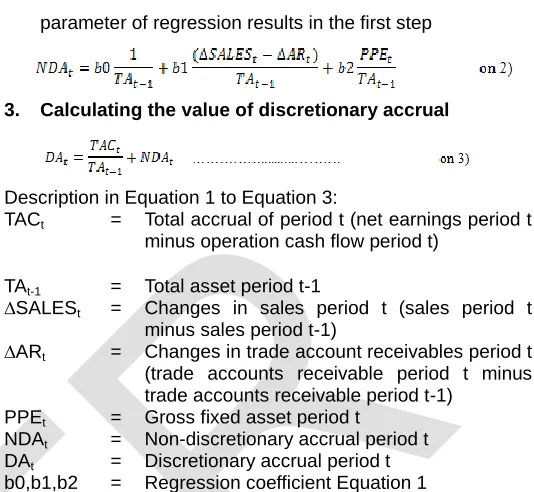
3.2 Variable and Operational DefinitionThe dependent variable in this research is accrual earnings management. Accrual earnings management was measured using discretionary accrual with Jones Modified method. The steps of Jones Modified method are as follows:
1. Conducting regression with the model as follow.
2. Calculating non-discretionary accrual values using the
parameter of regression results in the first step
3. Calculating the value of discretionary accrual
Description in Equation 1 to Equation 3:
TACt = Total accrual of period t (net earnings period t
minus operation cash flow period t)
TAt-1 = Total asset period t-1
∆SALESt = Changes in sales period t (sales period t
minus sales period t-1)
∆ARt = Changes in trade account receivables period t
(trade accounts receivable period t minus trade accounts receivable period t-1)
PPEt = Gross fixed asset period t
NDAt = Non-discretionary accrual period t
DAt = Discretionary accrual period t
b0,b1,b2 = Regression coefficient Equation 1
auditor's office size is measured using a dummy variable (score 1 if the auditor's office is included in the big four affiliates, a score of 0 if not included in the big four affiliates). Going concern opinion is an audit opinion that indicates the existence of a company's sustainability problem measured using a dummy variable (score 1 if the audit opinion includes an unqualified opinion, a score of 0 if the audit opinion is included in addition to an unqualified opinion). Auditor specialization is measured using industry specialization, which is indicated by the auditor's market share in one particular industry (Audousset-Coulier, Jeny, & Jiang, 2016; Bae, Choi, & Rho, 2016). If the auditor's market share is 20 percent or more, then it is included in the specialist auditor; if the auditor's market share is below 20 percent, then it is not a specialist auditor (Mayhew & Wilkins, 2003). The auditor’s specialization is measured using a dummy variable (score 1 if the auditor is a specialist auditor, score 0 if the auditor is not a specialist auditor).The company factor consists of the company size, company’s growth, and loss indicator. The big company will tend to conduct earnings management because it does not want to hold responsible for political costs (Watts & Zimmerman, 1990). The higher the growth and performance of the company, the more the company will do earnings management (Lee, Li, & Yue, 2005). Company size is measured by the logarithm of total assets. Company growth is measured by the ratio of market capitalization divided by total assets. The loss indicator is measured by a dummy variable (score 1 if the net earnings have a negative value, score 0 if the net earnings have a positive value).
3.3 Analysis Model
The research hypothesis testing employed a regression testing. Before the regression testing, this research conducted a classical assumption testing, namely normality, heteroscedasticity, multicollinearity, and autocorrelation; ensuring that the regression model is not biased. The model used in this research was as follow.
Description:
ML = Earnings Management
CEprior = Contagion effect of a decrease in audit quality in the previous period
CEcurrent = Contagion effect of a decrease in audit quality in the current period
BIG = Auditor’s office size OGC = Going concern opinion SPESIAL = Auditor’s Specialization SIZE = Company size
GROWTH = Company growth LOSS = Loss indicator
4 RESULT
AND
DISCUSSION
4.1 Descriptive Statistics
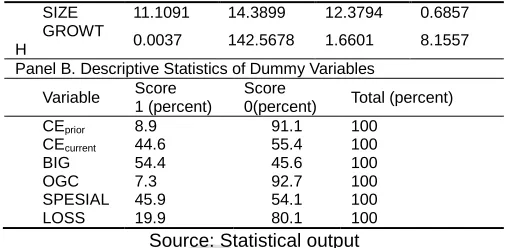
Descriptive statistics is the description of a variable in this research. The descriptions on research variables are as follows:
TABLE 2.
Descriptive Statistics
Panel A. Descriptive Statistics of Continuous Variables
Variable Minimum Maximum Mean Standard Deviation ML 0.0017 2.6220 0.1973 0.2711
SIZE 11.1091 14.3899 12.3794 0.6857 GROWT
H 0.0037 142.5678 1.6601 8.1557 Panel B. Descriptive Statistics of Dummy Variables
Variable Score 1 (percent)
Score
0(percent) Total (percent)
CEprior 8.9 91.1 100
CEcurrent 44.6 55.4 100
BIG 54.4 45.6 100
OGC 7.3 92.7 100
SPESIAL 45.9 54.1 100
LOSS 19.9 80.1 100
Source: Statistical output
Based on Table 2, the least practice of earnings management conducted by a company is 0.0017. The highest practice of earnings management conducted by a company is 2.6220. On average, each company carries out earnings management of 0.1973; with a deviation of 0.2711. Auditors who have contagion effects decrease audit quality from the previous period by 8.9 percent of all research observations. Auditors who have contagion effects of a decrease in audit quality from the same auditor office in the current period as much as 44.6 percent from the overall research observation.
4.2 Classical Assumption
The results of classical assumption testing are as follows.
TABLE 3.
Classical Assumption
Testing Results Descriptions
Kolmogorov-Smirnov
Significance < 0.05
Data are not normally distributed
Kolmogorov-Smirnov (after winsorizing)
Significance> 0.05
Data are normally distributed Glejser Significance >
0.05
Free from heteroscedasticity problem Durbin-Watson Value of DW =
2.097
Free from autocorrelation problem VIF VIF < 10 Free from multicollinearity
problem
Source: Statistical output
Based on Table 3, these research data are normally distributed (after winsorizing), free from heteroscedasticity problem, free from autocorrelation problem, and free from multicollinearity problem.
4.3 Hypothesis Testing and Discussion
The results of hypothesis testing using the regression analysis are as follows.
TABLE 4. Regression Testing
Variables Coefficient Description Constant 1.340
CEprior 0.110** H1 accepted
CEcurrent 0.052*** H2 accepted
BIG -0.052
OGC 0.072
SPESIAL -0.030 SIZE -0.092* GROWTH -0.001
LOSS 0.007
F Value 6.406* Adjusted
R2
0.121
*Significant at the level of 1 percent **Significant at the level of 5 percent ***Significant at the level of 10 percent
759
Based on Table 4, the contagion effect of a decrease in audit quality in the previous period has the regression coefficient of 0.110 (significant on the level of 5 percent). These results indicate that the first hypothesis of this study is accepted, the contagion effect of the decrease in auditor quality in the previous period has a positive effect on earnings management. The contagion effect of the decline in auditor quality in the current period has a regression coefficient of 0.052 (significant at the 10 percent level). These results indicate that the second hypothesis of this study is accepted, the contagion effect of the decline in auditor quality in the current period has a positive effect on earnings management. The results are in line with the previous research which discuss on the decrease of audit quality followed by the increase in the practice of earnings management (Andayani & Warsono, 2013; Christiani & Nugrahanti, 2014; Kanagaretnam et al., 2010; Memiş & Çetenak, 2012; Pujilestari & Herusetya, 2013; Yaşar, 2013).Misstatement shows the low quality of an auditor. The decrease in the auditor quality is also reflected from the low quality of the same auditor, both the one who audits the following financial statement (Li et al., 2017) and the one who audits the other companies’ financial statements (Du & Lai, 2018; Francis & Michas, 2013). The decrease in auditor quality opens opportunities for companies to practice earnings management. For example, if there is a misstatement of the company's financial statements (seen from the restatement of the financial statements of the following period) because of misuse of accounting estimates or misclassification in accordance with accounting standards, then this indicates that the auditor failed to ensure that the financial statements are presented. If the auditor fails to ensure an estimate or classification of accounting policies, then this is a gap for companies to practice earnings management. The misstatement was carried over to the following financial reporting period, thereby improving earnings management practices in the following period. The misstatement is carried away to the other companies’ financial statement with the same auditor, s that it increases the practice of earnings management of other companies audited by the same auditor.
4.4 Additional Analysis
The additional analysis in this research was considering the audit quality and earnings management from the aspect of audit conservatism. Audit conservatism shows that the audit’s focus in the misstatement on the reported earnings is an overstatement. This study measures the contagion effect of a
decrease in audit quality over income-increasing
misstatement. In addition, alternative management
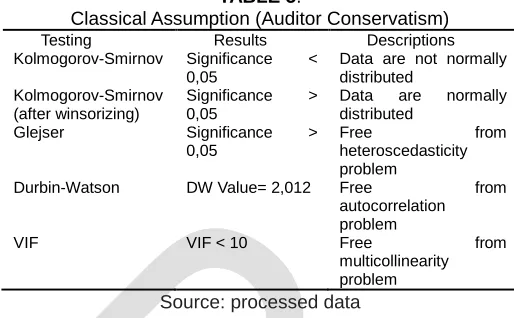
measurements use the value of discretionary accrual without absolute, so that this study can see earnings management with the aim of increasing earnings or decreasing earnings. Based on the concept of conservatism audit, high-quality auditors only focus on detecting and reducing the practice of earnings management with the aim of increasing profits. The possibility of audit conservatism due to time and cost constraints, so that the auditor only focuses on the greatest potential for the misstatement, in the context of this research namely the potential for the misstatement in the form of overstatement of earnings information (Francis & Michas, 2013). The results of classical assumption testing for additional analysis used the basis of audit conservatism as follow.
TABLE 5.
Classical Assumption (Auditor Conservatism)
Testing Results Descriptions
Kolmogorov-Smirnov Significance < 0,05
Data are not normally distributed
Kolmogorov-Smirnov (after winsorizing)
Significance > 0,05
Data are normally distributed
Glejser Significance > 0,05
Free from
heteroscedasticity problem
Durbin-Watson DW Value= 2,012 Free from autocorrelation problem
VIF VIF < 10 Free from
multicollinearity problem
Source: processed data
The Based on Table 5, the data of this research are well distributed (after winsorizing), Free from heteroscedasticity problem, free from autocorrelation problem, and free from multicollinearity problem.
The results of the additional analysis, as well as its comparison with the results of the main analysis, are as follows.
TABLE 5.
Comparison of Additional Testing Results
Variable Coefficient Description Main
Analysis
Analysis using Auditor Conservatism Constant 1.340 -2.613
CEprior 0.110** 1.133* Consistent
CEcurrent 0.052*** 0.099** Consistent
BIG -0.052 -0.041
OGC 0.072 0.110***
SPECIAL -0.030 -0.062*** SIZE -0,092* 0,212* GROWTH -0,001 0,001
LOSS 0,007 -0,019
Nilai F 6,406* 27,487* Adjusted R2 0,121 0,402
*Significant on the level of 1 percent **Significant on the level of 5 percent ***Significant on the level of 10 percent
Source: processed data
Based on Table 6, the comparison of results between the main analysis and analysis using auditor conservatism consideration shows that the additional analysis results are consistent with the main analysis results which show that the contagion effect of a decrease in auditor quality has a positive effect on the practice of earnings management.
5 CONCLUSION
companies to choose qualified auditors. Therefore, the quality of financial statement information increase and can be used in economic decision making.
REFERENCES
[1.] Ahmad, D. F. S. (2011). Hubungan Manajemen Laba Sebelum IPO dan Return Saham dengan Kepemilikan Institusional sebagai Variabel Pemoderasi. Universitas Diponegoro Semarang.
[2.] Andayani, W., & Warsono, S. (2013). Prospector-Defender Strategy, Auditor Industry Specialization, Earnings Management Through Real Activities, and Earnings Quality. Journal of Indonesian Economy and Business, 28(1), 115–131.
[3.] Audousset-Coulier, S., Jeny, A., & Jiang, L. (2016). The Validity of Auditor Industry Specialization Measures. Auditing: A Journal of Practice & Theory, 35(1), 139–161.
[4.] Bae, G. S., Choi, S. U., & Rho, J. H. (2016). Audit Hours and Unit Audit Price of Industry Specialist Auditors: Evidence from Korea. Contemporary Accounting Research, 33(1), 314–340.
[5.] Cassell, C. A., Giroux, G. A., Myers, L. A., & Omer, T. C. (2012). The Effect of Corporate Governance on Auditor-Client Realignments. Auditing: A Journal of Practice and Theory, 31(2), 167–188.
[6.] Christiani, I., & Nugrahanti, Y. W. (2014). Pengaruh Kualitas Audit Terhadap Manajemen Laba. Jurnal Akuntansi dan Keuangan, 16(1), 52–62.
[7.] Du, X., & Lai, S. (2018). Financial Distress, Investment Opportunity, and the Contagion Effect of Low Audit Quality: Evidence from China. Journal of Business Ethics, 147, 565–593.
[8.] Francis, J. R., & Michas, P. N. (2013). Contagion Effect of Low-Quality Audits. The Accounting Review, 88(2), 521–552.
[9.] Government-Accountable-Office. (2006). Financial Restatement Database Report. Washington DC: Government Printing Office.
[10.]Gul, F. A., Lim, C. Y., Wang, K., & Xu, Y. (2015). The Price Contagion Effects of Financial Reporting Fraud: Evidence form the Individual Audit Partner Level. Working Paper. Singapore Management University. [11.]Ikatan-Akuntan-Indonesia. (2013). PSAK 1: Penyajian
Laporan Keuangan. Jakarta: IAI.
[12.]Ikatan-Akuntan-Publik-Indonesia. (2015). Standar Audit 200: Tujuan Keseluruhan Auditor Independen dan Pelaksanaan Audit Berdasarkan Standar Audit [Overall Objective of the Independent Auditor and the Conduct of Audit in Accordance with Standards on Auditing]. Indonesia: IAPI.
[13.] International-Auditing-and-Assurance-Standards-Board. (2009). International Standard on Auditing 200: Overall Objective of the Independent Auditor and the Conduct of Audit in Accordance with International Standards on Auditing. USA: IAASB.
[14.]Jensen, M. C., & Meckling, W. H. (1976). Theory of The Firm: Managerial Behaviour, Agency Cost and Ownership Structure. Journal of Financial Economics, 3(4), 305–360.
[15.]Junaidi, Hartono, J., Suwardi, E., Miharjo, S., & Hartadi, B. (2016). Does Auditor Rotation Increase
Auditor Independence? Gadjah Mada International Journal of Business, 18, 315–336.
[16.]Kanagaretnam, K., Lim, C. Y., & Lobo, G. J. (2010). Auditor reputation and earnings management: International evidence from the banking industry. Journal of Banking & Finance, 34(10), 2318–2327. [17.]Lee, C.-W. J., Li, L. Y., & Yue, H. (2005).
Performance, Growth and Earnings Management. Review of Accounting Studies, 11(2-3).
[18.]Li, L., Qi, B., Tian, G., & Zhang, G. (2017). Contagion Effect of Low-Quality audits at the Level of Individual Auditors. The Accounting Review, 92(1), 137–163. [19.]Lin, Z. J., Liu, M., & Wang, Z. (2009). Market
Implications of the Audit Quality and Auditor Switches: Evidence from China. Journal of International Financial Management & Accounting, 20(1), 35–78. [20.]Mayhew, B. W., & Wilkins, M. S. (2003). Audit Firm
Industry Specialization as a Differentiation Strategy: Evidence from Fees Charged to Firms Going Public. Auditing: A Journal of Practice & Theory, 22(2), 33– 52.
[21.]Memiş, M. Ü., & Çetenak, E. H. (2012). Earnings Management, Audit Quality and Legal Environment: An International Comparison. International Journal of Economics and Financial Issues, 2(4), 460–469. [22.]Minutti-Meza, M. (2013). Does Auditor Industry
Specialization Improve Audit Quality? Journal of Accounting Research, 51(4), 779–817.
[23.]Plumlee, M., & Yohn, T. L. (2010). An Analysis of the Underlying Causes Attributed to Restatements. Accounting Horizons, 24(1), 41–64.
[24.]Pujilestari, R., & Herusetya, A. (2013). Pengaruh Kualitas Audit Terhadap Manajemen Laba Transaksi Real - Pengakuan Pendapatan Strategis. Jurnal Akuntansi dan Keuangan, 15(2), 75–85.
[25.]Roychowdhury, S. (2006). Earnings management through real activities manipulation. Journal of Accounting and Economics, 42(3), 335–370. https://doi.org/10.1016/j.jacceco.2006.01.002
[26.]Scott, W. R. (2014). Financial Accounting Theory (7th ed.). New Jersey, USA: Prentice Hall.
[27.] The-Insititute-of-Chartered-Accountants-in-England-and-Wales. (2005). Agency Theory and the Role of Audit. England: ICAEW.
[28.]Watts, R. L., & Zimmerman, J. L. (1990). Positive Accounting Theory: A Ten Year Perspective. The Accounting Review, 65(1), 131–156.