© 2017 IJSRST | Volume 3 | Issue 7 | Print ISSN: 2395-6011 | Online ISSN: 2395-602X Themed Section: Science and Technology
Numerical Studies on Heat Transfer Behavior of Electronics
Module with Zr, SiC and Cu Water Based Nanofluids
Dr. Nirmal Kumar Kund
Associate Professor, Department of Production Engineering, Veer Surendra Sai University of Technology, Burla, Odisha, India
ABSTRACT
Normal air cooling method is not pertinent for high heat flux electronics apparatuses. For that, the thermal investigation of electronics module is really indispensable towards its hassle free operation. The present study involves an electronics module kept horizontally at the base, inside a square shaped chamber filled with nanofluid as coolant. Three different water based nanofluids, specifically Water-Zr, Water-SiC and Water-Cu, are considered as coolants in the present investigations. The numerical studies are performed to obtain the heat transfer behavior of electronics module for maintaining its temperature within the safe limit. For that, a 2D numerical model is being developed which also includes thermal buoyancy. The continuity, momentum and energy equations are solved to predict the thermal behavior. Simulations are conducted to predict the temperature fields and temperature contours. The trends of results are along the expected lines. Simulation results predicted with three different water based nanofluids are analyzed and compared for realizing the relative importance of the stated nanofluids. The key model parameter considered is heat flux of 70 W/cm2 associated with the electronics module. The Water-SiC is witnessed as the nanofluid delivering comparatively greater cooling behavior towards electronics module with no such failure as a result of heat.
Keywords: Electronics Module, Simulation, Nanofluids, Water-Zr, Water-SiC, Water-Cu.
I.
INTRODUCTION
Modern fashion towards miniaturization of electronic packages accompanying the limitlessly more circuit densities has caused enormously high power densities. This tendency towards compactness involves high heat flux in various applications and has provided motivation, during the past several years, for significant volume of research related to the design and development of effective cooling schemes. In view of the present trend of continual increase in both packaging and power densities in modern day’s electronics gadgets, the search for the suitable cooling techniques, depending on the applications, motivated the investigators all over the world. As the simple free or forced convection air cooling exercise is unsatisfactory for the high heat flux usages, the race for several ways and means of cooling have congregated much prominence in recent years to surpass the trials of enormous heat related to the electronic objects.
From the referred revisions, to the best of author’ awareness, it is understood that there is not a single complete computational study connecting to the influences of water based nanofluids (actually Water-Zr, Water-SiC and Water-Cu) on heat related challenges of electronics modules. With this perspective, the present paper demonstrates numerical investigations with the stated nanofluids on thermal characteristics of electronics modules. And also, the numerical model includes additional key factors like inertia, viscosity and gravity effects apart from the usual issues concerning the present physical problem. However, the stated model ignores both compressibility and viscous heat dissipation effects. The model is very well demonstrated for the detailed numerical investigations on the influences of the already stated nanofluids (as they significantly affect the cooling characteristics) by taking electronics module heat flux and duct inlet nanofluid velocity as the important model parameters. In due course, the model predictions pertaining to the enumerated nanofluids are along the expected lines as well.
II.
DESCRIPTION OF PHYSICAL PROBLEM
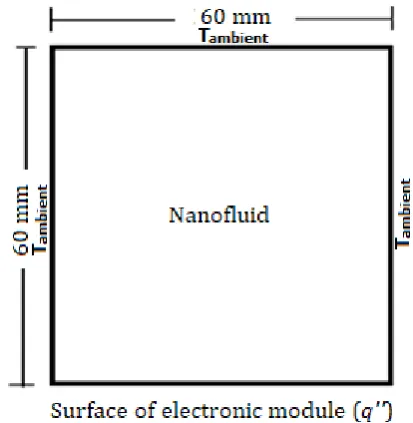
The neat sketch of a common electronics module representing the base of a square shaped chamber is very well described in the figure 1. It illustrates on the overall heat transfer from the electronics module kept horizontally at the base of square shaped chamber. The coolants considered in the present investigations are three different water based nanofluids named as Water-Zr, Water-SiC and Water-Cu. A 2D model is considered to save computation/simulation time by ignoring end effects in the transverse direction. The model includes thermal buoyancy, viscosity along with the gravity effect as well. The fluid flow is considered to be laminar and incompressible. The ambient together with the no slip boundary condition is specified at the walls. For cooling of the electronics module, a convective boundary condition in the form of heat flux is introduced at the base to simulate the overall temperature variation inside the square chamber due to heat transfer. The thermo-physical properties of listed nanoparticles in combination with the additional model data, are mentioned in table 1.
Figure 1. Schematic illustration of electronics module computational domain
Table 1. Thermophysical properties and model data
NanoparticleProperties Zr SiC Cu
Density, ρ (Kg/m3) 5680 3160 8940
Specific heat, CP (J/kg-K) 418 675 385 Thermal conductivity, k
(W/m-K)
22.6 490 401
Model Data Values
Height/Width of chamber 60 mm
Electronics module length 60 mm Ambient air temperature 300 K Electronics module heat flux 70 W/cm2
III.
MATHEMATICAL FORMULATION
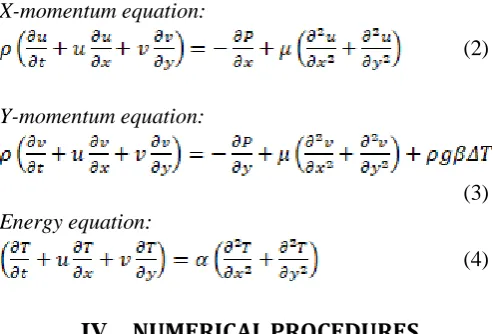
The related physical problem is converted into a set of governing transport equations which are solved with the accompanying computational trials on the subject of both modeling and simulation. The related continuity, momentum and energy equations in 2D for a fully developed hydrodynamic and thermal flow situations are described in equations from (1) to (4), respectively. The compressibility and the viscous heat dissipation effects are ignored in the present physical situation. However, the thermal buoyancy factor (represented by ρgβΔT) is incorporated in y-momentum equation (3).
X-momentum equation:
(2)
Y-momentum equation:
(3)
Energy equation:
(4)
IV.
NUMERICAL PROCEDURES
A. Numerical Scheme and Solution Algorithm
The related governing transport equations are modified into generalized form as follows.
u
St
.
.
u (5)The modified governing transport equations are discretized with the second order upwind scheme by means of a pressure based finite volume technique with the SIMPLER algorithm, where Γ represents a transport property (k or μ), ϕ specifies any conserved parameter and S is a source term.
In the beginning, both the continuity and momentum equations are solved at a time for generating the pressure and velocity fields. Subsequently, the energy equation is solved by expending the identified velocity field to get the related temperature field. In other words, all the associated equations are solved together (but not independently) bearing in mind the interdependency between the associated variables.
B. Choice of Grid Size, Time Step and Convergence
Criteria
A general grid-independence test is executed to establish the correct spatial discretization, and the levels of iteration convergence criteria to be worthwhile. As an outcome of this test, we have used 60 × 60 uniform grids for the final simulation. Corresponding time step taken in the simulation is 0.0001 seconds. Though we checked with smaller grids of 90 and 120 in numbers for 60 mm width/height of the computational domain, it is observed that a finer grid system does not alter the results
that the finer grids have minor effect in the simulation results which is quite obvious from the definition of grid-independence test. Additionally, the smaller grid requires more computational time vis-à-vis more constancy in predictions of several fields/contours.
Convergence in inner iterations is assured only when the
condition holds good for all variables
simultaneously, where 𝜑 stands for each variable u, v, and T at a grid point at the current iteration level, 𝜑old represents the corresponding value at the previous iteration level, and 𝜑max is the maximum value of the variable at the current iteration level in the entire domain.
V.
RESULTS AND DISCUSSION
Numerical simulations are executed to examine the effects of three different water based nanofluids (i.e. Water-Zr, Water-SiC and Water-Cu) on heat transfer characteristics of electronics module in terms of temperature distributions (i.e. temperature contours/fields) and surface temperatures of electronics modules. To begin with, the size of the square chamber is selected as 60 mm. Besides, the electronics module is subjected to a heat flux of 70 W/cm2.
A. Case study with Water-Zr nanofluid as coolant
With the enumerated model conditions, with the purpose of studying the effect of Water-Zr nanofluid on the thermal behavior of the electronics module, the numerical simulations are performed, by introducing the thermophysical properties of the stated nanofluid into the model.
electronics module and then it becomes equal to the atmospheric temperature in the far field region. The associated temperature contour is also shown in figure 3. Furthermore, the trends of results are also along the expected lines.
Figure 2. Temperature field with Water-Zr nanofluid as coolant
Figure 3. Temperature contour with Water-Zr nanofluid as coolant
B. Case study with Water-SiC nanofluid as coolant
With the stated model conditions, with the intention of studying the effect of Water-SiC nanofluid on the thermal behavior of the electronics module, the numerical simulations are performed, by introducing the thermophysical properties of the enumerated nanofluid into the model.
Figure 4 demonstrates the simulated results of the temperature field (along with the colored scale bar displaying the temperature values in terms of K) as obtained at the stated model conditions by considering Water-SiC nanofluid as coolant. The surface temperature of electronics module is found to be 309 K (which is far below the safe limit of 356 K temperature as desired in order to avoid the thermal failure of the electronics module). As expected, the temperature of the Water-SiC nanofluid is maximum near the vicinity of electronics module. And also, the temperature of the Water-SiC nanofluid gradually decreases with the increase in the distance from the electronics module and then it becomes equal to the atmospheric temperature in the far field region. The related temperature contour is also illustrated in figure 5. The trends of results are along the expected lines as well.
Figure 5. Temperature contour with Water-SiC nanofluid as coolant
C. Case study with Water-Cu nanofluid as coolant
With the enumerated model conditions, with the purpose of studying the effect of Water-Cu nanofluid on the thermal behavior of the electronics module, the numerical simulations are conducted, by incorporating the thermophysical properties of the specified nanofluid into the model.
Figure 6 illuminates the simulated results of the temperature field (combined with the colored scale bar unveiling the temperature values in terms of K) as observed at the specified model conditions by considering Water-Cu nanofluid as coolant. The surface temperature of electronics module is found to be 319 K (which is also within the safe limit of 356 K temperature as desired in order to avoid the thermal failure of the electronics module). As expected, the temperature of the Water-Cu nanofluid is maximum near the vicinity of electronics module. And also, the temperature of the Water-Cu nanofluid gradually decreases with the increase in the distance from the electronics module and then it becomes equal to the atmospheric temperature in the far field region. The corresponding temperature contour is also illustrated in figure 7. The trends of results are also along the lines of expectations.
Figure 6. Temperature field with Water-Cu nanofluid as coolant
Figure 7. Temperature contour with Water-Cu nanofluid as coolant
D. Comparison of predicted temperatures of electronics modules obtained with different nanofluids as coolants
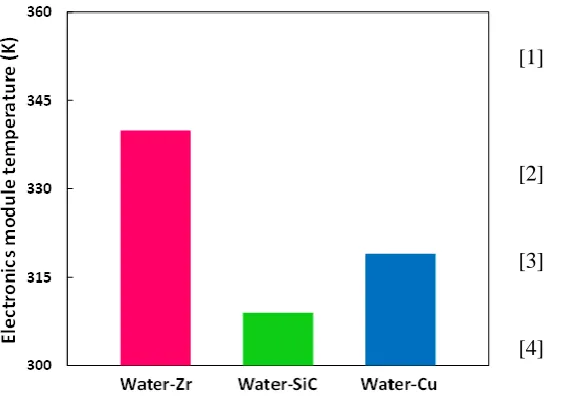
using three different water based nanofluids (specifically, Water-Zr, Water-SiC and Water-Cu) as coolants. It is noticed that the numerical predictions/results are comparable with each other. As expected, the variations in the numerically predicted temperatures of the electronics modules are witnessed very clearly with the use of the stated water based nanofluids as coolants. This is as a result of the variations in the thermal conductivities of the associated nanoparticles as mentioned in table 1.
Table 2. Comparison of numerical predictions of electronics modules temperatures with different nanofluids as coolants
Name of Nanofluid
Numerically Predicted Temperature of Electronics Module (K)
Water-Zr 340
Water-SiC 309
Water-Cu 319
Similarly, figure 8 also demonstrates the plot representing the variations in the electronics modules temperatures with three different water based listed nanofluids as coolants. It is seeming that the trends of the variations in the numerically predicted results are along the lines of expectations.
Figure 8. Variations in electronics modules temperatures with different water based nanofluids as coolants
VI.
CONCLUSION
A 2D numerical model pertaining to the electronics module is developed to predict the heat transfer issues
using three different water based nanofluids, namely Water-Zr, Water-SiC and Water-Cu as coolants. The model includes additional key factors like inertia, viscosity, gravity and thermal buoyancy effects apart from the usual issues concerning the present physical problem. However, the specified model ignores both compressibility and viscous heat dissipation effects. The model is very well demonstrated for the detailed numerical investigations on the influences of the already stated nanofluids (as they significantly affect the cooling characteristics) by taking electronics module heat flux of 70 W/cm2 as the important model parameter. The predictions of the model pertaining to the different nanofluids are along the expected lines. Direct comparison with other numerical models of electronics modules is not possible because of the absence of such models in the literature. However, the experimental comparison with an in-house experimental setup is planned for the future. With the enumerated model conditions, it is observed that the Water-SiC nanofluid delivers appropriately suitable cooling behavior without any kind of thermal failure and is the superior one as the electronics module temperature is far below the safe limit. Consequently, the identified model combined with the nanofluid can be utilized right away in industries for electronics modules cooling and to enhance heat transfer.
VII.
REFERENCES
[1] D.C Wadsworth and I.Mudawar, Cooling of a multichip electronic module by means of confined two dimensional jets of dielectric liquid, Journal of Heat Transfer, November (1990), Vol. 112/891. [2] Webb, B. W., and Ma, C. F., (1995), “Single phase Liquid Jet impingement heat transfer,” Adv. Heat Transfer, vol. 26, pp.105–217.
[3] Xuan Y, Roetzel W. Conceptions for heat transfer correlation of nanofluids. Int J Heat Mass Transfer 2000; vol 43:3701-7.
[4] Tanmay Basak, S.Roy and A.R. Balakrishnan, Effects of thermal boundary conditions on natural convection flows within a square cavity, International Journal of Heat and Mass Transfer
49 (2006) 4525–4535.
[6] Shanmuga Sundaram Anandan and Velraj Ramalingam, Thermal management of electronics: A review of literature, Thermal Science: Vol. 12 (2008), No. 2, pp. 5-26.
[7] Jundika C. Kurnia , Agus P. Sasmito , Arun S. Mujumdar, Numerical investigation of laminar heat transfer performance of various cooling channel designs, Applied Thermal Engineering 31 (2011), pp. 1293-1304.
[8] Yue-Tzu Yang, Yi-Hsien Wang, Numerical simulation of three-dimensional transient cooling application on a portable electronic device using phase change material, International Journal of Thermal Sciences 51 (2012), pp.155-162.
[9] Lin Zhu, Hongbo Tan, Jianlin Yu, Analysis on optimal heat exchanger size of thermoelectric cooler for electronic cooling applications, Energy Conversion and Management 76 (2013), pp. 685– 690.
[10] Liang Gong, Jin Zhao, Shanbo Huang, Numerical study on layout of micro-channel heat sink for thermal management of electronic devices,
Applied Thermal Engineering xxx (2014), pp. 1-11.
[11] P. Naphon , S. Wiriyasart , S. Wongwises, Thermal cooling enhancement techniques for
electronic components, International