Insights Into Consumer Resource Integration
And Value Co-Creation Process
Dr. Shilpa Iyanna, Abu Dhabi University, UAE
ABSTRACT
The contemporary view in marketing literature is that value is a subjective process created and defined by consumers during use. This perspective of value is emphasised by high-quality interactions between the company and the customer, enabling the co-creation of unique value. However, very little appears to be known about how consumers combine resources. The aim of this research is to provide an in depth understanding of how customers integrate their own and other resources in the context of value co-creation. The case study methodology, with in-depth semi-structured interviews as the methodological tool was employed in this paper. 33 interviews were conducted with first, second and third-year, business school undergraduate students. The paper provides evidence of resource integration and value co-creation being context or activity-dependent. In addition, the findings illustrate the pre-requisites and consequences of resource integration in the context of value co-creation.
Keywords: Resource Integration; Value Co-Creation; Customer Participation; Consumer Resources; Firm Resources; University Resources
INTRODUCTION
arketing has been defined as “the activity, set of institutions, and processes for creating, communicating, and delivering, and exchanging offerings that have value for customers, clients, partners and society at large” (AMA, 2007). This new definition of marketing focuses on value creation as the goal of marketing and takes marketing to a new level (Gronross 2008). Sheth and Uslay (2007) have argued that gearing marketing towards value creation may indeed be the contemporary focus for marketing.
Traditionally, value was viewed in the literature as embedded in a product that is exchanged, the value-in-exchange notion. Companies created value through activities inside the company walls, disconnected from the market (Prahalad and Ramaswamy 2004). The contemporary view in marketing literature however is that value is a subjective process created and defined by consumers during use (Vargo and Lusch 2004, 2008; Vargo et al. 2010, Helkkula et al. 2012; Bettencourt 2014). This new perspective of value is emphasised by high-quality interactions between the company and the customer, enabling the co-creation of unique value that might lead to alternative sources of competitive advantage. However, very little appears to be known about how consumers combine resources. Vargo and Lusch (2006: 284) state that the “resource integration concept needs refinement and elaboration”. Arnould et al. (2006: 95) posit, that “much remains to be done to systematise our understanding of customers’ operant resources .... we know relatively little about the interaction among the various types of consumer operant resources”. Taking inspiration from this the main aim of this paper is to provide an in depth understanding of how customers integrate their own and other resources in the context of value co-creation.
The paper is organized as follows. A review of the extant literature on value co-creation is presented. The role of the service provider and the customer in value co-creation and the resources that customers integrate in the process of value co-creation is discussed. Next, the research method and the approach to analysis are described. Finally, the findings and implications are reported and the contribution and directions for future research are outlined.
LITERATURE REVIEW
Value Co-Creation
The traditional wisdom was that value is created by a ‘producer’ and purchased by a customer for ‘consumption’. This artificial separation of production and consumption, which gets its support from contemporary economics and marketing research, implies that the consumer is not considered a creative actor in the value creating process but rather a passive responder (Firat and Venkatesh 1995). This misguided focus stems from a constrained view of markets that stifles growth (Bettencourt et al. 2014). Prahalad and Ramaswamy (2000) challenge this view and emphasise the transformation of customers from “passive” audience to “active players” in the service experience. The S-D logic, proposed by Vargo and Lusch (2004), also challenge the view of buyers as passive consumers, and include buyers in the value creating process by asserting that the “customer is always a co-creator of value” (FP 6).
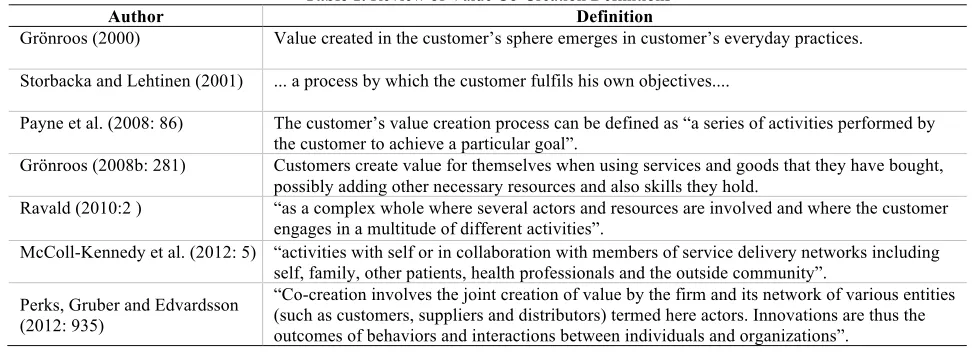
The active role of customers in the co-creation of value has been was recognised by many researchers (e.g. Holbrook 1994, Wikström and Normann 1994). Ravald (2010:2) defines the customer’s value creating process “as a complex whole where several actors and resources are involved and where the customer engages in a multitude of different activities”. Although value co-creation has received a lot of attention in recent times, only a few researchers have defined the concept. Table 1 provides a chronological review of the definitions of value co-creation.
Table 1. Review of Value Co-Creation Definitions
Author Definition
Grönroos (2000) Value created in the customer’s sphere emerges in customer’s everyday practices.
Storbacka and Lehtinen (2001) ... a process by which the customer fulfils his own objectives....
Payne et al. (2008: 86) The customer’s value creation process can be defined as “a series of activities performed by the customer to achieve a particular goal”.
Grönroos (2008b: 281) Customers create value for themselves when using services and goods that they have bought, possibly adding other necessary resources and also skills they hold.
Ravald (2010:2 ) “as a complex whole where several actors and resources are involved and where the customer engages in a multitude of different activities”.
McColl-Kennedy et al. (2012: 5) “activities with self or in collaboration with members of service delivery networks including self, family, other patients, health professionals and the outside community”.
Perks, Gruber and Edvardsson (2012: 935)
“Co-creation involves the joint creation of value by the firm and its network of various entities (such as customers, suppliers and distributors) termed here actors. Innovations are thus the outcomes of behaviors and interactions between individuals and organizations”.
The underlying concept implied in all the definitions is that, in value co-creation, suppliers and customers are, no longer on opposite sides, but interact with each other co-create value (Galvagno and Dalli 2014). Further, the definitions suggest that customers draw on a range of resources to achieve a particular outcome, that is, value. The next sub-sections will review the role of the service provider and the customer in value co-creation and the resources that customers draw on in the co-creation process.
Role of the Service Provider in Value Co-Creation
Firm Resources
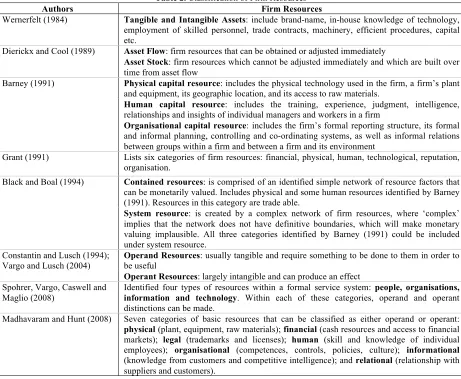
Firm resources can be understood from a number of perspectives. Traditionally, resources were viewed as tangible or intangible assets. Tangible assets refer to the fixed or current assets of an organisation that have long-term capacity (Wernerfelt, 1984). Intangible assets include intellectual property, such as trademarks and patents, as well as brand and company reputation, company networks and databases (Hall 1992; Williams 1992). Several authors have attempted to categorise firm resources, evidence of which is provided in Table 2. Although many attempts have been made, the table suggests that there is a lot of overlap in the categorisations, with no clear, acknowledged classification.
Table 2. Classification of Firm Resources
Authors Firm Resources
Wernerfelt (1984) Tangible and Intangible Assets: include brand-name, in-house knowledge of technology, employment of skilled personnel, trade contracts, machinery, efficient procedures, capital etc.
Dierickx and Cool (1989) Asset Flow: firm resources that can be obtained or adjusted immediately
Asset Stock: firm resources which cannot be adjusted immediately and which are built over time from asset flow
Barney (1991) Physical capital resource: includes the physical technology used in the firm, a firm’s plant and equipment, its geographic location, and its access to raw materials.
Human capital resource: includes the training, experience, judgment, intelligence, relationships and insights of individual managers and workers in a firm
Organisational capital resource: includes the firm’s formal reporting structure, its formal and informal planning, controlling and co-ordinating systems, as well as informal relations between groups within a firm and between a firm and its environment
Grant (1991) Lists six categories of firm resources: financial, physical, human, technological, reputation, organisation.
Black and Boal (1994) Contained resources: is comprised of an identified simple network of resource factors that can be monetarily valued. Includes physical and some human resources identified by Barney (1991). Resources in this category are trade able.
System resource: is created by a complex network of firm resources, where ‘complex’ implies that the network does not have definitive boundaries, which will make monetary valuing implausible. All three categories identified by Barney (1991) could be included under system resource.
Constantin and Lusch (1994);
Vargo and Lusch (2004) Operand Resources: usually tangible and require something to be done to them in order to be useful Operant Resources: largely intangible and can produce an effect
Spohrer, Vargo, Caswell and Maglio (2008)
Identified four types of resources within a formal service system: people, organisations, information and technology. Within each of these categories, operand and operant distinctions can be made.
Madhavaram and Hunt (2008) Seven categories of basic resources that can be classified as either operand or operant: physical (plant, equipment, raw materials); financial (cash resources and access to financial markets); legal (trademarks and licenses); human (skill and knowledge of individual employees); organisational (competences, controls, policies, culture); informational (knowledge from customers and competitive intelligence); and relational (relationship with suppliers and customers).
Role of The Customer in Value Co-Creation
Vargo et al. (2008), in their review, re-emphasise that, according to the S-D logic notion of value co-creation, “there is no value until an offering is used – experience and perceptions are essential to value determination” (Vargo and Lusch 2006: 44). In value co-creation, value is ultimately derived with the participation of, and determined by, the beneficiary (often the customer) through use (often called “consumption”) in the process of acquisition, usage, and disposal (Holbrook, 1987). With the evolution of customers from ‘passive audiences’ to ‘active players’ (Prahalad and Ramaswamy 2000; and O’Hern and Rindfliesch 2010), the role of customer-to-customer and customer-to-firm interactions has become increasingly important in generating new co-created customer value (Frow et al. 2015).
Customer Participation and Co-Creation
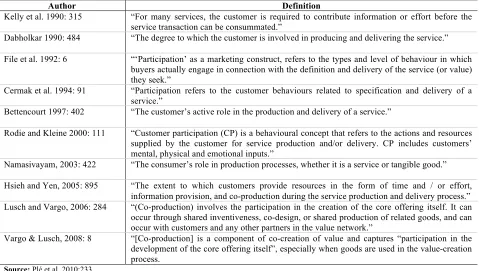
The concept of customer participation is not new, as early as 1938 Barnard noted the role played by customers (see Novicevic et al. 2006: 308). However, what is new is the recognition that the service providers are only providing partial inputs into customers’ value-creating processes and thus it’s important that the firms co-opt and empower the customers’ co-creator role (Bendapudi and Leone, 2003; Vargo and Lusch, 2004). Although customer participation has received a lot of attention, very few researchers have defined the concept. In fact, only a few have provided explicit definitions, while others merely refer to common sense (Fitzsimmons 1985; Bowers et al. 1990; Bitner et al. 1997). Table 3 provides a chronological review of definitions.
Table 3. Customer Participation Definitions
Author Definition
Kelly et al. 1990: 315 “For many services, the customer is required to contribute information or effort before the service transaction can be consummated.”
Dabholkar 1990: 484 “The degree to which the customer is involved in producing and delivering the service.”
File et al. 1992: 6 “‘Participation’ as a marketing construct, refers to the types and level of behaviour in which buyers actually engage in connection with the definition and delivery of the service (or value) they seek.”
Cermak et al. 1994: 91 “Participation refers to the customer behaviours related to specification and delivery of a service.”
Bettencourt 1997: 402 “The customer’s active role in the production and delivery of a service.”
Rodie and Kleine 2000: 111 “Customer participation (CP) is a behavioural concept that refers to the actions and resources supplied by the customer for service production and/or delivery. CP includes customers’ mental, physical and emotional inputs.”
Namasivayam, 2003: 422 “The consumer’s role in production processes, whether it is a service or tangible good.”
Hsieh and Yen, 2005: 895 “The extent to which customers provide resources in the form of time and / or effort, information provision, and co-production during the service production and delivery process.” Lusch and Vargo, 2006: 284 “(Co-production) involves the participation in the creation of the core offering itself. It can
occur through shared inventiveness, co-design, or shared production of related goods, and can occur with customers and any other partners in the value network.”
Vargo & Lusch, 2008: 8 “[Co-production] is a component of co-creation of value and captures “participation in the development of the core offering itself”, especially when goods are used in the value-creation process.
Source: Plé et al. 2010:233
customers while participating in the purchase decision. Menon and Dube` (1999) for instance provide evidence of a range of customer emotions in service encounters.
Vargo and Lusch (2004) refer to customer inputs as operant resources; they are dynamic in nature and a primary source of value. Customers’ operant resources have been classified by Arnould, Price and Malshe (2006) as physical, social and cultural (see Table 4).
Table 4. Classification of Consumer Operant Resources Operant Resource Classification Sub-Classification
Physical Resources Physical and mental endowment; Energy; Emotion; Strength.
Social Resources Family relationships; Social connections; Consumer communities (co-consumer relationships); Commercial relationships.
Cultural Resources Cultural capital - specialised knowledge / skills; History; Imagination. Source: Arnould, Price and Malshe (2006)
As is evident, what Arnould et al. (2006) refer to as physical resources, Rodie and Kleine (2000) refer to as physical (doing), mental (thinking), and emotional (feeling) inputs of participation. In addition to physical resources, Arnould et al. (2006) include social and cultural resources in the customer’s stock of operant resources. The above discussion indicates that there is no clear acknowledgement of the resources or inputs that consumers bring to the value co-creation process. Although the consumer resources identified by Rodie and Kleine (2000) are probably cited most often, the literature reviewed in the previous sections reveals that consumer resources identified by Arnould et al. (2006) are more comprehensive and include resource inputs identified by Rodie and Kleine (2000) in addition to others.
RESEARCH CONTEXT
The data for this study was drawn from the context of higher education (HE) because students (i.e. consumers of HE) through their participation in an array of learning activities “co-create” their own education. (Hennig-Thurau et al. 2001). Services marketing theorists have long acknowledged the participatory role of service customers and have also investigated the influence of customer participation on the productivity and quality of service encounters, as well as on customers’ quality, satisfaction, and value judgements (Lovelock and Young 1979; Mills and Morris 1986; Kelley et al. 1990; Schneider and Bowen 1995; Zeithaml and Bitner 1996; Rodie and Kleine 2000). Thus, the context of higher education provides a rich environment to examine resource integration during value co-creation.
METHODOLOGY
The case study methodology was considered appropriate in this research as the study attempted to explore (a) “how” and “why” questions; (b) a real-life context was chosen where the researchers ability to manipulate the environment or the subjects was minimal; and (c) the aim of the research was to explore and uncover contextual conditions that could be relevant to the phenomenon under study, i.e. value co-creation and resource integration. (Yin 2003). Thus, for this exploratory study the case study methodology, with in-depth semi-structured interviews as the methodological tool was employed. 33 interviews were conducted with first, second and third-year, business school undergraduate students. An interview protocol was used to ensure there would be a consistent pathway for analysing the interview data (Yin, 1994). Ethical approval was taken and participants were reimbursed for their time. All interviews were tape recorded and transcribed for analysis.
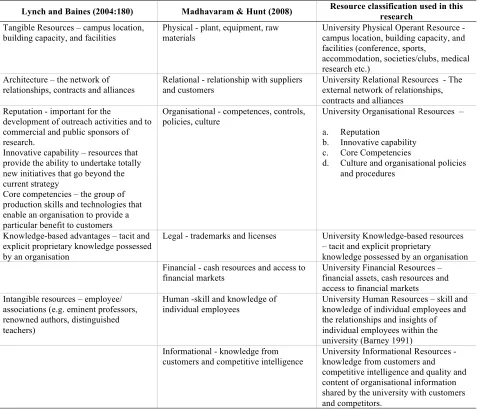
Table 5: Similarities and differences between Lynch & Baines (2004) and Madhavaram & Hunt (2008) classification of resources
Lynch and Baines (2004:180) Madhavaram & Hunt (2008) Resource classification used in this research Tangible Resources – campus location,
building capacity, and facilities Physical - plant, equipment, raw materials University Physical Operant Resource - campus location, building capacity, and facilities (conference, sports,
accommodation, societies/clubs, medical research etc.)
Architecture – the network of
relationships, contracts and alliances Relational - relationship with suppliers and customers University Relational Resources - The external network of relationships, contracts and alliances
Reputation - important for the
development of outreach activities and to commercial and public sponsors of research.
Organisational - competences, controls, policies, culture
University Organisational Resources –
a. Reputation
b. Innovative capability c. Core Competencies
d. Culture and organisational policies and procedures
Innovative capability – resources that provide the ability to undertake totally new initiatives that go beyond the current strategy
Core competencies – the group of production skills and technologies that enable an organisation to provide a particular benefit to customers
Knowledge-based advantages – tacit and explicit proprietary knowledge possessed by an organisation
Legal - trademarks and licenses University Knowledge-based resources – tacit and explicit proprietary
knowledge possessed by an organisation Financial - cash resources and access to
financial markets University Financial Resources – financial assets, cash resources and access to financial markets Intangible resources – employee/
associations (e.g. eminent professors, renowned authors, distinguished teachers)
Human -skill and knowledge of
individual employees University Human Resources – skill and knowledge of individual employees and the relationships and insights of individual employees within the university (Barney 1991) Informational - knowledge from
customers and competitive intelligence
University Informational Resources - knowledge from customers and competitive intelligence and quality and content of organisational information shared by the university with customers and competitors.
Initially, five transcripts were chosen at random and a preliminary analysis was done. The transcripts were read and re-read thoroughly. Memoing was undertaken, whereby the researcher attached reflections and remarks to relevant parts of the data, and theorised about codes and their relationships. Patterns, themes, relationships between variables, differences and similarities between the transcripts were identified and coded. The codes were checked and verified by another researcher to ensure reliability and validity. Once the codes were approved, a coding manual was developed and applied to the other transcripts.
FINDINGS AND IMPLICATIONS
The main findings of resource integration in the context of value co-creation are as follows:
a. The resources that respondents integrate in the co-creation process are context or activity-dependent:
For instance talking about her experiences in lectures (i.e. class activities), Esther says “In lectures I never ever ask questions, nobody does because our classes are quite big. If I don’t understand something I normally nudge my friends and ask what she’s (i.e. the lecturer) on about. I do write a lot of notes in lectures. I don’t like it when lecturers read notes …. I like it when lecturers have just basic points then you can draw on it and write your own comments. I like it much more than just being dictated to.” Here we see a reference being made to university organisational policy (regarding class size), university human resources (teaching skills of lecturer), consumer physical resources (time, effort, cognitive skills) and consumer social resources (peers i.e. co-consumers).
On the other hand, talking about her experience with extracurricular activities Mark, says: I am a member of SIFE which makes it very easy to meet lots of different people, I have met like ten to fifteen new people and one or two of them are now quite good friends of mine. Through SIFE, I am working with some children and teaching them what business means in the real world, which is very basic stuff but I have never worked with kids before and I wasn’t sure whether I was going to enjoy it, but I did enjoy it.” Here, we see evidence of the integration of consumer physical resources (time and effort), consumer social resources (peers who have now become good friends) with university relational resources (university networks and contacts e.g. SIFE) and other external resources (school children).
The results suggest that resource integration is a unique, idiosyncratic and dynamic process. The resources respondents integrated into the co-creation process depend on the activities/events they are describing. The findings lend empirical support to Chandler and Vargo’s (2011) argument that there is a fundamental need to differentiate among context as the resources that consumers draw on are dependent on the contexts in which they are embedded. Thus, a resource maybe more valuable in one context, but less valuable in other contexts.
b. Consumer physical resources inputs are an important pre-requisite for value co-creation and resource integration:
For instance, talking about his experience with tutorials (class activities) Ken says “tutorials are pretty good in Business school. I think that you get what you put in for the tutorials really. I don’t see the point in going for tutorials if you haven’t put in the work before you know. Because a few of them (i.e. tutorials) would say argue for and against and bring it together and if you haven’t done work then there is no argument so there’s no point going really”. The quote illustrates that time and efforts (i.e. consumer physical resource) that respondents invest in a particular activity are important for value co-creation. Moreover, in the absence of consumer physical resource inputs there is no resource integration. For instance with reference to personal tutor interactions (i.e. faculty interactions/support) David says “I don’t contact them really” The quote illustrate that resource integration is dependent on consumer physical resources. Findings suggest that in the absence of consumer physical resource inputs there is no resource integration or value co-creation. This is consistent with the idea put forth by Vargo (2008), who states that co-creation of value always requires customer involvement. In the context of HE, the results provide empirical support to Hennig-Thurau et al. (2001), who claims that students co-create their own education through participation in an array of activities.
c. Consumer physical resource inputs are influenced by the university resources and consumer social resources:
(class size), firm human resource (faculty teaching skills), and consumer physical resource (time and effort). In addition, there is evidence that consumer physical resource input is influenced by firm human resource (faculty teaching skills).
Evidence of consumer physical resource input being influenced by consumer social resources is provided in the following quote. Talking about her experience with extracurricular activities Katy says “I am playing netball since my first year, and I have also been on the cheerleading squad since my first year, which was a very random thing. I never expect to come to university and do that. A friend I made when I was in my first year, she was a year older, she was on the squad and said come along, and it’s been a lot of fun. Two of my housemates do it too (i.e. cheerleading)”. The quote illustrates the integration of firm physical operand resource (facilities), consumer social resource and consumer physical resource. Moreover, the quote illustrates the influence of consumer social resources on consumer physical resources.
Thus, the findings of this research support the claim that value-creating resources are not confined to the firm; customers, suppliers, and other stakeholders also contribute operant resources to value creation (Vargo and Akaka 2009). The results of this study thus extend the understanding of resource integration in value creation by empirically illustrating firm, consumer and external resource integration during value co-creation and thereby supporting the idea that, in value co-creation, all parties are resource integrators.
d. Customer learning from past experience influences resource integration:
For example, Ted describing his experience with lectures says “I missed some lectures for different modules in my first year and that really went against me so now I make sure that I go to every lecture whether I’m sick or whatever, I am sort of there all the time. And how I work as well has changed because before I just write all over my lecture notes in the lectures. I’ve learnt that that doesn’t actually work for me. I prefer now to number my slides and then write on it and then when I get home to put it together”. The quote provides evidence of customer learning taking place based on previous experience. Thus, as a result of learning, Ted engages in new type of behaviour that involves the utilization of customer physical resource (time, physical and mental effort) in more effective and efficient ways.
The findings are consistent with the idea that the customer’s experience with the service provider leads to customer learning (Payne et al. 2008). Customer learning can take place at differing levels of complexity. Evidence suggests that the form of customer learning in this context “proportioning” (Payne et al. 2008: 88). This involves the customer taking a step backwards to reflect on their experience with the service provider. Such reflection may cause them to change their behaviour by performing new activities, disengaging from existing practices, and/or using resources in new ways.
CONCLUSION
Literature suggests that an important theme in value co-creation, emphasised by S-D logic, is that of resource integration (Vargo and Lusch 2004; 2008; Sittaloppi and Vargo 2014). Brodie et al. (2011) posit that to date the discourse about S-D logic has largely been theoretical. Brown (2007) observes that the empirical potential of S-D logic should be explored if it is to develop beyond dialogue and debate. This research is thus an attempt to advance the theoretical understanding of resource integration that underpins the concept of value co-creation.
It has to be acknowledged that, the findings of this research maybe applicable to service contexts that extend over a period of time and provide a rich environment for co-creation. However, as the activities that defined the process in this study could be characterised as the active period of consumption. That is, the period in which consumers actively operate on the products or services (Holbrook, 1999), the findings could have a wider, more general application as well. A challenge for further research will be to examine whether the findings of this study can be replicated across different contexts.
Ravald’s (2011) arguments that the firm’s co-creation process and that of the customer must be approached as different processes. This is primarily because the processes in each case are owned by different subjects and guided by different goals. Thus, further research is needed to provide an in-depth understanding of the firm’s value co-creation process. Another challenge for the future will be to create conceptual models that successfully integrate the two types of value creation process (Grönroos and Ravald 2011).
Although it is acknowledged that much more work is required to further understanding of resource integration in the context of value co-creation, it is hoped that this study can be viewed as a crucial step in a long campaign.
AUTHOR BIOGRAPHY
Dr. Shilpa Iyanna is Assistant Professor of Marketing at the College of Business Administration at Abu Dhabi University. Shilpa holds a Ph.D. from Nottingham University Business School, University of Nottingham, UK. Throughout her teaching career, she has had the opportunity to teach a diverse group of students from different cultural and national backgrounds. Dr. Shilpa’s research interests are in the areas of customer value, value co-creation, resource integration and consumer behaviour. More recently her research is in the area of sustainable consumer behaviour. Her work has been published in many international peer reviewed conferences and journals.
REFERENCES
Arnould, E. J., L. L. Price et al. (2006), “Towards a Cultural Resource-Based Theory of the Customer”, In R. F. Lusch and S. L. Vargo (eds), The service-dominant logic of marketing: Dialog, debate, and direction, 91 – 104, Armonk, New York: M.E. Sharp.
Barney, J. (1991). “Firm resources and sustained competitive advantage”, Journal of Management, 17(1), 99−120.
Bendapudi, N., and Leone, R. P. (2003), “Psychological implications of customer participation in co-production”, Journal of Marketing, 67 (January), 14 – 28.
Bettencourt, L. A. (1997), “Customer voluntary performance: customers as partners in service delivery”, Journal of Retailing, 73(3), 383-406.
Bettencourt, L. A., Lusch, R. F., and Vargo, S. L. (2014), “ A Service Lens on Value Creation: Marketing’s Role in Achieving Strategic Advantage”, California Management Review, 57 (1), 44 – 66
Bitner, M. J., Faranda, W. T., Hubbert, A. R., & Zeithaml, V. A. (1997). “Customer contributions and roles in service delivery”, International Journal of Service Industry Management, 8(3), 193-205.
Black, J. A., & Boal, K. B. (1994), “Strategic resources: Traits, configurations and paths to sustainable competitive advantage”, Strategic Management Journal, 15: 131-148.
Bowen, D. E., & Jones, G. R. (1986). Transaction Cost Analysis of Service Organization-Customer Exchange. Academy of Management Review, 11(2), 428-441.
Bowers, M. R., Martin, C. L., & Lucker, A. (1990), “Trading places: employees as customers, customers as employees”, The Journal of Services Marketing, 4(2), 55-68.
Brodie, R. J., M Saren, J Pels, (2011), “Theorizing about the service dominant logic: The bridging role of middle range theory”, Marketing Theory
Brown, S. (2007), “Are we nearly there yet? on the retro-dominant logic of marketing”, Marketing Theory, 7 (3), 291 – 300. Cermak, D. S. P., File, K. M., & Prince, R. A. (1994), “Customer participation in service specification and delivery”, Journal of
Applied Business Research, 10(2), 90-97.
Chandler, Jennifer D., and Stephen L. Vargo (2011), “Contextualization and value-in-context: How context frames exchanges”, Marketing Theory, 11(1), 35-49
Constantin, J. A. and Lusch, R. F. (1994), “Understanding Resource Management”, Oxford, OH: The Planning Forum. Crabtree B, Miller W. (1999), “Using codes and code manuals: a template organizing style of interpretation”. In: Crabtree B,
Miller W, eds. Doing qualitative research. 2nd ed. Thousand Oaks, Calif: Sage Publications; 163–78.
Dabholkar, P. A. (1990), “How to Improve Perceived Service Quality by Increasing Customer Participation”, Paper presented at the AMS Conference, New Orleans, LA.
Dierickx, I., & Cool, K. (1989), “Asset stock accumulation and sustainability of competitive advantage”, Management Science, 35(12), 1504−1511.
File, K. M., Judd, B. B., & Prince, R. A. (1992), “Interactive marketing: the influence of participation on positive word-of-mouth and referrals”, Journal of Services Marketing, 6(4), 5-14.
Firat, A.F., & Venkatesh, A. (1995), “Liberatory Postmodernism and the Reenchantment of Consumption”, Journal of Consumer Research, 22(3): 239-267.
Frow, P., Nenonen, S., Payne, A., Storbacka, K. (2015), “ Managing Co-Creation Design: A strategic Approach to Innovation”, British Journal of Management, forthcoming (2015)
Galvagno, M and Daniele Dalli , (2014), “Theory of value co-creation: a systematic literature review”, Managing Service Quality, 24 (6), 643 – 683
Grant, R. M. (1991), “The resource-based theory of competitive advantage: Implications for strategy formulation”, California Management Review, 33(3): 114-135.
Grönroos, C. (2000), “Service Management and Marketing: A Customer Relationship Approach”, Chichester: John Wiley and Co.
Gronroos, C. (2008), “Service Logic Revisited: Who Creates Value? And Who Co-Creates?” European Management Review, 20 (4), 298 – 314.
Gronroos, C. (2008b), “Adopting a service business logic in relational business-to-business marketing”, Otago Forum 2, December 2008, New Zealand.
Grönroos, C., Annika Ravald, (2011), "Service as business logic: implications for value creation and marketing", Journal of Service Management, Vol. 22 Iss: 1, pp.5 - 22
Hall, R. (1992), “The strategic analysis of intangible resources”, Strategic Management Journal, 13: 135-144.
Helkkula, A., Kelleher,C., Pihlstrom, M. (2012), “Characterizing Value as an Experience: Implications for Service Researchers and Managers”, Journal of Service Research, 15(1), 59 – 72.
Hennig-Thurau, T., Langer, M.F., Hansen, U. (2001), "Modeling and managing student loyalty: an approach based on the concept of relationship quality", Journal of Service Research, Vol. 3 No.4, pp.331-44.
Holbrook, M. B. (1987), “What is consumer research?” The Journal of Consumer Research, 14(1), 128 – 132.
Holbrook, M. B. (1994), “The nature of customer value: an axiology of services in the consumption experience”, in Rust, R.T. and Oliver, R. O. (Ed’s.), Service Quality: New Directions in Theory and Practice, Sage Publications Inc., Thousand Oaks, California.
Holbrook, M. B. (1999), “Introduction to Consumer Value’, in M.B. Holbrook (ed.) Consumer Value. A Framework for Analysis and Research, pp. 1–28. London: Routledge.
Hsieh, A.-T., & Yen, C.-H. (2005), “The Effect of Customer Participation on Service Providers’ Job Stress”, The Service Industries Journal, 25(7), 891-905.
Kelley, S. W., Donnelly, J. H., & Skinner, S. J. (1990), “Customer Participation in Service Production and Delivery”, Journal of Retailing, 66(3), 315-335.
Loïc Plé, Xavier Lecocq, Jacques Angot. (2010), “Customer-Integrated Business Models: A Theoretical Framework”, M@n@gement, 13 (4), 226 - 265
Lovelock, C. H., and Young, R.F. (1979), “Look to consumers to increase productivity”, Harvard Business Review, 57/3, 168 – 178.
Lusch, R. F., & Vargo, S. L. (2006), “Service-dominant logic: reactions, reflections and refinements”, Marketing Theory, 6(3), 281-288.
Lynch, R. and Baines, P. (2004), “Strategy Development in UK Higher Education: Towards resource-based competitive advantages”, Journal of Higher Education Policy and Management, 26(2): 171 – 187.
Madhavaram, S. and Hunt, S. D. (2008), “The service-dominant logic and a hierarchy of operant resources: developing masterful operant resources and implications for marketing strategy”, Journal of the Academy of Marketing Science, 36, 67 – 82. McColl-Kennedy, J. R., Vargo, S. L., Dagger, T., and Sweeney, J. C. Yasmin van Kasteren (2012), “Health Care Customer Value
Cocreation Practice Styles”, Journal of Service Research, vol. 15 no. 4, 370-389
Menon, K and Laurette Dube` (1999), "Scripting Consumer Emotions in Extended Service Transactions: a Prerequisite For Successful Adaptation in Provider Performance", in NA - Advances in Consumer Research Volume 26, eds. Eric J. Arnould and Linda M. Scott, Provo, UT : Association for Consumer Research, Pages: 18-24.
Mills, P. K., & Turk, T. (1986), “A Preliminary Investigation Into the Influence of Customer-Firm Interface on Information Processing and Task Activities in Service Organizations”, Journal of Management, 12(1), 91-104.
Mills, P. K., Chase, R. B., & Margulies, N. (1983), “Motivating the Client/Employee System as a Service Production Strategy”, Academy of Management Review, 8(2), 301-310.
Mills, P.K., Morris, J.H. (1986), "Clients as ‘partial’ employees of service organizations: role development in client participation", Academy of Management Review, Vol. 11 No.4, pp.726-35.
Namasivayam, K. (2003), “The consumer as transient employee, Consumer satisfaction through the lens of job-performance models”, International Journal of Service Industry Management, 14(4), 420-435.
Normann, R (2001), “Reframing Business: When the Map Changes the Landscape”, Chichester: John Wiley and Co. Novicevic, M., Sloan, H., Duke, A., Holmes, E., & Breland, J. (2006), “Customer relationship management: Barnard's
foundations”, Journal of Management History, 12 (3), 306 – 318
O’Hern, M. S. and A. Rindfliesch (2010). ‘Customer co-creation: a typology and research agenda’. In N. K. Mal- holtra (ed.), Review of Marketing Research, Vol. 6, pp. 84–106. Armonk, NY: M. E. Sharpe.
Perks, H., T. Gruber and B. Edvardsson (2012). ‘Co-creation in radical service innovation: a systematic analysis of microlevel processes’, Journal of Product Innovation Management 29, pp. 935–951.
Plé, L., Lecocq, X. & Angot, J. (2010), "Customer-Integrated Business Models: A Theoretical Framework", Management, 13(4), 226 – 265.
Prahalad, C. K., V. Ramaswamy. (2004), "Co-creation experiences: The next practice in value creation", Journal of Interactive Marketing, 18(3), 5 – 14.
Prahalad, C.K. and Ramaswamy, V. (2000), ‘Co-opting Customer Competence’, Harvard Business Review, 78, January-February, 79 – 87.
Ravald, A. (2010), “The customer’s process of value creation”, Special issue on the 2009 Naples Forum on Service, Vol. 1 No. 1, pp. 41-51.
Rodie, A. R., & Kleine, S. S. (2000), “Customer Participation in Services Production and Delivery”, In T. A. Swartz & D. Iacobucci (Eds.), Handbook of Services Marketing and Management (pp. 111-125). Thousand Oaks: Sage Publications. Schneider, B., Bowen, D.E. (1995), “Winning the Service Game”, Harvard Business School Press, Boston, MA.
Sheth, J N and Uslay, C (2007), “Implications of the Revised Definition of Marketing: From Exchange to Value Creation”, Journal of Public Policy and Marketing, 26 (2), 302 – 307.
Sheth, J.N., Sisodia, R.S. (2006), Editors. “Does Marketing need reforms? Fresh Perspectives on the future”. M.E.Sharpe Inc. Siltaloppi, J. and Vargo, S. (2014), “Reconciling resource integration and value propositions – the dynamics of value
co-creation”, 47th Hawaii International Conference on System Science, 1278 – 1284
Sobh, R. and Perry, C. (2006), “Research design and data analysis in realism research”, European Journal of Marketing, 40(11/12), 1194 – 1209.
Spohrer, J., Vargo, S. L., Caswell, N., and Maglio, P.P. (2008), “The Service System is the Basic Abstraction of Service Science”, Paper submitted for the 41st Hawaii International Conference on System Science, 2008.
Storbacka, K. and Lehtinen, J. R. (2001), CRM: Customer Relationship Management – Creating competitive advantage through win-win relationship strategies, McGraw Hill, Singapore.
Vargo, S. L, Maglio, P. P., Akaka, M. A., (2008), “On value and value co-creation: A service systems and service logic perspective”, European Management Journal, 26, 145 – 152.
Vargo, S. L. and Lusch, R. F. (2004). Evolving to a New Dominant Logic for Marketing. Journal of Marketing, 68(1), 1-17. Vargo, S. L. and Lusch, R. F. (2006). Service-Dominant Logic: What It Is, What It Is Not, What It Might Be. In R. F. Lusch and
S. L. Vargo (Eds.) The Service-Dominant Logic of Marketing: Dialog, Debate, and Directions, (43-56). Armonk, New York: M.E. Sharpe.
Vargo, S. L. and Lusch, R. F. (2008). Service-Dominant Logic: Continuing the Evolution. Journal of the Academy of Marketing Science, 36(1), 1-10.
Vargo, S. L., and Robert F. Lusch (2012), “The Nature and Understanding of Value: A Service-Dominant Logic Perspective”, in Stephen L. Vargo, Robert F. Lusch (ed.) Special Issue – Toward a Better Understanding of the Role of Value in Markets and Marketing (Review of Marketing Research, Volume 9), Emerald Group Publishing Limited, pp.1-12 Vargo, S. L., Lusch, R. F., Archpru, M. A., & He, Y. (2010). Service-dominant logic: A review and assessment. Review of
Marketing Research, 6, 125–167.
Vargo, Stephen L. (2008), Customer Integration and Value Creation: Paradigmatic Traps and Perspectives, Journal of Service Research, 11 (Nov) 211-215.
Vargo, Stephen L., Archpru Akaka (2009), “Service-Dominant Logic as a Foundation for Service Science: Clarifications”, Service Science, 1(1), 32-41
Wernerfelt, B. (1984), “A resource-based view of the firm”, Strategic Management Journal, 5(2), 171 – 180.
Wikstrom, S and Normann, R (1994), “Knowledge and Value: A New Perspective on Corporate Transformation”, Routledge, London
Williams JR (1992), “How sustainable is your competitive advantage?”, in California Management Review, 34(3), 29-51 Woodruff, R. B. (1997), “Customer value: The next source for competitive advantage”, Journal of the Academy of Marketing
Science, 25(2), 139 – 153.
Yin, R. K. (1994), “Case Study Research – Design and Methods”, 2nd ed., Sage, Thousand Oaks, CA. Yin, R. K. (2003), “Case study research: Design and methods” (3rd ed.). Thousand Oaks, CA: Sage.
Zeithaml, V. A. (1988), "Consumer Perceptions of Price, Quality, and Value: A Means-End Model and Synthesis of Evidence", Journal of Marketing, 52, 2 – 22.