Licensed under Creative Common Page 166
http://ijecm.co.uk/
GROUP DECISION-MAKING TECHNIQUES: HOW
MUCH ARE KNOWN AND USED?
Juliana Osmani
University “Aleksandër Moisiu”, Durrës, Albania
Abstract
The relationship between organization and environment, based on the need to gather
information and find resources, is increasingly characterized by a high level of uncertainty.
Uncertainty means that managers do not have enough information and time to anticipate
changes and make good decisions. More and more managers have to make decisions about
new problems or situations. Under these conditions, organizations are moving towards the use
of groups. There are several techniques that a group can adopt to arrive at the final decision.
These techniques include different decision-making processes. Each of them is characterized
by strengths, but also by limits and often becomes difficult to define which technique is the best.
In this regard, is necessary to consider group composition, the problem to be analysed and also
contextual factors. The main purpose of the current research is to identify if and at what degree
the different group decision-making techniques are known and used within some of the most
important banking institutions in Albania. The reason for choosing to focus on such issue lies in
the fact that the effectiveness of the decisions made by a group is often determined by the
technique used. For the current study was adopted the quantitative research under the form of
descriptive analysis and for the data collection was used the questionnaire based on the Likert
scale 1-5. The results obtained suggest that within the banking institutions taken into analysis,
group decision-making processes are widely used, but the different group techniques are not
well known, and there is not a diversity of the techniques used.
Keywords: Decision, group decision-making, group decision-making techniques, group
Licensed under Creative Common Page 167
INTRODUCTION
Group decision-making is a participatory process in which some individuals act collectively, analyse problems or situations, consider and evaluate possible courses of action and choose an alternative. Classical theories perceived the organisation as a closed system. Under these conditions, the decision-making process is not influenced by the environment in which the company operates and therefore the decision maker will always achieve good results. Within a closed system, the decision-making process takes place on the basis of universal rules that facilitate the choice, helping to identify the optimal alternative. Instead, modern theories believe that organisation is an open system that influences and is influenced by the environment in which it operates, continuously adapting and reacting to opportunities and threats (Simon, 1960).
Organizations are facing an increasingly dynamic environment, which means rapid technological changes, products with short life cycle, the entry of strong new competitors, frequent competition manoeuvres to consolidate their position and rapid evolution of customer needs and expectations (Bateman and Snell, 2013). The dynamic environment requires decision-making processes not predetermined. Instead, flexible processes are needed in order to allow the adaptation to external and internal changes. It should be noted that the anticipation of these changes is difficult, as a result of the increasing level of turbulence. Decisions made in the past will be less and less encountered in the future, so any previously used procedure or rule loses value. New and unstructured decisions are often made based on feelings and intuition, not allowing the use of analytical reasoning (Stanovich and West, 2000; Keltner and Lerner, 2010). Under these conditions, the probability of bad decisions increases and this may be a reason to focus on group decision-making processes. Group decision-making through the distribution of responsibilities makes it easier to cope with unforeseen situations and on the other hand provides better decisions, as it makes possible to gather a greater amount of information. Also, the anticipation of possible changes and the design of situational plans, or the desire to become a change leader, require multidisciplinary knowledge that a single individual cannot have. So, the group becomes an important tool to cope with environmental dynamism.
Aim of the study and research questions
Licensed under Creative Common Page 168 decision maker has to face. Under these conditions, organizations are moving towards the use of groups.
If compared to individual decision-making, the advantages of group decision-making are numerous. Many researchers have argued that the group makes better decisions than the individual. So, some of the advantages of the group decision-making refer to the amount of information, the discussions, the legitimacy of the decision, the highest degree of creativity and innovation. Undoubtedly, the performance of the group is influenced by a number of factors, some of which are under the control of the group. One of them, is the technique used.
The main purpose of the current research is to identify if and at what degree the different group decision-making techniques are known and used within some of the most important banking institutions in Albania. The reason for choosing to focus on such issue lies in the fact that the effectiveness of decisions made by a group is often determined by the technique used. Thus, in consistency with the main purpose, the research questions are formulated as follows: 1. Do managers of banking institutions know the different techniques of group decision-making? 2. Are group decision-making techniques applicable in practice?
3. Does the chosen technique affect the effectiveness of group decision-making? 4. How much the nature of problem/situation does affect the choice of the technique?
LITERATURE REVIEW
There are several techniques that a group can adopt to arrive at the final decision. These techniques include different decision-making processes. Each of them is characterized by strengths, but also by limits. Under these conditions, it becomes often difficult to define which technique is the best. In this regard, it is necessary to consider group composition, the problem to be analysed and also contextual factors. In the following we discuss on some of the group techniques.
Brainstorming is a group technique that minimizes compliance, thus promoting creativity (Osborn, 1963, Smart and Vertinsky, 1977). According to Noorderhaven (1995), it is preferable to use Brainstorming when the problem can be solved based on the organisation internal information and is dispersed among different members, in different hierarchical levels and departments. In this case, an ad hoc group should be composed for the Brainstorming session, with the aim to put together the information coming from different sources. On the contrary, in a pre-established group, the information may not flow freely due to norms, which are important for the continuity of the group, but can damage creativity.
Licensed under Creative Common Page 169 concentrated analysis by a group with few members (Gallupe and Cooper, 1993). Brainstorming can be a very useful technique for generating alternatives, but it doesn't offer much about the evaluation of alternatives and the choice of a course of action. The phenomenon of social loafing can be one of the most important limits of this technique (Taylor, Berry and Block, 1958). While one part of the group exchanges ideas, the other remains passive, decreasing the number of potential ideas to consider. In addition, there is also a risk of identifying bad alternatives, if members feel compelled to generate more ideas (Bazerman, 1990). Furthermore, the members of the group have to wait for the turn to make their contribution. Under these conditions, they may forget ideas or may lose interest (Jones and George, 2008). Often, the fear that the ideas should be negatively evaluated and commented can lead to self-censorship, thus damaging creativity (Gallupe and Cooper, 1993).
Delbecq and Van de Ven (1971) developed the Nominal Group Technique, based on the communication processes that facilitate interaction between multiple people and decision-making. The term “nominal” refers to the interactions between some individuals who have a
specific decision-making objective and is based on a structured communication process. This technique, unlike Brainstorming, is very structured and is useful for reaching the consensus in situations where group members have very different opinions (Jones and George, 2008). Usually, it is used to set priorities for the future, rather than when facing a problem (Kume, 2010). Noorderhaven (1995) points out that the Nominal Group Technique ends with a voting procedure and can give the impression of a complete decision-making process, when instead the main objective is to generate alternatives (p.206).
Nominal Group Technique can be used for problems or situations similar to those of the Brainstorming technique. One of the important advantages of this technique is the speed of ideas generation. This is why it is preferable to use in situations where the time is a crucial element. If the members are not very able to communicate verbally, this technique is not effective. However, as Delbecq and Van de Ven (1971) argue, the Nominal Group is a technique well accepted by groups, because allows everyone to express and facilitates the identification of many ideas in a short time. The Nominal Group Technique generates more alternatives than a traditional group discussion. Furthermore, the members of the group write their ideas on a sheet, independently of each other. In this way it is possible to avoid the influence that some members of the group may have on others.
Another group technique is Delphi. It is a very structured group technique and unlike Brainstorming and the Nominal Group has the advantage that members don’t have to be face to
Licensed under Creative Common Page 170 and George, 2008). In its beginnings the technique was widely used to predict technological developments (Dalkey, 1969). Linstone and Turoff (2002) affirm that Delphi can be defined as a technique for structuring a group communication process, so the process becomes effective in allowing a group of individuals, as a whole, to face a complex problem (p.3).
One of the most important advantages of Delphi consists in the anonymity of the members, thus reducing the effect of the dominance of the member, which often becomes a great concern when group decision-making processes are used (Dalkey, 1972). Also, Delphi technique leads to a final decision that is more accepted and shared by the group than the decision that derives from any other form of consensus in the most direct interactions (Dalkey, 1969). For Delphi technique to be successful, is necessary the formation of a small monitoring group with the task of preparing the questionnaires and giving feedback to the members. It is very important that the monitoring team maintain the anonymity of the members, one of the greatest keys to the success of the technique (Luthans, 1992).
A group can make decisions also using the devil’s advocate technique. This technique takes its name from a practice used by the Catholic Church in the sixteenth century. The devil’s
advocate at that time was used for beatification and canonization processes (Gianandrea, 2009). When a candidate for holiness was presented to the College of Cardinals, an individual was assigned the role of devil’s advocate to discover any obstacles to canonization. This
technique has also been adopted by the organisations to improve the decisions made by the group, especially those of a strategic nature (Herbert and Estes, 1977). Thus, one of the group members assumes the role of the critic with the task to contradict the ideas and possible alternatives expressed by the other members. He examines the alternatives searching for elements of inconsistency, inaccuracy and irrelevance, thus giving the decision-making process a non-linear nature (Wheelen and Hunger, 2012). The biggest problem with this technique is the possible conflict between the opponent member and the others, because he may be perceived as a negative person who tries to hinder the decision-making process.
Similar to the devil’s advocate is the dialectical method that dates back to the ancient
Licensed under Creative Common Page 171 Discussing on the effectiveness of these two techniques, Kreitner and Kinicki (2012) argue that there are cases for which the decisions made are of equal quality both for groups that have used the devil’s advocate technique and for those that have used the dialectical method, as there is other evidence where groups that used the devil’s advocate have made more effective
decisions. What can be admitted with certainty is that both techniques, based on the constructive conflict, are useful to avoid groupthink and reduce the use of cognitive biases (Janis and Mann, 1977; Jones and George, 2008).
Recalling Kume (2010), the analysis of the forces is a technique that consists in the discussion and evaluation of the different forces/factors that influence the decision and is used to determine if a change within the organisation must be done or not. After the situation is presented, members are asked to identify the forces that need to be considered, which are classified into two categories: positive and negative forces (Kume, 2010). Positive forces are those that favour the change, while negative forces prevent it. Knowing these forces, managers are able to identify strategies that avoid negative forces. For each of the forces are asked some questions such as: how important this force is; which force may change over time, for example, transforming from a positive force into a negative one or vice versa; what kind of information and what skills are needed to change these forces? After that, there is an evaluation phase of the identified forces on a scale from 1 (weak force) to 5 (important force). If the sum of the points for positive forces is greater than the sum of the points for negative forces, the change must be undertaken. On the contrary, the change should not be done. However, if the sums of points for the two categories of forces are the same, to make a decision, this technique must be combined with another or the members should return to the evaluation phase of the forces.
RESEARCH METHODOLOGY
For the current study was adopted the quantitative research and for the data collection was used the questionnaire. This tool was considered useful in gathering facts and knowledge, behaviours and attitudes, opinions, motivations and perceptions regarding group decision-making processes and the techniques used. The questionnaire facilitates the collection of more information in less time.
Licensed under Creative Common Page 172 research. This field is characterized by a high level of confidentiality. Therefore, the risk was that the respondents gave unrealistic answers.
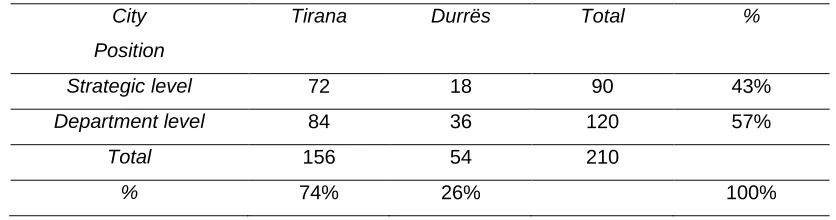
For the current research is chosen the non-probability sampling technique, mainly in the form of purposive sampling. So, the units of analysis are chosen for participating to group decision-making or for having the necessary knowledge and information about it. In some cases was also used the information provided from important or privileged subjects in order to identify other participants, anyway trying to meet certain criteria established previously. So, in addition to purposive sampling it was also used the snowball technique. The sample was also determined based on the geographical criteria. Thus, the current research was focused on the banking institutions and their branches in Tirana and Durrës as the two main cities of Albania. It was considered more convenient to interview managers because they can provide more precise and detailed information about groups and decision-making processes, as participants and compilers of decision-making policies and procedures. The managers selected for the survey belong to strategic and departmental level.
Table 1: The distributions of participants by hierarchical level and city
City Position
Tirana Durrës Total %
Strategic level 72 18 90 43%
Department level 84 36 120 57%
Total 156 54 210
% 74% 26% 100%
EMPIRICAL FINDINGS
Through the distribution of the questionnaires, we have tried to collect information about the decision-making techniques used by the groups within the banking institutions. A total of 347 questionnaires were distributed and 210 collected, for a response rate of 60.5%. Following, through tables and charts are summarized the data collected for each statement included in the questionnaire.
1: Within the company where I work, groups are largely used for making decisions.
Table 2: Number of responses for each scale (Statement 1)
Strongly disagree Disagree Neutral Agree Strongly agree
Licensed under Creative Common Page 173 Figure 1: Percentage of responses for each scale (Statement 1)
2: I prefer group decision-making, because groups make better decisions than individuals.
Table 3: Number of responses for each scale (Statement 2)
Strongly disagree Disagree Neutral Agree Strongly agree
7 10 4 116 73
Figure 2: Percentage of responses for each scale (Statement 2)
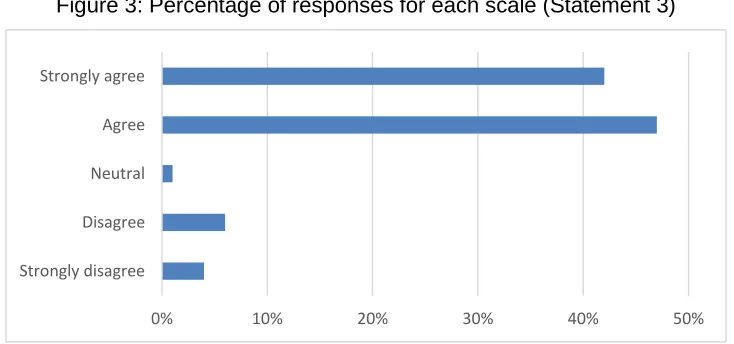
3: Group decision-making effectiveness depends on the technique used.
Table 4: Number of responses for each scale (Statement 3)
Strongly disagree Disagree Neutral Agree Strongly agree
8 13 2 98 89
0% 10% 20% 30% 40% 50% 60%
Strongly disagree Disagree Neutral Agree Strongly agree
0% 10% 20% 30% 40% 50% 60%
Licensed under Creative Common Page 174 Figure 3: Percentage of responses for each scale (Statement 3)
4: I know well the various group decision-making techniques such as Brainstorming, Delphi, Nominal Group Technique, Devil’s Advocate, etc.:
Table 5:Number of responses for each scale (Statement 4)
Strongly disagree Disagree Neutral Agree Strongly agree
27 74 34 42 33
Figure 4: Percentage of responses for each scale (Statement 4)
5: The organization where I work organizes trainings in the form of case studies, in order to make known the use of different group decision-making techniques.
Table 6: Number of responses for each scale (Statement 5)
Strongly disagree Disagree Neutral Agree Strongly agree
66 144 0 0 0
0% 10% 20% 30% 40% 50%
Strongly disagree Disagree Neutral Agree Strongly agree
0% 5% 10% 15% 20% 25% 30% 35% 40%
Licensed under Creative Common Page 175 Figure 5: Percentage of responses for each scale (Statement 5)
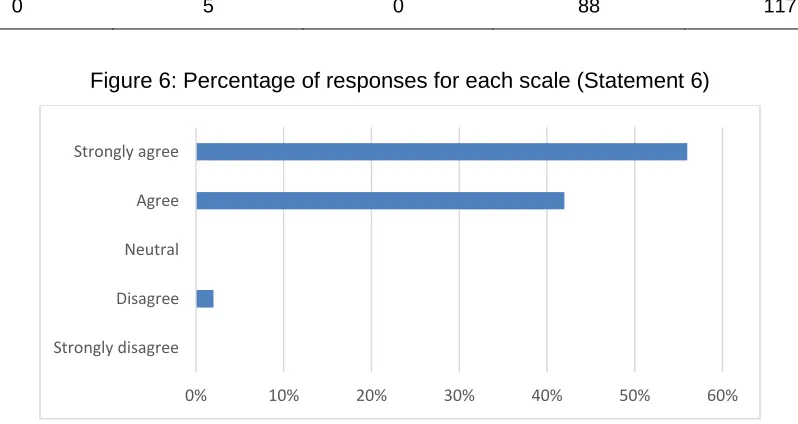
6: Group decision-making technique should be adapted to the problem/situation to be considered.
Table 7: Number of responses for each scale (Statement 6)
Strongly disagree Disagree Neutral Agree Strongly agree
0 5 0 88 117
Figure 6: Percentage of responses for each scale (Statement 6)
7: Within the organization where I work are applied different group decision-making techniques.
Table 8: Number of responses for each scale (Statement 7)
Strongly disagree Disagree Neutral Agree Strongly agree
122 64 7 12 5
0% 10% 20% 30% 40% 50% 60% 70% 80%
Strongly disagree Disagree Neutral Agree Strongly agree
0% 10% 20% 30% 40% 50% 60%
Licensed under Creative Common Page 176 Figure 7: Percentage of responses for each scale (Statement 7)
8. While participating in decision-making groups, I have often found that creativity is stimulated.
Table 9: Number of responses for each scale (Statement 8)
Strongly disagree Disagree Neutral Agree Strongly agree
48 87 19 34 22
Figure 8: Percentage of responses for each scale (Statement 8)
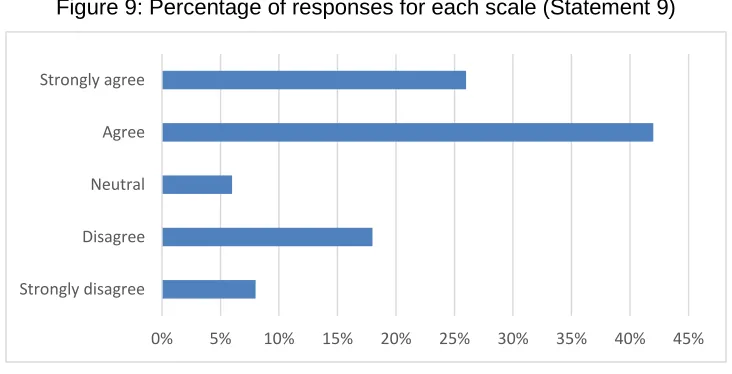
9: The method used for the group decision-making, always aims to reach the consensus.
Table 10: Number of responses for each scale (Statement 9)
Strongly disagree Disagree Neutral Agree Strongly agree
17 38 12 89 54
0% 10% 20% 30% 40% 50% 60% 70%
Strongly disagree Disagree Neutral Agree Strongly agree
0% 5% 10% 15% 20% 25% 30% 35% 40% 45%
Licensed under Creative Common Page 177 Figure 9: Percentage of responses for each scale (Statement 9)
CONCLUSIONS
The main purpose of the current research was to identify if and at what degree the different group decision-making techniques are known and used within some of the most important banking institutions in Albania. It was decided to take into analysis the banking sector because from the information collected informally prior to the current research, we were informed that almost all the decisions within the banking institutions are made by groups, a fact which is also confirmed by the present research. Thus, 97% of the participants affirm that group making processes are widely used within their organizations. But are preferred group decision-making processes? 90% of the participants express their support for the use of groups for decision-making purposes, stating that the decisions made by groups are better than those made at the individual level.
In the managerial and decision-making literature, the effectiveness of groups is often discussed, highlighting as an important factor, which impacts the quality of the results obtained by a group, precisely the technique adopted. This conclusion is also affirmed by 89% of the participants of the current research. Despite this, 48% of the participants reported that they did not know well the different group techniques, while 16% of them have chosen not to express in this regard. These results can be explained by the fact that 89% of the participants report that within their institutions are not applied different group techniques. Moreover, 100% of the participants state that their institutions have never held trainings in order to help members to know group decision-making techniques.
If the decision-making technique is always the same, this can damage the effectiveness of the decisions. The increasingly dynamic environment means that decisions are non-programmed and unstructured. Consequently, each situation requires a careful evaluation of the decision-making technique to be adopted. This consideration is also affirmed by the
0% 5% 10% 15% 20% 25% 30% 35% 40% 45%
Licensed under Creative Common Page 178 participants. Thus, even they point out that within their institutions are not applied different group decision-making techniques, 98% of the respondents admit that the choice of decision-making technique must be adapted to the type of problem/situation the group is considering.
Most of group decision techniques try to stimulate creativity and some of them aim for consensus. 64% of the participants of the current research affirm that during group participation they did not found the stimulation of creativity by the leader of the group, while 68% of them state that the decision-making method adopted by the group does not always aim for consensus.
LIMITATIONS OF THE STUDY
Through the current research, we tried to identify if and at what degree the different group decision-making techniques are known and used within some of the most important banking institutions in Albania. However, some limitations of the present study must be reported.
A first limitation of the research is related to the sample size, which can make it difficult to generalize the results obtained. A second limitation of the research refers to the use of the questionnaire, as a method for data collection. This tool is based on personal evaluations of the participants, which are often influenced by various biases, such as the tendency to exaggerate and the tendency to conform and report something not as it really is. To collect more information and also increase the degree of reliability, the use of the questionnaire could be combined with the semi-structured interview.
FURTHER STUDIES
The current research represents a contribution regarding the group decision-making process within the banking institutions. More specifically, this study tries to identify if and at what degree the different group decision-making techniques are known and used within some of the most important banking institutions in Albania. The reason for choosing to focus on such issue lies in the fact that the effectiveness of decisions made by a group is often determined by the technique used.
Licensed under Creative Common Page 179 positively the motivation and consequently the individual performance? Furthermore, the characteristics of the group decision-making process, the techniques adopted by a group and the propensity towards group decision-making can also be studied outside the banking sector, analysing other sectors of the economy.
REFERENCES
Bateman T.S., Snell S.A. (2013), Management: Leading and collaborating in a competitive world, New York: McGraw-Hill
Bazerman M.H. (1990), Judgment in managerial decision making, New York: John Wiley & Sons
Dalkey N.C. (1969), The Delphi method: An experimental study of group opinion, Santa Monica CA: The RAND Corporation
Dalkey N.C. (1972), The Delphi method: An experimental application of group opinion. In Dalkey N.C., Rourke D.L., Lewis R., Snyder D. (Eds.), Studies in the quality of life, Lexington: Lexington Books
Dalkey N.C., Helmer O. (1963), An experimental application of the Delphi method to the use of experts. Management Science, 9(3), 458-467
Delbecq A.L., Van de Ven A.H. (1971), A group process model for problem identification and program planning. Journal of Applied Behavioral Science, 7(4), 466-492
Gallupe R.B., Cooper W.H. (1993), Brainstorming electronically. Sloan Management Review, 35(1), 27-36
Gianandrea F.R. (2009), Creatività for ever: 60 tecniche di gruppo per stimolare nuove idee e risolvere problemi, Milano: Franco Angeli
Herbert T.T., Estes R.W. (1977), Improving executive decisions by formalizing dissent: The corporate devil’s advocate. Academy of Management Review, 2(4), 662-667
Janis I.L., Mann L. (1977), Decision making: A psychological analysis of conflict, choice and commitment, New York: The Free Press
Jones G.R., George J.M. (2008), Contemporary management, Boston: McGraw-Hill/Irwin, 5th Edition
Keltner D.T., Lerner J.S. (2010), Emotion. In D.T. Gilbert, S.T. Fiske, G. Lindzey (Ed.), The Handbook of Social Psychology, 317-52. New York: Wiley
Kreitner R., Kinicki A. (2012), Organizational behaviour, 10 Edition, McGraw-Hill Education Kume V. (2010), Vendimmarrja menaxheriale, Tiranë: Pegi
Linstone H.A., Turoff M. (2002), The Delphi Method: Techniques and Applications. Available at: http://www.is.njit.edu/pubs/delphibook/
Luthans F. (1992), Organizational behavior, New York: McGraw-Hill
Mason R.O., Mitroff I.I. (1981), Challenging strategic planning assumptions, New York: John Wiley & Sons Noorderhaven N.G. (1995), Strategic decision making, Wokingham: Addison-Wesley Longman
Osborn A.F. (1963), Applied imagination: Principles and procedures of creative problem-solving, New York: Scribner Simon H.A. (1960), The new science of management decision, New York: Harper & Row
Smart C.F., Vertinsky I. (1977), Designs for crisis decision units. Administrative Science Quarterly, 22, 639-657 Stanovich K.E., West R.F. (2008), On the relative independence of thinking biases and cognitive ability. Journal of Personality and Social Psychology, 94(4), 672-695
Taylor D.W., Berry P.C., Block C.H. (1958), Does group participation when using brainstorming facilitate or inhibit creative thinking. Administrative Science Quarterly, 6, 22-47