Veterinary Medicine: Research and Reports
Dove
press
R e V i e w
open access to scientific and medical research
Open Access Full Text Article
infectious bursal disease virus in poultry: current
status and future prospects
Tamiru Negash Alkie
1Silke Rautenschlein
21Department of Pathobiology, Ontario
Veterinary College, University of Guelph, Guelph, Canada; 2Clinic for
Poultry, University of Veterinary Medicine Hannover, Hannover, Germany
Correspondence: Silke Rautenschlein Clinic for Poultry, University of Veterinary Medicine Hannover, Bünteweg 17, 30559 Hannover, Germany
Tel 49 511 953 8779
email [email protected]
Abstract: Infectious bursal disease virus (IBDV) affects immature B lymphocytes of the bursa of Fabricius and may cause significant immunosuppression. It continues to be a leading cause of economic losses in the poultry industry. IBDV, having a segmented double-stranded RNA genome, is prone to genetic variation. Therefore, IBDV isolates with different genotypic and phenotypic diversity exist. Understanding these features of the virus and the mechanisms of protective immunity elicited thereof is necessary for developing vaccines with improved efficacy. In this review, we highlighted the pattern of virus evolution and new developments in prophylactic strategies, mainly the development of new generation vaccines, which will continue to be of interest for research as well as field application in the future.
Keywords: epidemiology, IBDV, immunity, poultry, vaccine
Introduction
In all poultry producing regions of the world, infectious bursal disease virus (IBDV)
continues to be a major constraint for poultry farmers. The consequences of
immu-nosuppression associated with IBDV are vaccination failure and susceptibility of
chickens to opportunistic pathogens. It was also shown that IBDV-infected birds may
become a good propagator for other viral pathogens. For example, low pathogenic
duck adapted avian influenza virus becomes more virulent when serially passaged in
IBDV-infected chickens.
1Moreover, highly virulent IBDV can cause high mortality
in unprotected flocks.
IBDV is a double-stranded RNA (dsRNA) virus,
2which targets immature B
lym-phocytes of the bursa of Fabricius (BF), a primary lymphoid organ in avian species,
and subsequently causes B-cell depletion in bursal follicles. Macrophages may be
susceptible to IBDV (reviewed by Khatri and Sharma
3) and recently IBDV-positive
T-cell populations were detected in the BF.
4Efficient horizontal virus transmission
between flocks through ingestion of feed and water contaminated with infectious
feces is remarkable, once a rearing site has been contaminated. However, there are no
indications of vertical transmission.
The virus may use one or more putative host cell receptors/structures such as
N-glycosylated polypeptide(s),
5heat shock proteins (HSPs),
6α
4
β
1 integrin,
7or lipid
raft endocytic pathways
8to enter into permissive cells. Mononuclear phagocytic cells
and lymphoid cells of the gut mucosa may serve as targets for initial IBDV infection and
replication following oral exposure. Infected macrophages transport the virus to the BF,
where extensive replication takes place.
9Virus spread from the bursa to other lymphoid
organs may occur depending on the virulence of the infecting IBDV strain.
Veterinary Medicine: Research and Reports downloaded from https://www.dovepress.com/ by 118.70.13.36 on 27-Aug-2020
For personal use only.
Number of times this article has been viewed
This article was published in the following Dove Press journal: Veterinary Medicine: Research and Reports
Dovepress
Alkie and Rautenschlein
Since the first discovery of classical IBDV strains in the
USA over 50 years ago,
10the virus has spread throughout the
world and complex evolution of the virus has taken place.
Our understanding of IBDV epidemiology has been much
more comprehensive by today. All major poultry producing
regions report the coexistence of two or more strains of
variable pathogenicity.
11A recent study addressing the global
molecular epidemiology of IBDV from four continents
revealed that 60%–76% of IBDV isolates are very virulent
(vv) IBDV strains. However, other strains including
vari-ants are also gaining grounds and are the most prevailing
in the USA.
Besides biosecurity, vaccination is the most important
measure to control IBDV in the field. Classical and variant
strains have been used for many years, but extensive usage
of live vaccines in the field is thought to favor the emergence
of new strains. The emerging viruses evade vaccine-induced
immunity, and may in addition contribute their viral genome
to reassortment and recombination events. In addition, some
IBDV live vaccines are expected to maintain quasispecies
nature, which in the face of selection pressure may favor the
outgrowth of more virulent antigenic variants or mutants in
the viral population.
12Understanding the current
epidemiol-ogy of IBDV and the implementation of new prophylactic
measures are vital to control IBDV. This review article
bridges the current understanding of IBDV from
epidemio-logical and immunoepidemio-logical perspectives, to possible control
measures and new developments in prophylactic strategies
against IBDV.
IBDV genome
IBDV has a bisegmented dsRNA genome.
2Segment A
contains two partially overlapping open reading frames
(ORFs). The larger ORF encodes for a polyprotein (PP),
which is autocatalytically cleaved into the two structural
proteins, virus protein (VP)2 and VP3, and a serine (S)
pro-tease, VP4.
13The PP is considered as the main mediator of
IBDV-induced immunosuppression and pathogenicity.
14VP2
contains the major antigenic sites responsible for induction
of neutralizing antibodies (Abs).
15VP5, which is encoded by
the small ORF, is involved in the dissemination of the virus
from infected cells.
16The crystal structure of VP2 indicates that most amino
acid (aa) changes are localized in the exposed projection
domain that contains the hypervariable region (hVP2).
17hVP2 has two major hydrophilic domains namely major
hydrophilic peak A (aa 212–224) and peak B (aa 314–325)
18that form loop P
BC(aa 219–224) and P
HI(aa 316–324),
19,20respectively. The minor hydrophilic peak 1 (aa 248–254) and
peak 2 (aa 279–290) of hVP2 form loop P
DE(aa 249–254)
and P
FG(aa 279–284), respectively.
19Segment B-encoded polymerase (VP1) mediates viral
RNA replication.
21The VP1 crystal structure shows three
domains: the N-terminal (aa 1–167), central polymerase
(aa 168–658), and C-terminal (aa 659–878) regions.
22IBDV is constantly evolving in the
field with varying virulence
Historically, IBDV evolution has three major events: the
first description of a classical IBDV outbreak in 1957 and
the occurrence of antigenic variants in 1980s, both in the
USA as well as the detection of vvIBDV in late 1980s in
Europe.
10,23While classical and variant strains dominated
field outbreaks for nearly 5 decades in the USA, the first
IBDV outbreak related to vvIBDV in the USA was reported in
2008.
24IBDV-neutralizing Ab escape mutants that have been
reported in most recurrent outbreaks in vaccinated flocks
were the result of mutations at major hydrophilic peak A
and B domains (loop P
BCand P
HI) of hVP2.
25,26Moreover,
the emergence of reassortant field strains plays a significant
role in current IBDV evolution.
In recent years, IBDV field strains from different
con-tinents showed aa exchanges at minor hydrophilic peak
domains (loop P
DEand P
FG) of hVP2.
27–29Single or combined
mutations at these regions affect the virulence of IBDV field
isolates. Experimentally, the substitution of aa at positions
253 (Q253H), 279 (D279N), and 284 (A284T) in the VP2
of vvIBDV isolates resulted in loss of virulence.
30However,
a single aa mutation at position 253 (H253Q/N) or 249
(R249Q) in VP2 markedly increased the virulence of an
attenuated IBDV strain.
31In addition, mutation at position
212 (D212N) is common in most recent vvIBDV isolates
and may influence the structure of VP2 and consequently
the antigenicity of the virus.
32Moreover, a S residue instead
of glycine (G) at position 254 (loop P
DE) was reported from
vvIBDV field isolates detected from chickens vaccinated
with classical IBDV vaccines,
33suggesting a role of this
aa mutation in vaccination failure.
28Chickens vaccinated
with a live Delaware (Del-E) variant and challenged with
a neutralizing Ab escape Del-E mutant that contains S at
position 254 developed severe bursal lesions.
28In the USA, one-third out of 300 IBDV field isolates failed
to react with any of the known monoclonal Abs raised against
VP2, which were used to identify IBDV strains for the last 2
decades and hence demonstrate enormous virus evolution.
27IBDV field isolates bearing VP2-epitopes chimeric of at least
Veterinary Medicine: Research and Reports downloaded from https://www.dovepress.com/ by 118.70.13.36 on 27-Aug-2020
Dovepress iBDV: current status and future
three strains are reported, which contribute to an enormous
variation in antigenicity and virulence diversity.
34Frequent
mutations in VP2 indicate that certain codons are under
constant purifying selection pressure and point mutations
(antigenic drift) may favor emerging neutralizing Ab escape
mutants.
35IBDV ecological diversity and
phylogenetic clustering
Based on geographic origin, phylogenetic analysis using
either partial or complete VP2 nucleotide sequences clustered
vvIBDV strains in one well-defined major monophyletic
lineage.
36,37In contrast to these reports, recent vvIBDV isolates
from major chicken producing regions of People’s Republic
of China showed rather divergent VP2 phylogenetic clusters.
When compared with earlier Chinese vvIBDVs, the present
Chinese vvIBDVs have unique mutations in both segments
and are more virulent compared with the typical European
vvIBDV, despite similarity in antigenic features.
38In support
of a direct correlation between geographic origin of IBDV
and phylogenetic clusters, Jackwood and Stoute
39described
spatially restricted IBDVs in northeast Ohio that contain
mutations unique to this geographic region in both VP2 and
VP1 gene. On the contrary, a large number of sequences
obtained from VP2 of IBDV field isolates from the USA
were phylogenetically different from any known IBDV VP2
sequences.
27The VP1 gene of most IBDV strains, however,
shows multiple phylogenetic lineages providing evidence of
VP1 contribution in IBDV epidemiology.
37,40All these reports
highlight the continuing evolution of both segments of the
virus and the circulation of genetically diverse IBDVs.
In addition, the existence of a worldwide-spread
genetic lineage of IBDVs designated as distinct IBDVs has
been described, which cause only immunosuppression.
41A discriminant analysis of principal components, a novel
specific multivariate method that identifies clustering
pat-terns of IBDVs, grouped distinct IBDVs as a distinct cluster
of genetically related viruses separated from the other
typi-cal IBDV strains. Genetic distance estimation predicts that
these viruses are one of the most genetically divergent IBDV
and showed the highest between-group variance and genetic
distance from vvIBDVs.
Recombination events in IBDV
Sequence diversity among field IBDVs may also be
due to homologous recombination between VP2 genes.
IBDV isolates were identified which gained aa sequences
from classic IBDV within the P
BCand P
HIloops and sequences
from Del-E variant strains within the minor P
DEand P
FGloops.
34Other isolates were described to have undergone
intrasegment recombination in their segment B between two
vvIBDV donors.
42If the exposed capsid residues (253H and
284T), which are involved in particle–particle interaction
are affected by recombination events, the orientation of the
capsid domains may be modified and vaccine failure may
be observed.
43Genetic reassortments play a
significant role in IBDV epidemiology
Basically, reassortment contributes to the first emergence of
vvIBDV in the late 1980s in Europe.
23,44Prediction of the most
recent common ancestor of vvIBDV describes an approximate
most recent common ancestor of vvVP2 around 1960 and
of vvVP1 from an unidentified avian reservoir around 1980
indicating that these two proteins of vvIBDV have evolved at
different time points.
44,45Recent genetic analysis showed that
most reassortant IBDVs reported from around the world have
segment A from vvIBDV that maintain key virulence marker
aa in their VP2 (222A, 256I, 294I, and 299S,
46,47attenuated
strains have 253H and 284T, and 253Q and 284A are often
found in variant strains
33) and segment B from attenuated
vaccine strains.
45,48Reassortants with segments from serotype
1 and serotype 2 IBDV or segment A from an attenuated and
segment B from vvIBDVs have also been reported.
49Differ-ent genotypes of IBDV are sometimes isolated from the same
bursa implying coinfection being common in the field.
50The frequent isolation of reassortant IBDV field isolates
indicates that phylogenetic markers need to include VP1 in
the molecular epidemiology of IBDV, especially if
consider-ing the contribution of VP1 to IBDV virulence.
51–53A field
reassortant IBDV comprising segment A of vvIBDV and
segment B of an attenuated strain caused reduced mortality
in specific pathogen free (SPF) chickens compared with a
typical vvIBDV isolate.
54When regions of VP1 of a vvIBDV
strain were exchanged with VP1 counterparts of an
attenu-ated IBDV, the resulting recombinant virus showed reduced
virulence and bursal lesions in chickens.
55Recent studies
have identified putative virulence markers in VP1 of IBDV
field isolates.
56A TDN (threonine/aspartic acid/asparagine)
motif was identified at aa residues 145, 146, and 147 of all
vvIBDVs tested, which is absent in most non-vvIBDV
iso-lates.
57Replacement of the TDN motif of a vvIBDV strain
with TEG (threonine/glutamic acid/glycine) or NEG
(aspar-agine/glutamic acid/glycine) resulted in loss of virulence, and
the change of NEG to TDN increased the virulence for an
attenuated strain, indicating the contribution of these three
Veterinary Medicine: Research and Reports downloaded from https://www.dovepress.com/ by 118.70.13.36 on 27-Aug-2020
Dovepress
Alkie and Rautenschlein
aa to the polymerase activity.
58Yu et al
59further evaluated
the pathogenicity of a vvIBDV strain by exchanging a single
aa at VP1 position 4 (V4I) which resulted in attenuation of
the respective mutated virus.
Host immunity to IBDV: innate and
adaptive immune responses
Role of pattern recognition receptors in
the immune response to iBDV
The innate immune response is the first-line of defense against
pathogens in vertebrate species. This response is mediated by
pattern recognition receptors (PRRs), which detect
pathogen-associated molecular patterns (PAMPs) for induction of
effec-tor molecules.
60In chickens, ten different Toll-like receptors
(TLRs), a well-characterized member of PRRs, have been
identified and their natural or synthetic ligands
represent-ing PAMPs have been characterized.
61Chickens mucosally
infected with IBDV showed upregulation of TLR transcripts
including TLR3
62,63and TLR21
62and molecules associated
with TLRs such as MD-1 and MD-2
64in the BF during the
acute phase of virus replication. Other studies have reported
the differential regulation of TLR3 and TLR7 after mucosal
IBDV infection.
62,65The results of these studies suggest that
TLRs may be involved in IBDV recognition for initiation of
innate immunity. The chicken melanoma
differentiation-asso-ciated gene (MDA5) has also been suggested as intracellular
PRRs for IBDV.
66In the course of mucosal IBDV infection,
Smith et al
62revealed increased expression of MDA5 in the
BF during early stages of IBDV infection.
expression of innate response genes
during in vitro and in vivo iBDV infection
When administered per os, IBDV can be detected at 8–12 hours
post infection in intestinal mononuclear phagocytic cells,
which transport the virus to the BF for extensive replication
in B-cells. IBDV infection activates intracellular signaling
cas-cades such as the nuclear factor (NF)-
κ
B pathway.
67Increased
macrophage infiltration into the BF may cause higher
expres-sion of proinflammatory cytokines (interleukin [IL]-6, IL-1
β
,
and IL-18) and inducible nitric oxide synthase.
63,68Higher
expression of interferon (IFN)-
γ
and chemokines (CXCLi2)
was detected in the BF compared with spleen specimens.
69Further IBDV infection studies in newly hatched chickens or
late-stage chicken embryos (infected at embryonation day 18)
resulted in higher expression of other components of innate
immunity such as stress response proteins, complement
components, and
β
-defensins in primary lymphoid organs.
64,70Transcriptome analyses may help to identify other candidate
host genes involved in the development of clinical disease,
bursal lesions, and protection.
63Rauf et al
71and Sharma and Lee
72did not find significant
evidence of natural killer (NK)-cell involvement in the
early immune response after IBDV infection. Smith et al
62demonstrated higher expression of NK lysin to
approxi-mately 15-fold at 4 days post infection (dpi) compared with
virus-free controls suggesting cytotoxic T-cells and NK cells
involvement. Still, the role of NK cells in IBDV pathogenesis
or immunity is not fully understood.
Type i iFN responses during iBDV infection
IBDV infection leads to upregulation of antiviral response
genes such as type I IFNs in the BF at 3 dpi and the expression
of IFN-stimulated genes such as viperin, Mx, and chicken
ZAP in BF and spleen tissues.
63,73,74This was confirmed in
other studies,
64where genes with regulatory functions (IFN
regulatory factor 7) and janus kinases/signal transducer and
activators of transcription (JAK/STAT), as well as other
classes of IFN-stimulated genes including interferon induced
protein with tetratricopeptide repeats 5, IFN-induced
trans-membrane protein (IFITM) 1, IFITM3, IFITM5, 2
′
-5
′
-oli-goadenylate synthase, and dsRNA-dependent protein kinase
were induced following IBDV infection.
62,64Recent studies
indicated that suppression of the IFN response may promote
IBDV replication, supporting the role of IFN in IBDV control
and pathogenesis.
75Understanding innate immune
mecha-nisms will benefit the development of strategies to target the
antiviral pathways in the chicken to control IBDV.
Adaptive immune responses and
mechanisms to prevent iBDV infection
IBDV evades innate responses by interfering with the
IFN pathway
76or impairment of dendritic cell function.
77For further control of infections, chicken rely on adaptive
immunity. Virus neutralizing Abs against the conformation
dependent neutralizing epitopes can be detected after few
days of infection or vaccination and provide protection
against antigenetically related viruses.
15,78The roles of
T-cell subpopulations in IBDV protection were previously
described (reviewed by Mahgoub et al
4).
The status of IBDV vaccines has been recently reviewed
by Müller et al.
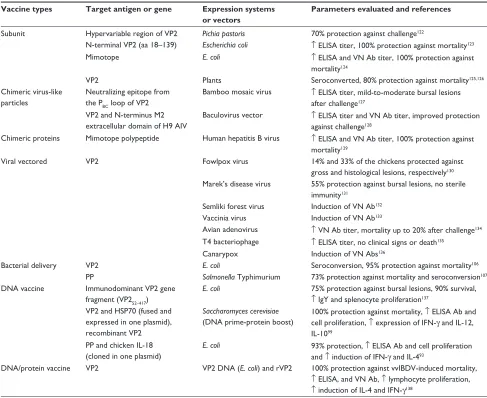
79Here, we have summarized commercial
and alternative vaccine candidates and their mechanisms
of protection against IBDV (Table 1). Conventional live
attenuated IBDV vaccines categorized as mild, intermediate,
or intermediate plus are suitable for mass vaccination and
Veterinary Medicine: Research and Reports downloaded from https://www.dovepress.com/ by 118.70.13.36 on 27-Aug-2020
Dovepress iBDV: current status and future
Table 1 examples of experimental candidate and commercial new generation iBDV vaccines
Vaccine types Target antigen or gene Expression systems
or vectors
Parameters evaluated and references
Subunit Hypervariable region of VP2 Pichia pastoris 70% protection against challenge122
N-terminal VP2 (aa 18–139) Escherichia coli ↑ eLiSA titer, 100% protection against mortality123
Mimotope E. coli ↑ eLiSA and VN Ab titer, 100% protection against mortality124
VP2 Plants Seroconverted, 80% protection against mortality125,126
Chimeric virus-like particles
Neutralizing epitope from the PBC loop of VP2
Bamboo mosaic virus ↑ eLiSA titer, mild-to-moderate bursal lesions after challenge127
VP2 and N-terminus M2 extracellular domain of H9 AiV
Baculovirus vector ↑ eLiSA titer and VN Ab titer, improved protection against challenge128
Chimeric proteins Mimotope polypeptide Human hepatitis B virus ↑ eLiSA and VN Ab titer, 100% protection against mortality129
Viral vectored VP2 Fowlpox virus 14% and 33% of the chickens protected against gross and histological lesions, respectively130
Marek’s disease virus 55% protection against bursal lesions, no sterile immunity131
Semliki forest virus induction of VN Ab132
Vaccinia virus induction of VN Ab133
Avian adenovirus ↑ VN Ab titer, mortality up to 20% after challenge134
T4 bacteriophage ↑ eLiSA titer, no clinical signs or death135
Canarypox induction of VN Abs136
Bacterial delivery VP2 E. coli Seroconversion, 95% protection against mortality106
PP Salmonella Typhimurium 73% protection against mortality and seroconversion107
DNA vaccine immunodominant VP2 gene fragment (VP252–417)
E. coli 75% protection against bursal lesions, 90% survival,
↑ igY and splenocyte proliferation137
VP2 and HSP70 (fused and expressed in one plasmid), recombinant VP2
Saccharomyces cerevisiae (DNA prime-protein boost)
100% protection against mortality, ↑ eLiSA Ab and cell proliferation, ↑ expression of iFN-γ and iL-12, iL-1099
PP and chicken iL-18 (cloned in one plasmid)
E. coli 93% protection, ↑ eLiSA Ab and cell proliferation and ↑ induction of iFN-γ and iL-493
DNA/protein vaccine VP2 VP2 DNA (E. coli) and rVP2 100% protection against vviBDV-induced mortality,
↑ eLiSA, and VN Ab, ↑ lymphocyte proliferation,
↑ induction of iL-4 and iFN-γ138
Note: Most of the vaccines evaluated in these studies were administered to chickens of different ages by parenteral vaccination (intramuscular and subcutaneous), with exception of the ones delivered by bacterial vectors or plants.
Abbreviations: aa, amino acid; Ab, antibody; AIV, avian influenza virus; ELISA, enzyme-linked immunosorbent assay; HSP, heat shock protein; IBDV, infectious bursal disease virus; iFN, interferon; iL, interleukin; PP, polyprotein; VN, virus neutralizing; VP, virus protein; vv, very virulent; ↑ upregulation or increased.
when applied in drinking water can induce robust
immu-nity.
80The potential for reversion to virulence,
81residual
immunosuppressive effects,
82as well as their role as genetic
sources for the generation of reassortant new viruses
32are
major safety concerns. Killed vaccines for breeder
vaccina-tion to transfer maternal Abs to progeny
83and infectious
bursal disease (IBD)-immune complex vaccines developed
for in ovo (administered at embryonation day 18)
84as well as
posthatch vaccination of broilers
85have been used in the past.
IBD-immune complex vaccines are prepared by combining
certain quantity of IBDV-specific hyperimmune sera with
live intermediate plus IBDV.
86As the viral capsid protein, VP2 carries
immunodomi-nant epitopes responsible for the induction of a protective
humoral immune response.
15The PP gene as a whole,
the mature VP2, or immunogenic/neutralizing domains
of VP2 are targeted to produce new generation candidate
vaccines. Viral-vectored vaccines such as the herpesvirus of
turkeys-IBD vaccine were licensed for in ovo and posthatch
vaccination of broilers and layers in various countries.
87,88These vectored vaccines induce strong systemic neutralizing
and/or mucosal Abs. Limitations are possible interference
with other herpesvirus of turkeys vaccines given at the
same time, which may affect vaccine efficacy by reducing
their replication in host tissues. IBDV DNA vaccines may
elicit cell-mediated immunity including memory T-cell
responses,
89,90contributing to the protective efficacy of the
vaccine. IBDV-VP2 subunit vaccines produced in yeast and
Escherichia coli expression systems have been licensed for
commercial use.
91,92Veterinary Medicine: Research and Reports downloaded from https://www.dovepress.com/ by 118.70.13.36 on 27-Aug-2020
Dovepress
Alkie and Rautenschlein
The way forward: improving the
quality of vaccine-induced immune
responses by molecular adjuvants
and vaccine delivery systems
New generation vaccine adjuvants
Due to partial protection offered by vaccination, especially
by nonreplicating constructs (subunit and DNA vaccines),
the development of new adjuvants and adjuvant formulations
may help to improve the immunogenicity and protection
provided by these vaccines. Vaccination of chickens with a
DNA vaccine coexpressing VP2/4/3 and IL-18 led to
pro-tection against challenge compared with the DNA vaccine
expressing only VP2/4/3.
93Good indicators of strong
cell-mediated immunity were higher T-cell counts and higher
antigen-specific T-cell proliferation in the cytokine-adjuvant
group. The immune potentiating effect of IL-2 was found to
be significant when cloned together with the VP2 gene into
a bicistronic eukaryotic expression vector.
94Recombinant
chicken cytokines such as IL-12 were used to improve
vec-tored IBD vaccines.
95But not in all cases tested recombinant
cytokines improved the IBDV vaccine response significantly
as shown with recombinant IFNs and IL-1
β
in combination
with an inactivated IBD vaccine.
96The administration regime of adjuvants may modify their
efficacy as shown by Negash et al,
97who demonstrated that
adjuvant application at staggered intervals improved vaccine
efficacy compared with simultaneous application of vaccine
and adjuvant. Other adjuvant candidates have also been
experimentally tested, including porcine lactoferrin,
98HSPs,
99chicken beta-defensin-1,
100or synthetic PAMP mimics
such as CpG oligodeoxynucleotides
97,101,102in combination
with different vaccine types. A DNA vaccine encoding
the C-terminal domain of the HSP70 of Mycobacterium
tuberculosis genetically fused with the full-length VP2 gene
induced higher Ab levels compared with the VP2 DNA
vac-cine without the HSP. It induced a mixed T helper 1- and T
helper 2-like response as well as provided complete
protec-tion in a “DNA prime-protein boost” approach.
99Mucosal vaccine delivery approaches as a
way to enhance immunity
Another approach to improve vaccine efficacy is to optimize
the delivery of candidate vaccines by targeting specific
immu-nological compartments, for example, antigen-presenting
cells. Microparticle (MP) and nanoparticle delivery systems,
particularly those made from biodegradable polymers such as
poly(lactic-co-glycolic acid) (PLGA) and chitosan have been
tested for mucosal delivery of poultry vaccines.
97Antigen
delivery by this system has several advantages including
pre-venting vaccine degradation by mucosal enzymes and a slow
controlled antigen release to avoid frequent boosting.
103,104Targeted delivery and increased antigen uptake by
antigen-presenting cells are other benefits.
105Mucosal immunization
of chickens with PLGA MPs with an adsorbed IBDV DNA
vaccine in conjunction with plasmids encoding chicken IL-2
or CpG oligodeoxynucleotide adsorbed onto different PLGA
MPs induced a detectable T-cell response and protection
against challenge.
97In addition, bacterial vectors including
Salmonella and E. coli were used for the delivery of IBDV
DNA vaccines through mucosal surfaces.
106,107In this case,
the recombinant plasmid pCI-VP2/4/3 was transformed by
electroporation into an attenuated Salmonella Typhimurium.
Oral immunization of chickens with transformed bacteria
elicited Ab responses offering approximately 73% protection
against virulent IBDV challenge.
106Reverse genetics and vaccinology
The introduction of vaccines targeting reassortant subsets of
circulating IBDVs may be necessary in future IBDV control
strategies. Different reverse genetic systems for IBDV have
been described, which can be used for better IBDV
character-ization and for IBDV vaccine development.
108,109A modified
IBDV that contained an authentic 3
′
RNA sequence generated
by cis-acting hepatitis delta virus ribozyme was less
patho-genic to the BF compared with a cell line-adapted variant
E IBDV strain, but induced higher Ab responses as early as
day 7 post infection.
110The risk of reversion to virulence of
the genetically modified viruses may exist.
111Conclusion and future perspectives
Prevention of IBDV-related losses associated with
immu-nosuppression and secondary infections will continue to be
a specific focus in the field.
112Moreover, the identification
and characterization of new emerging IBDV strains remains
a major reason for the development of new vaccination
strategies. In this regard, new sequencing technologies and
bioinformatics will be used in the future to understand IBDV
epidemiology and possibly predict the distribution of certain
strains in the field.
It is suggested that the progression of an infection within
a host will determine the ability of a pathogen to transmit to
new hosts and to maintain itself in the population,
113therefore,
additional understanding of IBDV pathogenesis and its
inter-actions with the innate immune system is still required to
provide the basis for improved prophylactic strategies.
114Veterinary Medicine: Research and Reports downloaded from https://www.dovepress.com/ by 118.70.13.36 on 27-Aug-2020
Dovepress iBDV: current status and future
New technologies including transcriptomics and
metabolom-ics may help to elucidate these aspects further.
Vectored IBD vaccines as well as immune complex
vaccines have been licensed in recent years to overcome some
of the problems related to classical vaccines. DNA vaccines
have not been introduced to the field mainly due to variable
or insufficient protection, especially after their mucosal
delivery; the method of choice for IBDV-field vaccination.
Therefore, efforts will continue to improve alternative
vac-cination strategies by testing new delivery systems and/or
adjuvants to stimulate innate and acquired immunity. In
addition to traditional adjuvants, other innovative strategies
improving vaccine-induced immunity are under development,
including inhibitors of metabolic pathways, modulators of
baseline inflammation levels, monoclonal Abs targeting
checkpoint inhibitors, and compounds depleting regulatory
cells (reviewed by De Gregorio
115). Possibly single-cycle
replication incompetent and nontransmissible vector vaccines
will gain more importance to overcome the risk of reversion
to virulence of classical attenuated vaccine strains.
116New alternative prophylactic strategies may be investigated
further, including the use of recombinant Abs, recombinant
single chain variable fragment Abs, or nanobodies specific
for vvIBDV.
117,118MicroRNAs targeting specific viral proteins
may also provide protection against IBDV challenge.
119Recently, the roles of mechanistic/mammalian target of
rapamycin (mTOR), an intracellular regulator of innate and
adaptive immunity, for controlling viral infections have been
described. By regulating the autophagy machinery, mTOR leads
in the generation of significant amounts of peptide epitopes by
delivering antigens to the autophagosomes. These major
histo-compatibility complex class II antigens derived from
intracellu-lar sources may be presented by dendritic cells and cross-prime
CD8
+T-cells (reviewed by Puleston and Simon
120). In IBDV
infection, the interaction of VP2 protein with an
avibirnavirus-binding receptor induces autophagy in an AKT-mTOR
depen-dent pathway.
121Therefore, targeting autophagy may have
promising implication in IBDV intervention strategy.
Disclosure
The authors report no conflicts of interest in this work.
References
1. Ramirez-Nieto G, Shivaprasad HL, Kim CH, et al. Adaptation of a mallard H5N2 low pathogenicity influenza virus in chickens with prior history of infection with infectious bursal disease virus. Avian Dis. 2010;54(1):513–521.
2. Müller H, Scholtissek C, Becht H. The genome of infectious bursal disease virus consists of two segments of double-stranded RNA.
J Virol. 1979;31(3):584–589.
3. Khatri M, Sharma JM. Modulation of macrophages by infectious bursal disease virus. Cytogenet Genome Res. 2007;117(1–4):388–393. 4. Mahgoub HA, Bailey M, Kaiser P. An overview of infectious bursal
disease. Arch Virol. 2012;157(11):2047–2057.
5. Luo J, Zhang H, Teng M, et al. Surface IgM on DT40 cells may be a component of the putative receptor complex responsible for the binding of infectious bursal disease virus. Avian Pathol. 2010;39(5):359–365. 6. Lin TW, Lo CW, Lai SY, et al. Chicken heat shock protein 90 is a
component of the putative cellular receptor complex of infectious bursal disease virus. J Virol. 2007;81(16):8730–8741.
7. Delgui L, Oña A, Gutiérrez S, et al. The capsid protein of infectious bursal disease virus contains a functional alpha 4 beta 1 integrin ligand motif. Virology. 2009;386(2):360–372.
8. Yip CW, Hon CC, Zeng F, Leung FC. Cell culture-adapted IBDV uses endocytosis for entry in DF-1 chicken embryonic fibroblasts. Virus Res. 2012;165(1):9–16.
9. Käufer I, Weiss E. Significance of bursa of Fabricius as target organ in infectious bursal disease of chickens. Infect Immun. 1980;27(2): 364–367.
10. Cosgrove. An apparently new disease of chickens: avian nephrosis.
Avian Dis. 1962;6(3):385–389.
11. Jackwood DJ, Sommer-Wagner S. Genetic characteristics of infectious bursal disease viruses from four continents. Virology. 2007;365(2): 369–375.
12. Jackwood DJ, Sommer SE. Identification of infectious bursal disease virus quasispecies in commercial vaccines and field isolates of this double-stranded RNA virus. Virology. 2002;304(1):105–113. 13. Birghan C, Mundt E, Gorbalenya AE. A non-canonical lon proteinase
lacking the ATPase domain employs the ser-Lys catalytic dyad to exercise broad control over the life cycle of a double-stranded RNA virus. EMBO J. 2000;19(1):114–123.
14. Peters MA, Lin TL, Wu CC. Infectious bursal disease virus polyprotein expression arrests growth and mitogenic stimulation of B lymphocytes.
Arch Virol. 2004;149(12):2413–2426.
15. Fahey KJ, Erny K, Crooks J. A conformational immunogen on VP-2 of infectious bursal disease virus that induces virus-neutralizing antibodies that passively protect chickens. J Gen Virol. 1989;70(6):1473–1481. 16. Lombardo E, Maraver A, Espinosa I, Fernández-Arias A, Rodriguez JF.
VP5, the nonstructural polypeptide of infectious bursal disease virus, accumulates within the host plasma membrane and induces cell lysis.
Virology. 2000;277(2):345–357.
17. Coulibaly F, Chevalier C, Gutsche I, et al. The birnavirus crystal structure reveals structural relationships among icosahedral viruses.
Cell. 2005;120(6):761–772.
18. Schnitzler D, Bernstein F, Müller H, Becht H. The genetic basis for the antigenicity of the VP2 protein of the infectious bursal disease virus.
J Gen Virol. 1993;74(8):1563–1571.
19. Coulibaly F, Chevalier C, Delmas B, Rey FA. Crystal structure of an Aquabirnavirus particle: insights into antigenic diversity and virulence determinism. J Virol. 2010;84(4):1792–1799.
20. Letzel T, Coulibaly F, Rey FA, et al. Molecular and structural bases for the antigenicity of VP2 of infectious bursal disease virus. J Virol. 2007;81(23):12827–12835.
21. Müller H, Nitschke R. The two segments of the infectious bursal disease virus genome are circularized by a 90,000-Da protein. Virology. 1987;159(1):174–177.
22. Pan J, Vakharia VN, Tao YJ. The structure of a birnavirus polymerase reveals a distinct active site topology. Proc Natl Acad Sci U S A. 2007; 104(18):7385–7390.
23. Chettle N, Stuart JC, Wyeth PJ. Outbreak of virulent infectious bursal disease in East Anglia. Vet Rec. 1989;125(10):271–272.
24. Stoute ST, Jackwood DJ, Sommer-Wagner SE, et al. The diagnosis of very virulent infectious bursal disease in California pullets. Avian Dis. 2009;53(2):321–326.
25. Bayliss CD, Spies U, Shaw K, et al. A comparison of the sequences of segment A of four infectious bursal disease virus strains and identification of a variable region in VP2. J Gen Virol. 1990;71(6):1303–1312.
Veterinary Medicine: Research and Reports downloaded from https://www.dovepress.com/ by 118.70.13.36 on 27-Aug-2020
Dovepress
Alkie and Rautenschlein
26. Dormitorio TV, Giambrone JJ, Duck LW. Sequence comparisons of the variable VP2 region of eight infectious bursal disease virus isolates.
Avian Dis. 1997; 41(1):36–44.
27. Durairaj V, Sellers HS, Linnemann EG, Icard AH, Mundt E. Investigation of the antigenic evolution of field isolates using the reverse genetics system of infectious bursal disease virus (IBDV). Arch Virol. 2011;156(10):1717–1728.
28. Jackwood DJ, Sommer-Wagner SE. Amino acids contributing to antigenic drift in the infectious bursal disease Birnavirus (IBDV).
Virology. 2011;409(1):33–37.
29. Kasanga CJ, Yamaguchi T, Wambura PN, Maeda-Machang’u AD, Ohya K, Fukushi H. Molecular characterization of infectious bursal disease virus (IBDV): diversity of very virulent IBDV in Tanzania. Arch Virol. 2007;152(4):783–790.
30. Mundt E. Tissue culture infectivity of different strains of infectious bursal disease virus is determined by distinct amino acids in VP2.
J Gen Virol. 1999;80(8):2067–2076.
31. Jackwood DJ, Sreedevi B, LeFever LJ, Sommer-Wagner SE. Studies on naturally occurring infectious bursal disease viruses suggest that a single amino acid substitution at position 253 in VP2 increases pathogenicity.
Virology. 2008;377(1):110–116.
32. He X, Xiong Z, Yang L, Guan D, Yang X, Wei P. Molecular epidemiology studies on partial sequences of both genome segments reveal that reassortant infectious bursal disease viruses were dominantly prevalent in southern China during 2000–2012. Arch Virol. 2014;159(12):3279–3292. 33. Negash T, Gelaye E, Petersen H, Grummer B, Rautenschlein S.
Molecular evidence of very virulent infectious bursal disease viruses in chickens in Ethiopia. Avian Dis. 2012;56(3):605–610.
34. Jackwood DJ. Molecular epidemiologic evidence of homologous recombination in infectious bursal disease viruses. Avian Dis. 2012;56(3):574–577.
35. Vukea PR, Willows-Munro S, Horner RF, Coetzer TH. Phylogenetic anal-ysis of the polyprotein coding region of an infectious South African bursal disease virus (IBDV) strain. Infect Genet Evol. 2014;21:279–286. 36. Cortey M, Bertran K, Toskano J, Majó N, Dolz R. Phylogeographic
distribution of very virulent infectious bursal disease virus isolates in the Iberian Peninsula. Avian Pathol. 2012;41(3):277–284.
37. Silva FMF, Vidigal PMP, Myrrha LW, Fietto JL, Silva A Jr, Almeida MR. Tracking the molecular epidemiology of Brazilian infectious bursal disease virus (IBDV) isolates. Infect Genet Evol. 2013;13:18–26. 38. Li K, Courtillon C, Guionie O, et al. Genetic, antigenic and pathogenic
characterization of four infectious bursal disease virus isolates from China suggests continued evolution of very virulent viruses. Infect
Genet Evol. 2015;30:120–127.
39. Jackwood DJ, Stoute ST. Molecular evidence for a geographically restricted population of infectious bursal disease viruses. Avian Dis. 2013;57(1):57–64.
40. Gelb J, Jackwood DJ, Mundt E, et al. Characterization of infectious bursal disease viruses isolated in 2007 from Delmarva commercial broiler chickens. Avian Dis. 2012;56(1):82–89.
41. Hernández M, Tomás G, Marandino A, et al. Genetic characterization of South American infectious bursal disease virus reveals the existence of a distinct worldwide-spread genetic lineage. Avian Pathol. 2015;44(3): 212–221.
42. Hon CC, Lam TT, Yip CW, et al. Phylogenetic evidence for homologous recombination within the family Birnaviridae. J Gen Virol. 2008;89(12): 3156–3164.
43. Garriga D, Querol-Audí J, Abaitua F, et al. The 2.6-Angstrom structure of infectious bursal disease virus-derived T = 1 particles reveals new stabilizing elements of the virus capsid. J Virol. 2006;80(14):6895–6905.
44. Hon CC, Lam TY, Drummond A, et al. Phylogenetic analysis reveals a correlation between the expansion of very virulent infectious bursal disease virus and reassortment of its genome segment B. J Virol. 2006;80(17):8503–8509.
45. Le Nouën C, Rivallan G, Toquin D, Eterradossi N. Significance of the genetic relationships deduced from partial nucleotide sequencing of infectious bursal disease virus genome segments A or B. Arch Virol. 2005;150(2):313–325.
46. Yamaguchi T, Ogawa M, Miyoshi M, Inoshima Y, Fukushi H, Hirai K. Sequence and phylogenetic analyses of highly virulent infectious bursal disease virus. Arch Virol. 1997;142(7):1441–1458.
47. Xia RX, Wang HY, Huang GM, Zhang MF. Sequence and phylogenetic analysis of a Chinese very virulent infectious bursal disease virus. Arch
Virol. 2008;153(9):1725–1729.
48. Lu Z, Zhang L, Wang N, et al. Naturally occurring reassortant infectious bursal disease virus in northern China. Virus Res. 2015;203:92–95. 49. Pitesky M, Cataline K, Crossley B, et al. Historical, spatial, temporal,
and time-space epidemiology of very virulent infectious bursal disease in California: a retrospective study 2008–2011. Avian Dis. 2013;57(1):76–82.
50. He X, Wei P, Yang X, Guan D, Wang G, Qin A. Molecular epidemiol-ogy of infectious bursal disease viruses isolated from Southern China during the years 2000–2010. Virus Genes. 2012;45(2):246–255. 51. Alfonso-Morales A, Rios L, Martínez-Pérez O, et al. Evaluation of a
phylogenetic marker based on genomic segment B of infectious bursal disease virus: facilitating a feasible incorporation of this segment to the molecular epidemiology studies for this viral agent. PLoS One. 2015;10(5):e0125853.
52. Liu M, Vakharia VN. VP1 protein of infectious bursal disease virus modulates the virulence in vivo. Virology. 2004;330(1):62–73. 53. Boot HJ, Hoekman AJW, Gielkens ALJ. The enhanced virulence of
very virulent infectious bursal disease virus is partly determined by its B-segment. Arch Virol. 2005;150(1):137–144.
54. Le Nouën C, Rivallan G, Toquin D, et al. Very virulent infectious bursal disease virus: reduced pathogenicity in a rare natural segment-B-reassorted isolate. J Gen Virol. 2006;87(1):209–216.
55. Le Nouën C, Toquin D, Müller H, et al. Different domains of the RNA polymerase of infectious bursal disease virus contribute to virulence.
PLoS One. 2012(1);7:e28064.
56. Yu F, Qi X, Yuwen Y, et al. Molecular characteristics of segment B of seven very virulent infectious bursal disease viruses isolated in China.
Virus Genes. 2010;41(2):246–249.
57. Jackwood DJ, Crossley BM, Stoute ST, Sommer-Wagner S, Woolcock PR, Charlton BR. Diversity of genome segment B from infectious bursal dis-ease viruses in the United States. Avian Dis. 2012;56(1):165–172. 58. Gao L, Li K, Qi X, et al. Triplet amino acids located at positions 145/146/147
of the RNA polymerase of very virulent infectious bursal disease virus contribute to viral virulence. J Gen Virol. 2014;95(4):888–897. 59. Yu F, Ren X, Wang Y, et al. A single amino acid V4I substitution in
VP1 attenuates virulence of very virulent infectious bursal disease virus (vvIBDV) in SPF chickens and increases replication in CEF cells.
Virology. 2013;440(2):204–209.
60. Doyle SL, O’Neill L a J. Toll-like receptors: from the discovery of NF-κB to new insights into transcriptional regulations in innate immunity. Biochem Pharmacol. 2006;72(9):1102–1113.
61. Kogut MH, Iqbal M, He H, Philbin V, Kaiser P, Smith A. Expression and function of Toll-like receptors in chicken heterophils. Dev Comp
Immunol. 2005;29(9):791–807.
62. Smith J, Sadeyen JR, Butter C, Kaiser P, Burt DW. Analysis of the early immune response to infection by infectious bursal disease virus in chickens differing in their resistance to the disease. J Virol. 2015;89(5):2469–2482.
63. Lee CC, Kim B-S, Wu CC, Lin TL. Bursal transcriptome of chickens protected by DNA vaccination versus those challenged with infectious bursal disease virus. Arch Virol. 2015;160(1):69–80.
64. Ruby T, Whittaker C, Withers DR, et al. Transcriptional profiling reveals a possible role for the timing of the inflammatory response in determining susceptibility to a viral infection. J Virol. 2006;80(18):9207–9216. 65. Rauf A, Khatri M, Murgia MV, Jung K, Saif YM. Differential
modulation of cytokine, chemokine and Toll like receptor expression in chickens infected with classical and variant infectious bursal disease virus. Vet Res. 2011;42:85.
66. Lee CC, Wu CC, Lin TL. Chicken melanoma differentiation-associated gene 5 (MDA5) recognizes infectious bursal disease virus infection and triggers MDA5-related innate immunity. Arch Virol. 2014;159(7): 1671–1686.
Veterinary Medicine: Research and Reports downloaded from https://www.dovepress.com/ by 118.70.13.36 on 27-Aug-2020
Dovepress iBDV: current status and future
67. Khatri M, Sharma JM. Infectious bursal disease virus infection induces macrophage activation via p38 MAPK and NF-kappaB pathways. Virus
Res. 2006;118(1–2):70–77.
68. Khatri M, Palmquist JM, Cha RM, Sharma JM. Infection and activation of bursal macrophages by virulent infectious bursal disease virus. Virus
Res. 2005;113(1):44–50.
69. Rasoli M, Yeap SK, Tan SW, et al. Differential modulation of immune response and cytokine profiles in the bursae and spleen of chickens infected with very virulent infectious bursal disease virus. BMC Vet
Res. 2015;11:75.
70. Khatri M, Sharma JM. Response of embryonic chicken lymphoid cells to infectious bursal disease virus. Vet Immunol Immunopathol. 2009;127(3–4):316–324.
71. Rauf A, Khatri M, Murgia MV, Saif YM. Expression of perforin-granzyme pathway genes in the bursa of infectious bursal disease virus-infected chickens. Dev Comp Immunol. 2011;3(5)5:620–627. 72. Sharma JM, Lee LF. Effect of infectious bursal disease on natural
killer cell activity and mitogenic response of chicken lymphoid cells: role of adherent cells in cellular immune suppression. Infect Immun. 1983;42(2):747–754.
73. Goossens KE, Karpala AJ, Rohringer A, Ward A, Bean AG. Characterisation of chicken viperin. Mol Immunol. 2015;63(2):373–380.
74. Goossens KE, Karpala AJ, Ward A, Bean AG. Characterisation of chicken ZAP. Dev Comp Immunol. 2014;46(2):373–381.
75. Ouyang W, Wang Y, Du X, Liu HJ, Zhang HB. gga-miR-9* inhibits IFN production in antiviral innate immunity by targeting interferon regulatory factor 2 to promote IBDV replication. Vet Microbiol. 2015;178(1–2):41–49.
76. Ye C, Jia L, Sun Y, et al. Inhibition of antiviral innate immunity by birnavirus VP3 protein via blockage of viral double-stranded RNA binding to the host cytoplasmic RNA detector MDA5. J Virol. 2014;88(19):11154–11165. 77. Liang J, Yin Y, Qin T, Yang Q. Chicken bone marrow-derived dendritic
cells maturation in response to infectious bursal disease virus. Vet
Immunol Immunopathol. 2015;164(1–2):51–55.
78. Azad AA, Jagadish MN, Brown MA, Hudson PJ. Deletion mapping and expression in Escherichia coli of the large genomic segment of a birnavirus. Virology. 1987;161(1):145–152.
79. Müller H, Mundt E, Eterradossi N, Islam MR. Current status of vaccines against infectious bursal disease. Avian Pathol. 2012;41(2):133–139. 80. Van den Berg TP, Eterradossi N, Toquin D, Meulemans G. Infectious
bursal disease (Gumboro disease). Rev Sci Tech. 2000;19(2):509–543. 81. Yamaguchi T, Setiyono A, Kobayashi M, Takigami S, Fukushi H, Hirai K.
Infectious bursal disease live vaccines: changes in the virus population during serial passage in chickens and chicken embryo fibroblast cells.
Avian Dis. 2000;44(2):284–290.
82. Rautenschlein S, Kraemer C, Vanmarcke J, Montiel E. Protective efficacy of intermediate and intermediate plus infectious bursal disease virus (IBDV) vaccines against very virulent IBDV in commercial broilers. Avian Dis. 2005;49(2):231–237.
83. Maas RA, Venema S, Oei HL, Pol JM, Claassen IJ, Huurne AA. Efficacy of inactivated infectious bursal disease (IBD) vaccines: comparison of serology with protection of progeny chickens against IBD virus strains of varying virulence. Avian Pathol. 2001;30(4):345–354.
84. Haddad EE, Whitfill CE, Avakian AP, et al. Efficacy of a novel infectious bursal disease virus immune complex vaccine in broiler chickens. Avian Dis. 1997;41(4):882–889.
85. Iván J, Velhner M, Ursu K, et al. Delayed vaccine virus replication in chickens vaccinated subcutaneously with an immune complex infectious bursal disease vaccine: quantification of vaccine virus by real-time polymerase chain reaction. Can J Vet Res. 2005;69(2):135–142. 86. Whitfill CE, Haddad EE, Ricks CA, et al. Determination of optimum
formulation of a novel infectious bursal disease virus (IBDV) vaccine constructed by mixing bursal disease antibody with IBDV. Avian Dis. 1995;39(4):687–699.
87. Bublot M, Pritchard N, Le Gros FX, Goutebroze S. Use of a vectored vaccine against infectious bursal disease of chickens in the face of high-titred maternally derived antibody. J Comp Pathol. 2007;137(S1): S81–S84.
88. Le Gros FX, Dancer A, Giacomini C, et al. Field efficacy trial of a novel HVT-IBD vector vaccine for 1-day-old broilers. Vaccine. 2009;27(4): 592–596.
89. Chang HC, Lin TL, Wu CC. DNA-mediated vaccination against infec-tious bursal disease in chickens. Vaccine. 2001;20(3–4):328–335. 90. Hsieh MK, Wu CC, Lin TL. DNA-mediated vaccination conferring
protection against infectious bursal disease in broiler chickens in the presence of maternal antibody. Vaccine. 2010;28(23): 3936–3943.
91. Pitcovski J, Gutter B, Gallili G, et al. Development and large-scale use of recombinant VP2 vaccine for the prevention of infectious bursal disease of chickens. Vaccine. 2003;21(32):4736–4743.
92. Rong J, Jiang T, Cheng T, et al. Large-scale manufacture and use of recombinant VP2 vaccine against infectious bursal disease in chickens.
Vaccine. 2007;25(46):7900–7908.
93. Li K, Gao H, Gao L, et al. Adjuvant effects of interleukin-18 in DNA vaccination against infectious bursal disease virus in chickens. Vaccine. 2013;31(14):1799–1805.
94. Kumar S, Ahi YS, Salunkhe SS, et al. Effective protection by high efficiency bicistronic DNA vaccine against infectious bursal disease virus expressing VP2 protein and chicken IL-2. Vaccine. 2009;27(6): 864–869.
95. Su BS, Chiu HH, Lin CC, Shien JH, Yin HS, Lee LH. Adjuvant activity of chicken interleukin-12 co-administered with infectious bursal disease virus recombinant VP2 antigen in chickens. Vet Immunol
Immunopathol. 2011;139(2–4):167–175.
96. Schijns VE, Weining KC, Nuijten P, Rijke EO, Staeheli P. Immunoadjuvant activities of E. coli- and plasmid-expressed recombi-nant chicken IFN-alpha/beta, IFN-gamma and IL-1beta in 1-day- and 3-week-old chickens. Vaccine. 2000;18(20):2147–2154.
97. Negash T, Liman M, Rautenschlein S. Mucosal application of cationic poly(D,L-lactide-co-glycolide) microparticles as carriers of DNA vaccine and adjuvants to protect chickens against infectious bursal disease. Vaccine. 2013;31(36):3656–3662.
98. Hung CM, Yeh CC, Chen HL, et al. Porcine lactoferrin administration enhances peripheral lymphocyte proliferation and assists infectious bursal disease vaccination in native chickens. Vaccine. 2010;28(16): 2895–2902.
99. Maity HK, Dey S, Mohan CM, Khulape SA, Pathak DC, Vakharia VN. Protective efficacy of a DNA vaccine construct encoding the VP2 gene of infectious bursal disease and a truncated HSP70 of Mycobacterium tuberculosis in chickens. Vaccine. 2015;33(8):1033–1039.
100. Zhang H, Yang X, Xie Q, et al. The potent adjuvant effects of chicken beta-defensin-1 when genetically fused with infectious bursal disease virus VP2 gene. Vet Immunol Immunopathol. 2010;136(1–2):92–97. 101. Wang X, Jiang P, Deen S, Wu J, Liu X, Xu J. Efficacy of DNA vaccines
against infectious bursal disease virus in chickens enhanced by coad-ministration with CpG oligodeoxynucleotide. Avian Dis. 2003;47(4): 1305–1312.
102. Mahmood MS, Siddique M, Hussain I, Khan A, Mansoor MK. Protection capability of recombinant plasmid DNA vaccine containing VP2 gene of very virulent infectious bursal disease virus in chickens adjuvanted with CpG oligodeoxynucleotide. Vaccine. 2006;24(22): 4838–4846.
103. Jones DH, Clegg JC, Farrar GH. Oral delivery of micro-encapsulated DNA vaccines. Dev Biol Stand. 1998;92:149–155.
104. Singh M, McGee JP, Li XM, et al. Biodegradable microparticles with an entrapped branched octameric peptide as a controlled-release HIV-1 vaccine. J Pharm Sci. 1997;86(11):1229–1233.
105. Kazzaz J, Singh M, Ugozzoli M, Chesko J, Soenawan E, O’Hagan DT. Encapsulation of the immune potentiators MPL and RC529 in PLG microparticles enhances their potency. J Control Release. 2006;110(3): 566–573.
106. Mahmood MS, Hussain I, Siddique M, Akhtar M, Ali S. DNA vac-cination with VP2 gene of very virulent infectious bursal disease virus (vvIBDV) delivered by transgenic E. coli DH5alpha given orally con-fers protective immune responses in chickens. Vaccine. 2007;25(44): 7629–7635.
Veterinary Medicine: Research and Reports downloaded from https://www.dovepress.com/ by 118.70.13.36 on 27-Aug-2020
Veterinary Medicine: Research and Reports
Publish your work in this journal
Submit your manuscript here: http://www.dovepress.com/veterinary-medicine-research-and-reports-journal
Veterinary Medicine: Research and Reports is an international, peer-reviewed, open access journal publishing original research, case reports, editorials, reviews and commentaries on all areas of veterinary medicine. The manuscript management system is com-pletely online and includes a very quick and fair peer-review system.
Visit http://www.dovepress.com/testimonials.php to read real quotes from published authors.
Dovepress
Dove
press
Alkie and Rautenschlein
107. Li L, Fang W, Li J, Huang Y, Yu L. Oral DNA vaccination with the polyprotein gene of infectious bursal disease virus (IBDV) delivered by the attenuated Salmonella elicits protective immune responses in chickens. Vaccine. 2006;24(33–34):5919–5927.
108. Mundt E, Vakharia VN. Synthetic transcripts of double-stranded Birnavirus genome are infectious. Proc Natl Acad Sci U S A. 1996; 93(20):11131–11136.
109. Silva JVJ, Arenhart S, Santos HF, et al. Efficient assembly of full-length infectious clone of Brazilian IBDV isolate by homologous recombination in yeast. Braz J Microbiol. 2014;45(4):1555–1563. 110. Mosley YYC, Wu CC, Lin TL. Infectious bursal disease virus rescued
efficiently with 3′ authentic RNA sequence induces humoral immunity without bursal atrophy. Vaccine. 2013;31(4):704–710.
111. Raue R, Islam MR, Islam MN, et al. Reversion of molecularly engineered, partially attenuated, very virulent infectious bursal disease virus during infection of commercial chickens. Avian Pathol. 2004;33(2):181–189.
112. Hoerr FJ. Clinical aspects of immunosuppression in poultry. Avian
Dis. 2010;54(1):2–15.
113. Handel A, Rohani P. Crossing the scale from within-host infection dynamics to between-host transmission fitness: a discussion of cur-rent assumptions and knowledge. Philos Trans R Soc Lond B Biol Sci. 2015;370.
114. Ingrao F, Rauw F, Lambrecht B, van den Berg T. Infectious bursal disease: a complex host-pathogen interaction. Dev Comp Immunol. 2013;41(3):429–438.
115. De Gregorio E. The path forward. Vaccine. 2015;33(S2):B60–B63. 116. Kalhoro NH, Veits J, Rautenschlein S, Zimmer G. A
recombi-nant vesicular stomatitis virus replicon vaccine protects chickens from highly pathogenic avian influenza virus (H7N1). Vaccine. 2009;27(8):1174–1183.
117. Sapats SI, Trinidad L, Gould G, et al. Chicken recombinant antibodies specific for very virulent infectious bursal disease virus. Arch Virol. 2006;151(8):1551–1566.
118. Xu LM, Li TH, Zhou B, et al. scFv antibodies against infectious bursal disease virus isolated from a combinatorial antibody library by flow cytometry. Biotechnol Lett. 2014;36(5):1029–1035.
119. Wang Y, Sun H, Shen P, Zhang X, Xia X, Xia B. Effective inhibition of replication of infectious bursal disease virus by miRNAs delivered by vectors and targeting the VP2 gene. J Virol Methods. 2010;165(2): 127–132.
120. Puleston DJ, Simon AK. Autophagy in the immune system.
Immunology. 2014;141(1):1–8.
121. Hu B, Zhang Y, Jia L, et al. Binding of the pathogen receptor HSP90AA1 to avibirnavirus VP2 induces autophagy by inactivating the AKT-MTOR pathway. Autophagy. 2015;11(3):503–515. 122. Villegas P, Hamoud M, Purvis LB, Perozo F. Infectious bursal disease
subunit vaccination. Avian Dis. 2008;52(4):670–674.
123. Pradhan SN, Prince PR, Madhumathi J, Roy P, Narayanan RB, Antony U. Protective immune responses of recombinant VP2 subunit antigen of infectious bursal disease virus in chickens. Vet Immunol
Immunopathol. 2012;148(3–4):293–301.
124. Wang Y, Fan H, Li Y, Shi ZL, Pan Y, Lu CP. Development of a multi-mimotope peptide as a vaccine immunogen for infectious bursal disease virus. Vaccine. 2007;25(22):4447–4455.
125. Wu H, Singh NK, Locy RD, Scissum-Gunn K, Giambrone JJ. Immunization of chickens with VP2 protein of infectious bursal disease virus expressed in Arabidopsis thaliana. Avian Dis. 2004;48(3): 663–668.
126. Wu J, Yu L, Li L, Hu J, Zhou J, Zhou X. Oral immunization with transgenic rice seeds expressing VP2 protein of infectious bursal disease virus induces protective immune responses in chickens. Plant
Biotechnol J. 2007;5(5):570–578.
127. Chen TH, Chen TH, Hu CC, et al. Induction of protective immunity in chickens immunized with plant-made chimeric Bamboo mosaic virus particles expressing very virulent Infectious bursal disease virus antigen. Virus Res. 2012;166(1–2):109–115.
128. Tang Y, Gong Y, Wang Y, et al. Chimaeric VP2 proteins from infectious bursal disease virus containing the N-terminal M2e of H9 subtype avian influenza virus induce neutralizing antibody responses to both viruses. Avian Pathol. 2013;42(3):260–267.
129. Wang Y, Ouyang W, Liu X, et al. Virus-like particles of hepatitis B virus core protein containing five mimotopes of infectious bursal disease virus (IBDV) protect chickens against IBDV. Vaccine. 2012; 30(12):2125–2130.
130. Tsukamoto K, Sato T, Saito S, et al. Dual-viral vector approach induced strong and long-lasting protective immunity against very virulent infectious bursal disease virus. Virology. 2000;269(2):257–267. 131. Tsukamoto K, Kojima C, Komori Y, Tanimura N, Mase M,
Yamaguchi S. Protection of chickens against very virulent infectious bursal disease virus (IBDV) and Marek’s disease virus (MDV) with a recombinant MDV expressing IBDV VP2. Virology. 1999;257(2): 352–362.
132. Phenix K V, Wark K, Luke CJ, et al. Recombinant Semliki Forest virus vector exhibits potential for avian virus vaccine development.
Vaccine. 2001;19(23–24):3116–3123.
133. Zanetti FA, Del Médico Zajac MP, Taboga OA, Calamante G. Evaluation of modified vaccinia virus Ankara expressing VP2 protein of infectious bursal disease virus as an immunogen in chickens. J Vet
Sci. 2012;13(2):199–201.
134. Francois A, Chevalier C, Delmas B, et al. Avian adenovirus CELO recombinants expressing VP2 of infectious bursal disease virus induce protection against bursal disease in chickens. Vaccine. 2004;22(17–18): 2351–2360.
135. Cao YC, Shi QC, Ma JY, Xie QM, Bi YZ. Vaccination against very virulent infectious bursal disease virus using recombinant T4 bacteriophage displaying viral protein VP2. Acta Biochim Biophys
Sin (Shanghai). 2005;37(10):657–664.
136. Zanetti FA, Grand MDC, Mitarotonda RC, Taboga OA, Calamante G. Canarypox virus expressing infectious bursal disease VP2 protein as immunogen for chickens. Braz J Microbiol. 2014;45(1): 231–234.
137. Pradhan SN, Prince PR, Madhumathi J, et al. DNA vaccination with VP2 gene fragment confers protection against infectious bursal disease virus in chickens. Vet Microbiol. 2014;171(1–2):13–22.
138. Gao H, Li K, Gao L, et al. DNA prime-protein boost vaccination enhances protective immunity against infectious bursal disease virus in chickens. Vet Microbiol. 2013;164(1–2):9–17.
Veterinary Medicine: Research and Reports downloaded from https://www.dovepress.com/ by 118.70.13.36 on 27-Aug-2020