Licensed under Creative Common Page 1
http://ijecm.co.uk/
ISSN 2348 0386
RESPONSIVENESS TO KNOWLEDGE
AS KEY DETERMINANT OF COMPETITIVE ADVANTAGE
A RESOURCE-BASED STUDY
Oriarewo, Godday Orziemgbe
Business Administration Department, College of Management Sciences
University of Agriculture, Makurdi, Nigeria
Agbim, Kenneth Chukwujioke
Business Administration Department, College of Management Sciences
University of Agriculture, Makurdi, Nigeria
Zever, Tor Aondoaver
Business Administration/Management Department
Benue State Polytechnic, Ugbokolo, Nigeria
Abstract
Today, organisations respond to the information age and the changes created by it by shifting
from being tangible assets conscious to leveraging intangible assets and core competencies.
These organisations employ tangible/intangible assets and intangible capabilities so as to
differentiate themselves from their competitors and to achieve/sustain Competitive Advantage
(CA). Therefore, owing to the upsurge in the number and standard of hotels in Benue State in
the wake of a democratically elected government, the competitive environment created by the
upsurge, and the contribution of tangible/intangible assets to the sustenance of competitive
advantage, this study investigated the relationship between responsiveness to knowledge and
competitive advantage among selected hotels in Benue State. The study adopted ex-post-facto
research design and multi-stage sampling technique to generate the study data. Chi-square
statistical method was employed to analyse the data and test the research hypothesis. It was
Licensed under Creative Common Page 2 recommended that managers of hotels should respond to technological, service and
knowledge-based environmental changes through the use of skilful, trained and retrained employees, and
the maintenance of a cordial relationship between employees/managers and customers/the
general public.
Keywords: Responsiveness to knowledge, Competitive advantage, Resource-based view,
Tangible/intangible assets, Intangible capabilities
INTRODUCTION
The information age and the changes created by it have shifted organizations away from being
myopically concerned with the exploitations of tangible assets toward a steadfast and holistic
interest in leveraging intangible assets and core competencies so as to achieve sustainable competitive advantage (D’Aveni, 1994; Gupta & McDaniel, 2002; Karami, 2008; Oghojafor et al.,
2011). This shift from less emphasis on tangible assets to more emphasis on intangible assets
as a way of achieving and/or maintaining sustainable competitive advantage has contributed to
the foundation of knowledge revolution (Prahalad & Hamel, 1990; Amit & Shoemaker, 1993;
Teece, 2000; Conner, 2002; Teece, 2007; Conner, 2007; Ambos & Schlegelmilch, 2009). These
organisations shift to intangible assets so as to differentiate themselves from their competitors
within the same markets because many markets are quite saturated with numerous
organizations (Gupta & McDaniel, 2002). As products and services become more similar, it is
the intangible nature of knowledge, its rareness, valuable and non-imitable characteristics that
can create a differential satisfaction in the market place (Sharkie, 2003; Barney, 2007).
More so, the shift from tangible to intangible assets has given rise to the question ‘‘why do some firms outperform others?’’ (Hawawini et al., 2003; Simon & Hitt, 2007; Teece, 2007). In
the last 50 years, researchers have attempted to answer this question with recourse to ‘‘resource-based view’’ (Grant, 1996; Barney, 1999; Rahimli, 2012). The ‘‘resource-based view’’
focuses on internal idiosyncratic resources in explaining the differences in success levels
among firms competing in the same industry (Wernerfelt, 1984; Barney, 1991). Knowledge is a
powerful resource and an asset that enable individuals and organizations to achieve several
benefits. These benefits include improved learning and decision-making (Davenport & Prusak,
1998; Al-Busaidi et al., 2010).
Knowledge is an important source for learning new things, solving problems, creating
core competencies and establishing new positions for individuals and organizations at present
and for the future. Consequently, knowledge is a competitive resource that should be managed
Licensed under Creative Common Page 3
competitive advantage. Fang et al. (2005) noted that in the present knowledge-based economy,
people are regarded as the most important asset. People, according to Alvesson (1993) are the
ultimate knowledge inventors and owners. Corroborating this claim, Davenport & Volpel (2001)
stated that to manage knowledge is to manage people; to manage people is to manage
knowledge.
In the literature of strategic management, intangible resources are divided into two
categories: assets and capabilities (skills). According to Hall (1992), intangible assets refer to “what a firm has” such as intellectual property, organizational assets and reputation assets,
while intangible resources, classified as skills (capabilities), are a firm’s skills or “what a firm does”, namely its managers, staff and firm know-how, and these skills are also referred to as
competencies. Lubit (2001) noted that competitive advantage is increasingly found in knowing
how to do things, rather than in having special access to resources and markets. Knowledge
and intellectual capital have become both the primary basis of core competencies and the key
resource with which to achieve competitive advantage. This implies that organizations need to
replenish their knowledge resource regularly for competitiveness (Harrison & Leitch, 2000).
Therefore, the key objective of management should be to improve the process of
responsiveness to knowledge so as to avoid the knowledge-based threats (imitation,
substitution, hold-up and slack) to the sustainability of competitive advantage (Brown & Duguid,
2001; Ghemawat, 2006).
Therefore, owing to the upsurge in the number and standard of small and medium sized
hotels in Benue State in the wake of a democratically elected government, the competitive
environment created by the upsurge, and the contribution of tangible/intangible assets and
intangible capabilities to sustaining competitive advantage, this study sought to investigate the
contribution of responsiveness to knowledge to competitive advantage among selected hotels in
Benue State.
Research Hypothesis
HO1: There is no significant relationship between responsiveness to knowledge and competitive
advantage.
THEORETICALBACKGROUND: Resource-based view
The Resource-Based View (RBV) was put forward by Wernerfelt (1984) based on the earlier
work of Penrose (1959). The RBV stresses the importance of internal idiosyncratic resources in
explaining the differences in success levels amongst firms when competing in the same industry
Licensed under Creative Common Page 4
possessed by competing firms that may differ, and these differences may be long lasting
(Rumelt, 1984; Wernerfelt, 1984; Barney, 1991). The RBV is the first stream in the field of
strategic management that has significantly grounded the understanding of the variations of
success levels in firms. However, the literature suggests that not all resources contribute equally to a firm’s success (Barney, 1991; Petraf, 1993; Adner & Zemsky, 2006; Moliterno & Wiersema, 2007). The resources that contribute to a firm’s success are valuable, rare, inimitable, non-substitutable, appropriable, and specialized capabilities that bestow the firm’s
competitive advantage. These resources are intangible in nature and include staff know-how,
organizational culture and reputation. These resources are called strategic assets (Itami &
Roehl, 1987; Hall, 1992; Amit & Shoemaker, 1993; Barney, 2001; Ray et al., 2004; Newbert,
2007).
The RBV has gained importance in the field of strategic management. Specifically,
during the 1990s, the RBV gained much attention in explaining why some firms outperformed
others (Barney, 1991; Ray et al., 2004). Within the RBV, capabilities are referred to as being the most important contributor to a firm’s success (Charan, 1991; Day, 1994; Grant, 1996;
Teece et al., 1997; McEvily & Chakravarthy, 2002; Grant, 2002; Teece, 2007; Moliterno &
Wiersema, 2007), and are ultimately reflected in managers and staff know-how (Grant, 2002). Capabilities can be considered a superior resource in a firm’s resource pool as a result of being
dynamic. This assists the firm in acquiring and developing all other assets (Itami & Rochi,
1987).
The main proposition of the RBV is that competitive advantage is based on valuable and
unique internal resources and capabilities that are costly to imitate for competitors (Wernerfelt,
1984; Burney, 1991). This implies that competitive advantage is an outcome of resources and capabilities residing within the firm, but these capabilities can be “directed” towards the
environment of the firm. Thus, if the firm is able to exercise this capability faster than its
competitors it can give the firm a competitive advantage (Eisenhardt & Schoonhoven, 1996;
Choudhury & Xia, 1999).
LITERATURE REVIEW
Responsiveness to Knowledge
Knowledge is an important source for learning new things, solving problems, creating core
competencies and establishing new positions for individuals and the organization at present and
in the future (Nasimi et al., 2013). Knowledge as a fundamental principle of competitive
advantage has been emphasized in the field of strategic management. To achieve sustainable
Licensed under Creative Common Page 5
knowledge (Rahimli, 2012); hence, the need for responsiveness to knowledge in organizations.
Based on the definition of Knowledge Management (KM) by Darroch (2003), responsiveness to
knowledge is one of the dimensions of KM (i.e., knowledge acquisition, knowledge
dissemination and responsiveness to knowledge). Since KM is a process that transforms
individual knowledge into organizational knowledge (Rasula et al., 2012), the dimensions of KM
allow organizations to learn, reflect, unlearn, relearn, build, maintain and replenish its core
competencies (Bhatt, 2001). Responsiveness to knowledge also known as knowledge
application is described as developing the knowledge acquired, enabling the use of the
knowledge to be more effective so as to increase its worth (Ng et al., 2012).
Responsiveness to knowledge has also been defined based on the perspective of
market orientation (Kohli & Jaworski, 1990; Narver & Slater, 1990; Kohli et al., 1993), the RBV
(Zaheer & Zaheer, 1997; Hult et al., 2005), dynamic capabilities (Wei & Wang, 2011) among
others. From a market intelligence perspective, responsiveness is established by the
generation and sharing of information, while from an organizational culture perspective,
responsiveness is constructed from three behavioural elements: orientation to customer needs;
actions of competitors; and inter-functional combination (Homburg et al., 2007). Researches on
responsiveness to knowledge that have been supported by the RBV have highlighted the
importance of the strategic use of information systems as a resource for action in response to
the changing business environment (Zaheer & Zaheer, 1997; Hult et al., 2005). Despite the use
of RBV in theoretical research in management, critics have pointed out its limitations in
explaining how and why certain firms achieve a competitive advantage in dynamic
environments. Strategic management theorists argued that in such markets, dynamic capability
perspective can make major contributions (Eisenhardt & Martin, 2000; Ngo & O’Cass, 2012).
Arguments in support of dynamic capabilities consider capabilities as those processes by
means of which companies integrate, create and reconfigure internal and external resources
and competencies in deals that allow their fit to changes in the business environment (Day,
2005).
Teece (2007) classified dynamic capabilities into three capabilities: sensing/shaping
opportunities and threats; seizing opportunities and managing threats; and reconfiguration.
Sensing/shaping opportunities and threats is concerned with the organizational ability to scan,
monitor, learn and interpret the environment. In a certain way, these capabilities are related to
the ability to assimilate and utilize knowledge and information. Managing and reconfiguration
reflect the organizational ability to recombine and reconfigure resources and organizational
Licensed under Creative Common Page 6
According to Kamya et al. (2010) once knowledge is disseminated it is expected that the
organization will respond by utilizing that knowledge. Chen & Chen (2006) asserted that
responsiveness to knowledge means that the organization must be seen to be utilizing the
knowledge acquired by making decisions and taking actions that create superior performance
internally and in the marketplace. The application of knowledge goes along the line of being
responsive to knowledge collected and shared (Darroch, 2003). Chen & Chen further asserted that internally, the organization can make improvements such as improving employees’ skills,
improving core business processes, decreasing operation costs, decreasing product cycle time,
increasing productivity, and externally by increasing sales volume, increasing market share,
develop better customer relationships and develop better supplier relationships.
Additionally, firms that achieve competitive advantage through responsiveness to
knowledge have also learned to combine effectively their KM resources to create an overall KM
capability. Thus, firms with high KM capability in a key area should be able to respond very
quickly to strategic moves by competitors (Gold et al., 2001). Adopting Pan & Scarbrouth (1998)
classification scheme for resources, the key KM resources are classified in the following order:
(i) the technical KM resources comprising the physical IT infrastructure components, and its KM
capability (Gold et al., 2001; Lee & Choi, 2003); and (ii) the social KM resource comprising the
structural, cultural and human resource, and its KM capability (Lee & Choi, 2003).
i. Technical KM resource
The physical IT assets which form the core of a firm’s overall information technology
infrastructure comprise the computer and communication technologies and the shareable
technical platforms and databases (Weill et al., 1996; Gold et al., 2001). The technical KM
resource includes IT assets and KM capability, that is, a shared knowledge delivery base and
the business functionality which has been defined in terms of its business intelligence,
collaboration, distributed learning, knowledge discovery, knowledge mapping, and knowledge
generation (Gold et al., 2001). The technical business intelligence enables a firm to generate
new knowledge. The technical collaboration and distributed learning allow individuals within the
firm to collaborate. The technical knowledge discovery allows the firm to find new knowledge.
The technical knowledge mapping and generation allows the firm to effectively track the source
of knowledge (Chuang, 2004).
A firm’s technical KM resource has been described as a major business resource and a
key resource for attaining long-term competitive advantage (Gold et al., 2001; Nemati, 2002). The technology underpins a firm’s competitive position by enabling initiatives such as product
Licensed under Creative Common Page 7
1998). Technological KM resource is the KM infrastructure dominated by system incompatibilities that severely restricts a firm’s knowledge sharing and new knowledge creation
(Stonehouse & Pemberton, 1999; Gold et al., 2001). Therefore, the assistance of technical KM
resource is essential for initiating and carrying out KM (Chuang, 2004).
Viewed from the resource-based perspective, the technical KM resource provides the
resources that make innovation feasible and enable continuous improvement of products
(Venkatramann, 1991). The unique characteristics of the technical KM resource that enable
firms to implement the right applications at the right time renders the cost and value of
technological innovation different for different firms. Indeed, technical KM resource enables
firms to: (1) facilitate rapid collection, storage and exchange of knowledge (Lee & Choi, 2003);
(2) integrate fragmented flows of knowledge (Gold et al., 2001); and (3) convert knowledge and
create new knowledge (Raven & Prasser, 1996; Scott, 1998).
ii. Social KM resource
Organizational social resources generally comprise the sum of the actual and potential
resources that are derived from the relationships possessed by humans or in a social unit
(Nahapiet & Ghoshal, 1998). Lee & Choi (2003) described the critical dimensions of social KM
resources as including: (1) the structural KM resource, such as an organizational structure that
may encourage or inhibit KM (Hedlund, 1994; Nonaka & Takeuchi, 1995); (2) the cultural KM
resource, such as an appropriate culture that encourages humans to create and share
knowledge within an organization (Holsapple & Joshi, 2001); and (3) human KM resource, such
as employees task knowledge and ability not only to have a deep knowledge of a discipline, but
also to know how their discipline interacts with other disciplines (Iansiti, 1993).
Organizations with strong social KM resources are able to: (1) integrate their KM and
business planning processes more effectively; (2) develop reliable and innovative applications
that support the business needs of the firm faster than competitors; and (3) predict future
business needs of the firm and innovate valuable new product features before competitors. The
social KM resources ability to encourage the multifaceted activities associated with the
successful implementation of KM has been found to be a key distinguishing factor of successful
firms (Lee & Choi, 2003).
Structural, cultural, human and technical KM resources typically evolve over long period
of time through the accumulation of organizational operations (Gold et al., 2001). Furthermore,
human competence is often tacit and dependent on other interpersonal relationships which may
take years to develop (Mata et al., 1995), and tend to be highly local or organization specific
Licensed under Creative Common Page 8
creating organizational knowledge (Chase, 1997; Holsapple & Joshi, 2001; Liebowitz, 2001).
Knowledge and competence can be acquired by admitting new humans with desirable
capabilities. In particular, KM capabilities embodied in humans are most often associated with
structural KM resource or cultural KM resource capabilities. Viewed from a resource-based
perspective, it is clear that social KM resources are difficult to acquire and complex to imitate,
thereby serving as sources of competitive advantage. In fact the wide difference in competitive
organizational and economic benefits that companies acquire from KM has been attributed
largely to their social KM resources (Miller & Shamsie, 1996; Lee & Choi, 2003).
Competitive Advantage
The world is changing more rapidly than ever before. Hence, managers and other employees
throughout an organization must perform at higher and higher levels. In the last 20 years,
rivalry between organizations competing domestically and globally has increased dramatically.
Today, managers who make no attempt to learn from and adapt to changes in the global
environment find themselves reacting rather than innovating and their organizations often
become uncompetitive and fail (Jones & George, 2008).
Conversely, managers who learn and adapt to changes in the global environment and
who effectively and efficiently manage their knowledge-base achieve competitive advantage.
Competitive advantage is the ability of one organization to outperform other organizations
because it provides desired goods and services more efficiently and effectively than they do (Jones & George, 2008). From the customers’ point of view, competitive advantage is a company’s attractiveness to its customers in comparism to their rivals (Chan et al., 2004). It is also viewed as diversity of features or any company’s dimensions that enables it to perform
better services to customers in comparism with rivals (Hao, 1999).
However, Macky & Johnson (2003) opined that there is a difference between competitive advantage and “sustained” competitive advantage. Macky & Johnson described sustained
competitive advantage as occurring when competitors are incapable of duplicating the benefits of a firm’s competitive advantage and cease their attempts to do so. It is the “cease” period in the firm’s attempts at duplication that signify a “sustained” competitive advantage. According to
Chan et al. (2004) some researchers agree that there are two main criteria by which firms can
achieve this sustainability of advantage: firstly, given the dynamic environment, they need to be
able to continuously identify, upgrade, rejuvenate and reinvent resources. Secondly, they need
to have the ability to create an environment in which they can be self-reinforcing and enhancing
Licensed under Creative Common Page 9
The relationship between responsiveness to knowledge and competitive advantage
Knowledge about customers, markets and other relevant factors of influence allows faster
utilization of opportunities and more flexible reaction to threats. Thus, through superior
knowledge, companies can accomplish their goals faster, cheaper and at higher quality than
their competitors (Gebert et al., 2002). Knowledge application or responsiveness to knowledge
incorporates the knowledge acquired from both the acquisition and dissemination stages of KM.
This knowledge is then integrated into the daily business processes to increase the economic effectiveness and efficiency of firm’s operations. In other words, the knowledge that resides in
the organization will be exploited to generate products, services and processes. Hence,
knowledge application will be useful and significant to generate value for the organization and
consequently help to achieve competitive advantage (Bhatt, 2001; Cegarra-Navarro &
Martinez-Conesa, 2007; Ng et al., 2012).
The application of the knowledge provides a more powerful distinctive competency for
the firm (Alavi & Leidner, 2001). Firms that engage in knowledge application can realize
superior performance. Application of the specialized knowledge can enhance organizational
competency by reducing the possibility of imitation (Grant, 1996). In other words, knowledge application produces superior value for the firms, such as firms’ innovation or profitability
(Johannesson et al., 1999; Lin & Lee, 2005).
Competitive advantage is not achieved by those firms who have the best knowledge, but
by those who make the best use of knowledge. Thus, the application of knowledge to
organizational technologies and processes aids in producing a competitive advantage (Pfeffer & Sutton, 2000). More specifically, Pfeffer & Sutton suggested that there is truly a “knowing-doing gap” in modern business, in which briefings, discussions and planning sessions all seem to take
the place of action in many organizations. This can create a passive culture in which sounding
smart is increasingly rewarded in lieu of real world results. These kind of arrangements does
not only create an environment in which project managers are more interested in knowledge in place than in knowledge at work, but they also cripple the vital “learning-by-doing” feedback
loop, which according to Parikh (2001) involves applying knowledge to a new scenario and
gaining contextual learning from that application. Such newly gained knowledge as noted by
Gupta & McDaniel (2002) does not only add to the knowledge bank of a firm, but also is seen as
more reliable than the more theoretical, abstract knowledge.
Pfeffer & Sutton (2000) described three approaches that move organizations from
adopting an almost mindless reliance on past things that impede action in the present: building
Licensed under Creative Common Page 10
sometimes by drastic means – to adhere to the old ways; and building an organization in which
employees constantly question precedent. The leaders of the firm must take the reins in
galvanizing and maintaining a persistent effort towards an organizational culture of purposeful
activity and knowledge application. This may be done by clearing, articulating new expectations
for firm employees, and by socially and fiscally rewarding pre-initiative behaviour change, while
penalizing lagging efforts toward organizational proactivity.
Learning from knowledge application involves post-analysis and critical process
evaluation. Such evaluation lead to managerial learning regarding what knowledge initiatives
actually produced tangible business results. This learning is difficult and often neglected by
firms, but it is very important to maintain the wellspring of knowledge (Parikh, 2001). Parikh
further asserted that this cycle of knowledge implementation and critical review helps to bridge
the gap between the possession of theoretical knowledge and the actual application of such. In
this sense, the speculative ideas regarding what will impact the bottom-line are empirically
tested in the real word. This is yet another crucial step in moving from esoteric
conceptualizations to refined knowledge that can impact business decisions.
Absorptive capability has been associated with the organizational learning process and
the ability to assimilate and utilize the combination of external/internal knowledge and
information. Adaptive capability refers to the ability to reflex, align and reconfigure resources
and capabilities in response to changes in the environment (Wang & Ahmed, 2007).
Thongsodsang & Ussahawanitchakit (2011) have associated the definition of responsiveness to
adaptive capability and strategic flexibility. Strategic flexibility can be an antecedent that has a decisive role in the company’s resource to changes in the environment. In a study to determine
the association between absorptive capacity and responsiveness to knowledge, Liao et al.
(2003) found an association between absorptive capacity and organizational responsiveness in
growth oriented Small and Medium Enterprises (SMEs). Darroch (2005) found that
responsiveness to knowledge is positively related to innovation, which is defined as resources,
routines and capabilities that underpins outputs. Lin & Lee (2005) also revealed that knowledge
application is positively related to technological innovation. Jantunen (2005) found that
knowledge application plays an important role in supporting innovativeness. Alipour et al. (2010)
revealed that knowledge application is related to competitive advantage.
RESEARCH METHODOLOGY
Ex-post-facto research design and multi-stage sampling technique were adopted for the study.
Data for the study were generated from 279 employees from a population of 922 employees
Licensed under Creative Common Page 11
knowledge and competitive advantage was measured in terms of improvement in employees’
skills, core business processes and KM/intangible resources, reduction in operation costs and
product cycle time, increase in productivity, sales volume and market share, the development of
better customers and suppliers relationships, innovativeness, industry position, and difficulty in
service duplication. This variable was measured on a 4-point Likert scale, ranging from very
high (4) to very low (1).
The result of the validation of the questionnaire by selected lecturers showed that the
questionnaire is significant, while for the Pearson Product Moment Correlation test, the result
showed 0.96 which is greater than the minimum threshold of 0.70 required for reliability. Out of
the 279 copies of the questionnaire that were administered, 264 copies were retrieved back,
while only 243 were properly completed and used for data analysis.
The generated data were analysed at 0.05 level of significance using Chi-square
statistical method through the Statistical Package for Social Sciences (SPSS Version 21.0 for
Windows). Thus, the null hypothesis is rejected if the critical level or P-value is less than 0.05
and accepted otherwise.
ANALYSIS
Test of Hypothesis
HO1: There is no significant relationship between responsiveness to knowledge and competitive
advantage
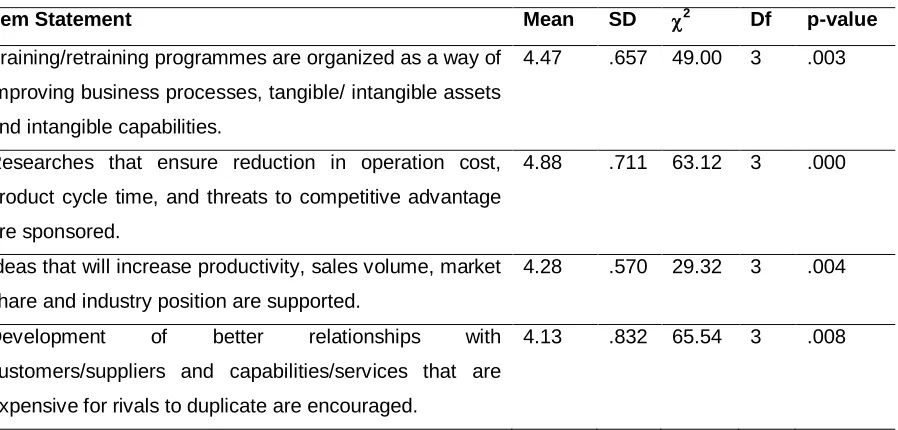
The summary of the responses and the result of the Chi-square test of the relationship between
responsiveness to knowledge and competitive advantage are presented in Table 1. The mean
values of 4.47, 4.88, 4.28 and 4.13 as shown in Table 1 indicate that the respondents agreed on
the average that: business processes, tangible/intangible assets and tangible capabilities are
improved through training/retraining programmes; their organisation sponsors researches
whose outcome will reduce operation cost, product cycle time and threats to competitive
advantage; their general managers supports ideas that will increase productivity, sales volume,
market share and industry position; and their general managers encourages the development of
better relationships with customers/suppliers and capabilities that are expensive for rivals to
duplicate.
Furthermore, Table 1 revealed that the Chi-square test for each of the item statements is
significant (p< 0.05). We therefore reject the null hypothesis and conclude that there is a
significant relationship between responsiveness to knowledge and competitive advantage
Licensed under Creative Common Page 12
TABLE 1: Summary of Responses and Chi-square Test on the Relationship between Responsiveness to Knowledge and Competitive Advantage
DISCUSSION OF FINDINGS
The result of the study revealed that responsiveness to knowledge is significantly related to
competitive advantage. This finding is similar to the results obtained in previous studies. For
instance, Darroch (2005) found that responsiveness to knowledge or knowledge application is
positively related to innovation, which is defined as resources, routines and capabilities that
underpins outputs. Thus, effective utilization of resources or better still tangible/intangible
assets and intangible capabilities will result in innovativeness and better competitive
performance. Alipour et al. (2010) concluded knowledge application is related to competitive
advantage.
Similarly, Kamya et al. (2010) found that there is a positive correlation between
responsiveness to knowledge and competitive advantage; which relationship is greatly
enhanced by the interaction impact of market orientation. When market-based knowledge is
appropriately responded to, it augments the competiveness of the organization. This is an
indication that competitive advantage is best achieved through a combination of
knowledge-based resources like adaptive capability. According to Wang & Ahmed (2007), adaptive
capability refers to the ability to reflex, align and reconfigure resources and capabilities in
response to changes in the environment. Liao et al. (2003) found an association between
absorptive capacity and organizational responsiveness in growth oriented SMEs.
Application of the knowledge provides a more powerful distinctive competency (Alavi &
Leidner, 2001), superior valve, innovation and profitability for a firm (Johamnesson et al., 1999;
Lin & Lee, 2005). Competitive advantage is not achieved by those firms who have the best
Item Statement Mean SD 2 Df p-value
Training/retraining programmes are organized as a way of
improving business processes, tangible/ intangible assets
and intangible capabilities.
4.47 .657 49.00 3 .003
Researches that ensure reduction in operation cost,
product cycle time, and threats to competitive advantage
are sponsored.
4.88 .711 63.12 3 .000
Ideas that will increase productivity, sales volume, market
share and industry position are supported.
4.28 .570 29.32 3 .004
Development of better relationships with
customers/suppliers and capabilities/services that are
expensive for rivals to duplicate are encouraged.
Licensed under Creative Common Page 13
knowledge, but by those who make the best use of knowledge. Thus, the application of
knowledge to organizational technologies and processes aids in producing competitive
advantage (Pfeffer & Sutton, 2000).
CONCLUSION, RECOMMENDATIONS AND LIMITATIONS OF THE STUDY
This study has empirically established that responsiveness to knowledge is significantly related
to competitive advantage among hotels in Benue State. Thus, the sustained competitiveness
among hotels in Benue State could be attributed to the prevalence and unprecedented increase
in the acquisition of ICT gadgets, employment of knowledge workers, ease of
sharing/transferring of information/knowledge, and above all the rate of application of knowledge
by these hotels. Based on this finding, the following are recommended:
i. hoteliers and hotel managers should employ ICT systems, skilled knowledge workers and all
other relevant KM resources that will further help to enhance knowledge application and sustain
their competitive advantage. At every point in time, efforts should be made to acquire modern and latest systems and to improve employees’ skills through training and retraining;
ii. a cordial relationship between employees/managers and customers/the general public should
be encouraged to ensure free flow of relevant information/knowledge from the customers/public
to the organization; and
iii. owing to the dynamism in the present knowledge economy, employees/managers must learn
to respond to technological, service and knowledge-based environmental changes frequently
and with the desired urgency so as to enhance and sustain competitive advantage at all time.
The interpretation of the results of this study is restricted in the light of two limitations.
First, the study covered only the hospitality sector- hotels. Thus, findings of this study should be
limited to this sector. Further studies in this area should endeavour to include other sectors like,
manufacturing, services, trading and marketing as they are also very important in the economy.
Second, the study was limited to employees as the single informants. Thus, further studies
should include customers, managers and suppliers as informants so as to have a broader
response concerning responsiveness to knowledge in organizations.
REFERENCES
Adner, R. & Zemsky, P. (2006). A demand-based perspective on sustainable competitive advantage.
Strategic Management Journal, 27, 621-636.
Alavi, M. & Leidner, D. (2001). Knowledge management and knowledge management systems: Conceptual foundations and research issues. MIS Quarterly, 25(1), 107-136.
Licensed under Creative Common Page 14
Organizational Knowledge Management, 2010. Retrieved from http://www.inimapublishing.com/journals/JOKM/jokm.html on 20/4/2014.
Alipour, H., Davabi, K., Mehrabi, Z. & Moshtaghi, M. (2010). The role of knowledge management in the achievement of competitive advantage: A case study of Iran Alborze insurance company in Western Mazandaran. African Journal of Business Management, 4(7), 1346-1350.
Alvesson, M. (1993). Organizations as rhetoric: Knowledge-intensive firms and the struggle with ambiguity. Journal of Management Studies, 30(6), 997-1015.
Ambos, T.C. & Schlegelmilch, B.B. (2009). Managing knowledge in international consulting firms. Journal of Knowledge Management, 13(6), 491-508.
Amit, R. & Shoemaker, P. (1993). Strategic assets and organizational rent. Strategic Management Journal, 14(1), 33-46.
Barney, J. (1991). Firm resources and sustained competitive advantage. Journal of Management, 17(1), 99-120.
Barney, J. (2001). Resource-based theories of competitive advantage: A ten-year retrospective on the resource-based view. Journal of Management, 17, 643-650.
Barney, J. (2007). Gaining and sustaining competitive advantage. Upper Saddle River: Pearson Education.
Bhatt, G.D. (2001). Knowledge management in organizations: Examining the interaction between technologies, techniques and people. Journal of Knowledge Management, 5(1), 68-75.
Brown, J.S. & Duguid, P. (2001). Knowledge and organization: A social-practice perspective.
Organization Science, 12(2), 198-213.
Cegarra-Navarro, J.G. & Martinez-Conesa, E.A. (2007). E-business through knowledge management in Spanish telecommunications companies. International Journal of Manpower, 28(3/4), 298-314.
Chan, L.L.M., Shaffer, M.A. & Snape, E. (2004). In search of sustained competitive advantage: The impact of organizational culture, competitive strategy and human resource management practices on firm performance. International Journal of Human Resource Management, 15(1), 17-35.
Charan, R. (1991). How networks reshape organizations for results. Harvard Business Review,
September/October, 104-115.
Chase, R. (1997). The knowledge-based organization: An international survey. Journal of Knowledge Management, 1(1), 38-49.
Chen, M.Y. & Chen, A.P. (2006). Knowledge management behaviours and practices. Journal of Knowledge Management, 7(5), 41-45.
Choi, B. & Lee, H. (2002). Knowledge management strategy and its link to knowledge creation process.
Expert Systems with Applications, 23, 173-187.
Chouldhury, V. & Xia, W. (1999). A resource-based theory of network structures. In N. Venkatramann and J.C. Henderson (Eds.), Research in strategic management and information technology. Greenwich, CN: JAI Press.
Chuang, S.H. (2004). A resource-based perspective on knowledge management capability and competitive advantage: An empirical investigation. Expert Systems with Applications, 27, 459-465. Conner, T. (2002). The resource-base view of strategy and its value to practicing managers. Strategic Change, 11, 307-316.
Conner, T. (2007). Research notes and commentaries, market orientation and performance. Strategic Management Journal, 28, 957-959.
Licensed under Creative Common Page 15 Darroch, J. (2003). Developing a measure of knowledge management behaviours and practices. Journal of Knowledge Management, 7(5), 41-45.
Darroch, J. (2005). Knowledge management, innovation and firm performance. Journal of Knowledge Management, 9(3), 101-115.
Davenport, T. & Prusak, L. (1998). Working knowledge. Boston: Harvard Business School Press.
Davenport, T.H. & Volpel, S.C. (2001). The rise of knowledge towards attention management. Journal of Knowledge Management, 5(3), 212-221.
Day, G. (1994). The capabilities of market-driven organizations. Journal of Marketing, 58, 37-52.
Day, R. (2005). Clearing up “implicit knowledge” management, information science, psychology and social epistemology. Journal of the American Society for Information Science and Technology, 56(6), 630-635.
Eisenhardt, K.M. & Martin, J.A. (2000). Dynamic capabilities: What are they? Strategic Management Journal, 21, 1105-1121.
Eisenhardt, K.M. & Schoonhoven, C.B. (1996). Resource-based view of strategic alliance formation: Strategic and social effects in entrepreneurial firms. Organization Science, 7(2), 136-150.
Fang, S.C., Tsai, F.S. & Chang, K.C. (2005). Knowledge sharing routines, task efficiency and team quality in instant service-giving settings. Journal of American Academy of Business, 6(1), 62-67.
Gebert, H., Geib, M., Kolbe, L. & Riempp, G. (2002). Towards customer knowledge management: Integrating customer relationship management and knowledge management concepts. Paper presented at the 2nd International Conference on Electronic Business, Taipei, Taiwan.
Ghemawat, P. (2006). Strategy and the business landscape. Upper Sadle River, New Jersey: Prentice Hall.
Gold, A.H., Malhotra, A. & Segars, A.H. (2001). Knowledge management: An organizational capabilities perspective. Journal of Management Information Systems, 18(1), 5-21.
Grant, R. (1996). Towards a knowledge-based theory of the firm. Strategic Management Journal, 17,
109-122.
Grant, R. (2002). Contemporary strategy analysis. Boston: Blackwell.
Gupta, A. & McDaniel, J. (2002). Creating competitive advantage by effectively managing knowledge: A framework of knowledge management. Journal of Knowledge Management Practice, October, 1-7. Hall, R. (1992). The strategic analysis of intangible resources. Strategic Management Journal, 13, 135-144.
Hao, M. (1999). Anatomy of competitive advantage. Management decision, 37(9), 709-718.
Hawawini, G., Subramanian, V. & Verdin, P. (2003). Is performance driven by industry or firm specific factors. A new look at the evidence. Strategic Management Journal, 24, 1-16.
Hedlund, G. (1994). A model of knowledge management and the N-form corporation. Strategic Management Journal, 15(5), 73-90.
Holsapple, C.W. & Joshi, K.D. (2001). Organizational knowledge resources. Decision Support Systems, 3(1), 39-54.
Homburg, C., Grozdanovic, M. & Klarmann, M. (2007). Responsiveness to customers and competitors: The role of affective and cognitive organizational systems. Journal of Marketing, 71, 18-38.
Hult, G.T., Ketchen, D.J. & Slater, S.F. (2005). Marketing orientation and performance: An integration of disparate approaches. Strategic Management Journal, 26, 1173-1181.
Iansiti, M. (1993). Real world R and D: Jumping the product development gap. Harvard Business Review, 71(3), 138-147.
Licensed under Creative Common Page 16 Jantuen, A. (2005). Knowledge-processing capabilities and innovative performance: An empirical study.
European Journal of Innovation Management, 8(3), 336-349.
Johannessen, J.A., Olsen, B. & Olaisen, J. (1999). Aspects of innovation theory based on knowledge management. International Journal of Information Management, 19(2), 121-139.
Jones, G.R. & George, J.M. (2008). Contemporary Management. New York: McGraw-Hill.
Kamya, M.T., Ntayi, J.M. & Ahiauzu, A. (2010). Knowledge management and competitive advantage: The interaction effect of market orientation. African Journal of Business Management, 4(14), 2971-2980. Karami, A.K. (2008, May). An investigation on environmental scanning and growth strategy in high tech small and medium sized enterprises. Paper presented at the High Technology Small Firms Conference, University of Twente, The Netherlands.
Kohli, A.K. & Jaworski, B.J. (1990). Market orientation: The construct, research propositions and managerial implications. Journal of Marketing, 54, 1-18.
Kohli, A.K., Jaworski, B.J. & Kumar, A. (1993). MARKOR: A measure of market orientation. Journal of Marketing Research, 30, 467-477.
Lee, H. & Choi, B. (2003). Knowledge management enablers, processes and organizational performance: An integrative view and empirical examination. Journal of Management Information Systems, 20(1), 179-228.
Liao, J., Welsh, H. & Stoica, M. (2003). Organizational absorptive capacity and responsiveness: An empirical investigation of growth-oriented SMEs. Entrepreneurship Theory and Practice, 28, 63-85. Liebowitz, J. (2001). Knowledge management and its link to artificial intelligence. Experts Systems with Application, 20, 1-6.
Lin, H.F. & Lee, G.G. (2005). Impact of organizational learning and knowledge management factors on e-business adaption. Management Decision, 42(2), 171-188.
Lubit, R. (2001). Tacit knowledge and knowledge management: The key to sustainable competitive advantage. Organizational Dynamics, 29(1), 164-178.
Macky, K. & Johnson, G. (2003). Managing human resources in New Zealand. Auckland: McGraw-Hill. Mata, F.J., Fuerst, W.L. & Barney, J.B. (1995). Information technology and sustained competitive advantage: A resource-based analysis. Management Information System Quarterly, 19(4), 487-505. McEvily, S. & Chakravarthy, B. (2002). The persistence of knowledge-based advantage: An empirical test for product performance and technology knowledge. Strategic Management Journal, 23, 285-305. Moliterno, T.P. & Wiersema, M.F. (2007). Firm performance, rent appropriation and the strategic resource divestment capability. Strategic Management Journal, 28, 1065-1087.
Nahapiet, J. & Ghoshal, S. (1998). Social capital, intellectual capital and the organizational advantage.
Academy of Management Review, 23(2), 242-266.
Narver, J.C. & Slater, S.F. (1990). The effect of a market orientation on business profitability. Journal of Marketing 54, 20-35.
Nasimi, M.H., Nasimi, S., Kasmaei, M.S., Kasmaei, H.S., Basirian, F. & Musapour, H. (2013). Knowledge management and competitive advantage for organizations. Kuwait Chapter of Arabian Journal of Business and Management Review, 2(5), 56-64.
Nemati, H.R. (2002). Global knowledge management: Exploring a framework for research. Journal of Global Information Technology Management, 5(3), 1-10.
Newbert, S.I. (2007). Empirical research on the resource-based view of the firm: An assessment and suggestions for future research. Strategic Management Journal, 28, 121-146.
Licensed under Creative Common Page 17 Ngo, L.V. & O’Cass, A. (2012). Performance implications of market orientations, marketing resources and marketing capabilities. Journal of Marketing Management, 28, 173-187.
Nonaka, I. & Takeuchi, H. (1995). The knowledge-creating company. New York: Oxford University Press.
Oghojafor, B.E.A., Dakare, O. & Sulaimon, A.A. (2011). Assessing the small and medium enterprises environment in Nigeria. International Journal of African Studies, 4, 22-27.
Pan, S. & Scarbrouth, H. (1998). A socio-technical view of knowledge sharing at Buckman laboratories.
Journal of Knowledge Management, 2(1), 55-66.
Parikh, M. (2001). Knowledge management framework for high-tech research and development.
Engineering Management, 13(3), 27-33.
Peteraf, M. (1993). The cornerstones of competitive advantage: A resource-based view. Strategic Management Journal, 14, 179-191.
Pfeffer, J. & Sutton, R.I. (2000). The knowing-doing gap: How smart companies turn knowledge into action. Cambridge, MA: Harvard Business School Press.
Porter, M. (1958). The logic of scientific discovery. New York: The Free Press.
Prahalad, C. & Hamel, G. (1990). The core competence of the corporation. Harvard Business Review,
May/June, 79-91.
Rahimli, A. (2012). Knowledge management and competitive management. Information and Knowledge Management, 2(7), 37-43.
Rasula, J., Vuksic, V.B. & Stemberger, M.I. (2012). The impact of knowledge management on organizational performance. Economic and Business Review, 14(2), 147-168.
Raven, A. & Prasser, S.G. (1996). Information technology support for the creation and transfer of tacit knowledge in paper presented at the 1996 Association for Information Systems Americas Conference, Phoenix.
Ray, G., Barney, J. & Muhanna, W. (2004). Capabilities, business processes and competitive advantage: choosing the dependent variable in empirical tests of the resource-based view. Strategic Management Journal, 25, 23-37.
Rumelt, R. (1984). Towards a strategic theory of the firm, In R.B. Lamb (Ed.), Competitive strategic management (pp. 82-114). Englewood Cliffs: Prentice-Hall.
Sambamurthy, V. & Zmud, R.W. (1992). Managing IT for success: The empowering business partnership. Financial Executive Research Foundation, 5(3), 21-36.
Scott, J.E. (1998). Organizational knowledge and the internet. Decision Support Systems, 23(1), 3-17. Sharkie, R. (2003). Knowledge creation and its place in the development of sustainable competitive advantage. Journal of Knowledge management, 7(1), 20-31.
Sirmon, D.G., Hitt, M.A. & Ireland, R.D. (2007). Managing firm resources in dynamic environments to create value: Looking inside the black box. Academy of Management Review, 32(1), 273-292.
Stonehouse, G.H. & Pemberton, J.D. (1999). Learning and knowledge management in the intelligent organization. Participation and Empowerment, 7(5), 131-144.
Teece, D. (2000). Strategies for managing knowledge assets: The role of firm structure and industrial context. Long Range Planning, 33, 35-54.
Teece, D. (2007). Explicating dynamic capabilities: The nature and micro-foundations of (sustainable) enterprise performance. Strategic Management Journal, 28, 1319-1350.
Licensed under Creative Common Page 18 Thongsodsang, C. & Ussahawanitchakit, P. (2011). Dynamic marketing capability, marketing outcomes and marketing growth: Evidence from foods and beverages businesses in Thailand. International Journal of Business Strategy, 11, 49-66.
Venkatraman, N. (1991). IT induced business reconfiguration. In M.S. Scott and E. Morton (Eds.). The corporation of the 1990s (Pp.22-158). New York: Oxford University Press.
Wang, C.L. & Ahmed, P.K. (2007). Dynamic capabilities: A review and research agenda. The International Journal of Management Review, 9, 31-51.
Wei, Y. & Wang, Q. (2011). Making sense of market information system for superior performance: The roles of organizational responsiveness and innovation strategy. Industrial Marketing Management, 40,
267-277.
Weill, P. & Broadbent, M. (1998). Leveraging the new infrastructure: How market leaders capitalize on information technology. Cambridge, MA: Harvard Business School Press.
Weill, P., Broadbent, M. & Butler, C. (1996). Exploring how firms view IT infrastructure. Melbourne: The University of Melbourne Press.
Wernerfelt, B. (1984). The resource-based view of the firm. Strategic Management Journal, 5(2), 171-180.