www.orientjchem.org
An International Open Free Access, Peer Reviewed Research Journal
2017, Vol. 33, No. (1): Pg. 324-328
Construction and Performance Characterization of Ion
Selective Electrodes for Potentiometric Determination of
Citapolarm
Hydrobromide in Biological Fluids
AMANI S . ALTURIqI
1,2, SAMAR O. ALJAzzAR
1,2,
REDA A. AMMAR
1,2and NUwAIR kHALAF
31Department of Chemistry, College of Science,
Princess Nourah Bint Abdul Rahman University, Riyadh, Saudi Arabia.
2Deanship of Scientific Research, Princess Nourah Bint Abdul Rahman University,
Riyadh, Saudi Arabia.
3Chemistry Department, College of Science, King Saud University, Riyadh, Saudi Arabia.
*Corresponding author E-mail: [email protected] http://dx.doi.org/10.13005/ojc/330138
(Received: December 30, 2016; Accepted: February 14, 2017)
ABSTRACT
A coated-wire ion selective electrode based on ion-pair complex of citapolarm hydrobromide (CT) with sodium tetraphenyl borate as electroactive material in the presence of dioctylphthalate (DOP) as the plasticizing solvent mediator was prepared. The electrode displays Nernstian response of 56.83 mV/decade over the concentration range of 1.0×10⁻⁶ to 1.0×10⁻² mol/L at 25°C. The influence
of membrane composition, pH of the test solution and foreign ions on the electrode were investigated. The electrode was successfully applied to determination of the drug in pure form, urine and plasma by standard addition potentiometry.
keywords: Citapolarm hydrobromide (CT), Ion selective electrodes, potentiometry.
INTRODUCTION
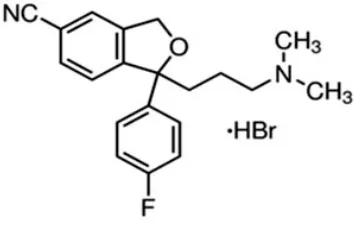
C i t a l o p r a m h y d r o c h l o r i d e ( C T ) (Fig. 1), (1RS)-1-[3-(Dimethylamino)propyl]-1- (4-fluorophenyl)-1,3-dihydroisobenzofuran-5-carbonitrile hydrobromide, is an antide pressant drug of the selective serotonin reuptake inhibitor (SSRI). The therapeutic mechanism of action of SSRIs involves the potentiation of serotonin [5-hydroxytryptamine (5-HT)] by the inhibition of its
has produced a modest reduction in alcoholic drink intake and increase in drink-free days in studies of alcoholics, possibly by decreasing desire or reducing the reward2. Citalopram has been found to reduce
the symptoms of diabetic neuropathy3. Several
methods have been reported for the determination of CT including spectrophotometry4-8, capillary
electrophoresis9-11 gas chromatography12, thin layer
chromatography13 and high performance liquid
chromatography14,15. The present work describes
preparation, characterization and application of coated wire electrode for continuous determination of CT in pure form and in biological fluids.
ExPERIMENTAL
Reagents and materials
Citapolarm hydrobromide (CT) was provided by Sigma-Aldrich. Sodium tetraphenyl borate (NaTPB) (C6H5)4BNa, dioctylphthalate (DOP) C24H38O4 were obtained from Sigma-Aldrich. Poly(vinyl chloride) (PVC) of high molecular mass and tetrahydrofuran (THF) were obtained from Fluka. Stock solution of CT (1.0×10⁻² mol/L) was prepared
by dissolving the accurately weighed amount into a 100-mL volumetric flask, which was dissolved in sufficient amount of phosphate buffer pH (5.3), and then the volume was brought up to the mark with the same solvent. Working solutions of the drug (1.0×10⁻⁷
to 1 × 10⁻² mol/L) ) were freshly prepared by serial
dilutions from the CT stock solution using phosphate buffer (pH 5.3) as a solvent.
Instrumentation
All potentiometric measurements were carried out with an Orion (Cambridge, MA, USA) Model 701 A digital pH/mV-meter. Ag/AgCl electrode was used as an external reference electrode.
The electrochemical system for the membrane electrode is represented as follows: Copper/membrane/test solution// KCl salt bridge/ Ag/AgCl.
Preparation of ion-pair compound
The ion-pair was prepared by mixing 50 ml aliquots of 1.0 × 10⁻² mol/L CT drug and sodium
tetraphenyl borate. The resulting precipitate was filtered through G4 sintered glass crucible and washed thoroughly with deionized water, then dried at room temperature for 24 h. The ion-pair should be stored in a desiccator. The chemical composition of the ion-pair as identified by elemental analysis was found to be 1:1 (CT-TPB).
Electrode fabrication
The membranes of optimum composition were prepared by dissolving the different amounts of ion-pair, PVC and DOP in 5 ml THF.The solution was mixed well into a 5 cm diameter glass Petri dish, covered with a filter paper and left to stand overnight to allow solvent evaporation at room temperature. Copper-wire, about 1cm long and 1 mm in diameter with a spherical head, sealed into the end of a glass tube and soldered onto a shielded cable, was dipped into the membrane solution three times, and the solvent was evaporated each time at room temperature. A membrane was formed on the copper surface; it was allowed to set for 2 h. The electrode was then rinsed with water and finally conditioned by soaking in in 10-3 mol/L CT for 12 h before use.
Construction of the calibration graphs
The electrode was calibrated by separately transferring 50 mL aliquots of solutions ((1× 10⁻⁷ to
1× 10⁻² mol/L) of CT into a series of 100 mL beakers.
The Prepared electrode in conjunction with the reference electrode was immersed in the above test solutions and allowed to equilibrate while stirring. The potential was recorded after stabilizing to ± 1 mV. The electrode was washed with phosphate buffer, pH 5.3 between measurements. The electrode potentials, Eelec, were calculated from the e.m.f. values and plotted versus negative logarithmic concentration of CT , Slopes of the resulting calibration curves were calculated.
Electrode selectivity
The selectivity coefficient values for the
proposed electrode were determined by the separate solution method17, in which the following equation
was applied:
(
)
[ ]
z+
1
pot. 2 1 z+ z+
CT,B
E -E
log K
=
S
+log CT -log B
where E1 and E2 are the electrode potentials of solutions of the CT drug and interfering cation, Bz+,
respectively (1×10⁻³ mol/L of both atomoxetine and
the interferent) and S is the slope of the calibration graph.
Potentiometric determination of citapolarmý hydrobromide
CT was determined potentiometrically using the investigated electrode by the standard addition method16. In the standard addition method,
Small increments of a standard CT solution 1.0×10⁻²
mol/L were added to 50 mL aliquot samples of various drug concentrations. The change in potential reading at a constant temperature of 25 ±1°C was recorded for each increment and used to calculate
the concentration of the drug sample solution.
Determination of citapolarm hydrobromide in biological fluids
Aliquots of 5 mL plasma or urine of a healthy person were placed in 50-ml measuring flasks, and different amounts of CT were added separately with constant shaking. The membrane electrode was immersed in these solutions and potentiometric determination was carried out. The electrode was washed with water between measurements.
RESULTS AND DISCUSSIONS
Composition of the membrane
Numerous membrane compositions as indicated in Table 1 were investigated, the excellent performance was obtained by using composition containing 13% CT-TPB, 43.5.0% of each PVC and DBP with resulting slope of 56.83 mV/decade over the concentration range of 1.0×10⁻⁵ to 1.0×10⁻²
mol/L at 25°C. The above optimum composition was
Table 1: Composition of different CT membranes and slopes of the corresponding calibration graphs at 25.0°C
Composition % (w/w) Slope RSDa
Membrane Ion Pair PVC DOP mV/decade (%)
a 3.0 48.5 48.5 38.65 0.36
b 5.0 47.0 47.0 46.00 0.26
c 9.0 45.0 45.0 51.63 0.19
d 13.0 43.5 43.5 56.83 0.08
e 15.0 42.5 42.5 41.61 0.34
a Relative standard deviation (three determinations)
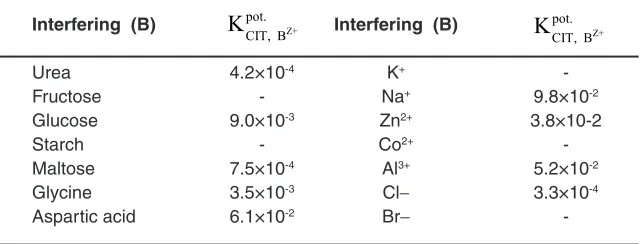
Table 2: Selectivity coefficients for the proposed electrode at 25.0°C
Interfering (B) pot. Z+
CIT, B
K
Interfering (B) pot. Z+CIT, B
K
Urea 4.2×10⁻⁴ K+
-Fructose - Na+ 9.8×10⁻²
Glucose 9.0×10⁻³ Zn2+ 3.8×10⁻²
Starch - Co2+
-Maltose 7.5×10⁻⁴ Al3+ 5.2×10⁻²
Glycine 3.5×10⁻³ Cl- 3.3×10⁻⁴
Aspartic acid 6.1×10⁻² Br-
used to prepare membrane electrodes for all further subsequent investigations.
Life time
The electrode response time was examined for 1.0 × 10⁻⁴-1.0 × 10⁻² mol/L drug solutions. The
measurements sequence was ordered from low to high concentrations. The electrode exhibited a fast and dynamic response of 25 s for a period of 30 days, without significant change in the electrode parameters.
Optimization of pH
The effect of pH of the CT test solution (1.0 × 10⁻⁴_1.0 × 10-2 mol/L) on the electrode potential
was investigated by following the potential variation with change in pH by the addition of small amount of HCl and/or NaOH (0.1–1 mol/L of each). It was cleared that the electrode do not respond to pH
changes in the range 3.4-7.8. At a pH less than 3.4, the response of electrode increased as the analyte acidity increase; the membrane may extract H+, leading to noisy responses. Because of the formation of non-protonated dimethyl amino group, the gradual decrease in potential noticed at a pH-value more than 7.8, which leads to a consequent decrease in its concentration.
Selectivity measurements
The effect of different basic materials on the electrode response was detected by measuring the potentiometric interference from many inorganic cations, sugars, organic, and amino acids. The values of selectivity coefficient for the proposed electrode which shown in Table 2 were very small, this means that there is no interference of these cations with the response of CT electrode. Because of their ionic size, and consequently in their permeabilites and
Table 3: Determination of citapolarm
hydrobromide in pure solutions applying the standard addition method at 25.0°C
Added
concentration Recovery RSD* (mg/ml) (%)
2 100.0 1.18
3 102.5 0.40
5 99.8 1.66
Average recovery 100.77 * RSD (three determination)
Fig. 2: Effect of pH of the test solutions on the potential response of electrode at 25.0°C
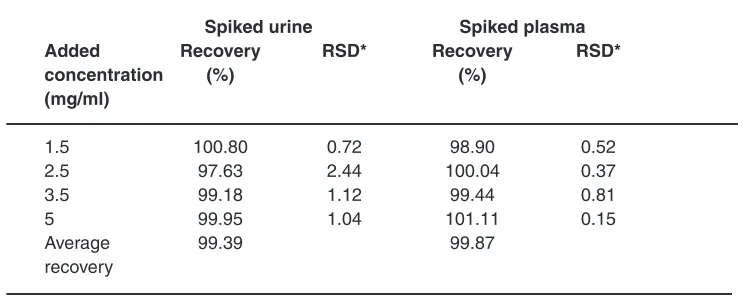
Table 4: Determination of citapolarm hydrobromide in spiked plasma and urine samples applying the standard addition method at 25.0°C
Spiked urine Spiked plasma Added Recovery RSD* Recovery RSD* concentration (%) (%)
(mg/ml)
1.5 100.80 0.72 98.90 0.52
2.5 97.63 2.44 100.04 0.37
3.5 99.18 1.12 99.44 0.81
5 99.95 1.04 101.11 0.15
Average 99.39 99.87
recovery
mobilities comparing to drug, the inorganic cations did not have any interfere. In the case of amino acids and sugars, the high selectivity is mainly attributed to the lipophilic nature of their molecules relative to CT cation and to the difference in polarity.
Regeneration of CT CwE
After working for a long time with the electrode, it becomes exhausted, so a regeneration procedure was done by soaking the exhausted electrode for 12 h in a solution of 1.0×10⁻³ mol/L CT
solution. The slope was increasing from 53.7mV/ decade to 56.3 mV/decade after regeneration. The reproducibility of repeated measurements on the same solutions was ±1 mV.
Analytical Applications
The proposed electrode was successfully employed for the determination of CT in pure solution, plasma and spiked urine by direct potentiometry using the standard addition method. The obtained average recovery and relative standard deviation values are summarized in Tables 3 and 4 respectively, which reflect the high accuracy and precision of the electrode.
CONCLUSION
A coated wire citapolarm-selective electrode based on incorporation of citapolarm- tetraphenylborate ion pair in a poly(vinylchloride) coating membrane was constructed and used for determining citapolarm HBr in pure form, urine and serum. The proposed ion-selective electrode has shown good performance characteristics with time stability up to five weeks. The good recoveries and low relative standard deviation reflect the high accuracy and precision of the proposed method. Moreover, the procedure is simple, easy to operate and it is inexpensive determination to make the electrode, therefore, an excellent tool for the routine determination of CT in quality control laboratories.
ACkNOwLEDGMENTS
This research project was supported by a grant from the Deanship of Scientific Research. Princess Nourah Bint Abdul Rahman University.
REFERENCES
1. Marjoribanks, J.; Brown, J.; O’Brien, P.M.; Wyatt, K.; “Selective serotonin reuptake inhibitors for premenstrual syndrome. Cochrane Database Syst Rev. 2013
2. Tiihonen, J.; Ryynänen, O.P.; Kauhanen, J . ; H a k o l a , H . P. ; S a l a s p u r o , M . Pharmacopsychiatry (1996), 29, 27–9. 3. Sindrup, S.H.; Bjerre, U.; Dejgaard, A.;
Brøsen, K.;, Aaes-Jørgensen, T, Gram, L.F. Clin. Pharmacol. Ther. (1992), 52, 547–52. 4. Raza, A. Chem. Pharm. Bull. (2006), 54,
432-434.
5. Darwish, I. A.; Refaat, I. H.; J. AOAC Int.
(2006), 89, 326-333.
6. Menegola, J.; Steppe, M.; Schapoval, E.E.S.; J. AOAC Int. (2008), 91, 52-58.
7. Narayana, B.; Veena, K. J. Mex. Chem. Soc.
(2010), 54, 98-102.
8. Halvorsen, T. G.; Pedersen -Bjergaard, S.; Rasmusse, K. E. J. Chromatogr. A (2001), 909, 87-93.
9. Rong, Z.; Shangyou, X.; Hongmei, X.; Rui,
H.; Zhining, X. Chin. j. Anal. Chem. (2006), 34, 1384-1388.
10. Nevado, J.J.B.; Cabanillas, C. G.; Llerena, M.J.V,; Robledo, V. R., J. Chromatogr. A (2005),1072, 249-257.
11. Berzas, J.J.; Guiberteau, C.; Villasenor, M.J.; Rodriguez, V. Anal. Chim. Acta , (2004), 519, 219–230.
12. Saravanan, M.T.C.; Kumar, C.A.S.; Sudhakar, C.; Rajesh, B.; Kumar, G.S. JASR. 2012, 3, 62.
13. Pistos, C.; Panderi, I.; Atta-Politou, J.; J. Chromatogr. B 2004, 810, 235-244.
14. Rao, R. N.; Raju, A. N.; Nagaraju, D. J. Pharm. Biomed. Anal. (2006), 41, 280-285.
15. Sujatha, K.; Rao, J. V. L. N. S. Pharmanest.
(2013), 4,1299-1605.
16. Baumann, E. Anal. Chim. Acta (1986), 42, 127-132.