IJEDR1704187
International Journal of Engineering Development and Research (
www.ijedr.org
)
1156
Experimental Study And Analysis For Chatter Of
Face Milling Tool
Mohit .A. Shrivastava, Maulik .V. Patel, D.H. Pandya Student Researcher, Student Researcher, Senior Professor Noise & Vibration Control Laboratory, Mechanical Department, LDRP Institute Of Technology And Research, Gandhinagar , India
________________________________________________________________________________________________________
Abstract - This paper deals with the experimental investigations of chatter in high speed milling on VMC. Producers of machined components are continually challenged to improve quality, reduce cost and minimize setup time in order to remain competitive that can be achieved by high speed milling operation. In high speed machine tool chatter must be avoided for better machine life, improve surface finish, and increase tool life. The chatter in face milling is reduced by introducing the damper in the cutting tool system. To reduce the vibration and chatter problem in face milling for this purpose investigation is carried out for introducing the shim attach with insert that provide damping. High speed and hard material applies pressures on the insert seat and shim. The shim acts as a shock absorber for the insert and work piece. The shim protects both insert and tool holder from damage due to high cutting forces. In the present work, the Carbide, Aluminum and Brass shim, material are used to find out there effect on reduction in vibration and improvement in surface finish. Finite Element Analysis (FEA) is done for finding the damping Ratio for different shim material using ANSYS-14.5 software. Experiments are conducted using without shim and with three shims in total 36 nos. of cutting operations were performed for combination of different cutting speed (200 m/min, 250 m/min and 300 m/min) , depth of cut (1.2 mm, 1.0 mm, and 0.8 mm) and shim material (Aluminum, Carbide and Brass) on VMC machine. Dynamic motion analysis is done to identify the motion behavior of face milling tool. In present work Time domain, FFT, Point care and Orbit plot are used for predication of tool holder behavior by dynamic motion analysis.
IndexTerms - Chatter, damping ratio, finite element method, model analysis, ANSYS, VMC
________________________________________________________________________________________________________
I. INTRODUCTION
In present day's in the manufacturing industries high-speed milling (HSM) plays a crucial role. Some examples include the fabrication of moulds and the Aeroplane building industry . The key benefit of high-speed milling is that a large amount of material can be cut in a short time span with relatively small tools due to the high rotational speed of the tool. There is also a demand for increasing the automation in the production. This means that tools and work pieces are changed automatically and that the process is being monitored constantly by various sensors in VMC.
The machining of metals are often accompanied by a violent relative vibration between work piece and tool that is called chatter. There are three different types of mechanical vibrations present as forced vibrations, free vibrations and self-excited vibrations, these are present due to a lack of dynamic stiffness/rigidity of the machine tool system comprising tool, tool holder, work- piece and machine tool itself. Successful machining operations depends upon the dynamic relationship between the work piece and cutting tool. Under certain circumstances, the motion of the tool against the work piece can produce a self-exciting system, resulting in large amplitude of vibrations. This vibration or chatter adversely affects the life of the tool, the quality of the cut, and the speed at which operations may be performed. Understanding and properly controlling the interaction of tool/work piece dynamics to control chatter can yield to reduced costs and higher overall productivity.
II. LITERATURE REVIEW
i. Chatter stability prediction in milling using speed-varying cutting force coefficients
In this work a method to include speed-dependent cutting force coefficients to traditional chatter stability theory is presented. Experimental validation demonstrated the accuracy of the proposed approach, nevertheless more accurate identification could be obtained introducing speed-varying FRFs, not considered in this work. Based on the results of this paper more reliable stability limits could be predicted after experimental characterization of materials at different spindle speeds. Cutting coefficients can be computed without compensating dynamometer dynamics in case of average cutting force method; on the other hand an effective compensation technique, as the one presented here, is needed for instantaneous force based methods.
ii. RCPM—A new method for robust chatter prediction in milling
IJEDR1704187
International Journal of Engineering Development and Research (
www.ijedr.org
)
1157
iii. Optimal control for chatter mitigation in milling
In this paper, an active structural control concept is presented for the mitigation of chatter occurrence in milling operation. A model of the mechatronic structure dynamics coupled with the milling process is described. This model allows the original formulation of two different control strategies, namely the disturbance rejection and stabilization schemes, feasible to improve the milling process stability. Two different optimal control strategies are investigated. The first one only considers the dynamics of the machine structure in the controller design and minimizes the influence of cutting forces on tool tip deviations. The second one takes explicitly the process interaction into account and attempts to guarantee the stability of the overall closed-loop system for specific machining conditions. The comparison of both strategies using simulation indicates completely different working principles. The disturbance rejection scheme tends to damp the critical resonance peak leading to an increase of the lower bound of the stability chart. Conversely, the stabilization scheme generates additional resonance peaks at specific frequencies allowing the creation of a zone of higher stability around the spindle speed selected for the control design. Furthermore, the proposed disturbance rejection scheme presents several practical advantages but assuming an accurate milling process modeling, stabilizing controller is susceptible to achieve a greater and more efficient improvement of the productivity in chatter-free conditions.
III. PROBLEM DEFINITION
Milling is very important process in field of production for higher production rate. In this field industries are facing problem of unwanted vibration which causes chatter and due to which required surface finish is not obtained. For obtaining required surface finish industries are taking finish cut which consumes more time and reduces productivity. For that in turning we are using shim but in face milling till now this has not been used.
IV. EXPERIMENTAL SETUP
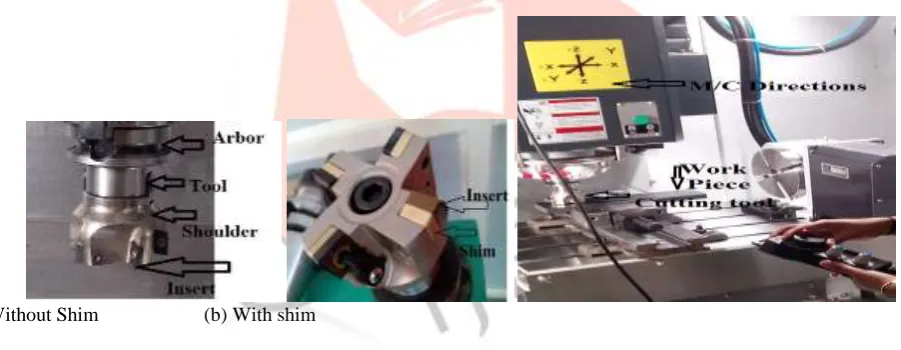
The experiments were carried out on the CVM 640 (VMC) Milling machine with two face milling tool. One is special purpose face milling tool 63 mm dia. 4 inserts cutting tool and second one is 63 mm dia. 5 inserts, work piece Plate of 75*25*300 mm of 2062 mild steel 130 BH work material were used for the experiments. The machining is done using CNMG 120412 (Carbide) insert. The experiments were conducted at constant feed per tooth 0.15. Three different cutting speed 200m/min, 250m/min, 300m/min are taken, three different depth of cut 0.8mm, 1.0mm, 1.2mm, without shim and with three different shim material Carbide, Brass and Aluminum are taken for experiments. Surface roughness is measured with SJ 210 surface roughness tester (-200 µm to 150µm). The experimental setup is shown in Figure (1) and (2)
(a) Without Shim (b) With shim
Fig. 1: Experimental set up Fig. 2: VMC for milling operation
V. MOTION ANALYSIS AND RESULT DISCUSSION
i. Dynamic motion analysis
IJEDR1704187
International Journal of Engineering Development and Research (
www.ijedr.org
)
1158
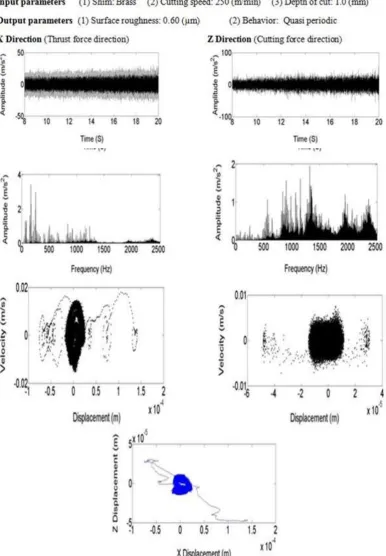
Figure 3: Brass Shim, Cutting speed 250 m/min and Depth of cut 1.0 mm
ii. Experimental results discussion
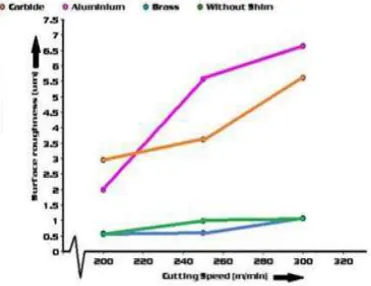
• Experimental results are as surface roughness for different cutting speed, Depth of cut and Different shim materials. • Experimental result as surface roughness for different cutting speed clearly shows that without shim surface roughness
value range 0.78 µm to 2.52 µm and with the brass shim surface roughness value 0.84 µm to 1.77 µm. With different shim material Aluminum has surface roughness value 2.0 µm to 6.92 µm. Carbide has surface roughness value 2.95 µm to 5.98 µm. Brass has surface roughness value 0.84 µm to 1.77 µm in carbide shim is used.
IJEDR1704187
International Journal of Engineering Development and Research (
www.ijedr.org
)
1159
Table. 1: Experimental Results Table with Shim 4 inserts and No shim with 5 inserts
No. of run Shim material Cutting speed Depth of cut Surface roughness
1 No shim 250 1.0 1.07
2 No shim 300 1.2 1.08
3 Aluminum 250 1.0 6.05
4 Aluminum 300 1.2 6.65
5 Carbide 250 1.0 4.47
6 Carbide 300 1.2 5.61
7 Brass 250 1.0 0.60
8 Brass 300 1.2 1.06
VI. CONCLUSION
In the present work, a computational model is used for finding out damping ratio and validated with the Experimental study to analyze the chatter in milling operation. The observation of this study can be used to reduce the chatter and improve surface roughness at 0.6 µm, 0.8 µm and 1.6 µm where as compared with without shim, brass again gives good surface finish at 250 m/ min (1010 r.p.m ) at depth of cut 1.2 mm and 1.0 mm with surface roughness of 0.6 µm and 1.0 µm. Rather than this result without shim and brass has having same and near approximate surface roughness. Aluminum is not justified for use in operation because of having very high roughness value as 6.9 µm. Conventionally used carbide shim gives poor surface roughness compared to Brass and without shim. From motion behavior again aluminum is not justified for use in operation because of chaotic behavior and conventionally used carbide also gives most of chaotic and multi periodic motion behavior. Motion behavior also justify the concluding results of surface finish. In this cutting frequency and thrust frequency of brass shim having less value compared with the without shim as well as the motion behavior of brass is having quasi periodic motion(figure 3) and that shows the reduced chatter for most off combination of input parameter compared to without shim.
REFERENCES
[1] R.P.H. Faassen , N. van de Wouw , J.A.J. Oosterling , H. Nijmeijer , 2003,” Prediction of regenerative chatter by modelling and analysis of high-speed milling”, The Netherlands Manufacturing Development, TNO Institute of Industrial Technology, 43, pp. 1437–1446.
[2] Jérémie Monnin, Fredy Kuster, Konrad Wegener,2014,” Optimal control for chatter mitigation in milling—Part 1: Modeling and control design”, Mikron Agie Charmilles AG, Nidau, Switzerland, 24, pp. 156-166.
[3] Giuseppe Catania, Nicolo Mancinelli,2011,”Theoretical –experimental modelling of milling machine for prediction of chatter vibration”, DIEM—Department of Mechanical Engineering, University of Bologna, Viale del Risorgimento, 2-40136 Bologna, Italy,51,pp. 339-348.
[4] N.Grossi, L.Sallese, A.Scippa, G.Campatelli,2014,"Chatter stability prediction in milling using speed varying cutting force coefficients”, Department of Industrial Engineering, University of Florence, Via di Santa Marta 3, 50139, Firenze, Italy,14,pp. 170-175.
[5] G. Totis, 2009 “RCPM- A new method for robust chatter prediction in milling”, DIEGM—Department of Electrical, Management and Mechanical Engineering, University of Udine, Via delle Scienze, 208, I-33100 Udine, Italy,49,pp. 273-284. [6] P. Franco , M. Estrems, F. Faura,2008,” A study of back cutting surface finish from tool errors and machine tool deviations during face milling”, Departamento de Ingenierı´a de Materiales y Fabricacio´n, Universidad Polite´cnica de Cartagena,C/Doctor Fleming s/n, 30202 Cartagena, Spain,48,pp.112-123.
[7] Hugo M. B. de Carvalho, Jefferson de Oliveira Gomes, Marco Antonio Schmidt, Vitor L.C.Brandão (2015) ‘Vibration analysis and energy efficiency in interrupted face milling processes’ , Procedia CIRP, vol.29, pp.245 – 250. Hongbin
[8] Chang, Suyun Li, Runping Shi (2016) ‘Design and manufacturing technology of high speed milling cutter for aluminum alloy’, Procedia Engineering, vol.174, pp.630 – 637.
Figure 4: Graph of Depth of cut(mm) Vs Surface roughness(µm) at cutting speed
300(mm/min.)
Figure 5: Graph of Cutting speed(mm/min.) Vs Surface roughness(µm) at Depth of cut 1.2
IJEDR1704187
International Journal of Engineering Development and Research (
www.ijedr.org
)
1160
[9] Armando Italo Sette Antonialli, AnselmoEduardoDiniz, RobsonPederiva (2010) ‘Vibration analysis of cutting force intitanium alloy milling’, International Journal of Machine Tools & Manufacture, vol.50, pp. 65–74.
[10] Mohammadjafar Hadad, Mohammadjavad Ramezani (2015) ‘Modeling and analysis of a novel approach in machining and structuring of flat surfaces using face milling process’, International Journal of MachineTools&Manufacture, vol.105, pp.32– 44.
[11] C.K. Toh (2004) ‘Vibration analysis in high speed rough and finish milling hardened steel’, Journal of Sound and Vibration, vol. 278, pp.101–115.
[12] Tzu-Liang Bill Tseng, Yongjin James Kwon (2014) ‘Characterization of machining quality attributes based on spindle probe,coordinate measuring machine, and surface roughness data’, Journal of Computational Design and Engineering, Vol. 1, No. 2, pp.128-139.